Less and More with Abstract Nouns: Meaning and Grammar Rules

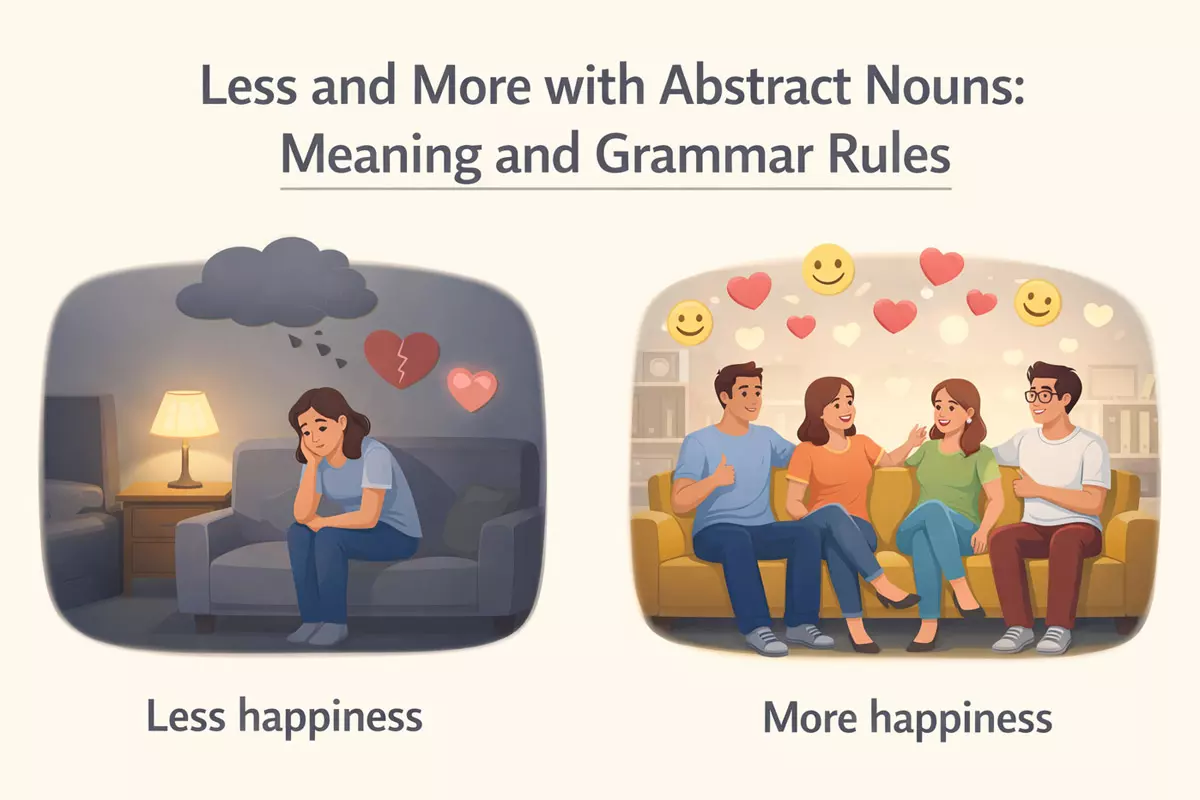 Here we what abstract nouns are, why less and more are used with them, common examples, how meaning changes with less or more, typical sentence patterns, frequent learner errors, context-based examples, and practice choosing the right word.
- What counts as an abstract noun in English
- Why abstract nouns follow different quantity logic
- Common abstract nouns used with less and more
- Meaning differences created by less vs more
- Typical sentence patterns and positions
- Frequent learner mistakes and overgeneralization
- Context-driven examples in neutral writing
- Practice: choosing less or more accurately
Using “less” and “more” with intangible concepts such as happiness or information can be challenging, as these words often follow specific patterns in English grammar. Mastering the appropriate contexts for “less” and “more” not only helps avoid common mistakes but also enhances your ability to express ideas clearly and accurately. This understanding is important because it allows you to communicate your thoughts more effectively, whether you are speaking or writing, and ensures your message is easily understood by others.
What counts as an abstract noun in English
Understanding what makes a noun "abstract" is crucial for grasping how these words function in English. Abstract nouns refer to ideas, qualities, conditions, or concepts that cannot be touched, seen, or measured directly. Unlike objects or people—which are concrete and can be experienced with the senses—these nouns point to things that exist only in our minds or as part of our shared understanding.
Defining Features of Abstract Nouns
Abstract nouns typically express:
- Emotions (e.g., happiness, anger, fear)
- States or conditions (e.g., freedom, poverty, health)
- Qualities or characteristics (e.g., honesty, beauty, intelligence)
- Ideas or concepts (e.g., justice, democracy, knowledge)
- Events or experiences (e.g., childhood, marriage, growth)
These words capture things you cannot physically interact with. For example, you can hold a book (concrete), but not "knowledge" itself (abstract).
Common Abstract Noun Endings
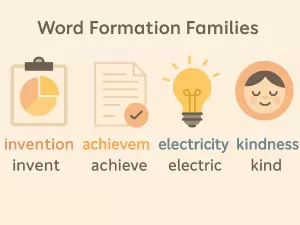
Many abstract nouns in English share certain suffixes, which can help you recognize them. Some of the most common endings include:
- -ness (e.g., darkness, kindness)
- -ity (e.g., ability, activity)
- -tion/-sion (e.g., action, decision)
- -ment (e.g., enjoyment, improvement)
- -ance/-ence (e.g., importance, difference)
- -ship (e.g., friendship, leadership)
Comparing Abstract and Concrete Nouns
To make the distinction clearer, here’s a comparison of abstract and concrete nouns with examples:
| Abstract Noun | Concrete Noun |
|---|---|
| Love | Dog |
| Wisdom | Book |
| Freedom | Chair |
| Anger | Apple |
| Friendship | Table |
| Justice | Car |
Examples of Abstract Nouns in English

Here’s a broader set of examples to help you spot these nouns in practice:
- Courage → It took great courage to speak up in front of the crowd.
- Curiosity → Her curiosity led her to explore new subjects.
- Trust → Trust is essential in any strong relationship.
- Patience → Learning a new language requires patience.
- Success → Success often comes after repeated effort.
- Failure → Failure can be a valuable learning experience.
- Liberty → Liberty is a fundamental human value.
- Peace → The agreement helped restore peace in the region.
- Responsibility → He accepted responsibility for the mistake.
- Happiness → Happiness means different things to different people.
- Gratitude → She expressed gratitude for the support she received.
- Hope → Hope kept them going during difficult times.
- Innocence → Childhood innocence is often short-lived.
- Truth → Truth eventually comes to light.
- Faith → Faith helped him stay optimistic.
Abstract nouns are essential for discussing feelings, values, and philosophies. Recognizing them helps you understand not just grammar rules, but also how English speakers talk about the intangible aspects of life.
Why abstract nouns follow different quantity logic
When talking about things like happiness, information, or advice, English speakers use different rules for expressing amounts compared to concrete objects. The logic comes from how these words represent ideas, qualities, or experiences rather than physical, countable things. For example, while you can have “three apples,” it’s odd to say “three knowledges”—instead, you talk about “more knowledge” or “less knowledge.”
How abstract nouns differ from concrete nouns
Abstract nouns usually refer to concepts that can’t be physically separated or counted in individual units. As a result, English treats them as uncountable nouns, using different quantity words and grammatical structures than those used for countable nouns. This distinction affects which modifiers and determiners are appropriate.
| Abstract Noun | Correct Quantity Phrases | Incorrect Quantity Phrases |
|---|---|---|
| advice | some advice, much advice, little advice, less advice | a few advices, many advices, fewer advices |
| information | a lot of information, more information, less information | an information, two informations |
| happiness | much happiness, more happiness, less happiness | many happinesses, fewer happinesses |
| knowledge | some knowledge, little knowledge, more knowledge | a knowledge, a few knowledges, several knowledges |
Typical modifiers for abstract nouns
Modifiers like much, little, less, and more are standard with intangible concepts. The grammar avoids “many” or “fewer” except in rare, specialized contexts. This pattern reflects the idea that you can’t split abstract concepts into separate pieces without changing their meaning.
- much courage → It takes much courage to admit a mistake.
- little patience → He showed little patience during the discussion.
- less honesty → The situation would improve with less honesty and more tact.
- more freedom → Young people today want more freedom in their choices.
- a lot of excitement → There was a lot of excitement before the concert.
- some progress → We’ve made some progress on the project.
- enough time → Do we have enough time to finish?
- plenty of support → She received plenty of support from her colleagues.
- great sadness → The news was met with great sadness.
- hardly any hope → There was hardly any hope of success.
Why this logic matters
Following these quantity patterns is essential for clear, natural English. Using the wrong structure—like “a few informations” or “many knowledges”—sounds awkward or incorrect because it treats abstract ideas as if they were countable items. Recognizing the difference helps learners avoid common mistakes and understand why these nouns behave differently from concrete words.
Common abstract nouns used with less and more
When talking about qualities, feelings, or concepts that can't be touched, English speakers often use "less" and "more" to express differences in amount or degree. These abstract nouns describe things we experience or think about, rather than physical objects. Understanding which words typically pair with these modifiers helps you communicate subtle distinctions in meaning.
Frequently paired abstract nouns
Many intangible concepts naturally work with "less" and "more" to indicate a comparative level. Here are some of the most commonly used abstract nouns in this context:
- Patience → Patience is essential when learning a new skill.
- Time → Time flies when you’re enjoying yourself.
- Love → Love plays a central role in close relationships.
- Freedom → Freedom allows people to express their ideas openly.
- Confidence → Confidence helps students perform better in exams.
- Understanding → Mutual understanding prevents many conflicts.
- Respect → Respect is fundamental in any professional environment.
- Happiness → Happiness often comes from simple everyday moments.
- Honesty → Honesty builds long-term trust.
- Stress → Stress can negatively affect both health and focus.
- Effort → Success requires consistent effort.
- Hope → Hope kept them motivated during difficult times.
- Interest → She showed interest in learning a new language.
- Trust → Trust develops over time through reliability.
- Attention → The speaker captured everyone’s attention.
- Support → Support from family makes challenges easier.
- Energy → Energy levels drop after a long day.
- Peace → Peace returned after the negotiations ended.
- Success → Success rarely happens overnight.
- Fear → Fear can prevent people from taking risks.
Notice that each of these words refers to a quality or state, not a countable item. For example, you might say, "We need more patience," or "There is less stress this week."
Comparison patterns with less and more
Abstract nouns often appear in sentences comparing situations or feelings. Here are some example patterns:
- More + [abstract noun]: "She has more confidence now."
- Less + [abstract noun]: "There's less noise in the office today."
- Comparative structure: "He showed less interest than before."
Examples in context
To see how these words function, compare how "less" and "more" modify the meaning of the same noun:
| Abstract Noun | Sample Sentences |
|---|---|
| Understanding | "We need more understanding in our community." → "There is less understanding between the teams." |
| Freedom | "People want more freedom at work." → "Some feel there is less freedom now." |
| Support | "She received more support than expected." → "There is less support for this idea." |
| Energy | "I have more energy in the morning." → "He has less energy after lunch." |
Keep in mind that not all abstract nouns fit naturally with "less" or "more." Some words may sound awkward or change meaning if you use them this way. When in doubt, check how native speakers use the noun or consult example sentences to ensure your usage feels natural.
Meaning differences created by less vs more
Understanding how less and more interact with abstract nouns is key to expressing nuanced ideas. These modifiers change the scope, intensity, or amount of qualities, feelings, or concepts that can't be counted directly. The choice between them doesn’t just alter the quantity; it can also shift the overall tone, intention, or implication of your sentence.
How “less” and “more” affect abstract nouns
When you use less with an abstract noun, you’re reducing the presence or degree of something. With more, you’re increasing it. This simple shift can create very different meanings:
- Less patience suggests someone is quicker to become frustrated.
- More patience implies greater tolerance or endurance.
- Less confidence means a decrease in self-assurance.
- More confidence signals a boost in belief in oneself.
Subtle shifts in meaning
Sometimes, the difference goes beyond quantity or degree and affects interpretation. For example, “less honesty” may imply dishonesty or withholding the truth, while “more honesty” could suggest being blunt or even tactless, depending on context.
Common abstract nouns with “less” and “more”
- Time: less time / more time
- Respect: less respect / more respect
- Freedom: less freedom / more freedom
- Interest: less interest / more interest
- Power: less power / more power
- Attention: less attention / more attention
- Hope: less hope / more hope
- Support: less support / more support
- Trust: less trust / more trust
- Understanding: less understanding / more understanding
- Effort: less effort / more effort
- Stress: less stress / more stress
- Control: less control / more control
Comparing the effects
To see how these modifiers influence meaning, consider the following comparisons:
| Phrase with “less” | Phrase with “more” |
|---|---|
| less motivation | more motivation |
| less ambition | more ambition |
| less creativity | more creativity |
| less enthusiasm | more enthusiasm |
| less responsibility | more responsibility |
| less courage | more courage |
| less curiosity | more curiosity |
| less generosity | more generosity |
Notice how each pair presents an opposite effect: not only do they indicate a difference in degree, but they may also suggest different emotional or social outcomes. Using the right modifier helps you communicate your intended meaning with clarity and precision.
Typical sentence patterns and positions
When using "less" and "more" with abstract nouns, their placement in sentences follows certain conventions. These modifiers usually appear directly before the abstract noun they describe, but there are variations depending on sentence structure and emphasis. Understanding these patterns is key for clarity and correctness.
Common placement of "less" and "more"
- Directly before the abstract noun: "more patience," "less honesty"
- After the verb "have": "have more confidence," "have less fear"
- In expressions with "show" or "demonstrate": "shows more empathy," "demonstrates less interest"
- With prepositional phrases: "with more enthusiasm," "with less concern"
- As complements after linking verbs: "is more courage than wisdom," "was less excitement than expected"
- In comparative clauses: "There is more hope than despair," "She felt less anxiety than before"
- Before a noun modified by an adjective: "more genuine kindness," "less obvious regret"
- In negative constructions: "not much more respect," "no less attention"
- With quantifiers: "a little more patience," "far less motivation"
- After modal verbs: "could use more support," "should show less aggression"
- Within passive constructions: "is given more recognition," "was shown less understanding"
Sentence patterns with "less" and "more"

Writers often use certain structures when comparing abstract qualities or discussing degrees. Here’s a comparison of typical patterns:
| Pattern | Example |
|---|---|
| Modifier + Abstract Noun | She has more patience. |
| Verb + Modifier + Abstract Noun | They need less supervision. |
| Be/Linking Verb + Modifier + Abstract Noun + Than | This is more hope than reality. |
| Prepositional Phrase with Modifier | He spoke with less conviction. |
| Comparative Clause | There is less confusion now than before. |
Tips for clarity and emphasis
- Place "less" or "more" as close as possible to the abstract noun for clear meaning.
- Use "more" and "less" with uncountable, non-concrete nouns: "more information," "less anger."
- To highlight contrast, use comparative clauses: "Her speech had more passion than his."
- Combine with adjectives for nuance: "more genuine concern" vs. "less obvious joy."
- In formal writing, avoid splitting the modifier and noun with unrelated words.
By following these patterns, writers and speakers can express degrees of abstract qualities smoothly and accurately, ensuring their intended meaning comes across to the reader or listener.
Frequent learner mistakes and overgeneralization
One of the main challenges English learners face with abstract nouns is misunderstanding how “less” and “more” are used. Many students try to apply the same rules they know from countable nouns, leading to awkward or incorrect sentences. This often happens because abstract concepts like “advice,” “information,” or “progress” don’t follow the same grammar patterns as concrete, countable items.
Common issues learners encounter
- Using “fewer” with uncountable abstract nouns (e.g., fewer information instead of less information)
- Adding an “s” to make abstract nouns plural (e.g., advices, knowledges)
- Trying to count abstract nouns directly (“two progresses,” “three happinesses”)
- Confusing “much” and “many” with abstract nouns (“many patience” instead of “much patience”)
- Forgetting that some words can be both countable and uncountable, depending on context (“experience” as an event vs. knowledge)
- Using “more” with comparative adjectives instead of with abstract nouns (“more happier” instead of “happier”)
- Overusing “less” and “more” when another word would be more natural (“a bit of advice,” “a piece of information”)
- Translating rules from their native language that do not apply in English
- Omitting necessary articles (“He gave me advice” vs. “He gave me an advice”)
- Trying to quantify the unquantifiable (“three knowledges” instead of “three pieces of knowledge”)
Patterns of overgeneralization
Learners frequently assume that all nouns can be made plural or counted, but abstract nouns often resist this. This leads to sentences that sound unnatural to native speakers. Overgeneralization also shows up in attempts to apply “fewer” to any situation where “less” is correct, and in mixing up when to use “much” versus “many.”
| Incorrect Usage | Correct Form |
|---|---|
| He gave me an advice. | He gave me some advice. |
| I have fewer information than you. | I have less information than you. |
| She has many patience. | She has much patience. |
| We made three progresses this year. | We made progress this year. |
| I received advices from my teacher. | I received advice from my teacher. |
| This is the most easiest way. | This is the easiest way. |
Tips to avoid these pitfalls
- Remember that most abstract nouns are uncountable; avoid adding “-s” endings.
- Use “less” (not “fewer”) with uncountable abstract nouns.
- Pair abstract nouns with quantifiers like “some,” “a bit of,” “a piece of,” or “a great deal of.”
- Check if a noun is countable or uncountable in English, as it may differ from your native language.
- Practice with real examples to internalize correct patterns.
By being mindful of these patterns, learners can use “less” and “more” with abstract nouns more naturally and accurately.
Context-driven examples in neutral writing
Understanding how abstract nouns interact with "less" and "more" often depends on the situation and the clarity of the writing. When using these modifiers, writers frequently need to consider whether the noun is countable or uncountable, as well as the potential for ambiguity. Below are several illustrative scenarios showing how such choices play out in objective, unbiased prose.
Comparing Usage: "Less" vs. "Fewer" with Abstract Nouns
Writers sometimes struggle to select between "less" and "fewer" when working with abstract concepts. The distinction is clearer with concrete nouns, but abstract terms can blur the line. For example:
- Less information (uncountable: "information" is a mass noun)
- Fewer details (countable: "details" are individual items)
- Less patience (patience is not counted in discrete units)
- Fewer options (options are countable choices)
- Less progress (progress is measured as a whole, not in units)
- Fewer requirements (requirements can be enumerated)
- Less excitement (a general feeling, not counted)
- Fewer distractions (individual distractions can be listed)
- Less responsibility (the overall concept, not individual tasks)
- Fewer obligations (obligations can be counted)
Nuanced Contexts and Neutral Tone
Writers aiming for impartiality often favor clear, unambiguous phrasing. For instance, using "less" with abstract mass nouns helps maintain a neutral tone:
- "After the policy change, there was less confusion among staff."
- "The new system allows for more collaboration."
- "Participants expressed less enthusiasm during the final session."
- "The update resulted in fewer interruptions."
These examples show how the choice of modifier subtly shifts the focus, depending on whether the abstract noun is treated as a singular concept or as a collection of discrete elements.
Common Abstract Nouns with "Less" and "More"
Writers frequently use certain abstract nouns with these modifiers to express degree or quantity. The following table demonstrates typical pairings and the rationale behind their use:
| Abstract Noun | Preferred Modifier ("Less" or "Fewer") |
|---|---|
| Advice | Less |
| Ideas | Fewer |
| Support | More/Less |
| Errors | Fewer |
| Knowledge | More/Less |
| Freedom | More/Less |
| Obstacles | Fewer |
| Stress | More/Less |
| Assistance | More/Less |
| Barriers | Fewer |
Summary of Contextual Choices
Selecting between "less" and "fewer" with abstract nouns depends on whether the writer is referencing a broad, uncountable concept or a set of distinct, countable instances. Neutral writing prioritizes clarity, so defaulting to "less" for mass nouns and "fewer" for countable terms helps maintain precision. By tailoring modifier choice to context, writers avoid ambiguity and ensure their meaning is easily understood.
Practice: choosing less or more accurately
Understanding when to use "less" or "more" with abstract nouns can be tricky, especially since countability rules in English often differ from other languages. Abstract nouns—such as "patience," "information," or "happiness"—are typically uncountable, so "less" and "more" are the correct modifiers. Let's explore how this works through examples and practice activities.
Common Abstract Nouns with Less/More
- Less patience / more patience
- Less information / more information
- Less happiness / more happiness
- Less confidence / more confidence
- Less freedom / more freedom
- Less knowledge / more knowledge
- Less honesty / more honesty
- Less respect / more respect
- Less attention / more attention
- Less courage / more courage
- Less experience / more experience
- Less excitement / more excitement
- Less understanding / more understanding
- Less trust / more trust
- Less creativity / more creativity
- Less support / more support
- Less motivation / more motivation
- Less cooperation / more cooperation
Comparing "Less" and "Fewer" with Abstract Nouns
| Modifier | Correct Usage with Abstract Nouns |
|---|---|
| Less | Use with abstract (uncountable) nouns: less time, less advice, less hope |
| Fewer | Not used with abstract nouns; use with countable nouns only |
| More | Works with both countable and uncountable nouns: more knowledge, more ideas |
| Examples | Correct: less courage, more patience Incorrect: fewer courage, fewer patience |
Quick Practice: Choose the Correct Modifier
- She has (less / fewer) confidence than before.
- We need (more / less) cooperation to finish the project.
- He gave me (less / fewer) advice this time.
- There is (more / fewer) excitement in the air today.
- I wish I had (less / fewer) stress in my life.
- The new plan requires (more / fewer) effort.
- She feels (less / fewer) fear about speaking in public.
- We noticed (more / fewer) interest in the topic this year.
- He has (less / fewer) patience with interruptions.
- The job brings (more / fewer) responsibility.
Show answers
- less confidence
- more cooperation
- less advice
- more excitement
- less stress
- more effort
- less fear
- more interest
- less patience
- more responsibility
Rewrite Practice: Correct the Mistakes
Identify and correct the errors in these sentences:
- She should show fewer respect to rude people.
- I want fewer happiness and more challenges.
- He has less friends but more trust.
- They need fewer information to make a decision.
- The job causes fewer stress than before.
- She needs fewer confidence to speak up.
- We expect less problems this time.
- He showed fewer patience during the meeting.
- The change brought fewer success than hoped.
- I have less responsibilities at my new job.
Show answers
- She should show less respect to rude people.
- I want less happiness and more challenges.
- He has fewer friends but more trust.
- They need less information to make a decision.
- The job causes less stress than before.
- She needs more confidence to speak up.
- We expect fewer problems this time.
- He showed less patience during the meeting.
- The change brought less success than hoped.
- I have fewer responsibilities at my new job.
Summary Tips
Remember: less is used with uncountable, abstract nouns, while fewer is for countable items. "More" works for both. Practicing with real sentences will help you internalize these patterns and avoid common mistakes.