Preposition Frequency Analysis by Corpus: Real Data and Patterns

 This article compares evidence-based and intuition-based learning in corpus linguistics, analyzes preposition frequency in major corpora, explores register variation, maps collocations, investigates context, and applies data-driven editing for natural English.
- Introduction to Corpus Linguistics: Evidence-based vs. Intuition-based learning
- Quantitative analysis: Top-tier prepositions in the COCA and BNC databases
- Register-driven variation: Contrastive analysis of prepositions in Fiction vs. Academic prose
- Collocation mapping: Using 'N-grams' to identify high-frequency prepositional clusters
- Concordance lines: Observing 'prepositions in the wild' to understand contextual behavior
- Prepositional 'Weight': Analyzing the distribution of simple vs. complex forms in research
- Semantic prosody: How prepositions signal positive or negative bias in discourse
- Practice: Navigating digital corpus tools to verify collocation reliability
- Data-driven editing: Correcting 'rare but grammatically correct' errors for natural flow
Analyzing the frequency of various prepositions in real-world language sources provides valuable insights into how we structure communication in everyday life. By examining authentic linguistic data, researchers can identify subtle patterns that influence the way we convey relationships between words and ideas. This approach not only highlights trends in language use but also deepens our understanding of the mechanisms underlying effective communication and the evolving nature of language itself.
Introduction to Corpus Linguistics: Evidence-based vs. Intuition-based learning
Corpus linguistics offers a practical approach to language study by analyzing large collections of real-world texts. This method stands in contrast to relying solely on personal intuition or traditional language rules. When it comes to understanding prepositions and their usage frequencies, corpus-based analysis provides insights that intuition alone might overlook or misjudge.
Evidence-based vs. Intuitive Approaches
Evidence-based learning in linguistics is grounded in empirical data. By examining thousands or even millions of authentic language samples, researchers can identify patterns, frequencies, and exceptions that are actually present in everyday communication. In contrast, intuition-based learning depends on what speakers feel is "correct" or "natural," which can be influenced by limited exposure, biases, or outdated grammar rules.
- Evidence-based: Relies on real usage data from corpora
- Intuition-based: Relies on personal judgment and experience
- Evidence-based methods help uncover unexpected or less obvious usage patterns
- Intuitive approaches may miss variations in register, region, or context
- Data-driven analysis supports teaching and learning with authentic examples
- Intuition can be useful for initial hypotheses, but needs verification
Why Corpus Analysis Matters for Prepositions
Prepositions are notoriously difficult for learners because their usage often varies between languages and contexts. Frequency analysis using corpora reveals which prepositions are most common, how they combine with other words, and in what contexts they appear. This information is invaluable for language teaching, materials development, and even automated language processing.
Comparing Approaches: Key Differences
| Aspect | Evidence-based (Corpus) | Intuition-based |
|---|---|---|
| Source of Information | Large, authentic language datasets | Individual experience or prescriptive rules |
| Objectivity | High ✅ | Variable; may be subjective ❌ |
| Coverage | Wide (regional, formal/informal, written/spoken) | Limited to known or familiar contexts |
| Application | Language teaching, dictionary-making, NLP | Personal language use, informal feedback |
Examples of Prepositional Patterns Revealed by Corpora

A data-driven approach uncovers frequent prepositional combinations and contexts that teachers and learners might otherwise miss. Examples include:
- at night → The city looks completely different at night.
- on the weekend → Many people prefer to relax on the weekend.
- in the morning → I usually check my emails in the morning.
- by chance → We met by chance at the airport.
- for example → Some fruits, for example apples and oranges, are rich in vitamins.
- with regard to → With regard to your request, we need more information.
- under pressure → She performs well even under pressure.
- over time → Skills improve over time with regular practice.
- after all → He decided to join the project after all.
- between friends → This is just a joke between friends.
- about to (do something) → I was about to leave when the phone rang.
- from experience → From experience, I know this approach works.
- without hesitation → She accepted the offer without hesitation.
- during the day → Energy levels change during the day.
- throughout the year → The museum is open throughout the year.
- according to → According to the report, sales increased significantly.
- because of → The match was canceled because of heavy rain.
- before long → Before long, the new system became widely used.
Empirical evidence from corpora not only clarifies which prepositions are most frequent but also highlights common collocations and idiomatic expressions. This evidence-based perspective supports more accurate, relevant, and effective language learning and analysis.
Quantitative analysis: Top-tier prepositions in the COCA and BNC databases
Understanding which prepositions are most frequently used in English offers valuable insights for language learners, educators, and linguists alike. By examining data from two major English corpora—the Corpus of Contemporary American English (COCA) and the British National Corpus (BNC)—we can identify the most common prepositions and observe patterns in their usage. These corpora provide a rich dataset, reflecting both American and British English in a variety of genres and contexts.
Comparing high-frequency prepositions
Both COCA and BNC agree on the dominance of certain prepositions. Words like of, in, to, for, and on consistently rank at the top. These prepositions serve essential grammatical and semantic functions, appearing in countless constructions across spoken and written texts. The following list showcases the most commonly occurring prepositions in both datasets:
- of → A cup of coffee helps me focus.
- in → She lives in a small city.
- to → He went to work early.
- for → This gift is for you.
- on → The keys are on the table.
- with → She arrived with her colleague.
- at → We met at the station.
- by → The book was written by a local author.
- from → I received a message from my manager.
- about → They talked about the project.
- as → He works as a designer.
- into → She walked into the room.
- like → This task looks like a challenge.
- through → We walked through the park.
- after → Let’s talk after the meeting.
- over → Prices increased over time.
- between → The café is between two offices.
- out → He stepped out for a moment.
- against → They voted against the proposal.
- during → No calls are allowed during class.
- before → Finish the task before noon.
- under → She works well under pressure.
- without → He left without his phone.
- around → We met around noon.
- among → Trust is important among team members.
- since → She has lived here since 2018.
- within → The reply arrived within an hour.
- per → The cost is $10 per person.
- via → The file was sent via email.
- along → They walked along the river.
COCA and BNC: Frequency comparison
Large-scale corpora such as COCA and BNC provide a reliable picture of how English is actually used in different varieties. Although American and British English may differ in spelling, vocabulary, and stylistic preferences, their core grammatical patterns remain remarkably stable. A comparison of the most frequent prepositions clearly illustrates this shared foundation.
The table below compares the top five prepositions in COCA (American English) and BNC (British English). Alongside the rankings, brief notes highlight how these frequencies should be interpreted from a learning perspective.
| Rank | COCA (American English) | BNC (British English) | Interpretation |
|---|---|---|---|
| 1 | of | of | Core preposition in both varieties; essential for noun phrases and abstract relations. |
| 2 | in | in | Shared high-frequency preposition for location, time, and abstract states. |
| 3 | to | to | Fundamental for direction, goals, and infinitive constructions in both corpora. |
| 4 | for | for | Stable across varieties; widely used for purpose, benefit, and duration. |
| 5 | on | with | Minor frequency shift reflecting usage preferences rather than grammatical differences. |
This comparison demonstrates that the most frequent prepositions form a shared core across American and British English. The complete overlap in the top four positions confirms that learners can rely on the same foundational set regardless of variety. Differences begin only at lower ranks and reflect distributional preferences rather than changes in meaning or rules.
For learners and teachers, this means that mastering high-frequency prepositions such as of, in, to, and for provides maximum coverage across both major varieties of English. Exposure to variety-specific preferences can then be developed naturally through reading and listening, without the need to relearn core prepositional usage.
Notable observations
A few interesting patterns emerge from the quantitative dаta:
- Stability: The same prepositions dominate both corpora, suggesting their essential role in English structure.
- Variation: While the top four prepositions are identical, the fifth spot can shift depending on regional usage patterns.
- Beyond the top five: Prepositions like about, as, and into also appear frequently and are vital for nuanced expression.
For anyone studying authentic English, focusing on these high-frequency prepositions is a practical starting point. Their prevalence in both American and British English ensures broad applicability and relevance.
Register-driven variation: Contrastive analysis of prepositions in Fiction vs. Academic prose
Writers in different genres often display distinct preferences for certain prepositions, shaped by register and communicative purpose. In fiction, language tends to be more narrative and concrete, often centering around characters, movement, and dialogue. Academic prose, by contrast, emphasizes abstraction, relationships between concepts, and logical structure, which is reflected in prepositional choice and frequency.
Prepositional patterns across registers
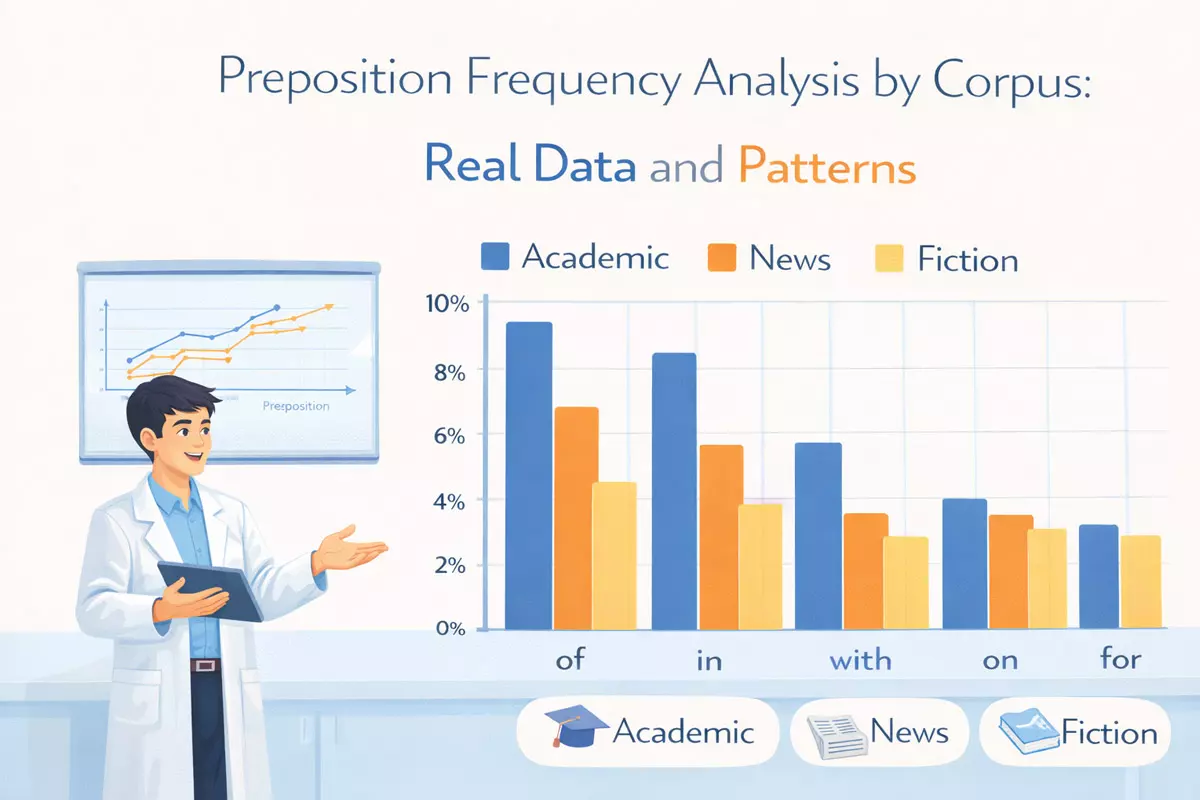
Corpus data reveals that some prepositions are notably more frequent in literary texts, while others dominate scholarly writing. For example, prepositions indicating spatial and temporal relations—such as on, in, and at—are ubiquitous in stories and novels, where setting and sequence are vital. Academic texts, on the other hand, rely more on prepositions that establish logical connections, such as of, for, and by.
Comparison of common prepositional usage
The following table highlights several prepositions and their typical functions or frequency in the two registers, based on large-scale corpus studies.
| Preposition | Frequent Function / Context | Fiction | Academic Prose |
|---|---|---|---|
| in | Location, time, abstract relation | High (physical settings: "in the room") | High (abstract: "in this study") |
| of | Possession, partitive, description | Moderate ("the sound of rain") | Very High ("analysis of data") |
| on | Surface, topic, time | High ("on the table") | High ("on the basis of") |
| by | Agent, method, proximity | Low ("sat by the window") | High ("by means of") |
| with | Accompaniment, means | High ("with a smile") | Moderate ("with respect to") |
| at | Specific time, place, target | High ("at midnight") | Low ("at issue") |
| for | Purpose, recipient, duration | Moderate ("for a moment") | High ("for example") |
| to | Direction, relation, purpose | High ("to the door") | High ("to illustrate") |
| about | Topic, approximation | High ("talk about it") | Moderate ("about 50%") |
| from | Source, separation | Moderate ("from the house") | High ("from this perspective") |
Key observations from corpus analysis
- Fiction favors prepositions tied to physical space, time, and interpersonal interaction.
- Academic prose exhibits a higher rate of abstract and logical connectors, supporting argumentation and definition.
- Some prepositions, like of and by, are especially characteristic of scholarly writing due to frequent use in passive structures and nominalizations.
- Conversational patterns (e.g., "with me," "at home") are more salient in narrative genres.
- Formulaic academic phrases ("in contrast to," "on the other hand," "with regard to") boost certain prepositions’ frequencies in research papers.
Implications for language learners and analysis
Understanding these distributional trends aids both language learners and researchers. Learners can target register-appropriate prepositional patterns, while analysts can use such contrasts to uncover genre conventions and stylistic tendencies. Real corpus data thus reveals how even the smallest words reflect broader communicative goals and textual norms.
Collocation mapping: Using 'N-grams' to identify high-frequency prepositional clusters
Understanding how prepositions group together in authentic language is crucial for both linguistic research and practical language teaching. By analyzing N-grams—strings of N words appearing together in a text—researchers can uncover which prepositional sequences are most common in actual usage. This approach shifts focus from isolated words to meaningful patterns, revealing how prepositions function in context.
What are N-grams and why do they matter?
N-grams are continuous sequences of N items (typically words) in a corpus. In the context of prepositions, examining bigrams (two-word groups) or trigrams (three-word groups) helps identify clusters like "in the," "at the end," or "on top of." These patterns can highlight set phrases, idiomatic expressions, or grammatical constructions that are prevalent in real data.
Examples of high-frequency prepositional clusters
Corpus-based studies often reveal that certain prepositional combinations appear far more frequently than others. Here are some common multi-word clusters involving prepositions, which are especially useful for language learners and teachers:
- in the → She left the keys in the car.
- on the → The report is on the table.
- at the → We met at the entrance.
- to the → Please send it to the manager.
- for the → This tool is for the project.
- with the → He arrived with the team.
- by the → A small café is by the river.
- from the → I got an email from the client.
- of the → The result of the test was surprising.
- about the → They talked about the plan.
- in front of → The taxi stopped in front of the hotel.
- on top of → Put the book on top of the notebook.
- at the end of → At the end of the day, we reviewed the notes.
- in addition to → In addition to English, she studies Spanish.
- in relation to → This rule is useful in relation to safety.
- in terms of → In terms of cost, option A is better.
- out of → We ran out of time.
- according to → According to the schedule, the meeting starts at 10.
- because of → The flight was delayed because of weather.
- due to → The road is closed due to repairs.
Comparing frequency and usage
Not all clusters are equally common or serve the same functions. Some, like "in the," are structurally fundamental, while others such as "in terms of" are more specialized. The table below compares selected high-frequency prepositional clusters by their type and typical use:
| Cluster | Typical Usage |
|---|---|
| in the | Locative, temporal, or abstract reference (e.g., "in the morning") |
| at the end of | Temporal or spatial endpoint (e.g., "at the end of the day") |
| in front of | Spatial relationship (e.g., "in front of the house") |
| according to | Reporting or attribution (e.g., "according to the report") |
| because of | Expressing cause or reason (e.g., "because of the rain") |
Implications for language analysis and teaching
Spotting these multi-word prepositional patterns helps refine grammar instruction and improve learners’ fluency by focusing on authentic, high-frequency chunks. For corpus linguists, mapping such clusters provides insight into how prepositions operate beyond single-word boundaries, revealing the building blocks of natural syntax and meaning. This data-driven approach supports more accurate descriptions of language and informs resource development for both learners and educators.
Concordance lines: Observing 'prepositions in the wild' to understand contextual behavior
When analyzing how prepositions function within authentic language data, examining concordance lines is a practical method. A concordance line shows a preposition embedded within its actual textual context, allowing us to see not just frequency, but the variety of patterns and meanings that emerge. By focusing on these “snapshots,” researchers can uncover subtle usage trends, co-occurrences, and even exceptions that frequency lists alone might miss.
Why Context Matters for Prepositions
Prepositions are notoriously flexible, often shifting meaning depending on the words around them. For instance, “in” in “in the morning” conveys time, but in “in the box” it expresses location. By studying real-world examples, we see how prepositions adapt to their linguistic environment, revealing both typical and unexpected pairings.
Common Patterns Revealed by Concordance Lines
Here are some recurring structures and collocations that become clear when analyzing prepositions in context:
- Preposition + noun phrase (e.g., on the table)
- Verb + preposition + object (look at the painting)
- Adjective + preposition (afraid of spiders)
- Prepositional phrases indicating time (at night, during the week)
- Prepositions with abstract nouns (by chance, in theory)
- Idiomatic expressions (under the weather, out of the blue)
- Multiple prepositions in sequence (from under the bed)
- Prepositions introducing clauses (after he left)
- Set phrases and fixed expressions (in charge of, on behalf of)
- Preposition + gerund (before leaving, without trying)
- Negative constructions (without any help)
- Prepositions in phrasal verbs (give up, look after)
- Contrastive uses (as opposed to)
- Prepositions with pronouns (with him, for her)
- Colloquial reductions (outta here for out of here)
- Prepositions in questions (What are you looking at?)
- Paired prepositions (between… and…)
- Prepositions with quantifiers (of all the people)
Comparing Prepositional Contexts
To illustrate how concordance lines help in comparing usage, consider the following structured data showing three common English prepositions in various real-life contexts:
| Preposition | Example Concordance | Observed Pattern |
|---|---|---|
| in | …arrived in the evening, ready to start… | Time reference, event context |
| on | …placed the keys on the kitchen counter… | Spatial relationship, surface location |
| at | …met her at the station just before noon… | Place (specific point), time (precise) |
| by | …finished the project by Monday morning… | Deadline, agent in passive voice |
Insights from Real Data
Reviewing authentic concordance lines exposes not only how often a preposition occurs, but also the range of functions it serves in everyday language. It highlights ambiguous cases, regional preferences, and evolving usage. For anyone building a deeper understanding of prepositional behavior—whether for teaching, learning, or research—these real-world examples are invaluable.
Prepositional 'Weight': Analyzing the distribution of simple vs. complex forms in research
Researchers often distinguish between simple and complex prepositions when analyzing corpora. Simple prepositions, such as "in" or "on," tend to be shorter and more frequent, often functioning as grammatical glue. In contrast, complex prepositions—multi-word units like "in front of" or "with respect to"—carry more semantic weight and can indicate more nuanced relationships. Understanding how these two types are distributed in real-world texts helps clarify not only usage patterns, but also the stylistic and functional tendencies of academic and general writing.
Simple vs. Complex Prepositions: Definitions and Examples

Simple prepositions consist of a single word and belong to the most frequent elements of English grammar. They are used to express basic relations of time, place, movement, and abstract connection.
- at → We met at the station.
- by → The report was finished by Friday.
- for → This tool is for beginners.
- from → She received a message from her colleague.
- in → He works in finance.
- of → The results of the study were published.
- on → The document is on the desk.
- to → Please send the file to the team.
- with → She arrived with her manager.
- about → They talked about the proposal.
- after → We reviewed the data after the meeting.
- before → Finish the task before noon.
- over → Sales increased over time.
- under → He works well under pressure.
- between → The office is between two buildings.
- during → No interruptions are allowed during class.
- without → She left without her phone.
Complex prepositions consist of two or more words that function together as a single grammatical unit. These expressions are fixed in form and are especially common in formal, academic, and professional contexts.
- according to → According to the report, costs will rise.
- because of → The flight was delayed because of weather.
- in addition to → In addition to English, he studies German.
- in front of → The car stopped in front of the building.
- in spite of → In spite of the delay, the project continued.
- on behalf of → She spoke on behalf of the entire team.
- with regard to → With regard to safety, changes are required.
- in accordance with → The process follows guidelines in accordance with regulations.
- by means of → The data was collected by means of surveys.
- in relation to → This rule applies in relation to privacy.
- in comparison with → In comparison with last year, results improved.
- in case of → In case of emergency, call this number.
- for the sake of → He agreed for the sake of clarity.
- in view of → In view of recent events, plans were revised.
- with respect to → With respect to pricing, no changes are planned.
Distribution Patterns in Academic Research
Corpus studies consistently show that simple prepositions dominate in raw frequency. This prevalence is partly due to their grammatical necessity for expressing basic relations. However, complex forms, though less frequent, often appear in more formal or technical contexts, adding precision or emphasizing relationships between ideas. For instance, research articles in linguistics or philosophy may favor complex prepositional phrases to articulate nuanced arguments, while narrative texts rely more on simple prepositions for straightforward description.
Comparative Frequency and Function
To illustrate the difference in frequency and function, consider the following comparison. Simple prepositions dominate frequency lists across corpora, while complex prepositions occur less often but carry high “information value” in formal and academic writing.
| Form Type | Examples | Main Function | Typical Contexts |
|---|---|---|---|
| Simple | of, in, to, for, on | Core grammatical relations (time, place, direction, basic links) | All registers: conversation, general writing, academic texts |
| Complex | in terms of, in spite of, with regard to | Precise logical relations (contrast, framing, reference, argument structure) | Formal and informational styles: academic, technical, legal, reports |
Simple forms almost always appear at the very top of frequency lists because they are essential to everyday grammar. Complex forms rank much lower, but they are crucial for organizing ideas, expressing nuance, and signaling a formal register. Exact ranks vary across corpora and genres, but the overall pattern remains consistent.
Implications for Corpus-Based Studies
Recognizing the balance between simple and complex prepositions is essential for accurate linguistic analysis. Overlooking either type can skew results, especially in studies of register or discourse style. Researchers should pay attention to not just how often prepositions appear, but also which forms are chosen in particular genres or communicative settings. In summary, examining the distribution of prepositional "weight"—from the ubiquity of simple forms to the targeted use of complex phrases—reveals much about language patterns, stylistic choices, and the communicative goals of different text types.
Semantic prosody: How prepositions signal positive or negative bias in discourse
Understanding how prepositions influence the tone of a sentence reveals subtle patterns in language. Certain prepositions, when paired with specific verbs or nouns, can consistently create a positive or negative impression. This phenomenon—where the meaning or mood of a phrase is shaped by surrounding words—plays a crucial role in both spoken and written communication.
How prepositions affect evaluative meaning
Some prepositions tend to appear more frequently in contexts that carry either favorable or unfavorable connotations. For example, “with” in “charged with” or “accused with” often implies negativity, while in “blessed with” or “gifted with,” it suggests something positive. Corpus studies help identify these tendencies by examining real usage data.
Common prepositions and their typical prosodic biases
The table below compares several prepositions and highlights typical patterns of positive or negative semantic coloring, based on frequent collocations found in corpus data.
| Preposition | Typical Semantic Bias (Examples) |
|---|---|
| with | Positive: “gifted with”, “blessed with” Negative: “charged with”, “infected with” |
| of | Positive: “full of hope”, “capable of” Negative: “guilty of”, “afraid of” |
| under | Negative: “under attack”, “under investigation” Neutral/Positive: “under consideration” |
| for | Positive: “famous for”, “known for” Negative: “criticized for”, “punished for” |
| by | Negative: “haunted by”, “plagued by” Neutral/Positive: “guided by”, “inspired by” |
Expanded list of prepositional patterns and their usual effects
- “responsible for” ✅ (can be positive or negative, but often negative in news)
- “suffer from” ❌
- “benefit from” ✅
- “threatened by” ❌
- “rewarded with” ✅
- “concerned about” ❌
- “associated with” ❌/✅ (context dependent)
- “engaged in” ✅
- “exposed to” ❌
- “committed to” ✅
- “limited by” ❌
- “equipped with” ✅
- “burdened with” ❌
- “endowed with” ✅
- “imposed on” ❌
- “filled with” ✅/❌ (depends on the noun)
- “motivated by” ✅
- “troubled by” ❌
Implications for discourse analysis
Recognizing these prosodic patterns helps in identifying subtle bias or stance in texts. For instance, recurring use of negative prepositional collocations can signal pessimism or criticism, while positive patterns may indicate approval or endorsement. In corpus-driven studies, mapping the frequency of such preposition-based patterns provides insight into underlying attitudes present in large bodies of real-world language data. Understanding these nuances is essential for accurate discourse analysis and for designing more effective communication in both academic and professional contexts.
Practice: Navigating digital corpus tools to verify collocation reliability
Exploring digital corpora is an essential skill for anyone analyzing real-world language patterns. Reliable collocation analysis helps us understand how prepositions are used in context, which is crucial for both linguistic research and practical language learning. This section guides you through hands-on tasks to develop your ability to assess the reliability of preposition collocations using digital tools.
Step-by-Step: Using a Corpus Tool for Collocations
- Choose a preposition (e.g., "on", "in", "at") to investigate.
- Access a digital corpus (such as COCA, BNC, or your preferred platform).
- Enter your query: Search for the preposition in context, with a collocation window (e.g., 4 words left/right).
- Review the output: Note frequent word partners and their frequencies.
- Compare results over different registers (spoken, academic, fiction, etc.) to identify patterns or anomalies.
- Assess reliability: Check if high-frequency combinations are consistent across samples or influenced by specific genres.
Common Collocations: Prepositions in Context
When analyzing prepositions, certain word pairings appear significantly more often than others. Here are some typical collocations for English prepositions, which you can verify using corpus tools:
- in the morning
- on the table
- at night
- by chance
- with regard (to)
- for example
- under pressure
- across the street
- between the lines
- over time
- about the issue
- through the window
- against the wall
- around the world
- without hesitation
- after the meeting
- before sunrise
- to the point
- from experience
- during the event
Comparing Corpus Results by Register
Different text types often reveal distinct collocation patterns. Here is a comparison of the preposition "in" across three registers:
| Register | Frequent Collocations with "in" |
|---|---|
| Spoken | in fact, in the morning, in trouble, in a minute |
| Academic | in conclusion, in contrast, in terms of, in addition |
| Fiction | in the dark, in silence, in the distance, in his mind |
Task: Analyze and Evaluate Collocation Reliability
Using your preferred corpus tool, try the following:
- Pick a preposition and find its top five collocations in two different registers.
- Compare the frequency and context of these collocations.
- Decide which collocations are truly reliable (consistent and frequent) and which seem register-specific or rare.
- Choose one “reliable” collocation and write three short sentences in different contexts (spoken, neutral writing, academic).
- Choose one register-specific collocation and rewrite it into a more general alternative without changing the main meaning.
- Find one collocation that looks common but is actually tied to a narrow topic (e.g., law, medicine, sports). Explain why.
- Identify the typical grammar pattern around the collocation (e.g., preposition + noun, preposition + -ing, preposition + determiner + noun).
- Test the collocation with pronoun changes (my/your/his/their) or article changes (a/the). Note what sounds natural and what does not.
- Group your collocations by function (time, place, cause, contrast, topic, method) and label each group.
- Pick two collocations and create a short mini-dialogue (3–5 lines) where both appear naturally.
Show answers
- Reliable collocations are those that appear frequently across multiple registers (e.g., "in fact" is common in both spoken and academic texts).
- Register-specific collocations (e.g., "in his mind" in fiction, "in terms of" in academic) can be useful, but they are less reliable for general-purpose production.
- Rare or context-bound collocations should be treated as low-priority patterns for everyday use and writing.
- Good practice is to confirm reliability by checking multiple genres/registers and testing the collocation in several sentence frames.
Data-driven editing: Correcting 'rare but grammatically correct' errors for natural flow
When editing texts using corpus-based analysis, we often encounter sentences where the preposition choice is technically correct but feels awkward or unnatural to native speakers. These "rare but grammatically correct" usages can disrupt the reading experience, even though they don't break any formal rules. By referencing large language corpora, editors can identify such outliers and suggest alternatives that align more closely with real-world usage patterns.
Why frequency matters in preposition selection
Prepositions are highly sensitive to context and collocation. While grammar books may list several possible options, native-like flow depends on what is most commonly found in authentic texts. For example, both "interested in" and "interested on" might seem plausible, but only the former is overwhelmingly supported by corpus data. Editors leveraging frequency analysis can flag these less common pairings and recommend more typical alternatives, improving both clarity and fluency.
Common examples of rarely used but permissible prepositions
Below are some prepositional combinations that, while not strictly incorrect, are seldom seen in native writing. Awareness of these patterns helps writers and editors produce smoother, more idiomatic prose.
- concerned with (common) vs. concerned about (preferred in most contexts)
- different from (standard) vs. different than (regionally accepted, but less frequent globally)
- on the weekend (US) vs. at the weekend (UK)
- married with (rare, except in "married with children") vs. married to (usual for a person)
- provide with information (common) vs. provide by information (rarely used)
- arrive at the station vs. arrive to the station (the latter is uncommon)
- capable of (standard) vs. capable for (infrequent, nonstandard in most varieties)
- depend on (preferred) vs. depend upon (formal, less common)
- in accordance with (typical) vs. in accordance to (rarely used)
- responsible for (frequent) vs. responsible to (used in specific contexts only)
- similar to (conventional) vs. similar with (uncommon)
- prefer to (usual) vs. prefer over (acceptable but less frequent in formal style)
- good at (standard) vs. good in (used regionally, less common overall)
- wait for (normal) vs. wait on (used in some dialects, rare in global English)
- participate in (expected) vs. participate at (very rare)
- listen to (standard) vs. listen at (nonstandard)
- apply for a job (common) vs. apply to a job (used for institutions, not positions)
- focus on (usual) vs. focus in (uncommon)
How corpus data guides natural editing
By consulting frequency statistics, editors can make informed decisions about preposition choice. When two similar-looking constructions show a dramatic difference in frequency within comparable contexts, corpus data provides a clear and objective signal. This approach helps writers avoid unnatural combinations and align their language with actual usage.
| Phrase with Preposition | Approximate Corpus Frequency (per million words) |
|---|---|
| interested in | ≈1200 ✅ |
| interested on | ≈5 ❌ |
| capable of | ≈850 ✅ |
| capable for | ≈7 ❌ |
| good at | ≈900 ✅ |
| good with | ≈80 ❌ |
Editing with reference to corpus frequency does not eliminate context-sensitive variation, but it strongly favors constructions that are both common and stable. This method helps non-native writers sound more fluent and natural, especially in academic, professional, and polished written English.