Abstract vs Concrete Usage Shifts in English Noun Meaning

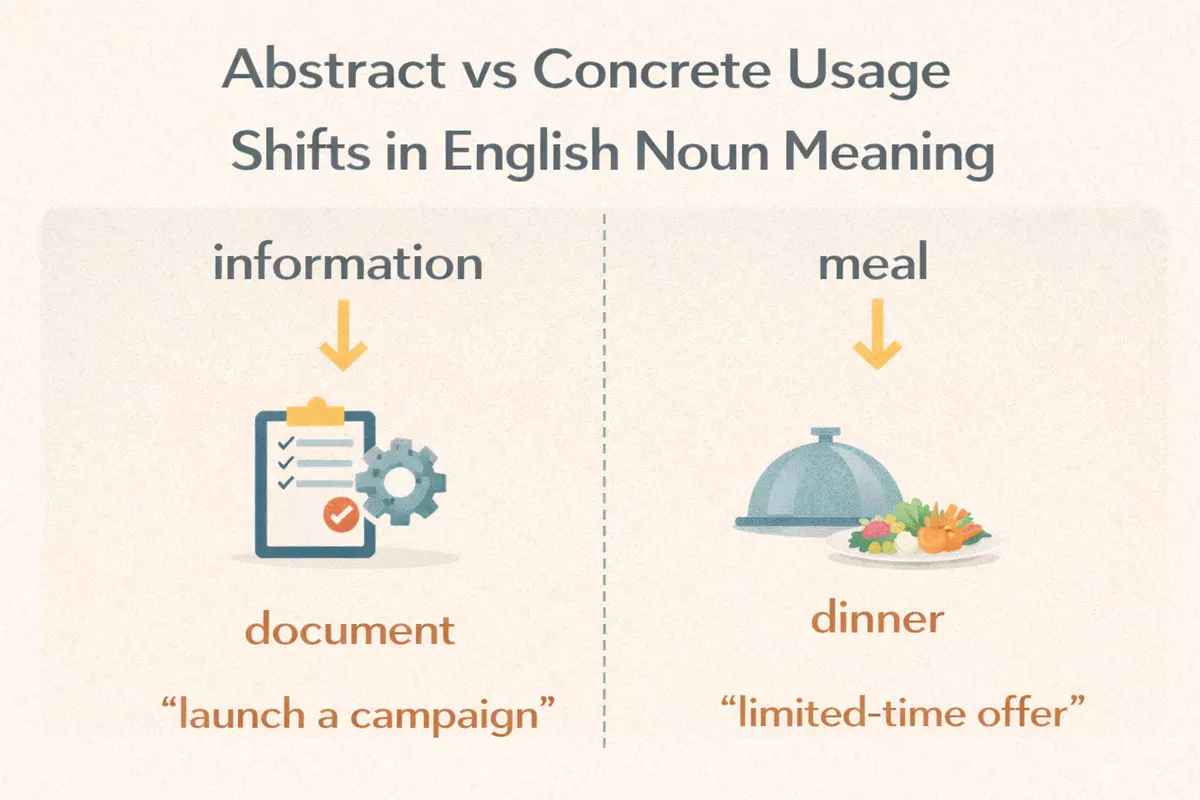 Here we how nouns such as experience, business, and life can be abstract or concrete depending on context and modifiers. It covers meaning changes, effects on articles and countability, common learner confusion, and provides practice choosing meanings.
- Difference between abstract and concrete noun meaning
- Nouns that shift between abstract and concrete use
- Meaning changes based on context and modifiers
- Examples like experience, business, and life
- Effect of these shifts on countability and articles
- Common learner confusion with shifted meanings
- Practice: choose abstract or concrete meanings in context
Words that originally refer to things we can see and touch often develop broader, more abstract meanings over time, reflecting changes in how we express and understand ideas. This shift happens as people use familiar nouns in new contexts, drawing on physical experiences to explain or describe intangible concepts. For example, the word "grasp" once meant only to physically hold something, but now it also means to understand an idea. Such changes in meaning illustrate how language adapts to our evolving ways of thinking and communicating.
Difference between abstract and concrete noun meaning
Abstract and concrete nouns represent fundamentally different ways of expressing ideas in English. While concrete nouns refer to objects or things that can be perceived by the senses—like a table or music—abstract nouns deal with concepts, states, or qualities that cannot be touched or seen, such as freedom or happiness. Understanding this distinction is crucial for recognizing how meaning shifts between the tangible and the intangible in English noun usage.
Defining Abstract and Concrete Nouns
- Concrete nouns: Refer to physical entities—people, places, or things you can see, hear, touch, smell, or taste.
- Abstract nouns: Refer to ideas, qualities, events, or emotions that exist in thought but lack physical presence.
Key Characteristics
- Concrete nouns are often countable and can be pluralized (cats, chairs).
- Abstract nouns are usually uncountable and are not used with articles like "a" or "an" (honesty, not an honesty).
- Concrete terms are generally easier to visualize or recognize in the real world.
- Abstract terms often require context or explanation to fully grasp their meaning.
Common Examples
- Concrete: apple, mountain, perfume, thunder, sand, child, river, truck, flower, bread
- Abstract: courage, justice, beauty, trust, time, love, intelligence, democracy, luck, anger
Comparing Usage and Meaning
| Concrete Noun | Abstract Noun |
|---|---|
| Book (a physical object you can hold) | Knowledge (the information or understanding you gain from books) |
| Rain (drops of water falling from the sky) | Sadness (an emotional state often metaphorically linked to rain) |
| Voice (the sound produced by a person) | Freedom (the ability to express one's voice or opinion) |
| Door (a tangible barrier you can open) | Opportunity (an abstract concept sometimes described as 'a door opening') |
Why the Distinction Matters
Recognizing whether a noun is abstract or concrete can help clarify meaning, guide word choice, and improve both comprehension and expression. This is especially important as many English nouns shift between these senses depending on context, leading to subtle—or sometimes significant—changes in usage. For example, taste can refer to a physical sensation (concrete) or to personal preference (abstract).
Nouns that shift between abstract and concrete use
English is full of words that can carry both a tangible, physical meaning and a more intangible, conceptual one. This dual nature often depends on context, allowing speakers to move seamlessly between talking about real-world objects and expressing ideas, qualities, or experiences. Understanding this flexibility enriches both comprehension and expression.
Common patterns and examples
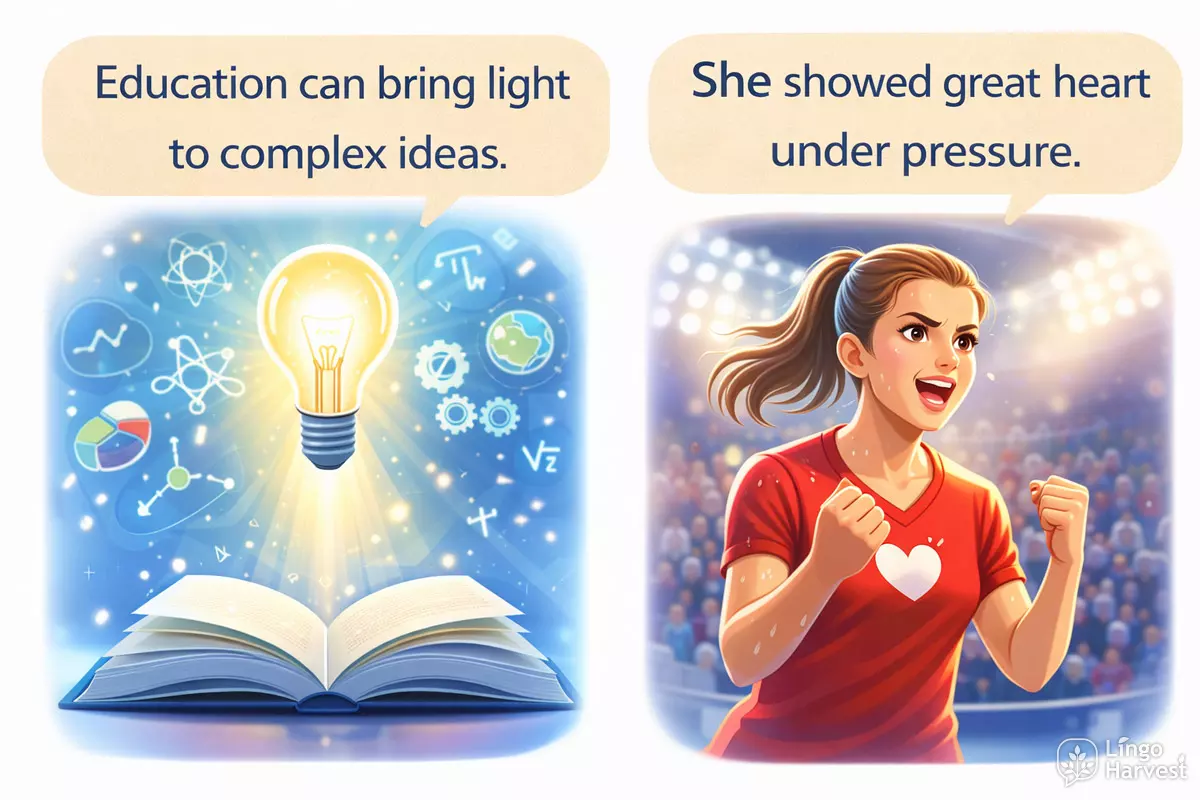
Many nouns can be used in both concrete and abstract contexts, sometimes with subtle shifts in meaning. For example, “light” can refer to the physical phenomenon you see, or to an idea of understanding (“He saw the light”). Here’s a list of frequently encountered nouns that demonstrate this kind of semantic versatility:
- Light (a lamp vs. enlightenment) → The light in the room was too bright / Education can bring light to complex ideas.
- Heart (an organ vs. emotion or courage) → His heart is healthy / She showed great heart under pressure.
- Head (body part vs. leader or intellect) → He hit his head / She is the head of the department.
- Voice (sound made vs. opinion) → Her voice was quiet / Young people deserve a voice in decisions.
- Wall (physical barrier vs. emotional barrier) → They painted the wall / Fear built a wall between them.
- Bridge (structure over water vs. connection between people) → The bridge crosses the river / Dialogue can build a bridge between cultures.
- Key (object for a lock vs. crucial element) → I lost my key / Trust is the key to success.
- Root (part of a plant vs. origin or cause) → The tree has deep roots / Poverty is the root of the problem.
- Field (open land vs. area of study or activity) → Cows grazed in the field / She works in the medical field.
- Wave (movement of water vs. gesture or surge) → A wave hit the shore / A wave of optimism spread.
- Shadow (dark shape vs. lingering influence) → His shadow stretched across the road / The past cast a long shadow.
- Chain (links of metal vs. sequence of events) → The bike chain broke / A chain of events followed.
- Season (time of year vs. phase of life) → Winter is my favorite season / It was a difficult season in her career.
- Space (physical area vs. opportunity or freedom) → There is no space here / Give him space to grow.
- Point (dot or tip vs. argument or purpose) → Mark the point on the map / You missed the point.
- Line (drawn mark vs. a series or boundary) → Draw a straight line / He crossed the line.
- Face (front of the head vs. aspect or surface) → She washed her face / This is another face of the issue.
- Circle (shape vs. group of people) → Draw a circle / He has a small circle of friends.
- Balance (physical equilibrium vs. mental stability or fairness) → He lost his balance / Work-life balance matters.
- Ground (earth vs. basis for reasoning) → The ground was wet / There are solid grounds for this decision.
How context guides meaning
The surrounding words and situation almost always clarify whether a word refers to something you can touch or something you can only imagine. For instance, “She lost her balance on the beam” points to a literal, physical event, while “He found balance in his life” clearly means something mental or emotional. This contextual flexibility is a hallmark of English and is especially common with short, everyday nouns.
Comparison of abstract and concrete uses
Some nouns have typical patterns for both uses. Here’s a structured look at how a few nouns can shift between tangible and intangible meanings:
| Noun | Concrete Example | Abstract Example |
|---|---|---|
| Bridge | The bridge crosses the river. | Education is a bridge to opportunity. |
| Root | She pulled the root from the soil. | Fear was the root of his problems. |
| Wall | A wall divided the two rooms. | She put up a wall between herself and others. |
| Key | He lost his house key. | Trust is the key to a good relationship. |
| Light | The light in the hallway is broken. | She brought light to the discussion. |
Why these shifts matter
Being aware of these dual meanings is helpful for both learners and fluent speakers. It allows for richer metaphor, more expressive communication, and a better grasp of nuance. When writing or speaking, recognizing when a noun is being used literally or figuratively can prevent confusion and open up creative possibilities.
Meaning changes based on context and modifiers
English nouns often shift between abstract and concrete interpretations depending on the surrounding words and the situation. The same term may refer to a physical object in one sentence and an idea or quality in another. These shifts are frequently triggered by modifiers (like adjectives) or the broader context within which the noun appears.
How context influences interpretation
The words and phrases around a noun play a crucial role in determining how it is understood. For example, "light" in "turn on the light" points to a tangible source of illumination, while "see the light" refers to an abstract realization. The meaning emerges from the sentence as a whole, not just from the noun itself.
- Paper: "She bought paper" (material) vs. "She presented a paper" (academic work)
- Glass: "A glass of water" (container) vs. "The table is made of glass" (substance)
- Hope: "There is hope" (feeling/abstract) vs. "A hope for change" (specific wish/goal)
- School: "The school is old" (building/concrete) vs. "School starts at nine" (institution/abstract)
- Work: "She has a lot of work" (tasks/abstract) vs. "Go to work" (workplace/concrete)
- Chicken: "Chicken is tasty" (meat/food) vs. "The chicken crossed the road" (animal)
- Mind: "Keep an open mind" (attitude/abstract) vs. "He lost his mind" (mental state/concrete metaphor)
- Memory: "A happy memory" (recollection/abstract) vs. "He has a good memory" (mental capacity/concrete metaphor)
- Color: "Blue is a color" (category/abstract) vs. "A color on the wall" (pigment/concrete)
- Book: "A book on the shelf" (object) vs. "A book about history" (content/abstract)
Role of modifiers in meaning shifts
Adjectives and quantifiers often guide whether a noun is interpreted as abstract or concrete. For instance, "an interesting experience" refers to a particular event, while "experience is valuable" means the general concept. Modifiers such as "much," "many," "little," or specific descriptors (e.g., "scientific," "personal") can nudge the meaning one way or the other.
| Noun + Modifier Example | Abstract or Concrete Meaning? |
|---|---|
| Heavy traffic | Concrete (physical vehicles on the road) |
| Traffic laws | Abstract (rules/concepts) |
| Strong evidence | Abstract (quality of argument) |
| Physical evidence | Concrete (tangible items) |
| Deep thought | Abstract (process of thinking) |
| A thought in his mind | Concrete (discrete idea) |
| Fresh air | Concrete (actual air) |
| An air of mystery | Abstract (atmosphere) |
Summary
A noun’s meaning can shift substantially with changes in context or when paired with different modifiers. Recognizing these patterns is key to understanding and using English flexibly, as the same word can point to something you can touch or to an intangible concept, depending on how it’s framed.
Examples like experience, business, and life
Many English nouns undergo interesting shifts between abstract and concrete meanings, often depending on their context. Words such as experience, business, and life are classic illustrations: their sense can swing from something you can touch or count, to something you can only imagine or discuss. Understanding these shifts helps clarify both subtle and dramatic changes in meaning.
Shifting from Abstract to Concrete
Consider the noun experience. Used abstractly, it refers to knowledge or awareness gained over time ("She has a lot of experience in teaching."). In a concrete sense, it can mean a particular event ("It was a strange experience."). Similarly, business may refer to an abstract concept like commercial activity, but also to a specific company or shop. Life can mean the general phenomenon of living (abstract), or a particular person’s existence (concrete).
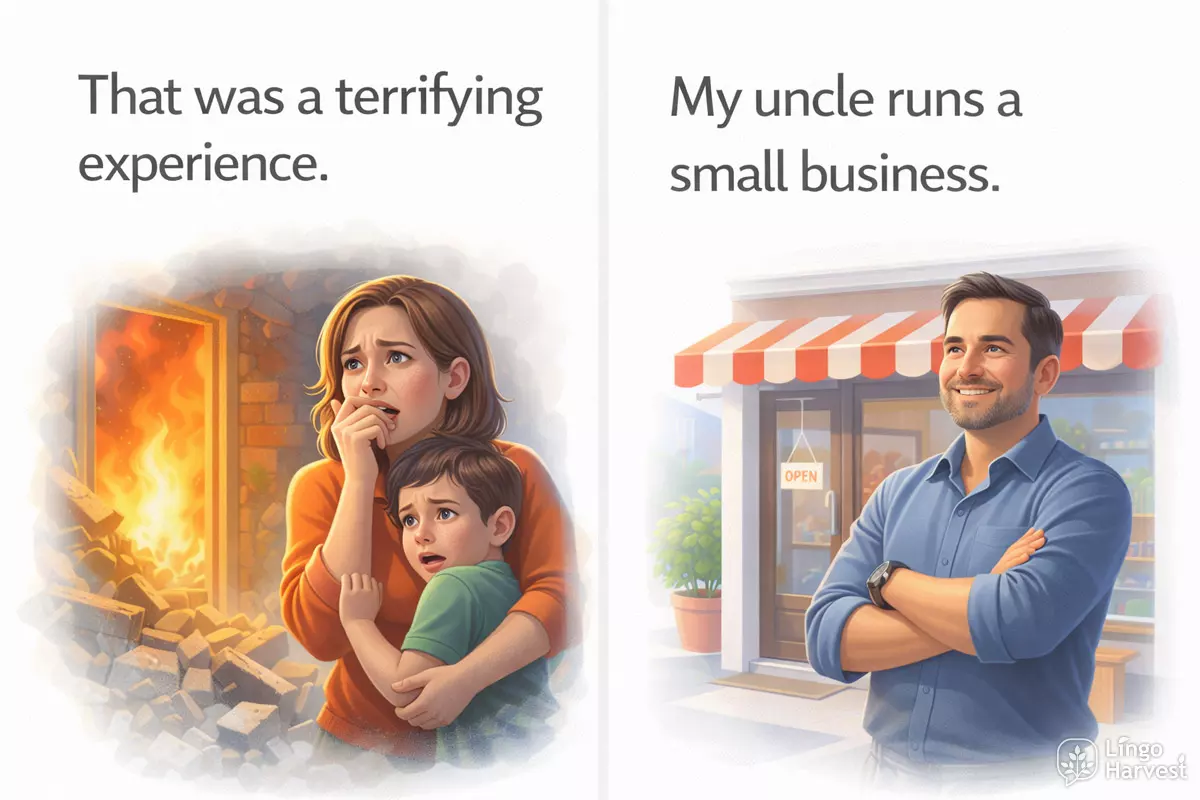
- Experience: "Experience is the best teacher." (abstract) → "That was a terrifying experience." (concrete)
- Business: "Business is booming." (abstract) → "My uncle runs a small business." (concrete)
- Life: "Life is unpredictable." (abstract) → "He saved a life." (concrete)
- Memory: "Memory fades with age." (abstract) → "She has a vivid memory of her childhood home." (concrete)
- Work: "Work is important for growth." (abstract) → "He finished the work on time." (concrete)
- Art: "Art inspires people." (abstract) → "The gallery displayed several fine arts." (concrete)
- Love: "Love is powerful." (abstract) → "They shared a love of music." (concrete)
- Education: "Education opens doors." (abstract) → "She received an education at Oxford." (concrete)
- Light: "Light travels fast." (abstract) → "A light shone in the distance." (concrete)
- Speech: "Speech is a human trait." (abstract) → "He gave a moving speech." (concrete)
Patterns and Contexts
Whether a noun leans abstract or concrete often depends on grammatical cues. Articles, plural forms, and countability can signal a shift. For instance, "an experience" or "a business" are more likely to indicate a specific, tangible referent, while the bare noun ("experience", "business") tends to suggest a general or abstract concept.
| Noun | Abstract Usage | Concrete Usage |
|---|---|---|
| Experience | Experience is invaluable. | I had a strange experience yesterday. |
| Business | Business requires innovation. | She opened a new business downtown. |
| Life | Life can be challenging. | They saved a life. |
| Memory | Memory is unreliable. | This is my favorite memory from school. |
| Work | Work shapes character. | The artist’s latest work is on display. |
Recognizing these shifts is essential for nuanced communication. Even advanced learners sometimes miss how a noun’s role can change depending on whether it’s used to refer to a general idea or a specific instance. Paying attention to the clues in surrounding words, and the context, helps determine whether a word like life is being used in an abstract or concrete sense.
Effect of these shifts on countability and articles
When English nouns switch between abstract and concrete senses, their grammatical behavior often changes—especially in terms of countability and how articles are used. Understanding these patterns is crucial for accurate and natural expression.
Abstract meanings often make nouns uncountable, while concrete senses tend to be countable. For instance, “experience” as a general concept (“Experience is the best teacher”) is uncountable. But when referring to specific events (“I had three unforgettable experiences”), it becomes countable. The choice between definite, indefinite, or zero articles shifts accordingly.
Typical Patterns in Article and Countability Shifts
- Advice: Uncountable in the abstract (“She gave good advice”), but countable in the sense of “pieces of advice” (“Several advices” is rare but possible in specialized contexts).
- Light: Abstract (“Light is essential for life”) is uncountable; specific instance (“a light in the window”) is countable.
- Work: General activity (“Work is tiring”) is uncountable; concrete task (“a work of art”) is countable.
- Paper: Material (“Paper is expensive”) is uncountable; document (“a paper on linguistics”) is countable.
- Room: Space (“There is room for everyone”) is uncountable; physical space (“a room with a view”) is countable.
- Glass: Material (“Glass breaks easily”) is uncountable; object (“a glass of water”) is countable.
- Time: General concept (“Time heals all wounds”) is uncountable; specific event (“a good time at the party”) is countable.
- Chicken: Food (“Chicken is delicious”) is uncountable; animal (“three chickens”) is countable.
- Hair: Substance (“Hair grows quickly”) is uncountable; individual strand (“a hair in my soup”) is countable.
- Business: Activity (“Business is booming”) uncountable; specific company (“a business in town”) is countable.
- Noise: General (“Noise annoys me”) is uncountable; specific sound (“a noise in the attic”) is countable.
- Iron: Material (“Iron conducts electricity”) is uncountable; object (“an iron for clothes”) is countable.
- Chocolate: Substance (“Chocolate melts easily”) is uncountable; specific item (“a chocolate on the table”) is countable.
- Hope: Concept (“Hope is important”) is uncountable; specific wish (“a hope for peace”) is countable.
- Water: Substance (“Water is essential”) is uncountable; serving (“two waters, please”) is countable in casual speech.
- Salt: Material (“Salt is salty”) is uncountable; type (“a salt used for de-icing”) is countable.
- Memory: Ability (“Memory fades”) is uncountable; specific recollection (“a memory of childhood”) is countable.
- Fruit: General (“Fruit is healthy”) is uncountable; individual item (“three fruits”) is countable, though less common.
- Stone: Material (“Stone is hard”) is uncountable; object (“a stone on the path”) is countable.
- Hope: (abstract: “Hope is eternal”, countable: “a hope for change”).
Article Usage and Shifts: Key Differences
Switching between abstract and concrete meanings not only affects the use of “a/an” or “the,” but also determines if a noun can appear without any article. Abstract, uncountable senses often drop the article (“Love conquers all”), whereas concrete, countable uses require one (“A love that lasts”).
| Noun | Abstract (Uncountable) Example | Concrete (Countable) Example |
|---|---|---|
| Experience | Experience is valuable. | She had an experience. |
| Paper | Paper is thin. | I wrote a paper. |
| Light | Light travels fast. | There’s a light on. |
| Hair | Hair grows quickly. | I found a hair. |
| Business | Business is slow. | They run a business. |
| Glass | Glass is fragile. | He broke a glass. |
| Iron | Iron is used in construction. | She bought an iron. |
| Hope | Hope keeps us going. | A hope was rekindled. |
These shifts impact not only countability and article choice but also idiomatic usage and meaning. Mastery of such nuances helps avoid errors like “an information” (❌) or “a water” (acceptable only in certain contexts).
Common learner confusion with shifted meanings
Learners of English often stumble when nouns take on new roles, shifting from concrete to abstract senses or vice versa. This is especially tricky because the same word can behave quite differently depending on the context, leading to misinterpretations or awkward usage. Understanding these changes is crucial for both comprehension and accurate expression.
Typical Patterns That Cause Problems
A single noun might refer to a physical object in one sentence and an idea or activity in another. For example, "paper" can mean the material you write on, but also a written report. These unpredictable shifts often trip up even advanced students. Some confusion arises from:
- Assuming a word always keeps its original, tangible meaning
- Translating directly from a first language, missing abstract usage
- Misunderstanding figurative expressions
- Overgeneralizing from a familiar context
Examples of Abstract vs. Concrete Usage
Here are common English nouns that often change their meaning between physical and conceptual senses. This list shows how context can completely alter interpretation:
- Light: a lamp (object) → not heavy (quality) → understanding ("shed light on")
- Room: a space in a building (place) → opportunity ("room for improvement")
- Head: body part (object) → leader ("the head of the company")
- Paper: sheet for writing (thing) → academic article (work/product)
- Book: physical item (object) → content ("a good book to read")
- Window: glass opening (thing) → opportunity ("a window of time")
- Foot: body part (object) → measurement ("a foot of snow")
- Ground: earth (substance) → basis for argument ("on what ground?")
- Table: furniture (object) → data arrangement ("a table of results")
- Point: dot or tip (shape) → argument or idea ("the main point")
- Voice: sound (thing) → opinion ("a voice in the debate")
- Face: front of the head (object) → surface ("the face of the clock")
- Field: area of land (place) → academic or professional area ("field of study")
- Key: device for opening (object) → essential component ("the key to success")
- Line: mark (shape) → telephone connection ("the line is busy")
- Capital: city (place) → money ("to raise capital")
- Season: time of year (period) → broadcast series ("the new season")
- Arm: body part (object) → division of an organization ("the arm of the company")
- Wave: movement in water (thing) → gesture ("give a wave")
- Chain: metal links (object) → business group ("a chain of stores")
Contrast Table: Concrete vs Abstract Usage
| Noun | Concrete Example | Abstract Example |
|---|---|---|
| Paper | I bought some paper for the printer. | He published a paper on climate change. |
| Head | She hurt her head. | He is the head of the department. |
| Window | Please close the window. | We have a short window to finish this project. |
| Ground | The ground was wet after the rain. | They have no ground for complaint. |
| Key | Where is my car key? | Trust is the key to a good relationship. |
Why These Shifts Matter
Misreading whether a noun is meant literally or figuratively can lead to errors in both understanding and communication. Learners might take an idiomatic phrase too literally, or miss the intended nuance, especially in academic or professional English. Recognizing these patterns helps build confidence and accuracy in language use.
Practice: choose abstract or concrete meanings in context
Understanding how nouns can shift between physical and intangible meanings is essential for interpreting English accurately. Below, you'll find exercises to test your ability to distinguish between these types of usage, explanations, and a variety of examples to deepen your grasp.
Task: Identify the Meaning Type in Sentences
Read each sentence carefully. Decide whether the highlighted noun is used in a concrete (physical) or abstract (conceptual) sense.
- The light in the hallway was left on all night.
- He finally saw the light and changed his ways.
- She broke the record for the 100-meter dash.
- Their argument is on record for everyone to read.
- He lost his balance and fell off the bike.
- She tries to keep a good balance between work and life.
- The charge on your phone is low.
- He faced a serious charge in court.
- The head of the statue was damaged.
- She is the head of the research team.
- The wall was painted white.
- There is a wall between them emotionally.
Show answers
- Concrete
- Abstract
- Concrete
- Abstract
- Concrete
- Abstract
- Concrete
- Abstract
- Concrete
- Abstract
- Concrete
- Abstract
Common Nouns with Abstract and Concrete Uses
Some nouns are especially flexible, easily switching between specific, touchable things and more figurative meanings. Here are several common examples:
- Head: Put your head down (concrete) / The head of the company (abstract)
- Heart: She has a strong heart (concrete) / He put his heart into the project (abstract)
- Foundation: The building’s foundation (concrete) / The foundation of an argument (abstract)
- Bridge: Cross the old bridge (concrete) / A bridge between cultures (abstract)
- Field: Playing on the field (concrete) / The field of medicine (abstract)
- Shell: Pick up a shell (concrete) / A shell of a plan (abstract)
- Point: The pencil’s point (concrete) / The point of the story (abstract)
- Root: Pull out the root (concrete) / Root of the problem (abstract)
- Wave: Catch a wave (concrete) / A wave of emotion (abstract)
- Chain: A gold chain (concrete) / A chain of events (abstract)
Comparison Table: Abstract vs Concrete Uses
| Word | Concrete Example | Abstract Example |
|---|---|---|
| Ground | The ground is wet. | They found common ground. |
| Space | There’s space in the parking lot. | He needed space to think. |
| Subject | The subject of the painting. | That’s a difficult subject. |
| Time | What time is it? | In time, you’ll understand. |
| Voice | She has a loud voice. | He gave people a voice. |
| Table | Put it on the table. | Let’s table the discussion. |
Challenge: Create Your Own Examples
Pick any two words from the table above. Write one sentence where the word is used concretely, and one where it is used abstractly.
Show answers
- Space: Concrete: "There’s not enough space on the shelf." / Abstract: "She asked for some space after the argument."
- Voice: Concrete: "His voice echoed in the hall." / Abstract: "The movement gave a voice to the unheard."
Practicing with such distinctions helps you read, write, and converse more precisely, especially when encountering words that shift between literal and figurative meanings.