Postmodifying Prepositional Phrases after Nouns

 This article explains postmodification in noun phrases, covering noun plus prepositional phrase structures, types of meaning like place or time, the difference between pre- and post-modifiers, stacking phrases, avoiding ambiguity, style tips, and practice exercises.
- What postmodification is in noun phrases
- Basic structure: noun + prepositional phrase
- Meaning types: place, time, content, purpose, possession
- Difference between pre-modifiers and post-modifiers
- Stacking several prepositional phrases after one noun
- Avoiding ambiguity and heavy, hard-to-read clusters
- Punctuation and style tips in formal writing
- Practice: rewrite and expand noun phrases with postmodifiers
Have you ever noticed how certain groups of words can add detail to nouns in English sentences? These are often prepositional phrases, and they play an important role in clarifying meaning and making our descriptions more precise. By attaching to nouns, prepositional groups provide extra information such as location, time, or possession, helping us communicate more clearly. Understanding how these groups work allows us to construct richer, more effective sentences in both writing and conversation.
What postmodification is in noun phrases
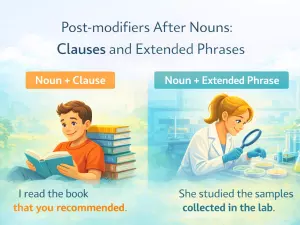
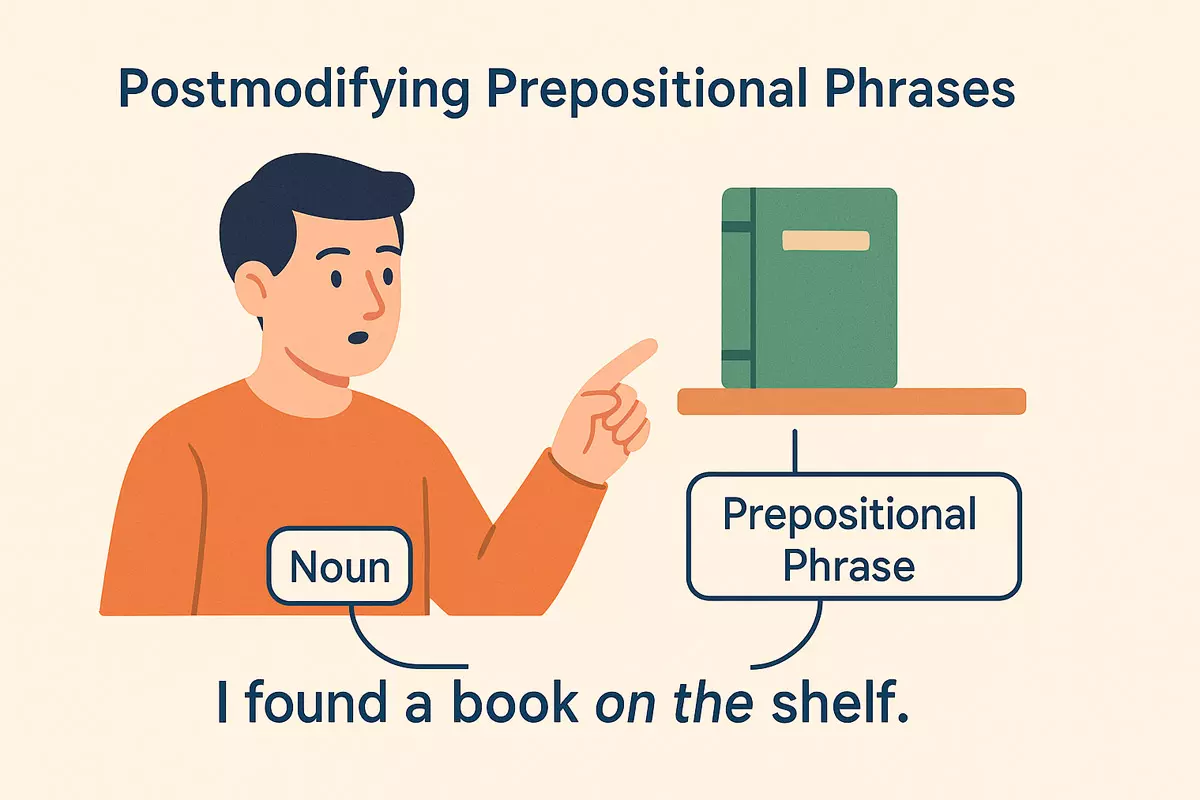
When building noun groups in English, it’s common to add extra information after the noun to clarify or specify what you mean. This process, known as postmodification, involves attaching words or phrases directly after the noun rather than before it. These additions help describe, identify, or give more details about the noun in question. For example, in the phrase the book on the table, the words on the table follow and modify book, telling us which book is meant.
Common types of postmodifiers
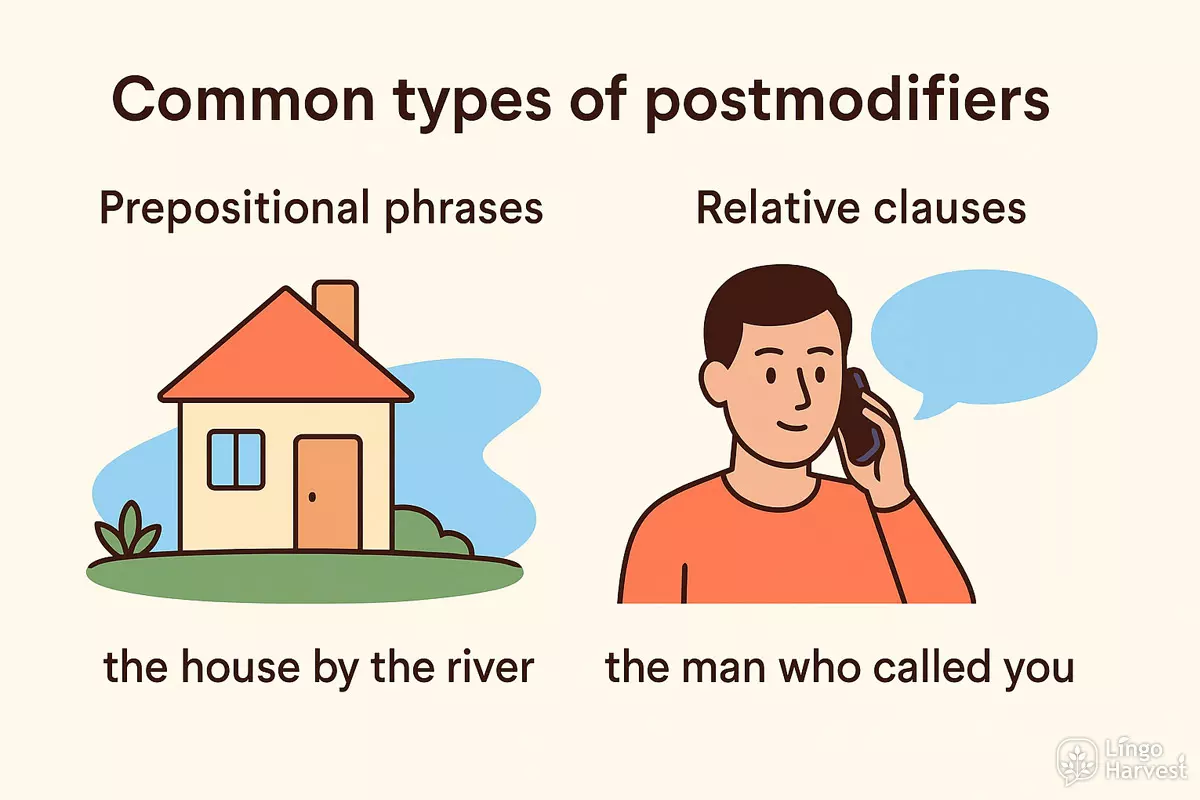
Postmodifiers can take several forms, ranging from single words to longer phrases and clauses. Here are some of the most frequent types:
- Prepositional phrases: the house by the river
- Relative clauses: the man who called you
- Participial phrases: the students sitting near the window
- Infinitive phrases: a book to read
- Adjective phrases: something interesting to do
- Appositive noun phrases: my friend, a skilled musician
- Adverbial phrases: the day after tomorrow
- Quantifier phrases: many of the guests
- Numerals or measurements: a distance of ten miles
- Time expressions: the meeting next week
- Comparative phrases: a story longer than mine
- Gerund phrases: the habit of smoking
- Possessive phrases: the car of my friend
How postmodifiers function
Adding elements after a noun allows you to specify or narrow down which person, place, thing, or idea you mean. Consider these examples:
- The girl in the red dress → specifies which girl.
- The decision to postpone → clarifies which decision.
- The results announced yesterday → indicates which results.
Without postmodifiers, sentences may be vague or ambiguous. By attaching extra details after the noun, you guide the reader or listener to the exact meaning intended.
Postmodification vs. premodification
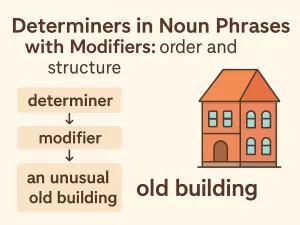
In English, you can also add information before the noun—this is called premodification, as with adjectives (a large house) or other modifiers. The key difference is that postmodifiers follow the noun and often provide more complex or specific information than premodifiers.
| Premodification | Postmodification |
|---|---|
| the old car | the car with the broken window |
| a famous author | an author from Canada |
| her new job | the job she started last week |
| the next train | the train to Manchester |
Understanding how to use postmodifiers lets you create more precise and informative noun phrases, making your communication clearer and more effective.
Basic structure: noun + prepositional phrase
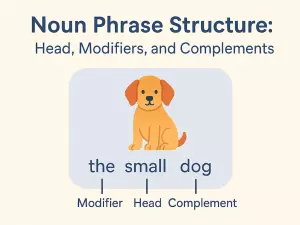
When discussing how prepositional phrases follow nouns, we're talking about a common way to give extra information about a person, place, thing, or idea. This pattern involves a noun (the main subject) directly followed by a prepositional phrase, which usually starts with a word like of, in, with, or for. The prepositional phrase functions as a modifier, helping to clarify which specific noun is meant or to add descriptive detail.
How it works
The core idea is simple: a noun is immediately expanded by attaching a phrase that begins with a preposition. This construction is extremely common in both spoken and written English. It’s used to narrow down meaning, identify relationships, or add context.
- book on the table
- students of mathematics
- story about friendship
- box with a lid
- teacher from Canada
- group of people
- plan for the weekend
- list of ingredients
- meeting at noon
- painting by Monet
- advice on cooking
- cup of tea
- car with leather seats
- house by the sea
- letter to my friend
- discussion about the project
- photo of the mountain
- example from history
What does the prepositional phrase add?
A phrase after a noun can specify which one (as in “the book on the table”), describe characteristics (“a house by the sea”), or show possession and origin (“the teacher from Canada”). This structure is especially useful for making sentences more precise and information-rich.
Common prepositions used in these phrases
- of
- in
- on
- with
- for
- by
- about
- from
- at
- to
In summary, using a prepositional phrase after a noun is a straightforward yet powerful way to add detail and context in English. This pattern is flexible and can be adapted to many different situations, making it an essential part of fluent communication.
Meaning types: place, time, content, purpose, possession
When a prepositional phrase follows a noun, it often clarifies the noun by specifying location, time, what something contains, why it exists, or who owns it. These postmodifying prepositional phrases help readers and listeners understand more precisely what is meant, reducing ambiguity and adding detail.
Place
Postmodifying prepositional phrases frequently describe where something is found, located, or takes place. For example, in "the building on the corner," the phrase "on the corner" specifies the building's position. This pattern is common with nouns related to physical objects or locations.
- the house by the river
- the car in the driveway
- a shop near the station
- the painting above the fireplace
- the notes under the book
Time
These phrases also clarify when something happens or is relevant. In "the meeting after lunch," the phrase "after lunch" provides a temporal reference for the noun "meeting." This use is frequent with events, schedules, and periods.
- the concert during the summer
- the deadline before Friday
- the party at midnight
- the lesson in the morning
- the call on Monday
Content
Prepositional phrases can indicate what something contains, is made of, or involves. For instance, "a box of chocolates" uses "of chocolates" to tell us the box's content. This structure often appears with containers, groups, and abstract concepts.
- a bag of apples
- a cup of tea
- a list of names
- a collection of poems
- an article about history
Purpose
Sometimes, the phrase explains why something exists or is used, as in "a tool for gardening." Here, "for gardening" shows the noun's function or intended use.
- a room for guests
- a machine for making coffee
- instructions for use
- a grant for research
- a campaign against pollution
Possession
Possessive relationships are also expressed with prepositional phrases, especially when indicating more complex ownership or association, as in "the son of a neighbor." This is common with formal or literary styles.
- the decision of the committee
- the color of the sky
- the works of Shakespeare
- the rights of citizens
- the keys of the car
| Type | Typical Example |
|---|---|
| Place | the park near the river |
| Time | the meeting after lunch |
| Content | a box of books |
| Purpose | a tool for painting |
| Possession | the decision of the council |
Understanding these different types of postmodifying prepositional phrases after nouns helps make writing and speech more precise, allowing for clear and detailed communication. Each type brings its own nuance, so choosing the right one depends on what you wish to express.
Difference between pre-modifiers and post-modifiers
Understanding how modifiers work with nouns is key to constructing clear and precise sentences. Pre-modifiers and post-modifiers both add information to nouns, but they do so in different positions and often with different effects on meaning and emphasis.
What are pre-modifiers?
Pre-modifiers appear before the noun they describe. These are typically adjectives or other descriptive words that give more detail about the noun directly in front of them. For example:
- red car
- old wooden chair
- three large apples
- new business idea
- fast-moving train
Pre-modifiers are usually brief and compact, helping to quickly identify or characterize the noun.
What are post-modifiers?
Post-modifiers come after the noun and often provide more complex information, such as details about location, time, or purpose. Prepositional phrases are a common type of post-modifier, but you’ll also see clauses and participial phrases in this role. Examples include:
- the car with the broken window
- a book about astronomy
- students in the library
- the decision to postpone the meeting
- a friend from college
Post-modifiers often add context or specify which particular person or thing is meant.
Comparison of pre-modifiers and post-modifiers
| Pre-modifiers | Post-modifiers |
|---|---|
| Come before the noun | Come after the noun |
| Usually short: single words or short phrases (adjectives, numbers) | Can be longer: prepositional phrases, relative clauses, participial phrases |
| Example: a blue shirt | Example: a shirt with blue buttons |
| General description or quantity | Specific details, clarification, or extra information |
| Common in headlines and short descriptions | Useful for complex or detailed explanations |
Quick reference: Types of modifiers
- Adjectives (pre-modifier): a delicious cake
- Numbers (pre-modifier): ten stories
- Participles (pre-modifier): a running stream
- Prepositional phrases (post-modifier): the house on the hill
- Relative clauses (post-modifier): the woman who called
- Infinitive phrases (post-modifier): a chance to win
- Adverbial phrases (post-modifier): the moment before dawn
- Appositive phrases (post-modifier): my friend, a talented musician
Summary
Choosing between pre-modification and post-modification depends on how much detail you need and where it fits best. Pre-modifiers work well for simple, direct descriptions, while post-modifiers are ideal for adding layers of information or clarifying which specific noun you mean. Both are essential tools for effective and nuanced writing.
Stacking several prepositional phrases after one noun
Writers often extend a noun by attaching multiple prepositional phrases. This technique packs more detail into a sentence, but it can also create ambiguity or awkwardness if not managed carefully. When several prepositional groups follow a single noun, the order and clarity of each phrase become especially important.
Common Patterns
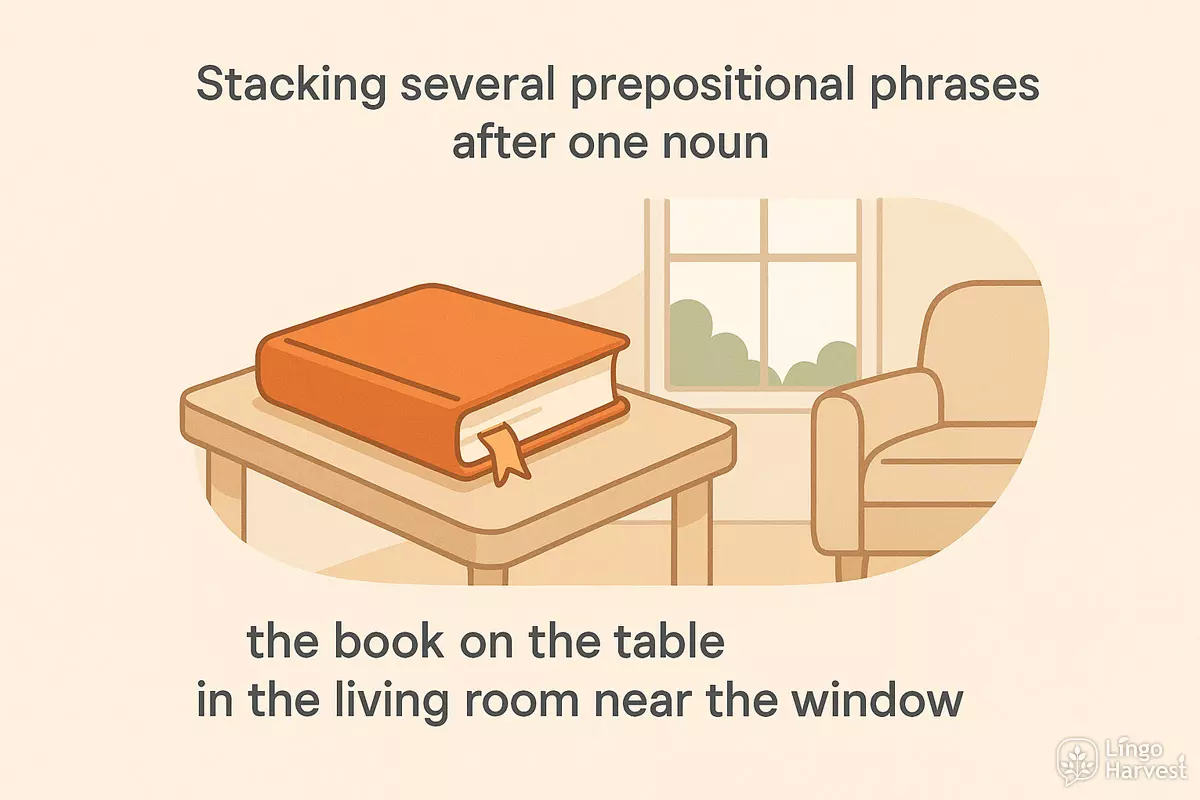
In English, it's not unusual to see a chain of prepositional phrases modifying a noun. Consider these examples:
- the book on the table in the living room near the window
- the manager of the department with the highest sales in the company
- a painting by an artist from Italy in the 18th century
- the boy with the blue hat under the tree beside the fence
- The conference on climate change at the university in Paris
- the letter from my friend in Canada about the festival
- the café at the corner of the street near the park
- the woman with the umbrella in the red coat by the door
- the report on biodiversity in tropical forests of South America
- the statue in the garden behind the museum on Main Street
Interpreting Meaning and Avoiding Ambiguity
Adding several prepositional phrases in a row can sometimes confuse readers about which phrase modifies which noun. For instance, does "with the blue hat" describe "the boy" or is it linked to "the tree"? Careful word order and, when needed, rephrasing can help clarify relationships.
Order of Phrases
The sequence in which you layer prepositional groups often reflects logical or spatial relationships. Typically, the first phrase is the most directly linked to the noun, with each following phrase expanding on the previous one or providing more detail.
| Example | Interpretation |
|---|---|
| the painting by Picasso in the museum | Picasso’s painting located in the museum |
| the painting in the museum by Picasso | Painting located in the museum, created by Picasso |
| the girl with the book on the bench | The girl holding the book who is on the bench |
| the girl on the bench with the book | The girl who is on the bench and has the book |
Best Practices
- Keep the number of consecutive prepositional phrases reasonable to maintain readability.
- If a phrase might be ambiguous, consider breaking the sentence or reordering for clarity.
- Read sentences aloud: if the meaning is unclear, your reader may also struggle.
- Use commas sparingly; they rarely separate prepositional phrases unless needed for clarity.
In summary, layering multiple prepositional phrases after a noun can enrich description, but always check for clarity and avoid overcomplicating your sentences.
Avoiding ambiguity and heavy, hard-to-read clusters
Long sequences of postmodifying prepositional phrases after nouns can make sentences difficult to process and sometimes confusing. To maintain clarity, it’s important to spot where these phrases might lead to multiple interpretations or simply overload the reader.
Common Problems with Stacked Prepositional Phrases
When several prepositional phrases are placed in succession after a noun, the intended meaning can become unclear. For example, in "the report on changes in policy at the company during the year," it’s not immediately obvious which phrase modifies which noun. Ambiguity can arise if the relationship between the phrases is not immediately clear.
- Misreading which noun a prepositional phrase is attached to
- Difficulty tracking the main subject
- Increased cognitive load from dense information clusters
- Potential for unintended interpretations
- Disrupted flow and readability
Strategies for Clearer Sentences
Writers can use several techniques to make sentences with postmodifying prepositional phrases easier to follow:
- Break up long noun phrases into shorter sentences
- Use relative clauses instead of stacked prepositional phrases
- Move key information earlier in the sentence
- Replace some prepositional phrases with adjectives or participles
- Reorder phrases for natural, logical flow
- Employ punctuation, such as commas, to signal grouping
- Favor familiar collocations and idiomatic expressions
- Check for possible double meanings or misattachments
- Read sentences aloud to test for natural rhythm
- Ask a peer to paraphrase the sentence for clarity check
Comparing Dense and Revised Structures
Dense clusters can be contrasted with more readable alternatives. Here’s a side-by-side comparison:
| Dense/ambiguous version | Revised/clearer version |
|---|---|
| The proposal for a change in the policy of the department under review | The department’s policy, which is under review, may change based on the proposal |
| The analysis of trends in sales by region during the quarter | The quarterly regional sales trends analysis |
| The meeting about the update of procedures for staff in training | The staff training procedures update meeting |
| The investigation into complaints from customers with orders from abroad | The investigation of overseas customer order complaints |
Tips for Editing Complex Phrases
Careful revision is often the best way to prevent confusion. When reviewing your writing, ask yourself:
- Does each prepositional phrase clearly attach to the correct noun?
- Could a reader misinterpret the relationships between phrases?
- Is there a more direct or concise way to convey the information?
By actively simplifying and restructuring, you can avoid the pitfalls of overly complex noun phrases and ensure your message comes across with precision.
Punctuation and style tips in formal writing
Clarity and precision are essential when using postmodifying prepositional phrases after nouns in formal contexts. Small punctuation choices and stylistic decisions can subtly change meaning or flow, so it’s important to be mindful of these details. This section reviews common conventions and offers practical advice for presenting postmodifying prepositional phrases effectively in academic or professional writing.
Comma usage with postmodifying prepositional phrases
Generally, postmodifying prepositional phrases that are essential to the noun’s meaning do not require commas. However, if the phrase is non-essential or provides extra information, set it off with commas. Consider these points:
- No comma: “The book on the table belongs to Sarah.” (The phrase specifies which book.)
- Comma needed: “The book, on the other hand, was missing.” (Here, the phrase is parenthetical.)
- Non-restrictive phrases (those not necessary for identification) are usually enclosed in commas.
Maintaining formality and avoiding ambiguity
Keep sentence structure straightforward to prevent misreading. In formal writing, avoid stacking multiple prepositional phrases directly after a noun, as this often leads to ambiguity. If clarity suffers, rephrase or break the sentence into shorter units.
- Prefer: “The results of the experiment in the laboratory were conclusive.”
- Avoid: “The results of the experiment in the laboratory on Monday by the students…” (Consider splitting or reordering for clarity.)
Style and conciseness tips
- Limit the number of consecutive prepositional phrases after a noun to two, unless absolutely necessary.
- Use pronouns or relative clauses if the phrase becomes unwieldy.
- Favor active constructions when possible to keep sentences engaging and direct.
- Adjust word order to prioritize the most important information at the start of the sentence.
- Maintain parallel structure when listing multiple postmodifying phrases.
- Be mindful of register—avoid informal prepositions or phrasings in academic or business writing.
- Choose precise prepositions to convey exact relationships (e.g., “regarding,” “concerning,” “with respect to”).
- Eliminate redundant or vague phrases such as “in terms of” or “with regard to” unless truly needed.
- Revise for conciseness by removing unnecessary modifiers.
- Read sentences aloud to check for awkward pauses or confusing groupings.
Quick reference: Common pitfalls and solutions
| Pitfall | Solution |
|---|---|
| Overlong noun phrases with stacked prepositional phrases | Break into two sentences or use a relative clause |
| Ambiguous attachment (unclear what the phrase modifies) | Rephrase or reposition the prepositional phrase |
| Incorrect comma placement | Check if the phrase is restrictive or non-restrictive |
| Vague or wordy phrasing | Edit for specificity and conciseness |
By applying these conventions and reviewing your writing for clarity, you can ensure that postmodifying prepositional phrases support your message without introducing confusion or stylistic errors.
Practice: rewrite and expand noun phrases with postmodifiers
Working with noun phrases that include prepositional phrase postmodifiers helps add detail and clarity to sentences. By expanding basic noun phrases, you can make your writing more precise and descriptive. Below, you'll find practice activities, example transformations, and tips for using prepositional phrases after nouns.
Examples: Expanding Noun Phrases
Start with a simple noun phrase, then add a prepositional phrase to give more information:
- the book → the book on the table
- a student → a student from Brazil
- the car → the car with the red roof
- a letter → a letter to my friend
- the house → the house by the river
- a solution → a solution to the problem
- the man → the man in the blue jacket
- an idea → an idea for the project
- the picture → the picture on the wall
- a team → a team of experts
- the story → the story about the lost dog
- a meeting → a meeting with the manager
- the keys → the keys in my pocket
- a message → a message from my teacher
- the window → the window above the door
- a recipe → a recipe for chocolate cake
- the woman → the woman behind the counter
- a chair → a chair near the fireplace
Practice Activities
Try rewriting and expanding these basic noun phrases by adding a prepositional phrase postmodifier. Make the noun phrase more specific or informative.
- the dog
- a gift
- the report
- a girl
- the photograph
- a painting
- the street
- a cup
Show answers
- the dog with the curly tail
- a gift for my brother
- the report on climate change
- a girl in a yellow dress
- the photograph of the mountain
- a painting by Picasso
- the street near the park
- a cup on the shelf
Transforming Sentences: Adding Detail
Take the following short sentences and expand the noun phrase by adding a prepositional phrase. This practice helps you use postmodifying structures to make your writing richer and more engaging.
- I saw a cat.
- She bought a dress.
- They visited a museum.
- He opened a box.
- We found a map.
- She wrote a letter.
- He met a friend.
- They built a house.
- I watched a movie.
- She planted a tree.
Show answers
- I saw a cat under the car.
- She bought a dress with blue stripes.
- They visited a museum in the city center.
- He opened a box of chocolates.
- We found a map of the national park.
- She wrote a letter to her grandmother in Spain.
- He met a friend from his old school.
- They built a house near the river in the countryside.
- I watched a movie about ancient civilizations.
- She planted a tree in the garden behind the house.
Tips for Using Postmodifying Prepositional Phrases
- Choose a preposition that shows relationship: of, with, in, on, by, for, from, about, near, etc.
- Keep the phrase immediately after the noun it modifies.
- Use these structures to clarify which person, thing, or idea you mean.
- Be careful not to stack too many postmodifiers, which can make a sentence confusing.
- Practice by expanding everyday nouns in your own writing or speech.