Layered Modifiers in Noun Phrases: Pre- and Postmodification

 This article explains types of premodifiers and postmodifiers, the standard order of adjectives and modifiers, and how to combine multiple layers of information in noun phrases. It also covers balancing clarity, common errors, and provides practice exercises.
Adding descriptive details before or after a noun helps create more complex and nuanced noun groups, which can greatly enrich our communication by providing additional context and specificity. Understanding how these descriptive elements combine and interact with each other reveals important insights into the structure and flexibility of English, allowing speakers and writers to convey precise meanings and subtle distinctions. This process not only enhances clarity but also adds depth and variety to both spoken and written language, making it more engaging and effective.
Types of premodifiers and postmodifiers
Noun phrases can be expanded and specified in a variety of ways using elements that come before (premodifiers) or after (postmodifiers) the main noun. Each type of modifier adds a different layer of meaning or detail, making noun phrases more informative or descriptive.
Common types of premodifiers
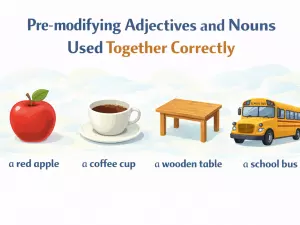
Premodifiers are words or groups of words placed before the noun to add information. They are most commonly adjectives, but can include several other forms as well:
- Adjectives: red car, happy child
- Nouns (as modifiers): chicken soup, computer screen
- Participles: broken window, smiling face
- Numbers: three dogs, first prize
- Quantifiers: many people, several options
- Posssessives: her idea, John’s book
- Compound adjectives: well-known author, high-speed train
- Ordinal numbers: second attempt, fourth chapter
- Determiners: these shoes, some advice
- Intensifiers (with adjectives): very large suitcase, super soft pillow
Main types of postmodifiers

Postmodifiers follow the noun and often provide essential information or clarification. They can take several forms:
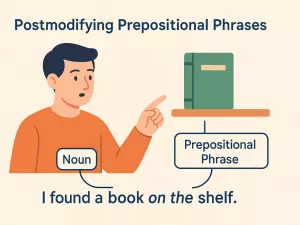
- Prepositional phrases: the book on the table, a friend from college
- Relative clauses: the man who called, the cake that she baked
- Non-finite clauses: the student studying abroad, the car parked outside
- Appositive phrases: my brother, a talented musician
- Adjective phrases: a room full of light
- Infinitive phrases: a chance to win, a task to complete
- Participle phrases: the child crying in the corner
- Adverbial phrases: the meeting next week
- Quantifier phrases: a group of students
- Time expressions: the class yesterday
Comparing premodifiers and postmodifiers
Both premodifiers and postmodifiers enrich noun phrases, but their placement and function differ. Premodifiers usually add descriptive or quantitative details, while postmodifiers often clarify identity, location, or action related to the noun.
| Premodifier Example | Postmodifier Example |
|---|---|
| old house | house on the hill |
| three cats | cats that sleep all day |
| delicious soup | soup with noodles |
| my friend | friend from Spain |
| running water | water flowing quickly |
Understanding the range and structure of these modifiers helps in crafting more precise and vivid noun phrases, whether in academic writing, storytelling, or everyday communication.
Typical order of adjectives and other modifiers
Understanding how modifiers are layered before and after nouns helps create natural and clear noun phrases. In English, multiple adjectives and other premodifiers usually follow a set pattern, which native speakers apply instinctively. Placing these elements in the conventional sequence ensures that phrases sound fluent and are easily understood.
Common Sequence of Premodifiers
When several adjectives or modifiers come before a noun, they typically follow this order:
- Quantity or number (e.g., two, several)
- Opinion or evaluation (e.g., beautiful, boring)
- Size (e.g., small, enormous)
- Age (e.g., young, antique)
- Shape (e.g., round, rectangular)
- Color (e.g., red, pale)
- Origin or nationality (e.g., French, rural)
- Material (e.g., wooden, plastic)
- Purpose or qualifier (e.g., sleeping [as in ‘sleeping bag’], racing [car])
For instance, “three lovely old round Italian marble serving bowls” places each modifier in its conventional slot.
Examples of Layered Adjectives
Arranging several modifiers can feel tricky. Here are some sample noun phrases built using the standard pattern:
- Four delicious large ripe red Spanish tomatoes
- A strange little old black leather notebook
- Several impressive modern glass office buildings
- Those three heavy oval silver serving trays
- A beautiful tiny antique golden brooch
- My two favorite big green wool sweaters
- Some unusual tall blue ceramic vases
- An elegant small white porcelain cup
- Many charming young Dutch artists
- That enormous new steel railway bridge
Placement of Other Modifiers
Not all modifiers are adjectives. Noun phrases may also include determiners (such as articles and possessives), quantifiers, and postmodifiers. The overall structure is typically:
Determiner + Pre-modifiers + Head noun + Postmodifiers
Some common postmodifiers:
- Prepositional phrases (e.g., “the book on the table”)
- Relative clauses (e.g., “the woman who arrived late”)
- Present or past participles (e.g., “the man running fast”, “the car parked outside”)
Summary Table: Modifier Order in Noun Phrases
| Modifier Type | Typical Example |
|---|---|
| Determiner | the, a, my, those |
| Quantity | five, several, many |
| Opinion | lovely, horrible, fascinating |
| Size | tiny, huge, medium-sized |
| Age | ancient, new, young |
| Shape | square, flat, round |
| Color | blue, crimson, striped |
| Origin | Italian, Victorian, rural |
| Material | wooden, plastic, silk |
| Qualifier/Purpose | sleeping (bag), tennis (shoes) |
| Postmodifier | on the desk, that I bought, running late |
Combining multiple layers of information
When constructing noun phrases, speakers often use both premodifiers (elements before the noun) and postmodifiers (elements after the noun) to add detail, clarify meaning, or specify reference. The interplay between these layers allows for highly nuanced descriptions, making English noun phrases remarkably flexible and precise.
How layers interact in noun phrase structure
Premodifiers—such as adjectives, participles, and quantifiers—typically stack before the noun, while postmodifiers—like prepositional phrases or relative clauses—follow the noun. The order and combination of these elements shape the overall meaning. For example, "the three old stone houses on the hill that survived the storm" includes quantifiers, adjectives, and two types of postmodification.
Common patterns of layered modifiers
Writers and speakers frequently combine several types of modifiers to enrich noun phrases. Here are some typical patterns and examples:
- Adjective + Noun + Prepositional phrase: the red car in the garage
- Quantifier + Adjective + Noun: many interesting books
- Noun + Relative clause: students who arrived early
- Adjective + Noun + Relative clause: the tall man who lives next door
- Participle + Noun + Prepositional phrase: broken windows on the upper floor
- Adjective + Noun + Prepositional phrase + Relative clause: the small painting in the hallway that she bought in Paris
- Ordinal + Adjective + Noun: the first successful flight
- Possessive + Noun + Prepositional phrase: my friend from Canada
- Compound noun + Postmodifier: coffee table with glass top
- Superlative + Noun + Postmodifier: the most expensive item on the menu
- Adjective + Compound noun + Prepositional phrase: old wooden bridge over the river
- Number + Noun + Prepositional phrase: two cats under the sofa
Comparing pre- and postmodification
Premodifiers tend to provide general, sometimes subjective, information, while postmodifiers often add specific, factual details. The table below illustrates how these two types of modification can layer together to build meaning:
| Premodifier(s) | Postmodifier(s) |
|---|---|
| the large wooden | on the corner |
| my three favorite | that I bought last year |
| a recently discovered | in the old library |
| several ancient stone | with mysterious markings |
| every blue | that you can see from here |
Guidelines for effective layering
To ensure clarity, modifiers should be ordered according to conventional patterns (e.g., opinion, size, age, shape, color, origin, material, purpose) before the noun, while postmodifiers should follow the noun in order of importance or proximity. Overloading a noun phrase with modifiers can lead to confusion, so balance and relevance are key. By thoughtfully combining different types of modifiers, speakers and writers can convey complex, precise meanings and create vivid, contextually rich descriptions.
Balancing specificity and readability
Writers often face a trade-off when constructing noun phrases: the more modifiers they add, the more precisely they can describe a concept, but a string of layered adjectives and other modifiers can quickly become difficult to process. Effective communication depends on finding that sweet spot where detail enriches meaning without overwhelming or confusing the reader.
When to add more detail
Adding layers of information before or after a noun is useful when clarifying distinctions, narrowing reference, or providing essential context. For instance, in technical writing, a phrase like high-performance polymer-based composite material leaves little room for ambiguity. However, in everyday contexts, simpler structures like red sports car are often more effective.
- To distinguish between similar items (the old wooden bridge vs. the new steel bridge)
- To specify function or purpose (water-resistant hiking boots)
- To indicate origin or composition (French silk scarf, cotton kitchen towel)
- To convey subjective impressions (delightful little café)
- To supply critical context in instructions or technical material
Risks of overloading noun phrases
Dense noun phrases can slow down readers and obscure meaning. Overuse of premodifiers and postmodifiers may lead to ambiguities or force the reader to backtrack. Consider the difference in clarity between a large old red-brick Victorian house with a wraparound porch and a Victorian house with a wraparound porch, made of old red bricks and quite large.
Strategies for clarity
Writers can keep their noun phrases clear and accessible by prioritizing the most relevant information and reordering or omitting less important modifiers. Breaking up very complex noun phrases into separate clauses or sentences can also help. Here are some practical strategies:
- Limit the number of premodifiers (adjectives before the noun) to three or fewer
- Use postmodification (e.g., relative clauses or prepositional phrases) for extended explanations
- Place the most distinguishing information closest to the noun
- Revise for parallel structure in lists of modifiers
- Read aloud to check for natural flow and comprehensibility
Examples: Impact of modifier choices

Below are examples of layered noun phrases with varying levels of detail and readability:
- The old stone bridge
- The recently restored medieval stone bridge
- The recently restored medieval stone bridge spanning the river near the village
- The highly detailed, hand-painted ceramic vase from southern Italy
- The small, battery-powered, remote-controlled helicopter
- The well-known, award-winning science fiction author
- The environmentally friendly, biodegradable packaging material
- The rapidly growing, tech-focused start-up in the city center
- The custom-built, solar-powered family home overlooking the valley
- The brightly colored, intricately woven Peruvian textile
- The state-of-the-art, voice-activated home security system
- The recently discovered, potentially habitable exoplanet
- The last surviving, hand-carved wooden carousel horse
- The user-friendly, open-source software platform for educators
Choosing which details to include—and how to structure them—depends on your audience and purpose. In formal writing, clarity often takes precedence over exhaustive description. In creative or technical contexts, layering modifiers can add necessary precision or vividness. Successful writers develop an intuition for when to elaborate and when to simplify.
Common errors with modifier order and attachment
Misplacing modifiers or arranging them in the wrong sequence can lead to confusion or even alter the intended meaning of a noun phrase. When combining multiple adjectives, participles, or prepositional phrases, writers often struggle with both the order in which modifiers appear and their proper connection to the noun they modify. These issues are especially common for learners and in complex sentences.
Typical pitfalls in modifier placement
- Order inversion: Placing opinion adjectives after color or size (e.g., a red beautiful dress instead of a beautiful red dress).
- Ambiguous attachment: Positioning a prepositional phrase so it could modify more than one element (e.g., the painting in the hallway of the artist).
- Dangling modifiers: Using a participial phrase without a clear noun to attach to (Walking down the street, the trees looked lovely).
- Overlapping modifiers: Stacking too many modifiers without clear separation (the old French wooden chair can be unclear—does "French" modify "wooden chair" or just "chair"?).
- Incorrect compound modifier hyphenation: Omitting hyphens in multi-word premodifiers (well known artist instead of well-known artist).
- Redundant modifiers: Using modifiers that repeat information (the large gigantic elephant).
- Misordered quantifiers: Placing quantifiers after descriptive adjectives (beautiful three flowers instead of three beautiful flowers).
- Adjective-noun confusion: Using noun modifiers in the wrong order (glass wine bottle instead of wine glass bottle).
- Postmodifier overload: Attaching too many postmodifiers, making the noun phrase difficult to process (the book on the table near the window with the blue curtains that she bought yesterday).
- Misplaced limiting modifiers: Placing words like only, almost, or just too far from the word they’re meant to modify (She almost drove her kids to school every day can be confusing).
Illustrative comparison: Correct vs. incorrect modifier order
| Incorrect Example | Corrected Form |
|---|---|
| A leather brown old bag | An old brown leather bag |
| The cake with candles for children | The cake for children with candles |
| She found a gold tiny ring | She found a tiny gold ring |
| The man driving quickly who lives next door | The man who lives next door driving quickly |
| Only she spoke to the manager | She spoke only to the manager |
Tips for avoiding modifier order mistakes
- Recall the typical sequence: quantity, opinion, size, age, shape, color, origin, material, purpose, noun.
- Check that each modifier clearly refers to the correct noun.
- When in doubt, rephrase or split long noun phrases for clarity.
- Read sentences aloud to spot awkward or ambiguous constructions.
- Use hyphens for compound adjectives before nouns (e.g., well-known author).
By paying close attention to the sequence and attachment of modifiers, you can craft noun phrases that are both clear and precise, avoiding the most frequent stumbling blocks.
Practice: build and simplify layered noun phrases
Layered noun phrases often combine several modifiers before and after a noun, creating precise and sometimes complex meanings. To become comfortable with these structures, try both building your own examples and simplifying dense phrases to their essentials. This hands-on approach helps you notice how each modifier contributes to the whole.
Building Complex Noun Phrases
Start by stacking premodifiers (adjectives, participles, nouns) and postmodifiers (prepositional phrases, relative clauses) around a head noun. Here are some prompts to get you started:
- a well-known classical music composer from Vienna
- the large red brick house at the end of the street
- an old wooden sailing ship with torn sails
- the delicious homemade chocolate cake that my aunt baked
- a recently published scientific article on climate change
- the enthusiastic young teacher with curly hair
- a tightly sealed glass jar full of honey
- the last unopened envelope on the kitchen table
- a fast-growing tech company based in Berlin
- the beautifully illustrated children’s book about dinosaurs
Practice: Simplifying Layered Noun Phrases
Long noun phrases can sometimes be trimmed for clarity or brevity. Try reducing these examples, keeping only the most essential modifiers.
- The old, dusty, leather-bound encyclopedia on the top shelf of the library
- A small, hand-painted ceramic bowl from Morocco
- The young, energetic dog with a wagging tail and bright eyes
- An expensive Italian sports car with custom leather seats
- The long, winding mountain road covered in fresh snow
- A beautifully crafted wooden table made from oak
- The quiet little café hidden behind the main square
- An elegant silver necklace decorated with tiny gemstones
- The tall, modern office building in the business district
- A soft, warm wool blanket with traditional patterns
Show answers
- the encyclopedia on the top shelf
- a ceramic bowl from Morocco
- the energetic dog with a wagging tail
- an Italian sports car
- the mountain road covered in snow
- a wooden table made from oak
- the café behind the main square
- a silver necklace with gemstones
- the office building in the business district
- a wool blanket with patterns
Comparing Layered Structures: Before and After Simplification
| Original Layered Phrase | Simplified Version |
|---|---|
| the old, dusty, leather-bound encyclopedia on the top shelf of the library | the encyclopedia on the top shelf |
| a small, hand-painted ceramic bowl from Morocco | a ceramic bowl from Morocco |
| the young, energetic dog with a wagging tail and bright eyes | the energetic dog with a wagging tail |
| an expensive Italian sports car with custom leather seats | an Italian sports car |
| the long, winding mountain road covered in fresh snow | the mountain road covered in snow |
Try It Yourself: Create and Edit Noun Phrases
Invent your own extended noun phrases by layering premodifiers and postmodifiers, then rewrite them in a more concise form. Focus on the information that is most relevant for your intended meaning. This exercise not only improves your understanding of complex noun structures but also helps you write more clearly and effectively.