Determiners in Noun Phrases with Modifiers: order and structure

 This article explains the structure of English noun phrases, where to place determiners, adjectives, and quantity words, and their correct order. It includes examples, tips for using prepositional phrases, common mistakes, and word order practice.
- Basic structure of an English noun phrase
- Where determiners go in relation to adjectives and nouns
- Order of determiners, quantity words, and describing words
- Examples with multiple modifiers before a noun
- Moving information into prepositional phrases after the noun
- Common word order mistakes in longer noun phrases
- Practice: reorder words to build clear noun phrases with determiners
Mastering English sentence structure requires understanding how elements such as articles, possessives, and quantifiers interact with descriptive terms within noun groups. These words follow specific patterns and rules regarding their order and combination, which are essential for forming clear and accurate phrases. By learning how to arrange these elements correctly, English learners can enhance both their writing and speaking skills, ensuring that their sentences are grammatically correct and effectively convey the intended meaning.
Basic structure of an English noun phrase
Noun phrases in English combine several elements in a predictable order, allowing for both simple and highly complex expressions. The core component is always the noun itself, but surrounding words—such as determiners, modifiers, and quantifiers—add detail and specificity. Understanding the typical arrangement of these components helps make sense of how meaning is built in everyday English sentences.
Order of Elements in a Noun Group
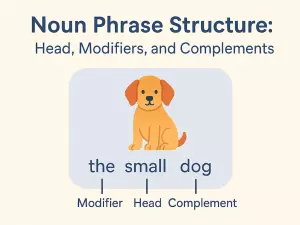
The sequence of words in a noun group generally follows this pattern:
- Determiner (e.g., the, a, some, this, my)
- Pre-modifiers (adjectives, participles, or modifying nouns; e.g., old, running, chicken)
- Head noun (the main noun; e.g., book, garden, answer)
- Post-modifiers (phrases or clauses after the noun; e.g., of the year, who arrived late)
Not every noun phrase includes all these parts. Some are just a single noun, while others use several modifiers and determiners for more detail.
Examples of Noun Phrase Structures

- Books (head noun only)
- The cat (determiner + noun)
- These old coins (determiner + pre-modifier + noun)
- My three favorite movies (determiner + quantifier + pre-modifier + noun)
- A student from Spain (determiner + noun + post-modifier)
- Several large brown boxes in the corner (quantifier + pre-modifiers + noun + post-modifier)
- That tall man who lives next door (determiner + pre-modifier + noun + relative clause)
- Every single one of those complicated questions (determiner + modifier + noun + post-modifier)
- Some very interesting stories about history (determiner + intensifier + pre-modifier + noun + post-modifier)
- Her best friend’s advice (possessive determiner + pre-modifier + noun + possessive post-modifier)
- All the new books on the shelf (quantifier + determiner + pre-modifier + noun + post-modifier)
Typical Noun Phrase Components
| Component | Examples | Function |
|---|---|---|
| Determiner | the, a, some, my, this | Specifies which noun is meant |
| Pre-modifier | big, red, wooden, running | Describes or qualifies the noun |
| Head noun | book, house, children | Central word in the phrase |
| Post-modifier | of the year, in the park, who sang | Adds information after the noun |
Key Points to Remember
- Word order matters: determiners always come first, followed by modifiers, with the noun at the center.
- Modifiers can appear before or after the noun, but their position changes the meaning.
- Complex noun phrases can include multiple modifiers and post-modifying elements such as prepositional phrases or relative clauses.
- Determiners and quantifiers are not used together unless following specific patterns (e.g., all the books ✅ but all books is also possible).
By recognizing the order and function of each part, you can both understand and construct more precise and natural-sounding noun groups in English.
Where determiners go in relation to adjectives and nouns
Understanding the placement of determiners is essential for constructing clear noun phrases, especially when adjectives are involved. In English, determiners almost always come before any adjectives and the noun they describe. This fixed order helps listeners and readers immediately recognize what is being specified or quantified.
Typical Structure of Noun Phrases
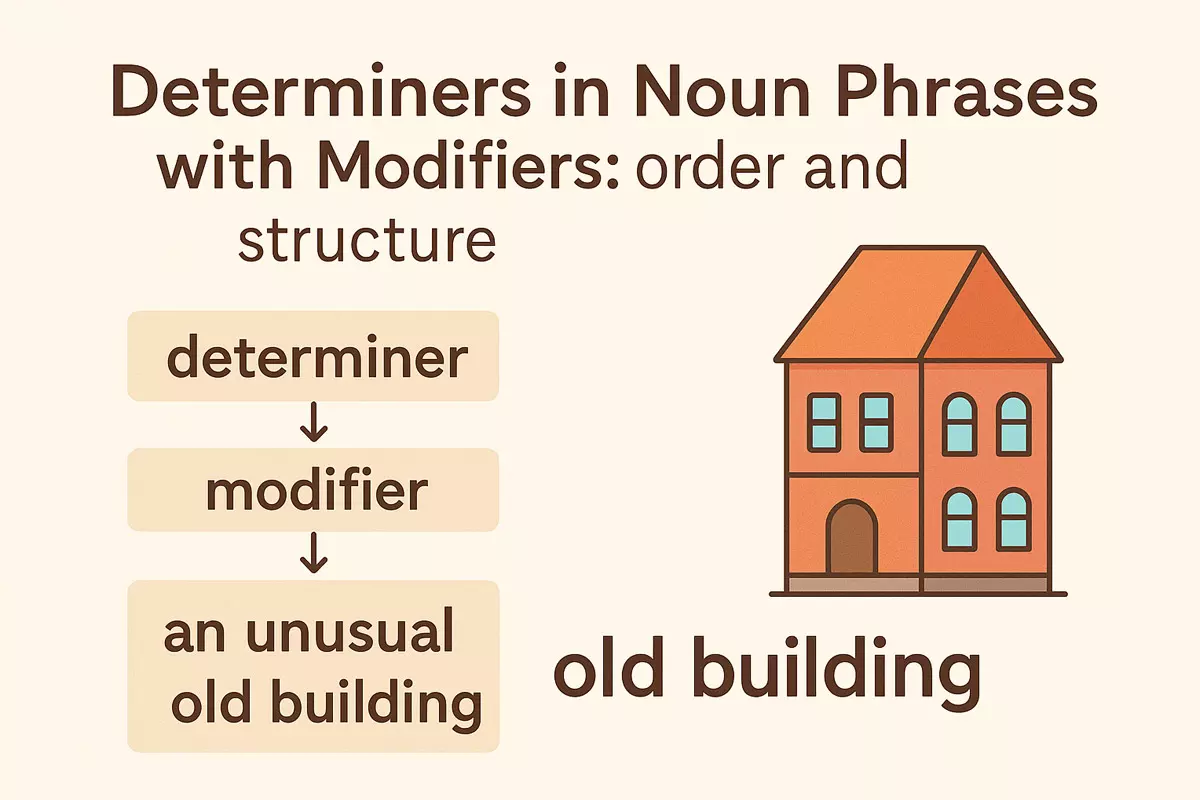
The standard sequence in English noun phrases is: determiner + adjective(s) + noun. For example:
- the old house → We decided to renovate the old house.
- some interesting ideas → She shared some interesting ideas during the meeting.
- her new car → Her new car is parked outside.
- every delicious meal → Every delicious meal was prepared by a professional chef.
- my favorite book → My favorite book is on the top shelf.
- this large building → This large building used to be a factory.
- an expensive watch → He bought an expensive watch for his birthday.
- those blue shoes → Those blue shoes don’t match your jacket.
- your honest opinion → I really need your honest opinion.
- each unique opportunity → Each unique opportunity should be taken seriously.
- all relevant documents → Please attach all relevant documents.
- another funny story → He told another funny story.
- his recent achievement → Everyone congratulated him on his recent achievement.
- their final decision → Their final decision was announced yesterday.
- no clear answer → There is still no clear answer.
Positioning Rules and Exceptions
Determinants always precede descriptive words and the main noun. You cannot place an adjective before a determiner. For example, ❌ blue the car is ungrammatical, while ✅ the blue car is correct. This order holds regardless of how many adjectives you use.
Comparison of Placement
The following table shows how determiners, adjectives, and nouns are sequenced in typical noun phrases, compared with ungrammatical alternatives:
| Correct Structure | Incorrect Structure |
|---|---|
| the red apple | red the apple |
| some big ideas | big some ideas |
| her beautiful dress | beautiful her dress |
| these old books | old these books |
| my new shoes | new my shoes |
Summary
In summary, determiners always come at the very start of a noun phrase, setting the scope or reference before any descriptive elements. This order is a core feature of English grammar and rarely, if ever, changes. Following this structure ensures your noun phrases are both clear and natural.
Order of determiners, quantity words, and describing words
Understanding the correct sequence of elements in noun phrases is essential for clear and natural English. When combining determiners (like "the," "my," or "these"), quantifiers (such as "many," "few," "all"), and adjectives (describing words), following a typical order helps your sentences flow smoothly and avoids confusion. Native speakers often use these patterns instinctively, but breaking down the structure can clarify things for learners.
Typical Sequence in Noun Phrases
The standard order for these elements in English is:
- Determiner (articles, possessives, demonstratives, etc.)
- Quantity word (numbers, quantifiers)
- Describing word (adjective or adjective phrase)
- Noun
For example: those three old books Here, "those" is the determiner, "three" is the quantity word, "old" is the adjective, and "books" is the noun.
Examples of Common Patterns
Ordering these components correctly helps you build more complex noun phrases. Consider these examples:
- my two large dogs
- the several interesting articles
- these few important details
- her many creative ideas
- those five red apples
- some delicious homemade cookies
- our several big projects
- each small step
- his few close friends
- every single useful tool
- no further information
- all the available tickets
- an unusual tall plant
- this one simple rule
- their many shared experiences
Summary Table: Structure of Noun Phrases
| Element | Examples | Position |
|---|---|---|
| Determiner | the, my, these, every | 1st |
| Quantity word | two, several, all, few | 2nd |
| Describing word | big, old, interesting, red | 3rd |
| Noun | books, projects, apples | 4th (last) |
Points to Remember
- Not every noun phrase includes all three types of modifiers; some may have just a determiner and an adjective, or only a determiner and a quantity word.
- The order is generally fixed; rearranging these elements can make the phrase sound unnatural or confusing.
- Some quantifiers (like "all" or "both") can appear before or after a determiner, but the overall sequence remains mostly consistent.
- Adjectives describing the noun nearly always come after determiners and quantity words.
Mastering this order will help you construct clear, precise noun phrases in both writing and speaking.
Examples with multiple modifiers before a noun
Noun phrases in English often include several modifiers leading up to the main noun. These modifiers can include determiners, adjectives, quantifiers, numerals, and more. Understanding their typical order helps form natural, clear sentences. Below, you'll find varied examples of how different kinds of modifiers combine before a noun, showing the structure and flexibility of English noun phrases.
Typical order of modifiers
Modifiers usually follow a set sequence: determiner (like 'the', 'my'), quantity/number, opinion adjective, size, age, shape, color, origin, material, and finally the noun itself. Not every noun phrase will use all of these, but the order is generally consistent.
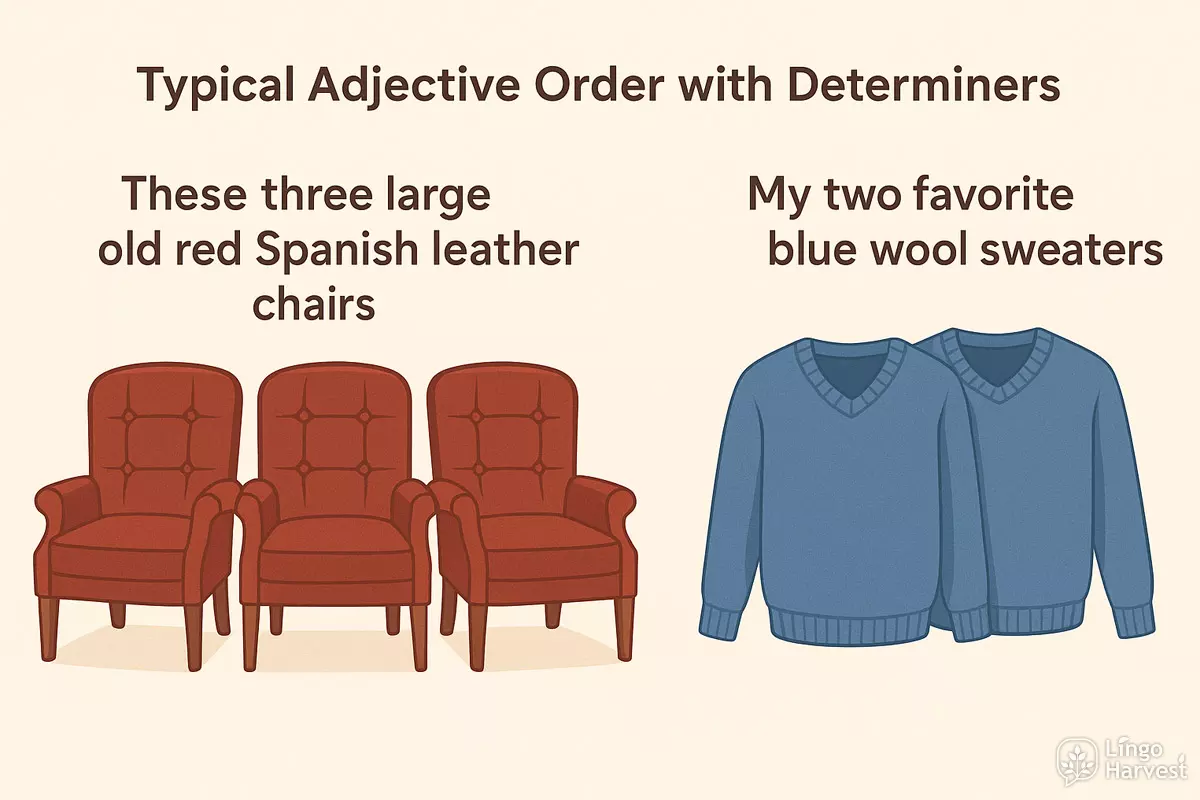
- These three large old red Spanish leather chairs
- My two favorite blue wool sweaters
- Several tiny round glass beads
- That beautiful young Italian artist
- Each delicious homemade chocolate cake
- Some clever new marketing ideas
- The first big exciting football match
- Our last two family holiday photos
- Every single little green apple
- Those five impressive antique silver candlesticks
- My favorite old science fiction books
- All those annoying little details
- His next important business meeting
- Another interesting historical documentary
- Several expensive modern Japanese cars
Modifier patterns in complex noun phrases
Notice how determiners typically come first, directly followed by quantifiers or numbers, then descriptors such as adjectives. This order ensures that the phrase remains understandable and idiomatic.
| Full Noun Phrase | Modifier Breakdown |
|---|---|
| All those beautiful old French paintings | Determiner + demonstrative + opinion adj + age adj + origin adj + noun |
| My three big black dogs | Possessive + number + size adj + color adj + noun |
| These last two urgent customer requests | Demonstrative + order adj + number + opinion adj + noun + noun |
| Every delicious new vegan recipe | Determiner + opinion adj + age adj + origin adj + noun |
| Several impressive international science awards | Quantifier + opinion adj + origin adj + noun + noun |
By analyzing these examples, you can see how stacking modifiers in the right order allows for precise and natural-sounding noun phrases in English. Practicing with your own combinations will help reinforce the sequence and structure.
Moving information into prepositional phrases after the noun
Shifting descriptive or qualifying details into prepositional phrases following the noun is a common strategy for creating clear, natural noun phrases—especially when multiple modifiers are involved. Instead of stacking several adjectives or determiners before the noun, English often favors placing more complex or lengthy information after the noun using prepositional phrases. This approach helps avoid ambiguity and keeps sentences readable.
Why use post-nominal prepositional phrases?
Placing information after the noun aids in:
- Reducing confusion when there are many modifiers
- Emphasizing specific details or attributes
- Allowing for longer, more complex modifiers
- Improving sentence rhythm and flow
Examples of modifiers before vs. after the noun
Consider how the meaning and clarity can change depending on modifier placement. Here are several typical patterns:
- Before the noun: the old wooden chair
- After the noun (with prepositional phrase): the chair with old wooden legs
- Before the noun: a new student project
- After the noun: a project by the new students
- Before the noun: a large glass window
- After the noun: a window of large glass
- Before the noun: the city transport system
- After the noun: the system for city transport
- Before the noun: a famous painting technique
- After the noun: a technique used in famous paintings
- Before the noun: a summer holiday plan
- After the noun: a plan for the summer holiday
- Before the noun: the green metal box
- After the noun: the box made of green metal
- Before the noun: a three-year-old child
- After the noun: a child of three years
Common prepositions used after nouns
Some prepositions frequently introduce post-nominal information:
- of → A piece of cake is missing.
- with → She arrived with her brother.
- for → This gift is for you.
- by → The book was written by a famous author.
- in → He left his keys in the car.
- on → The phone is on the table.
- about → They talked about the problem for hours.
- from → She received a message from her teacher.
- to → I’m going to the office now.
Comparison: stacked modifiers vs. prepositional phrases
| Stacked Modifiers (before noun) |
Prepositional Phrase (after noun) |
|---|---|
| a detailed annual financial report | a report on annual financial details |
| the old city stone wall | the wall of stone in the old city |
| an expensive Italian leather bag | a bag made of expensive Italian leather |
| the new employee training schedule | the schedule for training new employees |
When to use post-nominal prepositional phrases
Choose this structure when:
- Modifiers are long or complex
- Multiple modifiers could make the phrase unclear
- You want to explain a relationship (ownership, material, purpose, etc.)
- The modifier is a noun phrase itself or contains a verb
In summary, moving descriptive content into prepositional phrases after the noun is a flexible tool for building clear, natural noun phrases—especially when dealing with multiple or complex modifiers. This technique enhances both readability and precision in English sentence structure.
Common word order mistakes in longer noun phrases
When noun phrases include several modifiers—such as determiners, adjectives, quantifiers, and other elements—their arrangement can become confusing. Misplacing these elements is a frequent challenge, especially for learners who are translating from languages with different structures. The result is often awkward, unclear, or incorrect phrases.
Typical sources of confusion
- Placing adjectives before determiners (e.g., red the car instead of the red car)
- Using quantifiers in the wrong position (e.g., the some books instead of some of the books)
- Stacking multiple modifiers without correct order (e.g., my old two friends instead of my two old friends)
- Mixing up possessives and articles (e.g., the my dog instead of my dog)
- Incorrect placement of numbers and opinion adjectives (e.g., interesting three books instead of three interesting books)
Common misordered phrases and corrections
| Incorrect Phrase | Corrected Version |
|---|---|
| the blue three cars | the three blue cars |
| my these books | these books of mine / these my books (rare, poetic) |
| an amazing old house | an old amazing house (depends on intended meaning) |
| some the interesting articles | some of the interesting articles |
| the two first chapters | the first two chapters |
| my all friends | all my friends |
| the my new car | my new car |
| this beautiful that dress | that beautiful dress / this beautiful dress |
| delicious some cakes | some delicious cakes |
| the green five apples | the five green apples |
| many the questions | many of the questions |
| her both children | both her children |
| a Spanish beautiful painting | a beautiful Spanish painting |
| some my ideas | some of my ideas |
| the three my sisters | my three sisters |
| the amazing that story | that amazing story |
| an expensive red car | an expensive red car (correct, but order can vary for emphasis) |
Tips to avoid misordering modifiers
- Start with the determiner (articles, demonstratives, possessives, quantifiers).
- Follow with numbers or amount words.
- Add opinion adjectives, then size, age, shape, color, origin, material, and purpose in that order.
- Place the noun at the end.
- Review your phrase: Does it sound natural when read aloud?
Awareness of typical pitfalls and practicing with real examples helps build intuition for correct modifier order. Over time, arranging these elements properly becomes more automatic.
Practice: reorder words to build clear noun phrases with determiners
Understanding the correct order of determiners, adjectives, and nouns is essential for constructing clear and natural noun phrases in English. This practice section focuses on developing your ability to recognize and produce well-ordered noun phrases, especially when multiple modifiers are involved. By reordering jumbled phrases, you’ll strengthen your grasp of how determiners fit with adjectives and nouns, leading to smoother and more precise writing.
Reorder the words: build complete noun phrases
Below are groups of words arranged out of order. Rearrange each group to form a natural-sounding noun phrase that includes a determiner, any adjectives, and the noun. Pay attention to the typical word order: determiner + opinion adjective + size/shape + age + color + origin + material + noun.
- cat / black / the / small
- interesting / some / articles / new
- an / old / wooden / box
- delicious / those / red / apples
- this / French / beautiful / painting
- three / golden / rings / lovely
- her / leather / elegant / brown / bag
- every / difficult / problem / math
- my / friend / best / childhood
- that / long / blue / silk / dress
- the / ancient / stone / impressive / castle
- each / fresh / white / egg
- a / new / Italian / restaurant
- their / modern / glass / office / spacious
- another / funny / story / short
Common mistakes: spot and fix the errors
Some of the following noun phrases have incorrect word order or missing determiners. Identify the errors and rewrite the phrases correctly.
- big two dogs brown
- expensive these watches Swiss
- book interesting a old
- white every shirts cotton
Show answers
- the small black cat
- some interesting new articles
- an old wooden box
- those delicious red apples
- this beautiful French painting
- three lovely golden rings
- her elegant brown leather bag
- every difficult math problem
- my best childhood friend
- that long blue silk dress
- the impressive ancient stone castle
- each fresh white egg
- a new Italian restaurant
- their spacious modern glass office
- another funny short story
- two big brown dogs
- these expensive Swiss watches
- an interesting old book
- every white cotton shirt
Patterns and tips for ordering modifiers
Keep in mind the general sequence for modifiers in English noun phrases. Here is a useful summary:
- Determiner (the, a, some, this, each, etc.)
- Opinion adjective (lovely, interesting, beautiful, etc.)
- Size/shape (small, big, long, round, etc.)
- Age (old, new, ancient, etc.)
- Color (black, white, red, etc.)
- Origin (French, Italian, Swiss, etc.)
- Material (wooden, silk, leather, etc.)
- Noun (cat, box, dress, etc.)
Practice regularly by taking mixed phrases and reconstructing them. This habit will help you internalize the natural order and improve your fluency with complex noun phrases.