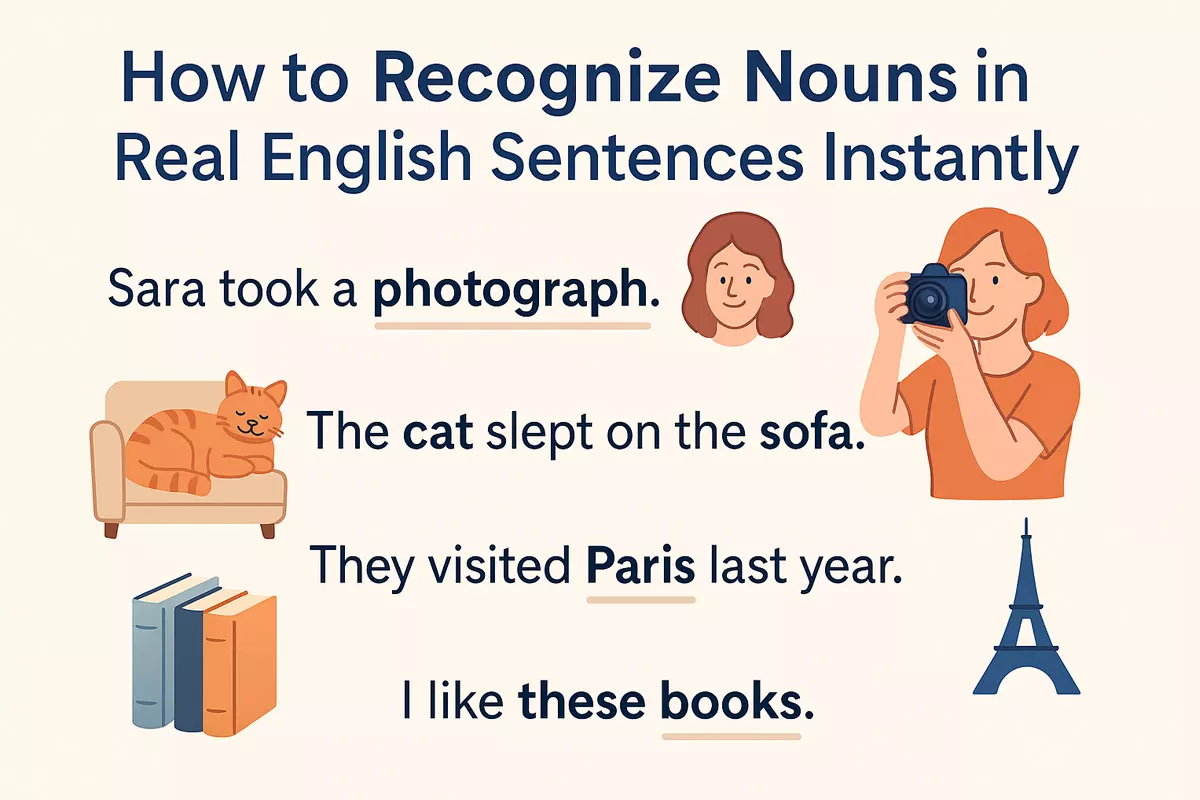
How to Recognize Nouns in Real English Sentences Instantly

 This article explains how to identify nouns in sentences using word endings, position, and their roles as subject, object, or complement. It also covers determiners, adjectives, noun-verb differences, common confusions, and practice examples.
- Basic definition of a noun in sentence structure
- Form clues: endings and word position
- Function clues: subject, object, and complement roles
- Using determiners and adjectives to spot nouns
- Difference between nouns and verbs in real context
- Common confusing cases for learners
- Practice: identify nouns in short authentic texts
Learning to quickly identify words that are names of people, places, or things—known as nouns—can greatly improve your reading and writing skills in English. When you read a sentence, look for words that refer to specific individuals, locations, or objects, as these usually function as nouns within the sentence. Practicing this technique helps you understand sentence structure better and makes it easier to communicate clearly in both spoken and written English.
Basic definition of a noun in sentence structure
Nouns are the words we use to name people, places, things, and ideas. In English sentences, they usually act as the subject (who or what the sentence is about) or the object (who or what receives the action). Recognizing them quickly helps you understand who is involved in the action and what is being discussed.
You’ll often spot a noun because it answers questions like “Who?” or “What?” For example, in the sentence “The dog barked,” dog is the noun—it names the animal doing the action. In “She read a book,” book is the object that receives the action of reading.
Common roles nouns play in sentences
- Subject: Children play outside.
- Object: She loves music.
- Object of a preposition: They sat on the bench.
- Possessive: The cat’s tail is fluffy.
- Complement: My friend is a teacher.
Typical noun indicators
Certain signs can help you spot nouns at a glance:
- Often appear after articles (a, an, the): the apple
- Can follow possessive pronouns: her idea, their house
- Frequently end with suffixes like -tion, -ment, -ness, -ity, -er
- Can be made plural: dogs, books
- May be capitalized if they’re proper nouns: London, Sarah
Examples of nouns in real sentences

- The car is fast.
- My brother works in a hospital.
- She has a great idea.
- We visited the museum last week.
- Happiness is important.
- Water fills the glass.
- The team won the game.
- This city never sleeps.
- Love is powerful.
- My computer crashed.
- Children need guidance.
- The mountain is tall.
- He ate an apple.
- Music can heal.
- The company grew fast.
- Books are valuable.
Types of nouns you’ll encounter
- Common nouns: table, city, teacher
- Proper nouns: Japan, Emily, Amazon
- Abstract nouns: freedom, love, honesty
- Collective nouns: team, group, family
- Countable nouns: apple, car, idea
- Uncountable nouns: water, information, rice
Understanding what a noun is and how it functions is the first step to mastering sentence structure in English. Spotting them instantly becomes easier with practice and by noticing these common patterns.
Form clues: endings and word position
Identifying nouns in English often comes down to noticing how words are built and where they appear in a sentence. Certain endings and placements are strong hints that a word is functioning as a noun, even if the context is new or unfamiliar.
Common noun endings
Many nouns share typical suffixes. While there are exceptions, spotting these endings can quickly help you pick out noun candidates:
- -tion / -sion (e.g., nation, decision)
- -ment (e.g., agreement, improvement)
- -ness (e.g., happiness, darkness)
- -ity (e.g., ability, reality)
- -ance / -ence (e.g., importance, difference)
- -ship (e.g., friendship, leadership)
- -er / -or (often for people or devices: teacher, actor)
- -ism (e.g., realism, optimism)
- -age (e.g., storage, courage)
- -al (e.g., arrival, refusal)
- -ing (when used as a noun, a gerund: reading, swimming)
- -dom (e.g., kingdom, freedom)
- -cy (e.g., agency, policy)
Word position in sentences
Nouns typically appear in certain spots. Look for these common patterns:
- After articles: the book, a solution
- After possessives: my friend, John’s car
- After numbers or quantifiers: three houses, some advice
- As the subject of a sentence: Cats sleep
- As the object of a verb: I like music
- Following prepositions: on the table, in trouble
- Before possessive ’s: the city’s lights
Summary of endings and sentence positions
| Typical Noun Endings | Frequent Noun Positions |
|---|---|
| -tion, -ment, -ness, -ity, -ance, -ship, -er, -ism, -age, -al, -ing, -dom, -cy | After articles, after possessives, after numbers/quantifiers |
| Irregular or root forms (e.g., dog, car, city) | As subject, as object, after prepositions, before possessive ’s |
If you’re unsure, check if the word can take an article or possessive, or if it makes sense after a preposition. These clues, paired with typical noun endings, will help you spot nouns quickly in real sentences.
Function clues: subject, object, and complement roles
Spotting nouns in English sentences often comes down to noticing what role a word plays. The most reliable signals come from a word’s position and how it interacts with verbs and other sentence parts. If you can tell whether a word is doing the job of a subject, object, or complement, you’re already halfway to identifying a noun.
How nouns function in sentences
Nouns most commonly fill three main “jobs” in a sentence:
- Subject: The “doer” of the action or the topic being described.
- Object: The receiver of the action, either directly (after the verb) or indirectly (often with “to” or “for”).
- Complement: A word or phrase that completes the meaning of the subject or object, often after linking verbs like “be,” “become,” or “seem.”
Quick ways to recognize these roles
Here are practical clues that help you instantly spot nouns by their position and function:
- If a word comes before a verb and tells who or what acts, it’s likely a subject. (“The cat sleeps.”)
- When a word follows an action verb and answers “what?” or “whom?”, it’s probably the object. (“He reads a book.”)
- After linking verbs like “is,” the word describing or renaming the subject is commonly a complement. (“My friend is a teacher.”)
- Objects can be direct (“She found the keys.”) or indirect (“He gave Tom a gift.”)
- Prepositions (in, on, with, to, for, etc.) are usually followed by a noun or noun phrase: “on the table,” “with friends.”
- Pronouns and noun substitutes also fill these slots, but the “noun job” is the same: “Someone called.”
Common sentence patterns with nouns
These patterns make it easier to identify nouns based on their role:
- Noun + verb: “Rain falls.”
- Noun + verb + noun: “Children eat lunch.”
- Noun + linking verb + noun: “She is a painter.”
- Verb + noun: “Bring water.”
- Noun + preposition + noun: “Book on the shelf.”
Examples of nouns by function
| Role in Sentence | Example Sentence (Noun in bold) |
|---|---|
| Subject | Music inspires people. |
| Direct Object | She painted a portrait. |
| Indirect Object | He gave his sister a gift. |
| Subject Complement | The winner is a student. |
| Object of Preposition | We walked to the station. |
Instant checks for noun roles
If you’re unsure, try replacing the word with a common noun (like “thing” or “person”) and see if the sentence structure still makes sense. This quick test often confirms whether a word is acting as a noun. Remember, recognizing these patterns in real sentences makes it much easier to spot nouns in everyday English.
Using determiners and adjectives to spot nouns
Recognizing nouns quickly in real English sentences often comes down to noticing the words that typically appear right before them. Words like "the," "a," "my," or "this" (called determiners) and describing words (adjectives) such as "big," "red," or "interesting" almost always need a noun to complete their meaning. So, if you see a determiner or an adjective, chances are the next word is a noun.
Common determiners and adjectives before nouns

Both determiners and adjectives serve as clues. Determiners include words like "some," "each," "those," "her," and "many." Adjectives describe qualities, such as "old," "delicious," or "happy." Here are some typical patterns you might spot:
- The car
- A new idea
- My friend
- Every morning
- These shoes
- Delicious food
- Big city
- Happy child
- Several books
- Old building
- Her answer
- Those apples
- Interesting question
- Some water
- Our house
- Each student
Identifying nouns by their position
In English, determiners and adjectives almost never stand alone. If you see a sequence like "a tall," "his favorite," or "an expensive," the word that follows is almost always a noun. This trick works whether the noun is concrete ("cat," "book") or abstract ("idea," "decision").
Comparing noun signals: determiners vs. adjectives
It's helpful to distinguish the roles of determiners and adjectives as signals for nouns. Determiners set limits or identify which noun is meant, while adjectives describe or modify the noun. Both types of words appear directly before nouns, but their functions differ.
| Type | Example (with noun highlighted) |
|---|---|
| Determiner + Noun | these dogs, my car, some ideas |
| Adjective + Noun | happy news, old house, delicious cake |
| Determiner + Adjective + Noun | the red ball, her interesting story, an expensive watch |
| Noun without determiners/adjectives | Time flies, Water boils, Children play |
By paying attention to these patterns, you’ll start to recognize nouns in context without needing to memorize long lists. This approach is especially helpful when reading or listening to authentic English, where spotting these signals can make noun identification almost automatic.
Difference between nouns and verbs in real context
Understanding how nouns and verbs function in actual sentences is crucial for recognizing them quickly. Nouns typically refer to people, places, things, or ideas, while verbs express actions, states, or occurrences. In real usage, context and word order help you distinguish between them.
How to Spot Nouns and Verbs by Their Roles
Nouns often act as the subject or object of a sentence. Verbs, on the other hand, usually show what the subject is doing or experiencing. For example:
- Noun: The dog barked loudly.
- Verb: The dog barked loudly.
Common Patterns and Clues
Look for these signals in sentences to tell the two apart:
- Nouns often follow articles (a, an, the) or quantifiers (some, many, two).
- Verbs usually follow the subject and can change form (walk, walks, walked, walking).
- Nouns can be replaced by pronouns (he, she, it, they), while verbs cannot.
- Many verbs can take objects, but nouns rarely do.
- Some words can be both, depending on context: play (Let's play vs. The play was great).
Real Sentence Examples
Here are sentences showing how the same word can be a noun or a verb, depending on its role:
- Run: "He will run tomorrow." (verb) / "He went for a run." (noun)
- Call: "Please call me." (verb) / "I received a call." (noun)
- Visit: "They visit often." (verb) / "We enjoyed your visit." (noun)
- Dance: "They dance beautifully." (verb) / "The dance was fun." (noun)
- Answer: "Can you answer?" (verb) / "That was the right answer." (noun)
- Plan: "Let's plan a trip." (verb) / "The plan sounds great." (noun)
- Cook: "She loves to cook." (verb) / "He's a good cook." (noun)
- Watch: "They watch TV." (verb) / "He bought a new watch." (noun)
- Work: "I work here." (verb) / "The work is hard." (noun)
- Play: "Children play outside." (verb) / "The play was funny." (noun)
Quick Comparison: Nouns vs. Verbs in Sentences
| Noun Example | Verb Example |
|---|---|
| The cat slept. | The cat slept. |
| We enjoyed the movie. | We watched the movie. |
| His decision surprised us. | He decided quickly. |
| She gave a presentation. | She presented her ideas. |
| The rain was heavy. | It rained all night. |
Summary Tips
- Check if the word names something—likely a noun.
- See if it shows action or state—probably a verb.
- Look at the sentence structure: articles and adjectives often signal nouns, while tense changes mark verbs.
With practice, these clues will help you instantly recognize whether a word is acting as a noun or a verb in authentic English sentences.
Common confusing cases for learners
For many English students, certain words and patterns make it tricky to spot nouns right away. Some words look like verbs but act as nouns, while others can switch roles depending on the sentence. Recognizing these can speed up your reading and understanding.
Words that change function
English has many words that can be a noun or a verb, depending on context. For example, run can mean the act of running (noun: "a quick run") or the action itself (verb: "I run daily"). To identify which is which, look at the words around it—articles (the, a), possessives (my, her), or adjectives often signal a noun.
- “Plan” (noun: “a detailed plan”, verb: “I plan to travel”)
- “Hope” (noun: “a feeling of hope”, verb: “I hope you come”)
- “Drive” (noun: “a long drive”, verb: “I drive to work”)
- “Call” (noun: “a phone call”, verb: “Call me later”)
- “Walk” (noun: “a short walk”, verb: “Let’s walk”)
Gerunds and present participles
Words ending in -ing can confuse learners. Is “swimming” a noun or a verb? If it acts as the subject or object, it’s a noun (gerund): “Swimming is fun.” If it’s part of a verb phrase, it’s not: “She is swimming.”
- Reading (noun: “Reading helps you learn”)
- Painting (noun: “Painting relaxes me”)
- Running (noun: “Running is healthy”)
- Writing (noun: “Writing takes practice”)
Abstract nouns vs. adjectives
Words like “beauty” (noun) and “beautiful” (adjective) can trip up learners. Abstract nouns often end with -ness, -ity, -tion, or -ment, but not always. Adjectives describe nouns, while these forms are usually the name of an idea, state, or quality.
- Happiness (noun) vs. happy (adjective)
- Ability (noun) vs. able (adjective)
- Movement (noun) vs. moving (adjective/verb)
- Decision (noun) vs. decisive (adjective)
Collective nouns and uncountables
Some nouns, like “information” or “furniture,” are always singular and uncountable, even though they refer to many things. Collective nouns like “team” or “family” refer to groups but are treated as singular in American English.
- Information → This information is very useful.
- Advice → She gave me good advice.
- News → The news was surprising.
- Equipment → All the equipment is ready.
- Traffic → The traffic was heavy today.
- Team → The team is playing well.
- Staff → The staff is very helpful.
- Police → The police are investigating.
- Family → My family is visiting today.
- Audience → The audience was excited.
Quick comparison: noun or not?
| Word | Noun example | Not a noun example |
|---|---|---|
| Run | I went for a run. | I run every day. |
| Swimming | Swimming is my hobby. | She is swimming now. |
| Advice | She gave me good advice. | (No verb form: “advise” is the verb.) |
| Plan | We made a plan. | Let’s plan our trip. |
By paying attention to these patterns and examples, you’ll be able to spot nouns more quickly, even when English tries to trick you.
Practice: identify nouns in short authentic texts
Learning to spot nouns quickly in real English sentences is a practical skill. Below, you'll work with authentic examples and tasks designed to sharpen your recognition of nouns in context. Remember, nouns typically name people, places, things, or ideas, and often follow articles ("the", "a", "an") or possessive pronouns ("my", "her", "their").
Task 1: Find the nouns in each sentence
- The children played in the garden after lunch.
- My friend bought a new laptop yesterday.
- Knowledge is important for success.
- We visited the museum during our trip.
- The weather changed suddenly in the afternoon.
- The teacher explained the lesson clearly.
- My sister found a beautiful shell on the beach.
- The company announced a new project last week.
- A cat was sleeping on the warm windowsill.
- Scientists studied the behavior of the animals.
Show answers
- children, garden, lunch
- friend, laptop, yesterday
- Knowledge, success
- museum, trip
- weather, afternoon
- teacher, lesson
- sister, shell, beach
- company, project, week
- cat, windowsill
- Scientists, behavior, animals
Common noun types in real English
Here are some typical categories of nouns you’ll encounter, with examples from authentic contexts:
- People: teacher, doctor, Maria, team
- Places: city, park, London, kitchen
- Things: book, phone, water, car
- Ideas: freedom, love, information, happiness
- Events: meeting, party, exam, festival
- Animals: cat, birds, elephant, puppy
- Groups: audience, committee, class, staff
- Abstract: advice, progress, beauty, strength
- Materials: wood, gold, paper, plastic
- Time: morning, year, minute, history
Task 2: Identify the nouns in a short paragraph
Read the paragraph and list all the nouns you can find:
On Sunday, Sarah and her brother went to the market. They bought apples, bread, and cheese. Later, they met their cousin at the park and played football until sunset.
Show answers
- Sunday, Sarah, brother, market, apples, bread, cheese, cousin, park, football, sunset
Quick noun recognition tips
- Look for words after "the", "a", or "an".
- Check for capitalized words (proper nouns) that aren't at the start of a sentence.
- Watch for plural endings like "-s" or "-es".
- Notice words used as subjects or objects in sentences.
Challenge: Spot the nouns in authentic headlines
Below are real-style headlines. Can you pick out all the nouns?
- Technology shapes the future of education
- Wildfires threaten forests and communities
- Scientists discover new species in the ocean
- Music festival attracts thousands of visitors
Show answers
- Technology, future, education
- Wildfires, forests, communities
- Scientists, species, ocean
- Music festival, thousands, visitors