Word Formation Families: -tion / -ment / -ity / -ness

 Here we word-formation families, showing how suffixes like -tion, -ment, -ity, and -ness turn words into nouns. It explains meaning patterns, spelling changes, register notes, building word lists, avoiding near synonyms, and offers practice tasks.
- What word-formation families are
- How -tion, -ment, -ity, and -ness create nouns from other forms
- Typical meaning patterns for each suffix
- Common spelling changes when adding these endings
- Register notes: everyday vs academic vocabulary
- Building word lists from one base (develop → development, etc.)
- Avoiding double forms and near synonyms in the same sentence
- Practice: grow families from a set of base verbs and adjectives
Have you ever wondered how new nouns are formed in English? By learning about common suffixes such as -tion, -ment, -ity, and -ness, you can discover the patterns that help create a wide variety of words. These suffixes are added to base words to form nouns that express actions, states, qualities, or results. Recognizing these patterns not only makes it easier to understand unfamiliar words but also helps you expand your vocabulary more effectively and confidently.
What word-formation families are
In English, sets of words often share a common core and develop in predictable ways using certain suffixes. These sets are called word-formation families, and they help learners see relationships between words such as inform, information, informative, and informant. Recognizing these families makes it easier to expand vocabulary and understand new terms, especially when dealing with abstract nouns and concepts.
Understanding word-building patterns
Many English nouns are formed by adding endings like -tion, -ment, -ity, or -ness to verbs or adjectives. These suffixes often signal a change in word class, such as turning a verb into a noun. For example, the action of "develop" becomes the result or process "development." Familiarity with these patterns lets you guess or deduce meanings even if you haven't seen the exact word before.
Main suffix families: -tion, -ment, -ity, -ness
- -tion: Often makes a noun from a verb (e.g., creation from create)
- -ment: Forms nouns showing actions or results (agreement from agree)
- -ity: Creates nouns expressing a state or quality (activity from active)
- -ness: Also forms nouns showing qualities (happiness from happy)
These endings can sometimes be confusing, but each has typical patterns and preferred word roots. Some verbs and adjectives can take more than one suffix, but the meaning may shift.
Examples of word-formation families
- inform → information
- develop → development
- active → activity
- happy → happiness
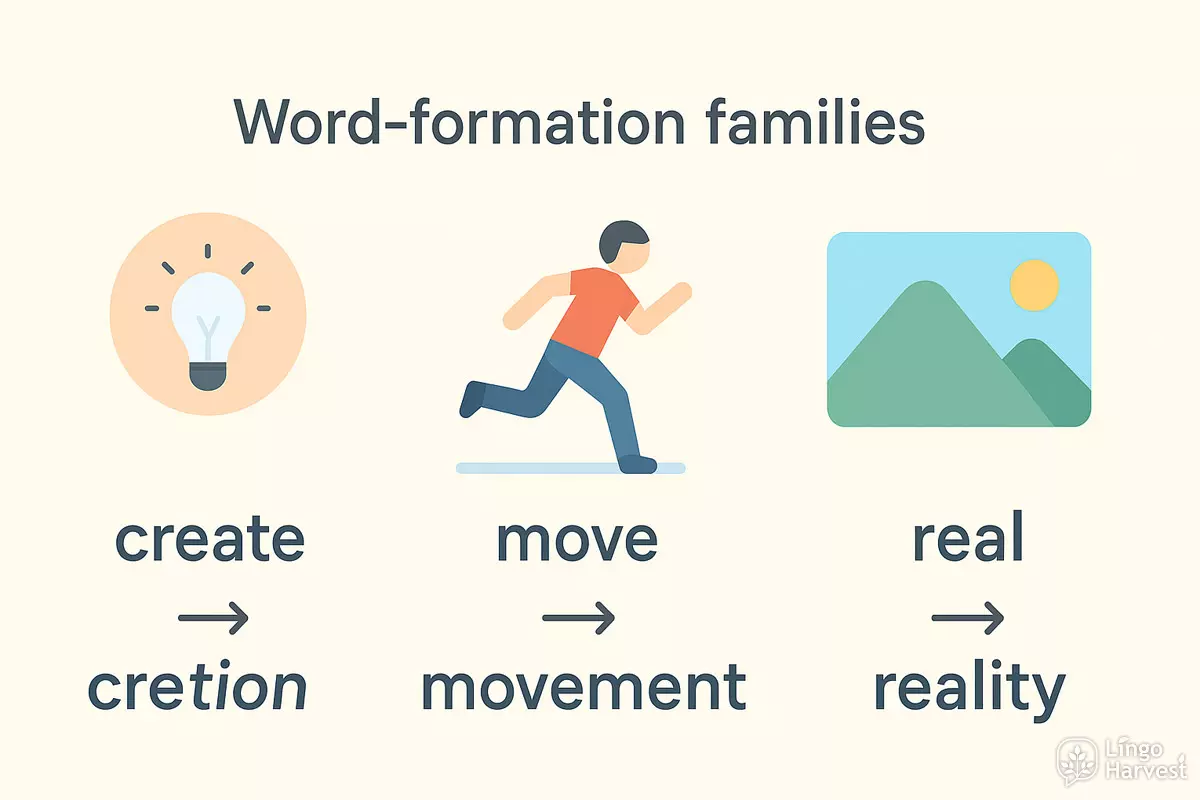
- create → creation
- move → movement
- real → reality
- dark → darkness
- educate → education
- improve → improvement
- curious → curiosity
- kind → kindness
- motivate → motivation
- arrange → arrangement
- possible → possibility
- sad → sadness
- relax → relaxation
- manage → management
- pure → purity
- weak → weakness
- decide → decision
- prepare → preparation
- establish → establishment
- communicate → communication
- describe → description
- flexible → flexibility
Comparing suffix usage
| Base Word | Suffix | Example Noun |
|---|---|---|
| inform | -tion | information |
| develop | -ment | development |
| active | -ity | activity |
| happy | -ness | happiness |
| motivate | -tion | motivation |
| arrange | -ment | arrangement |
| possible | -ity | possibility |
| dark | -ness | darkness |
By recognizing these groups and the ways endings are added, you can build vocabulary efficiently and spot connections between unfamiliar and known words. This approach is especially useful for reading academic or formal texts, where such word-building is frequent.
How -tion, -ment, -ity, and -ness create nouns from other forms
Suffixes like -tion, -ment, -ity, and -ness play a key role in English by turning verbs and adjectives into nouns. These endings help speakers express actions, states, qualities, or results by forming new words that fit neatly into different sentence roles.
Turning verbs into nouns
Adding certain endings to verbs allows us to talk about the action or result rather than the act itself. For example:
- inform → information
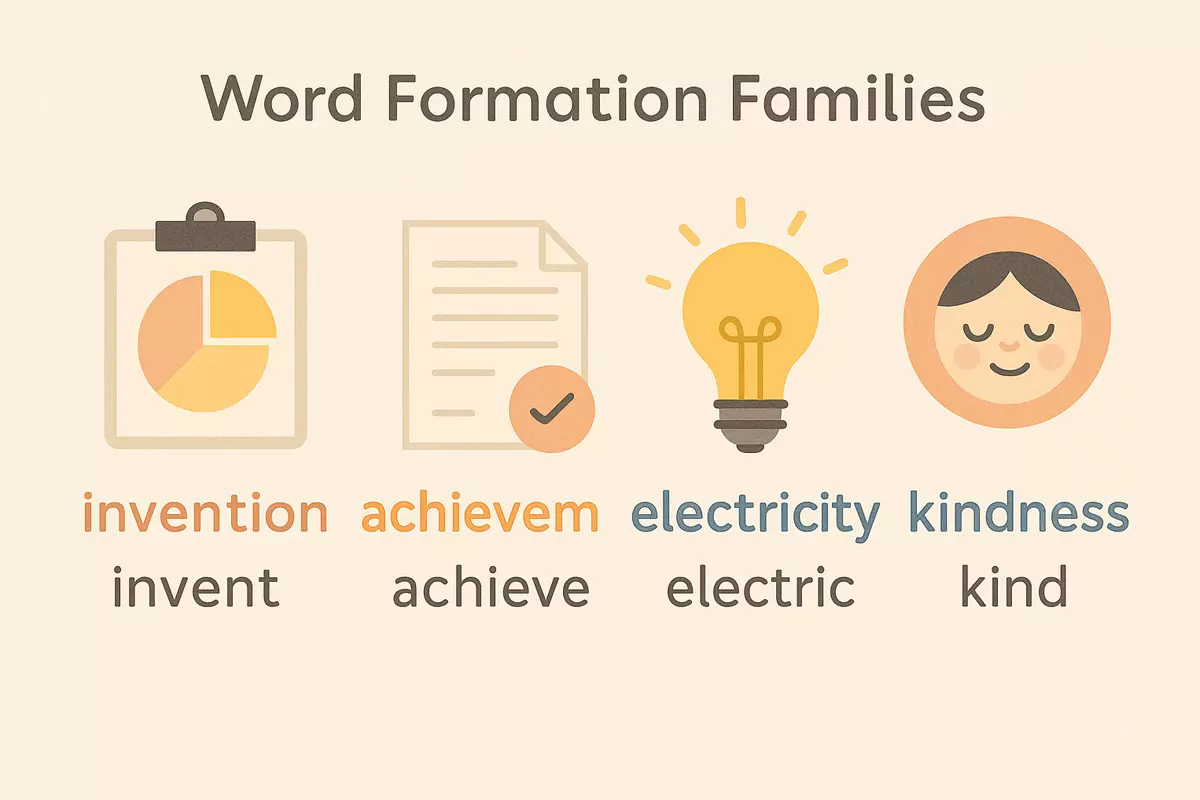
- achieve → achievement
- decide → decision
- move → movement
- create → creation
- develop → development
- invent → invention
- commit → commitment
The new noun forms allow us to refer to the process or outcome, e.g., “the invention changed history.”
Forming nouns from adjectives
Some endings, especially -ity and -ness, are used to create nouns that express qualities or states from adjectives:
- active → activity
- curious → curiosity
- happy → happiness
- dark → darkness
- able → ability
- certain → certainty
- kind → kindness
- honest → honesty
- complex → complexity
- weak → weakness
These transformations help describe characteristics, e.g., “Her kindness is appreciated.”
Comparing suffix uses
The four endings have their own preferred uses and typical source words. Here’s a comparison:
| Suffix | Usual Source Word | Example | Meaning in Noun |
|---|---|---|---|
| -tion | Verb | organization | Action or result of organizing |
| -ment | Verb | enjoyment | State or process of enjoying |
| -ity | Adjective | responsibility | Quality or state of being responsible |
| -ness | Adjective | sadness | State or quality of being sad |
Why these patterns matter
Understanding how these endings work helps you expand your vocabulary, express abstract ideas, and recognize word families more easily. By spotting these patterns, you can guess meanings, form new words, and notice relationships between different English terms.
Typical meaning patterns for each suffix
Understanding how each suffix contributes to word formation helps clarify why and how new nouns are created from verbs or adjectives. The suffixes -tion, -ment, -ity, and -ness all signal the creation of nouns, but each tends to attach to specific types of base words and carries subtle differences in meaning or usage.
-tion
The ending -tion is commonly used to form abstract nouns from verbs. It typically refers to the action or process of the verb, or sometimes the result. For example:
- inform → information
- create → creation
- communicate → communication
- educate → education
- relax → relaxation
- organize → organization
- invent → invention
- protect → protection
- describe → description
- act → action
Nouns ending in -tion often refer to activities, processes, or the outcome of an action.
-ment
The suffix -ment also forms nouns, usually from verbs, and often indicates the result, means, or product of an action. Examples include:
- develop → development
- move → movement
- encourage → encouragement
- achieve → achievement
- enjoy → enjoyment
- improve → improvement
- treat → treatment
- agree → agreement
- punish → punishment
- adjust → adjustment
While similar to -tion, -ment often emphasizes the state or result rather than the process itself.
-ity
Attaching -ity to adjectives forms nouns that denote a quality, state, or condition. These words are more abstract and often describe a characteristic:
- active → activity
- real → reality
- curious → curiosity
- possible → possibility
- equal → equality
- flexible → flexibility
- electric → electricity
- responsible → responsibility
- personal → personality
- complex → complexity
These nouns tend to highlight inherent features or abstract concepts.
-ness
-ness is typically added to adjectives to create nouns that express a particular quality or state. These words are often straightforward and concrete:
- happy → happiness
- dark → darkness
- kind → kindness
- weak → weakness
- sad → sadness
- ill → illness
- soft → softness
- polite → politeness
- lonely → loneliness
- mad → madness
Compared to -ity, -ness tends to be more productive with everyday adjectives and is often used for more tangible qualities.
| Suffix | Common Meaning | Typical Base Word | Example |
|---|---|---|---|
| -tion | Action, process, result | Verb | creation (create) |
| -ment | Result, means, state | Verb | achievement (achieve) |
| -ity | State, quality, condition | Adjective | curiosity (curious) |
| -ness | State, quality | Adjective | kindness (kind) |
By recognizing these patterns, you can often predict the meaning and grammatical category of new words formed with these endings. This knowledge is especially useful for expanding your vocabulary and understanding unfamiliar terms.
Common spelling changes when adding these endings
When forming nouns with suffixes like -tion, -ment, -ity, and -ness, some predictable spelling adjustments often occur. These changes help the new word fit English pronunciation and orthographic conventions. Let's look at typical patterns that come up when building these noun families.
Dropping Silent 'e'
Many verbs ending in a silent e lose this letter before certain suffixes. For example:
- create → creation
- invite → invitation
- divide → division
- refine → refinement
The e is usually dropped before -tion and -ment, but not always before -ness or -ity.
Consonant Doubling
If a word ends with a single vowel followed by a single consonant, the consonant is often doubled before adding -ness or -ment:
- sad → sadness
- fit → fitness
- commit → commitment
- equip → equipment
This doubling helps maintain the correct vowel sound.
Changing Final 'y' to 'i'
When a base word ends in y preceded by a consonant, the y typically changes to i before adding -ness or -ity:
- happy → happiness
- active → activity
- curious → curiosity
- ready → readiness
Vowel Changes and Irregular Forms
Some words undergo vowel shifts or more significant changes when taking these suffixes. For instance:
- permit → permission
- decide → decision
- compose → composition
- possess → possession
These are less predictable and often need to be memorized.
Comparison Table of Spelling Adjustments
| Base Word | With Suffix | Spelling Change |
|---|---|---|
| create | creation | Drop final 'e' |
| happy | happiness | 'y' → 'i' |
| permit | permission | Vowel change |
| fit | fitness | Double final consonant |
| active | activity | Silent 'e' dropped, 'y' added |
| compose | composition | Vowel change, drop 'e' |
Summary of Key Patterns
Paying attention to these spelling shifts makes it easier to recognize and form correct nouns from verbs or adjectives. Not every word follows the rules perfectly, but most fit into these categories. Noticing endings and their effects on root words will help you expand your vocabulary accurately.
Register notes: everyday vs academic vocabulary
When discussing words formed with -tion, -ment, -ity, and -ness, it's important to notice how some of these forms are common in daily conversation, while others are much more frequent in academic or formal writing. The suffixes themselves often signal the register: for example, -tion and -ity tend to sound more formal and are typical in scientific or scholarly contexts, whereas -ness and -ment often appear in both casual and professional speech.
Patterns of use in different contexts
Words with -tion and -ity frequently show up in textbooks, research articles, and official documents. In contrast, -ness and -ment derivatives are more likely to be used in stories, conversations, and everyday writing. Recognizing these tendencies helps you choose the right word for your audience.
Examples: informal vs. academic forms
- Happiness (everyday) vs. felicity (academic/literary)
- Movement (neutral) vs. locomotion (scientific)
- Weakness (casual) vs. fragility (formal/technical)
- Agreement (common) vs. ratification (legal/official)
- Kindness (friendly, general) vs. benevolence (formal, philosophical)
- Ability (neutral) vs. capability (business/technical)
- Excitement (casual) vs. stimulation (scientific/medical)
- Information (general) vs. data (technical, academic)
- Brightness (daily speech) vs. luminosity (science)
- Development (neutral) vs. evolution (academic/scientific)
- Darkness (everyday) vs. opacity (formal/scientific)
- Statement (common) vs. assertion (formal/argumentative)
- Friendliness (casual) vs. affability (literary/formal)
- Improvement (general) vs. amelioration (formal/academic)
- Sadness (everyday) vs. melancholy (literary/academic)
- Activity (neutral) vs. operation (technical/formal)
- Relation (neutral) vs. correlation (scientific/statistical)
- Management (business/general) vs. administration (formal, institutional)
- Clarity (neutral) vs. perspicuity (rare, academic)
- Politeness (everyday) vs. courtesy (formal)
Choosing the right word
Selecting between these noun forms often depends on your audience and purpose. In academic writing, choosing a more formal or technical term can add precision and authority. For daily communication, the simpler form may sound more natural and approachable. For example, "sadness" is likely to appear in a personal conversation, while "melancholy" may be reserved for literature or psychology essays.
Quick comparison: suffixes and register
| Suffix | Typical Register | Examples |
|---|---|---|
| -tion | Academic/Formal | nation, solution, adaptation |
| -ment | General/Everyday | enjoyment, improvement, statement |
| -ity | Academic/Technical | complexity, activity, sensitivity |
| -ness | Everyday/Neutral | kindness, darkness, weakness |
In summary, being aware of how these suffixes shape the tone and register of your words helps you communicate more effectively, whether you need to sound conversational or scholarly.
Building word lists from one base (develop → development, etc.)
Understanding how English words grow from a single root can make vocabulary study more efficient. Many nouns are formed by adding different suffixes like -tion, -ment, -ity, or -ness to a base word. Recognizing these patterns helps you quickly expand your word bank and see connections between related words.
Common Patterns for Expanding Word Families
Start with a simple verb or adjective, then add a suffix to create a related noun. For example, “develop” becomes “development”, and “create” turns into “creation”. This approach is especially useful for learners aiming to master academic or professional vocabulary. Here are some typical transformations:
Many English nouns are formed by adding common suffixes to verbs or adjectives, such as -tion, -ment, -ness, -ity, or -ation. Understanding these patterns helps learners expand vocabulary quickly and recognize relationships between words.
Comparing Suffixes and Their Effects
Some base words can combine with more than one suffix, forming multiple nouns with slightly different meanings or uses. Let’s look at a few examples in a structured way:
| Base Word | -tion | -ment | -ity | -ness |
|---|---|---|---|---|
| inform | information | ❌ | ❌ | ❌ |
| develop | ❌ | development | ❌ | ❌ |
| active | ❌ | ❌ | activity | ❌ |
| happy | ❌ | ❌ | ❌ | happiness |
| create | creation | ❌ | ❌ | ❌ |
| weak | ❌ | ❌ | ❌ | weakness |
| flexible | ❌ | ❌ | flexibility | ❌ |
| arrange | ❌ | arrangement | ❌ | ❌ |
This table shows how not every suffix works with every root. Some words accept only one, while others allow for more than one transformation. When practicing, pay attention to which suffixes are natural for each base.
Tips for Practicing Word Families
Focus on one root at a time and try to create as many correct forms as possible. This method builds both vocabulary and your understanding of English word formation. Watch for spelling changes, especially with -tion and -ity. Not every combination exists, so it’s helpful to check a reliable dictionary if unsure. By grouping related words, you make it easier to remember and use them in context, whether for writing, speaking, or comprehension.
Avoiding double forms and near synonyms in the same sentence
Writers and speakers often encounter confusion when using words from the same word family—especially those ending in -tion, -ment, -ity, or -ness—within a single sentence. These forms can be so similar in meaning that pairing them together sounds awkward or redundant. To communicate clearly, it’s important to choose just one noun form or synonym, unless you have a specific reason to include both.
Common pitfalls with double forms
It’s easy to accidentally double up on nouns that are derived from the same root or that serve a similar function. This often happens when writers aren’t sure which form is most appropriate, or when they try to sound formal by piling on abstract nouns.
- He showed great happiness and joy at the news. ❌ (repetitive)
- The development and formation of the plan took weeks. ❌
- We discussed the possibility and probability of rain. ❌
- Her decision and determination impressed everyone. ❌
- The clarity and clearness of the explanation helped. ❌
- Agreement and consensus were finally reached. ❌
- He admired her creativity and inventiveness. ❌
- The movement and motion of the train was smooth. ❌
- There was a difference and distinction between the two. ❌
- The complexity and complication of the task surprised us. ❌
How to avoid redundancy
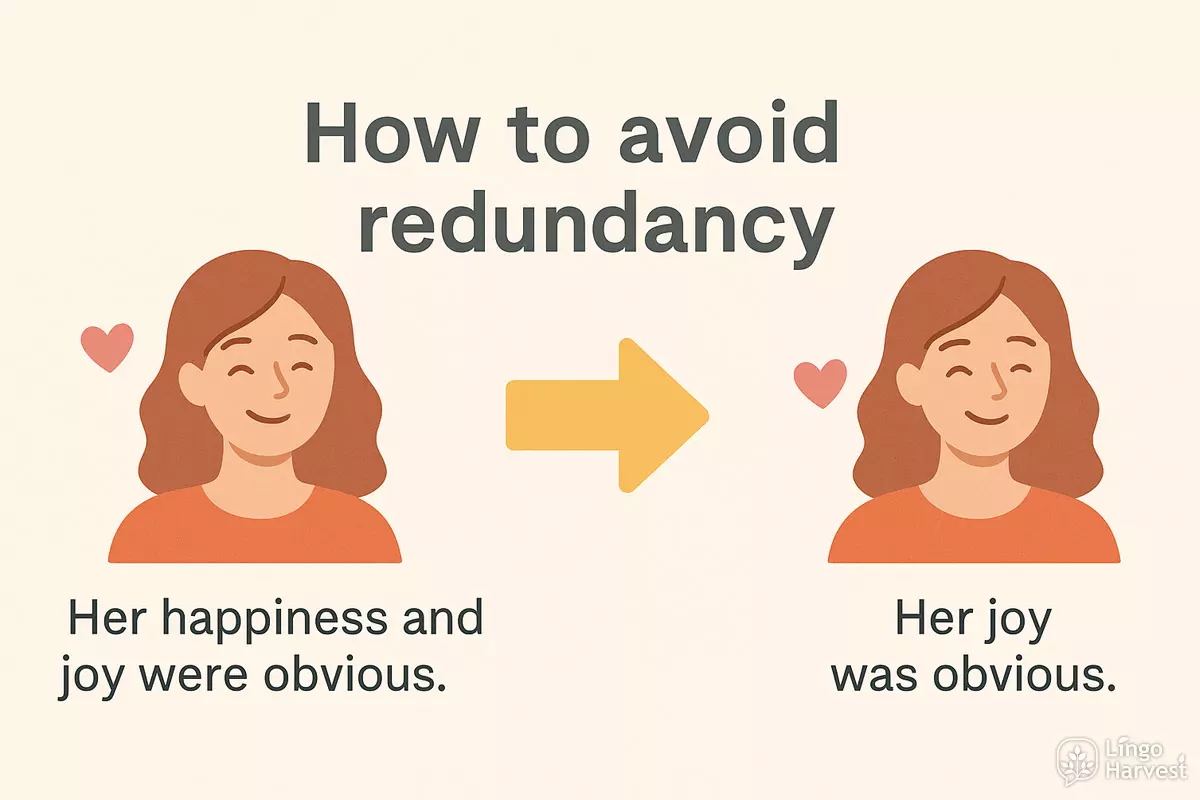
The simplest way to improve clarity is to select the most precise noun for your context. Instead of pairing similar forms, pick one that best expresses your meaning. If you need to refer to two separate concepts, make sure they are not just near synonyms.
| Weak / Redundant | Improved Version |
|---|---|
| Her happiness and joy were obvious. | Her joy was obvious. |
| The development and formation of habits takes time. | The development of habits takes time. |
| We discussed the possibility and probability of success. | We discussed the possibility of success. |
| Her decision and determination were clear. | Her determination was clear. |
| The clarity and clearness of the instructions helped. | The clarity of the instructions helped. |
| Agreement and consensus were reached. | Consensus was reached. |
| He admired her creativity and inventiveness. | He admired her creativity. |
| The movement and motion of the car was smooth. | The motion of the car was smooth. |
| There was a difference and distinction between them. | There was a distinction between them. |
| The complexity and complication surprised us. | The complexity surprised us. |
Tips for choosing the right form
- Check if both nouns add new information; if not, remove one.
- Use a dictionary to clarify subtle differences, especially with near synonyms.
- Favor the simpler or more common form for clarity.
- When in doubt, rewrite the sentence for conciseness.
Selecting the most accurate noun form from the -tion, -ment, -ity, or -ness families improves both style and precision. Avoiding unnecessary repetition keeps your writing direct and effective.
Practice: grow families from a set of base verbs and adjectives
Working with word formation helps you see how English vocabulary expands from a handful of roots. By adding suffixes like -tion, -ment, -ity, and -ness, new nouns are created from verbs and adjectives. This practice section will guide you in building such word families step by step.
Build noun families from base words
Start with these verbs and adjectives. For each, try to write the noun form(s) with the correct suffix. Some words can take more than one suffix; note all correct options.
- decide
- achieve
- move
- active
- happy
- inform
- dark
- curious
- develop
- create
- improve
- patient
- kind
- real
- weak
- agree
- certain
- manage
- possible
- sad
See how suffixes change word meaning
Below is a table showing how different suffixes attach to base words, forming nouns with slightly different nuances. Notice the patterns:
| Base Word | -tion | -ment | -ity / -ness |
|---|---|---|---|
| inform | information | — | — |
| develop | development | development | — |
| active | — | — | activity |
| kind | — | — | kindness |
| create | creation | — | creativity |
| happy | — | — | happiness |
| curious | — | — | curiosity |
| move | motion | movement | — |
| certain | certification | — | certainty |
| sad | — | — | sadness |
Try it yourself: word formation quiz
For each base word below, write the correct noun formed with -tion, -ment, -ity, or -ness.
- achieve
- dark
- improve
- possible
- patient
Show answers
- achievement
- darkness
- improvement
- possibility
- patience
Notice how each suffix creates a slightly different meaning and use. By practicing these transformations, you gain a deeper understanding of English word formation and can expand your vocabulary more confidently.