Appositive Nouns in English for Clear and Precise Meaning

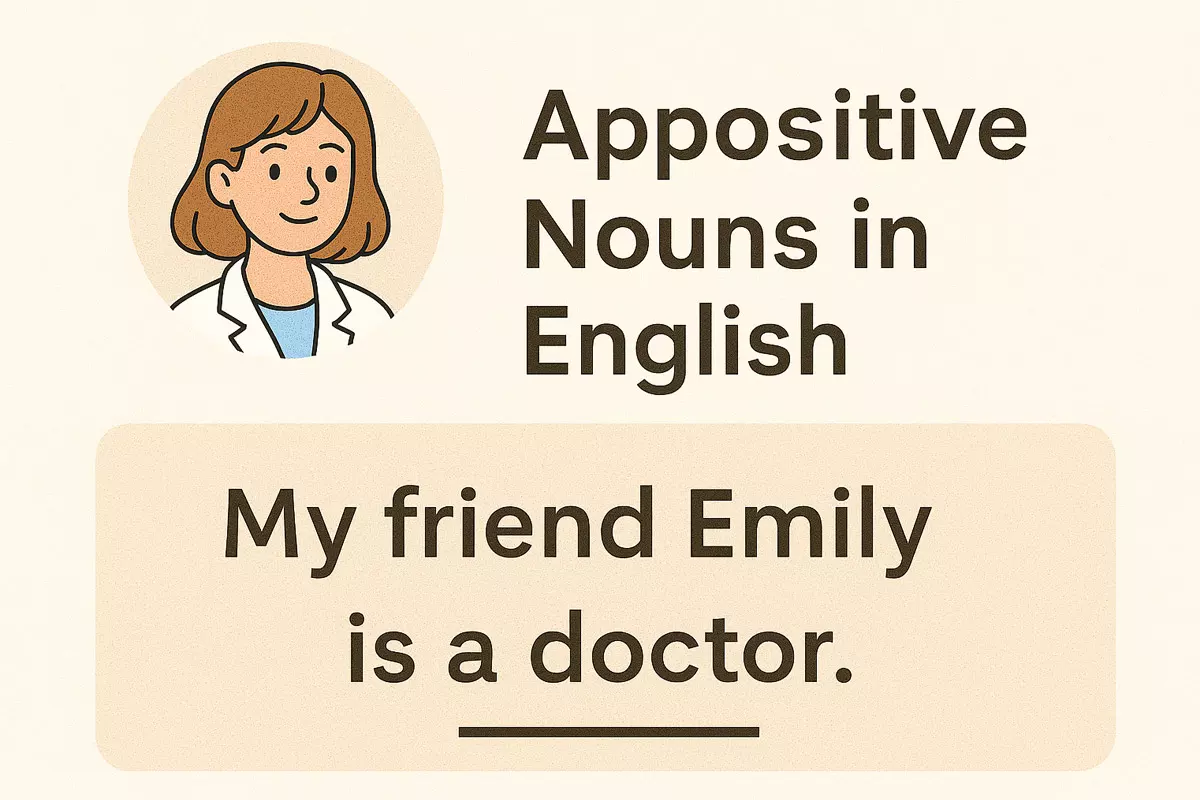 Here we what appositive nouns are, their purpose, and how to distinguish restrictive from non-restrictive appositives. It explains punctuation rules, common comma mistakes, differences in writing and speech, and offers practice with rewriting sentences.
- What appositive nouns are and why they are used
- Identifying restrictive and non-restrictive appositives
- Punctuation rules for appositive noun structures
- Using appositives to add clarity and extra information
- Appositive nouns in written vs spoken English
- Common mistakes with comma usage in appositives
- Practice: rewrite sentences using correct appositive nouns
Enhancing your sentences with descriptive noun phrases placed directly beside the words they clarify can significantly improve both the specificity and readability of your writing. This technique allows you to convey your ideas with greater clarity, ensuring that readers easily understand your intended meaning. By carefully choosing and positioning these phrases, you provide essential details without overcomplicating your sentences, making your communication more effective and engaging for your audience.
What appositive nouns are and why they are used
Appositive nouns are words or phrases placed next to another noun to help explain, identify, or give extra information about it. Instead of repeating details or using long, complex sentences, writers and speakers often use appositives to make their meaning clearer and more concise. For example, in the sentence “My friend Sarah is visiting,” the word “Sarah” is an appositive that explains who “my friend” is.
Why English uses appositive nouns
Adding an appositive lets you clarify who or what you are talking about, avoid repetition, and add detail without awkwardness. This technique is common in both written and spoken English, especially when you want to specify, rename, or give more context about a person, place, or thing.
- Clarity: Appositives prevent confusion by specifying exactly which noun you mean.
- Efficiency: They combine two pieces of information into one smooth sentence.
- Detail: Appositives let you add extra facts or descriptors without starting a new sentence.
- Variety: Using appositives keeps your writing from sounding repetitive or choppy.
Types of appositive nouns
Appositives can be a single word, a phrase, or even a longer description. They may be essential (restrictive) or nonessential (non-restrictive). Essential appositives are needed to identify the noun, while nonessential ones just add extra detail.
Common patterns and examples
Writers use this structure in many everyday situations. Here are some patterns and expanded examples:
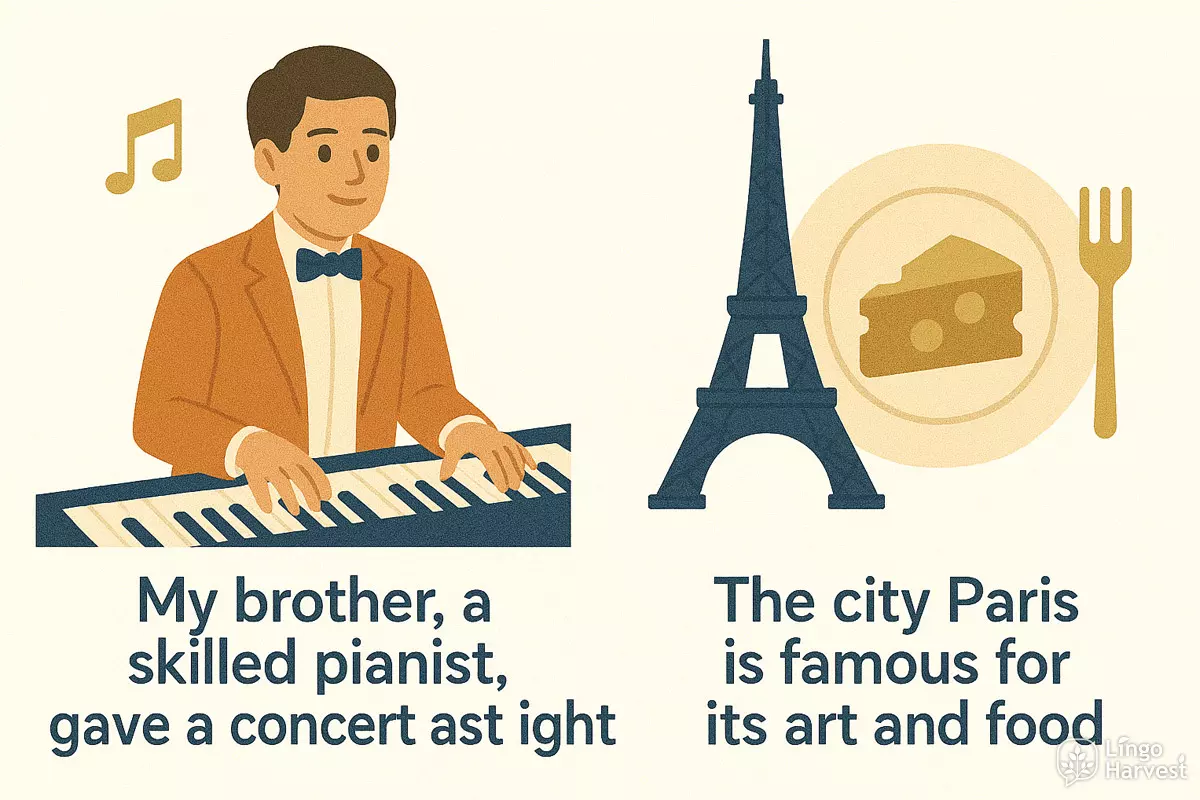
- My brother, a skilled pianist, gave a concert last night.
- The city Paris is famous for its art and food.
- Her dog Max loves to chase squirrels.
- Our teacher, Mrs. Ruiz, assigns creative projects.
- The book To Kill a Mockingbird is a classic.
- My best friend, an avid reader, always has a book in hand.
- Shakespeare’s play Hamlet explores deep themes.
- The mountain Everest attracts climbers worldwide.
- My uncle John is visiting from Canada.
- The dessert tiramisu is my favorite.
- Her car, a red convertible, is parked outside.
- The movie Inception challenges viewers’ minds.
- Our neighbor, a retired firefighter, tells fascinating stories.
- The river Amazon flows through South America.
- His invention, a solar-powered charger, won an award.
- My cousin Lily is learning French.
- The painting Starry Night hangs in the museum.
- The scientist Marie Curie pioneered research in radioactivity.
Appositive nouns help English speakers and writers share information more precisely and naturally. By mastering this structure, you can express ideas with greater clarity and style.
Identifying restrictive and non-restrictive appositives
Understanding the difference between restrictive and non-restrictive appositives helps you convey meaning clearly and avoid confusion. Both types add information about a noun, but they function differently in sentences and affect punctuation choices.
Restrictive appositives: essential information
A restrictive appositive provides crucial details that define or limit the noun it follows. If you remove it, the sentence loses its intended meaning or becomes ambiguous. These appositives are not set off by commas. For example:
- My friend Alice is visiting tomorrow. (I have several friends; Alice specifies which one.)
- The poet Emily Dickinson wrote many famous poems.
- Author George Orwell warned about surveillance.
- My cousin the doctor lives in Seattle.
- The city Paris is known for its art and culture.
- The novel 1984 is a classic.
- Teacher Mr. Lee assigns interesting projects.
- The river Amazon flows through South America.
- Scientist Marie Curie won two Nobel Prizes.
- Composer Beethoven created symphonies.
Non-restrictive appositives: extra details
Non-restrictive appositives offer additional, but not essential, information about a noun already clearly identified. They are set off by commas. Removing them leaves the main meaning unchanged. Here are some examples:
- My brother, an excellent cook, made dinner. (I have only one brother; "an excellent cook" is extra information.)
- London, the capital of England, attracts tourists from around the world.
- Our car, a red sedan, needs new tires.
- My dog, Max, loves to play fetch.
- Ms. Brown, our history teacher, is retiring.
- The book, a bestseller, was recommended to me.
- My laptop, a recent model, is very fast.
- My sister, the youngest in our family, graduated last year.
- The restaurant, a local favorite, is always busy.
- The painting, a masterpiece, hangs in the museum.
Comparing restrictive and non-restrictive forms
The distinction between these two types of appositive nouns often comes down to punctuation and the necessity of the information. Here is a side-by-side comparison to clarify:
| Restrictive Appositive (No commas, essential info) |
Non-restrictive Appositive (Commas, extra info) |
|---|---|
| My friend Sarah loves music. ('Sarah' tells which friend) |
My friend, Sarah, loves music. ('Sarah' is extra detail) |
| The artist Picasso was Spanish. | Picasso, a famous artist, was Spanish. |
| The movie Inception is complex. | Inception, a popular movie, is complex. |
| Teacher Ms. Smith assigns homework. | Ms. Smith, our math teacher, assigns homework. |
In summary, paying attention to whether an appositive is essential or additional—and punctuating accordingly—ensures your writing is both precise and easy to follow.
Punctuation rules for appositive noun structures
Understanding how to punctuate appositive phrases is essential for clarity in writing. The placement of commas, dashes, or parentheses depends on whether the appositive is essential (restrictive) or non-essential (non-restrictive) to the meaning of the sentence.
Commas and Non-Essential Appositives
When the appositive provides extra information that can be removed without changing the core meaning, it is non-essential. In these cases, commas are used to set off the appositive from the rest of the sentence. For example:
- My friend, an excellent pianist, will perform tonight.
- The capital of France, Paris, is known for its art and culture.
Commas before and after the phrase signal to the reader that this information is additional, not crucial.
No Commas with Essential Appositives
If the appositive is essential, meaning it identifies the noun more specifically and cannot be omitted, no commas are used. For example:
- The author George Orwell wrote "1984".
- My cousin Sarah is visiting next week.
Leaving out commas here keeps the meaning precise, as the appositive is needed to clarify which person or thing is meant.
Dashes and Parentheses for Emphasis or Side Notes
Dashes or parentheses can replace commas if you want to add emphasis or create a side note:
- His first car—a rusty old sedan—barely made it up the hill.
- The CEO (a former engineer) announced the new project.
Dashes draw attention, while parentheses make the appositive feel like an aside.
Common Patterns and Examples
Here are more appositive examples with correct punctuation:
- My brother, a skilled chef, loves to experiment in the kitchen.
- The book “To Kill a Mockingbird” is a classic.
- Our dog, Max, barks at strangers.
- The river Amazon flows through several countries.
- Her favorite movie—Inception—is a mind-bender.
- Jane Austen, the famous novelist, wrote “Pride and Prejudice.”
- The city Tokyo is known for its technology.
- His mentor (a retired professor) guided him throughout college.
- Our teacher, Mrs. Lee, assigns creative projects.
- The planet Mars fascinates scientists.
Quick Reference: Punctuation Choices
| Type of Appositive | Punctuation Used | Example |
|---|---|---|
| Non-Essential (Non-Restrictive) | Commas | My sister, a talented artist, painted this. |
| Essential (Restrictive) | No punctuation | The poet Emily Dickinson is famous for her style. |
| Emphasis or Side Note | Dashes or Parentheses | Our guide—a local historian—explained the ruins. The recipe (a family secret) was delicious. |
Focusing on these patterns helps writers ensure their meaning is clear and accurate. The right punctuation signals to readers what information is central and what is simply extra detail.
Using appositives to add clarity and extra information
Appositives are a powerful tool in English for making sentences more precise and informative. By providing extra details about a noun, they help readers or listeners understand exactly what is meant. This is especially useful when a single word might be too vague or when introducing new or unfamiliar concepts.
How appositives clarify meaning
When you add an appositive, you give your audience more context. For instance, consider the difference between "My friend is visiting" and "My friend, a talented musician, is visiting." The second sentence immediately tells us something special about your friend, making the statement more specific.
Types of information appositives can add
- Identification: Names or titles that specify exactly who or what is meant.
- Description: Details that paint a clearer picture of the noun.
- Explanation: Clarifying terms, roles, or relationships.
- Examples: Listing instances that fit the noun.
- Synonyms or rephrasings: Restating a noun in different words for emphasis or clarity.
Common patterns and examples
Appositives can be placed after the noun they describe and are often set off by commas. Below are common patterns and sample sentences:
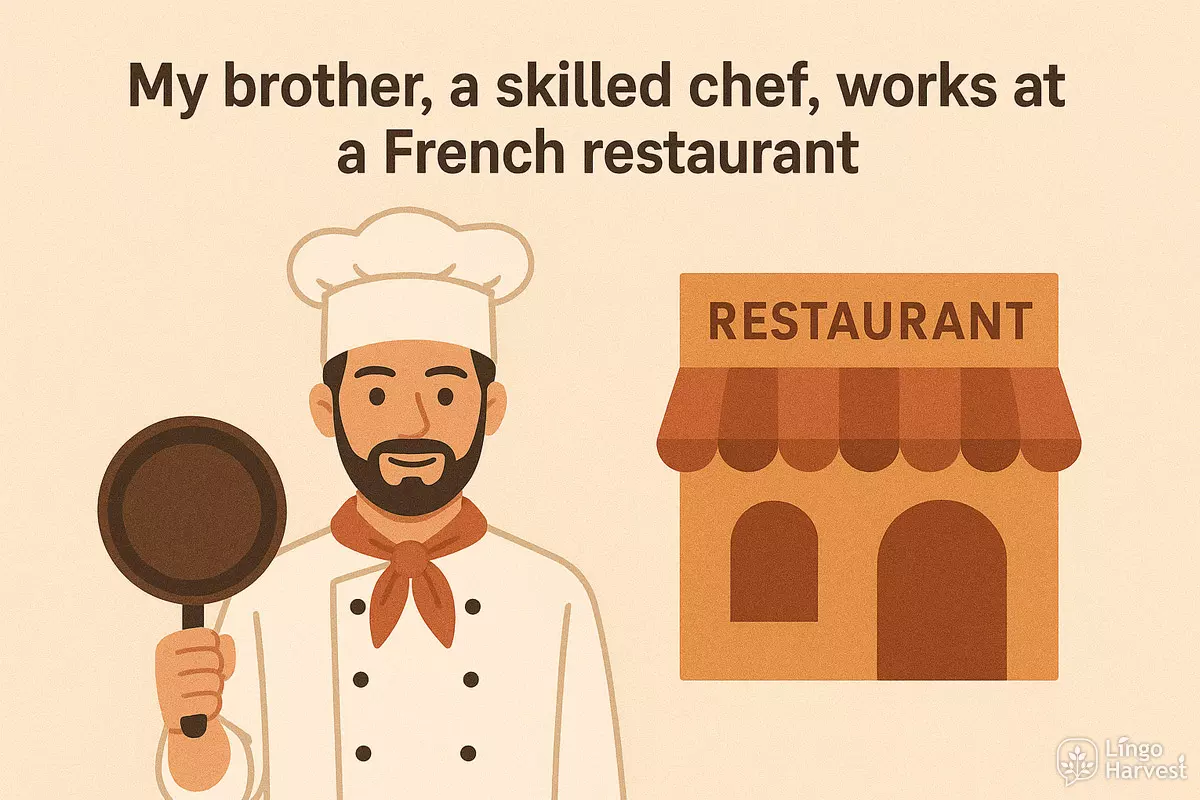
- My brother, a skilled chef, works at a French restaurant.
- The capital of France, Paris, is famous for its art and cuisine.
- Our teacher, Ms. Johnson, loves literature.
- That building, an old library, will be renovated soon.
- His dog, a golden retriever, is very friendly.
- The movie, a thrilling adventure, kept us on the edge of our seats.
- My favorite book, 1984, explores dystopian themes.
- The author, George Orwell, wrote several classics.
- My cousin, an engineer, lives in Canada.
- The holiday, Thanksgiving, is celebrated in November.
- Our neighbor, Mr. Lee, grows beautiful roses.
- The team captain, Sarah, inspired everyone.
- The dessert, a chocolate cake, was delicious.
- My laptop, a gift from my parents, is very reliable.
- The city, known for its jazz music, attracts many tourists.
Restrictive vs. non-restrictive appositives
Appositives can be either essential (restrictive) or extra (non-restrictive) information. Non-restrictive appositives are set off by commas and can be omitted without changing the basic meaning. Restrictive ones are not separated by commas and are necessary to identify the noun.
| Type | Example | Can be omitted? |
|---|---|---|
| Non-restrictive | My sister, a doctor, moved to London. | ✅ Yes |
| Restrictive | The poet Emily Dickinson wrote many short poems. | ❌ No |
| Non-restrictive | The car, a red convertible, is expensive. | ✅ Yes |
| Restrictive | The city New York never sleeps. | ❌ No |
Using appositives thoughtfully can make your writing clearer and more engaging, allowing you to share extra details without creating long, complex sentences. Whether you are identifying, describing, or explaining, these structures support effective communication in both spoken and written English.
Appositive nouns in written vs spoken English
How appositives appear and function can differ quite a bit between writing and everyday conversation. In texts or formal documents, appositive phrases are usually more carefully constructed, often set off with commas or dashes to clarify and add detail. In contrast, when people speak, they tend to use shorter or even incomplete appositives, relying on voice inflection and pauses instead of punctuation to signal extra information.
Written English: Structure and Clarity
Writers use appositives to provide precise, concise details, usually to avoid ambiguity. These phrases are typically inserted with clear punctuation, making the relationship between nouns unmistakable. For example: My friend, a talented musician, will perform tonight. Here, the phrase a talented musician gives extra information about my friend, and the commas show it’s non-essential.
- Often appear in academic, journalistic, or formal writing
- Use commas, dashes, or parentheses for separation
- Can be more complex or extended, sometimes containing additional modifiers
- Help clarify which person or thing is being discussed
- Example: The capital of France, Paris, is known for its art and cuisine.
Spoken English: Simplicity and Intuition
In conversation, speakers tend to use simpler appositive structures, sometimes omitting punctuation-equivalent pauses entirely. Intonation and rhythm do much of the work. It’s common to hear brief clarifications or identifiers, such as My brother John is coming (no pause) or This is Sarah, my neighbor (slight pause).
- Usually shorter; often just a name or title
- Relies on natural pauses, not punctuation
- Listeners infer meaning from context and tone
- May skip non-essential details for speed
- Example: I saw Mike, the chef, at the store. (with a slight pause)
Key Differences: A Side-by-Side Comparison
| Aspect | Written English | Spoken English |
|---|---|---|
| Formality | More formal; precise construction | Casual; may be incomplete |
| Punctuation/Pausing | Uses commas, dashes, or parentheses | Uses pauses, intonation, or stress |
| Complexity | Can be extended or nested | Usually brief and direct |
| Examples | “Marie Curie, the Nobel Prize winner, discovered radium.” | “This is Marie Curie—she discovered radium.” (spoken pause) |
Common Patterns and Examples
Here are some typical ways appositives show up in both forms:
- Names: My cousin Emily
- Jobs: Dr. Smith, our dentist
- Titles: Hamlet, Shakespeare’s play
- Locations: London, the capital of England
- Roles: Anna, team leader
- Relationships: My sister, a nurse
- Identifications: The insect, a butterfly
- Clarifications: The planet Mars
- Nicknames: Paul “The Rock” Johnson
- Descriptive phrases: The old house, a relic from the 1800s
- Objects: The car, a red convertible
- Events: The festival, an annual celebration
In sum, knowing how appositive nouns function in both writing and speech helps you adjust your style for clarity and precision, whether you’re crafting a formal essay or chatting with a friend.
Common mistakes with comma usage in appositives
Misusing commas around appositive nouns is a frequent source of confusion for English learners and even native speakers. The placement of commas can change the meaning of a sentence, or make it sound awkward. Understanding when to use or omit commas is key for clear communication.
Restrictive vs. non-restrictive appositives
One of the most common pitfalls is not distinguishing between restrictive (essential) and non-restrictive (non-essential) appositives. A restrictive appositive provides information vital to identifying the noun, so it is not set off by commas. In contrast, a non-restrictive appositive adds extra detail and is separated by commas.
- Incorrect: My friend, Sarah likes sushi. (Implies you have only one friend.)
- Correct: My friend Sarah likes sushi. (You have multiple friends; Sarah is specified.)
- Incorrect: The author Mark Twain, wrote many novels. (Comma is unnecessary.)
- Correct: The author Mark Twain wrote many novels.
Overusing commas with short or single-word appositives
Another mistake is adding commas around brief or single-word appositives, which can interrupt the sentence flow unnecessarily.
- Incorrect: My dog, Max, loves to run.
- Correct: My dog Max loves to run.
Forgetting commas with non-essential appositives
When an appositive is not essential to the meaning of the sentence, it should be set off with commas. Omitting them can confuse readers or obscure the intended nuance.
- Incorrect: My brother a talented musician will perform tonight.
- Correct: My brother, a talented musician, will perform tonight.
- Incorrect: Paris the capital of France is beautiful in spring.
- Correct: Paris, the capital of France, is beautiful in spring.
Comparing correct and incorrect usage
| Example | Explanation |
|---|---|
| My sister Emily is a doctor. | Restrictive appositive; no commas needed because "Emily" specifies which sister. |
| Emily, my sister, is a doctor. | Non-restrictive appositive; commas indicate "my sister" is extra information. |
| The novelist Jane Austen wrote Pride and Prejudice. | "Jane Austen" identifies which novelist; no commas used. |
| Jane Austen, the novelist, wrote Pride and Prejudice. | "The novelist" is additional detail; set off with commas. |
Other typical pitfalls to avoid
- Adding unnecessary commas before or after essential names or titles.
- Leaving out commas in long sentences with multiple appositives.
- Using commas inconsistently in a series of appositives.
- Confusing parenthetical phrases with appositive structures.
- Misplacing commas when the appositive is at the end or beginning of a sentence.
- Forgetting that appositives can be phrases, not just single words.
- Failing to check for clarity when omitting or adding commas.
- Assuming all names or titles require commas regardless of context.
Mastering the use of commas with appositive nouns leads to sentences that are both precise and easy to understand. By watching out for these frequent errors, you can improve both your writing and your reader’s comprehension.
Practice: rewrite sentences using correct appositive nouns
Understanding how to use appositive nouns can greatly improve clarity and detail in your writing. This practice section will help you identify and correctly insert appositives into sentences, making your statements more precise and informative. Review the examples and try the exercises to test your skills.
Examples: Adding Appositive Nouns for Clarity
- My friend Sarah loves to paint. → My friend, Sarah, loves to paint.
- The city Paris is famous for its art. → The city Paris is famous for its art.
- My pet a golden retriever is very playful. → My pet, a golden retriever, is very playful.
- Our teacher Mr. Lee gave us extra homework. → Our teacher, Mr. Lee, gave us extra homework.
- The author Agatha Christie wrote many mysteries. → The author Agatha Christie wrote many mysteries.
- Her brother an engineer works in Germany. → Her brother, an engineer, works in Germany.
- The mountain Everest is the tallest in the world. → The mountain Everest is the tallest in the world.
- My car a red sedan needs repairs. → My car, a red sedan, needs repairs.
- The movie Inception was mind-bending. → The movie Inception was mind-bending.
- Her favorite singer Beyoncé released a new album. → Her favorite singer, Beyoncé, released a new album.
- The planet Mars may support life. → The planet Mars may support life.
- His father a doctor works at the local hospital. → His father, a doctor, works at the local hospital.
Rewrite the Sentences
Rewrite each sentence to include a correct appositive noun for clarity. Place commas correctly when the appositive is nonessential.
- My cousin is visiting from Canada.
- The painting was created by Van Gogh.
- We visited the museum yesterday.
- His friend is a talented musician.
- Our neighbor gave us fresh vegetables.
- The book was written in the 19th century.
- Her brother works as an engineer.
- The city attracts millions of tourists.
- The movie won several awards.
- Our teacher explained the rule clearly.
Show answers
- My cousin, Emily, is visiting from Canada.
- The painting was created by Van Gogh, a Dutch artist.
- We visited the museum, the Louvre, yesterday.
- His friend, a talented musician, played the piano.
- Our neighbor, Mr. Brown, gave us fresh vegetables.
- The book, a famous novel, was written in the 19th century.
- Her brother, an engineer, works abroad.
- The city, a popular tourist destination, attracts millions.
- The movie, a historical drama, won several awards.
- Our teacher, Mrs. Lee, explained the rule clearly.
Tips for Using Appositive Nouns
- Use commas around nonessential appositives. For example: My brother, John, is a lawyer.
- Do not use commas if the appositive is essential to the meaning. For example: The poet Shakespeare wrote many plays.
- Appositives can be single words, phrases, or even clauses.
- Position the appositive immediately after the noun it identifies or explains.