Noun Phrases in Spoken English for Natural Communication

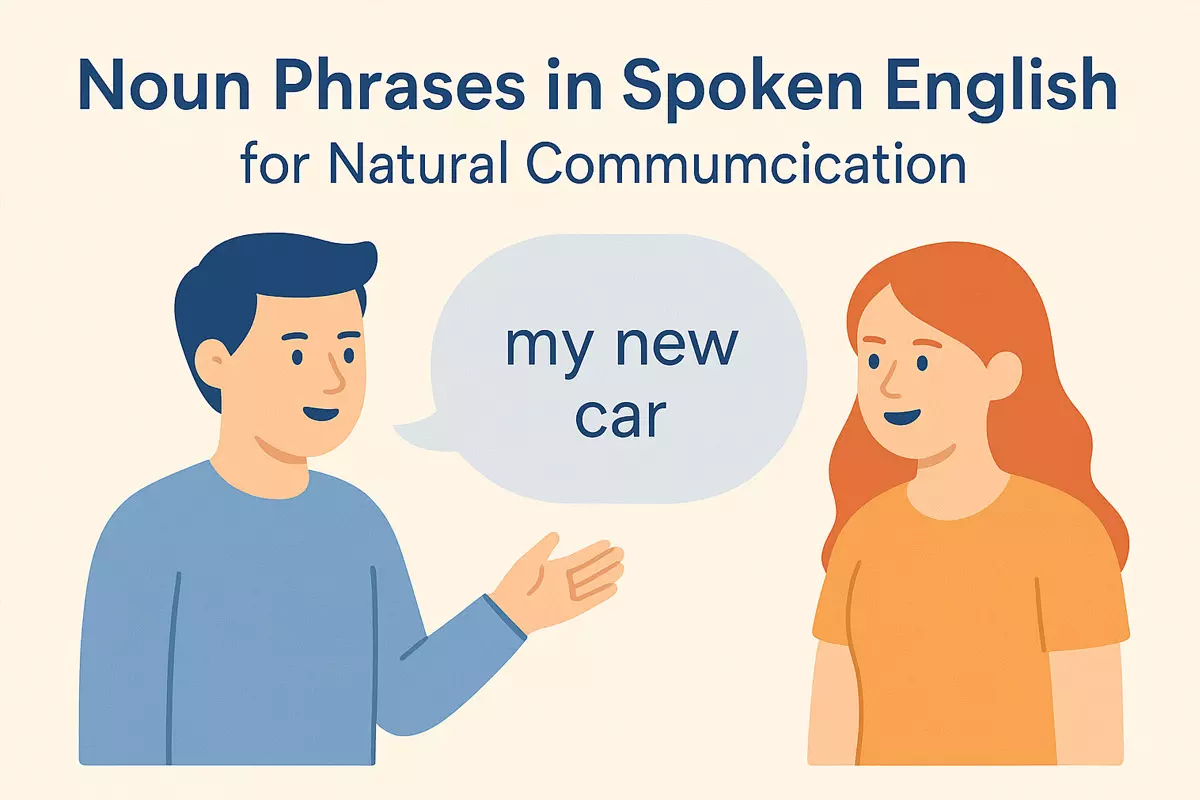 Here we how noun phrases in spoken English differ from written forms. It covers shortened and vague noun phrases, intonation with long phrases, errors learners make, and offers practice through role-play for natural conversation.
- How noun phrases differ in speech and in writing
- Shortened noun phrases in daily conversation
- Use of vague noun phrases in spoken English
- Intonation patterns with long noun phrases in speech
- Spoken noun phrases in requests and explanations
- Common learner errors in spoken noun phrase construction
- Practice: role-play using natural spoken noun phrases
Everyday conversations depend on groups of words that work together to identify people, places, or things, which helps make our speech both clear and efficient. Recognizing how these word combinations function in spoken English is important for communicating smoothly and naturally. By understanding and using these clusters, speakers can express their ideas more precisely and avoid confusion, leading to better interactions in daily life. This awareness not only improves fluency but also helps build confidence in using English in a variety of situations.
How noun phrases differ in speech and in writing
When speaking, people often use shorter, less complex noun groups than they do in formal texts. Spoken English tends to favor simpler structures, often omitting unnecessary details or using pronouns instead of full noun phrases. In contrast, written language—especially academic or professional writing—relies on more elaborate and information-packed noun groups to convey precise meaning.
Typical Features in Spoken vs. Written Noun Phrases
- Spoken: Shorter, may lack modifiers (“my friend” vs. “my closest childhood friend from school”).
- Written: More modifiers and qualifiers (“the innovative urban transportation initiative” instead of “the project”).
- Speech often uses repetition or vague references (“that thing,” “this guy”) for efficiency.
- Writers typically avoid ambiguity by specifying details.
- Spoken forms frequently use pronouns or ellipsis (“Want some?” instead of “Do you want some of the cake?”).
- Written forms use full noun phrases for clarity, especially in complex ideas.
- Spoken noun phrases are sometimes interrupted or revised mid-sentence as speakers think aloud.
- Writers have time to plan and revise, so written noun phrases tend to be more cohesive and complete.
Common Examples of Noun Phrase Variation
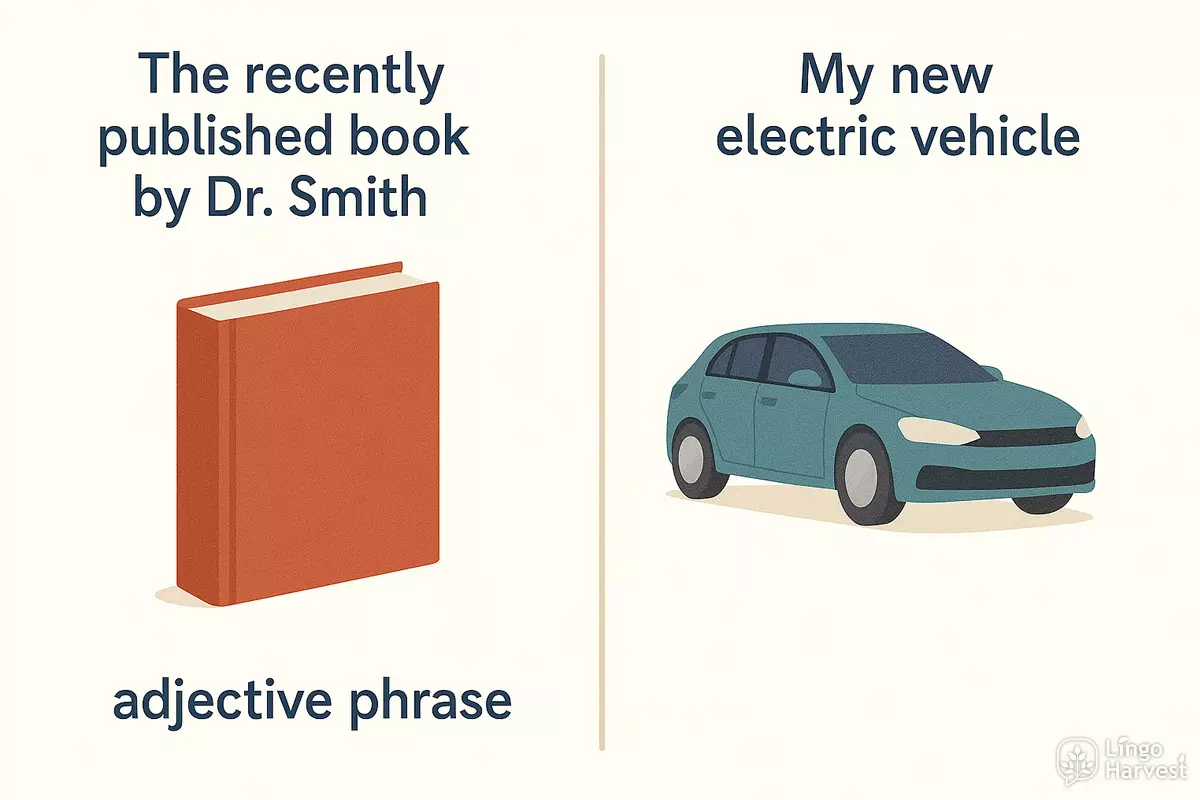
- “That book” → “The recently published book by Dr. Smith”
- “My car” → “My new electric vehicle”
- “His friend” → “His longtime business associate from college”
- “Some people” → “Several local community members concerned about safety”
- “A problem” → “A significant logistical problem affecting the event schedule”
- “Those kids” → “The children participating in the after-school program”
- “This place” → “This historic landmark in downtown Boston”
- “The meeting” → “The annual shareholders’ meeting for the corporation”
- “Our boss” → “Our department manager, Ms. Lee”
- “That thing” → “The technical device required for the presentation”
Contrast Table: Spoken vs. Written Noun Phrases
| Spoken English Example | Written English Example |
|---|---|
| “She called.” | “The project manager contacted the team.” |
| “This guy I know” | “An acquaintance of mine who works in finance” |
| “That thing over there” | “The equipment located in the storage area” |
| “My old school” | “The secondary school I attended as a teenager” |
| “Some people think…” | “Several researchers suggest that…” |
Why These Differences Matter
Understanding how noun groups shift between speech and writing helps learners choose the right level of detail and formality for the context. In conversation, brevity and clarity are key, while in writing, specificity and detail often take priority. Adapting noun phrase complexity improves both comprehension and naturalness in communication.
Shortened noun phrases in daily conversation
Spoken English often favors brevity, leading speakers to drop or reduce parts of noun groups. This natural tendency makes sentences more efficient and less formal, especially in casual interactions. Instead of using full, detailed noun phrases, people frequently rely on context to fill in missing information.
Why do speakers shorten noun phrases?
Cutting down noun groups helps maintain conversational flow. Context, shared knowledge, and visual cues allow listeners to understand what is meant, even when words are omitted. For example, in a café, "One coffee, please," is understood as "I would like one cup of coffee, please," because the setting makes it clear.
Common patterns and examples
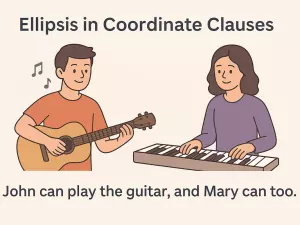
Ellipsis and reduction happen in many everyday scenarios. Here are typical ways noun phrases get shortened:
- Omitting determiners: "Need help?" instead of "Do you need help?"
- Leaving out adjectives or modifiers: "Got milk?" instead of "Have you got any milk?"
- Dropping head nouns when understood: "I'll take the red (shirt)"
- Using pronouns for repetition: "I'll have that one."
- Contextual shorthand: "More sugar?"
- Leaving out objects: "Want some?" (implied: food, drink, etc.)
- Abbreviating lists: "Keys, phone, wallet?"
- Single-word responses: "Coffee?" or "Window?"
- Reduced requests: "Another round?" (in a bar, for drinks)
- Omitting possessives: "Your turn."
- Using adjectives alone: "Something cold?" (implied: to drink)
- Leaving out verbs: "Questions?"
- Using fragments: "The usual?"
- Implied subjects: "Coming?"
- Minimal offers: "Change?" (when offering coins)
- Single-item references: "Umbrella?" (implying, 'Do you have one?')
- Short instructions: "Inside voices!" (to mean 'Use inside voices!')
- Abbreviated directions: "Left or right?"
- Descriptive fragments: "Big or small?"
- Omitting repeated information: "I’ll have the chicken. And you, the beef?"
Comparing full and reduced forms
Notice how spoken language trims extra words while still making sense. The table below compares expanded and shortened versions:
| Full Form | Reduced in Conversation |
|---|---|
| Could I have a glass of water? | Water? |
| Would you like another cup of coffee? | Another coffee? |
| Do you want to open the window? | Window? |
| Is this your umbrella? | Umbrella? |
| Shall we order dessert now? | Dessert? |
| Do you need any help with that? | Help? |
| Would you like something cold to drink? | Something cold? |
| Can I get you anything else? | Anything else? |
When to use shortened forms
These reductions are most natural in informal, spoken settings where context is shared. They're less common in formal writing or situations where clarity is crucial. Adjusting how much you shorten noun groups depends on your relationship with the listener and the environment. Using these concise forms helps your speech sound more fluent and authentic in everyday English.
Use of vague noun phrases in spoken English
Everyday conversation often depends on noun phrases that are intentionally non-specific. These vague expressions help speakers stay informal, avoid repetition, and keep the interaction flexible. Instead of providing exact details, people frequently use general terms when the specifics are unnecessary, unknown, or irrelevant to the point being made.
Why speakers choose vague noun phrases
Speakers use these expressions for several reasons:
- To save time or mental effort when details aren't important
- To refer to things in a general or collective way
- To soften directness, especially in sensitive situations
- To signal shared knowledge or familiarity
- When exact information is unavailable or forgotten
Common vague noun phrase patterns
Some phrases appear regularly in casual talk. These constructions allow speakers to be imprecise without causing confusion. Here are some widely used examples:
- things like that → We talked about work, travel, and things like that.
- that sort of thing → I am not interested in gossip or that sort of thing.
- stuff → I left my stuff at home.
- something or other → He was complaining about something or other.
- one of those things → Making mistakes is one of those things you learn from.
- a bunch of people → A bunch of people were waiting outside.
- a couple of things → I need to ask you a couple of things.
- some kind of problem → There seems to be some kind of problem.
- all that jazz → We discussed deadlines, budgets, and all that jazz.
- whatnot → He collects old coins, stamps, and whatnot.
- bits and pieces → I found bits and pieces of information online.
- this and that → We talked about this and that over coffee.
- loads of stuff → She has loads of stuff to finish today.
- nothing much → I did nothing much over the weekend.
- whoever / whatever → You can invite whoever you like.
- somebody or other → Somebody or other left their phone here.
- that kind of thing → I do not enjoy loud parties and that kind of thing.
- plenty of things → There are plenty of things to see in the city.
- all sorts of stuff → They sell all sorts of stuff at that market.
- more or less everything → He knows more or less everything about the topic.
Comparison: Precise vs. vague noun phrases
When deciding whether to be specific or general, context matters. The table below shows how speakers may shift between detailed and vague expressions, depending on the situation:
| Precise Noun Phrase | Vague Noun Phrase |
|---|---|
| the blue notebook on the desk | that thing over there |
| three large apples | a bunch of fruit |
| my neighbor, Mr. Wilson | some guy next door |
| the meeting at 3 p.m. about budgets | that thing this afternoon |
| my keys and wallet | my stuff |
How vague noun phrases shape spoken English
Using these expressions makes speech sound more natural and spontaneous. They help keep conversation light and adaptable, especially when details are either obvious or unimportant. However, overusing them can lead to misunderstandings if listeners need more information. In most cases, though, these general phrases are a practical tool for maintaining the flow of talk and building rapport.
Intonation patterns with long noun phrases in speech
When speakers use extended noun groups in conversation, the prosody—specifically, the pitch, stress, and pauses—often changes to help listeners process the information. These adjustments are vital for clarity and natural flow, especially when a phrase contains several modifiers or embedded clauses. Understanding these vocal cues can make both comprehension and production of complex noun structures much easier in spontaneous English.
How intonation aids listener comprehension
Long noun phrases can be dense and challenging. Native speakers intuitively break them up using intonation. Common strategies include:
- Pitch rises at the start of a long noun group, signaling upcoming details.
- Pauses inserted between modifiers or descriptive elements.
- Stress placed on the most important information, such as the head noun or contrastive adjective.
- Falling intonation at the end, marking the completion of the phrase and readiness for the main verb.
Common intonation patterns for complex noun groups
Let’s look at typical patterns used by proficient speakers when handling intricate noun phrases in conversation:
- Rising pitch with a pause before a relative clause (e.g., “the book that you gave me”).
- Steady, level tone through lists of adjectives (“a big, old, red barn”).
- Lengthened syllables at major breaks (“the man… with the umbrella”).
- Contrastive stress to clarify meaning (“the old teacher, not the young one”).
- Quickening pace for less important modifiers.
- Pause before prepositional phrases (“the cat on the mat”).
- Falling-rising intonation to indicate unfinished thought.
- Shortened pauses if context is clear and listener is familiar.
- Use of filled pauses (“uh,” “um”) to plan complex groups.
- Resetting pitch after digressions within the noun phrase.
Comparison: Short vs. long noun phrase intonation
| Short Noun Phrase | Extended Noun Phrase |
|---|---|
| “the car” Even, falling intonation |
“the car with the dented bumper and the cracked windshield” Rising pitch at start, pauses before each modifier, falling intonation at end |
| “my friend” Short, flat delivery |
“my friend who moved to Canada last year” Pitch rise on “friend”, slight pause before “who”, stress on “Canada” |
| “those books” Single stress, quick |
“those books stacked on the table by the window” Rising pitch at “books”, pause at “table”, falling at phrase end |
| “a decision” Simple, falling tone |
“a decision about the new marketing strategy for next quarter” Stress on “decision”, pause before “about”, even pace through modifiers, final drop |
Tips for sounding natural with complex noun phrases
- Group information into “chunks” with clear pauses.
- Use pitch to show when you’re adding more detail.
- Highlight the main noun or key descriptor with stress.
- Let your voice fall at the end to signal closure.
- Don’t rush—allow listeners time to process each part.
- Practice by reading long noun phrases aloud, focusing on natural breaks.
- Listen to native speakers and note where they pause or change pitch.
Mastering these prosodic cues will help your spoken English sound more fluent and easier to follow, especially when sharing detailed or descriptive information.
Spoken noun phrases in requests and explanations
Noun phrases play a central role in how people formulate both requests and explanations in everyday English. Unlike formal writing, spoken English often relies on shorter, more flexible noun phrases that fit the flow of conversation. These phrases help speakers be clear yet concise, making their intentions easy to understand.
How noun phrases shape requests
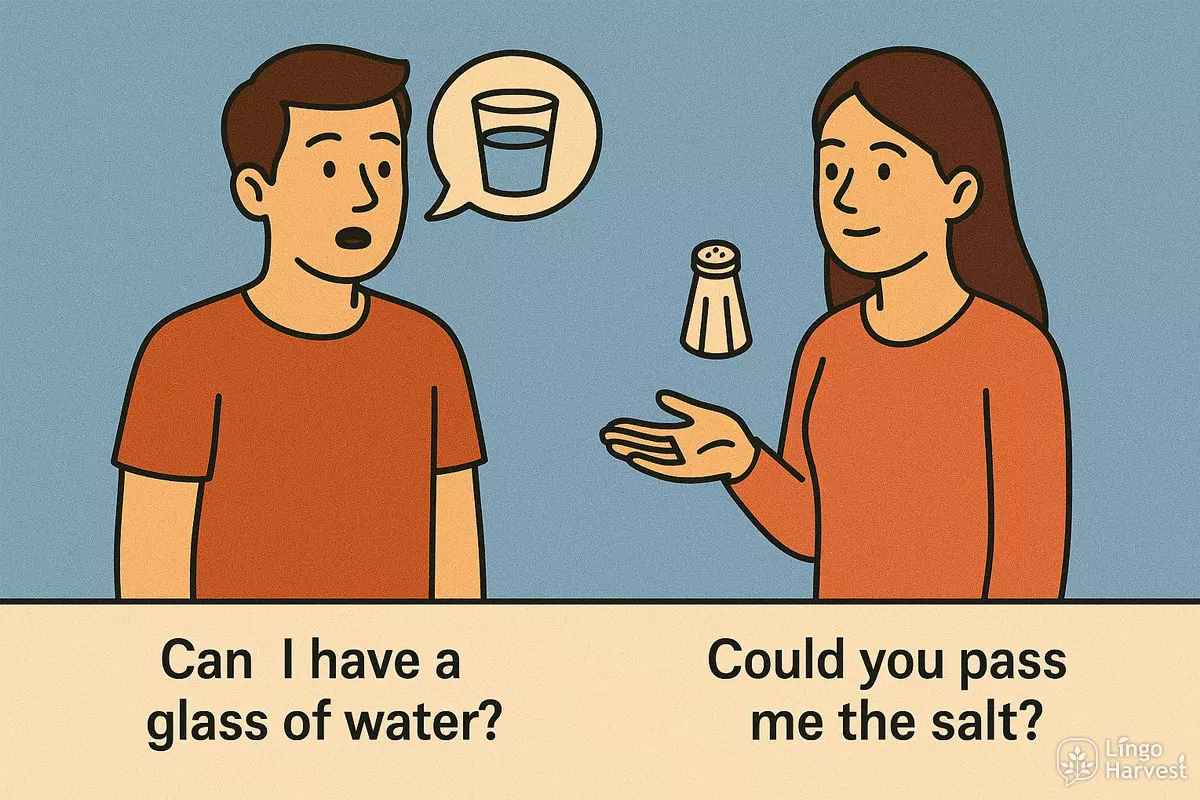
When making a request, speakers typically use noun phrases to specify what they want, need, or hope to receive. The structure and choice of words can affect the politeness or directness of the interaction. For example, adding modifiers like “a bit of” or “some” can soften a request, while definite articles and possessives clarify exactly what is being referred to. Here are common patterns:
- Can I have a glass of water?
- Could you pass me the salt?
- Would you mind giving me a minute?
- Is there any chance for a discount?
- I need your advice.
- Could I get some help?
- May I borrow your pen?
- Do you have an extra ticket?
- Can you send me the details?
- Would you bring that file?
Explaining with noun phrases
In spoken explanations, noun phrases help speakers clarify causes, reasons, or processes. The phrasing often depends on context and the relationship between speakers. Modifiers, quantifiers, and descriptive adjectives are frequently used to add detail. Here are some typical forms:
- The main reason is the delay.
- One possible explanation is traffic.
- My concern is your safety.
- Another factor is cost.
- The issue was the timing.
- A common mistake is forgetting the password.
- The problem is lack of time.
- Our goal is efficiency.
- The solution might be a new plan.
- This approach saves time.
Comparing request and explanation noun phrases
The structure of noun phrases in requests and explanations often overlaps, but their communicative function differs. Requests tend to highlight objects or actions desired, while explanations focus on reasons or clarifications. The table below outlines some typical contrasts:
| Request Example | Explanation Example |
|---|---|
| Can I have a moment? | The reason for the delay is traffic. |
| Could you pass the remote? | The cause was a power outage. |
| Would you send the document? | A possible solution is to reschedule. |
| May I borrow your phone? | The main issue is connectivity. |
Tips for natural use in conversation
To sound fluent and approachable, choose noun phrases that match the level of formality and familiarity with your listener. Use articles, quantifiers, and descriptive words to tailor your meaning. Listening to native speakers and practicing with real-life examples can help you master these patterns for everyday interaction.
Common learner errors in spoken noun phrase construction
Learners often struggle with assembling noun groups naturally when speaking. Unlike written English, spoken language tends to be more flexible and sometimes incomplete, making it easy to fall into patterns that sound unnatural or unclear. Below are some frequent issues encountered by those learning to use noun phrases fluently in conversation.
Typical Problems in Everyday Speech
Many language users omit necessary elements, overcomplicate, or misorder parts of a noun phrase. Some common mistakes include:
- Leaving out articles: saying “I have dog” instead of “I have a dog.”
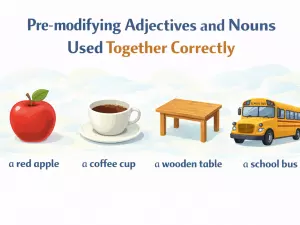
- Incorrect adjective order: “a red big car” instead of “a big red car.”
- Overusing possessives: “the my friend’s house” instead of “my friend’s house.”
- Confusing singular and plural: “these information” instead of “this information.”
- Missing prepositions: “the top the table” instead of “the top of the table.”
- Unnecessary repetition: “the the book” or “my my brother.”
- Forgetting quantifiers: “few money” instead of “a little money.”
- Using wrong determiners: “this books” instead of “these books.”
- Mixing up count/non-count: “much apples” instead of “many apples.”
- Inserting extra words: “the a car” instead of just “a car.”
- Incorrect noun modifiers: “a information important” instead of “important information.”
- Word order mistakes: “a cake chocolate” instead of “a chocolate cake.”
- Omitting noun heads: “the big and red” (missing the noun: “the big and red ball”).
- Using adjectives as nouns: “the beautifuls” instead of “the beautiful ones.”
Comparison of Spoken vs. Written Noun Phrases
Spoken English is often less formal and more fragmented than written forms. This can create opportunities for error, especially when learners translate structures from their native language. The following table illustrates some key contrasts:
| Spoken English Example | Written/Formal English Equivalent |
|---|---|
| “My friend, she’s got a dog.” | “My friend has a dog.” |
| “That big red, uh, car over there.” | “The big red car over there.” |
| “There’s lots of people here.” | “There are many people here.” |
| “A kind of strange feeling.” | “A somewhat strange feeling.” |
| “This one, the blue pen.” | “This blue pen.” |
Strategies for Clearer Noun Phrases in Conversation
Improving spoken noun group accuracy is possible with conscious practice. Some helpful strategies include:
- Listening to native speakers for natural patterns.
- Practicing common adjective-noun combinations aloud.
- Checking word order with short phrases.
- Using simpler structures when unsure.
- Recording and reviewing your own speech for errors.
Focusing on these areas can help learners sound more fluent and be better understood in real-world interactions.
Practice: role-play using natural spoken noun phrases
Role-play is an effective way to internalize how noun groups appear in casual speech. By stepping into everyday situations, you can practice using authentic, spontaneous structures, making your English sound more natural and fluent.
Role-play Scenarios for Practicing Spoken Noun Groups
Try these scenarios with a partner or in a small group. Focus on using noun clusters as they would occur in informal conversations:
- Ordering food at a café (e.g., "Can I get the big iced coffee and a blueberry muffin?")
- Describing your weekend plans (e.g., "I'm meeting some old friends from college at the new pizza place downtown.")
- Shopping for clothes (e.g., "Do you have this shirt in a larger size?")
- Asking for directions (e.g., "Is there a bus stop near the main library?")
- Making small talk about the weather (e.g., "Such a beautiful sunny morning, isn't it?")
- Talking about hobbies (e.g., "I've just started taking beginner guitar lessons.")
- Discussing a movie (e.g., "That action movie with the two famous actors was incredible!")
- Making a doctor's appointment (e.g., "I need to see a general practitioner about a sore throat.")
- Sharing news about a family member (e.g., "My younger brother just graduated from university.")
- Explaining a problem (e.g., "There’s a weird noise coming from my car engine.")
- Giving advice (e.g., "You should try the new Italian restaurant on Baker Street.")
- Talking about work or studies (e.g., "We’ve got a big project deadline next week.")
Common Patterns in Spoken Noun Phrases
Notice how conversational noun phrases often use simple structures, contractions, and omit unnecessary words. Here are some typical patterns:
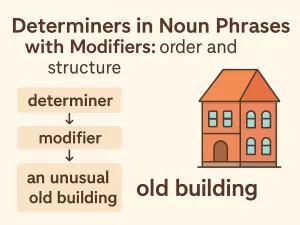
- Article + adjective + noun ("a great idea")
- Possessive + noun ("my friend’s car")
- Demonstrative + noun ("this book")
- Quantifier + noun ("some advice")
- Adjective + noun + prepositional phrase ("a new café near my house")
- Compound nouns ("birthday party")
- Noun + relative clause ("the guy who lives next door")
- Number + noun ("two tickets")
- Adjective + plural noun ("happy memories")
- Superlative + noun ("the best movie")
Mini-Dialogue Practice
Work with a partner. One person asks a question or makes a statement; the other responds, using a natural noun phrase. Try to build on each other's responses.
- A: "What did you do last weekend?"
B: "I went to a small music festival in the city park." - A: "Have you seen Anna's new dog?"
B: "Yes! That little brown puppy is so cute." - A: "Where's the nearest supermarket?"
B: "There's a big one two blocks down the street." - A: "How was the meeting?"
B: "Just the usual Monday morning chaos."
Show answers
- Try to use at least one descriptive noun phrase in each response (e.g., "small music festival," "little brown puppy," "big one," "usual Monday morning chaos").
- Listen for natural rhythm and word order; avoid overly formal or written-style phrases.
Checklist for Natural Noun Phrase Use ✅
Before finishing your practice, review these points:
- Did you use articles (a, the) where needed?
- Did you add adjectives or quantifiers for detail?
- Did your phrases sound like something you’d say in real life?
- Were your noun phrases clear and concise?
Practicing in real-life contexts helps solidify your ability to use authentic noun phrases, making your spoken English both natural and effective.