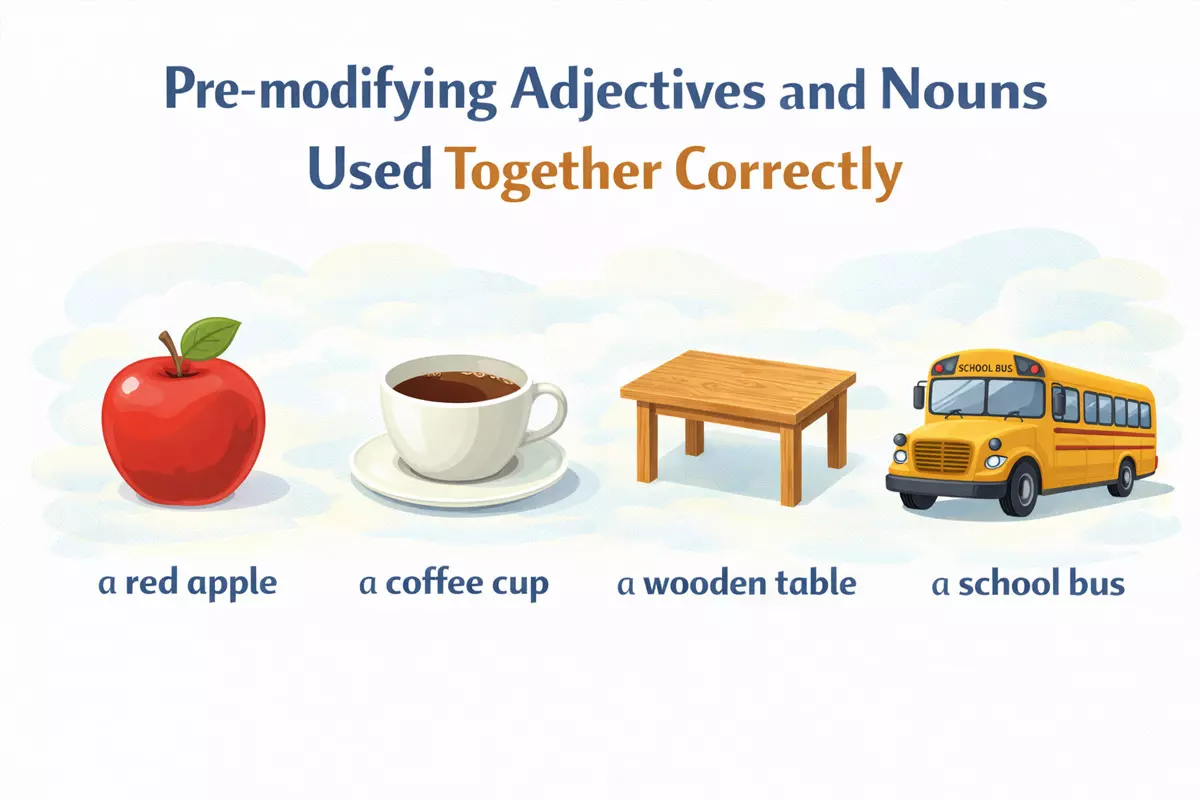
Pre-modifying Adjectives and Nouns Used Together Correctly

 Here we what pre-modifiers are in English noun phrases, the rules for ordering adjectives and noun modifiers, how modifier position affects meaning, differences between spoken and written use, common learner mistakes, and practice exercises.
- What pre-modifiers are in English noun phrases
- Order of adjectives and noun modifiers before a noun
- Combining descriptive adjectives with noun modifiers
- Meaning changes based on modifier position
- Differences between spoken and written pre-modification
- Common learner errors with mixed modifiers
- Practice: build natural noun phrases with multiple modifiers
Combining descriptive words with nouns is a valuable skill that can make your writing clearer and more interesting. By learning how to use adjectives effectively, you can add detail and depth to your sentences, helping readers form a vivid picture of what you are describing. This ability allows you to communicate your ideas more precisely and confidently, whether you are writing an essay, telling a story, or having a conversation. Developing this fundamental aspect of English will enhance both your written and spoken communication in a variety of situations.
What pre-modifiers are in English noun phrases
When we talk about how nouns are described or specified in English, pre-modifiers play a key role. These are words that come before a noun to give extra detail, limit the meaning, or add color to a noun phrase. Pre-modifiers can be adjectives, nouns, participles, and even numbers or quantifiers. Each type helps to build a more specific and informative noun phrase.
Types of pre-modifiers commonly used
Several word classes function as pre-modifiers. Here are some of the most frequent types:
- Adjectives (e.g., red apple, happy child)
- Nouns used attributively (e.g., chicken soup, car keys)
- Present participles (e.g., running water, boiling kettle)
- Past participles (e.g., baked beans, broken window)
- Numbers (e.g., three dogs, ten books)
- Quantifiers (e.g., several options, many questions)
- Ordinal numbers (e.g., first prize, second chance)
- Possessives (e.g., my bag, John's jacket)
- Determiners (e.g., this car, those houses)
- Compound pre-modifiers (e.g., high-speed train, old-fashioned dress)
Order of pre-modifiers
When several modifiers appear before a noun, they often follow a typical order in English. For example, opinion adjectives usually come before size, which comes before age, and so on. Mixing different types of pre-modifiers can lead to more descriptive and precise noun phrases.
| Modifier Type | Example in a Noun Phrase |
|---|---|
| Adjective + Noun | blue sky, wooden table |
| Noun + Noun | chicken soup, football match |
| Number + Noun | five apples, two tickets |
| Adjective + Noun + Noun | big city life, old stone house |
| Quantifier + Adjective + Noun | many interesting books, several small boxes |
| Possessive + Noun | Sarah’s notebook, my phone |
| Participial Modifier + Noun | boiling water, fallen leaves |
Why use pre-modifiers?
Adding modifiers in front of a noun helps to clarify meaning, narrow down choices, and make communication more efficient. For example, saying red sports car tells us much more than just car. The combination and order of these elements are an essential part of natural English usage.
Order of adjectives and noun modifiers before a noun
Understanding how to arrange descriptive words and noun modifiers before a noun helps your sentences sound natural and clear. In English, there’s a preferred sequence for different types of modifiers, and mixing up the order can make phrases sound awkward or confusing. Let’s break down the typical structure so you can confidently describe things in detail without stumbling over word order.
Standard sequence of modifiers
Generally, adjectives and noun modifiers appear closest to the noun they describe, with the most specific or defining information placed last. For example, in "a large wooden dining table," each word adds a layer of detail, moving from general to specific. A common order for multiple modifiers is:
- Quantity or number (e.g., three, several, many)
- Opinion or quality (e.g., beautiful, interesting, delicious)
- Size (e.g., small, huge, tall)
- Age (e.g., new, ancient, young)
- Shape (e.g., round, square, flat)
- Color (e.g., red, blue, striped)
- Origin or nationality (e.g., French, American, Victorian)
- Material (e.g., wooden, plastic, silk)
- Purpose or type (often a noun used as an adjective, e.g., tennis racket, running shoes, wedding dress)
Examples of modifier order in context
It’s helpful to see how these elements combine in real sentences. Notice how the word order flows naturally from general to specific:
- Six beautiful old Italian marble statues
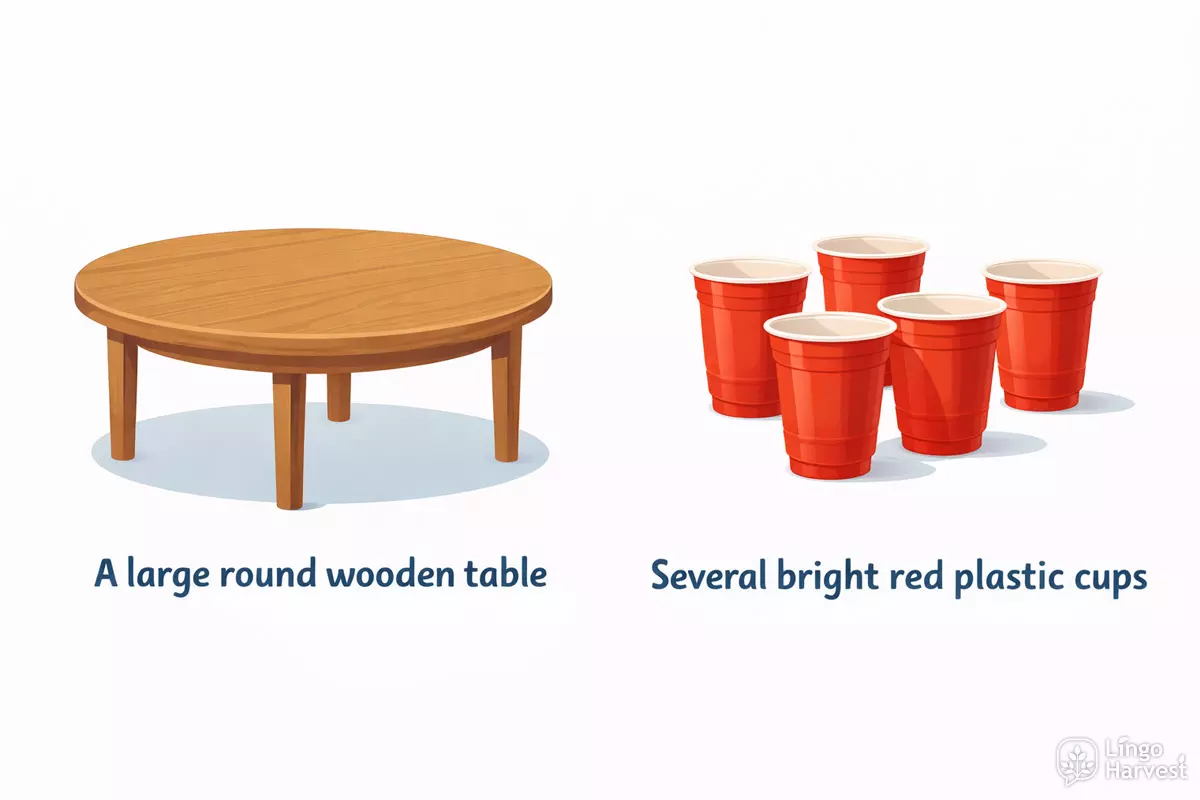
- A large round wooden table
- Several bright red plastic cups
- An interesting new science book
- Two enormous blue silk curtains
- That tiny antique silver spoon
- Some delicious homemade chocolate cookies

- My favorite little green notebook
- Three sturdy black hiking boots
- A famous French fashion magazine
- Every cheerful young soccer player
- Those heavy metal garage doors
- Another long rectangular dining table
- Several old ceramic flower pots
- One expensive Japanese kitchen knife
Where noun modifiers fit in
Noun modifiers (nouns used before another noun, like "chicken soup" or "garden chair") usually come immediately before the main noun. When combined with adjectives, they follow the adjectives but precede the noun. For instance, "a small wooden garden shed" — "garden" (noun modifier) comes right before "shed" (main noun).
Quick reference: modifier order with examples
| Modifier Type | Example Phrase |
|---|---|
| Number + Opinion + Noun Modifier + Noun | Two lovely garden chairs |
| Size + Age + Origin + Material + Noun | Large old French oak desk |
| Opinion + Color + Noun Modifier + Noun | Beautiful blue ceramic vase |
| Quantity + Purpose (noun) + Noun | Several tennis balls |
| Shape + Material + Noun Modifier + Noun | Round glass kitchen table |
Tips for natural-sounding descriptions
- Use only as many modifiers as necessary; too many can overwhelm the noun.
- If unsure, try saying the phrase aloud — native speakers often notice awkward word order by ear.
- Remember that some combinations are more flexible, but the sequence above works in nearly all situations.
- Mastering the arrangement of descriptive words and noun modifiers takes practice, but these guidelines help you create clear, precise, and natural English phrases.
Combining descriptive adjectives with noun modifiers
When building clear and precise noun phrases in English, using descriptive adjectives alongside noun modifiers is essential. Descriptive adjectives provide qualities or features (such as “old,” “blue,” “interesting”), while noun modifiers (also called attributive nouns) specify the type or category of the main noun (like “chicken” in “chicken soup”). The challenge lies in ordering and combining these modifiers so the meaning is natural and unambiguous.
Word order: Adjectives before noun modifiers
In most cases, the descriptive adjective comes before the noun modifier, which is then followed by the main noun. For example, we say “delicious chicken soup,” not “chicken delicious soup.” This order helps listeners immediately grasp the qualities and the specific type of noun being described.
- fresh orange juice → I drink fresh orange juice every morning.
- large stone building → The large stone building dominates the square.
- old wooden chair → He sat down on an old wooden chair.
- bright kitchen window → Sunlight came through the bright kitchen window.
- famous Italian artist → She admires a famous Italian artist.
- small business owner → He is a small business owner in the city center.
- new sports car → She bought a new sports car last year.
- ancient Greek temple → Tourists visited an ancient Greek temple.
- heavy metal music → He listens to heavy metal music.
- fast train service → The fast train service connects the two cities.
- thick winter coat → I need a thick winter coat for cold weather.
- modern art museum → We spent the afternoon in a modern art museum.
- high school student → She is a high school student.
- young animal lover → The young animal lover volunteers at a shelter.
- busy city street → They live on a busy city street.
- traditional family recipe → This dish follows a traditional family recipe.
Common pitfalls and clarifying meaning
Sometimes, the combination can cause confusion if the order is mixed up or the noun modifier is ambiguous. For example, “plastic bottle cap” clearly means a cap for a plastic bottle, while “plastic-bottle cap” (with a hyphen) might suggest a cap made of plastic and bottle-shaped. Careful placement ensures the intended meaning.
Multiple modifiers: Building complex phrases
It’s possible to use more than one adjective or noun modifier, but the order becomes even more important. The standard sequence is: opinion → size → age → shape → color → origin → material → noun modifier → main noun. For example: “a beautiful large old round wooden dining table.”
| Descriptive Adjective | Noun Modifier | Main Noun |
|---|---|---|
| cold | winter | morning |
| expensive | leather | shoes |
| old | family | photo |
| famous | science | museum |
| new | sports | center |
| sweet | apple | pie |
| bright | office | lights |
| small | garden | shed |
Paying attention to the sequence and clarity of descriptive adjectives and noun modifiers will make your writing and speech more precise, allowing you to communicate details naturally and effectively.
Meaning changes based on modifier position
The placement of adjectives and nouns before a main noun can significantly impact the precise interpretation of a phrase. In English, the order in which descriptive words and premodifying nouns appear is not arbitrary—shifting their sequence often leads to a change in meaning or even ambiguity. This is especially important when both adjectives and nouns are used together as modifiers.
How word order affects interpretation
Changing the sequence of modifiers can highlight different qualities or shift the focus of the noun phrase. For example, "old stone house" suggests a house made of stone that is old, while "stone old house" (though awkward in standard English) would be confusing or imply a different structure altogether.
Examples of order and meaning shifts
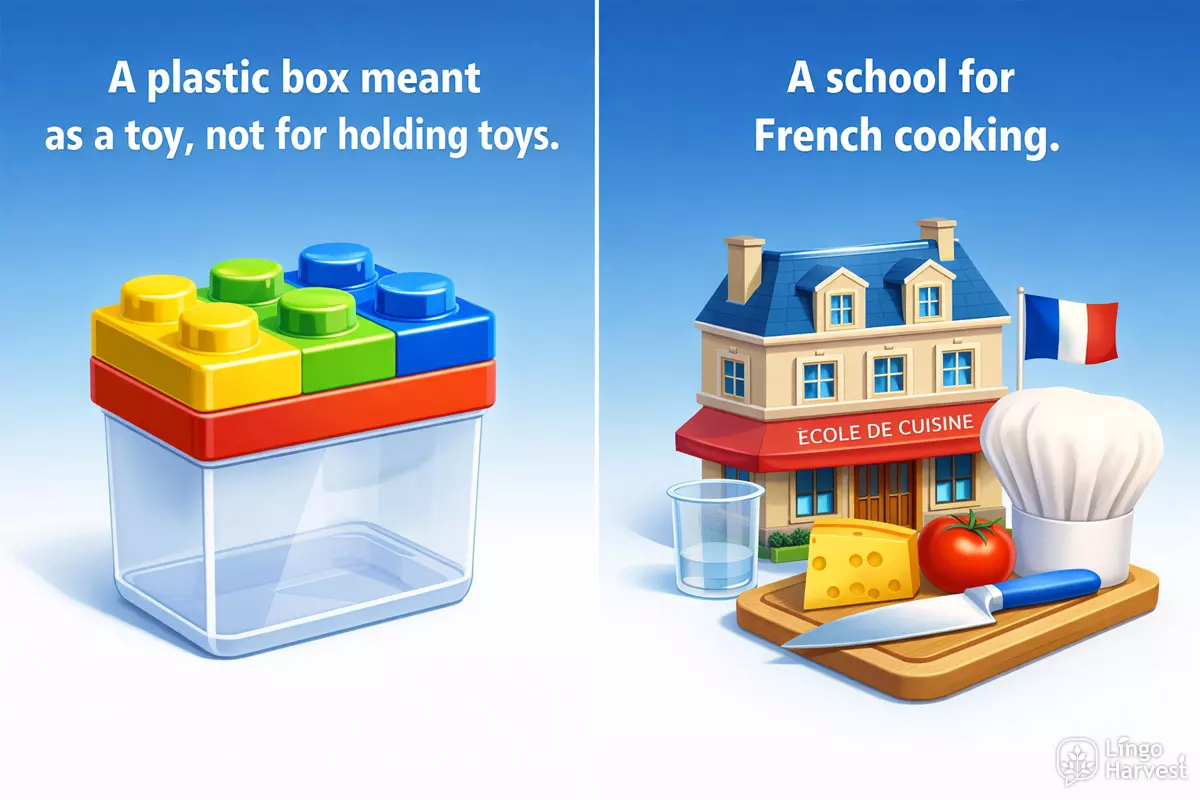
- Plastic toy box → a box for toys, made of plastic
- Toy plastic box → a plastic box meant as a toy, not for holding toys
- French cooking school → a school for French cooking
- Cooking French school → unclear, possibly a school for cooking French people (incorrect!)
- Small animal hospital → a hospital for small animals
- Animal small hospital → a small hospital for animals (emphasis on the hospital's size)
- English language teacher → a teacher of the English language
- Language English teacher → an English teacher of language (ambiguous; nonstandard)
- Chocolate birthday cake → a birthday cake made of chocolate
- Birthday chocolate cake → a chocolate cake for a birthday
- Wooden garden chair → a garden chair made of wood
- Garden wooden chair → a wooden chair for the garden (possible, but less natural)
- Large dog kennel → a kennel for large dogs
- Dog large kennel → a large kennel for dogs (emphasis on kennel size)
Typical modifier order
There is a conventional order for stacking modifiers: adjectives of size, shape, age, color, origin, material, and then the noun modifier. Altering this order can make a phrase sound unnatural or change its intended meaning. Native speakers tend to follow this sequence intuitively.
| Modifier Order | Resulting Meaning or Example |
|---|---|
| Adjective + Noun + Main Noun | large dog house → a house for big dogs |
| Noun + Adjective + Main Noun | dog large house → a large house (for dogs); sounds unnatural |
| Noun + Noun + Main Noun | chicken soup bowl → a bowl for chicken soup |
| Adjective + Adjective + Main Noun | red velvet cake → a cake made with red velvet |
| Adjective + Noun + Noun | small garden table → a small table for the garden |
Summary
Getting the order of premodifying adjectives and nouns right is essential for clear communication. A misplaced modifier can change the focus, create confusion, or even produce an unintended meaning. Always consider which element you want to emphasize and follow standard patterns for clarity.
Differences between spoken and written pre-modification
When we look at how adjectives and nouns are combined before a main noun, the patterns often shift depending on whether language is spoken or written. In everyday conversation, people tend to keep things simple and intuitive, rarely stacking multiple descriptive words in front of a noun. In contrast, written texts—especially formal or academic writing—often feature longer, more complex strings of modifiers.
Complexity and Length
Spoken English favors brevity. It’s far more common to hear “a big house” or “an old red car” than something like “a newly renovated three-story Victorian brick townhouse.” Writers, on the other hand, may use several premodifiers to pack information efficiently or create a specific tone.
Typical Patterns in Each Mode
- Spoken: short, familiar combinations (e.g., “nice blue shirt,” “old wooden chair”)
- Written: longer, more technical or precise sequences (e.g., “highly specialized medical equipment,” “rapidly growing international technology company”)
Flexibility and Planning
Speech is spontaneous, so speakers often adjust as they go, sometimes abandoning or rephrasing mid-sentence. Writers have time to plan and edit, resulting in more carefully structured premodification.
Structured Comparison
| Spoken Language | Written Language |
|---|---|
| Short, common adjective+noun pairs | Longer chains of adjectives and nouns |
| Few technical or rare adjectives | Frequent use of technical/abstract modifiers |
| Simple order: opinion, size, color, noun | More variation for nuance and specificity |
| Self-correction and hesitation allowed | Carefully revised for clarity and impact |
Examples of Pre-modification in Each Context
- Quick phone call (spoken): “Grab the big red folder.”
- Email instructions (written): “Please review the attached comprehensive quarterly financial report.”
- Chatting with friends: “That’s a cute little puppy!”
- Magazine article: “The recently discovered ancient Roman mosaic floor…”
- Ordering food: “I’ll have the spicy chicken sandwich.”
- Recipe book: “Add the finely chopped fresh parsley.”
- Giving directions: “Turn left at the tall white building.”
- Travel guide: “Visit the world-famous historic city center.”
- Making plans: “Let’s meet at the new Italian place.”
- Business proposal: “Our innovative cloud-based data management solution…”
In summary, how we stack adjectives and nouns before the main noun often reflects whether we’re speaking or writing. Spoken English keeps things light and direct; written forms can afford more detail and complexity.
Common learner errors with mixed modifiers
When using both adjectives and nouns to pre-modify another noun, English learners often struggle with the correct order and combination. The confusion usually arises from differences between native language structure and English word order, as well as uncertainty about which modifiers are needed or redundant.
Mixing up modifier order
A frequent mistake is placing descriptive words in the wrong sequence. In English, adjectives typically come before modifying nouns, and the noun acting as a modifier is closest to the main noun. For example, "a wooden garden chair" (correct) vs. "a garden wooden chair" (incorrect).
Redundant or conflicting modifiers
Learners sometimes stack modifiers that repeat information or contradict each other. This can make the phrase awkward or illogical. For instance, "an old antique vase" is redundant, while "a plastic wooden table" is conflicting.
Incorrect noun-adjective combinations
Another pitfall is combining modifiers without considering conventional usage or collocations. Not all adjective-noun or noun-noun combinations are natural in English. For example, "a fast train ticket" should be "a high-speed train ticket," and "a chicken soup bowl" may be clearer as "a bowl of chicken soup" or "a chicken-soup bowl" depending on the intended meaning.
Common confusion points
- Using too many modifiers: "big red metal tool box" → "big red metal toolbox"
- Wrong order: "plastic blue bag shopping" → "blue plastic shopping bag"
- Mixing countable/uncountable: "a rice delicious dish" → "a delicious rice dish"
- Omitting necessary linking hyphens: "a well known author" → "a well-known author"
- Misplacing descriptive adjectives: "a student French book" → "a French student book" or "a French book for students"
- Using noun modifiers where adjectives are needed: "a danger road" → "a dangerous road"
- Transferring word order from other languages, leading to "a shoes black leather" instead of "black leather shoes"
- Combining unrelated modifiers: "a happy glass bottle" (unless contextually appropriate)
- Double modifiers with the same meaning: "round circular table"
- Forgetting plural forms for noun modifiers when needed: "a two year old boy" → "a two-year-old boy"
Typical correction patterns
| Incorrect Example | Natural English Version |
|---|---|
| a soup chicken bowl | a chicken soup bowl |
| wooden big chair | big wooden chair |
| red sports nice car | nice red sports car |
| a shoes black leather | black leather shoes |
| two years old girl | two-year-old girl |
| plastic bottle water | plastic water bottle |
| danger road | dangerous road |
| round circular table | circular table |
Awareness of these patterns and regular practice with authentic English examples can help learners avoid these common pitfalls and produce more natural-sounding noun phrases.
Practice: build natural noun phrases with multiple modifiers
Combining adjectives and nouns as modifiers allows you to create rich, precise descriptions in English. The order of these modifiers is important for sounding natural. Let’s work with real examples and exercises to help you master these patterns.
Common modifier order patterns
In English, pre-modifiers (words before the main noun) usually follow this order:
- Quantity (three, many, several)
- Opinion (beautiful, delicious, strange)
- Size (small, huge, tall)
- Age (old, new, ancient)
- Shape (round, square, flat)
- Color (red, blue, golden)
- Origin (French, wooden, silk)
- Material (metal, plastic, cotton)
- Purpose (sleeping [bag], running [shoes])
For example: a beautiful old Italian marble statue (opinion + age + origin + material + noun)
Build and analyze: modifier combinations
Try to combine adjectives and nouns into natural-sounding noun phrases. Arrange the modifiers in the most usual order. Here are some elements; make phrases out of them:
- modern / blue / sports / car
- large / wooden / dining / table
- delicious / homemade / chocolate / cake
- ancient / Greek / marble / temple
- three / small / yellow / chicks
- comfortable / leather / office / chair
- old / French / wine / bottle
- tiny / glass / perfume / bottle
- expensive / Swiss / wrist / watch
- handmade / wool / winter / scarf
- shiny / red / fire / truck
- long / silver / kitchen / knife
- spacious / new / hotel / room
- crispy / fried / chicken / wings
- fresh / organic / apple / juice
- old / wooden / sailing / ship
- giant / African / elephant / statue
- classic / black / leather / shoes
- soft / cotton / baby / blanket
- famous / British / detective / novel
- Rearrange the words in each group to create a natural noun phrase.
- Identify which word is the main noun in each phrase.
Show answers
- modern blue sports car (main noun: car)
- large wooden dining table (main noun: table)
- delicious homemade chocolate cake (main noun: cake)
- ancient Greek marble temple (main noun: temple)
- three small yellow chicks (main noun: chicks)
- comfortable leather office chair (main noun: chair)
- old French wine bottle (main noun: bottle)
- tiny glass perfume bottle (main noun: bottle)
- expensive Swiss wrist watch (main noun: watch)
- handmade wool winter scarf (main noun: scarf)
- shiny red fire truck (main noun: truck)
- long silver kitchen knife (main noun: knife)
- spacious new hotel room (main noun: room)
- crispy fried chicken wings (main noun: wings)
- fresh organic apple juice (main noun: juice)
- old wooden sailing ship (main noun: ship)
- giant African elephant statue (main noun: statue)
- classic black leather shoes (main noun: shoes)
- soft cotton baby blanket (main noun: blanket)
- famous British detective novel (main noun: novel)
Notice the difference: natural vs. unnatural order
Modifier order can make a phrase sound awkward or incorrect to native speakers. Compare these examples:
| Natural order | Unnatural order |
|---|---|
| a big red plastic ball | a plastic red big ball |
| an old Italian leather bag | a leather Italian old bag |
| two delicious homemade cookies | homemade two delicious cookies |
| beautiful small glass beads | glass beautiful small beads |
Practice rearranging modifiers and notice how the sequence affects the flow and clarity of the noun phrase. The natural order usually feels smoother and more familiar.