Nouns with Positive and Negative Connotations in English

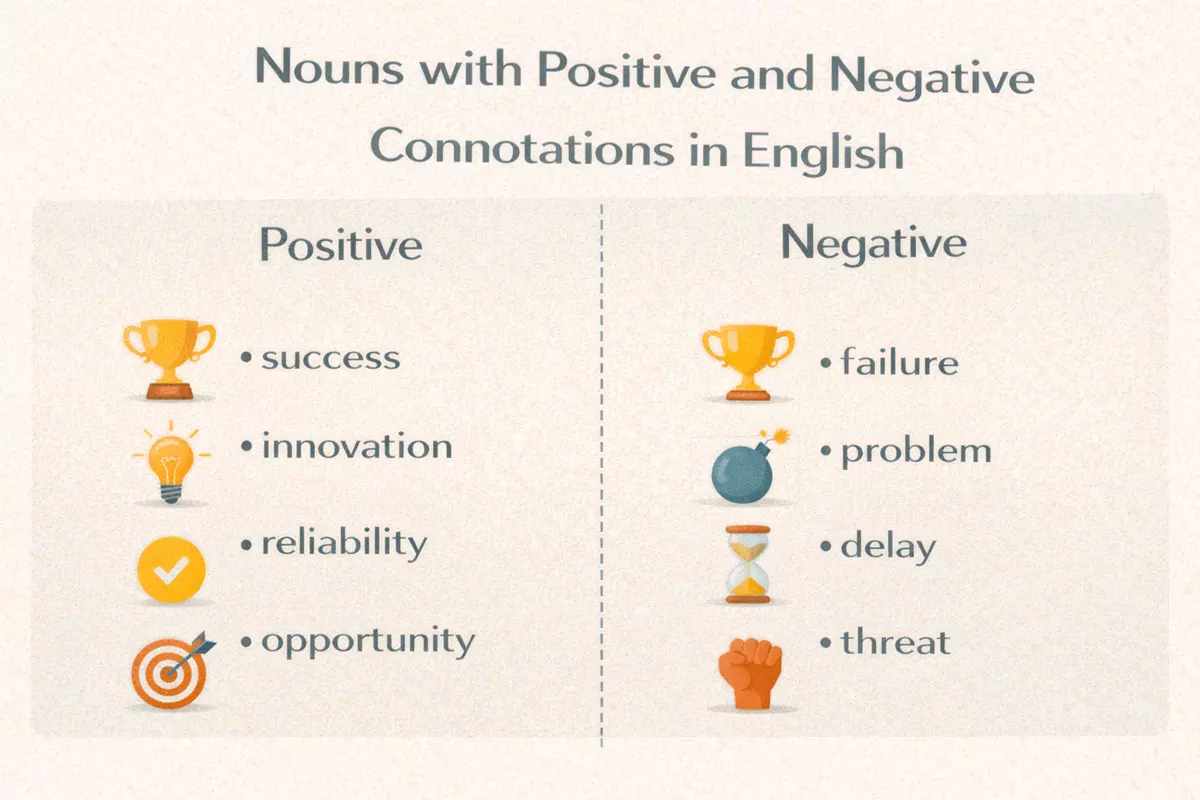 Here we how noun connotation influences communication, contrasts positive, negative, and neutral nouns, discusses context and cultural impact, highlights typical learner errors, and provides exercises for choosing more effective connotations.
- What noun connotation means in communication
- Positive vs negative emotional coloring in nouns
- Neutral nouns vs loaded nouns in persuasion
- Connotation shifts by context and register
- Cultural sensitivity in noun connotation
- Common learner mistakes with unintended negativity
- Practice: replace neutral nouns with positive or negative ones
Everyday language contains words that subtly influence our perceptions of people, places, and experiences, often without us realizing it. By becoming aware of how specific word choices can create positive or negative impressions, you can communicate more clearly and thoughtfully in English. This awareness allows you to express your ideas in a way that matches your intentions, helps avoid misunderstandings, and makes your interactions more effective. Thoughtful language use not only improves clarity but also builds stronger connections with others.
What noun connotation means in communication
The connotation of a noun is the set of emotional or cultural associations that a word carries, beyond its basic dictionary meaning. When people use nouns in conversation or writing, they often choose words that subtly express approval, disapproval, warmth, or criticism. These underlying associations can influence how a message is received, even if the literal meaning stays the same.
How connotations impact understanding
The words people select can shape tone and attitude. For example, using "youth" rather than "child" might suggest energy or promise, while "brat" introduces a negative judgment. Such nuances can affect relationships, clarity, and even persuasiveness in communication.
Positive and negative connotation in action
Consider how different nouns describing the same person or thing can evoke different responses:
- Leader (positive) vs. Boss (neutral) vs. Dictator (negative)
- Home (warmth) vs. House (neutral) vs. Shack (negative)
- Visionary (admiring) vs. Dreamer (neutral or slightly negative)
- Companion (friendly) vs. Associate (neutral) vs. Accomplice (negative)
- Slim (compliment) vs. Thin (neutral) vs. Scrawny (insult)
- Child (neutral) vs. Kid (informal) vs. Brat (disapproving)
- Curiosity (positive) vs. Nosiness (negative)
- Economist (neutral) vs. Penny-pincher (negative)
- Guest (welcome) vs. Intruder (unwelcome)
- Collector (hobbyist) vs. Hoarder (negative)
- Optimist (positive) vs. Dreamer (ambiguous) vs. Fool (negative)
- Volunteer (altruistic) vs. Do-gooder (mocking)
Why these associations matter
Choosing nouns with suitable connotations helps writers and speakers create the desired mood, persuade an audience, or show subtle judgments. Misusing them, even unintentionally, can lead to misunderstandings or offense. Being aware of these shades of meaning is essential for effective and respectful communication.
Typical patterns of connotation
Some words naturally carry positive or negative overtones due to history or social context. Here’s a comparison:
| Positive or Neutral Noun | Negative Noun (Similar Meaning) | Example (using negative noun) |
|---|---|---|
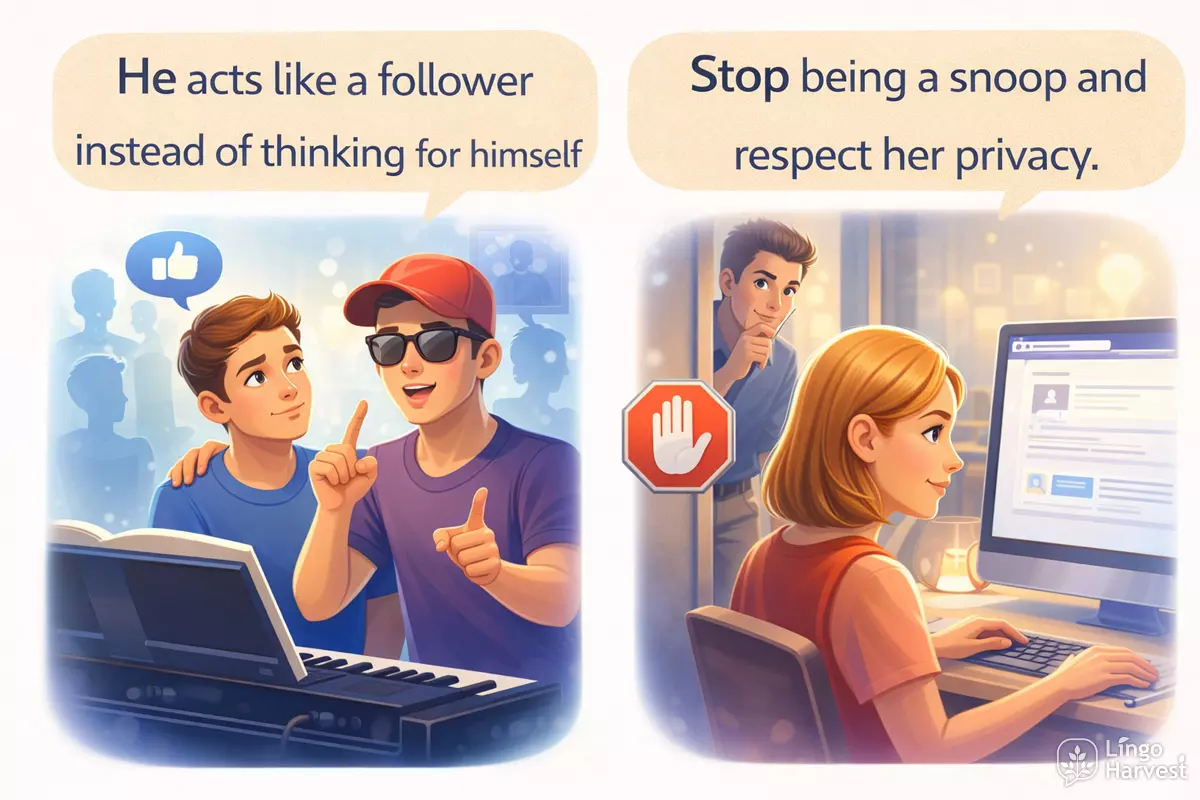
| Friend | Follower | He acts like a follower instead of thinking for himself. |
| Investigator | Snoop | Stop being a snoop and respect her privacy. |
| Enthusiast | Fanatic | He’s a fanatic who won’t listen to any other opinion. |
| Manager | Bureaucrat | Another bureaucrat delayed the approval process. |
| Innovator | Upstart | The upstart challenged the industry leaders. |
| Celebration | Riot | The crowd turned the event into a riot. |
| Guest | Interloper | Security removed an interloper from the private event. |
| Supporter | Zealot | A zealot tried to silence anyone who disagreed. |
| Professional | Hack | Don’t hire that hack for a serious job. |
| Critic | Nitpicker | The nitpicker complained about every tiny detail. |
Understanding the subtle emotional coloring of nouns helps people navigate conversations and texts more thoughtfully. By recognizing these effects, communicators can better align their word choices with their intentions.
Positive vs negative emotional coloring in nouns
Nouns in English often carry an emotional overtone, shaping the way we perceive people, objects, or situations. This emotional coloring can be uplifting or disparaging, depending on the word chosen. For example, describing someone as a “visionary” immediately evokes respect, while “fanatic” suggests a more negative judgment, even if both refer to someone with strong beliefs.
How emotional coloring affects meaning
The emotional charge of a noun goes beyond its dictionary definition. Choosing between synonyms like “enthusiast” and “addict” can drastically alter the tone of a sentence. This subtlety plays an important role in communication, influencing impressions and attitudes.
Common examples of positive and negative connotations
Below is a list highlighting how emotional coloring distinguishes similar nouns. Notice how each pair shares a core meaning, but the emotional slant is quite different:
| Positive / Neutral ✅ | Negative ❌ | Example (Negative) |
|---|---|---|
| Hero | Villain | The villain escaped at the end of the story. |
| Leader | Dictator | The dictator silenced all opposition. |
| Home | Hovel | They lived in a damp hovel on the edge of town. |
| Visionary | Fanatic | A fanatic rejected any compromise. |
| Companion | Accomplice | Police arrested his accomplice. |
| Economist | Penny-pincher | Don’t be a penny-pincher when it comes to safety. |
| Patriot | Nationalist | The nationalist speech divided the crowd. |
| Curiosity | Meddler | He’s a meddler who can’t mind his own business. |
| Scholar | Bookworm | He’s a bookworm who spends every weekend reading. |
| Child | Brat | The brat refused to share the toys. |
| Gourmet | Glutton | He ate like a glutton at the buffet. |
| Protector | Busybody | That busybody keeps asking personal questions. |
| Pioneer | Experimenter | An experimenter tested risky ideas without a plan. |
| Idealist | Dreamer | He’s a dreamer who never follows through. |
| Expert | Know-it-all | Don’t be a know-it-all in the meeting. |
| Host | Intruder | Security removed an intruder from the building. |
| Supporter | Follower | He acts like a follower instead of making his own choices. |
| Innovator | Rebel | A rebel ignored the rules and caused trouble. |
Comparing positive and negative connotations
Sometimes, the distinction between uplifting and negative emotional coloring is best understood through direct comparison. Here’s a table with typical pairs:
| Positive Connotation | Negative Connotation |
|---|---|
| Benefactor | Interferer |
| Leader | Bully |
| Collector | Hoarder |
| Investigator | Snoop |
| Advisor | Manipulator |
| Negotiator | Swindler |
| Ally | Conspirator |
| Dreamer (aspirational) | Escapist |
Why word choice matters
Selecting nouns with the right emotional coloring is essential for accurate, nuanced communication. A positive or negative connotation can subtly persuade, insult, compliment, or criticize, even when describing the same reality. Being aware of these differences helps avoid misunderstandings and ensures your message matches your intent.
Neutral nouns vs loaded nouns in persuasion
When trying to sway opinions or shape perceptions, the choice between neutral and emotionally charged nouns can have a significant effect. Neutral nouns, like "person," "event," or "object," aim to present information without implying approval, disapproval, or emotional coloring. In contrast, loaded nouns—sometimes called evaluative or emotive nouns—carry clear positive or negative associations. These subtle differences often influence how messages are received, especially in debates, advertising, or political speech.
How loaded nouns shape perception
Words with strong connotations can steer the listener’s emotions or judgments, even before any facts are presented. For example, describing a group as a "team" (positive association) versus a "mob" (negative association) immediately frames their actions differently. The use of loaded nouns is a common rhetorical device in persuasive writing and speech.
- Hero vs. criminal
- Ally vs. enemy
- Innovation vs. gimmick
- Leader vs. dictator
- Solution vs. problem
- Opportunity vs. risk
- Home vs. property
- Supporter vs. fanatic
- Reform vs. scheme
- Community vs. crowd
- Advocate vs. agitator
- Benefit vs. cost
- Freedom vs. anarchy
- Discovery vs. accident
- Challenge vs. obstacle
- Gift vs. bribe
Comparing neutral and loaded nouns
Sometimes, the distinction between a neutral and a loaded term is subtle but impactful. Consider these pairs, where the first is neutral and the second carries a positive or negative slant:
| Neutral Noun | Loaded Noun (Positive or Negative) |
|---|---|
| Group | Team ✅ / Mob ❌ |
| Plan | Strategy ✅ / Scheme ❌ |
| Person | Citizen ✅ / Intruder ❌ |
| Building | Home ✅ / Shack ❌ |
| Change | Improvement ✅ / Disruption ❌ |
| Event | Ceremony ✅ / Incident ❌ |
| Food | Cuisine ✅ / Slop ❌ |
| Proposal | Offer ✅ / Demand ❌ |
| Action | Effort ✅ / Stunt ❌ |
| Statement | Testimony ✅ / Accusation ❌ |
When to use neutral or loaded terms
Choosing between a neutral or loaded noun depends on your communicative goal. Neutral terms are best for objective reporting and academic writing, where fairness and impartiality are valued. Loaded nouns are effective when aiming to persuade, motivate, or influence emotions, but overuse can lead to perceived bias or manipulation. Recognizing this distinction is key for both speakers and listeners to understand the underlying intent in any message.
Connotation shifts by context and register
How a noun is perceived often depends on who is speaking, the setting, and the relationship between speakers. In English, the emotional coloring of many nouns can change dramatically depending on whether the language is formal or informal, who is being addressed, and the speaker's intention. For example, a word that sounds friendly in a casual conversation may feel dismissive or even insulting in a more official or academic context.
Influence of Situation and Audience
Words like childish and youthful both refer to young people, but childish often carries a negative implication in professional environments, suggesting immaturity, whereas youthful typically has a positive ring, especially in advertising or compliments. Similarly, boss might sound neutral or positive among friends, but in some workplaces, it might feel disrespectful compared to manager or supervisor.
Register: Formal vs. Informal Usage
Register plays a crucial role in how nouns are understood. Words that are neutral or even positive in informal speech can take on negative overtones in formal situations. Here are some examples:
- Geek (informal, positive among peers) → can be negative in formal settings
- House (neutral) vs. Home (positive, emotional)
- Old man (affectionate in some families) → disrespectful in formal speech
- Scheme (neutral in British English) → negative in American English
- Ambition (positive in career contexts) → negative if implying ruthlessness
- Cheap (negative: low quality) vs. Affordable (positive: good value)
- Spinster (negative, outdated) vs. Bachelor (positive/neutral)
- Fat (negative) vs. Plump (milder, sometimes positive)
- Stubborn (negative) vs. Determined (positive)
- Pushy (negative) vs. Assertive (positive in business)
Table: Nouns With Context-Dependent Connotations
| Noun | Connotation Shift (Example Contexts) |
|---|---|
| Curiosity | Positive (scientific research) → Negative (prying into private affairs) |
| Ambition | Positive (career motivation) → Negative (overly competitive or selfish) |
| Discipline | Positive (self-control) → Negative (strict punishment in schools) |
| Fanatic | Neutral (sports context) → Negative (extremism, intolerance) |
| Freedom | Positive (personal rights) → Negative (lack of restraint, chaos) |
| Gossip | Negative (spreading rumors) → Neutral/positive (community news) |
| Luxury | Positive (reward, treat) → Negative (excess, wastefulness) |
| Rebel | Positive (standing up for beliefs) → Negative (troublemaker) |
| Pride | Positive (achievement, dignity) → Negative (arrogance, hubris) |
| Traditionalist | Positive (respect for customs) → Negative (resistant to change) |
Understanding how context and register affect the emotional meaning of nouns is key for effective communication. Being sensitive to these shifts helps speakers choose words that match the desired tone and relationship, avoiding misunderstandings and unintended offense.
Cultural sensitivity in noun connotation
Understanding how nouns carry positive or negative undertones is crucial when communicating across different cultures. Words that seem neutral or even complimentary in one context may be considered disrespectful or offensive elsewhere. This happens because the emotional weight and associations of nouns often depend on cultural background, history, and social values.
Why context matters
The same noun can evoke pride or insult depending on the audience. For example, calling someone "ambitious" is often a compliment in English-speaking business circles, but in some traditions, it may imply selfishness or a lack of humility. Similarly, "foreigner" can be neutral in some places, but in others, it might carry exclusionary overtones.
Examples of shifting connotations
| Word | Contextual Meaning | Example |
|---|---|---|
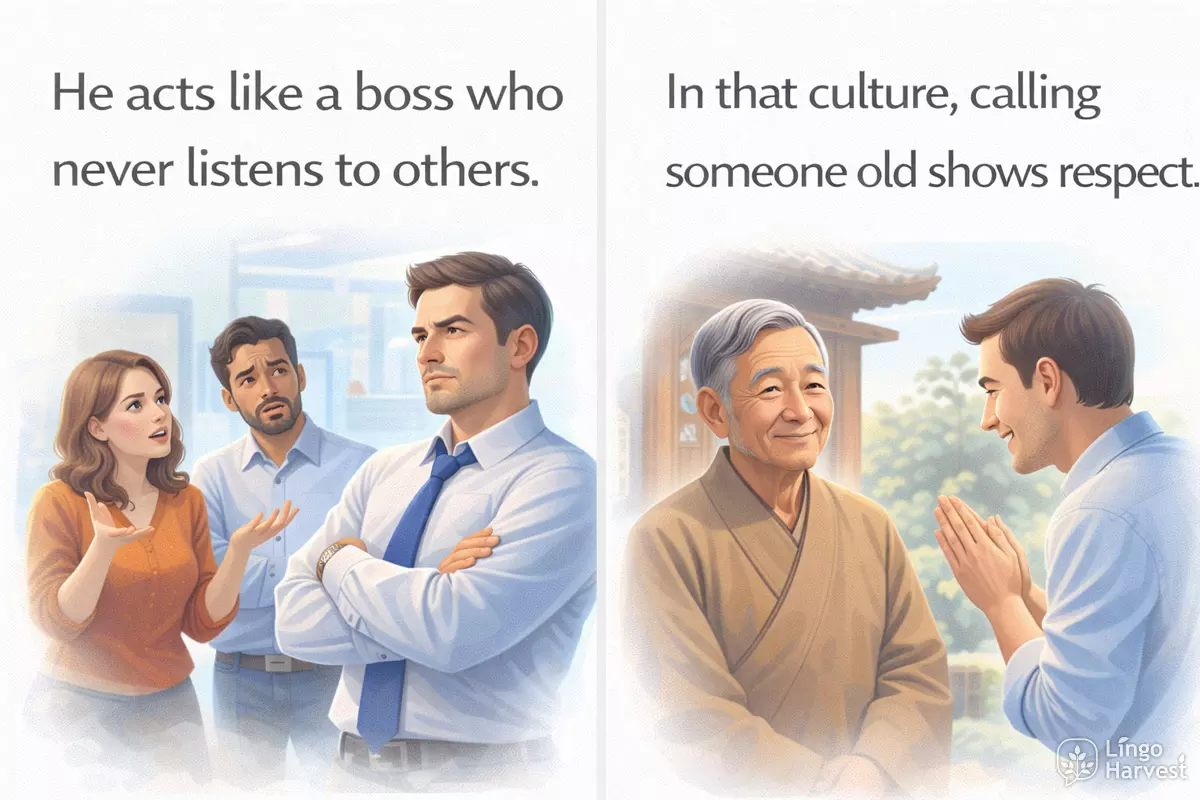
| Boss | authority vs. arrogance | He acts like a boss who never listens to others. |
| Old | respect vs. negativity | In that culture, calling someone old shows respect. |
| Exotic | admiration vs. objectification | The writer described the island as exotic. |
| Traditionalist | conservative values vs. resistance to change | As a traditionalist, he opposed the reform. |
| Immigrant | neutral identity vs. stigma | The city was built by immigrants. |
| Patriot | devotion vs. extremism | He is seen as a patriot by his supporters. |
| Geek | social awkwardness vs. expertise | She’s a tech geek who solves complex problems. |
| Servant | service role vs. subordination | The servant followed strict household rules. |
| Lady | politeness vs. condescension | He referred to her as a lady in a formal tone. |
| Housewife | family role vs. outdated label | She described herself as a housewife. |
| Native | heritage vs. careless labeling | The museum highlights native traditions. |
| Refugee | sympathy vs. stigma | The country accepted thousands of refugees. |
| Hero | admiration vs. irony | He was treated as a hero after the rescue. |
| Victim | empathy vs. blame | The victim received public support. |
| Child | innocence vs. inexperience | She is still a child in many ways. |
| Professional | trustworthiness vs. emotional distance | He maintained a professional attitude. |
| Fanatic | dedication vs. danger | The fanatic refused to compromise. |
| Idealist | hopeful vs. unrealistic | As an idealist, she believes change is possible. |
| Scholar | academic respect vs. impracticality | The scholar published several studies. |
| Villager | hard-working vs. unsophisticated | The villager relied on farming for income. |
Comparing connotations across cultures
The connotative meaning of nouns is not fixed. For instance, the noun "foreigner" can be a simple descriptive word or carry a strong negative charge. The table below compares how certain nouns may be interpreted differently in various cultural settings:
| Noun | Possible Connotations in Different Cultures |
|---|---|
| Foreigner | Neutral (descriptive) → Exclusionary or suspicious |
| Boss | Respected leader → Overbearing authority |
| Elder | Wise and honored → Outdated or powerless |
| Rebel | Heroic freedom-fighter → Troublemaker |
| Servant | Diligent worker → Inferior status |
Practical tips for navigating connotations
- Research local usage before using potentially sensitive words.
- Pay attention to how people react to certain nouns in conversation.
- When in doubt, choose more neutral or universally positive terms.
- Be open to correction and willing to adapt your vocabulary.
In summary, awareness of how nouns are perceived in different cultures can help avoid misunderstandings and foster respectful communication.
Common learner mistakes with unintended negativity
When learning English, it's easy to accidentally choose a noun that sounds more negative than intended. This often happens when a word’s meaning is technically correct, but its emotional tone (connotation) is off. Such slips can make your speech or writing seem harsher, less polite, or even offensive, even if that wasn’t your goal. Understanding which nouns carry negative undertones—and which have neutral or positive alternatives—can help you communicate more effectively.
Mixing up neutral and negative nouns
Learners sometimes confuse words with similar dictionary definitions but very different emotional impacts. Here are some frequent mix-ups:
- Childish (negative: immature) vs. childlike (positive: innocent)
- Cheap (negative: low quality) vs. inexpensive (neutral/positive: affordable)
- Stubborn (negative: unwilling to change) vs. determined (positive: persistent)
- Nosy (negative: intrusive) vs. curious (neutral/positive: eager to learn)
- Bossy (negative: domineering) vs. confident (positive: assertive)
- Skinny (negative: unhealthily thin) vs. slim (positive: attractively thin)
- Pushy (negative: aggressive) vs. persuasive (positive: convincing)
- Stingy (negative: unwilling to share) vs. thrifty (positive: careful with money)
- Weird (negative: strange in a bad way) vs. unique (positive: special/different)
- Lazy (negative: unwilling to work) vs. relaxed (positive: calm)
Negative connotation in group nouns
Describing groups can be tricky. Certain collective nouns carry strong negative associations, even if the context isn’t negative. For example, calling a group of people a “mob” or a “gang” instead of a “group” or “team” can imply aggression or criminal intent.
| Negative Noun | Preferred Alternative |
|---|---|
| Mob | Crowd, group, assembly |
| Gang | Team, group, club |
| Freak | Individual, unique person |
| Fanatic | Enthusiast, supporter |
| Enemy | Opponent, rival |
| Victim | Survivor, affected person |
Unintentionally rude or offensive choices
Sometimes, a word that seems neutral in your first language can sound rude in English. For example, describing someone as “old” instead of “elderly” or “senior,” or calling a colleague “fat” rather than “overweight” or “full-figured,” can cause offense. Always consider the emotional impact of the nouns you choose.
Tips to avoid negative undertones
- Check example sentences in reliable dictionaries to see how a noun is typically used.
- When in doubt, choose more neutral or positive alternatives.
- Listen to native speakers and note their word choices in different situations.
- Ask for feedback if you’re unsure about a word’s connotation.
Choosing the right noun isn’t just about grammar—it’s about expressing respect, friendliness, and clarity. Being aware of connotation helps prevent misunderstandings and fosters better communication.
Practice: replace neutral nouns with positive or negative ones
Choosing the right noun can completely change the impression a sentence gives. Neutral nouns describe things without emotional coloring, while positive and negative nouns add a layer of feeling or judgment. Practicing these substitutions helps you express yourself more precisely and understand the connotations in what you read or hear.
Task: Substitute for effect
Below are sentences with neutral nouns. For each, try replacing the neutral noun with a more positive or negative alternative to shift the tone. Think about the effect each change has on the overall meaning.
- The person spoke at the meeting.
- She lives in a house by the lake.
- He found a solution to the problem.
- The food was served quickly.
- He has a job downtown.
- They have a new plan for the project.
- The dog waited by the door.
- She wore a dress to the party.
- The child drew a picture.
- He bought a car last week.
Show answers
- The guest (positive) / intruder (negative) spoke at the meeting.
- She lives in a villa (positive) / shack (negative) by the lake.
- He found a breakthrough (positive) / quick fix (negative) to the problem.
- The cuisine (positive) / grub (negative) was served quickly.
- He has a career (positive) / gig (negative) downtown.
- They have a new vision (positive) / scheme (negative) for the project.
- The companion (positive) / mutt (negative) waited by the door.
- She wore a gown (positive) / rag (negative) to the party.
- The angel (positive) / brat (negative) drew a picture.
- He bought a vehicle (neutral), luxury sedan (positive), or jalopy (negative) last week.
More examples: Neutral nouns and their positive/negative counterparts
| Neutral Noun | Positive Alternative | Negative Alternative |
|---|---|---|
| leader | visionary | dictator |
| group | team | mob |
| request | appeal | demand |
| change | improvement | disruption |
| friend | ally | accomplice |
| story | tale | rumor |
| budget | investment | cutback |
| plan | strategy | plot |
| idea | inspiration | delusion |
| discussion | dialogue | argument |
Reflection
Notice how the choice of noun can subtly or dramatically affect the message. Practicing these substitutions will help you recognize and use positive or negative connotations more effectively in your own English communication.