Cognitive Nouns Like Belief, Idea, and Opinion in English

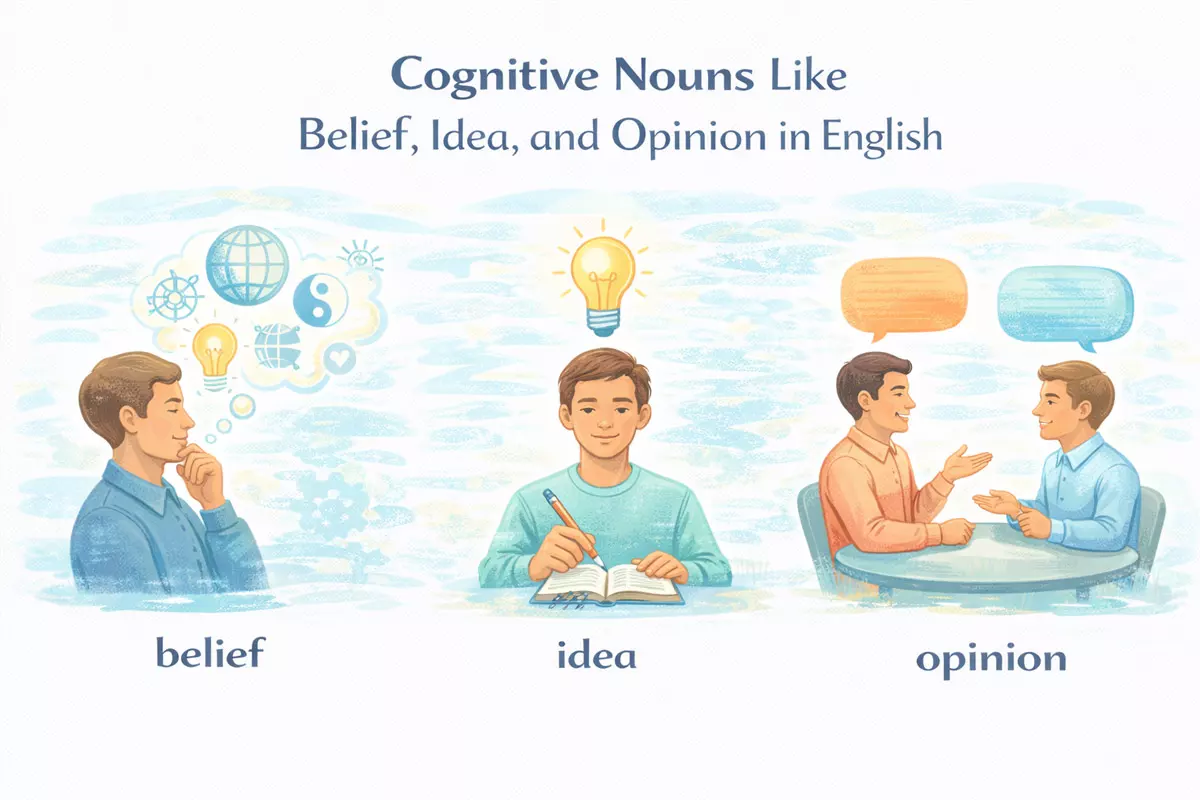 The article defines cognitive nouns in communication, lists common examples for discussion and debate, explains their use with reporting verbs, distinguishes them from adjectives, covers register differences, outlines typical learner errors, and provides practice tips.
- What cognitive nouns represent in communication
- Common cognitive nouns used in discussion and debate
- Using cognitive nouns with reporting verbs
- Difference between cognitive nouns and adjectives
- Register differences in spoken and academic contexts
- Typical learner errors with cognitive noun usage
- Practice: express views using correct cognitive nouns
The language we choose to express our thoughts and perspectives, including terms like convictions, notions, and viewpoints, significantly influences how we communicate complex ideas in English. By understanding the nuances of these words, we can better appreciate the subtle differences in meaning and intention behind what people say, which helps us share and interpret perspectives more effectively. This awareness enhances both our own expression and our ability to understand others’ interpretations and beliefs.
What cognitive nouns represent in communication
Words like belief, idea, and opinion do more than name mental states—they signal how people process, share, and evaluate knowledge and perspectives. In English, these nouns help speakers refer to inner concepts or attitudes, making abstract thoughts shareable in conversation. When someone says, "My belief is that hard work pays off," they are not just describing a feeling, but presenting a framework for discussion or debate.
Functions of cognitive nouns in English
- Labeling mental content (thought, notion)
- Signaling uncertainty or certainty (assumption, conviction)
- Distinguishing personal vs. shared knowledge (view vs. consensus)
- Introducing or hedging statements (suggestion, guess)
- Framing arguments or positions (stance, stance)
- Organizing discussion topics (proposal, theory)
- Clarifying the source of information (rumor, report)
- Expressing doubt or skepticism (suspicion, misgiving)
- Summarizing collective attitudes (consensus, sentiment)
- Marking hypothetical or potential ideas (possibility, hypothesis)
How cognitive nouns shape conversation
By using these nouns, speakers can distance themselves from a statement ("It is just a theory"), claim authority ("My knowledge is..."), or invite others to contribute ("What's your opinion?"). The choice of noun often reveals the speaker's attitude toward the information—whether they see it as fact, speculation, or merely a passing thought.
Comparing common cognitive nouns
| Noun | Typical Use in Communication |
|---|---|
| Belief | Expresses a conviction or something held as true, often without proof |
| Idea | Refers to a thought, suggestion, or concept; may be original or shared |
| Opinion | Indicates a personal judgment or viewpoint, often open to challenge |
| Assumption | Highlights something taken for granted, possibly without evidence |
| Knowledge | Denotes information accepted as true or proven, often with authority |
| Hypothesis | Presents a proposed explanation, typically for further testing |
| Suspicion | Implies doubt or mistrust, often without concrete evidence |
| Proposal | Offers a plan or suggestion for consideration and discussion |
| Notion | Describes a vague or initial idea, sometimes with uncertainty |
| Theory | Represents a system of ideas intended to explain something |
In summary, cognitive nouns are essential for clarifying how people frame and exchange mental content, negotiate meaning, and signal the nature or reliability of what is being discussed. They are vital tools for making thought processes explicit and for managing the subtleties of interaction.
Common cognitive nouns used in discussion and debate
In English, certain nouns are central when people exchange viewpoints, examine arguments, or express reasoning. These words help structure dialogue, clarify positions, and indicate how ideas are processed or evaluated. Recognizing these nouns can improve clarity and precision in both formal debates and everyday discussions.
Key cognitive nouns for expressing thoughts and positions

Some of the most frequent nouns in this context refer to mental constructs, attitudes, or judgments. They allow speakers to introduce, challenge, or clarify what is being considered or asserted. Here are several widely used examples:
- Belief – a conviction or acceptance that something is true or exists
- Idea – a thought, suggestion, or possible plan
- Opinion – a personal view or judgment, often subjective
- Assumption – something accepted as true without proof
- Argument – a set of reasons or evidence supporting a claim
- Claim – a statement asserted as fact, often requiring support
- Hypothesis – a proposed explanation made on limited evidence
- Inference – a conclusion drawn from evidence or reasoning
- Notion – a vague or general understanding or impression
- Perspective – a particular attitude or way of viewing something
- Judgment – an opinion formed after consideration
- Conclusion – a final decision or deduction reached after reasoning
- Viewpoint – a particular way of considering a matter
- Premise – a foundational statement or idea that supports an argument
- Interpretation – an explanation or way of understanding something
- Conviction – a firmly held belief or opinion
- Understanding – comprehension or grasp of a concept
- Supposition – an uncertain belief or hypothesis
- Attitude – a settled way of thinking, often reflected in behavior
- Objection – an expression of disagreement or doubt
Comparing select cognitive nouns in use
For those learning English or aiming to sharpen their communication, it can help to see how some of these terms differ in nuance and function. The following table offers a side-by-side look at several common examples:
| Noun | Typical Meaning and Usage |
|---|---|
| Belief | A strong acceptance that something is true, often without proof; e.g., "Her belief in equality shapes her actions." |
| Opinion | A personal judgment or attitude, not necessarily based on facts; e.g., "In my opinion, the policy needs revision." |
| Argument | A reasoned statement or series of statements for or against something; e.g., "His argument was supported by data." |
| Assumption | Something accepted as true without evidence, forming the basis for further reasoning; e.g., "The plan relies on the assumption of steady growth." |
| Hypothesis | A testable idea or explanation, usually in scientific or academic contexts; e.g., "Their hypothesis was later confirmed by experiments." |
| Claim | A statement asserted as fact, which may require evidence; e.g., "She made a claim about the results, but did not provide proof." |
| Perspective | A particular way of seeing or thinking about something; e.g., "His perspective on the issue was influenced by his background." |
| Conclusion | A final judgment or decision reached after analysis; e.g., "The study’s conclusion was widely debated." |
Understanding these nouns and their subtle differences helps participants in any conversation articulate their thoughts more precisely and respond to others with clarity. Whether you’re analyzing a debate, writing an essay, or simply sharing your viewpoint, choosing the right term strengthens your message and facilitates productive exchange.
Using cognitive nouns with reporting verbs
Pairing nouns like "belief," "idea," and "opinion" with reporting verbs helps clarify how information is shared or attributed in English. These combinations are common in both formal and informal contexts, allowing speakers to signal the source of a statement, the level of certainty, or the nature of the information being conveyed.
Common reporting verbs with cognitive nouns
Certain verbs naturally combine with these abstract nouns to express what someone thinks, feels, or claims. Here are some frequent pairings:
- express a belief → She used the interview to express a belief about equality.
- hold an opinion → Many people hold an opinion that climate change is urgent.
- share an idea → He wants to share an idea with the team tomorrow.
- offer an opinion → Anyone may offer an opinion during the discussion.
- challenge a belief → The study aims to challenge a belief held for years.
- support an idea → The data appears to support an idea we proposed earlier.
- question an assumption → Scientists often question an assumption to find the truth.
- reject a notion → She chose to reject a notion that success requires luck.
- clarify a perspective → The book helps clarify a perspective on history.
- accept an argument → They decided to accept an argument based on evidence.
- voice a concern → Parents will voice a concern about safety at the meeting.
- present a theory → He plans to present a theory at the conference.
- state a position → The speaker will state a position before the debate begins.
- debate a viewpoint → Students will debate a viewpoint in class tomorrow.
- defend a principle → She is ready to defend a principle she believes in.
- discuss a perception → We will discuss a perception about culture differences.
- adopt a stance → The group decided to adopt a stance against pollution.
- propose a hypothesis → Researchers propose a hypothesis for further testing.
Patterns and usage notes
These constructions typically follow a clear structure: reporting verb + cognitive noun. For example, "He expressed his belief that the project would succeed." The reporting verb frames the cognitive noun, showing the attitude or action taken toward the thought or opinion. It's important to match the verb to the cognitive noun for natural-sounding English. For instance, "hold a belief" is correct, while "offer a belief" is less common. Some verbs can pair with multiple cognitive nouns, but not all combinations work equally well.
Comparing reporting verb and noun combinations
Below is a table illustrating some natural and less common pairings of reporting verbs with cognitive nouns to help you choose the most idiomatic combinations:
| Reporting Verb | Typical Cognitive Noun(s) |
|---|---|
| express | opinion, concern, doubt, idea |
| hold | belief, view, opinion |
| challenge | assumption, belief, idea |
| propose | idea, theory, hypothesis |
| reject | notion, claim, argument |
| support | view, position, argument |
| share | idea, opinion, experience |
| question | assumption, belief, claim |
Practical tips
When combining reporting verbs with cognitive nouns, consider the register (formal vs. informal) and the nuance you wish to convey. For academic or professional writing, these structures help you attribute ideas accurately and maintain objectivity. In conversation, they can soften disagreement ("I respect your opinion, but...") or clarify your stance ("Let me share my idea on this"). Remember, choosing the right verb-noun pairing not only improves clarity, but also makes your English sound more natural and precise.
Difference between cognitive nouns and adjectives
Understanding the way English expresses mental concepts requires distinguishing between words that name these concepts (nouns like “belief,” “idea,” or “opinion”) and those that describe them (adjectives like “believable,” “ideological,” or “opinionated”). Nouns identify the entity or content of a thought, while adjectives qualify or characterize something related to thinking.
How cognitive nouns function
Cognitive nouns refer directly to mental constructs or products of the mind. They answer “what?”—for example, “She shared a new idea” or “His belief changed over time.” These words can act as the subject or object in a sentence, and often represent abstract things.

- belief → Many people hold the belief that failure is a necessary part of long-term success.
- idea → She presented an interesting idea that could completely change the direction of our project.
- opinion → In my opinion, learning a second language opens important opportunities in the future.
- knowledge → His knowledge of world history helped the group understand the problem more clearly.
- thought → The thought of moving abroad excites her, but it also makes her nervous.
- assumption → Their assumption about the results turned out to be wrong after further research.
- perception → Media can shape our perception of events even when we are not fully aware of it.
- judgment → Her judgment in stressful situations is reliable, which is why people trust her.
- conclusion → After comparing the data, they reached the conclusion that the plan needed revision.
- notion → He disagrees with the notion that money alone can bring happiness.
- view → The manager expressed the view that teamwork leads to faster progress.
- understanding → A deeper understanding of the topic will help students write better essays.
- impression → She got the impression that he wasn’t fully prepared for the presentation.
- theory → The scientist developed a theory that challenges traditional explanations.
- conviction → He spoke with conviction, convinced that his plan would benefit everyone.
- concept → The concept of cultural identity is complex and can change over time.
- awareness → Public awareness of climate issues has grown rapidly in recent years.
- expectation → There is a strong expectation that the new policy will improve productivity.
How adjectives derived from cognitive nouns work
Adjectives related to cognitive vocabulary modify people, objects, or situations according to their mental aspect. They answer “what kind?” or “how?” For example, “an imaginative solution” or “a doubtful claim.” These words do not name the thought itself, but describe qualities or characteristics related to thinking.
- believable → Her excuse sounded believable, so everyone accepted it without question.
- ideological → The team faced ideological differences that made decision-making difficult.
- opinionated → He is quite opinionated and rarely changes his mind about anything.
- knowledgeable → The guide was very knowledgeable about local history and culture.
- thoughtful → She wrote a thoughtful message that showed real care for his feelings.
- assumptive → Their assumptive comments caused confusion because they lacked evidence.
- perceptive → She is a perceptive listener who notices details that others miss.
- judgmental → His judgmental attitude made people uncomfortable during the meeting.
- conclusive → The research did not provide conclusive results, so more testing is needed.
- notional → The notional plan looked good in theory, but it failed in real situations.
- viewpointed → His viewpointed comments reflected his strong cultural background.
- understandable → Her reaction was understandable given the stress she was under.
- impressionable → Teenagers are often impressionable and can be influenced easily.
- theoretical → We discussed a theoretical model before testing it in practice.
- convicted → He remained convicted that honesty was the best approach in business.
- conceptual → The artist presented a conceptual project that challenged traditional art styles.
- aware → She is fully aware of the risks involved in this decision.
- expectant → The audience waited in an expectant silence for the speaker to begin.
Comparison of usage and meaning
The distinction becomes clearer when considering how these forms appear in sentences. Nouns can stand alone as the subject or object, while adjectives must describe or modify another noun. Here is a structured comparison:
| Cognitive Noun | Related Adjective | Example Sentence |
|---|---|---|
| belief | believable | His belief was strong. / The story was believable. |
| idea | ideological | She shared an idea. / The group is ideological. |
| opinion | opinionated | He gave his opinion. / She is very opinionated. |
| thought | thoughtful | One thought led to another. / He is a thoughtful person. |
| knowledge | knowledgeable | Her knowledge is impressive. / He is very knowledgeable. |
| perception | perceptive | Our perception can change. / She is perceptive. |
| judgment | judgmental | His judgment was fair. / Don’t be judgmental. |
| theory | theoretical | The theory is new. / It’s a theoretical issue. |
| concept | conceptual | This concept is useful. / It’s a conceptual problem. |
| awareness | aware | His awareness grew. / She is very aware. |
Summary
In short, nouns like “opinion” or “belief” name the actual mental entity, while adjectives such as “opinionated” or “believable” describe qualities connected to these concepts. Recognizing this difference helps clarify meaning and improves both expression and comprehension in English.
Register differences in spoken and academic contexts
Understanding how cognitive nouns like "belief," "idea," and "opinion" function depends greatly on whether they are used in casual speech or formal academic writing. These words may look the same on the page, but their usage, nuance, and collocations often shift with context.
Everyday Conversation
In informal settings, speakers tend to use cognitive nouns more loosely and personally. They often appear in short, direct statements or questions, and are sometimes paired with colloquial verbs or fillers. Common patterns include:
- I have no idea what that means.
- It’s just my opinion.
- Do you believe that story?
- My idea is a bit weird, but hear me out.
- I don’t buy that belief.
- Everyone’s got their own opinion.
- That’s just what I think.
- I guess my belief is different.
- Got any ideas?
- What’s your opinion on this?
- Honestly, I’m not sure what to believe.
- It’s only a thought, but…
- I’ve never heard that idea before.
Tone is usually subjective, and these nouns often signal personal perspective rather than objective analysis.
Academic and Formal Contexts
In scholarly writing, cognitive nouns are more likely to be used precisely, often embedded in complex sentences and paired with hedging language or references to sources. They help construct arguments, evaluate evidence, or distinguish between competing perspectives. Examples include:
- The prevailing belief among researchers is that…
- This idea has been challenged in recent literature.
- It is the opinion of several scholars that…
- Her hypothesis is based on the belief that…
- The theory presents a novel idea about cognition.
- There is a widely held opinion that…
- The author’s belief underpins the argument.
- This idea warrants further investigation.
- Contrary to popular belief, evidence suggests…
- Scholarly opinion remains divided.
- The paper introduces the idea that…
- This belief is not universally accepted.
Academic language often minimizes personal involvement, focusing instead on collective viewpoints, evidence, and logical connections.
Comparison of Features
| Feature | Spoken/Informal | Academic/Formal |
|---|---|---|
| Typical Collocations | my idea, just an opinion, got a belief | prevailing belief, scholarly opinion, novel idea |
| Verb Choice | have, get, think, guess | hold, propose, assert, challenge |
| Perspective | Personal, subjective | Objective, third-person |
| Sentence Complexity | Short, direct | Complex, hedged |
| Reference to Evidence | Rare | Frequent |
Summary
Choosing the right register for cognitive nouns depends on the communicative goal. In conversation, these terms express personal attitudes and uncertainty. In academic writing, they help structure argumentation and reference broader discourse. Recognizing these distinctions is crucial for effective communication across different contexts.
Typical learner errors with cognitive noun usage
Learners of English often struggle with how to use cognitive nouns—like “belief,” “idea,” and “opinion”—in natural, idiomatic ways. These words can be tricky because their usage often depends on subtle collocation patterns, article choice, and preposition use. Mistakes in these areas can make sentences sound awkward or even change the intended meaning.
Confusing Countable and Uncountable Forms
A frequent source of confusion is whether these nouns are countable or uncountable. For example, "belief" can be both, but "knowledge" is typically uncountable. Using the wrong article or plural form leads to non-native-sounding English.
- "He has a strong knowledge about history." ❌ (Should be "He has strong knowledge of history.")
- "She shared her beliefs with us." ✅
- "She shared her knowledges with us." ❌ (Incorrect pluralization)
Incorrect Prepositions
Prepositions are challenging with cognitive nouns. Learners often use “about” instead of “of,” or omit necessary prepositions.
- "An idea about starting a business" (Correct: "An idea for starting a business")
- "A belief on ghosts" (Correct: "A belief in ghosts")
- "Opinion for the movie" (Correct: "Opinion of/about the movie")
Collocation and Fixed Expressions
Certain expressions use cognitive nouns in fixed ways. Misusing these patterns can make English sound unnatural.
| Incorrect Usage | Natural/Correct Usage |
|---|---|
| I have an opinion to this. | I have an opinion about this. |
| He made a belief that... | He holds the belief that... |
| This is my idea on that problem. | This is my idea about/for that problem. |
| She gave me an advice. | She gave me advice. (no article, uncountable) |
| Many informations are available. | Much information is available. |
| I have a knowledge about this. | I have knowledge of this. |
Overusing "That" Clauses
Learners sometimes overuse “that” clauses after these nouns, when a prepositional phrase would be more natural.
- "Her idea that to travel is fun" (Better: "Her idea of traveling being fun")
- "My opinion that the movie is boring" (Correct, but "My opinion about the movie" is also common)
Mixing Up Similar Nouns
Words like “belief,” “faith,” “opinion,” and “idea” have overlapping but distinct meanings. Confusing them can lead to miscommunication.
- Using “belief” when “opinion” is intended, or vice versa
- Calling a suggestion an “opinion” instead of an “idea”
Summary
To use cognitive nouns accurately, pay attention to countability, articles, prepositions, and fixed expressions. Regular exposure to authentic examples and practice with feedback can help learners avoid these common pitfalls.
Practice: express views using correct cognitive nouns
Understanding how to use cognitive nouns like “belief,” “idea,” and “opinion” allows for clearer communication of thoughts and perspectives in English. Let’s explore practical activities and examples to help you become more comfortable expressing viewpoints with the right nouns.
Practice: sentence completion
Try to complete each sentence below with the most suitable cognitive noun from the list above.
- Her _______ that the project would succeed was based on previous experience.
- In my _______, this solution is the most practical.
- He formed a new _______ after reading the article.
- The scientist’s _______ was later proven correct.
- My initial _______ was that the task would be easy.
- The manager reached a _______ after analysing all the data.
- Her strong _______ helped her stay motivated during tough times.
- We changed our _______ once new evidence appeared.
- The judge made a fair _______ based on the facts.
- His false _______ about the company created confusion.
Show answers
- belief
- opinion
- idea
- hypothesis
- impression
- conclusion
- conviction
- view
- judgment
- assumption
Comparing similar nouns
Some cognitive nouns are close in meaning but used in different contexts. Compare these examples:
| Noun | Typical Use / Example |
|---|---|
| Belief | Refers to something accepted as true, often without proof. “She has a strong belief in equality.” |
| Opinion | Personal view, often subjective or debatable. “In my opinion, the book is too long.” |
| Idea | Thought or suggestion about a possible course of action. “He had an idea for a new app.” |
| Assumption | Something accepted as true without proof, usually as a starting point. “The plan is based on the assumption that sales will rise.” |
| Perspective | A particular attitude or way of viewing something. “Her perspective on the issue is unique.” |
Task: rephrase using cognitive nouns
Rewrite the following sentences using an appropriate cognitive noun:
- I think the meeting will be short.
- I suppose that’s the reason she left.
- I imagine the results will surprise us.
- I believe he will accept the offer.
- I guess they are already on their way.
- I expect the plan to work well.
- I feel the team needs more time.
- I assume the problem is solved now.
- I predict the company will grow rapidly.
- I suspect she knew the truth.
Show answers
- My opinion is that the meeting will be short.
- My assumption is that’s the reason she left.
- I have the impression that the results will surprise us.
- My belief is that he will accept the offer.
- My guess is that they are already on their way.
- My expectation is that the plan will work well.
- My feeling is that the team needs more time.
- My assumption is that the problem is solved now.
- My prediction is that the company will grow rapidly.
- My suspicion is that she knew the truth.
Reflection: choosing the right noun
Consider which noun best fits your meaning: is it an idea, a belief, or an opinion? Selecting the most precise word helps your listener understand your point of view more clearly. Try using different nouns in your own sentences to practice these distinctions.