Nouns with Reported Speech Structures in Advanced English

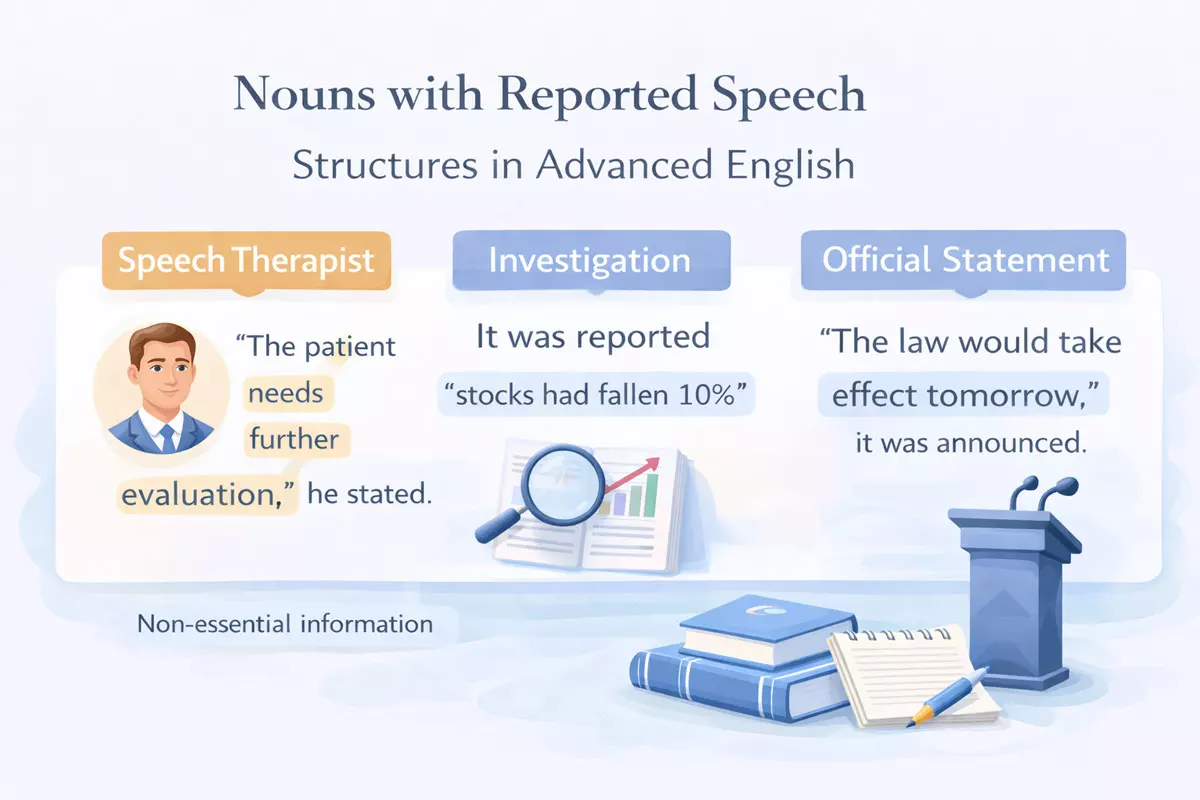 Here we how reporting nouns such as statement, claim, and report function in reported speech, including their use with that-clauses, tense and reference changes, formal and informal styles, common learner errors, and practical transformation exercises.
- How nouns function with reported speech patterns
- Common reporting nouns like statement, claim, and report
- Using that-clauses after reporting nouns
- Tense and reference shifts in reported noun structures
- Formal vs informal reporting styles using nouns
- Typical learner errors with reporting noun patterns
- Practice: transform direct speech into noun-based reporting
Understanding how specific nouns operate within indirect speech is an essential aspect of achieving fluency in advanced English. This article examines the ways these nouns function in indirect speech, providing clear explanations and practical examples to illustrate their role in conveying meaning accurately. By focusing on these structures, learners can enhance their communication skills, making their spoken and written English more precise and effective in a variety of contexts.
How nouns function with reported speech patterns
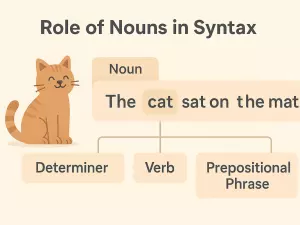
Nouns play a central role when conveying indirect statements, questions, or commands in advanced English. They frequently act as the “subject” or “object” within clauses introduced by reporting verbs, such as “say,” “tell,” “explain,” or “admit.” In reported speech, nouns often refer to the person or thing involved in the original utterance or become the anchor for information that follows.
The position and function of nouns in indirect discourse
Within indirect speech, the noun can specify who is speaking, who is being addressed, or what is being discussed. For example, in “She told the students that the exam would be postponed,” “the students” is the noun receiving the reported information. Similarly, “His admission that he was late surprised everyone” uses “his admission” as a noun phrase, summarizing the reported idea.
Common noun roles in reported structures
Nouns typically appear in the following ways when reporting speech or ideas:
- Agent of reporting: The person or entity conveying the information (“The manager announced…”).
- Recipient of information: Who receives the message (“He told his friend…”).
- Content noun: Summarizes the reported message (“Her claim that…”).
- Abstract concepts: Ideas or topics being discussed (“The suggestion that…”).
- Fact nouns: Used to introduce information as a fact (“The fact that…”).
- Question nouns: Used with indirect questions (“The question whether…”).
- Command/request nouns: Nouns summarizing directives (“His request to leave…”).
- Possessive nouns: Indicating ownership of the information (“John’s statement…”).
- Appositive nouns: Clarifying or renaming another noun (“Her promise, a surprise to everyone…”).
- Nominalization: Transforming verbs or adjectives into nouns to report speech (“Her refusal to participate…”).
Examples of noun usage in indirect speech

Consider these patterns, which show how nouns are integrated with reporting verbs and clauses:
- His denial that he knew anything was unconvincing.
- The question whether she would attend remained unanswered.
- Our belief that the plan would succeed gave us confidence.
- The manager’s announcement about the new policy surprised the staff.
- Her insistence on leaving early caused confusion.
- My suggestion that we take a break was ignored.
- The rumor that the event was canceled spread quickly.
- Tom’s advice to reconsider the offer was wise.
- The fact that you arrived on time was appreciated.
- The request for an extension was granted.
- His promise to help made a difference.
- The invitation to speak at the conference was accepted.
- The claim that the product is effective is disputed.
- Her explanation for the delay was satisfactory.
- The warning about the storm was taken seriously.
- The instruction to submit reports by Friday was clear.
- The hint that changes were coming was subtle.
- The assertion that the results are final cannot be challenged.
Comparing noun functions in reported and direct speech
| Direct Speech Structure | Reported Speech with Noun |
|---|---|
| He said, "I’m tired." | His admission of tiredness surprised us. |
| She asked, "Is it true?" | The question of its truth was raised by her. |
| The teacher said, "Submit your work." | The teacher’s instruction to submit work was clear. |
| They said, "We will help." | Their promise to help was appreciated. |
| She said, "I don’t know." | Her denial of knowledge was unexpected. |
Nouns in these contexts allow complex ideas to be summarized, referenced, or discussed efficiently. They provide clarity and specificity, especially in advanced writing, by encapsulating the entire content of a reported utterance within a single phrase. This usage is crucial for formal, academic, or professional communication, where conciseness and precision matter.
Common reporting nouns like statement, claim, and report
Reporting nouns play a pivotal role in advanced English, especially when summarizing or referencing what others have said. These nouns act as a bridge between the original words and your own writing, letting you express information, opinions, or findings in a concise way. Words such as “statement,” “claim,” and “report” are frequently used for this purpose, but there is a broad range of alternatives, each with its own nuance.
Typical Functions and Patterns
Reporting nouns often introduce indirect speech or summarize someone’s position. They can appear after reporting verbs, within passive structures, or as the subject of a sentence. For example:
- The statement issued by the spokesperson clarified the company’s position.
- Her claim that the policy was ineffective sparked debate.
- The report on climate change was widely discussed.
These nouns are usually followed by “that”-clauses, noun phrases, or prepositional phrases (e.g., “about,” “on,” “regarding”).
Expanded List of Common Reporting Nouns
Advanced users of English benefit from a varied vocabulary. Here are some frequently encountered reporting nouns:
- statement → His statement that the data were unreliable raised concerns.
- claim → The claim that the method is superior needs more evidence.
- report → The report that several errors occurred prompted a review.
- assertion → Her assertion that motivation affects performance was tested experimentally.
- suggestion → The suggestion that we include more participants improved the study design.
- recommendation → The recommendation that schools adopt digital tools was widely accepted.
- announcement → The announcement that the course would be online surprised many students.
- explanation → His explanation that the delay was unavoidable seemed reasonable.
- observation → The observation that children learn faster through play informed the policy.
- conclusion → The conclusion that exercise improves memory is supported by the results.
- assumption → The assumption that all variables were independent turned out to be false.
- admission → Her admission that the sample size was too small increased transparency.
- promise → The promise that funding would continue reassured the research team.
- warning → The warning that the system could fail was ignored.
- denial → Their denial that any rules were broken was questioned by investigators.
- proposal → The proposal that the schedule be changed was approved unanimously.
- complaint → The complaint that instructions were unclear appeared in several reviews.
- argument → His argument that technology widens inequality sparked debate.
- prediction → The prediction that demand would rise proved correct.
- confirmation → The confirmation that the results were accurate strengthened the study.
Comparing Meaning and Use
Different reporting nouns carry distinct implications. For instance, a “claim” often suggests doubt or lack of proof, while a “report” may indicate researched or official information. “Statement” is neutral and broad, suitable for any declared information.
| Noun | Typical Use / Nuance |
|---|---|
| statement | Neutral; a declared or officially communicated idea or fact. |
| claim | Often implies the information may be disputed or unproven. |
| report | Usually refers to researched, documented, or official information. |
| assertion | Emphasizes confidence and sometimes a lack of evidence. |
| suggestion | Indicates a proposal or idea rather than a fact. |
| warning | Highlights potential danger or risk expressed by someone. |
| recommendation | Advisory; based on expertise or authority. |
| complaint | Expresses dissatisfaction or criticism. |
Understanding the subtle distinctions among these nouns helps writers and speakers convey the original speaker’s intent more accurately. Selecting the right reporting noun can indicate your stance on the information—whether you view it as reliable, questionable, or merely suggested. For advanced English, mastering a range of these nouns and their structures is essential for nuanced communication.
Using that-clauses after reporting nouns
Many advanced English nouns can introduce reported information by linking directly to a that-clause. This structure is common in both academic and formal writing, allowing writers to present statements, beliefs, or findings clearly. Instead of using a reporting verb (like "say" or "claim"), the noun itself carries the reporting function.
Common reporting nouns followed by that-clauses
Writers often use certain nouns to summarize what someone said, thought, or discovered. Here are some frequently used examples:
- belief → The belief that education improves society is widely accepted.
- claim → The claim that the experiment was flawless is questionable.
- assumption → The assumption that participants understood the instructions was incorrect.
- suggestion → Her suggestion that we revise the plan was implemented immediately.
- statement → The statement that all results were verified was reassuring.
- fact → The fact that climate change is accelerating is undeniable.
- rumour → The rumour that the company was closing caused panic.
- possibility → The possibility that the vaccine is effective is encouraging.
- view → The view that technology enhances learning is supported by research.
- notion → The notion that success comes from effort alone is debated.
- idea → The idea that we can reduce waste inspired a new project.
- report → The report that errors were found prompted immediate action.
- promise → The promise that funding would continue reassured the team.
- conclusion → The conclusion that exercise improves cognition is supported by data.
- evidence → The evidence that the theory holds true is compelling.
- argument → His argument that taxes should be lowered was persuasive.
- fear → The fear that technology may replace jobs is widespread.
- hope → The hope that peace will prevail encouraged negotiations.
- realization → The realization that the system was flawed led to reform.
- decision → The decision that funding would be cut surprised many stakeholders.
Sentences with these nouns can be followed by a that-clause to express the content related to the noun. For example: "The assumption that prices will fall is unfounded." Here, "that prices will fall" explains what the assumption is.
Patterns and usage tips
The noun + that-clause pattern is especially useful for making writing more concise and formal. Notice these points:
- The that-clause often acts as a subject or object complement.
- Some nouns require an article or determiner (e.g., the claim that…, his belief that…).
- In spoken English, "that" is sometimes omitted after reporting verbs, but it is usually kept after reporting nouns for clarity.
- Use this structure to avoid repeating verbs like "say," "think," or "believe" in academic writing.
Examples of reporting nouns with that-clauses
- The claim that the earth is flat has been debunked.
- There is a rumour that the company will merge with a competitor.
- Her view that early intervention matters shaped the policy.
- He made the suggestion that we postpone the meeting.
- The fact that she speaks five languages impressed the panel.
- They expressed the hope that the weather would improve.
- Our decision that everyone should participate was unanimous.
- The evidence that climate change is accelerating is overwhelming.
- His fear that he would fail proved unfounded.
- The realization that time was limited spurred them to act.
Comparing reporting nouns and reporting verbs
This structure is distinct from sentences using reporting verbs. Consider the comparison below:
| Reporting Noun + that-clause | Reporting Verb + that-clause |
|---|---|
| The belief that the project will succeed is widespread. | Many people believe that the project will succeed. |
| Her suggestion that we meet earlier was accepted. | She suggested that we meet earlier. |
| The conclusion that he was guilty shocked everyone. | They concluded that he was guilty. |
| The hope that peace is possible remains strong. | They hope that peace is possible. |
This comparison highlights how reporting nouns can make statements more formal and often more objective.
Summary
Using reporting nouns followed by that-clauses is a powerful way to present information, arguments, and opinions in advanced English. This pattern is especially useful in formal writing, academic texts, and structured arguments, where clarity and objectivity are valued. By mastering this structure, you can add variety and sophistication to your English expression.
Tense and reference shifts in reported noun structures
Advanced English often presents challenges when transforming direct statements into reported speech, especially within noun phrases that encapsulate reported content. Shifts in tense and reference are not limited to full clauses; they also appear in noun-based structures, subtly altering meaning and requiring attention to grammatical detail.
Understanding Shifts in Noun-Based Reporting
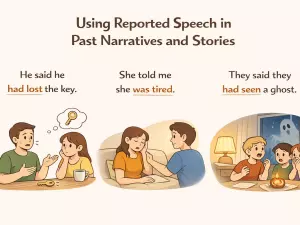
When nouns like "announcement," "claim," or "belief" are used to report speech or thought, the verbs and references embedded within these structures often change to reflect indirectness, time distance, or speaker perspective. For advanced learners, recognizing these shifts is crucial for accuracy and nuance.
- Tense backshifting: Present tense in direct speech frequently becomes past tense in reported noun phrases (e.g., "the claim that he was late").
- Reference adjustment: Pronouns and time expressions are modified to fit the context of reporting (e.g., "today" becomes "that day," "I" becomes "he/she").
- Modal changes: Modals like "will" may become "would," and "can" may become "could" within the noun phrase.
- Article and possessive changes: Definite and indefinite articles, as well as possessive adjectives, may shift to maintain coherence.
Common Patterns and Examples

The following table illustrates how direct statements are transformed when embedded in noun structures, highlighting both tense and reference shifts:
| Direct Statement | Reported Noun Structure |
|---|---|
| She says, "I am tired." | Her statement that she was tired |
| He claims, "We will win." | His claim that they would win |
| They announce, "The event is today." | Their announcement that the event was that day |
| John insists, "This is my book." | John's insistence that it was his book |
| Mary reports, "I can help." | Mary's report that she could help |
| He notes, "She has left." | His note that she had left |
| They believe, "We are right." | Their belief that they were right |
| The manager says, "You must finish." | The manager's instruction that we had to finish |
| She remarks, "It is raining." | Her remark that it was raining |
| He warns, "You should not go." | His warning that we should not go |
Key Points for Advanced Learners
- Always consider the time frame of the original speech versus the reporting context.
- Adjust pronouns and temporal markers to preserve clarity and reference.
- Be alert to modal verb shifts, which affect both meaning and formality.
- Practice with a variety of reporting nouns to build flexibility and precision in usage.
By mastering these transformations, speakers and writers can accurately convey reported ideas within complex noun phrases, maintaining both grammatical correctness and subtlety of meaning.
Formal vs informal reporting styles using nouns
In advanced English, the choice between formal and informal reporting often hinges on the nouns and structures you use to convey reported speech. Academic, business, or professional contexts tend to favor more precise and abstract nouns, while conversational settings use simpler, more direct alternatives. Recognizing these differences enables you to adjust your style for appropriateness and clarity.
Common reporting nouns in formal contexts
Writers and speakers in formal situations frequently select nominalizations and abstract nouns to introduce reported information. Some typical choices include:
- assertion → Her assertion that the data was flawed sparked debate.
- claim → The claim that the results were accurate was challenged.
- statement → His statement that the project would finish on time reassured everyone.
- observation → The observation that students learn faster through practice informed the study.
- recommendation → The recommendation that the policy be revised was accepted.
- admission → Her admission that the experiment failed increased transparency.
- agreement → The agreement that funding would continue was signed by all parties.
- denial → The denial that any mistakes were made was questioned by colleagues.
- prediction → The prediction that the economy would grow proved correct.
- conclusion → The conclusion that more research is needed is widely supported.
- suggestion → The suggestion that the team meet earlier improved efficiency.
- explanation → His explanation that the delay was unavoidable seemed reasonable.
- warning → The warning that the system could fail was ignored.
- request → The request that all files be submitted on time was followed.
- announcement → The announcement that the conference was postponed reached everyone.
- proposal → The proposal that additional resources be allocated was approved.
These nouns often appear in written reports, research papers, or news articles. For example: Her assertion that the data was flawed sparked debate.
Informal reporting with nouns
In casual conversation, speakers usually opt for more accessible nouns or even omit them, relying on direct speech or verbs instead. When nouns are used, they tend to be simple and familiar:
- idea → I had an idea that we could start earlier.
- thought → She shared her thought that it might rain today.
- note → He made a note that the meeting was cancelled.
- plan → Their plan to visit the museum seemed fun.
- story → She told a story that made everyone laugh.
- promise → He kept his promise that he would help.
- excuse → I accepted his excuse that he was late.
- joke → They shared a joke that lightened the mood.
- answer → Her answer that she could attend was appreciated.
- question → He asked a question that confused the audience.
For instance: He made a promise to call back. Or, more informally still: He said he’d call back.
Comparing structures: Formal vs informal
The following table highlights typical differences in reporting noun use and structure between the two styles:
| Formal Structure | Informal Structure |
|---|---|
| There was an admission that she had made a mistake during the experiment. | She admitted that she had made a mistake during the experiment. |
| The recommendation was made that all participants complete the survey by Friday. | They suggested that all participants complete the survey by Friday. |
| His denial of involvement in the project was clearly stated in the report. | He denied being involved in the project. |
| Her observation indicated that students performed better in smaller groups. | She noticed that students performed better in smaller groups. |
| The conclusion reached was that further research was necessary to confirm the findings. | They decided that further research was necessary to confirm the findings. |
Choosing the right noun for your context
Selecting between formal and informal reporting nouns depends on audience and purpose. In academic writing, nouns like assertion or recommendation signal objectivity and distance. In everyday conversation, direct verbs or basic nouns keep exchanges natural and clear. Mastery of this distinction is a marker of advanced proficiency in English, allowing you to tailor your speech or writing for maximum effectiveness.
Typical learner errors with reporting noun patterns
Advanced English students often struggle with noun-based reporting structures, especially when shifting from direct to indirect speech. These difficulties usually stem from confusion over correct verb forms, word order, and the use of necessary connectors or prepositions. Mastering these patterns is essential for clear, accurate academic and formal writing.
Common mistakes with reporting nouns
Learners frequently make predictable slip-ups when using reporting nouns (e.g., claim, suggestion, statement) that introduce reported information. Some of the most frequent issues include:
- Using the wrong preposition after the reporting noun (“the suggestion of to leave” ❌ instead of “the suggestion to leave” ✅)
- Confusing noun and verb patterns (“the claim that to have seen” ❌ vs. “the claim that he saw” ✅)
- Omitting the required clause introducer (“the announcement he would resign” ❌ instead of “the announcement that he would resign” ✅)
- Overusing “of” structures even when not needed (“the report of that prices rose” ❌)
- Directly translating from native language patterns, leading to unnatural or incorrect phrases
Typical reporting noun patterns: Errors and corrections
Learners need to remember that different reporting nouns require different structures. For example, some are followed by “that”-clauses, others by infinitives, and some by gerunds or prepositional phrases. The following table outlines common reporting nouns, incorrect student uses, and the correct pattern to use:
| Reporting Noun | Incorrect Example | Correct Pattern |
|---|---|---|
| Claim | the claim of that he was right | the claim that he was right |
| Suggestion | the suggestion of going home | the suggestion to go home |
| Announcement | the announcement he would leave | the announcement that he would leave |
| Advice | the advice to that we study | the advice to study |
| Promise | the promise of to help | the promise to help |
| Report | the report of prices rose | the report that prices rose |
| Request | the request of him to attend | the request for him to attend |
| Demand | the demand to that action be taken | the demand that action be taken |
| Offer | the offer that to help | the offer to help |
| Recommendation | the recommendation for to read more | the recommendation to read more |
Further pitfalls to avoid
Another frequent error is mismatching verb tense or person within the reported clause, especially in academic writing. Learners should also be careful not to overcomplicate sentences by mixing multiple reporting structures or omitting necessary determiners (e.g., “a suggestion that…”).
Summary tips for mastering reporting noun patterns
- Check which structure (that-clause, infinitive, gerund, or prepositional phrase) is required for each reporting noun.
- Avoid literal translation from your first language.
- Review reporting noun lists and practice with varied examples.
- Compare your sentences to reliable model texts for accuracy.
By paying attention to these common trouble spots, advanced English users can greatly improve the clarity and correctness of their reported speech structures.
Practice: transform direct speech into noun-based reporting
Mastering the conversion of direct quotations into noun-based reporting structures is essential for advanced English writing and academic communication. This approach often enhances objectivity and conciseness, especially in essays, reports, and research. Let’s work through various examples to reinforce this skill.
Common Patterns for Noun-Based Reporting
- The claim that the new policy would reduce emissions was supported by evidence.
- The suggestion that the meeting be postponed was accepted by the team.
- The argument that technology improves learning outcomes is widely discussed.
- The announcement of the conference date excited the participants.
- The assertion that the experiment was flawless was questioned by reviewers.
- The denial of any wrongdoing was published in the official report.
- The statement that all results were verified reassured the readers.
- The warning that the system could fail prompted immediate action.
- The proposal to increase funding was approved unanimously.
- The admission that mistakes were made increased transparency.
- The insistence that safety protocols be followed was emphasized by the manager.
- The explanation that the delay was unavoidable clarified the situation.
- The observation that students learn faster through practice informed the curriculum.
- The confirmation of the results strengthened the validity of the study.
- The promise to provide additional resources reassured the team.
Transformation Task: Rewrite Direct Speech
Rewrite each direct quote below into a noun-based reporting structure. Focus on changing the verb-based reporting (e.g., "said", "claimed") into a noun phrase that encapsulates the speaker’s action or intent.
- Maria said, "I will help with the project."
- The manager announced, "There will be a meeting tomorrow."
- He claimed, "I have finished the assignment."
- The teacher warned, "This chapter is important for the exam."
- The scientist explained, "These results support our hypothesis."
- The spokesperson denied, "We did not receive any complaints."
- She promised, "I won’t be late again."
- The lawyer argued, "The evidence is insufficient."
- He admitted, "I forgot to send the email."
- The report stated, "Global temperatures are rising."
Show answers
- Maria’s promise to help with the project.
- The manager’s announcement of a meeting the next day.
- His claim that he had finished the assignment.
- The teacher’s warning that the chapter was important for the exam.
- The scientist’s explanation that the results supported their hypothesis.
- The spokesperson’s denial of having received any complaints.
- Her promise not to be late again.
- The lawyer’s argument that the evidence was insufficient.
- His admission that he had forgotten to send the email.
- The report’s statement that global temperatures were rising.
Comparison: Direct vs. Noun-Based Reporting Structures
| Direct Speech | Noun-Based Reporting |
|---|---|
| “I don’t agree with this policy,” she said. | Her disagreement with the policy. |
| “We will launch a new product,” the CEO announced. | The CEO’s announcement of a new product launch. |
| “I am sorry for the delay,” he apologized. | His apology for the delay. |
| “This method improves results,” the researcher asserted. | The researcher’s assertion that the method improved results. |
| “Let’s postpone the meeting,” she suggested. | Her suggestion to postpone the meeting. |
| “We achieved our target,” the team reported. | The team’s report of achieving their target. |
| “It is not my responsibility,” he insisted. | His insistence that it was not his responsibility. |
| “I saw him at the event,” she observed. | Her observation that she had seen him at the event. |
| “You must submit the form today,” the official instructed. | The official’s instruction to submit the form that day. |
| “I have no further comments,” the spokesperson stated. | The spokesperson’s statement that they had no further comments. |
Tips for Clear Noun-Based Reporting
- Identify the reporting verb and choose a corresponding noun (e.g., "claim" → "claim", "explain" → "explanation").
- Shift the content of the direct speech into a noun clause or infinitive phrase as appropriate.
- Maintain the original meaning and tense where possible.
- Use these forms in formal writing to increase clarity and objectivity.
- Practice with a variety of reporting verbs to expand your flexibility.