Nouns Followed by That-Clauses in Academic English

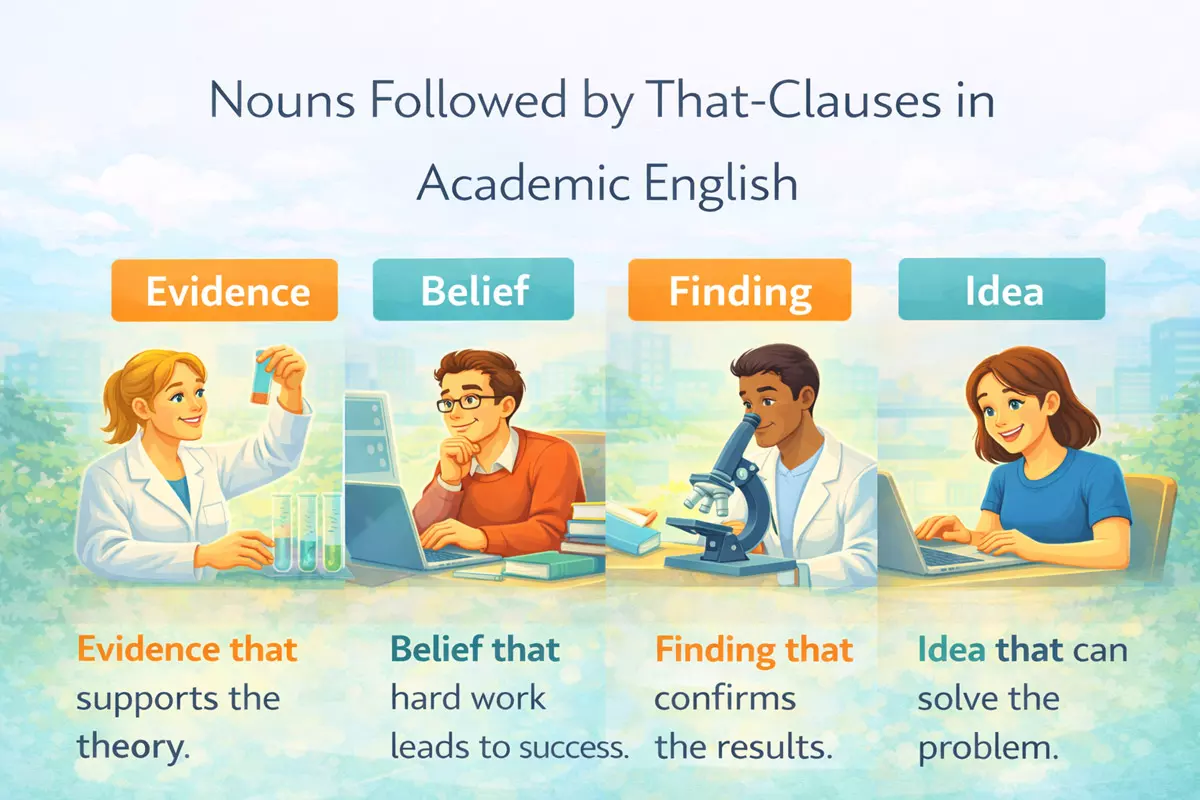 Here we how noun plus that-clause structures are used, details common academic nouns and their reporting functions, explains when to omit or keep that, explores meaning differences, and highlights typical learner errors with practice exercises.
- What noun + that-clause structures express
- Common academic nouns followed by that-clauses
- Functions of that-clauses after reporting nouns
- Omission vs retention of that in formal writing
- Meaning differences created by that-clause complements
- Typical learner errors with verb form and structure
- Practice: complete sentences using noun + that-clause patterns
In academic writing, certain nouns serve as links to introduce detailed explanations or statements, often followed by subordinate clauses that provide further information. Mastering these grammatical structures enables students and researchers to articulate complex ideas more precisely and clearly within scholarly texts. By understanding how these naming words function, writers can improve the clarity, coherence, and depth of their academic arguments, making their work more effective and engaging for readers in their field.
What noun + that-clause structures express
Noun + that-clause patterns are commonly used in academic English to convey complex ideas, report information, and introduce arguments. These structures allow writers to present facts, beliefs, or findings in a more precise and formal way. Instead of simply stating information, these patterns help frame the information as a claim, observation, or conclusion, which is particularly useful in scholarly writing.
Common functions of noun + that-clause constructions
Writers use these structures to achieve several communicative goals. Some of the main uses include:
- Stating research findings (e.g., the fact that climate change is accelerating)
- Expressing beliefs or assumptions (e.g., the assumption that all variables were controlled)
- Reporting opinions (e.g., the idea that technology always improves life)
- Highlighting problems or issues (e.g., the problem that resources are limited)
- Emphasizing importance (e.g., the importance that teamwork plays in success)
- Describing evidence (e.g., the evidence that supports the hypothesis)
- Summarizing results (e.g., the result that productivity increased)
- Identifying reasons (e.g., the reason that sales declined)
- Noting discrepancies (e.g., the discrepancy that exists between studies)
- Pointing out consequences (e.g., the consequence that pollution causes health issues)
- Clarifying requirements (e.g., the requirement that students submit reports)
- Referring to claims (e.g., the claim that exercise improves mood)
- Mentioning suggestions (e.g., the suggestion that further research is needed)
- Outlining proposals (e.g., the proposal that fees be reduced)
- Introducing warnings (e.g., the warning that the data may be incomplete)
- Stating acknowledgments (e.g., the acknowledgment that errors occurred)
- Describing observations (e.g., the observation that students participated actively)
- Noting predictions (e.g., the prediction that demand will grow)
How these structures shape academic discourse
By using noun + that-clause forms, academic writers can distance themselves from the information, present it as generally accepted, or attribute it to a source. This helps achieve objectivity and clarity. For example, saying "The claim that this method is superior" positions the statement as someone’s assertion rather than the writer’s direct opinion.
Examples of nouns frequently used before that-clauses

Below is a structured overview of typical nouns that often precede that-clauses in academic writing, along with the function they serve:
| Noun | Function in Academic English |
|---|---|
| assumption | Expresses something taken for granted or accepted as true |
| fact | Presents information as objective or proven |
| claim | Attributes a statement or viewpoint to a source |
| evidence | Indicates supporting information or justification |
| idea | Introduces a concept or theory |
| suggestion | Refers to a proposed course of action or recommendation |
| concern | Highlights issues or areas needing attention |
| belief | Signals a conviction or widely held opinion |
| notion | Describes a general concept or impression |
| warning | Draws attention to possible risks or problems |
In summary, these constructions are essential in formal writing for framing information, referencing sources, and supporting clear academic argumentation.
Common academic nouns followed by that-clauses
In academic English, certain nouns are frequently used as the subject or object of sentences and are followed by a that-clause to introduce additional information, explanation, or evidence. These structures allow writers to present claims, summarize findings, or state beliefs in a precise and formal way. Understanding which nouns can be followed by that-clauses helps improve clarity and sophistication in academic writing.
Typical nouns introducing that-clauses
Writers often choose specific nouns to lead into a that-clause. These nouns usually signal that the information to follow is a statement, idea, or result. Here are some of the most common options:
- Assumption → The plan is based on the assumption that costs will stay low.
- Belief → It’s his belief that everyone deserves equal opportunities.
- Claim → She made the claim that the product is 100% safe.
- Conclusion → We reached the conclusion that further testing is required.
- Concern → There is growing concern about water shortages.
- Discovery → The discovery changed how scientists view the disease.
- Evidence → There is no solid evidence to support the theory.
- Fact → It’s a known fact that exercise improves mental health.
- Finding → Their main finding was that students learn faster online.
- Hypothesis → The hypothesis still needs to be tested further.
- Idea → The idea came to him during breakfast.
- Implication → The decision has serious financial implications.
- Notion → She rejected the notion that success happens overnight.
- Observation → His observation revealed clear patterns in behavior.
- Possibility → There is a strong possibility of rain tomorrow.
- Prediction → Their prediction was that sales would increase.
- Proposal → The proposal was approved by the board.
- Realization → Her realization changed the direction of the conversation.
- Statement → The official statement will be released at noon.
- Suggestion → She offered a helpful suggestion during the meeting.
These nouns are often used in patterns such as: the claim that, the evidence that, or the suggestion that. For example: The assumption that all variables are independent is often challenged in recent studies.
How these nouns function in context
Using these structures, writers can introduce complex ideas or summarize research in a concise way. The noun signals the type of information, while the that-clause provides the specific content. For instance, “The finding that exercise improves cognitive function has been widely supported” clearly connects the research result with the evidence.
Examples of academic usage
Below are sample sentences illustrating how these nouns are commonly followed by that-clauses in academic writing:
- There is growing evidence that climate change affects weather patterns.
- The hypothesis that sleep enhances memory was tested in several experiments.
- His statement that technology will replace many jobs is controversial.
- Researchers rejected the notion that genes alone determine intelligence.
- The observation that children learn languages quickly is well-documented.
These patterns help writers communicate complex relationships and findings efficiently and are a key part of formal academic style. Recognizing and using these nouns with that-clauses can elevate the clarity and authority of your academic work.
Functions of that-clauses after reporting nouns
In academic and formal writing, clauses introduced by "that" often follow nouns related to reporting, such as "claim," "suggestion," or "observation." These constructions allow writers to present information, state opinions, or summarize findings with precision. The use of such clauses helps to clarify what is being reported, believed, or asserted, making arguments more explicit and cohesive.
Key Purposes of That-Clauses
That-clauses after reporting nouns typically serve several communicative functions:
- Expressing reported information: They relay what someone has said, suggested, or discovered, e.g., "the claim that the results are significant."
- Clarifying content: They specify the exact content of a report, belief, or idea, reducing ambiguity.
- Summarizing research: Academic writers use them to encapsulate findings or arguments, e.g., "the observation that temperature affects reaction speed."
- Attributing responsibility: They make it clear who holds a particular view or has made a particular assertion.
Common Patterns with Reporting Nouns
Writers frequently combine reporting nouns with that-clauses to introduce statements. Here are some typical examples:
- the argument that climate change is accelerating
- the suggestion that further research is needed
- the assumption that all variables were controlled
- the belief that exercise improves mental health
- the conclusion that the hypothesis was correct
- the finding that rates increased over time
- the proposal that new methods should be tested
- the statement that funding is limited
- the warning that results may be inconclusive
- the report that cases are rising
- the claim that the policy is effective
- the observation that errors were frequent
- the expectation that data will be shared
- the recognition that more evidence is required
- the prediction that demand will grow
- the explanation that delays were unavoidable
- the announcement that new guidelines apply
- the declaration that the project is finished
Comparison of Reporting Noun Functions
The table below illustrates how different reporting nouns paired with that-clauses convey various types of information:
| Reporting Noun | Typical Function in Academic Context |
|---|---|
| Claim | Expresses an assertion or position, often requiring evidence. |
| Suggestion | Indicates a proposed idea or course of action for consideration. |
| Observation | Describes something noticed or recorded, often as a result of research. |
| Conclusion | Presents a final judgment or inference drawn from evidence. |
| Assumption | States something accepted as true without proof, as a basis for reasoning. |
| Finding | Reports a result or discovery from a study or experiment. |
| Announcement | Communicates new or important information officially. |
| Belief | Expresses a conviction or accepted truth, often subjective. |
These patterns are especially valued in scholarly discourse for their ability to present complex information clearly and objectively. By mastering such structures, academic writers can better attribute sources, synthesize research, and present nuanced arguments.
Omission vs retention of that in formal writing
In academic English, whether to include or leave out the word that after nouns introducing clauses is a stylistic choice with real implications for clarity and tone. Formal writing tends to favor precision, which often means retaining that to avoid ambiguity. However, omitting that is sometimes possible, especially when the meaning remains clear and the sentence is not overly complex.
When to Keep that for Clarity
Writers frequently retain that in contexts where its omission could lead to confusion or misreading. This is especially true in sentences with long or complicated noun clauses, or when multiple clauses are involved. Consider these points:
- Complex sentences with embedded clauses benefit from keeping that.
- When the noun clause follows a noun such as evidence, assumption, suggestion, or belief, that is usually retained.
- If omitting that would make the sentence ambiguous, it should be included.
Situations Where Omitting that is Acceptable
In less formal contexts or when the clause is short and straightforward, leaving out that can make writing more concise without sacrificing clarity. However, this is less common in academic texts.
- Short, simple noun clauses may allow omission.
- If the subject and structure of the sentence are unmistakable, that can sometimes be dropped.
- Writers may omit that after reporting nouns in informal writing or spoken English, but this is rare in scholarly articles.
Comparison: Retaining vs Omitting that after Nouns
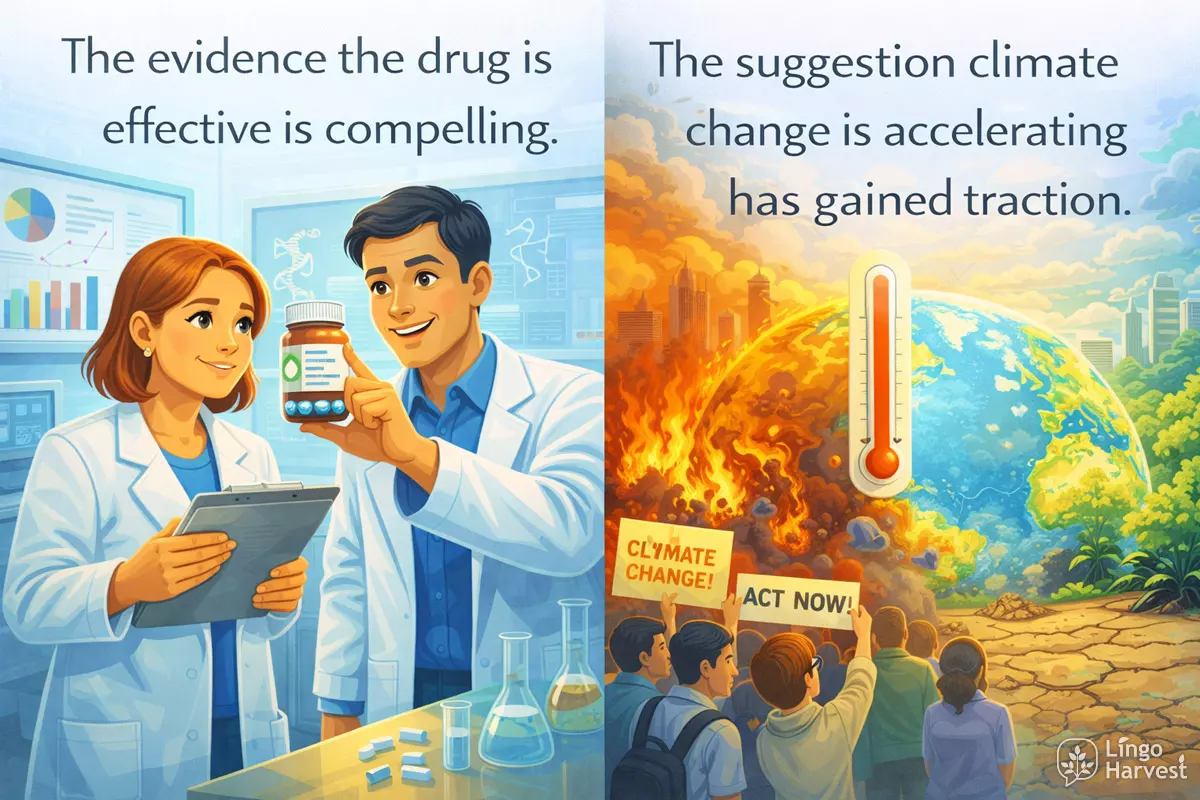
| With that | Without that |
|---|---|
| The evidence that the drug is effective is compelling. | The evidence the drug is effective is compelling. |
| The suggestion that climate change is accelerating has gained traction. | The suggestion climate change is accelerating has gained traction. |
| The assumption that all variables are independent is flawed. | The assumption all variables are independent is flawed. |
| The claim that results were manipulated was investigated. | The claim results were manipulated was investigated. |
Common Nouns Followed by that-Clauses
Writers often encounter these nouns followed by a that-clause in academic prose:
- Argument – The argument that online learning increases flexibility is widely supported.
- Assertion – The assertion that the data were manipulated was never proven.
- Expectation – The expectation that students will complete the task independently is unrealistic.
- Explanation – The explanation that the delay was caused by traffic seemed reasonable.
- Indication – There is an indication that performance has improved over time.
- Proof – There is no proof that this method is more effective.
- Report – The report that several samples were contaminated raised concerns.
- Result – The result that treatment A outperforms treatment B was unexpected.
- Theory – The theory that language influences thought has been debated for decades.
- View – The view that technology isolates people is not shared by everyone.
- Rumor – The rumor that the company will close two offices has spread quickly.
- Confirmation – We received confirmation that the payment had been processed.
- Estimate – The estimate that costs will double next year is worrying.
- Agreement – The agreement that both sides will share data was signed yesterday.
- Announcement – The announcement that the policy would change surprised employees.
- Guarantee – There is no guarantee that the plan will succeed.
- Perception – The perception that the course is too difficult discourages some learners.
- Recognition – There is recognition that climate change affects all regions.
- Inference – The inference that the system is failing comes from limited evidence.
- Promise – The promise that support will be available 24/7 encouraged more users to join.
- Warning – The warning that the river might flood was ignored by many residents.
Summary
Academic style generally favors the inclusion of that after reporting nouns to maximize clarity and formality. Omitting it is rare in scholarly writing and should only be done when the meaning remains unmistakable. Retaining that helps readers process complex information smoothly, which is a key aim in academic communication.
Meaning differences created by that-clause complements
How a noun is followed by a that-clause can shape the nuance of the sentence in academic writing. The presence of a that-clause after certain nouns often shifts the focus, adding detail, clarification, or a stance, and sometimes even changing the core meaning. For instance, “the claim that…” versus “the fact that…” signal different levels of certainty and perspective. Recognizing these variations is crucial for clear academic communication.
Shifts in certainty and objectivity
Some nouns with that-clauses indicate a strong assertion, while others introduce doubt or neutrality. For example:
- Fact that → indicates something accepted as true
- Claim that → suggests an idea is being asserted, but not necessarily accepted
- Assumption that → marks something taken for granted, possibly without proof
- Suggestion that → points to a proposal or recommendation, not a confirmed truth
- Evidence that → refers to support for a position, but not the position itself
- Possibility that → signals uncertainty or potential
- Argument that → emphasizes logical reasoning rather than fact
- Decision that → focuses on a conclusion reached
- Demand that → expresses a requirement or request
- Observation that → highlights something noticed or recorded
- Promise that → commits to future action
- Warning that → alerts to potential danger or need for caution
- Rumor that → suggests unverified information
- Belief that → reflects a personal or group conviction
- Knowledge that → points to information understood as true
- Fear that → introduces anxiety or concern
- Expectation that → expresses anticipation or assumption about the future
- Requirement that → identifies a necessity or rule
- Announcement that → publicizes information formally
Comparing noun + that-clause patterns
The choice of noun before a that-clause often signals the writer’s attitude or the function of the information. The table below summarizes some common academic patterns:
| Noun + that-clause | Typical Meaning/Implication |
|---|---|
| the fact that | ✅ Presents established truth or reality |
| the claim that | → Suggests unverified assertion or contested point |
| the assumption that | → Indicates a premise accepted without proof |
| the suggestion that | → Implies a tentative or hypothetical idea |
| the evidence that | ✅ Provides support for a claim, but not absolute proof |
| the rumor that | ❌ Points to information that may be false or unsubstantiated |
| the possibility that | → Highlights uncertainty or potentiality |
Implications for academic writing
Selecting the right noun before a that-clause helps writers clearly convey stance, certainty, and the type of information presented. Misusing these patterns can lead to confusion or unintended bias. Careful attention to these subtle distinctions makes academic texts more precise and credible.
Typical learner errors with verb form and structure
Understanding how nouns are followed by that-clauses in academic English can be challenging for learners, especially when it comes to verb agreement, tense consistency, and clause structure. These challenges often lead to confusion or ungrammatical sentences. Below, we explore frequent issues and illustrate them with practical examples.
Common difficulties in verb usage after noun + that-clause
Learners often struggle with selecting the appropriate verb tense or form within the that-clause. The main problems include mismatched tenses, incorrect subject-verb agreement, and confusion between indicative and subjunctive moods.
- Using present tense where past is needed: "The result that shows..." instead of "The result that showed..."
- Omitting necessary auxiliaries: "The evidence that he guilty..." instead of "The evidence that he is guilty..."
- Incorrect subject-verb agreement: "The data that supports..." instead of "The data that support..."
- Mixing up indicative and subjunctive: "The suggestion that he goes..." instead of "The suggestion that he go..."
- Confusing singular and plural forms: "The findings that suggests..." instead of "The findings that suggest..."
- Unnecessary repetition of subjects: "The claim that that he..."
- Including modal verbs incorrectly: "The idea that he can goes..."
- Using passive voice awkwardly: "The belief that is held that..."
- Misplacing negation: "The assumption that not all people are..." (better: "The assumption that all people are not..." or vice versa, depending on meaning)
- Fragmented clauses: "The argument that because..." (incomplete clause)
Confusion between noun + that-clause and other structures
Another frequent issue is mixing up that-clauses with relative clauses or gerund forms. This can result in sentences that are unclear or grammatically incorrect.
- Using a relative clause instead of a that-clause: "The fact which he left..." instead of "The fact that he left..."
- Replacing that-clause with an infinitive: "The plan to he arrives..." instead of "The plan that he arrives..."
- Using a gerund: "The possibility of he leaving..." instead of "The possibility that he leaves..."
Comparison of correct and incorrect verb structures
| Incorrect Structure | Correct Structure |
|---|---|
| The claim that he is knows the answer. | The claim that he knows the answer. |
| The suggestion that he goes to the meeting. | The suggestion that he go to the meeting. |
| The evidence that support the theory. | The evidence that supports the theory. |
| The idea that he can goes alone. | The idea that he can go alone. |
| The assumption that all people is equal. | The assumption that all people are equal. |
| The belief that is held that he is right. | The belief that he is right. |
Summary
To avoid these pitfalls, learners should focus on ensuring verb form and tense match the meaning intended by the noun + that-clause structure, and double-check that subject-verb agreement is accurate. Awareness of these common patterns can help writers in academic contexts produce clearer, more precise sentences.
Practice: complete sentences using noun + that-clause patterns
Understanding how to use nouns followed by that-clauses is essential for clear, precise academic writing. These structures help express evidence, beliefs, expectations, and other abstract concepts. Below you’ll find varied exercises and examples to build confidence in using this grammatical pattern.
Task 1: Complete the Sentences
Fill in the blanks by adding a suitable that-clause after the noun in each sentence.
- The assumption __________ was later questioned by new research.
- There is a possibility __________ will change in the near future.
- The fact __________ cannot be ignored by policymakers.
- Her belief __________ shaped the direction of the discussion.
- The suggestion __________ was accepted by the entire team.
- The claim __________ was not supported by the data.
- The observation __________ helped refine the hypothesis.
- The prediction __________ turned out to be correct.
- The evidence __________ was presented during the trial.
- The conclusion __________ was reached after extensive analysis.
Show answers
- The assumption that the data was accurate was later questioned by new research.
- There is a possibility that funding will change in the near future.
- The fact that climate change is accelerating cannot be ignored by policymakers.
- Her belief that cooperation leads to better results shaped the direction of the discussion.
- The suggestion that more training is needed was accepted by the entire team.
- The claim that the new method was superior was not supported by the data.
- The observation that students learn better in smaller groups helped refine the hypothesis.
- The prediction that sales would increase turned out to be correct.
- The evidence that the product was unsafe was presented during the trial.
- The conclusion that further research is necessary was reached after extensive analysis.
Task 2: Identify the Noun + That-Clause Pattern
In each example below, identify the noun and the that-clause. Write them in your notes.
- The evidence that the experiment was flawed became clear.
- His theory that language shapes thought is widely discussed.
- The proposal that we extend the deadline was approved.
- There is a warning that the process may be dangerous.
- The conclusion that the treatment is effective was unexpected.
- The assumption that all participants understood the task was incorrect.
- The prediction that sales would rise proved accurate.
- The announcement that the policy would change surprised employees.
- The belief that hard work leads to success is common.
- The statement that the data was lost caused concern.
Show answers
- evidence (noun); that the experiment was flawed (that-clause)
- theory; that language shapes thought
- proposal; that we extend the deadline
- warning; that the process may be dangerous
- conclusion; that the treatment is effective
- assumption; that all participants understood the task
- prediction; that sales would rise
- announcement; that the policy would change
- belief; that hard work leads to success
- statement; that the data was lost
Patterns in Academic Writing
Here is a structured overview of how these noun + that-clause patterns appear in academic contexts:
| Noun | Example with That-Clause |
|---|---|
| assumption | The assumption that all variables are independent is often unrealistic. |
| fact | The fact that the results were consistent supports the hypothesis. |
| suggestion | The suggestion that further research is necessary was well received. |
| view | The view that technology improves learning is gaining popularity. |
| evidence | There is evidence that stress affects memory. |
| notion | The notion that creativity can be measured is debated. |
| belief | The belief that exercise reduces anxiety is supported by data. |
| indication | The indication that sales will increase is encouraging. |
Practicing with these patterns will help you write more complex and nuanced sentences in formal English. Try creating additional examples using the nouns provided above.