Noun Stackings in Technical and Scientific English Texts

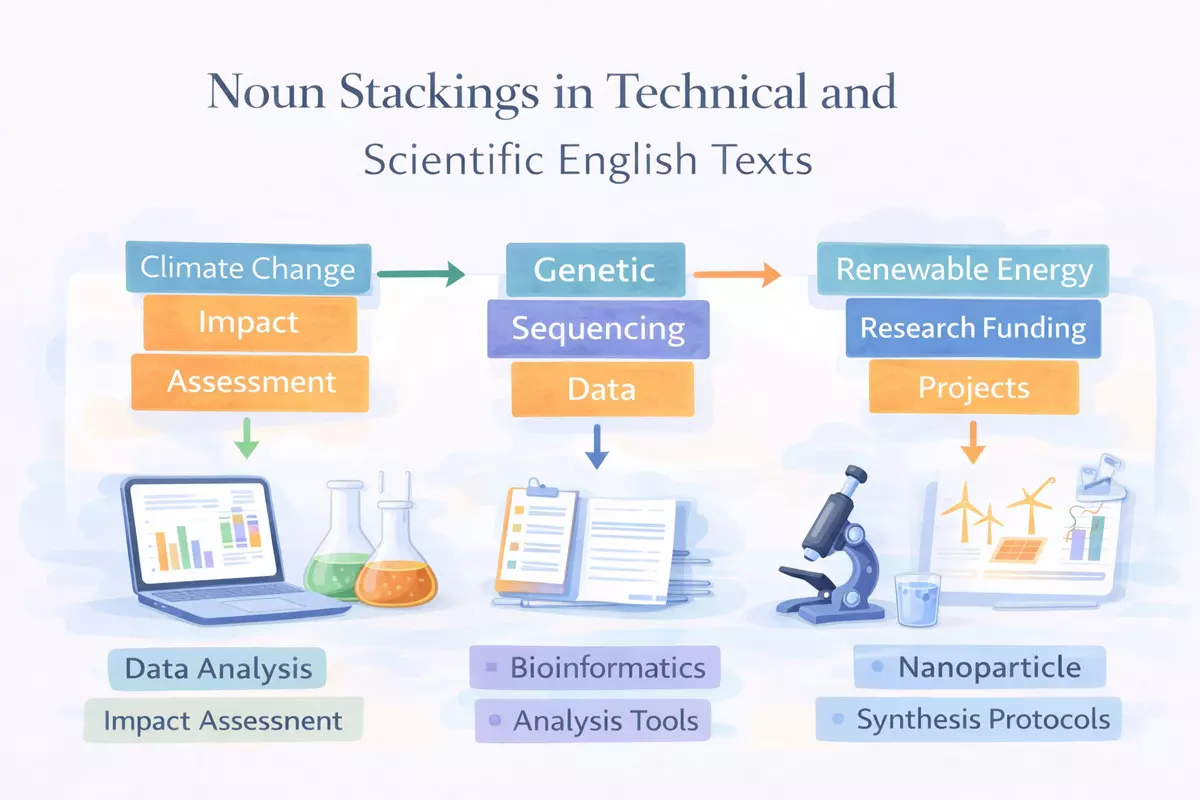 Here we what noun stacking is in technical writing, how stacked nouns create compact meanings, common patterns in science and technology, strategies to unpack long stacks, risks of ambiguity, differences from general English, and practice in paraphrasing.
- What noun stacking means in technical writing
- How multiple nouns build compact technical meaning
- Typical noun stack patterns in science and technology
- Reading strategies for unpacking long noun stacks
- Risks of ambiguity in heavy noun stacking
- Differences between technical and general English usage
- Practice: break down and paraphrase noun stacks
Dense clusters of nouns frequently occur in scientific and technical writing, where they condense complex ideas into brief expressions. While this style can increase efficiency and precision, it often makes sentences harder to understand, especially for readers unfamiliar with the subject. Such compact noun groupings can also complicate translation into other languages, as the relationships between terms are not always clear. As a result, careful analysis of their structure and purpose is essential for effective communication.
What noun stacking means in technical writing
Noun stacking, also called noun compounding, refers to the practice of placing multiple nouns together to form a single, compressed phrase. This is common in scientific and technical documents, where writers often need to express complex ideas concisely. For example, instead of saying “the system that manages user accounts,” a writer might use “user account management system.” These condensed chains can make text efficient but also risk creating ambiguity or confusion, especially for readers unfamiliar with the subject area.
How noun stacks are formed
A noun stack is created by combining two or more nouns, where the first noun modifies the one that follows. Often, the first several elements act as adjectives, while the final noun is the main subject. The result is a dense phrase that packs significant meaning into a few words. Commonly, these stacks appear in technical terminology, documentation, and academic papers.

- Data processing algorithm
- Server configuration file
- Machine learning model
- Network security protocol
- User authentication process
- Temperature sensor calibration
- Battery life estimation method
- Cloud storage solution
- Speech recognition accuracy
- Quality control procedure
- Software update notification
- Wireless signal strength indicator
- Patient health record system
- Remote monitoring device
- Project deadline extension request
- File access permission settings
- Vehicle emissions control policy
- Database query optimization strategy
- Image processing toolkit
- Power supply voltage regulator
Benefits and challenges
Using noun stacks allows writers to avoid repetition and increase brevity. However, long or unfamiliar stacks can become difficult to interpret, particularly for non-expert readers. Overuse can result in phrases that are hard to parse or that require multiple readings to understand.
| Clear Version | Noun Stack Version |
|---|---|
| System for monitoring air quality | Air quality monitoring system |
| Device that measures heart rate | Heart rate monitoring device |
| Algorithm used for data analysis | Data analysis algorithm |
| Policy regarding password changes | Password change policy |
| Procedure for user account creation | User account creation procedure |
When to use and when to avoid noun stacks
- Use: When brevity is essential, and the terms are widely recognized in your field.
- Avoid: When the phrase becomes too long (more than three nouns), or when it may confuse readers.
- Consider your audience’s familiarity with technical jargon.
- If in doubt, rewrite for clarity, even if it means using more words.
In summary, noun stacks are a hallmark of technical English, offering concise ways to communicate intricate concepts. However, clarity should always take precedence over brevity, especially in documentation intended for broad or mixed audiences.
How multiple nouns build compact technical meaning
In technical and scientific English, stacking nouns is a common way to condense complex ideas into brief, information-rich phrases. By placing two or more nouns together, writers can specify objects, processes, or concepts with remarkable precision. This approach is especially useful in fields where space is limited or clarity is crucial, such as engineering, medicine, and computer science.
Why noun stacking is favored in technical writing
Combining several nouns into a single phrase allows for the rapid transmission of detailed information. Instead of using lengthy descriptive clauses, experts can refer to intricate concepts succinctly. For example, "data transmission protocol" instantly conveys a specific set of rules governing how information is sent, without needing additional explanation.
Common patterns and structures
Noun stacks typically follow a left-to-right structure, where each noun modifies the one that follows. The first noun usually acts as an adjective, narrowing the meaning of the next. The final noun is the core concept, while the preceding nouns provide context or detail.
- Satellite communication system
- Blood pressure monitor
- Machine learning algorithm
- Carbon fiber composite
- Genome sequencing data
- Electric vehicle battery
- Protein folding simulation
- Water purification process
- Climate change model
- Laser scanning microscope
- Quantum computing research
- Microbial fuel cell
- Patient safety protocol
- Power transmission line
- Surface temperature measurement
- Energy storage device
- Automated testing framework
- Wireless sensor network
- Gene expression analysis
- Thermal insulation material
Advantages and challenges
Compact noun groupings save space and reduce repetition, but they can also introduce ambiguity for readers unfamiliar with the terminology. Interpreting these phrases often requires background knowledge or familiarity with the subject area. For non-native speakers or interdisciplinary audiences, unpacking dense noun clusters may be challenging.
Comparing stacked and expanded forms
To illustrate the efficiency and potential complexity of noun groupings, consider how the same idea can be expressed in a more expanded form:
- Stacked: Solar panel efficiency study
- Expanded: A study about the efficiency of solar panels
- Stacked: Heart disease risk factor
- Expanded: A factor that increases the risk of heart disease
Writers in technical domains rely on noun stacking to maintain clarity and brevity, but must balance this with the need for comprehensibility, especially when communicating across disciplines or to broader audiences.
Typical noun stack patterns in science and technology
Noun stacking, or the use of multiple nouns in sequence to form compact phrases, is especially prevalent in technical and scientific writing. These dense constructions allow authors to express complex ideas efficiently, but can also create challenges for readers unfamiliar with the terminology or conventions. In science and technology, noun stacks often serve to specify types, functions, or relationships in a concise format.
Common structures and uses
Writers in scientific domains frequently combine two to five nouns, with the final noun typically serving as the "head" that is modified by the preceding nouns. This enables precise descriptions of instruments, processes, materials, and concepts. Some common patterns include:
- Material + Device: silicon wafer sensor, polymer membrane filter
- Process + Parameter: data acquisition rate, gene expression profile
- Discipline + Method: physics simulation model, chemistry analysis technique
- Function + Component: signal processing unit, error correction code
- Quantity + Measurement: temperature control system, pressure calibration standard
- Modifier + Core Concept: high-resolution image, low-noise amplifier
- Object + Location: tissue culture plate, groundwater monitoring site
- Time + Event: post-treatment sample, pre-experiment protocol
- Purpose + Tool: data mining algorithm, virus detection assay
- Medium + Process: air quality assessment, water purification system
- Size/Scope + Entity: large-scale study, multi-phase experiment
- Origin + Product: plant-derived compound, animal model research
- Technology + Application: blockchain security solution, CRISPR gene editing
- Subject + Indicator: patient outcome measure, population growth rate
Three- and four-noun stacks: Examples and functions
As technical specificity increases, so does the length of the noun sequence. Three- and even four-noun clusters occur regularly, especially in fields such as engineering, computer science, and biology. These longer stacks often compress detailed relationships into a single phrase, which can be efficient but sometimes opaque for non-experts.
| Noun Stack Example | Possible Interpretation |
|---|---|
| cell culture medium component | a component found in the medium used for cell culture |
| machine learning algorithm performance | the performance of an algorithm used in machine learning |
| solar panel efficiency measurement | the measurement of how efficiently a solar panel operates |
| genetic sequence analysis tool | a tool designed for analyzing genetic sequences |
| water quality monitoring protocol | a protocol for monitoring the quality of water |
Challenges and best practices
While noun stacking streamlines communication among specialists, excessive compaction can hinder clarity. For readers, parsing which nouns modify which can be difficult, especially in unfamiliar fields. Writers are encouraged to balance brevity with clarity, sometimes rephrasing or adding hyphens for disambiguation. Understanding these patterns helps both in reading technical literature and in constructing precise, effective scientific texts.
Reading strategies for unpacking long noun stacks
Deciphering extended noun clusters in technical or scientific writing can be daunting, especially when several descriptive words precede the main noun. These compact phrases often pack multiple layers of meaning, requiring readers to break them down thoughtfully for clarity. Rather than reading from left to right in a single sweep, it is usually more effective to analyze the components and their relationships step by step.
Step-by-step approach to parsing
- Identify the core noun: Locate the word that serves as the central subject or object; this is usually the last noun in the stack.
- Work backwards: Move from right to left, attaching each preceding noun or modifier logically to the core noun.
- Group modifiers: If possible, mentally group adjectives or descriptive nouns that form a logical unit (e.g., "carbon fiber" in "carbon fiber composite panel").
- Check for established terms: Some stacks contain common phrases or technical terms (e.g., "data storage device") that should be recognized as single units.
- Paraphrase for understanding: Try rephrasing the stack in more explicit language to clarify relationships ("high-pressure steam turbine" becomes "a steam turbine designed for high pressure").
Common patterns in dense noun sequences

Many technical noun phrases follow recurring structures. Becoming familiar with these can speed up comprehension. Here are some typical patterns and what they often indicate:
| Modifier + Noun | Example Noun Phrase | Example Sentence |
|---|---|---|
| Material + object | aluminum alloy frame | The aluminum alloy frame provided excellent structural support for the device. |
| Function + device | data processing unit | The data processing unit handled all computations efficiently. |
| Measurement + noun | ten-meter antenna | The ten-meter antenna captured signals from distant satellites. |
| Process + product | welding joint strength | The welding joint strength was tested under high stress conditions. |
| Location + item | laboratory air filter | The laboratory air filter removed contaminants from the workspace. |
| Purpose + tool | emergency shutoff valve | The emergency shutoff valve prevented system overload. |
| Type + equipment | rotary drilling rig | The rotary drilling rig was deployed to extract samples from deep layers. |
| Property + substance | high-purity silicon wafer | The high-purity silicon wafer ensured optimal performance in microchips. |
| Time + event | post-deployment inspection report | The post-deployment inspection report highlighted minor adjustments needed. |
| Quantity + component | three-phase power supply | The three-phase power supply provided stable electricity to the facility. |
| Condition + system | low-voltage distribution board | The low-voltage distribution board managed current distribution safely. |
| Subject + method | protein extraction protocol | The protein extraction protocol ensured high purity yields. |
| Source + output | solar energy conversion efficiency | The solar energy conversion efficiency was improved by the new panels. |
| Shape + item | cylindrical pressure vessel | The cylindrical pressure vessel was designed to withstand extreme internal pressures. |
Comparison of strategies for tackling complex noun phrases
| Strategy | Application & Benefits |
|---|---|
| Right-to-left analysis | Clarifies the head noun first, then attaches modifiers for precise meaning. |
| Chunking established phrases | Speeds up comprehension by recognizing familiar technical terms as single units. |
| Paraphrasing | Rewords the stack into a full phrase or sentence, making implicit relationships explicit. |
| Structural visualization | Mentally mapping the phrase as a tree or diagram to see modifier relationships. |
| Contextual inference | Uses surrounding text and prior knowledge to interpret ambiguous or novel stacks. |
By practicing these methods, readers can make sense of even the most intricate noun constructions in scientific and technical literature. Over time, familiarity with common patterns and a systematic approach will enable more confident and efficient reading.
Risks of ambiguity in heavy noun stacking
Dense noun sequences are a common feature in technical and scientific English, but their overuse can lead to significant interpretational challenges. When multiple nouns are stacked together without clear markers of their relationships, readers may struggle to parse the intended meaning. This can result in miscommunication, especially in fields where precision is crucial.
How ambiguity arises
Long noun strings often obscure the underlying syntactic structure. Without prepositions or relative clauses, it becomes unclear which nouns modify others. For example, in the phrase "data analysis software quality assessment," it is not immediately obvious whether the assessment pertains to the quality of the software, the analysis, or the data itself.
Common sources of confusion
- Multiple possible groupings: Readers may interpret the same string in different ways depending on how they group the nouns.
- Lack of context: Without supporting information, even experienced readers of scientific texts can misinterpret compact noun phrases.
- Field-specific terminology: Jargon or abbreviations within noun clusters may further cloud the meaning for non-specialists.
- Ambiguous modifiers: Adjectives or participles within stacks can attach to different nouns.
Illustrative examples
Consider these heavy noun stacks, each with multiple possible readings:
- Protein structure prediction algorithm performance
- Satellite image data processing system
- Machine learning model evaluation criteria
- Water quality monitoring equipment calibration
- Genetic sequence alignment method comparison
- Climate change impact assessment report
- Battery storage system safety standards
- Medical device user interface design
- Network security protocol implementation guide
- Soil moisture sensor accuracy analysis
- Renewable energy integration strategy plan
- Cell membrane protein interaction study
- Air pollution control regulation compliance
- Automated vehicle navigation system update
- Database query optimization technique review
- Human-computer interaction experiment results
- Solar panel efficiency measurement procedure
- Wireless communication signal interference test
Practical consequences
Ambiguity in complex noun phrases can have tangible negative effects:
- ❌ Misinterpretation of research findings
- ❌ Errors in technical documentation or specifications
- ❌ Increased cognitive load for readers
- ❌ Delays in project execution due to miscommunication
Possible resolutions
To mitigate these issues, writers can:
- Break up long noun stacks with prepositions or relative clauses
- Use hyphens to clarify relationships between terms
- Provide definitions or glossaries for dense technical terms
- Favor clarity and explicitness over brevity where precision is needed
In summary, while stacking nouns is efficient, excessive compaction can introduce substantial ambiguity. Careful structuring and reader awareness are essential to maintain clear communication in scientific and technical writing.
Differences between technical and general English usage
In scientific and technical writing, noun stackings—sequences of nouns grouped together—are far more frequent and complex than in everyday English. This difference often creates challenges for readers who are more familiar with conversational or literary styles. Technical texts use noun clusters to compress information, making sentences denser and sometimes harder to parse without specialized knowledge.
Typical Features of Noun Stackings in Technical Texts
Technical English favors compactness and precision. Authors often join several nouns together to form a single phrase that conveys a specific, sometimes highly specialized, concept. For example, "data transmission protocol design" packs four nouns together, each specifying and narrowing the meaning.
- High frequency of multi-noun sequences (three or more nouns in a row)
- Reduced use of articles and prepositions within noun clusters
- Preference for brevity and information density
- Frequent use of abbreviations and acronyms as part of stacks
- Reliance on shared domain knowledge to interpret meaning
- Use of noun modifiers instead of relative clauses or adjectives
- Stackings often represent established concepts or procedures
- Can obscure meaning for those outside the field
- Common in titles, headings, diagrams, and figure captions
- Rarely found in spoken English or casual writing
Comparison: Technical vs. General English Noun Usage
The contrast between scientific writing and everyday language can be illustrated by how noun combinations are constructed and understood.
| Technical/Scientific English | General/Everyday English |
|---|---|
| Gene expression regulation mechanism | The way genes are controlled |
| High-resolution satellite imagery analysis | Looking at detailed pictures from satellites |
| Water purification system efficiency | How well a water cleaning system works |
| Machine learning algorithm performance | How well a computer learning method does its job |
| Battery life cycle testing protocol | The way batteries are tested over their lifetime |
| Quantum dot display technology | Screen technology that uses tiny particles |
| Protein structure prediction tool | A tool for guessing the shape of proteins |
| Soil moisture sensor calibration | Adjusting a device that measures soil wetness |
| Wind turbine blade failure analysis | Studying why windmill blades break |
| Automated vehicle navigation system | A system that helps a car drive by itself |
Implications for Comprehension
While noun stackings help specialists communicate efficiently, they can be a barrier for non-experts. Readers must often mentally "unpack" the sequence and supply missing connectors or prepositions. In contrast, general English typically uses simpler structures, more function words, and explicit relationships between nouns, making it accessible to a broader audience.
Practice: break down and paraphrase noun stacks
When reading technical or scientific texts, dense groups of nouns—often called noun stacks or noun clusters—can make comprehension challenging. Being able to unpack these compressed segments is an essential skill for both readers and writers. Let’s explore practical ways to identify, separate, and restate these structures for clearer understanding.
Identifying complex noun sequences
Noun stacks typically consist of three or more nouns or noun modifiers in a row, often omitting prepositions or articles. Here are some common examples from academic writing:
- Protein structure analysis methods
- Data encryption algorithm design
- Soil moisture sensor calibration
- Machine learning application development
- Wireless network security protocols
- Gene expression regulation mechanisms
- Climate change impact studies
- Battery life improvement techniques
- Software user interface guidelines
- Water quality monitoring equipment
- Energy consumption reduction strategies
- Automated vehicle navigation systems
- Medical device approval process
- Cell membrane transport proteins
- High-frequency trading algorithms
Strategies for breaking down noun stacks
To clarify the meaning of these dense constructions, try the following approaches:
- Add prepositions (of, for, in, to) to show relationships.
- Insert articles (the, a, an) where appropriate.
- Rephrase using relative clauses or possessives.
- Consider the logical order: which word describes or modifies which?
- Check for possible ambiguity—can the stack mean more than one thing?
Practice: Paraphrasing noun clusters
Below are several noun stacks. Rewrite each one in a more explicit, readable form. Think about the relationships between the nouns and how you would explain them to someone unfamiliar with the topic.
- Genetic mutation detection method
- Solar panel efficiency improvement project
- Urban air pollution monitoring system
- Human-computer interaction research group
- Deep learning model training data
- Drug resistance gene identification
- Mobile device battery optimization software
- Noise reduction headphone technology
- River water contamination analysis
- Plant disease control strategy
Show answers
- A method for detecting genetic mutations
- A project aimed at improving the efficiency of solar panels
- A system for monitoring pollution in urban air
- A research group focused on human-computer interaction
- Data used for training deep learning models
- Identification of genes responsible for drug resistance
- Software that optimizes the battery of mobile devices
- Technology used in headphones to reduce noise
- Analysis of contamination in river water
- A strategy for controlling plant diseases
Common patterns in noun stack paraphrasing
Recognizing frequent structures helps in both unpacking and rewriting. Here is a summary of typical patterns and their expanded forms:
| Pattern | Expanded Paraphrase |
|---|---|
| Noun1 Noun2 Noun3 | Noun3 for/of Noun1 Noun2 e.g., gene expression analysis → analysis of gene expression |
| Noun1 Noun2-ing Noun3 | Noun3 for Noun1 Noun2-ing e.g., plant disease control strategy → strategy for controlling plant diseases |
| Noun1-Noun2 Noun3 | Noun3 related to Noun1-Noun2 e.g., wireless network security protocols → protocols for the security of wireless networks |
| Adjective Noun1 Noun2 | Noun2 of Adjective Noun1 e.g., urban air pollution monitoring → monitoring of urban air pollution |
| Noun1 Noun2 Noun3 Noun4 | Noun4 for/of Noun1 Noun2 Noun3 e.g., solar panel efficiency improvement project → project for improving the efficiency of solar panels |
By practicing these techniques, you’ll become more comfortable reading and writing clear, accessible technical English.