Control and Reference After Nouns in Complex Sentences

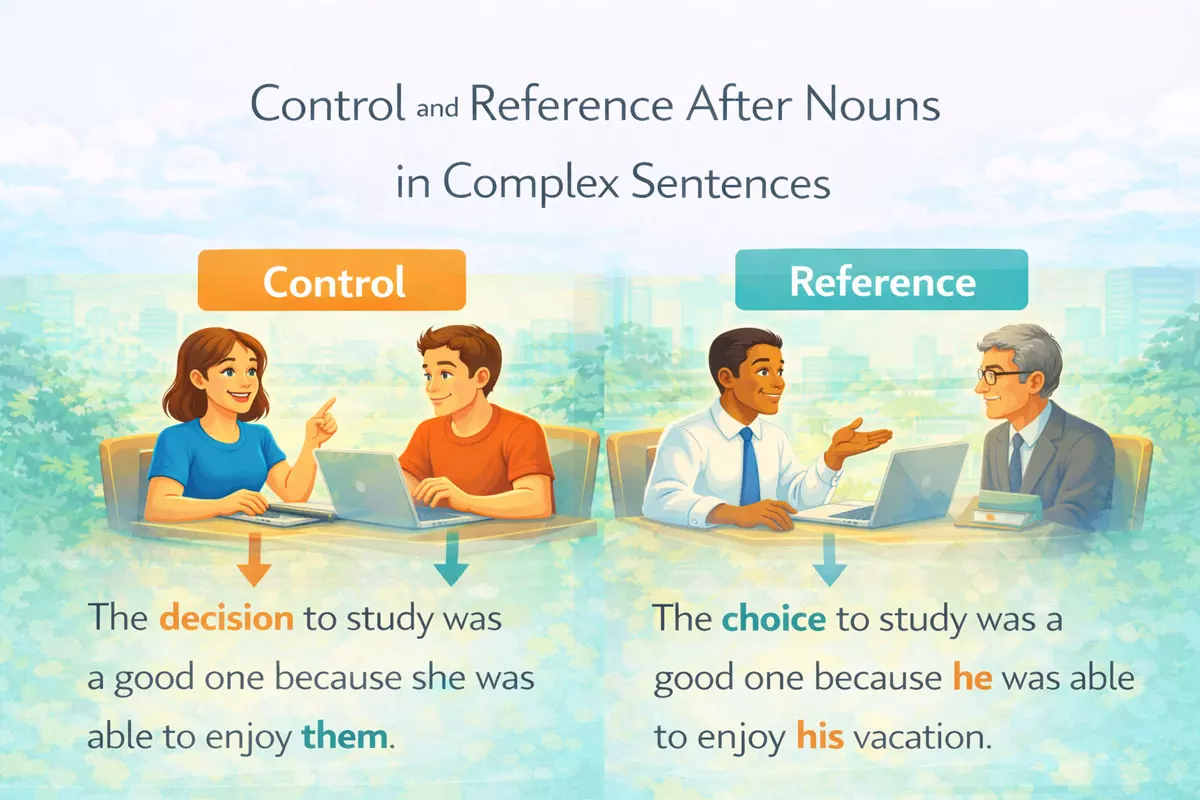 Here we how nouns control infinitives and clauses, how reference chains work in complex structures, and ways to avoid ambiguous pronoun reference. It also discusses common academic patterns, frequent learner mistakes, and provides practice for clarity.
- What control and reference mean after nouns
- Nouns that control following infinitives and clauses
- Reference chains across long noun-based structures
- Avoiding ambiguity in pronoun reference after nouns
- Common academic patterns with controlled reference
- Typical learner problems with unclear noun reference
- Practice: clarify control and reference in complex sentences
Managing pronouns and noun references effectively is essential for maintaining clarity and coherence in complex sentences. By carefully tracking how nouns and pronouns relate to each other throughout layered statements, writers can prevent ambiguity and confusion. Clear connections between referents help readers follow the progression of ideas, making the writing more engaging and easier to understand. Mastering these skills not only improves sentence structure but also elevates the overall quality and impact of your writing.
What control and reference mean after nouns
When discussing complex sentences, two important concepts that often follow nouns are “control” and “reference.” These terms describe how a noun relates to other elements in a sentence, particularly clauses and verb phrases that depend on or clarify the noun’s meaning.
Control: Who Performs the Action?
Control refers to the relationship where a noun determines who is understood to perform the action in a non-finite clause (like an infinitive or gerund phrase). For example, in “the decision to leave,” the noun “decision” controls the understood subject of “to leave” (the one who will leave). Sometimes, the noun itself is the agent; other times, another participant is implied or specified.
- attempt to solve – the “attempt” is made by someone, usually the subject.
- permission to enter – someone receives “permission” to do something.
- request to speak – the “request” is made by the one who wants to speak.
- order to evacuate – the “order” is given, but the action is carried out by someone else.
- promise to help – the “promise” is made by the one who will help.
- plan to travel – the “plan” concerns the person who will travel.
- refusal to cooperate – the “refusal” comes from the one who would cooperate.
- chance to win – the “chance” is for the one who may win.
Reference: Linking Back to Nouns
Reference describes how a noun connects to pronouns, definite descriptions, or clauses that refer back to it. This is common with relative clauses or other modifiers that give additional information about the noun.

- the man who called – “who” refers to “the man.”
- the book that I read – “that” is linked to “the book.”
- the idea which surprised us – “which” points back to “the idea.”
- a time when things were easier – “when” refers to “a time.”
- the reason why we left – “why” connects to “the reason.”
- the place where we met – “where” refers to “the place.”
- the person whose car was stolen – “whose” links to “the person.”
- the method by which it was done – “by which” refers to “the method.”
Control vs. Reference: Key Differences
The main distinction is that control involves the noun’s relationship to an action (who does what), while reference involves the noun’s relation to descriptive or identifying information. These two concepts help clarify meaning in complex sentences and prevent ambiguity.
| Control (Action-based) | Reference (Identification-based) |
|---|---|
| the attempt to escape → who escapes? | the person who escaped → who is identified? |
| the decision to resign → who will resign? | the reason why he resigned → what reason? |
| the plan to travel → who will travel? | the place where they traveled → which place? |
| the promise to help → who helps? | the time when he helped → when? |
Why These Concepts Matter
Understanding control and reference after nouns allows for clearer, more precise communication, especially in academic or formal writing. Recognizing these patterns helps you interpret complex sentences accurately and construct your own sentences with greater confidence.
Nouns that control following infinitives and clauses
Some nouns in English act as triggers for infinitive phrases or subordinate clauses that follow them. These nouns serve as “controllers,” determining which subject (explicit or implied) is understood in the subsequent phrase. This syntactic mechanism is especially important in complex sentences, where clarity about who is supposed to carry out the action can hinge on noun choice.
Common noun types that govern infinitives
Several categories of nouns frequently introduce infinitive constructions. These are often abstract nouns connected to personal plans, needs, permission, or obligation. Here are some of the most typical examples:
- decision (decision to leave)
- plan (plan to travel)
- ability (ability to swim)
- request (request to speak)
- permission (permission to enter)
- attempt (attempt to solve)
- failure (failure to comply)
- offer (offer to help)
- promise (promise to return)
- desire (desire to succeed)
- refusal (refusal to cooperate)
- opportunity (opportunity to learn)
- invitation (invitation to participate)
- order (order to evacuate)
- chance (chance to win)
- need (need to rest)
- intention (intention to resign)
- wish (wish to continue)
How nouns govern the subject of infinitives
When a noun is followed by an infinitive, the understood subject of the infinitive is usually determined by the noun’s relationship to the rest of the sentence. For example, in “her decision to leave,” the person leaving is “her.” However, in “the order to evacuate,” the subject carrying out the evacuation may be someone else, depending on the context.
Comparison: Nouns with infinitives vs. clauses
Some nouns can take either an infinitive or a “that”-clause, but the meaning or grammatical structure can shift. Here’s a structured look at how some nouns behave when used with infinitives versus clauses:
| Noun | With Infinitive | With Clause |
|---|---|---|
| decision | decision to leave | decision that she would leave |
| promise | promise to help | promise that he would help |
| plan | plan to expand | plan that they would expand |
| request | request to speak | request that he speak |
| order | order to evacuate | order that everyone evacuate |
| desire | desire to succeed | desire that she succeed |
Key points to remember
- Not all nouns can control an infinitive or clause—usage is idiomatic and sometimes restricted.
- The “controller” of the infinitive is often the possessor or subject in the larger sentence, but context can shift this.
- Some nouns shift meaning depending on whether they’re followed by an infinitive or a clause.
In summary, certain nouns serve as anchors for following infinitives or subordinate clauses, shaping the structure and meaning of complex sentences. Recognizing which nouns can perform this syntactic role helps clarify who is responsible for the action described and ensures precise communication.
Reference chains across long noun-based structures
Complex noun groups in sentences often create intricate webs of reference, where pronouns, determiners, or even ellipsis pick up meaning from earlier nominal elements. The ability to track these links is essential for understanding both written and spoken discourse, especially in academic or technical contexts where noun phrases can be heavily layered.
Challenges in tracking reference
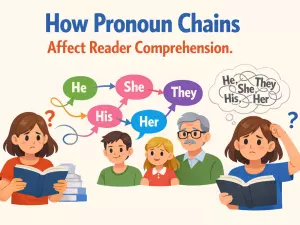
Ambiguity arises easily when several noun phrases are embedded within one another. For instance, the referent of "it" or "this" may not be immediately obvious if the preceding nouns are numerous or conceptually related. Misinterpretations can occur if the reader or listener loses track of which entity a pronoun or definite description actually points to.
Common patterns of reference
Writers and speakers use a variety of strategies to maintain clarity when constructing extended noun-based structures. Some frequent mechanisms include:
- Repeating the head noun with variation (e.g., "the committee" followed by "the group")
- Employing pronouns (he, she, it, they) to avoid repetition
- Using demonstratives (this, that, these, those) for emphasis or contrast
- Utilizing possessives (his, their) to signal ownership or association
- Relying on definite descriptions ("the former", "the latter")
- Introducing appositive phrases for clarification
- Omitting repeated information through ellipsis
- Switching to generic references ("such entities")
- Choosing synonyms or near-synonyms to shift focus
- Employing anaphoric and cataphoric references (backward- and forward-looking)
- Marking focus with contrastive structures ("the first...the second...")
- Relying on contextually salient information
Examples and potential pitfalls
When reference chains stretch across multiple clauses or sentences, the risk of confusion increases. Consider the following:
- "The proposal submitted by the research team, which included several innovative methods, was reviewed by the panel. They found it promising." — Does "they" refer to the research team or the panel?
- "After the board discussed the results of the survey, the members decided to publish them." — "Them" could refer to results or survey, depending on context.
Summary of reference strategies
Below is a comparative overview of some common devices for sustaining reference across complex noun-based constructions:
| Reference Device | Typical Use |
|---|---|
| Pronouns | Maintains cohesion, avoids repetition; can be ambiguous in dense contexts |
| Definite Descriptions | Clarifies or narrows reference, especially after multiple entities are introduced |
| Appositives | Provides additional identifying information for clarity |
| Demonstratives | Highlights or contrasts specific entities in a sequence |
| Ellipsis | Omission of repeated elements when context makes reference clear |
Best practices for clarity
Writers can enhance comprehension by repeating key nouns when necessary, varying reference devices, and ensuring that each pronoun or descriptive phrase unambiguously points to its intended antecedent. When in doubt, explicitness prevents misunderstanding and supports the reader in navigating complex syntactic landscapes.
Avoiding ambiguity in pronoun reference after nouns
Clarity in complex sentences often depends on how well pronouns are connected to their intended nouns. When a pronoun follows several possible antecedents, readers can easily misinterpret the reference, leading to confusion. Writers and speakers need to construct sentences that make these connections unmistakable.
Common Causes of Pronoun Confusion
Ambiguity typically arises when:
- Multiple nouns of the same gender or number appear before a pronoun
- Long clauses separate the pronoun from its intended noun
- Generic nouns or groups are referenced
- Pronouns are used without clear context
- Parallel structures introduce more than one candidate for reference
Strategies to Ensure Clear Pronoun Reference
Writers can minimize misunderstandings in several ways:
- Repeat the noun instead of using a pronoun when ambiguity is possible
- Rephrase the sentence to bring the pronoun closer to its antecedent
- Use specific names or titles if multiple people/things are involved
- Insert clarifying phrases (“the latter,” “the former,” etc.)
- Avoid using “it,” “they,” or “this” at the start of a sentence unless the reference is unambiguous
- Break up long sentences into shorter ones
- Introduce pronouns only after their antecedents have been clearly established
- Rely on possessive forms (“her book,” “their project”) for clarity
- Structure sentences so that the pronoun directly follows its referent
- Check for potential confusion by reading sentences aloud or having someone else review them
Examples of Ambiguous and Clear References
| Ambiguous Sentence | Clear Revision |
|---|---|
| Maria told Anna that she would win the prize. | Maria told Anna, "You will win the prize." |
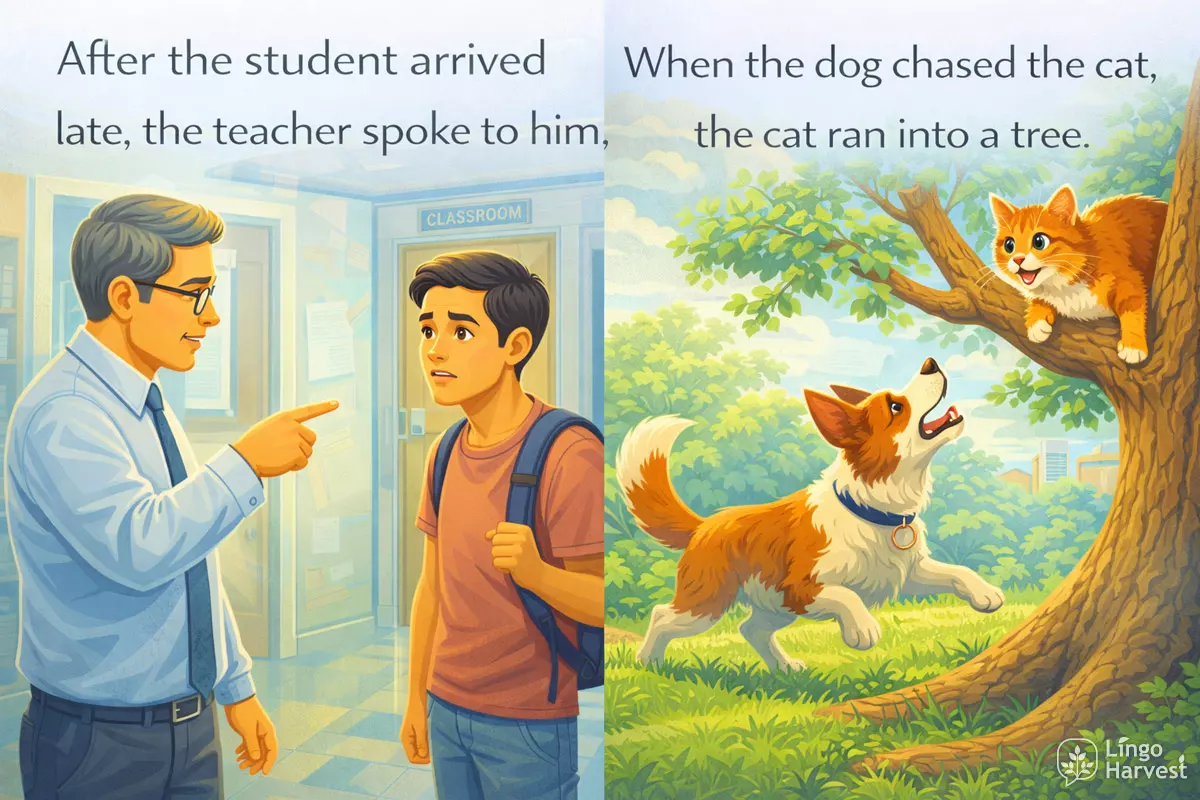
| The teacher spoke to the student after he arrived late. | After the student arrived late, the teacher spoke to him. |
| When the dog chased the cat, it ran into a tree. | When the dog chased the cat, the cat ran into a tree. |
| Jane gave Sarah her book. | Jane gave her book to Sarah. |
| Paul called Mark while he was driving. | While Paul was driving, he called Mark. |
| The manager spoke with the assistant before he left. | The manager spoke with the assistant before the manager left. |
| After John talked to Mike, he went home. | After John talked to Mike, John went home. |
| The bottle was on the table, but it was empty. | The bottle was on the table, but the table was empty. |
| The girls saw the boys before they left. | The girls left after they saw the boys. |
| Alex met Chris at the café, and he ordered coffee. | At the café, Alex met Chris and Chris ordered coffee. |
Quick Tips
- Always check for more than one possible antecedent.
- Use repetition judiciously to prevent confusion, but avoid unnecessary redundancy.
- Be especially careful with “it,” “they,” and “this” in complex sentences.
Clear pronoun reference not only makes writing easier to understand but also helps avoid misunderstandings in both academic and casual contexts.
Common academic patterns with controlled reference
Academic writing often employs specific structures to clarify how nouns are linked to their referents, especially in longer or more complex sentences. These patterns help avoid ambiguity and ensure that readers can easily follow which noun is being referenced or controlled by subsequent clauses or phrases.
Frequent Structures in Academic Texts
Writers typically use a range of grammatical configurations to manage reference after nouns. The following are among the most frequent:
- Noun + relative clause (e.g., "The theory that he proposed was groundbreaking.")
- Noun + infinitive clause (e.g., "The decision to postpone the seminar was unanimous.")
- Noun + prepositional phrase (e.g., "The results of the experiment were inconclusive.")
- Noun + participial phrase (e.g., "The students attending the lecture took notes.")
- Noun + appositive (e.g., "The variable, a crucial component, was redefined.")
- Noun + that-clause (e.g., "The assumption that data would be available proved false.")
- Noun + for/to-phrase (e.g., "The time for submission is limited.")
- Noun + possessive construction (e.g., "The professor’s explanation clarified the issue.")
- Noun + adjective clause (e.g., "The method, which was recently developed, is effective.")
- Noun + conditional clause (e.g., "Any student who fails the test must retake it.")
- Noun + quantifier or determiner (e.g., "Several issues mentioned concerned funding.")
- Noun + noun modifier (e.g., "Data collection procedures were standardized.")
- Noun + gerund phrase (e.g., "The possibility of completing the project early exists.")
- Noun + adverbial clause (e.g., "The conclusion, when considered carefully, is convincing.")
- Noun + postmodifying phrase (e.g., "The paper under review addresses the topic in depth.")
- Noun + restrictive/non-restrictive clause (e.g., "The participants, who were volunteers, received compensation.")
- Noun + comparative phrase (e.g., "The approach is more effective than anticipated.")
- Noun + explanatory phrase (e.g., "The sample size, measured in units, was adequate.")
- Noun + coordination (e.g., "The aim and scope of the study are clearly defined.")
- Noun + negative phrase (e.g., "No evidence supporting the claim was found.")
Comparison of Reference Control Patterns
Some academic constructions require explicit reference control, while others allow implicit understanding. The table below contrasts common examples:
| Pattern | Reference Control Example |
|---|---|
| Noun + to-infinitive | The plan to improve efficiency was approved. ("to improve efficiency" refers to "plan") |
| Noun + that-clause | The claim that the results are biased is disputed. ("that the results are biased" refers to "claim") |
| Noun + relative clause | The students who participated were surveyed. ("who participated" refers to "students") |
| Noun + participial phrase | The data collected supports the hypothesis. ("collected" refers to "data") |
| Noun + prepositional phrase | The outcome of the analysis was surprising. ("of the analysis" refers to "outcome") |
Usage Tips
Clarity is essential: always ensure that reference after nouns is unambiguous, especially when sentences become lengthy or involve multiple possible referents. Using explicit relative clauses or noun modifiers can help readers follow the intended meaning. In complex academic prose, judicious use of controlled reference enhances precision and reader comprehension.
Typical learner problems with unclear noun reference
When working with complex sentences, students often struggle to identify what a noun or pronoun is actually referring to. This confusion can make sentences ambiguous and sometimes even change the intended meaning. One major cause is a lack of clear links between nouns and their referents, especially when multiple nouns appear close together or when subordinate clauses intervene.
Common issues learners face
- Using pronouns like it, they, this, or which without a clear antecedent
- Placing pronouns too far from the noun they refer to
- Introducing several possible nouns before a pronoun, making it unclear which is meant
- Reusing the same noun for different things in a single sentence
- Forgetting to repeat the noun when necessary for clarity
- Overusing demonstratives (this, that) without specifying the object again
- Assuming shared context that isn’t actually clear to the reader
- Using “one” or “ones” without being specific about the referent
- Confusing relative clauses, e.g., “the book that she gave him, which was expensive” (unclear what “which” refers to)
- Switching subjects within a sentence without clear signals
- Referencing actions or ideas instead of objects (“He left early, which was surprising” — “which” refers to the act, not a noun)
- Ambiguous placement of modifiers that could attach to more than one noun
- Failing to clarify reference in lists or sequences (“He gave John and Mark his book” — whose book?)
- Using “such” or “these” without a concrete noun
- Not matching pronoun number or gender to the noun (“The team won their game” — is “team” singular or plural?)
- Omitting definite articles, making it unclear which noun is referenced
- Referencing abstract concepts without explicit nouns
- Switching between nouns and pronouns too quickly
Illustrative examples and patterns
Let’s look at some typical sentences where unclear reference causes problems:
- “Mary told Jane that she would help.” (Unclear: Who will help?)
- “The teacher spoke to the student after she finished the test.” (Ambiguous: Who finished?)
- “Tom gave the book to Bill because he was late.” (Who was late?)
- “I saw the man with the telescope.” (Who had the telescope?)
- “The dog chased the cat, which ran up a tree.” (Ambiguous: Which animal ran?)
Table: Ambiguous vs. Clear Reference
| Ambiguous Example | Clearer Revision |
|---|---|
| John met Paul after he finished work. | John met Paul after John finished work. |
| She put the vase on the table and broke it. | She put the vase on the table and broke the vase. |
| The car hit the tree, but it wasn’t damaged. | The car hit the tree, but the tree wasn’t damaged. |
| They said the students didn’t study because they were lazy. | The teachers said the students didn’t study because the students were lazy. |
| Lisa told Sara she passed the exam. | Lisa told Sara that Sara passed the exam. |
Why reference confusion happens
Learners often transfer patterns from their native language or assume that context is enough for clarity. English, however, requires explicitness, especially in writing. Without clear signals, even native speakers may misunderstand sentences. Practicing rephrasing and being aware of potential ambiguity are key strategies to avoid these pitfalls.
Practice: clarify control and reference in complex sentences
Understanding control and reference after nouns is essential for interpreting who is responsible for actions and which entities are being referred to in complex sentences. Below, you'll find targeted exercises and illustrative examples to help you recognize and resolve ambiguities in these constructions.
Identify the Controller or Referent
In many complex sentences, especially those with infinitival or gerundive complements, it can be unclear who performs the action. Practice by determining the most likely subject or referent for each underlined phrase.
- Maria persuaded her brother to leave early.
- The promise to finish the project was appreciated by the team.
- They gave the students the opportunity to ask questions.
- Julia regretted her decision to move abroad.
- The report contains recommendations for improving safety.
- The teacher encouraged the children to participate.
- The decision to cancel the event surprised many people.
- They asked the manager to explain the changes.
- Liam remembered his promise to call his grandmother.
- The leaflet includes instructions for using the device.
Show answers
- Her brother is the one who leaves early (her brother = controller).
- The person who made the promise is not specified; context needed.
- The students are given the opportunity (students = controller).
- Julia made the decision (Julia = referent).
- Recommendations are for someone (not specified) to improve safety; usually addressed to the reader or organization.
- The children are the ones who participate (the children = controller).
- The person or group who cancels the event is not specified; context needed to identify the controller.
- The manager is the one who explains the changes (the manager = controller).
- Liam is the one who calls his grandmother (Liam = controller).
- The user or reader is the one who uses the device (user/reader = implied controller).
Spotting Ambiguity and Clarifying Reference
Ambiguity often arises when it is not clear which noun a modifying phrase refers to. Consider the following sentences and note where clarification is needed:
- The manager spoke to the assistant of the director who was late.
- She saw the painting of her friend hanging in the gallery.
- The teacher praised the students with enthusiasm.
- We discussed the proposal to reduce costs at the meeting.
- They admired the view of the mountains covered in snow.
- The journalist interviewed the employee of the company that was bankrupt.
- She spoke to the mother of the boy who was crying.
- They reviewed the reports from the manager in the morning.
- He watched the documentary about the animals on the plane.
- I read the email from the student about the exam yesterday.
Show answers
- It's unclear if the director or the assistant was late.
- It's unclear if the painting depicts her friend or if her friend was hanging it.
- Ambiguity: Did the teacher have enthusiasm, or did the students?
- Who is to reduce costs? The proposal itself, or the people at the meeting?
- Do the mountains have snow, or is the view somehow covered in snow?
- Was the company bankrupt, or was the employee bankrupt?
- Was the mother crying, or was the boy crying?
- Were the reports from the manager, or did they review them in the morning?
- Were the animals on the plane, or was he on the plane watching the documentary?
- Was the email sent yesterday, or did I read it yesterday, or was the exam yesterday?
Common Patterns of Control and Reference
Here are some patterns where control and reference issues frequently appear. Being able to spot these will help you analyze complex sentences more effectively:
- Noun + infinitive: "The plan to expand operations" (Who will expand?)
- Noun + gerund: "His insistence on leaving early" (Who is leaving?)
- Noun + prepositional phrase: "Advice for improving performance" (Who should improve?)
- Noun + relative clause: "The book that inspired him" (Which book?)
- Genitive constructions: "John’s attempt to solve the puzzle" (Who attempts?)
- Appositive structures: "Her goal, to become a doctor, was clear" (Whose goal?)
- Possessive + noun + infinitive: "Their decision to relocate" (Who relocates?)
- Noun + of + noun: "The fear of failure" (Who fears?)
- Noun + for + noun + to-infinitive: "A chance for you to win" (Who wins?)
- Noun + with + noun: "The man with the hat" (Who has the hat?)
Clarification Techniques
To avoid ambiguity, writers can use various strategies to make control and reference clear:
- Add explicit subjects: "The promise by John to finish the project..."
- Restructure sentences: "She saw her friend's painting hanging..."
- Use relative clauses: "The assistant, who was late,..." vs. "The director, who was late,..."
- Replace ambiguous pronouns with proper nouns.
Quick Check: Who Does What?
For each sentence, choose the correct controller or referent.
- Paul’s suggestion to cancel the event surprised everyone.
a) Paul cancels the event
b) Someone else cancels the event - The decision of the committee to postpone made sense.
a) The committee postpones
b) Someone else postpones - The request for information was processed quickly.
a) Someone requests information
- Sarah’s promise to help motivated the team.
a) Sarah helps
b) Someone else helps - The plan of the engineers to expand the bridge shocked residents.
a) The engineers expand
b) Someone else expands - The demand from students to shorten the course increased pressure.
a) Students shorten the course
b) Someone else shortens the course - The order of the manager to close the store was unexpected.
a) The manager closes the store
b) Someone else closes the store - The offer to pay for the repairs was generous.
a) The person offering pays
b) Someone else pays - The request of staff to pause the project was refused.
a) Staff pause the project
b) Someone else pauses the project - The proposal from the team to hire more workers sounded reasonable.
a) The team hires more workers
b) Someone else hires more workers
Show answers
- a) Paul cancels the event
- a) The committee postpones
- a) Someone requests information
- a) Sarah helps
- a) The engineers expand
- b) Someone else shortens the course
- b) Someone else closes the store
- a) The person offering pays
- a) Staff pause the project
- b) Someone else hires more workers