Finite and Non-Finite Verb Forms

 This article explains how finite verbs indicate person and tense, while non-finite forms—infinitives, gerunds, and participles—have other functions. It includes examples and practice to help you identify each verb form in context.
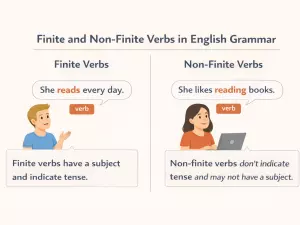
Mastering English grammar requires understanding the difference between verb forms that change depending on the subject and tense, and those that stay the same regardless of these factors. This distinction is crucial because it directly influences how we communicate actions, events, and states accurately. By recognizing when to adjust a verb form and when to use a consistent one, learners can construct sentences that are both grammatically correct and easy to understand, ultimately enhancing their overall fluency and confidence in English.
What Finite Verbs Show
Finite verbs carry crucial grammatical information in a sentence. Unlike non-finite forms, these verbs make it clear who is doing the action and when it happens. Their forms change to reflect details about the subject and the time frame. This makes them essential for constructing complete sentences.
Key Grammatical Features Expressed by Finite Verbs
These verbs typically indicate several grammatical categories. Here are the main features they express:
- Person: Shows whether the subject is first, second, or third person (e.g., I walk, you walk, she walks).
- Number: Distinguishes between singular and plural subjects (e.g., he runs vs. they run).
- Tense: Specifies when the action occurs—past, present, or future (e.g., walked, walks, will walk).
- Aspect: Expresses if the action is completed, ongoing, or habitual (e.g., is running, has run).
- Mood: Shows the speaker’s attitude or intent, such as statements, commands, or possibilities (e.g., If she goes, Go!).
- Agreement: Matches the verb form to the subject in person and number.
Examples: How Finite Verbs Reflect Grammatical Information
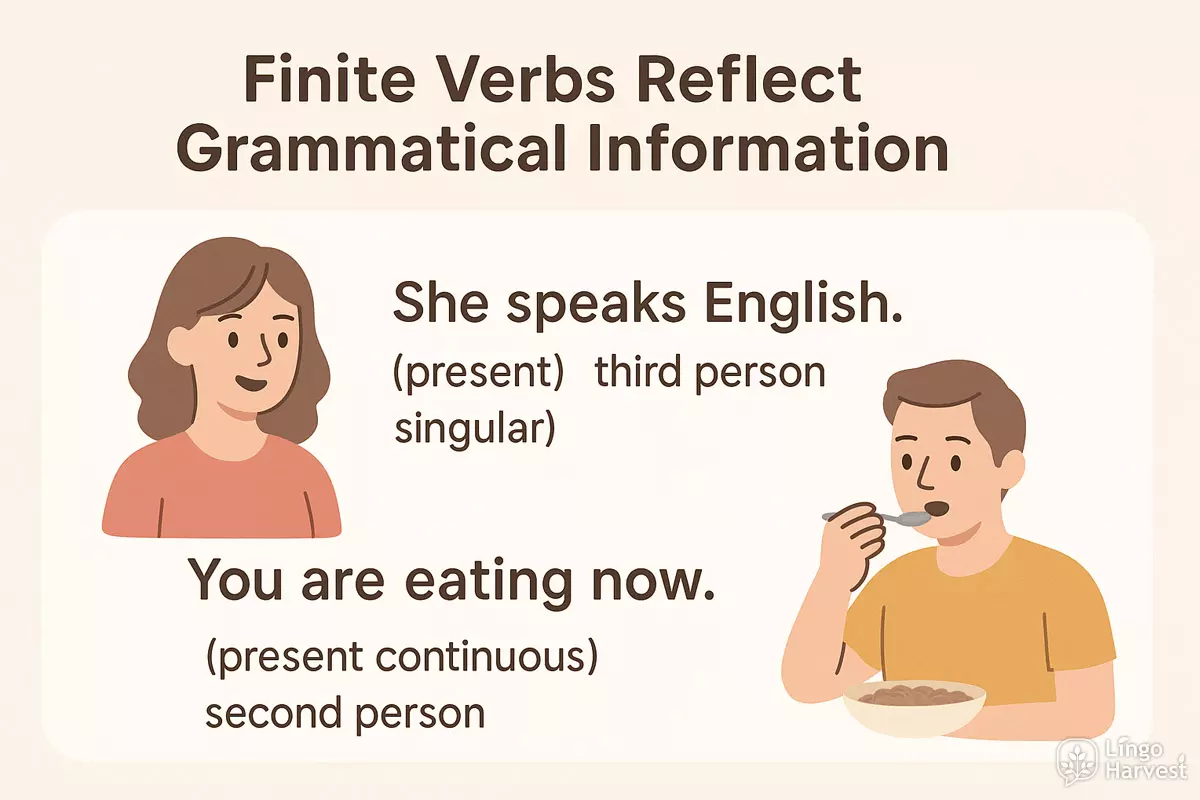
Let’s look at some examples that highlight how these verbs change form to convey different meanings:
- She speaks English. (present, third person, singular)
- They spoke quickly. (past, third person, plural)
- You are eating now. (present continuous, second person)
- I was reading yesterday. (past continuous, first person)
- If he comes, let me know. (present, third person, subjunctive mood)
- We have finished the work. (present perfect, first person, plural)
- Go to bed! (imperative mood)
- She would sing if asked. (conditional mood)
- He does his homework. (present, third person, singular, emphatic)
- They will arrive soon. (future, third person, plural)
Comparison of Finite Verb Forms
To better illustrate, here’s a summary showing how verb forms shift to match grammatical categories:
| Subject & Tense | Finite Verb Example | Grammatical Features |
|---|---|---|
| I (present) | run | 1st person, singular, present |
| He (present) | runs | 3rd person, singular, present |
| We (past) | ran | 1st person, plural, past |
| They (future) | will run | 3rd person, plural, future |
| You (imperative) | Run! | 2nd person, command mood |
In summary, finite verbs are the core of sentences because they reveal who is involved, when the action happens, and the speaker’s intent. Their forms provide the necessary clues for understanding the structure and meaning of statements, questions, and commands.
Person and Tense
Verbs in English and many other languages change form to show who is performing the action and when the action occurs. These grammatical features—person (first, second, third) and tense (past, present, future)—are central to understanding how finite verb forms work. Non-finite forms, by contrast, do not shift according to these categories.
Finite Verb Forms: Expressing the Subject and Time
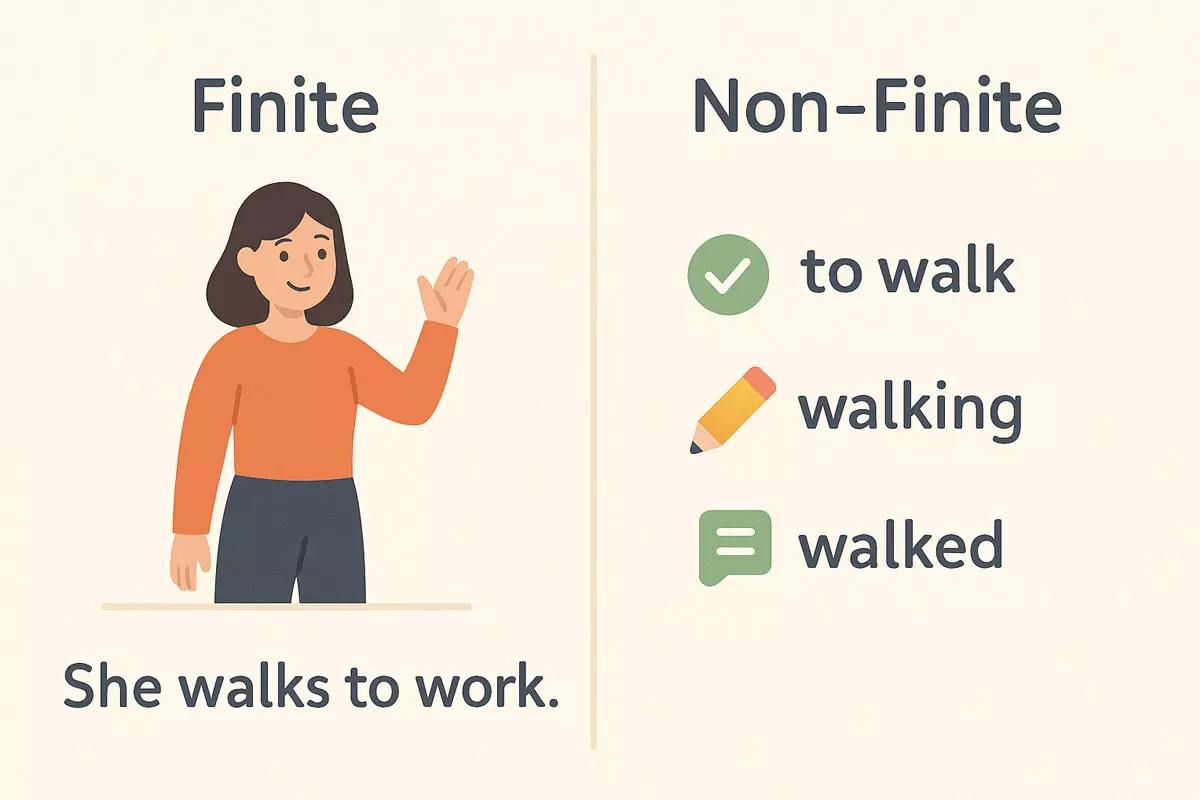
Finite verbs adapt to match their subject and the time frame of the action. For example, in English, "walk" becomes "walks" for third person singular in present tense, and "walked" for the past. This adaptation is called agreement or conjugation. The form of the verb changes depending on:
- Who is doing the action (I, you, he/she/it, we, they)
- When the action is happening (now, before now, or in the future)
| Person | Present (walk) | Past (walk) | Future (walk) |
|---|---|---|---|
| First (I/we) | I walk / We walk | I walked / We walked | I will walk / We will walk |
| Second (you) | You walk | You walked | You will walk |
| Third (he/she/it/they) | He walks / They walk | He walked / They walked | He will walk / They will walk |
Non-Finite Verb Forms: No Person or Tense Marking
Non-finite verbs, such as infinitives, participles, and gerunds, do not show who is acting or when. They remain unchanged regardless of subject or time. For example:
- to walk (infinitive)
- walking (present participle/gerund)
- walked (past participle, not as simple past)
These forms are used for various grammatical purposes, like building verb phrases, expressing ongoing or completed actions, or functioning as nouns or adjectives.
Key Differences at a Glance
Finite forms are always linked to a subject and a specific time frame, while non-finite forms are more flexible and do not carry these markers. Recognizing whether a verb form is finite or non-finite helps with sentence analysis, verb agreement, and tense consistency.
Examples of Person and Tense Variation
Here are further examples showing how verbs change with the subject and time:
- She runs (present, third person singular)
- They run (present, third person plural)
- We ate (past, first person plural)
- You will see (future, second person)
- He has finished (present perfect, third person singular)
- I am going (present continuous, first person singular)
- She was reading (past continuous, third person singular)
- They had left (past perfect, third person plural)
- We will have arrived (future perfect, first person plural)
- You are invited (present passive, second person)
Understanding these distinctions is essential for forming correct sentences and spotting the difference between finite and non-finite verb forms.
Non-Finite Forms
Verbs that do not show tense, person, or number play a unique role in English grammar. These verb forms are not limited by the subject or the time of the action, making them versatile across different sentence structures. Instead of acting as the main verb, they often function as nouns, adjectives, or adverbs, integrating smoothly into phrases and clauses.
Types of Non-Finite Verb Forms
Three primary types exist: infinitives, participles, and gerunds. Each has distinct characteristics and grammatical uses.
- Infinitive: Usually appears as "to" + base verb (e.g., to write, to dance).
- Present participle: Verb + -ing (e.g., writing, dancing).
- Past participle: Typically ends in -ed for regular verbs (e.g., written, danced), but many irregular verbs have unique forms (e.g., eaten, gone).
- Gerund: Verb + -ing used as a noun (e.g., Writing is fun).
Functions in Sentences
These forms enable complex sentence construction. For example, an infinitive can express purpose ("She went to study"), a gerund can act as a subject ("Swimming relaxes me"), and participles often introduce descriptive phrases ("Bored by the lecture, he left early").
Common Examples
Here are some verbs in their non-finite forms:
- to read, reading, read
- to play, playing, played
- to go, going, gone
- to eat, eating, eaten
- to sing, singing, sung
- to run, running, run
- to see, seeing, seen
- to break, breaking, broken
- to write, writing, written
- to drive, driving, driven
- to choose, choosing, chosen
- to begin, beginning, begun
- to take, taking, taken
- to sleep, sleeping, slept
- to speak, speaking, spoken
- to build, building, built
- to catch, catching, caught
- to make, making, made
- to find, finding, found
- to teach, teaching, taught
Comparison of Non-Finite Forms
The chart below helps visualize differences in structure and function for the main types.
| Form | Typical Usage | Example |
|---|---|---|
| Infinitive | Expresses purpose, intention, or result; can act as noun, adjective, or adverb | to read a book |
| Present Participle | Used for continuous tenses, or as an adjective/modifier | reading quietly |
| Past Participle | Forms perfect tenses, passive voice, or acts as an adjective | read by many |
| Gerund | Acts as a noun (subject or object) | Reading helps |
Key Points to Remember
- These forms never function as the main verb showing tense in a sentence.
- They are essential for constructing phrases, clauses, and adding detail.
- Understanding their use increases flexibility and clarity in writing and speaking.
Infinitives
The base form of a verb, most often preceded by "to," serves as a non-finite verb construction that does not show tense, person, or number. This form can function in various grammatical roles, such as the subject, object, or complement within a sentence. Unlike finite verbs, this structure does not act as the main verb of an independent clause.
Common Uses and Functions
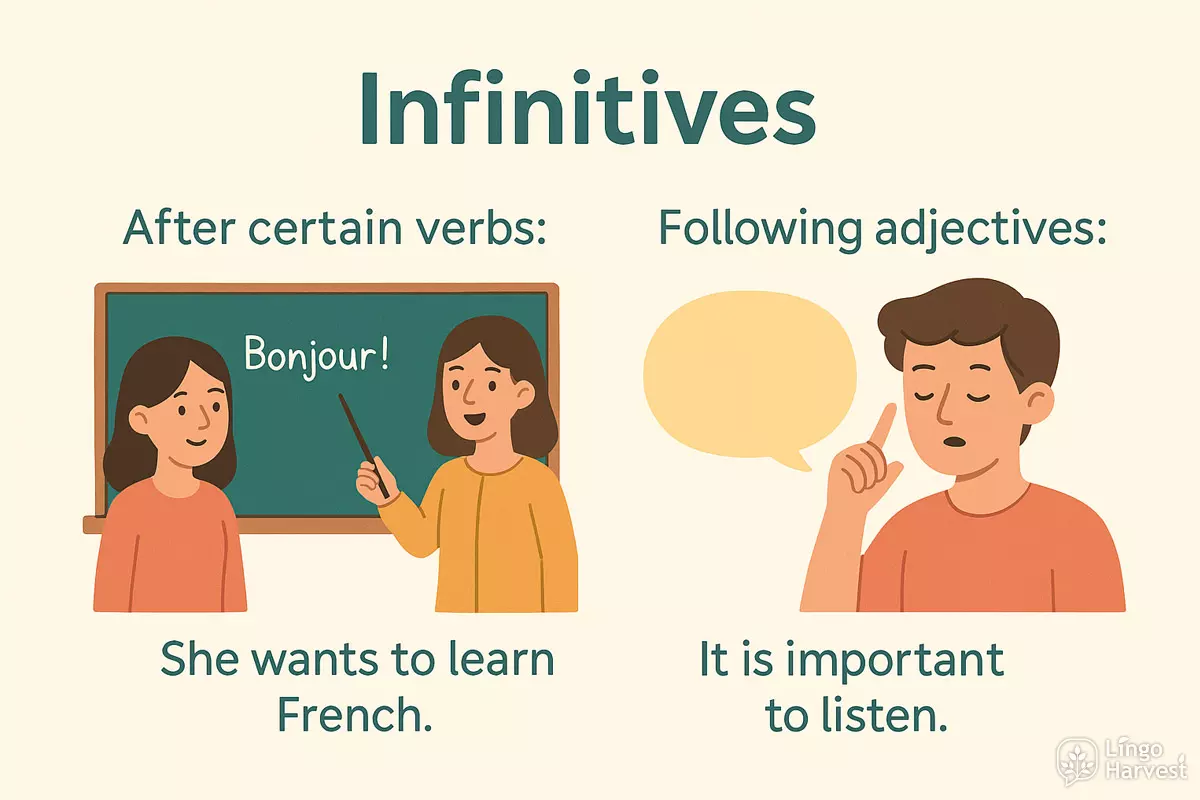
Writers and speakers use the "to" form for a variety of purposes:
- As the subject of a sentence: To read is enjoyable.
- After certain verbs: She wants to learn French.
- Following adjectives: It is important to listen.
- To express purpose: He went to the store to buy milk.
- After question words: She explained how to solve the problem.
- With objects or complements: Their goal is to win.
- After certain nouns: He has a plan to travel abroad.
- To indicate obligation or necessity: You need to finish your work.
- For expressing preference or intention: I hope to see you soon.
- To form passive constructions: The homework is to be completed by Monday.
Forms: Simple, Continuous, Perfect, and Passive
This non-finite structure can appear in several forms, showing different aspects such as time or voice. The following table presents the main patterns:
| Form | Example | Usage |
|---|---|---|
| Simple | to write | General actions or states |
| Continuous | to be writing | Ongoing actions |
| Perfect | to have written | Completed actions before another event |
| Perfect Continuous | to have been writing | Ongoing actions up to a point in the past |
| Passive | to be written | Actions done to the subject |
Key Points to Remember
- The "to" form never changes to show tense or subject agreement.
- Some verbs (like "make," "let," "help") take the bare form (without "to").
- Split infinitives (placing an adverb between "to" and the verb) are common and generally accepted: She wants to really understand.
- Negative forms use "not": It is important not to forget the deadline.
Although this verb form can appear flexible, its function remains consistent: it serves as a non-finite element, providing additional meaning without carrying tense or person markers.
Gerunds
Verb forms ending in -ing often act as nouns in English sentences. These forms can play the role of subject, object, or complement, making them a unique blend of verb and noun properties. Unlike simple nouns, these verbal nouns maintain some characteristics of verbs, such as taking objects and being modified by adverbs.
Functions and Usage
These -ing forms commonly appear in everyday English in a variety of roles. Consider how they can serve:
- Subject: Swimming is good exercise.
- Object: She enjoys reading.
- Object of a preposition: They talked about traveling.
- Complement: His favorite activity is painting.
Forming Verbal Nouns
To create these forms, simply add -ing to the base verb. Spelling rules apply: for example, double the final consonant if a verb ends with one vowel plus one consonant (run → running), or drop the final -e (make → making).
Common Verbs Followed by -ing Forms
Certain verbs in English are typically followed by a verbal noun rather than an infinitive. Here are some frequent examples:
- admit
- avoid
- consider
- deny
- enjoy
- finish
- imagine
- mind
- miss
- postpone
- practice
- recommend
- risk
- suggest
- keep (on)
- discuss
- involve
- mention
- resist
- tolerate
Comparison: Noun vs. -ing Form
| Traditional Noun | -ing Form Used as Noun |
|---|---|
| Music is relaxing. | Listening to music is relaxing. |
| Food helps recovery. | Eating helps recovery. |
| Exercise is important. | Running is important. |
| Art inspires people. | Painting inspires people. |
Key Features
- Can take a direct object: Reading books improves vocabulary. ✅
- Can be modified by an adverb: Running quickly tires me out. ✅
- Cannot show tense or person: Swimming is fun, not swammings or swammed. ❌
Understanding how and when to use these -ing forms helps make your English more natural and expressive, especially when describing actions as concepts or activities.
Participles
The English language uses certain verb forms that function as adjectives or form verb phrases, rather than serving as the main verb of a clause. These forms, called participial constructions, play an important role in both written and spoken communication. There are two main types: present and past, each with distinct uses and forms.
Types and Formation
Present participles are created by adding -ing to the base verb (for example, walking, eating). They can describe actions in progress or ongoing states, or modify nouns as in “the running water.” Past participles usually end in -ed for regular verbs (walked, played), but many irregular verbs have unique forms (written, broken, gone). These forms are often used in perfect tenses and passive voice, or as adjectives (“a broken vase”).
Main Uses
- Forming continuous and perfect verb tenses (She is running, They have eaten).
- Creating passive structures (The letter was written).
- Acting as adjectives (boiling water, a forgotten song).
- Introducing participial phrases for additional information (Feeling tired, he went home).
Present vs. Past Participles: Key Differences
| Form | Example (Regular) | Example (Irregular) | Typical Function |
|---|---|---|---|
| Present participle | walking | going | Progressive aspect, adjective |
| Past participle | walked | gone | Perfect tense, passive, adjective |
Examples in Context
A wide variety of words use these forms. Here are some examples showing both types:
- Present: running, swimming, laughing, cooking, reading, sleeping, dancing, singing, driving, playing
- Past: cooked, driven, written, seen, eaten, broken, taken, chosen, begun, built
These non-finite verb forms are versatile tools, allowing sentences to be more descriptive and concise. Recognizing and using them correctly can add precision and variety to your writing.
Practice: Identify the Form
Understanding how to distinguish between finite and non-finite verb forms is crucial for accurate grammar usage. Below, you'll find various exercises and examples to help you recognize these forms in context. Use the tasks to test your knowledge and solidify your understanding of how verbs function in different sentences.
Task 1: Choose the Correct Label
Read each sentence and decide whether the highlighted verb is finite or non-finite. Write your answer next to each example.
- She runs every morning.
- They want to travel abroad.
- Having finished his homework, he went out.
- The cake was baked by my sister.
- We are watching a movie.
- Reading improves your vocabulary.
- The dog barks loudly at night.
- He likes playing chess.
- She has written three novels.
- To understand the problem, read the instructions carefully.
Show answers
- Finite
- Non-finite
- Non-finite
- Finite
- Finite
- Non-finite
- Finite
- Non-finite
- Finite
- Non-finite
Task 2: Spot the Form
Below are more examples. Identify the verb form in each. If it’s non-finite, specify if it is an infinitive, gerund, or participle.
- He hopes to win the prize.
- Walking in the rain can be relaxing.
- Excited by the news, she called her friend.
- They were studying all night.
- The letter written by her was heartfelt.
- We enjoy music.
- She helped organize the event.
- Broken windows need repair.
- He drives to work every day.
- To finish early, she skipped lunch.
Show answers
- Non-finite (Infinitive)
- Non-finite (Gerund)
- Non-finite (Participle)
- Finite
- Non-finite (Participle)
- Finite
- Non-finite (Bare Infinitive)
- Non-finite (Participle)
- Finite
- Non-finite (Infinitive)
Common Non-Finite Verb Forms
Here’s a quick reference for the most common non-finite verb forms and their uses:
| Form | Example | Typical Use |
|---|---|---|
| Infinitive | to read, to write | Purpose, intent, or after certain verbs |
| Gerund | reading, writing | Subject, object, after prepositions |
| Participle (Present) | reading, writing | Describing an action happening at the same time |
| Participle (Past) | written, broken | Describing a completed action or passive meaning |
Practice identifying verb forms in real sentences to build confidence. Look for clues like verb endings, sentence structure, and whether the verb shows tense or agrees with the subject. This skill is essential for clear and accurate writing.