Nouns with Latin and Greek Plurals in Academic English

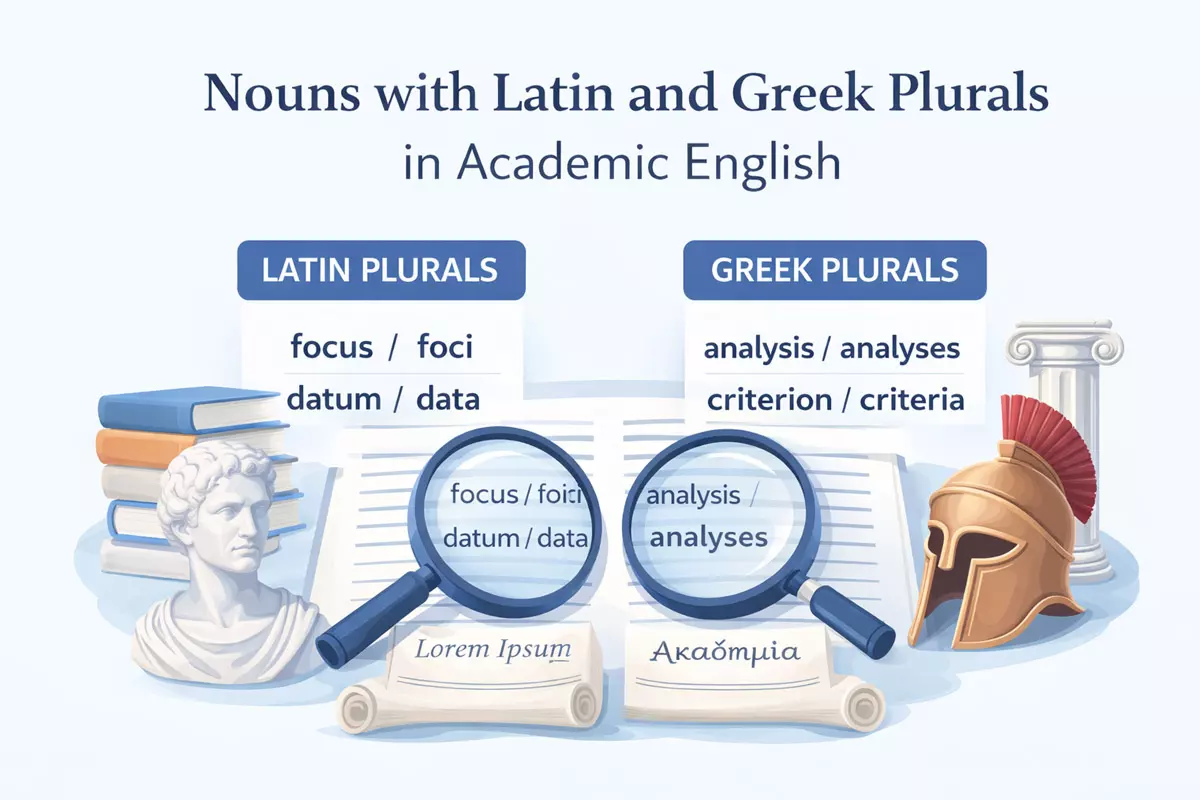 Here we why English uses Latin and Greek plurals such as criteria and phenomena, examines how singular and plural agreement works, covers modern trends and usage differences, highlights common mistakes, and includes practice with classical forms.
- Why Latin and Greek plurals exist in English
- Common academic examples like data, criteria, and phenomena
- Singular vs plural agreement with classical forms
- Modern trends toward regular pluralization
- Differences between formal and informal usage
- Typical learner mistakes with classical plurals
- Practice: choose correct singular and plural forms
Academic writing frequently includes words that form their plurals in unexpected ways, particularly those derived from Latin or Greek. Recognizing these distinctive pluralization patterns is important, as it enables both readers and writers to interpret and produce scholarly texts with greater accuracy and confidence. By becoming familiar with such irregular forms, individuals can avoid common errors and enhance the clarity and professionalism of their academic communication.
Why Latin and Greek plurals exist in English
English has absorbed vocabulary from Latin and Greek for centuries, especially in academic, scientific, and technical fields. Because these words arrived along with their original forms, their plural endings often came too. Scholars and early scientists, communicating across borders, found it practical to stick to the established plural patterns, especially since Latin was the universal language of scholarship for many years.
The influence of classical languages
Many academic disciplines—biology, medicine, philosophy, and law—built their foundational terminology from Latin and Greek. Using the original plural forms helped maintain consistency and clarity among educated readers and writers. For example, the plural of criterion (from Greek) is criteria, and phenomenon becomes phenomena.
Why not just use regular English plurals?
While it might seem simpler to add -s or -es to every noun, preserving classical plurals often signals a word’s technical or scholarly status. It can also help distinguish between similar-looking words. For instance, appendices (the anatomical plural) differs from appendixes (the plural for supplementary sections in books).
- Latin and Greek plurals carry prestige and tradition in academic writing.
- They provide precision and reduce ambiguity in specialized contexts.
- Some words are mainly used in their plural forms (e.g., data).
- Maintaining the original plural can signal familiarity with scholarly conventions.
Common Latin and Greek plural patterns
Here are some frequent endings and their plural forms found in academic English:
| Singular Ending | Plural Ending / Example | Origin |
|---|---|---|
| -us (focus) | -i (foci) | Latin |
| -um (datum) | -a (data) | Latin |
| -a (formula) | -ae (formulae) | Latin |
| -on (phenomenon) | -a (phenomena) | Greek |
| -is (analysis) | -es (analyses) | Greek |
| -ix/-ex (index) | -ices (indices) | Latin |
| -ma (stigma) | -mata (stigmata) | Greek |
| -en (phenomenon) | -a (phenomena) | Greek |
Choosing between classical and regular English plurals can depend on context, audience, and tradition. In academic English, the original forms are more likely to be used, reflecting both the history and the ongoing influence of Latin and Greek on scholarly communication.
Common academic examples like data, criteria, and phenomena
Many academic terms in English come from Latin or Greek, and their original plural forms often persist in scholarly writing. Understanding these forms is useful for students, researchers, and anyone reading or producing academic texts. While everyday English sometimes treats these words as regular nouns, formal contexts usually maintain their traditional plurals.
Frequently Used Latin and Greek Plural Nouns
Academic writing relies on a set of nouns whose pluralization follows older, classical patterns. Here are some of the most common examples you might encounter:
- Datum (singular) → Data (plural) → The data show significant improvement over time.
- Criterion → Criteria → The criteria were carefully selected for the study.
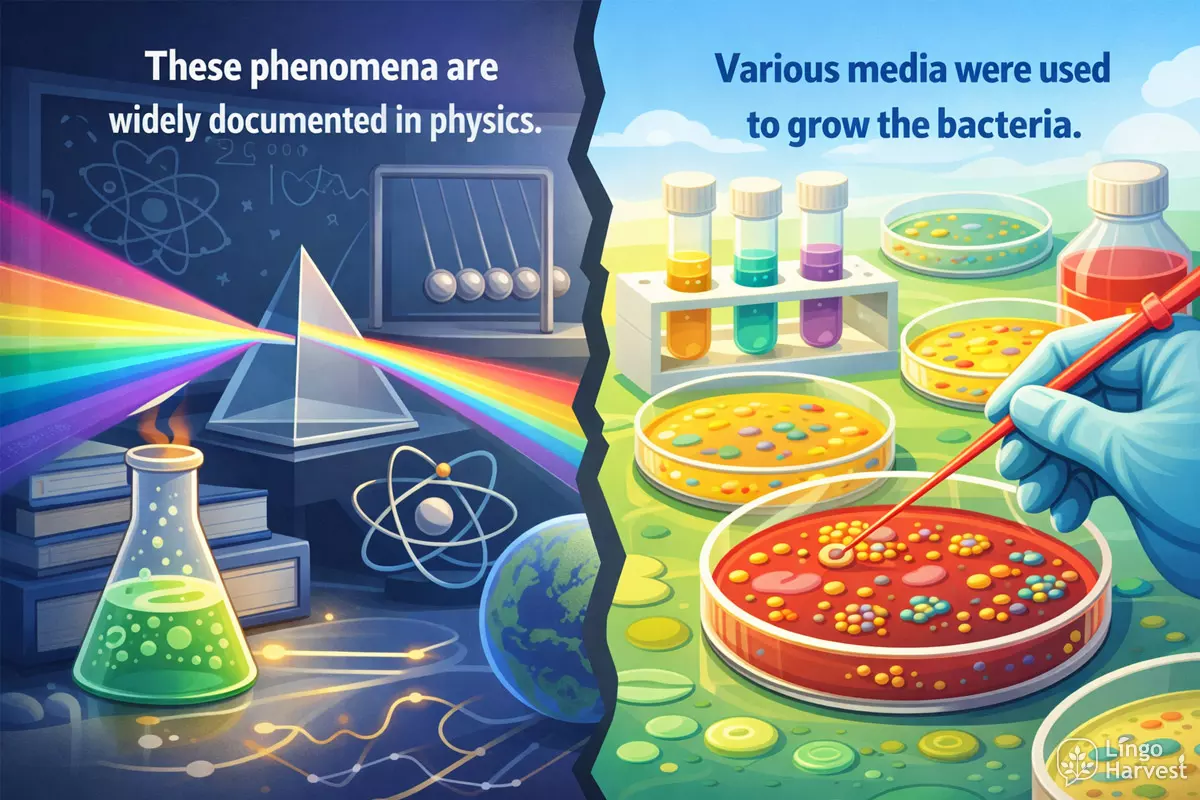
- Phenomenon → Phenomena → These phenomena are widely documented in physics.
- Medium → Media → Various media were used to grow the bacteria.
- Bacterium → Bacteria → The bacteria multiplied rapidly in ideal conditions.
- Analysis → Analyses → Several analyses were conducted before final approval.
- Thesis → Theses → The theses covered a range of academic disciplines.
- Stimulus → Stimuli → The stimuli triggered different emotional responses.
- Syllabus → Syllabi or Syllabuses → The syllabi were updated for the new semester.
- Appendix → Appendices or Appendixes → The appendices contain supplementary graphs and charts.
- Index → Indices (math/science) or Indexes (general) → The indices indicate a gradual market recovery.
- Corpus → Corpora → The corpora were analyzed to identify language patterns.
- Alumnus (male) → Alumni → The alumni attended the annual conference.
- Alumna (female) → Alumnae → The alumnae contributed to the scholarship fund.
- Genus → Genera → The genera were classified according to morphology.
- Formula → Formulae or Formulas → These formulas help calculate structural load.
- Axis → Axes → The axes show time along the horizontal line.
- Hypothesis → Hypotheses → Several hypotheses were tested during the study.
- Basis → Bases → The bases of the claims were thoroughly evaluated.
- Matrix → Matrices → The matrices were reviewed for consistency.
Comparing Singular and Plural Forms
Sometimes, both the classical plural and an anglicized form are used. The choice often depends on discipline or formality. Here’s a quick reference showing some singular and plural pairs, along with notes on usage:
| Singular | Plural | Notes |
|---|---|---|
| Datum | Data | Formal writing treats "data" as plural (e.g., "the data are...") |
| Criterion | Criteria | Use "criteria" for more than one; "criterion" for a single standard |
| Phenomenon | Phenomena | "Phenomena" is plural, not to be confused with the singular |
| Bacterium | Bacteria | "Bacteria" is often used as a mass noun, but is technically plural |
| Analysis | Analyses | Common in science and research |
| Thesis | Theses | Used for academic dissertations |
| Appendix | Appendices / Appendixes | Both forms accepted; "appendices" is more formal |
| Medium | Media | In art and communication, "media" refers to multiple forms |
Usage Tips
Writers sometimes mix up singular and plural forms, especially with words that sound unusual in English. Remember: data are, criteria are, phenomena are. Using the correct form not only maintains accuracy but also signals attention to academic detail. When in doubt, check a reliable dictionary or style guide for the preferred usage in your field.
Singular vs plural agreement with classical forms
Writers in academic English often grapple with whether to treat classical forms as singular or plural, especially when Latin or Greek nouns carry unfamiliar endings. The issue usually arises in scientific or scholarly contexts, where precision and tradition both matter. For instance, while some classical plurals are widely accepted and understood, others can sound awkward or even incorrect to the modern ear.
Patterns of Agreement in Academic Usage
A key factor is whether the noun in question is perceived as a collective, a countable entity, or an abstract concept. This perception influences verb agreement and the form of related determiners. For example, "data" (from the Latin plural of "datum") is often treated as a plural in scientific writing ("the data are conclusive"), but as a singular mass noun in general English ("the data is useful").
- Phenomenon/Phenomena: "This phenomenon occurs..." vs. "These phenomena occur..."
- Criterion/Criteria: "A criterion for inclusion is..." vs. "The criteria for inclusion are..."
- Bacterium/Bacteria: "A bacterium was observed..." vs. "Bacteria were observed..."
- Corpus/Corpora: "The corpus contains..." vs. "The corpora contain..."
- Stigma/Stigmata: "A stigma is present..." vs. "Stigmata are present..."
- Analysis/Analyses: "An analysis shows..." vs. "Analyses show..."
- Appendix/Appendices: "The appendix provides..." vs. "The appendices provide..."
- Thesis/Theses: "This thesis demonstrates..." vs. "These theses demonstrate..."
- Index/Indices: "The index lists..." vs. "The indices list..."
- Matrix/Matrices: "A matrix is used..." vs. "Matrices are used..."
- Alga/Algae: "An alga grows..." vs. "Algae grow..."
- Nucleus/Nuclei: "The nucleus contains..." vs. "The nuclei contain..."
- Formula/Formulas or Formulae: "This formula works..." vs. "These formulas/formulae work..."
- Focus/Foci: "The focus is..." vs. "The foci are..."
- Medium/Media: "The medium transmits..." vs. "The media transmit..."
- Stimulus/Stimuli: "A stimulus triggers..." vs. "Stimuli trigger..."
- Oasis/Oases: "An oasis exists..." vs. "Oases exist..."
- Diagnosis/Diagnoses: "A diagnosis is made..." vs. "Diagnoses are made..."
- Axis/Axes: "The axis rotates..." vs. "The axes rotate..."
- Automaton/Automata: "An automaton moves..." vs. "Automata move..."
Common Agreement Pitfalls
Problems frequently occur when the classical plural looks similar to an English singular, or when a plural form becomes adopted as a collective noun. For example, "agenda" is historically a plural (from "agendum"), but now treated as singular: "The agenda was discussed." Similarly, "criteria" should only be used with plural agreement (❌ "This is an important criteria" → ✅ "This is an important criterion").
Summary Table: Classical Noun Agreement
| Singular Form | Plural Form | Typical Academic Agreement |
|---|---|---|
| Phenomenon | Phenomena | These phenomena are widely reported in recent studies. |
| Datum | Data | The data are often treated as plural in formal academic writing. |
| Criterion | Criteria | The criteria are clearly defined in the methodology section. |
| Bacterium | Bacteria | The bacteria have developed resistance to several antibiotics. |
| Analysis | Analyses | The analyses indicate a strong correlation between the variables. |
| Corpus | Corpora | The corpora contain millions of words from different genres. |
| Medium | Media | The media are used to distribute information to a broad audience. |
| Appendix | Appendices | The appendices list additional tables, figures, and questionnaires. |
| Alga | Algae | The algae thrive in warm, nutrient-rich water. |
| Thesis | Theses | The theses explore various perspectives on the same topic. |
In summary, when using classical forms in academic English, always check whether a noun is truly singular or plural and match verbs and pronouns accordingly. This ensures clarity and accuracy, especially in formal writing where such distinctions are expected.
Modern trends toward regular pluralization
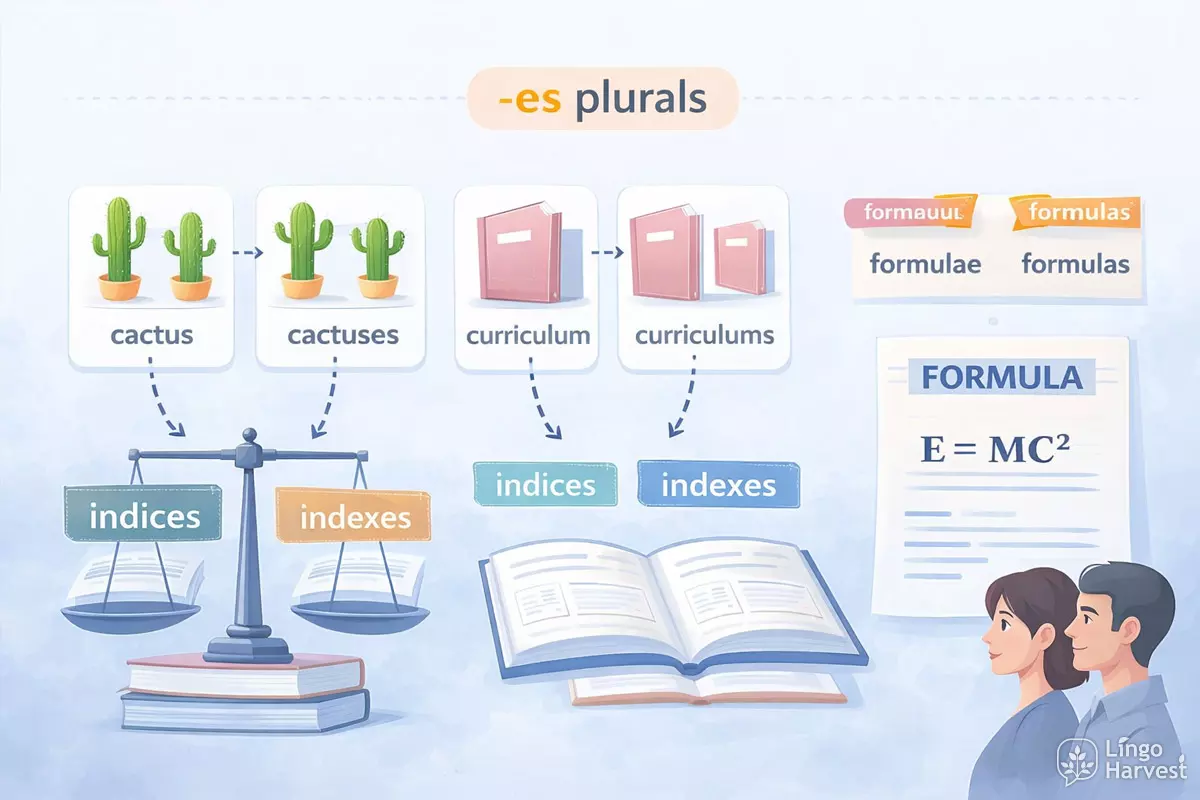
Contemporary academic English increasingly favors the use of standard English plural forms for words that originally had Latin or Greek endings. This shift reflects a general movement toward linguistic regularity and user-friendliness, especially when communicating complex ideas to broader audiences. While traditional plurals like phenomena or alumni still appear in formal writing, many speakers and writers now opt for regularized forms such as formulas or indexes in both academic and professional settings.
The growing preference for -s plurals
The tendency to use the simple -s or -es ending is especially pronounced with words that have become fully assimilated into English. For example, "cactuses" and "syllabuses" are now widely accepted alternatives to "cacti" and "syllabi." This regularization is often seen in educational contexts, technical writing, and publishing, where clarity and ease of understanding are prioritized.
Comparison of traditional and regular forms
| Singular | Traditional Plural | Regularized Plural |
|---|---|---|
| antenna | antennae | antennas |
| curriculum | curricula | curriculums |
| syllabus | syllabi | syllabuses |
| index | indices | indexes |
| formula | formulae | formulas |
| medium | media | mediums |
| focus | foci | focuses |
| criterion | criteria | criterions |
| appendix | appendices | appendixes |
| phenomenon | phenomena | phenomenons |
Reasons for the change
- Ease of learning: Regular plurals are easier for both native and non-native speakers to acquire and use correctly.
- Consistency: Using one pluralization rule streamlines grammar and reduces exceptions.
- Clarity: In technical and scientific writing, regular forms can prevent confusion.
- Frequency of use: Words used in everyday contexts tend to shift more quickly to regular forms.
Despite this ongoing shift, some Latin and Greek plurals remain entrenched in academic disciplines, especially where tradition or precision is valued. However, the overall direction is clear: regular English plurals are gaining ground, and their acceptance continues to grow in scholarly publishing and educational materials.
Differences between formal and informal usage
Academic English often favors the original Latin or Greek plurals, especially in scholarly writing, scientific publications, and technical contexts. In contrast, everyday speech and informal writing tend to use regularized, anglicized forms. This distinction is shaped by tradition, audience expectations, and the desire for clarity or precision.
Contextual Preferences
Writers and speakers choose between classical and anglicized plurals based on their audience and the level of formality. For example, a scientific paper is more likely to use "criteria" (the Latin plural of "criterion"), while casual conversation might use "criterions" (though rare) or even treat "criteria" as singular.
Common Patterns
Some nouns retain their classical plural almost exclusively in formal settings, while others have shifted toward regular -s endings in general use. Below is a comparative overview:
| Singular Form | Formal/Traditional Plural | Informal/Anglicized Plural | Typical Context |
|---|---|---|---|
| phenomenon | phenomena | phenomenons | Academic vs. casual speech |
| criterion | criteria | criterions | Scientific writing vs. informal |
| analysis | analyses | analysises | Research papers vs. error in speech |
| appendix | appendices | appendixes | Books/journals vs. general use |
| formula | formulae / formulas | formulas | Science vs. everyday language |
| datum | data | datas | Technical vs. informal (rarely used) |
| medium | media / mediums | mediums | Journalism vs. art/spiritualism |
| index | indices / indexes | indexes | Mathematics vs. general books |
| alumnus | alumni | alumnuses | Universities vs. casual |
| focus | foci / focuses | focuses | Science vs. everyday |
| syllabus | syllabi / syllabuses | syllabuses | Academic vs. general |
| thesis | theses | thesises | Formal vs. incorrect/rare |
| stimulus | stimuli | stimuluses | Biology vs. informal |
| vertebra | vertebrae | vertebras | Medical vs. layman |
| radius | radii / radiuses | radiuses | Math vs. general |
| matrix | matrices / matrixes | matrixes | Mathematics vs. general |
| curriculum | curricula / curriculums | curriculums | Academia vs. everyday |
| nucleus | nuclei / nucleuses | nucleuses | Science vs. informal |
| bacterium | bacteria | bacterias | Science vs. error in speech |
| axis | axes | axises | Technical vs. informal |
Usage Tips and Considerations
- Classical plurals (like "phenomena" or "indices") are expected in academic writing, but may seem pretentious in casual conversation.
- Some words have accepted anglicized forms ("formulas," "indexes") even in formal contexts, especially in American English.
- Occasionally, both plural forms coexist, with subtle differences in meaning; for example, "media" (mass communication) vs. "mediums" (psychics).
- Using the classical plural incorrectly, or over-regularizing ("criterias"), can undermine credibility in professional or academic settings.
- In technical fields, sticking to the traditional plural forms is usually safest and clearest.
Summary
The choice between Latin or Greek plurals and their anglicized versions often signals the register and expertise of the writer or speaker. Awareness of audience and context helps maintain both clarity and appropriateness in academic English.
Typical learner mistakes with classical plurals
Many students of academic English encounter difficulties when using nouns with Latin and Greek origins, especially regarding plural forms. These classical nouns often do not follow the regular English "-s" or "-es" pluralization rules, leading to confusion and mistakes in both writing and speech.
Common error patterns
- Using regular English plurals for classical nouns (e.g., "criterias" instead of "criteria").
- Confusing singular and plural forms (e.g., treating "phenomena" as singular).
- Mixing forms (e.g., "appendixes" in scientific writing instead of "appendices").
- Mismatching verb agreement with plural or singular classical nouns.
- Overcorrecting by applying classical plurals to words that don't require them (e.g., "datums" instead of "data" as a plural).
Frequently confused forms
Learners often mix up the correct endings or apply the wrong pluralization pattern. Here are some examples of nouns that frequently cause trouble:
- Analysis → Analyses
- Criterion → Criteria
- Phenomenon → Phenomena
- Thesis → Theses
- Bacterium → Bacteria
- Curriculum → Curricula
- Alumnus → Alumni
- Stimulus → Stimuli
- Medium → Media
- Appendix → Appendices (in academic/scientific context)
- Formula → Formulae (in mathematics), Formulas (in general English)
- Index → Indices (mathematics), Indexes (books/databases)
- Corpus → Corpora
- Genus → Genera
- Matrix → Matrices
- Axis → Axes
- Basis → Bases
- Datum → Data
Singular-plural mismatches in context
One of the most persistent pitfalls is using a plural form as if it were singular, or vice versa. For instance, saying "This criteria is important" instead of "This criterion is important." Similarly, "The data is reliable" is debated, as "data" is technically plural in formal contexts, though singular usage is common in modern English.
| Singular | Classical Plural | Typical Mistake |
|---|---|---|
| phenomenon | phenomena | "a phenomena" |
| criterion | criteria | "the criterias" |
| appendix | appendices | "appendixes" (scientific context) |
| analysis | analyses | "analysises" |
| bacterium | bacteria | "bacterias" |
| thesis | theses | "thesises" |
| medium | media | "mediums" (in academic context) |
| corpus | corpora | "corpuses" |
Tips for avoiding errors
Become familiar with the most frequently used classical forms in your field. Remember that some words have both classical and regular plurals with different meanings or usage contexts (e.g., "indexes" vs. "indices"). When in doubt, consult a reputable academic style guide or dictionary to verify the correct plural.
Practice: choose correct singular and plural forms
Understanding the correct singular and plural forms of nouns from Latin and Greek origins is essential for academic writing. Below, you’ll find exercises and structured examples designed to help you recognize and use these forms accurately in context.
Quick Challenge: Select the Correct Form
For each sentence, choose the right word from the pair in parentheses:
- Several important (phenomena / phenomenon) were observed during the experiment.
- The (criterion / criteria) for selection must be clear and objective.
- Each (analysis / analyses) was conducted independently.
- The ancient Greeks built magnificent (stadiums / stadia).
- Multiple (indexes / indices) are used in economic reports.
- Only one (bacterium / bacteria) was found in the sample.
- Several (alumni / alumnus) attended the reunion.
- This theory has several supporting (hypothesis / hypotheses).
- One (appendix / appendices) is missing from the report.
- These (theses / thesis) were submitted last year.
Show answers
- phenomena
- criterion
- analysis
- stadia
- indices
- bacterium
- alumni
- hypotheses
- appendix
- theses
Patterns: Common Academic Noun Endings
Latin and Greek nouns often follow predictable patterns. Here are some frequent endings and their transformations:
- -um → -a: datum → data
- -us → -i: alumnus → alumni
- -on → -a: criterion → criteria
- -is → -es: analysis → analyses
- -a (singular) → -ae: formula → formulae
- -ex / -ix → -ices: index → indices, appendix → appendices
- -ma → -mata: stoma → stomata
- -on (Greek) → -a: phenomenon → phenomena
Table: Singular and Plural Forms of Common Academic Nouns
| Singular | Plural |
|---|---|
| phenomenon | phenomena |
| criterion | criteria |
| analysis | analyses |
| appendix | appendices |
| alumnus | alumni |
| thesis | theses |
| index | indices |
| formula | formulae |
| datum | data |
| bacterium | bacteria |
| hypothesis | hypotheses |
| stimulus | stimuli |
| curriculum | curricula |
| vertebra | vertebrae |
| stadium | stadia |
Self-Test: Fill in the Missing Plural or Singular
Write the correct form (singular or plural) for each item:
- One ________ (stimulus), several ________.
- One ________ (datum), many ________.
- One ________ (thesis), two ________.
- One ________ (curriculum), three ________.
- One ________ (bacterium), millions of ________.
- One ________ (phenomenon), multiple ________.
- One ________ (criterion), several ________.
- One ________ (matrix), two ________.
- One ________ (analysis), five ________.
- One ________ (index), several ________.
Show answers
- stimulus, stimuli
- datum, data
- thesis, theses
- curriculum, curricula
- bacterium, bacteria
- phenomenon, phenomena
- criterion, criteria
- matrix, matrices
- analysis, analyses
- index, indices
Regular review and practice with these noun forms can help you avoid common mistakes in scholarly writing. Pay attention to context, as some borrowed plurals now have regular English alternatives in informal usage.