Loanword Nouns and Their Plural Forms in Modern English

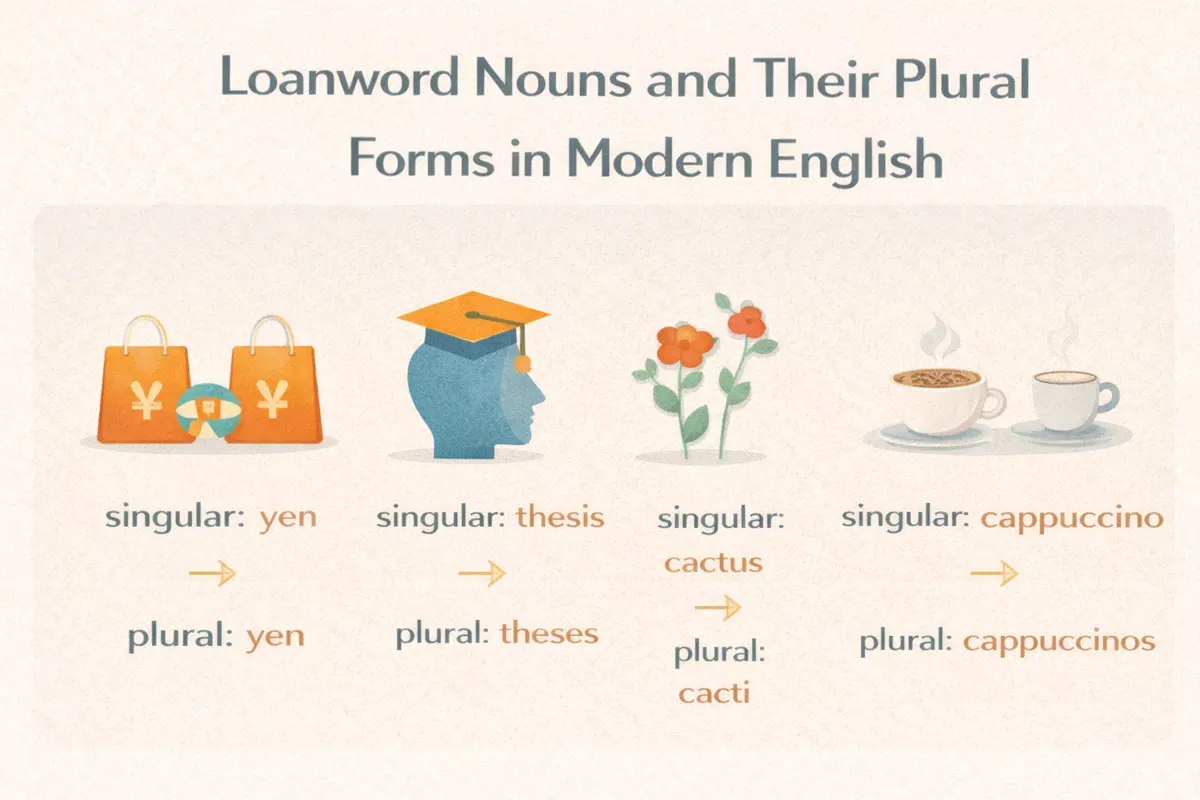 The article identifies loanword nouns in modern English, highlights common examples and their origins, compares native and foreign plural forms, explains when English plurals are used instead, discusses register differences, and provides practice picking correct…
- What loanword nouns are in modern English
- Common everyday loanwords and their origins
- Native vs original plural forms of loanwords
- When English-style plurals replace foreign plurals
- Register and style differences in plural choice
- Typical learner confusion with loanword plurals
- Practice: pick correct plural forms for loanword nouns
Borrowed terms from other languages enrich the English vocabulary, yet their plural forms often confuse even experienced speakers. Many of these foreign nouns follow unique pluralization rules from their original languages, such as "cacti" from Latin or "phenomena" from Greek, while others gradually adopt standard English endings like "sushis" or "pizzas." Recognizing how these words adapt—or resist adaptation—offers insight into the flexible nature of English grammar and highlights the ongoing influence of global cultures on the language.
What loanword nouns are in modern English
Modern English vocabulary is filled with nouns borrowed from many other languages. These imported words reflect centuries of cultural exchange, trade, migration, and technological development. Loan nouns often retain traces of their original spelling, pronunciation, or plural forms, making English rich and sometimes unpredictable. Some borrowed terms have become so familiar that their foreign origins are rarely noticed, while others still feel distinctly “exotic” or specialized.
Common Sources of Borrowed Nouns
Many everyday nouns come from Latin, French, Greek, Italian, German, Arabic, and other sources. For instance, English adopted legal and culinary terms from French after the Norman Conquest, while scientific and academic vocabulary often comes from Latin and Greek. Words for food, music, art, and technology also frequently reflect their roots in other languages.
Examples of Loanword Nouns in Daily Use
- Piano (Italian)
- Ballet (French)
- Algebra (Arabic)
- Robot (Czech)
- Sushi (Japanese)
- Safari (Swahili)
- Kindergarten (German)
- Patio (Spanish)
- Chocolate (Nahuatl via Spanish)
- Guitar (Greek/Spanish)
- Opera (Italian)
- Guru (Sanskrit)
- Menu (French)
- Tsunami (Japanese)
- Fiancé (French)
- Yoga (Sanskrit)
- Café (French)
- Jury (French/Latin)
- Safari (Swahili)
- Avatar (Sanskrit via Hindi)
Loan Nouns with Distinctive Plural Forms
Some borrowed nouns keep their original plural endings, which can seem unusual compared to regular English patterns. Others have both traditional and anglicized plurals in use. Here’s a look at a few noteworthy cases:
| Singular | Original Plural | Anglicized Plural | Source Language |
|---|---|---|---|
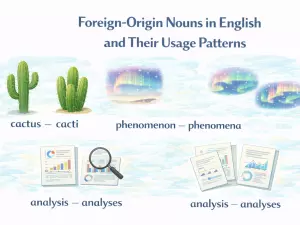
| cactus | cacti | cactuses | Latin |
| criterion | criteria | ❌ | Greek |
| phenomenon | phenomena | ❌ | Greek |
| analysis | analyses | ❌ | Greek |
| index | indices | indexes | Latin |
| syllabus | syllabi | syllabuses | Latin |
| fungus | fungi | funguses | Latin |
| thesis | theses | ❌ | Greek |
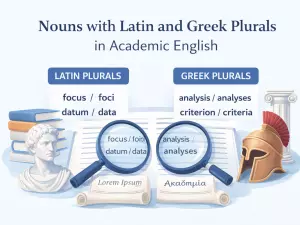
| datum | data | ❌ | Latin |
| medium | media | mediums (in some senses) | Latin |
Why Borrowed Nouns Matter
Imported nouns enrich English by adding precision, cultural flavor, and expressive options. They also create some challenges, especially when it comes to spelling and forming plurals. Learning which forms are standard in modern usage can help avoid confusion and make your language more accurate and varied.
Common everyday loanwords and their origins
Many words English speakers use daily have roots in other languages. These borrowed nouns often reflect historical contact, trade, or cultural exchange. Understanding where these terms come from not only enriches vocabulary but also reveals how English adapts and pluralizes foreign words.
Examples of familiar borrowed nouns

Some words have become so naturalized that their origins are often overlooked. Here are several widely used nouns that English has adopted from various sources:
- Piano (Italian, "pianoforte") → She practices the piano every evening.
- Restaurant (French, "restaurer" – to restore) → We booked a table at a new restaurant.
- Kindergarten (German, "children's garden") → Her son starts kindergarten this fall.
- Safari (Swahili, "journey") → They went on a safari in Kenya.
- Algebra (Arabic, "al-jabr") → Algebra is a core subject in high school.
- Banana (West African, possibly Wolof) → He ate a banana after the workout.
- Robot (Czech, "robota" – forced labor) → The factory uses robots for assembly.
- Chocolate (Nahuatl, "xocolātl") → Dark chocolate is rich in flavor.
- Jungle (Hindi, "jangal") → The explorers crossed the jungle.
- Patio (Spanish, "courtyard") → We had lunch on the patio.
- Yoga (Sanskrit, "yoga" – union) → She does yoga every morning.
- Avatar (Sanskrit, "avatāra" – descent) → He changed his avatar on the forum.
- Kung fu (Chinese, "gongfu") → He trained in kung fu for years.
- Café (French, from Turkish "kahve") → Let’s meet at a café near the office.
- Tsunami (Japanese, "harbor wave") → The tsunami caused massive destruction.
- Guitar (Spanish, from Arabic "qīthārah") → She plays the guitar in a band.
- Kimono (Japanese, "thing to wear") → She wore a traditional kimono.
- Opera (Italian, "work, labor") → They attended an opera in Milan.
- Pizza (Italian, "pie") → We ordered pizza for dinner.
- Safari (Swahili, "journey") → A safari can last several days.
Loanwords and their plural forms
Some borrowed nouns keep their original plural endings, while others adapt to regular English forms. For example, "cactus" (from Latin) can become "cacti" or "cactuses," and "syllabus" (from Greek via Latin) can be "syllabi" or "syllabuses." The table below highlights a few common nouns, their language of origin, and the way their plural forms are handled in modern usage.
| Loanword | Origin | Plural in English | Notes |
|---|---|---|---|
| Analysis | Greek | Analyses | Retains Greek -es ending |
| Criterion | Greek | Criteria | Original plural form |
| Bacterium | Latin | Bacteria | Latin plural is standard |
| Index | Latin | Indexes/Indices | Both forms accepted |
| Alumnus | Latin | Alumni | Latin masculine plural |
| Phenomenon | Greek | Phenomena | Retains Greek plural |
| Focus | Latin | Focuses/Foci | Both forms in use |
| Appendix | Latin | Appendices/Appendixes | Context-dependent plural |
How loanwords shape English
Borrowed nouns often arrive with their original spellings and pronunciations, but over time, they may adapt to English patterns. Some, like "pizza" and "robot," take standard "-s" plurals, while others retain older forms. This ongoing process keeps English flexible and open to new influences, reflecting its global connections.
Native vs original plural forms of loanwords
When English borrows nouns from other languages, their pluralization often creates interesting choices. Some words keep their original foreign plural endings, while others adapt to the standard English "-s" or "-es" pattern. The decision can depend on the level of assimilation, familiarity, or context in which the word is used.
Common Patterns of Pluralization
In everyday English, most borrowed nouns eventually take on the regular English plural. However, certain words—especially those from Latin, Greek, or French—may retain their native plurals, at least in formal or technical settings. Here are some patterns you might notice:
- Latin -us → -i (alumnus → alumni)
- Latin -um → -a (datum → data)
- Greek -on → -a (criterion → criteria)
- French -eau → -eaux (bureau → bureaux)
- Italian -o → -i (tempo → tempi)
- Hebrew -im (cherub → cherubim)
Mixed Usage and Shifting Preferences
Some borrowed words have both forms in circulation. The choice between an English plural and the original one can signal register, formality, or tradition. For example, scientists may prefer formulae over formulas, while everyday usage leans toward the simpler native form.
| Singular | Original Plural | English Plural | Notes |
|---|---|---|---|
| cactus | cacti | cactuses | Both are accepted; "cactuses" more common in general speech. |
| appendix | appendices | appendixes | "Appendices" for anatomical or book references; "appendixes" is also correct. |
| phenomenon | phenomena | phenomenons | "Phenomena" is standard; "phenomenons" is rare and nonstandard. |
| index | indices | indexes | "Indices" in mathematics/science; "indexes" in publishing. |
| focus | foci | focuses | Both are correct; "focuses" is more common in general English. |
| criterion | criteria | criterions | "Criteria" is standard; "criterions" is rare. |
Loanwords That Only Take English Plurals
Some borrowed nouns never use their original plural in modern English. For example:
- pizza → pizzas (not "pizze")
- robot → robots
- taco → tacos
- studio → studios
- banana → bananas
Summary
Whether a loanword keeps its original plural or switches to a native English one depends on usage, tradition, and context. Over time, most borrowed nouns settle into a regular pattern, but some retain their foreign flavor, especially in academic or technical fields. This flexibility is a hallmark of English as a living, changing language.
When English-style plurals replace foreign plurals
In modern English, loanwords often start with their original plural endings, but as they become more familiar, speakers tend to adopt regular "-s" or "-es" endings. This shift usually happens when the foreign form feels awkward, is hard to remember, or when the word is used frequently in everyday conversation. Over time, the English system for forming plurals becomes the default, even for words that once had distinctive endings from Latin, Greek, or other languages.
Common triggers for adopting regular English plurals
- The original plural is unfamiliar or counterintuitive for most speakers.
- The word is widely used outside academic or specialist contexts.
- Media, educators, or style guides recommend the English form.
- The foreign plural conflicts with English pronunciation or spelling habits.
- Children and non-native speakers naturally apply English rules.
Examples: English plurals replacing foreign endings
| Original Loanword | Foreign Plural → English Plural |
|---|---|
| cactus | cacti → cactuses |
| stadium | stadia → stadiums |
| syllabus | syllabi → syllabuses |
| antenna | antennae → antennas |
| fungus | fungi → funguses |
| formula | formulae → formulas |
| index | indices → indexes |
| memorandum | memoranda → memorandums |
| curriculum | curricula → curriculums |
| phenomenon | phenomena → phenomenons |
| appendix | appendices → appendixes |
| octopus | octopodes/octopi → octopuses |
| criterion | criteria → criterions |
| medium | media → mediums |
| data (datum) | data (uncountable) → datas (rare, in some fields) |
Notes on usage and variation
In some cases, both the foreign and the regular English forms are accepted, but the English version may be more common in everyday language. Some words, like cactus and octopus, illustrate how even specialist fields may stick to the traditional plural, while general usage prefers the simpler English ending. As language evolves, these patterns reflect how speakers prioritize ease and clarity over strict adherence to original grammar.
Register and style differences in plural choice
When it comes to pluralizing loanwords in English, the choice between traditional (often foreign) plurals and regularized English endings frequently depends on the level of formality and the context. Academic, scientific, or technical writing sometimes preserves the original plural forms to signal precision or erudition, while everyday conversation and general prose often opt for the regular "-s" ending for clarity and ease.
Contextual Factors Influencing Plural Form
Writers and speakers typically select plural forms based on several factors:
- Register: Formal writing tends to retain Latin or Greek plurals (e.g., "phenomena"), whereas informal speech prefers anglicized forms ("phenomenons").
- Audience: Specialist audiences expect traditional forms in professional settings, but lay audiences may find them obscure.
- Frequency: Less common loanwords are more likely to keep their original plurals; highly assimilated words often use "-s" or "-es".
- Stylistic Consistency: Authors may choose based on the desired tone or to avoid inconsistency within a text.
Examples: Plural Forms in Different Registers
Below is a comparison of pluralization patterns for several common loanword nouns, illustrating how register and style shape the chosen form.
| Singular | Traditional Plural (Formal/Academic) | Anglicized Plural (Informal/General) | Typical Usage Context |
|---|---|---|---|
| criterion | criteria | criterions | Academic writing: traditional; conversation: anglicized rare |
| appendix | appendices | appendixes | Medical/academic: traditional; books: both |
| index | indices | indexes | Math/finance: traditional; books: anglicized |
| antenna | antennae | antennas | Biology: traditional; electronics: anglicized |
| formula | formulae | formulas | Sciences: traditional; general: anglicized |
| syllabus | syllabi | syllabuses | Education: both |
| phenomenon | phenomena | phenomenons | Formal: traditional; rare informal: anglicized |
| analysis | analyses | analysises | Traditional only (anglicized very rare) |
| focus | foci | focuses | Science: both; general: anglicized |
| datum | data | datums | Science: traditional; general: collective “data” |
Shifting Preferences and Style Guides
Language change leads to shifting preferences over time. Many style guides now accept either plural form for certain words, especially if the anglicized version is widely understood. For instance, "indexes" is common in library science, while "indices" dominates in mathematics. Choosing between forms can signal group membership, expertise, or simply reflect evolving English usage.
- Media and journalism: Favor regular forms for accessibility.
- Scientific journals: Often insist on classical plurals.
- Everyday speech: Tends toward simplicity and regularity.
Ultimately, the plural form you select for a loanword depends on your purpose, audience, and the norms of your field or context.
Typical learner confusion with loanword plurals
Many English learners find pluralizing nouns borrowed from other languages tricky. This confusion stems from the variety of pluralization rules that depend on the word’s origin, as well as the coexistence of traditional and anglicized forms. For example, some loanwords retain their original plural endings, while others adapt to the regular English "-s" or "-es" pattern. Learners often hesitate between these options, unsure which is considered standard or acceptable.
Common pitfalls with foreign plurals
- Over-applying English rules: Adding "-s" to every loanword, such as "criterias" instead of "criteria".
- Using foreign plurals where not needed: Saying "syllabi" for "syllabuses" in all contexts, even when the anglicized form is more common.
- Mixing singular and plural forms: Using "phenomena" as singular, or "datum" as plural.
- Not recognizing irregular patterns: Uncertainty with words like "cactus" (cacti/cactuses) or "appendix" (appendices/appendixes).
- Confusing identical forms: Words like "species" and "series" look the same in singular and plural, causing errors in agreement.
Examples of loanword plural confusion

Here are some words that often cause uncertainty, along with the most common mistakes learners make:
- alumnus → alumni (not "alumnuses") → The alumni gathered for a reunion.
- analysis → analyses ("analysis" as plural is incorrect) → Several analyses support this conclusion.
- criterion → criteria (avoid "criterions" or "criterias") → These criteria must be met.
- fungus → fungi or "funguses" → The fungi spread rapidly in damp areas.
- medium → media (not "mediums" in most contexts) → Social media influences public opinion.
- syllabus → syllabi or "syllabuses" → The syllabi were updated this year.
- appendix → appendices or "appendixes" → The report includes several appendices.
- index → indices or "indexes" → Market indices closed higher today.
- cactus → cacti or "cactuses" → Desert cacti store water efficiently.
- datum → data (avoid "datums" for scientific use) → The data was collected over five years.
- phenomenon → phenomena → Natural phenomena fascinate scientists.
- thesis → theses → Several theses were defended today.
- basis → bases → Trust forms the bases of cooperation.
- focus → foci or "focuses" → The study has two main foci.
- axis → axes → The graph shows values on two axes.
- stimulus → stimuli → Visual stimuli affect attention.
- matrix → matrices or "matrixes" → Data is stored in large matrices.
- vertebra → vertebrae → The spine consists of many vertebrae.
- radius → radii → The circles have different radii.
- formula → formulae or "formulas" → Mathematical formulae describe patterns.
When both plural forms are accepted
Sometimes, both the original and anglicized plurals are correct, but one may be preferred in academic or formal writing. The choice can depend on context, audience, or even personal style, further complicating things for learners.
| Singular | Traditional Plural | Anglicized Plural | Typical Contexts |
|---|---|---|---|
| cactus | cacti | cactuses | Both accepted; "cacti" in science, "cactuses" in general use |
| syllabus | syllabi | syllabuses | "Syllabi" in academia, "syllabuses" in everyday English |
| appendix | appendices | appendixes | "Appendices" for texts, "appendixes" for anatomy |
| index | indices | indexes | "Indices" in math/finance, "indexes" in books |
| matrix | matrices | matrixes | "Matrices" in math/science, "matrixes" less common |
In summary, the mix of original and English plural forms, each with its own nuances, often leaves learners unsure which to use. Practice, exposure to varied contexts, and consulting reliable dictionaries can help clarify these patterns over time.
Practice: pick correct plural forms for loanword nouns
Understanding how to pluralize nouns borrowed from other languages can be tricky, since some keep their original plural forms while others adapt to standard English patterns. Let’s test your knowledge with some exercises and examples based on common loanwords.
Choose the correct plural form
Below are several sentences. In each one, select the appropriate plural for the highlighted loanword noun. Some may use the original plural from their language of origin, while others follow English conventions.
- There are several cactus growing in the desert.
- Many phenomenon have been observed in the experiment.
- The museum displayed rare criterion for judging art.
- All the syllabus were distributed on the first day.
- She bought two analyses of the data for her research.
- The chef prepared several different stratum of desserts.
- We compared the appendix at the end of each book.
- There are many alumna at the reunion this year.
- The university’s curriculum have changed over time.
- The doctor examined all of the vertebra in the spine.
Show answers
- cacti
- phenomena
- criteria
- syllabi
- analyses
- strata
- appendices (or appendixes)
- alumnae
- curricula
- vertebrae
Common loanwords: singular and plural forms
Here are some examples of borrowed nouns and their plural forms. Notice the variety in endings and patterns:
- datum → data
- stimulus → stimuli
- radius → radii
- fungus → fungi
- index → indices (or indexes)
- medium → media
- thesis → theses
- diagnosis → diagnoses
- axis → axes
- octopus → octopuses (sometimes octopodes)
- antenna → antennae (for insects), antennas (for radios)
- formula → formulae (or formulas)
- curriculum → curricula (or curriculums)
- alumnus → alumni
- alumna → alumnae
- phenomenon → phenomena
- criterion → criteria
- analysis → analyses
- syllabus → syllabi (or syllabuses)
- appendix → appendices (or appendixes)
Comparing regular and irregular pluralization
Some loanwords have both traditional and Anglicized plural forms. Below is a comparison of four such nouns:
| Singular | Traditional Plural | Anglicized Plural |
|---|---|---|
| appendix | appendices | appendixes |
| syllabus | syllabi | syllabuses |
| index | indices | indexes |
| formula | formulae | formulas |
Quick practice: pick the right plural
Decide which plural form fits best for each word below:
- stimulus: stimuli or stimuluses?
- thesis: theses or thesises?
- antenna: antennae or antennas?
- octopus: octopuses or octopi?
- analysis: analyses or analysis?
- criterion: criteria or criterions?
- phenomenon: phenomena or phenomenons?
- datum: data or datums?
- medium: media or mediums?
- radius: radii or radiuses?
Show answers
- stimuli
- theses
- antennae (for insects), antennas (for radios)
- octopuses (octopi is commonly used but not technically correct)
- analyses
- criteria
- phenomena
- data (scientific use)
- media (general use), mediums (spiritual or technical)
- radii (technical), radiuses (general)
Mastering these plural forms helps you sound natural and precise, especially in academic or formal writing. Recognizing both traditional and anglicized variants will also help you understand and produce more accurate English in different contexts.