Activity vs Result Nouns in Formal English Communication

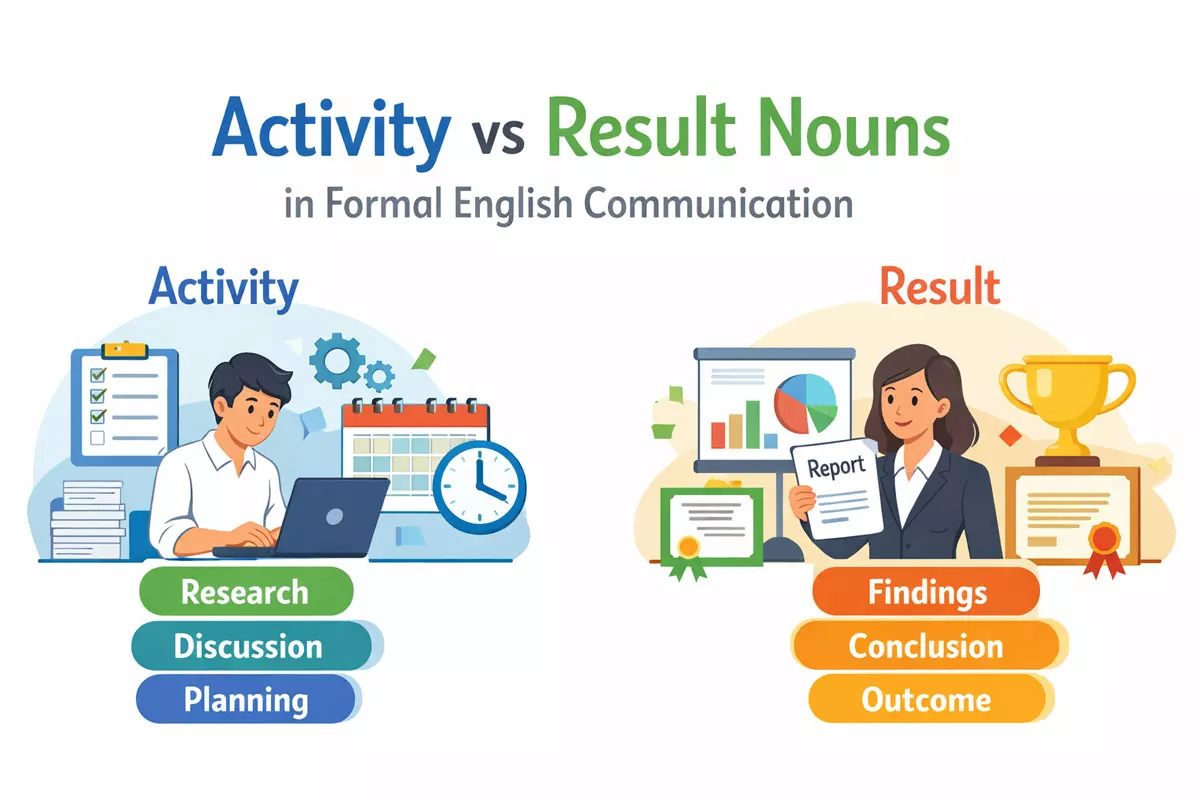 Here we the difference between activity and result nouns, how verb–noun pairs show process versus outcome, context clues for choosing the right noun, the effect on meaning in reports, formal style preferences, common learner confusion, and practice exercises.
- Difference between activity and result nouns
- Verb–noun pairs showing process vs outcome
- Context clues for choosing activity or result nouns
- Effect on meaning in reports and explanations
- Preference for result nouns in formal style
- Typical learner confusion between process and outcome
- Practice: select correct noun type in professional contexts
Selecting appropriate words to describe ongoing actions or their outcomes is essential for clear professional communication. Knowing how to differentiate between terms that express processes and those that refer to results allows your writing to be both accurate and impactful. This skill not only improves clarity but also demonstrates your command of English, helping you to convey your message effectively and avoid misunderstandings in workplace interactions.
Difference between activity and result nouns
In formal English, certain nouns are closely related but serve distinct roles: some refer to ongoing processes or repeated actions, while others indicate the outcome or product of those actions. Understanding this distinction helps improve clarity and precision in academic, business, and technical writing.
What are activity nouns?
Activity nouns describe the process, act, or state of doing something. They often express actions that are continuous, habitual, or general, without focusing on the outcome. Commonly, these nouns are derived from verbs and end in -ing or -ion, such as learning, negotiation, or discussion. They answer the question: "What is happening or being done?"
What are result nouns?
Result nouns, on the other hand, refer to the specific product, effect, or consequence that arises from an action or process. These nouns often have different forms from their activity counterparts and are used when the focus is on what has been achieved, created, or concluded. Examples include decision, solution, or construction. They answer: "What has been produced or accomplished?"
Key distinctions at a glance
| Activity Nouns | Result Nouns |
|---|---|
| Describe the process or act e.g., writing, translation, negotiation |
Refer to the product or outcome e.g., text, translation (as a document), agreement |
| Emphasize ongoing or repeated action | Emphasize completion or result |
| Often used with "by" to show agent (by the team) | Often used with "of" to show possession or origin (the result of the meeting) |
| Examples: training, reading, analysis, examination, implementation | Examples: report, reading (as a text), analysis (as findings), exam, implementation (as a system) |
Common pairs in formal communication
- Application (the act of applying) → Application (the form submitted)
- Translation (the process of translating) → Translation (the finished text)
- Analysis (the act of analyzing) → Analysis (the findings or report)
- Examination (the act of examining) → Examination (a test or assessment)
- Construction (the process) → Construction (the building or structure)
- Presentation (the act of presenting) → Presentation (the slide deck or speech)
- Discovery (the act of discovering) → Discovery (the thing found)
- Recording (the process of recording) → Recording (the audio or video file)
- Publication (the act of publishing) → Publication (the published work)
- Decision (the act of deciding) → Decision (the chosen option)
- Assignment (the act of assigning) → Assignment (the task given)
- Observation (the act of observing) → Observation (the remark or data point)
- Agreement (the act of agreeing) → Agreement (the contract or consensus)
- Collection (the process of collecting) → Collection (the gathered items)
- Submission (the act of submitting) → Submission (the document submitted)
- Measurement (the act) → Measurement (the value/result)
Usage in formal writing
Choosing between these two types depends on what you intend to emphasize. In reports or proposals, activity nouns are often used to describe ongoing work or processes, while result nouns highlight achievements, outputs, or deliverables. Being aware of this nuance helps avoid ambiguity, especially in project management, academic papers, and official correspondence.
Verb–noun pairs showing process vs outcome
Understanding the difference between activity (process) nouns and result (outcome) nouns is crucial for precise communication in formal English. This distinction often appears in pairs where a verb can generate two related nouns: one focusing on the ongoing action, the other on the completed result. Recognizing and choosing the correct form helps clarify intent, responsibility, and the stage of an action in professional contexts. Many English verbs produce two types of nouns. The first, an activity noun, usually ends in -ing or -ion and refers to the process itself. The second, a result noun, often ends in -ment, -al, -ure, or other suffixes, and refers to the product or outcome of that process. Selecting between these forms can change the nuance or even the meaning of a sentence, especially in business writing, academic reports, or technical documentation.
Common verb-based noun pairs: process vs. outcome

The following list highlights typical verb–noun pairs, illustrating the contrast between the ongoing action and its final product:
- Apply: application (process) vs. appliance (result)
- Develop: development (process) vs. developer (result/person)
- Approve: approval (process/outcome, context-dependent)
- Build: building (process or structure) vs. build (result/structure, in IT or construction)
- Deliver: delivery (process) vs. deliverable (result/product)
- Produce: production (process) vs. product (result)
- Decide: deciding (process) vs. decision (result)
- Sign: signing (process) vs. signature (result)
- Translate: translating (process) vs. translation (result/document)
- Measure: measuring (process) vs. measurement (result/data)
- Arrange: arranging (process) vs. arrangement (result)
- Assign: assigning (process) vs. assignment (result/task)
- Approve: approving (process) vs. approval (result/permission)
- Submit: submitting (process) vs. submission (result/document)
- Design: designing (process) vs. design (result/plan)
- Plan: planning (process) vs. plan (result/strategy)
- Inform: informing (process) vs. information (result/data)
- Report: reporting (process) vs. report (result/document)
- Review: reviewing (process) vs. review (result/document/feedback)
- Analyze: analyzing (process) vs. analysis (result)
Comparing process and outcome nouns
To make the differences even clearer, here’s a table showing several verb roots, their process-focused nouns, and corresponding outcome-focused nouns:
| Verb | Process Noun | Outcome Noun |
|---|---|---|
| Approve | Approving | Approval |
| Build | Building | Building (structure) |
| Measure | Measuring | Measurement |
| Assign | Assigning | Assignment |
| Deliver | Delivery (process) | Deliverable |
| Design | Designing | Design (plan) |
| Plan | Planning | Plan |
| Report | Reporting | Report |
Choosing the appropriate noun depends on whether you wish to emphasize the unfolding of an action or its end result. In formal writing, this subtlety can affect clarity and reader expectations. For example, requesting a "report" implies a finished document, while "reporting" signals ongoing updates or communication. In summary, distinguishing process from outcome nouns helps avoid ambiguity and ensures your message accurately reflects the intended stage or focus of an action in formal English contexts.
Context clues for choosing activity or result nouns
Selecting between nouns that refer to actions (activity nouns) and those that denote outcomes (result nouns) often depends on subtle hints in the sentence. These cues can be grammatical, contextual, or based on the intent behind the communication. Understanding these signals helps ensure precision and clarity, especially in formal writing or professional correspondence.
Recognizing activity nouns
Activity nouns typically describe ongoing processes, repeated actions, or general behaviors. They are common when the focus is on the act itself rather than what is achieved. Look for these indicators:
- Use of words like during, while, or time phrases (e.g., throughout the meeting)
- References to duration or frequency (regular reporting, ongoing monitoring)
- Instructions or policies (Participation is mandatory, Planning is required)
- Descriptions of methods or procedures (Analysis of data, Negotiation with partners)
- Emphasis on involvement or engagement
Spotting result nouns
Result nouns, in contrast, highlight what has been accomplished or produced. They are especially useful when discussing outcomes, deliverables, or conclusions. You’ll often find them in these settings:
- Sentences focusing on achievement or completion (The decision was announced, The solution was effective)
- References to products, findings, or documents (The proposal, The report, The outcome)
- When summarizing results at the end of activities (The agreement was signed, The presentation received approval)
- Evaluation or assessment contexts (The improvement was significant)
- Statements of fact or result, not process
Comparing typical clues in context
| Activity Noun Example | Result Noun Example |
|---|---|
| During negotiation, both sides presented their views. | The agreement was finalized after lengthy talks. |
| Continuous monitoring is essential for quality. | The report highlights the key findings. |
| Active participation improves team morale. | Her contribution was recognized by the board. |
| Regular training keeps skills updated. | The certificate was issued upon completion. |
| Effective planning prevents delays. | The schedule was revised for efficiency. |
| Thorough analysis informs decisions. | The conclusion was based on all available data. |
| Group discussion fosters creativity. | The decision was unanimous. |
| Frequent consultation builds trust. | The final recommendation was well-received. |
| Open communication reduces misunderstandings. | The resolution addressed all concerns. |
| Ongoing development is encouraged. | The prototype was delivered on time. |
Quick checklist for determining the right noun type
- Is the focus on the process or the end product?
- Does the sentence describe something happening over time (activity) or something completed (result)?
- Are you describing how something is done, or what was achieved?
- Does the surrounding text use verbs like require, participate, analyze (activity), or achieve, produce, deliver (result)?
Practice: Identify the noun type
- The presentation was well-received by the audience.
- Consistent preparation leads to better outcomes.
- Her assessment was thorough and impartial.
- Effective coordination among teams is essential.
Show answers
- 1. Result noun (focus on the completed event)
- 2. Activity noun (focus on the ongoing process)
- 3. Result noun (focus on the completed evaluation)
- 4. Activity noun (focus on the process of working together)
Effect on meaning in reports and explanations
Choosing between activity nouns (like "development" or "analysis") and result nouns (such as "product" or "conclusion") can subtly shift the focus and interpretation of formal English communication. When preparing reports or explanations, this choice impacts whether the emphasis lies on the process or the outcome.
Emphasizing Process vs. Outcome
Activity nouns draw attention to ongoing actions, methods, or operations. They are useful when the process itself is significant, for example in progress updates, methodologies, or when clarity about procedures is required. In contrast, result nouns highlight completed events, products, or findings, which is essential for summaries, conclusions, or deliverables.
- "Investigation" (activity) vs. "finding" (result)
- "Negotiation" (activity) vs. "agreement" (result)
- "Measurement" (activity) vs. "value" (result)
- "Evaluation" (activity) vs. "assessment" (result)
- "Preparation" (activity) vs. "report" (result)
- "Design" (activity) vs. "prototype" (result)
- "Discussion" (activity) vs. "recommendation" (result)
- "Research" (activity) vs. "discovery" (result)
- "Inspection" (activity) vs. "certificate" (result)
- "Presentation" (activity) vs. "summary" (result)
- "Testing" (activity) vs. "score" (result)
- "Calculation" (activity) vs. "figure" (result)
- "Observation" (activity) vs. "evidence" (result)
- "Compilation" (activity) vs. "database" (result)
- "Comparison" (activity) vs. "difference" (result)
- "Revision" (activity) vs. "update" (result)
- "Implementation" (activity) vs. "system" (result)
- "Consultation" (activity) vs. "plan" (result)
- "Reporting" (activity) vs. "statement" (result)
- "Supervision" (activity) vs. "approval" (result)
Clarity and Reader Expectations
Using process-oriented nouns can sometimes obscure the end result, especially if the audience expects to see outcomes or final products. On the other hand, result nouns may leave out important details about how the outcome was achieved. Writers should consider their audience’s needs: technical readers may want to see both, while executives might prefer succinct statements of results.
| Purpose | Preferred Noun Type |
|---|---|
| Describing methods or steps | Activity Nouns |
| Highlighting achievements or deliverables | Result Nouns |
| Explaining ongoing work | Activity Nouns |
| Summarizing findings | Result Nouns |
Practical Impact in Formal Writing
The distinction is not just stylistic. Overuse of activity nouns can make writing seem vague or overly procedural, while exclusive use of result nouns may result in a lack of transparency about how results were achieved. Striking a balance ensures both the process and the achievements are communicated clearly.
Preference for result nouns in formal style
In formal English, writers and speakers frequently opt for nouns that indicate the outcome or product of an action, rather than the action itself. This tendency arises because such terms often sound more objective, concise, and detached—qualities valued in academic, legal, government, and business communication. Using nouns that highlight results also allows for greater specificity and clarity, particularly when discussing procedures, findings, or official decisions.
Why result nouns are favored
Result-oriented nouns carry a sense of finality and precision. They are particularly useful in summarizing complex processes or when the focus is on what has been achieved, rather than on the activity leading up to it. This approach helps maintain a formal tone and avoids unnecessary verbosity. Additionally, these nouns can reduce ambiguity by shifting attention away from ongoing processes to concrete outcomes.
Common result nouns in formal English
The following is a list of frequently used result nouns that often replace their activity-based counterparts in more formal registers:
- Approval: The plan received official approval last week.
- Assessment: A full assessment of the risks will be completed soon.
- Completion: The completion of the project was a major success.
- Decision: His decision to leave surprised everyone.
- Development: The latest development in the case shocked the public.
- Discovery: Their discovery led to new medical research.
- Evaluation: We need an evaluation of the results before moving forward.
- Implementation: The implementation of new software improved efficiency.
- Improvement: There has been a clear improvement in sales this year.
- Increase: There was a sharp increase in customer numbers.
- Invention: His new invention could change the industry.
- Investment: Their investment in education paid off.
- Investigation: The investigation revealed important information.
- Observation: Her observation helped solve the problem.
- Presentation: His presentation was clear and informative.
- Publication: The publication of the report caused debate.
- Recommendation: We followed the recommendation from the experts.
- Registration: Online registration made the process faster.
- Resolution: The conflict ended after a peaceful resolution.
- Submission: Late submission will not be accepted.
Comparing activity and result nouns
Writers often face a choice between emphasizing the process or the outcome. For example, "analyzing" (process) versus "analysis" (result), or "applying" versus "application." The table below illustrates this distinction and offers context for each usage.
| Activity Noun (Process) | Result Noun (Outcome) | Typical Formal Context |
|---|---|---|
| investigating | investigation | official reports, academic papers |
| applying | application | legal documents, job procedures |
| developing | development | project management, scientific writing |
| deciding | decision | policy statements, meeting minutes |
| presenting | presentation | conference programs, business communications |
Summary of stylistic benefits
Choosing nouns that denote results helps maintain a tone of objectivity and authority. Such usage is less personal, which suits the conventions of formal writing. It also facilitates clearer documentation, as outcomes are often the primary concern in professional and academic contexts.
Typical learner confusion between process and outcome
Learners of formal English often mix up when to use nouns that describe an ongoing activity (process) and those that refer to the finished product (result). This confusion can lead to unclear writing, especially in academic, legal, or business contexts. For instance, choosing between "application" and "applying," or "decision" and "deciding," can subtly change the meaning of a sentence.
Common sources of confusion
Understanding the distinction is tricky because many English nouns look similar, but their use is context-dependent. Factors that contribute to mistakes include:
- Similar spelling or pronunciation of process and result nouns
- L1 interference (influence from the learner’s native language)
- Overgeneralizing patterns (e.g., assuming all "-ing" forms are interchangeable with "-tion" forms)
- Limited exposure to authentic formal writing
Examples of process vs. result nouns
Misuse often occurs with pairs like the following. Notice how the meaning shifts depending on the noun chosen:
- Translation (the finished text) vs. translating (the activity of converting text)
- Completion (the state of being finished) vs. completing (the act of finishing)
- Decision (the choice made) vs. deciding (the process of choosing)
- Approval (the granted permission) vs. approving (the act of permitting)
- Application (the submitted form) vs. applying (the act of requesting)
- Publication (the released work) vs. publishing (the act of making public)
- Suggestion (the idea given) vs. suggesting (the act of proposing)
- Analysis (the completed study) vs. analyzing (the act of examining)
- Presentation (the delivered talk) vs. presenting (the act of showing)
- Graduation (the ceremony/event) vs. graduating (the act of receiving a degree)
Contextual mistakes in formal communication
Errors often appear in writing such as reports, proposals, or academic papers. For example:
- Incorrect: "The applying was successful." ❌
- Correct: "The application was successful." ✅
- Incorrect: "After the analyzing, we found the error." ❌
- Correct: "After the analysis, we found the error." ✅
Choosing the wrong noun can make sentences sound awkward or change the intended meaning, which can undermine professionalism.
Quick reference: Activity vs. result noun patterns
| Process (Activity) Noun | Result (Outcome) Noun |
|---|---|
| Applying | Application |
| Analyzing | Analysis |
| Deciding | Decision |
| Presenting | Presentation |
| Suggesting | Suggestion |
| Completing | Completion |
| Publishing | Publication |
| Graduating | Graduation |
| Approving | Approval |
| Translating | Translation |
Tips to avoid confusion
- Check if your noun refers to an action (process) or a finished product (result).
- In formal English, outcome nouns are usually favored when discussing documents, events, or decisions.
- Review common noun pairs and practice using them in context.
- Read formal texts to see authentic usage of these patterns.
By carefully distinguishing between activity and result nouns, your formal writing will become clearer and more precise.
Practice: select correct noun type in professional contexts
Understanding when to use activity nouns (process-focused, e.g., "negotiation") versus result nouns (outcome-focused, e.g., "agreement") is essential for precision in formal communication. Below, you’ll find practical exercises and examples to help you identify and select the most appropriate noun type in a range of workplace scenarios.
Common Professional Contexts: Activity vs. Result Nouns
Consider these tasks and the nouns typically used in each context. For each, think about whether it’s more appropriate to emphasize the process or the outcome.
- Project Management: completion (result), planning (activity)
- Legal Documents: signature (result), drafting (activity)
- Meetings: discussion (activity), decision (result)
- Sales: negotiation (activity), contract (result)
- Research: analysis (activity), findings (result)
- Recruitment: interviewing (activity), appointment (result)
- Finance: budgeting (activity), allocation (result)
- Quality Control: inspection (activity), certification (result)
- Training: instruction (activity), qualification (result)
- Customer Service: troubleshooting (activity), resolution (result)
Quick Practice: Choose the Correct Noun Type
Read each sentence and decide which noun (activity or result) best fits the professional context.
- The __________ of the report took three days. (writing / report)
- After lengthy __________, both parties signed the agreement. (negotiation / agreement)
- Her __________ was announced after the interviews. (appointment / interviewing)
- Quality __________ ensures products meet standards. (inspection / certification)
- The __________ was issued by the finance department. (budgeting / allocation)
- The company saw a steady __________ in profits last year. (increase / improvement)
- The __________ of new staff begins next week. (training / presentation)
- The __________ of the building will start in April. (construction / decision)
- Her research __________ impressed the panel. (presentation / observation)
- Final __________ must be submitted by Friday. (submission / publication)
Show answers
- writing
- negotiation
- appointment
- inspection
- allocation
- increase
- training
- construction
- presentation
- submission
Structured Comparison: Activity vs. Result Nouns in Context
| Activity Noun (Process) | Result Noun (Outcome) |
|---|---|
| planning | plan |
| negotiation | agreement |
| training | qualification |
| discussion | decision |
| inspection | certificate |
| budgeting | allocation |
| analysis | finding |
| drafting | contract |
| interviewing | appointment |
| troubleshooting | resolution |
Short Task: Rewrite for Clarity
Rewrite the following sentences by replacing the noun with a more precise activity or result noun, as appropriate:
- The decision-making was efficient. (Suggest an outcome noun.)
- The completion of the task was delayed. (Suggest a process noun.)
- They conducted an analysis. (Suggest a result noun.)
- The planning was thorough. (Suggest an outcome noun.)
- The investigation took months to finish. (Suggest a result noun.)
- The development went smoothly. (Suggest an outcome noun.)
- The evaluation was complex. (Suggest a process noun.)
- The researching continued for years. (Suggest a result noun.)
- The preparation was exhausting. (Suggest an outcome noun.)
- The implementation requires time. (Suggest a result noun.)
Show answers
- The decision was efficient.
- The execution of the task was delayed.
- They reported their findings.
- The plan was thorough.
- The results took months to finish.
- The outcome went smoothly.
- The process was complex.
- The results continued for years.
- The outcome was exhausting.
- The results require time.
Practicing these distinctions will help you communicate more effectively and precisely in formal English settings. Choosing between activity and result nouns is not only about grammar—it’s about conveying the right focus for your message.