Nouns in Business and Workplace English Communication

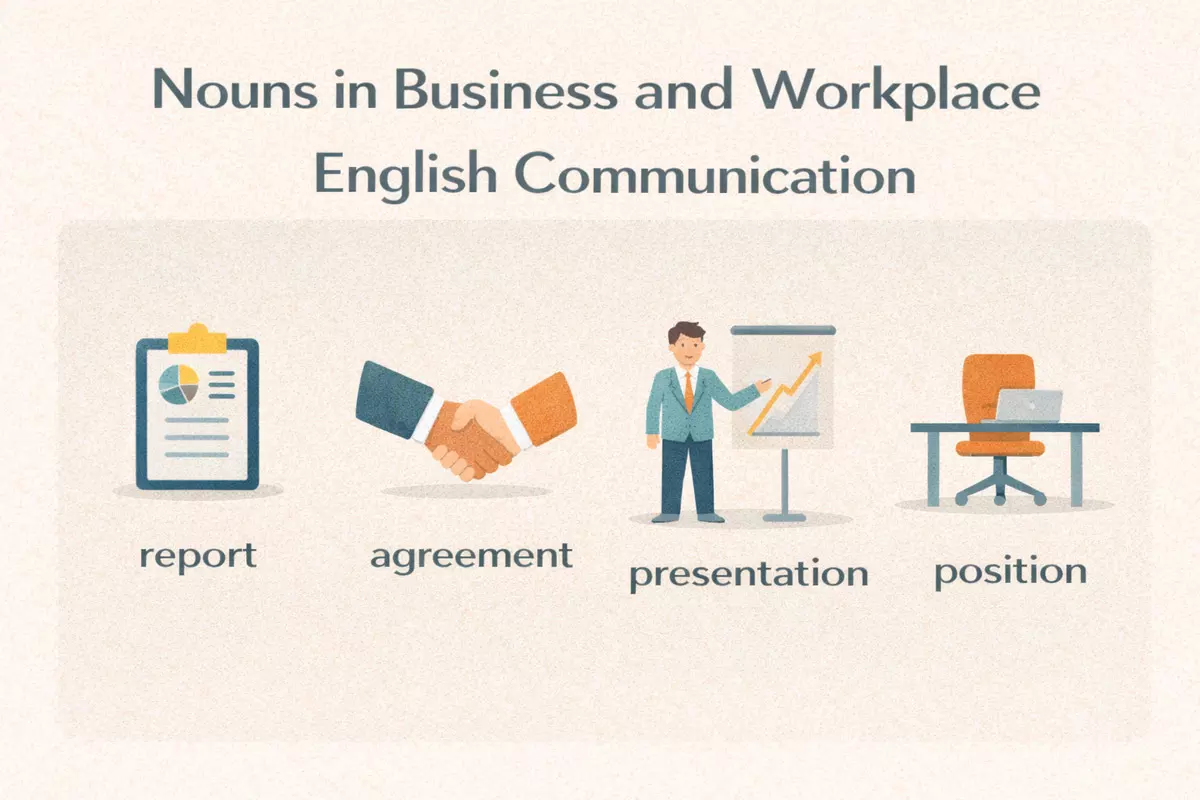 The article outlines important business and workplace noun categories, including terms for meetings, projects, management, and abstract concepts like strategy. It also addresses using nouns in professional communication, common mistakes, and offers practice exercises.
- Key business and workplace noun categories
- Common nouns for meetings, projects, and management
- Abstract business nouns like strategy and performance
- Using business nouns in emails and reports
- Formal tone through correct noun choice
- Typical learner errors in business noun usage
- Practice: complete short workplace messages with correct nouns
Knowing the appropriate terminology to use in professional environments is essential for effective workplace communication. By mastering the selection and use of precise terms, you can express your ideas more clearly and confidently, which fosters better understanding among colleagues and helps you build credibility. Using the right language not only demonstrates your professionalism but also ensures that your messages are interpreted accurately, reducing the potential for misunderstandings and making your interactions more productive.
Key business and workplace noun categories
Understanding which types of nouns commonly appear in professional English can help you communicate more clearly and confidently at work. In business contexts, nouns are used to describe people, roles, organizations, processes, and things. Recognizing these categories helps you both comprehend and produce effective workplace communication.
Types of nouns found in professional settings
Workplace English relies on several main types of nouns, each serving a specific function. Here are some of the most relevant groups:
- Job titles and roles: manager, consultant, analyst, director, intern, supervisor, CEO, assistant, clerk, engineer, specialist
- Departments and divisions: finance, marketing, sales, human resources, operations, logistics, procurement, IT, R&D, administration
- Organizations and entities: company, firm, corporation, partnership, subsidiary, branch, client, vendor, competitor, stakeholder
- Processes and activities: negotiation, planning, recruitment, evaluation, presentation, training, auditing, budgeting, forecasting, development
- Documents and deliverables: report, invoice, contract, proposal, agenda, minutes, memo, policy, summary, brief
- Tools and resources: software, platform, equipment, database, template, device, spreadsheet, dashboard, manual, tool
- Abstract business concepts: strategy, objective, revenue, risk, compliance, productivity, growth, performance, investment, feedback
- Time and events: deadline, meeting, milestone, schedule, review, launch, conference, session, target, appointment
Common countable and uncountable nouns in the workplace
Some nouns in business English are countable (can be pluralized), while others are uncountable (used only in the singular form). Distinguishing between them can improve both writing and speaking accuracy.

| Countable Nouns | Uncountable Nouns | Example (using uncountable noun) |
|---|---|---|
| project | information | We need more information before starting. |
| meeting | advice | She gave useful advice during the discussion. |
| opportunity | progress | The team has made good progress this week. |
| client | equipment | The equipment was delivered yesterday. |
| task | research | Research is still ongoing. |
Function of nouns in workplace communication
Nouns are essential for naming people, things, and ideas in business writing and speech. They form the backbone of reports, instructions, and emails. By mastering key categories—such as job titles, department names, and abstract concepts—you’ll be better equipped to navigate meetings, negotiations, and everyday correspondence with clarity and professionalism.
Common nouns for meetings, projects, and management
In business English, a wide range of nouns is used to describe activities, people, and processes related to collaboration and organization. Understanding these words helps you follow conversations, write emails, and participate in workplace discussions with confidence.
Key vocabulary for meetings
Meetings are a cornerstone of professional communication. Here are some of the most frequent nouns you’ll hear or use when talking about workplace gatherings:
- Agenda – the list of topics to discuss
- Minutes – notes or a written record of what was said
- Attendee – someone who is present at the meeting
- Chairperson – the person leading or moderating the session
- Action item – a specific task assigned during the meeting
- Discussion – the exchange of ideas about a topic
- Consensus – general agreement among participants
- Deadline – the date by which something must be completed
- Proposal – a suggestion or plan for consideration
- Feedback – comments or suggestions about the meeting or topic
Essential nouns for project work
Projects involve collaboration and planning. The following words are essential for discussing progress and responsibilities:
- Milestone – a significant stage or event in a project
- Deliverable – a tangible result or output
- Timeline – a schedule of tasks and deadlines
- Resource – something (personnel, money, equipment) needed for the project
- Budget – the amount of money allocated to the project
- Phase – a distinct period in the project process
- Objective – a specific goal to achieve
- Stakeholder – anyone with an interest in the project’s outcome
- Constraint – a limitation or restriction
- Risk – a potential problem that could affect the project
Management-related nouns
When discussing supervision, leadership, and organization, these nouns often come up:
- Strategy – a plan for achieving goals
- Supervisor – the person overseeing work
- Department – a division within a company
- Policy – a set of rules or guidelines
- Procedure – the official way of doing something
- Team – a group working together
- Target – a specific result to aim for
- Evaluation – the process of judging performance
- Authority – the power to make decisions
- Report – a document describing progress or results
Comparing nouns for different contexts
Some nouns are unique to a specific context, while others overlap. The table below highlights how certain terms are used in meetings, projects, or management:
| Noun | Typical Context |
|---|---|
| Agenda | Used mainly for organizing meetings and discussions |
| Milestone | Specific to project planning and tracking progress |
| Policy | Relevant to management and company-wide practices |
| Feedback | Appears in meetings, project reviews, and management evaluations |
| Resource | Common in project contexts; also used in management for planning |
| Team | Mentioned in all contexts: meetings, project work, and management structures |
Familiarity with these nouns will make your communication in professional environments clearer and more precise, whether you’re leading a project, attending a team meeting, or reporting to management.
Abstract business nouns like strategy and performance
In business English, some of the most frequently used nouns refer to intangible concepts. These words help professionals discuss goals, results, and processes without naming specific objects or people. Terms like strategy and performance are essential for talking about planning and evaluating work, but they can sometimes be challenging for learners or non-native speakers because their meaning depends on context.
Common abstract nouns in workplace communication
Abstract vocabulary in the workplace enables clarity when discussing targets, achievements, and approaches. Here are some typical examples you might encounter in meetings, reports, or presentations:
- Strategy → The company revised its strategy to enter new markets.
- Performance → Team performance improved after the training.
- Productivity → Remote work increased overall productivity.
- Efficiency → Process automation boosted efficiency.
- Growth → The startup reported strong growth this year.
- Innovation → Innovation drives long-term competitiveness.
- Leadership → Effective leadership builds trust.
- Compliance → Compliance with regulations is mandatory.
- Engagement → Employee engagement rose after the survey.
- Profitability → Profitability improved despite higher costs.
- Risk → The plan carries significant risk.
- Responsibility → Safety is a shared responsibility.
- Accountability → Clear accountability speeds up decisions.
- Quality → Quality checks are performed weekly.
- Culture → A positive culture attracts talent.
- Vision → The CEO shared a clear vision for the future.
- Mission → The mission focuses on customer value.
- Reputation → Reputation matters in competitive markets.
- Collaboration → Collaboration across teams is essential.
- Motivation → Motivation increases when goals are clear.
How context shapes abstract noun meaning
A word like performance may refer to how an employee carries out their tasks, the results of a team, or even how a product functions. Similarly, strategy could mean an overall company plan or a specific approach to a project. Understanding these words in context is crucial for clear communication.
Typical usage patterns
Abstract nouns often appear with verbs like improve, measure, develop, or evaluate. Here are some common patterns:
- Our strategy focuses on digital transformation.
- We need to improve performance in the next quarter.
- Innovation drives our business forward.
- Employee engagement has increased this year.
- We assess risk before launching new products.
Abstract nouns: nuances and comparisons
Some abstract nouns may appear similar but have important differences in meaning or use. For example, efficiency and productivity are related but not always interchangeable. Productivity often refers to output, while efficiency relates to the resources used.
| Noun | Typical Business Context |
|---|---|
| Strategy | Long-term plan or approach for achieving objectives |
| Performance | Quality or level of results achieved by people, teams, or systems |
| Productivity | Amount of output produced per unit of input or time |
| Efficiency | How well resources are used to achieve results with minimal waste |
| Innovation | Introduction of new ideas, products, or processes |
| Engagement | Level of commitment and involvement employees have in their work |
Grasping the nuances of these abstract terms is essential for effective business communication. They allow professionals to discuss complex ideas succinctly and facilitate collaboration and decision-making in diverse workplace situations.
Using business nouns in emails and reports
Clear and precise noun choices are key to effective business writing, especially in professional correspondence and formal documents. The right nouns help convey information efficiently, reduce ambiguity, and support logical organization. Whether drafting a project update, summarizing meeting outcomes, or sending a client proposal, using specific nouns improves professionalism and clarity.
Common Business Nouns for Professional Communication
In workplace emails and reports, some nouns appear frequently due to their usefulness in describing processes, people, and results. Consider incorporating these types of nouns for better communication:
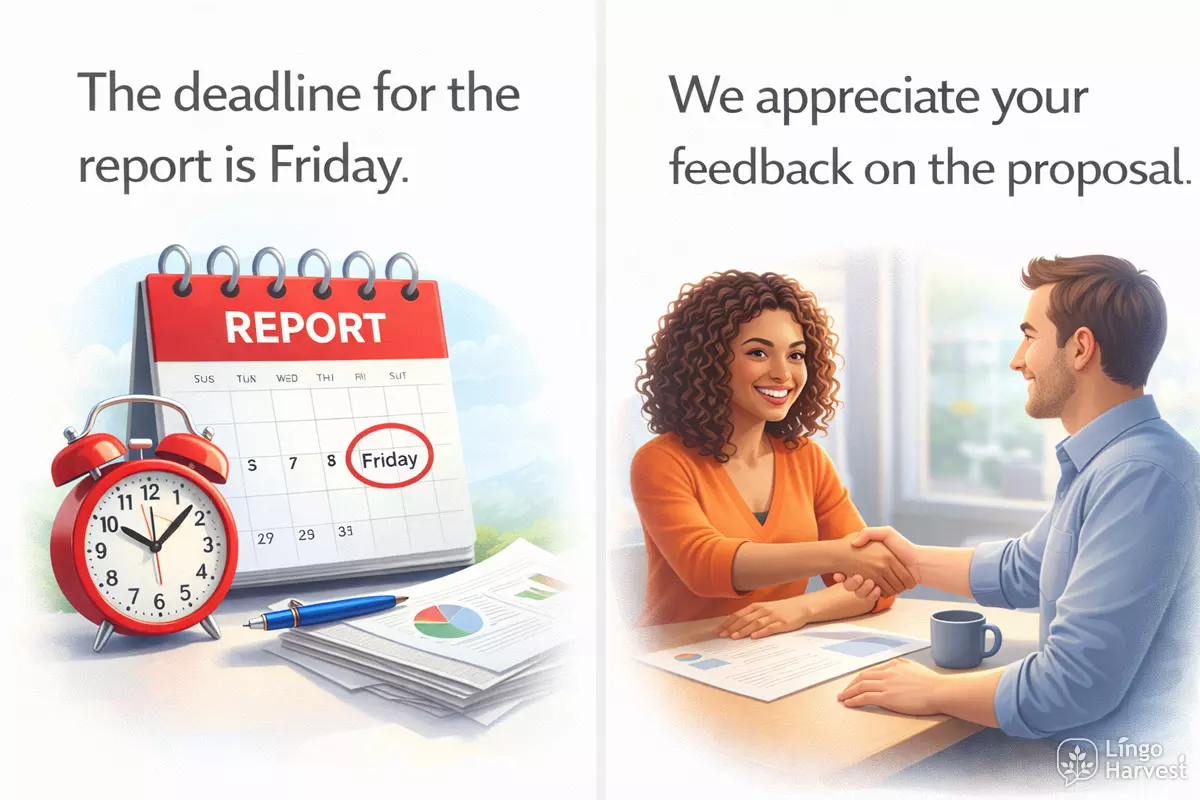
- Deadline → The deadline for the report is Friday.
- Feedback → We appreciate your feedback on the proposal.
- Proposal → The proposal includes a detailed timeline.
- Budget → The budget was approved by the finance team.
- Strategy → Our strategy focuses on customer retention.
- Objective → The objective is to improve response time.
- Stakeholder → Each stakeholder was informed about the changes.
- Agenda → The agenda covers costs and next steps.
- Resource → Time is our most limited resource.
- Update → Please share an update by the end of the day.
- Requirement → A valid ID is a requirement for entry.
- Schedule → The schedule changed due to a delay.
- Performance → Performance improved after the upgrade.
- Contract → The contract was signed last week.
- Policy → The policy outlines data privacy rules.
- Issue → We need to fix this issue immediately.
- Outcome → The outcome of the meeting was positive.
- Task → She completed the task ahead of time.
- Report → The report summarizes quarterly results.
- Benefit → One benefit of the plan is flexibility.
Contextual Use: Choosing the Right Noun
Selecting the most accurate term depends on context. For instance, "feedback" is appropriate when requesting opinions or evaluations, while "proposal" suits suggestions for action. Ambiguous nouns such as "thing" or "stuff" should be avoided in favor of more precise alternatives.
Example: Noun Use in Workplace Scenarios
The following table illustrates how different nouns are used in typical business situations, helping writers choose the right word for various contexts.
| Scenario | Appropriate Business Nouns |
|---|---|
| Project planning | Timeline, milestone, budget, objective, deliverable |
| Performance review | Feedback, evaluation, achievement, goal, result |
| Client communication | Proposal, contract, requirement, solution, agreement |
| Team updates | Progress, update, issue, action item, deadline |
| Reporting | Summary, analysis, finding, recommendation, metric |
Tips for Using Business Nouns Effectively
- Be specific: Choose the most precise noun to avoid confusion.
- Stay consistent: Use the same terms for the same concepts throughout your document.
- Avoid jargon: Only use specialized terms when your audience will understand them.
- Check for clarity: Review your writing to ensure each noun clearly refers to a specific person, object, or idea.
By focusing on accurate noun selection, you can make your business emails and reports more efficient and easier to understand, supporting better workplace communication overall.
Formal tone through correct noun choice
Selecting the right nouns is essential for maintaining professionalism in business English. Using precise and appropriate nouns helps convey information clearly and avoids misunderstandings. In workplace settings, word choice can significantly impact how messages are received—formal vocabulary often signals respect, competence, and seriousness.
Why noun selection matters
The nouns you use in emails, reports, and meetings can influence how you are perceived. Informal or vague nouns may make communication seem less credible or authoritative. Conversely, specific and formal nouns can strengthen your message and reflect your understanding of business conventions.
Common formal vs. informal noun choices
Some everyday nouns are too casual for professional documents or conversations. Switching to their more formal counterparts can immediately elevate the tone. Consider the following examples:
- Job → Position
- Help → Assistance
- Thing → Item / Object
- Start → Commencement / Initiation
- End → Conclusion / Termination
- Need → Requirement
- Plan → Proposal / Strategy
- Deal → Agreement / Contract
- Boss → Supervisor / Manager
- Pay → Compensation / Remuneration
- Talk → Discussion / Consultation
- Rules → Regulations / Policies
- Ask (noun: "request") → Request / Inquiry
- Chance → Opportunity
- Fix → Solution / Resolution
- Check (noun: "review") → Review / Inspection
- People → Personnel / Staff
- Problem → Issue / Concern
Contextual usage: formal noun patterns
In business writing, noun forms often appear in set phrases or structures. Here are some patterns that contribute to a more polished style:
- In accordance with company policy → In accordance with company policy, all expenses must be approved in advance.
- Upon receipt of your application → Upon receipt of your application, we will contact you within five business days.
- Subject to approval → The proposal will be implemented, subject to approval by management.
- Pending confirmation → The meeting date is pending confirmation.
- On completion of the project → On completion of the project, a final report will be submitted.
- Following the review → Following the review, recommendations will be made.
Comparing formal and informal noun usage
The following table demonstrates how replacing informal nouns with more formal alternatives can change the tone of a sentence in professional communication:
| Informal Example | Formal Alternative |
|---|---|
| We need to fix the problem. | We must find a resolution to the issue. |
| Can you check this thing? | Could you review this item? |
| Let’s talk about the deal. | Let us discuss the agreement. |
| I want to ask for help from my boss. | I would like to request assistance from my supervisor. |
Choosing nouns thoughtfully not only clarifies your intent but also demonstrates attention to detail. Over time, practicing these choices will make formal communication feel more natural and effective.
Typical learner errors in business noun usage
Many English learners face challenges when using nouns in a professional context. These difficulties often stem from differences between their native language and English, as well as the specialized vocabulary and structures common in business settings.
Common mistakes with countable and uncountable nouns
Confusing countable and uncountable nouns is a frequent issue. For example, learners might incorrectly say "an advice" or "many information," not realizing that "advice" and "information" are uncountable in English. In business English, this can lead to misunderstandings or a less professional impression.
- Saying "a feedback" instead of just "feedback"
- Using "equipments" instead of "equipment"
- Writing "informations" rather than "information"
- Referring to "a research" when "research" is typically uncountable
Incorrect noun forms and word choice
Selecting the wrong noun form or confusing similar words also causes problems. Business vocabulary often includes words that look or sound alike but have different meanings or grammatical roles.
- Mixing up "profit" (noun) and "profitable" (adjective)
- Confusing "employee" (person) and "employment" (concept)
- Using "advise" (verb) instead of "advice" (noun)
- Writing "responsibility" when "response" is meant, or vice versa
Pluralization errors
Applying regular plural rules to irregular nouns or to words that do not take plurals is another common pitfall. In business writing, such mistakes can be distracting or change the meaning of a sentence.
| Incorrect Form | Correct Form |
|---|---|
| informations | information |
| staffs | staff |
| criterias | criteria |
| datas | data |
| feedbacks | feedback |
| advices | advice |
Misuse of compound nouns and noun phrases
Learners might misunderstand how to form or use compound nouns, leading to awkward or unclear expressions. For example, saying "a sales report analysis" when "sales analysis report" is intended, or misplacing possessive 's with company names.
- Writing "report of sales" instead of "sales report"
- Using "company's policy" when "company policy" is standard in business contexts
- Mistaking "project's manager" for "project manager"
Summary of frequent trouble spots
To communicate clearly and professionally, it's important to be aware of frequent noun errors, such as:
- Incorrect use of articles with business nouns
- Wrong plural forms, especially for uncountable nouns
- Mixing up similar-sounding nouns (e.g., "acceptance" vs "accepting")
- Overusing possessive forms where compound nouns are expected
- Forgetting to use the correct noun in set business phrases (e.g., "take responsibility," not "take responsible")
By paying attention to these patterns, learners can improve both accuracy and confidence in workplace communication.
Practice: complete short workplace messages with correct nouns
Understanding how to use the right noun in business English is crucial for clarity and professionalism. Below you’ll find exercises to help you apply nouns correctly in typical office scenarios. These tasks are designed to strengthen your ability to choose the precise word for each context, whether you’re writing emails, reports, or chat messages.
Fill in the blanks: Common workplace messages
Read each short message and select the most appropriate noun from the options in brackets. Think about which noun best fits the meaning and tone of the message.
- Please send me the latest _______ (report, program, discussion) by 4 p.m.
- Could you confirm your _______ (attendance, arrival, performance) at tomorrow’s meeting?
- The IT _______ (department, location, suggestion) will handle your request.
- We need your _______ (feedback, presentation, salary) on the new guidelines.
- The _______ (deadline, holiday, meeting) for the project is next Friday.
- Please attach the _______ (document, equipment, coffee) to your email.
- Let me know if you have any _______ (questions, vacations, sales).
- Our _______ (team, furniture, lunch) will review your proposal.
- The _______ (client, printer, break) has requested a call this afternoon.
- Thank you for your _______ (support, keyboard, printer) during this project.
Show answers
- report
- attendance
- department
- feedback
- deadline
- document
- questions
- team
- client
- support
Word bank: Useful workplace nouns
Here’s a list of common nouns that often appear in business communication. Expanding your vocabulary can make your writing more precise and effective:
- agenda
- proposal
- contract
- invoice
- deadline
- colleague
- client
- manager
- feedback
- schedule
- policy
- budget
- department
- presentation
- update
- request
- assignment
- resource
- meeting
- support
Matching exercise: Noun selection
Match each sentence with the best-fitting noun from the word bank above.
- We have received your _______ for additional training.
- All staff must follow the new _______ on remote work.
- The monthly _______ review will be held next week.
- She prepared an impressive _______ for the board.
- The _______ outlines the goals for the next quarter.
- Please send an _______ on the project status by Friday.
- We need stakeholder _______ before moving forward.
- The signed _______ must be returned today.
- This _______ is a top priority for the team.
- The final _______ will be included in the annual report.
Show answers
- request
- policy
- budget
- presentation
- strategy
- update
- approval
- contract
- task
- outcome