Nouns Referring to Processes and Results in Modern Usage

 The article clarifies the distinction between process and result nouns, provides common verb–noun pairs, explains how to identify each using morphology and context, discusses their use in formal writing, and offers practice to address typical learner confusion.
- Difference between process nouns and result nouns
- Common verb–noun pairs showing process vs result
- Morphological patterns for forming process nouns
- Context clues for interpreting process or result meaning
- Use of process and result nouns in formal writing
- Typical learner confusion between action and outcome nouns
- Practice: choose correct noun type from contextual examples
Everyday language is rich with words that convey not only the way events unfold but also the results they produce, influencing how we talk about actions and their consequences. As language evolves, the meanings and nuances of these terms can shift, reflecting changes in how people communicate and understand each other. By examining the way such words are used in modern conversations, we can gain insight into both linguistic trends and the ways our perceptions of cause and effect are expressed in daily life.
Difference between process nouns and result nouns
Understanding how process nouns and result nouns function can clarify both meaning and usage in modern language. Process nouns refer to ongoing actions, activities, or states — the “doing” or “happening” aspect. In contrast, result nouns point to the outcome, product, or completed state after an action has taken place. This distinction often influences sentence structure, verb choice, and even the nuance of a message.
Core Characteristics
- Process nouns express the act itself or its duration (e.g., "construction" as the act of building).
- Result nouns indicate what is produced or achieved (e.g., "building" as the finished structure).
- Process types usually answer “What is happening?” while result types answer “What exists now because of the action?”
- Some English words can serve as both, depending on context; others have distinct forms.
Common Examples and Patterns

Here are typical pairs and forms found in English, illustrating the shift from activity to outcome:
- creation → creation (the act) vs. creation (the thing made)
- development → development (the process) vs. development (the area/building)
- translation → translation (the act) vs. translation (the document)
- invention → invention (inventing) vs. invention (the device)
- collection → collection (gathering) vs. collection (the items gathered)
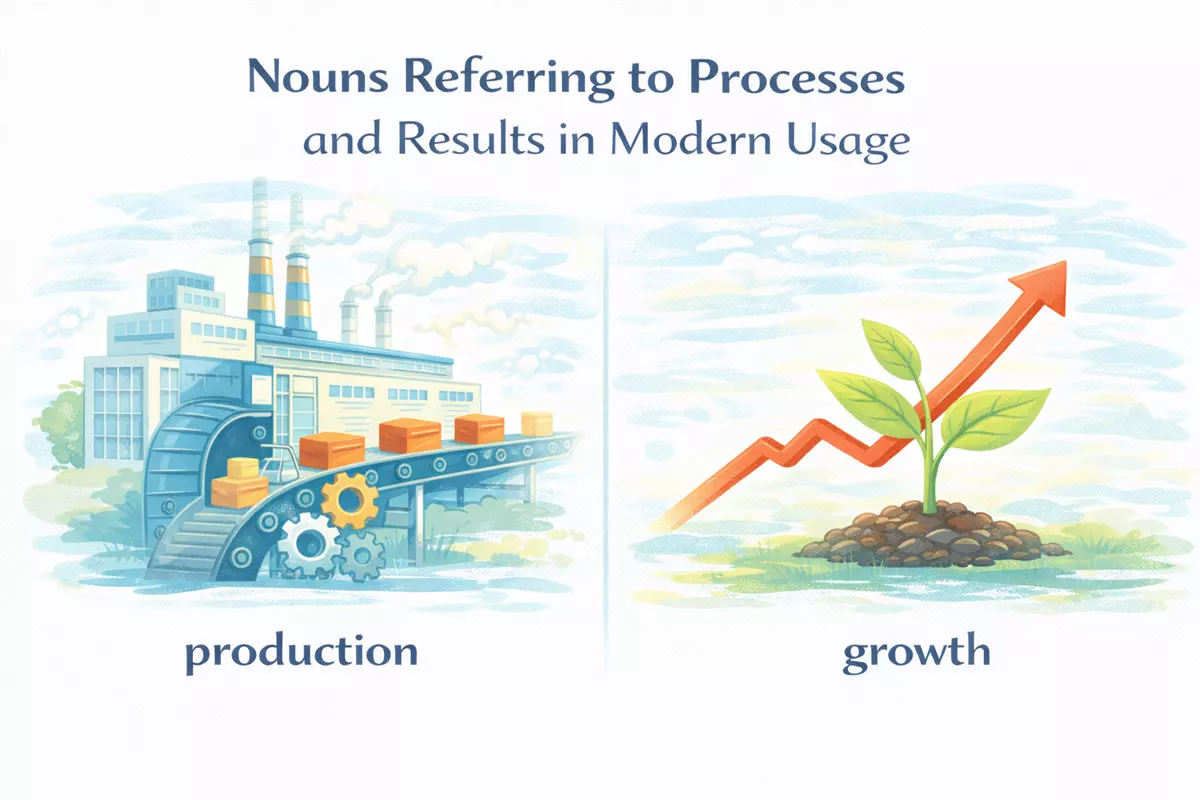
- growth → growth (process of growing) vs. growth (the result, e.g., a tumor)
- assembly → assembly (the act) vs. assembly (the group)
- refinement → refinement (the process of refining) vs. refinement (the quality or result)
- delivery → delivery (the act) vs. delivery (the parcel)
- production → production (the process) vs. production (the play, film, or item)
- construction → construction (the act) vs. construction (the building)
- decision → decision (the process of deciding) vs. decision (the outcome)
- recording → recording (the act) vs. recording (the audio file)
- selection → selection (the process) vs. selection (the group chosen)
- application → application (the act of applying) vs. application (the form or software)
- extraction → extraction (the act) vs. extraction (the substance obtained)
- presentation → presentation (the act) vs. presentation (the slides or talk)
- design → design (the process) vs. design (the plan or pattern)
- operation → operation (the process) vs. operation (the surgery or business)
- formation → formation (the act) vs. formation (the structure or group)
Comparison Table
| Process Noun (Action/State) |
Result Noun (Outcome/Product) |
|---|---|
| construction (the act of building) | building (the completed structure) |
| translation (the act of translating) | translation (the translated text/document) |
| collection (gathering process) | collection (the items gathered) |
| recording (the act of recording) | recording (the audio or video file) |
| selection (choosing process) | selection (the group chosen) |
| application (the act of applying) | application (the form/software submitted or used) |
| operation (the process) | operation (the surgical procedure or business) |
| formation (the act of forming) | formation (the group or structure created) |
Usage in Sentences
The choice between these two types of nouns can subtly shift the focus of a sentence. For instance, "The construction took two years" highlights the activity, while "The construction is impressive" refers to the finished structure. Recognizing whether a noun expresses an ongoing event or its outcome helps convey precise meaning in both spoken and written communication.
Common verb–noun pairs showing process vs result
Understanding how verbs and nouns relate helps clarify whether we’re talking about an ongoing action or its outcome. In modern usage, many verbs have corresponding nouns that either focus on the process itself or on the end result. Recognizing these distinctions is essential for precise communication, especially in academic, technical, and everyday contexts. Some verbs yield two distinct nouns: one for the action, one for the achievement. For example, “explore” leads to “exploration” (the act of exploring) and “discovery” (the thing found). Other pairs use different forms or entirely separate roots. Below, you’ll find a range of these verb–noun relationships, highlighting how English differentiates between action and result.
Typical verb–noun pairs
- explore → exploration (process), discovery (result)
- decide → decision (result), deliberation (process)
- apply → application (process), outcome (result)
- construct → construction (process), building (result)
- choose → choosing (process), choice (result)
- analyze → analysis (process), finding (result)
- develop → development (process), product (result)
- invent → invention (result), inventing (process)
- translate → translation (process), version (result)
- solve → solving (process), solution (result)
- negotiate → negotiation (process), agreement (result)
- measure → measuring (process), measurement (result)
- perform → performance (process), result (outcome)
- investigate → investigation (process), finding (result)
- create → creation (result), creating (process)
- publish → publishing (process), publication (result)
- approve → approval (result), approving (process)
- assess → assessment (process), score (result)
- review → reviewing (process), review (result)
- submit → submission (process), entry (result)
Comparing process and result nouns
Some word pairs are more transparent than others. The following table shows several cases where the link between verb, process noun, and result noun is particularly clear, helping learners and writers see the distinction at a glance:
| Verb | Process Noun | Result Noun |
|---|---|---|
| apply | application | outcome |
| construct | construction | building |
| solve | solving | solution |
| negotiate | negotiation | agreement |
| analyze | analysis | finding |
| publish | publishing | publication |
In summary, the distinction between action and result is often marked by different noun forms, which helps avoid ambiguity. Recognizing these patterns is valuable for both learners and proficient users aiming to communicate with clarity and precision.
Morphological patterns for forming process nouns
Understanding how language forms nouns that refer to actions or processes is essential for grasping modern usage patterns. In English, these nouns often arise from verbs, adjectives, or even other nouns, through a variety of productive morphological strategies. The most common method involves affixation, but other mechanisms such as compounding and zero-derivation also play notable roles.
Suffixation: Productive Endings
Adding suffixes to verb stems is the primary way English creates nouns that denote processes. Here are several commonly used suffixes and examples:
- -ion/-tion/-sion: creation, decision, expansion
- -ment: development, movement, arrangement
- -ing: painting, building, processing
- -ance/-ence: performance, emergence, difference
- -al: approval, renewal, arrival
- -ure: closure, exposure, failure
- -age: storage, drainage, package (though not always process-related)
- -y: inquiry, delivery, discovery
- -tion/-ation: adaptation, rotation, translation
- -sis: analysis, synthesis, diagnosis
These endings often signal that the noun refers to an ongoing action, the act itself, or the result of an action.
Conversion (Zero-Derivation)
Sometimes, verbs serve directly as nouns without any change in form, a process known as zero-derivation or conversion. For example:
- Run (to run → a run)
- Drive (to drive → a drive)
- Change (to change → a change)
This pattern is especially common in informal registers and allows for flexible, context-dependent usage.
Compounding and Other Patterns
Combining two words, often a noun and a verb or a noun and another noun, can yield process nouns as well. Examples include:
- Takeover
- Breakdown
- Check-in
- Setup
These forms frequently describe specific types of processes, especially in technical or organizational contexts.
Affix Comparison Table
| Suffix | Example Process Nouns |
|---|---|
| -ion / -tion / -sion | creation, expansion, decision, discussion |
| -ment | development, movement, establishment, agreement |
| -ing | building, processing, painting, reading |
| -ance / -ence | performance, emergence, difference, persistence |
| -al | approval, arrival, renewal, proposal |
| -ure | closure, exposure, failure, measure |
Summary
In sum, English employs a range of morphological strategies to create nouns that express dynamic actions or processes. Suffixation stands out as the most systematic method, but conversion and compounding also provide productive avenues for expanding the lexicon in this area. Whether for everyday conversation or technical writing, recognizing these patterns helps with both comprehension and effective word formation.
Context clues for interpreting process or result meaning
When encountering nouns that could refer to either a process (an ongoing action) or a result (the outcome of that action), readers often rely on surrounding words and sentence structure to infer the intended meaning. Modern usage frequently blurs these distinctions, especially with abstract or technical terms, so recognizing signals in the context is essential.
Common linguistic signals
Several cues in the sentence can help distinguish whether a noun is being used for a process or its result. Pay attention to these features:
- Verb tense and aspect: Past tense verbs often pair with result meanings, while present participles or continuous aspects suggest an ongoing process.
- Modifiers: Words like "ongoing," "gradual," or "current" hint at a process; adjectives such as "final," "completed," or "definite" signal results.
- Prepositions: Phrases like "during the..." or "in the course of..." are typical for processes, while "as a result of..." or "after the..." indicate outcomes.
- Collocations: Some verbs naturally collocate with one sense, e.g., "undergo" (process), "achieve" (result).
Examples of context clues in action
Examining real sentence fragments clarifies these distinctions. For instance, consider the noun "development":
- "The development of the software took two years." ✅ process
- "The development is now available for purchase." ✅ result
Typical patterns to watch for
Here are more cues and example nouns where process/result distinctions often arise. Look for these patterns:
- Analysis: "During the analysis..." → process; "The analysis revealed..." → result
- Translation: "While translation was underway..." → process; "The translation is complete..." → result
- Construction: "Construction is ongoing..." → process; "The construction stood tall..." → result
- Decision: "Decision-making requires time..." → process; "The decision was announced..." → result
- Production: "Production began last month..." → process; "The production won awards..." → result
- Creation: "Creation of the sculpture..." → process; "The creation amazed viewers..." → result
- Migration: "Migration occurs annually..." → process; "The migration ended safely..." → result
- Presentation: "During the presentation..." → process; "Her presentation was praised..." → result
- Improvement: "Improvement is happening..." → process; "The improvement is noticeable..." → result
- Investment: "Investment in research..." → process; "The investment paid off..." → result
- Formation: "Formation of clouds..." → process; "The formation was unusual..." → result
Structured comparison: Process vs. Result cues
| Process Indicators | Result Indicators |
|---|---|
| Present participles (e.g., "is developing") | Past participles (e.g., "has developed") |
| Temporal markers ("while," "during," "throughout") | Completion markers ("after," "once," "as a result of") |
| Action verbs ("undergo," "participate in") | Stative verbs ("possess," "show," "demonstrate") |
| Adjectives: ongoing, partial, preliminary | Adjectives: finished, final, achieved |
By noticing these contextual markers, you can more confidently interpret whether a noun refers to an activity or its outcome. Practice with varied examples will sharpen your ability to pick up on these subtle but important distinctions in modern English usage.
Use of process and result nouns in formal writing
In academic and professional contexts, it is common to encounter nouns that denote either a process (e.g., development, negotiation) or a result (e.g., decision, solution). These terms allow writers to convey abstract actions or outcomes succinctly, which is especially important for clarity and precision in formal documents.
Functions and Advantages
Employing process and result nouns enables writers to generalize complex actions or achievements without excessive detail. This abstraction is useful when discussing theories, methodologies, or findings, as it helps maintain focus and avoid unnecessary repetition of verbs. For example, instead of saying "when we develop X," one might use "the development of X" to keep the sentence concise.
Common Examples in Formal Writing

- Analysis → The analysis revealed several weaknesses in the system.
- Assessment → A full assessment of the risks will be completed tomorrow.
- Implementation → The implementation of the new software starts next week.
- Investigation → The investigation uncovered new evidence.
- Observation → Careful observation helped them understand the problem.
- Recommendation → The board followed his recommendation to expand the team.
- Adoption → The adoption of new policies improved workplace safety.
- Justification → She gave a clear justification for her decision.
- Approval → We received final approval from the manager today.
- Evaluation → The evaluation of the project will begin next month.
- Conclusion → Their conclusion was based on strong data.
- Revision → The document needs revision before publishing.
- Transformation → Digital transformation changed the company culture.
- Submission → The report is ready for submission.
- Interpretation → His interpretation of the results was surprising.
- Preparation → Good preparation is essential for success.
- Resolution → The conflict reached a peaceful resolution.
- Modification → The design requires slight modification.
- Application → The application of these methods improved productivity.
- Presentation → She gave a clear presentation to the audience.
Choosing Process vs. Result Nouns
Writers should select between these two types based on whether the focus is on the activity itself or its outcome. For instance, "evaluation" highlights the act of assessing, while "result" or "finding" centers on what was discovered. Choosing the right form clarifies intent and supports logical flow.
| Process Noun | Result Noun |
|---|---|
| Investigation | Finding |
| Negotiation | Agreement |
| Development | Product |
| Application | Outcome |
| Submission | Approval |
Stylistic Considerations
Using too many nominalized forms (nouns formed from verbs) can make writing dense or abstract. Balance is essential: rely on these nouns for clarity, but mix with active verbs and concrete language for readability. In summary, process/result nouns are valuable tools for structured, precise communication in formal writing.
Typical learner confusion between action and outcome nouns
One of the most persistent challenges for English learners is distinguishing between nouns that refer to an activity or process and those that refer to its result. This confusion often leads to awkward or incorrect usage, especially with noun pairs derived from the same verb. Many verbs form two related nouns: one denoting the act itself, the other the product or consequence.
Common sources of confusion
Learners frequently mix up forms because both types can look similar or have overlapping meanings. For instance, “construction” and “construct” are related, but only one is commonly used as a noun for the process. The problem is intensified by irregularities and exceptions in English word formation.
- Action nouns: Usually refer to the process, activity, or ongoing state (e.g., “discussion,” “movement”).
- Outcome/result nouns: Indicate the product, result, or completed action (e.g., “decision,” “building”).
Typical pairs that cause mistakes
Below is a comparison of some frequently confused noun pairs. The first column shows the noun for the process or action, while the second shows the noun for the result or outcome. Notice how the meaning shifts subtly or significantly between the two.
| Action/Process Noun | Outcome/Result Noun |
|---|---|
| application (the act of applying) | applicant (person who applies) / application (the form submitted) |
| construction (the process of building) | building (the finished structure) |
| production (the act of producing) | product (the item produced) |
| translation (the act of translating) | translation (the text that is translated) |
| movement (the act of moving) | move (a specific action or change in position) |
| decision (the process of deciding) | decision (the choice made) |
| collection (the act of collecting) | collection (the group of items collected) |
| selection (the process of selecting) | selection (the item or group chosen) |
| presentation (the act of presenting) | presentation (the event or the material shown) |
| assignment (the act of assigning) | assignment (the task assigned) |
| development (the process of developing) | development (the result, such as a new product or area) |
| impression (the process of impressing) | impression (the effect or result left) |
| expression (the act of expressing) | expression (the phrase or facial movement) |
| protection (the act of protecting) | protection (the object or measure that protects) |
| preparation (the act of preparing) | preparation (the thing prepared, e.g., a meal) |
Why do these mix-ups happen?
The overlap between process and result nouns is often subtle, and in some cases, the same word can represent both concepts depending on context. Additionally, some process nouns are rarely used in everyday speech, while their outcome counterparts are much more common. This can mislead learners into using the wrong form, especially in writing or formal situations.
Tips to avoid confusion
- Check example sentences to see if the noun refers to an activity or a finished product.
- Remember that many nouns ending in -tion or -ment can be ambiguous; context is key.
- Look for clues in the sentence: is it about something happening, or something that exists as a result?
- When in doubt, consult a corpus or dictionary for common usage patterns.
Understanding these distinctions helps learners choose the right word and communicate more precisely. Practice with real-world examples and pay attention to how native speakers use these forms in context.
Practice: choose correct noun type from contextual examples
Understanding how nouns can refer to processes or their results is crucial for accurate and nuanced communication. Below, you'll find a set of contextual examples where the noun’s role—whether indicating an ongoing process or a completed result—can change the meaning of a sentence significantly. Your task is to select the correct noun type in each scenario.
Quick review: Process vs. Result Nouns
- Process nouns refer to actions, states, or ongoing activities (e.g., “investigation,” “translation”).
- Result nouns refer to the outcome or product of an action (e.g., “finding,” “translation” as a text).
Read each sentence and select whether the noun in context names a process or a result. Where nouns can serve as both, pay close attention to the surrounding words for clues.
- The construction of the bridge took five years.
- The decision was announced at noon.
- Her performance impressed the judges.
- The translation of the poem was published last week.
- The analysis revealed surprising trends.
- Our preparation for the exam included daily practice.
- The collection of rare coins attracted many visitors.
- The application is reviewed by the committee.
- After extensive negotiation, the contract was signed.
- The publication was well received by critics.
- The organization of the files made work easier.
- The explanation was clear and concise.
- His creation was displayed in the gallery.
- The presentation lasted an hour.
- The observation led to new hypotheses.
- The measurement confirmed the hypothesis.
- The registration process is now online.
- The selection was based on merit.
- Her innovation changed the industry.
- The conclusion was supported by the data.
Show answers
- Process (the act of building)
- Result (the outcome, the decided thing)
- Result (the event or display, not the act of performing)
- Result (the finished text, not the act of translating)
- Result (the outcome of analyzing)
- Process (the act of preparing)
- Result (the group of coins, not the act of collecting)
- Result (the submitted document, not the act of applying)
- Process (the act of negotiating)
- Result (the book, article, etc., not the act of publishing)
- Process (the act of organizing)
- Result (the statement that explains)
- Result (the artwork, not the act of creating)
- Result (the event or talk, not the act of presenting)
- Result (the data or fact observed, not the act of observing)
- Result (the number/fact, not the act of measuring)
- Process (the act of registering)
- Result (the chosen person/thing, not the act of selecting)
- Result (the invention, not the act of innovating)
- Result (the final statement, not the act of concluding)
Comparison: When a noun can be both process and result
| Noun | Process Meaning → Result Meaning |
|---|---|
| Translation | The act of translating a text (process) → The finished version in another language (result) |
| Application | The act of applying (process) → The document submitted (result) |
| Collection | The act of collecting items (process) → The group of items (result) |
| Observation | The act of observing (process) → The fact/phenomenon observed (result) |
Notice how context determines whether these nouns refer to an action or its outcome. Being able to distinguish these uses is essential for clear and precise writing or speaking.