Nouns Expressing Cause and Consequence in English Writing

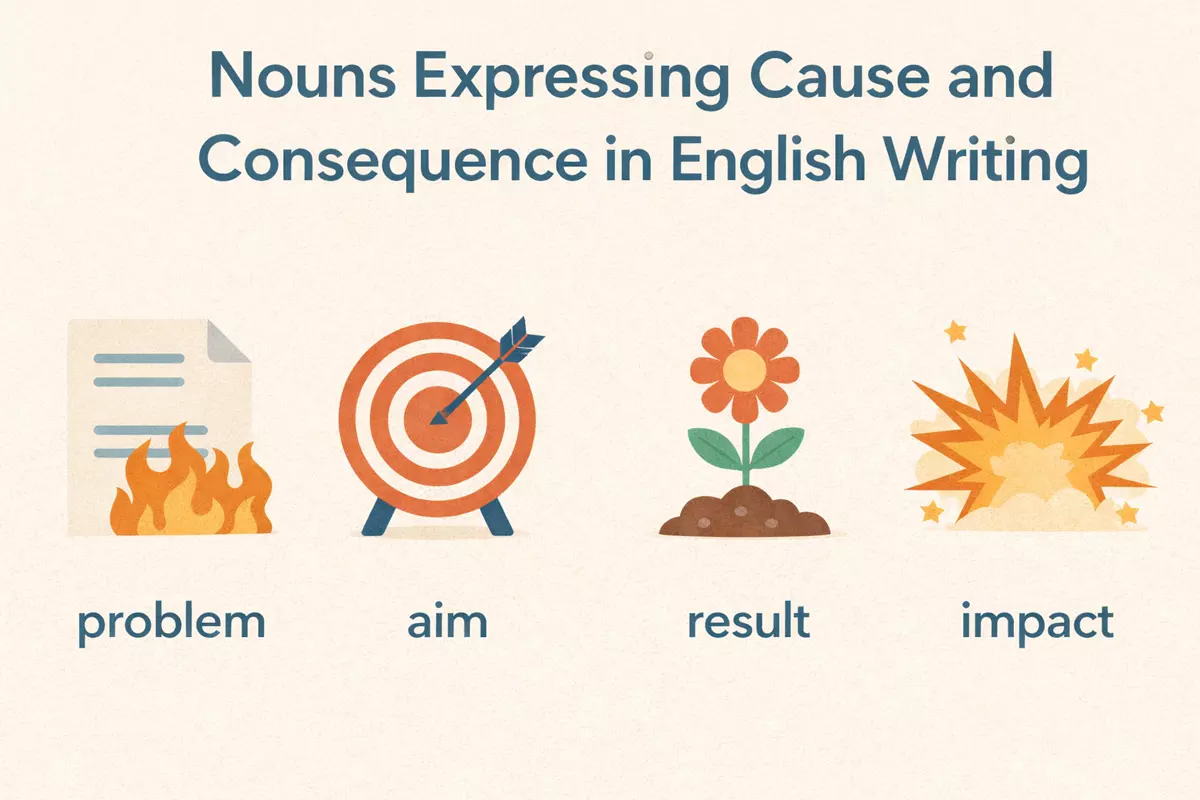 This article explains key cause and consequence nouns in English, such as reason, factor, result, and outcome. It covers their use in writing, differences between academic and everyday contexts, common learner mistakes, and practical exercises.
- Key cause and consequence nouns in English
- Cause nouns like reason, factor, and source
- Consequence nouns like result, effect, and outcome
- Using causal nouns to link ideas in writing
- Academic vs everyday cause–consequence nouns
- Typical learner errors with causal noun reference
- Practice: connect ideas using cause and consequence nouns
Learning how specific nouns express reasons and results can greatly enhance clarity in English writing. By examining these nouns, writers develop stronger logical connections within their work, which leads to more persuasive arguments and clearer overall communication. Mastering this aspect of language not only improves the effectiveness of writing but also ensures that ideas are conveyed in a coherent and convincing manner, making it easier for readers to follow and understand the intended message.
Key cause and consequence nouns in English
Understanding which nouns signal cause or consequence can help writers structure arguments, explain relationships, and clarify meaning in academic and everyday English. These nouns often serve as anchors in sentences, making it clear what led to an event or what resulted from an action. Many nouns point to a reason or origin for something. Common examples include cause, source, reason, trigger, factor, and stimulus. In contrast, nouns expressing results or outcomes often include effect, result, consequence, outcome, impact, and repercussion. Recognizing these helps in both reading comprehension and clear writing.
Typical cause nouns
- cause → Poor maintenance was the cause of the system failure.
- reason → The main reason for the delay was bad weather.
- source → The source of the error was a configuration issue.
- origin → The origin of the conflict remains unclear.
- trigger → Stress can be a trigger for headaches.
- factor → Cost was a major factor in the decision.
- stimulus → The announcement acted as a stimulus for growth.
- motivation → Her motivation comes from a desire to improve.
- incentive → Bonuses provide an incentive to perform better.
- impetus → The success gave new impetus to the project.
- basis → Trust is the basis of the partnership.
- foundation → Education is the foundation of long-term success.
Typical consequence nouns
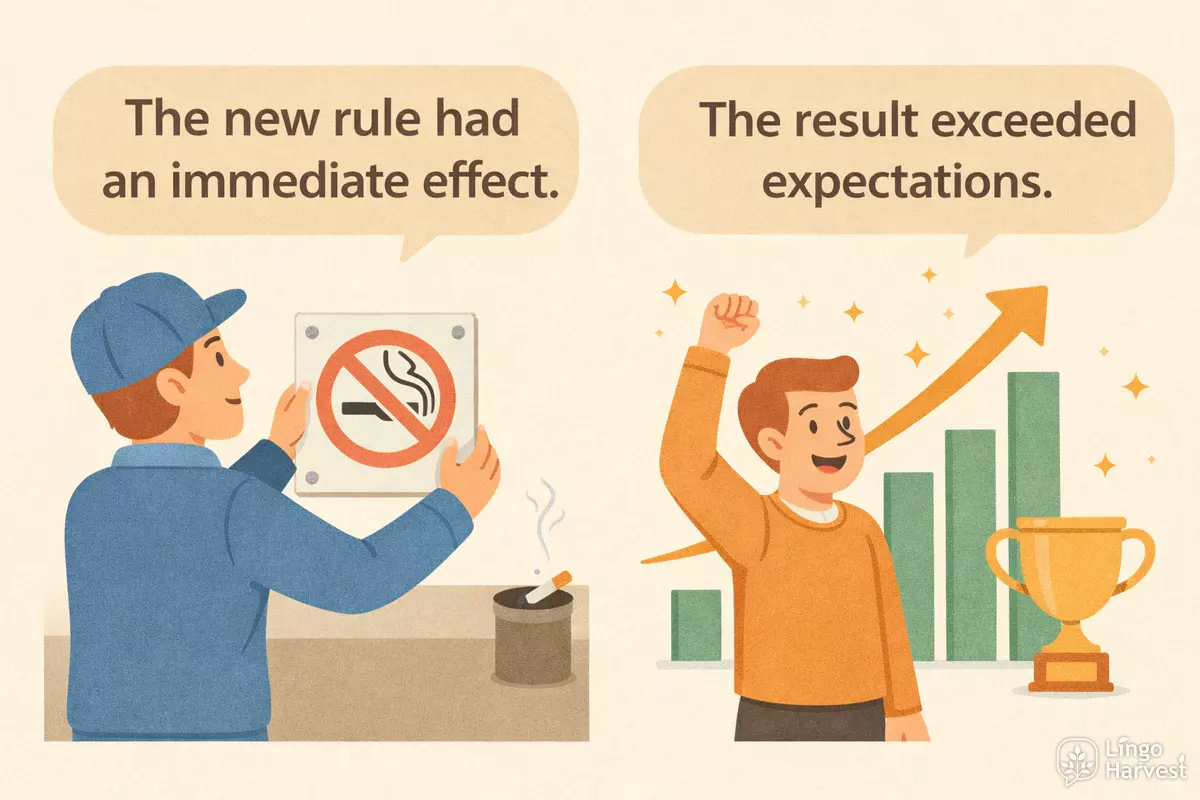
- effect → The new rule had an immediate effect.
- result → The result exceeded expectations.
- outcome → The outcome of the talks was positive.
- consequence → One consequence of the change was higher costs.
- impact → The decision had a lasting impact.
- repercussion → The scandal had serious repercussions.
- aftermath → In the aftermath of the storm, repairs began.
- product → Innovation is often the product of collaboration.
- ramification → The policy has legal ramifications.
- legacy → The reform left a lasting legacy.
- byproduct → Increased traffic was a byproduct of development.
- fallout → The political fallout continued for months.
Comparing cause and consequence nouns
Some nouns may look similar but have distinct uses. For example, factor usually refers to something contributing to a situation, while effect describes what happens as a result. Understanding these distinctions is important for precise communication.
| Cause Noun | Consequence Noun |
|---|---|
| reason | result |
| cause | effect |
| trigger | consequence |
| factor | outcome |
| stimulus | impact |
| incentive | byproduct |
These nouns are essential for connecting ideas and showing logical relationships. Using them appropriately strengthens both the clarity and persuasiveness of English writing.
Cause nouns like reason, factor, and source
Nouns such as “reason,” “factor,” and “source” are central when expressing why something happens in English writing. These words help clarify the origin or explanation behind an event, decision, or situation, making writing more precise and analytical. Instead of vague statements, writers can use these nouns to structure their arguments and connect ideas logically.
Common Cause Nouns and Their Typical Uses
Writers often select specific nouns depending on the context and the nuance they wish to express. Here are several widely used terms that signal causes or contributing elements:
- Reason – points to an explanation or justification (e.g., “The reason for the delay was traffic.”)
- Cause – indicates the direct origin of an effect (e.g., “The cause of the error was a miscalculation.”)
- Factor – refers to one of several elements contributing to a result (e.g., “Weather was a significant factor in the outcome.”)
- Source – highlights the starting point or origin, often for information or materials (e.g., “The source of the rumor is unknown.”)
- Origin – used for the beginning or derivation of something (e.g., “The origin of the tradition dates back centuries.”)
- Root – metaphorically or literally the deepest cause (e.g., “The root of the problem is miscommunication.”)
- Basis – foundation or underlying reason (e.g., “There is no basis for these claims.”)
- Motivation – refers to the driving force, especially in personal or psychological contexts (e.g., “His motivation for studying was clear.”)
- Ground(s) – formal, often legal or academic, for justification (e.g., “She was dismissed on the grounds of misconduct.”)
- Determinant – a technical or formal term for a decisive factor (e.g., “Socioeconomic status is a key determinant of health.”)
- Impetus – the force or influence making something happen (e.g., “The new policy provided the impetus for change.”)
- Trigger – something that initiates an immediate response (e.g., “The announcement was the trigger for protests.”)
- Incentive – a motivating reason, often in economic or behavioral contexts (e.g., “Tax breaks serve as incentives for investment.”)
- Precondition – something that must exist before another event can occur (e.g., “Trust is a precondition for cooperation.”)
- Contributor – an element that adds to a result (e.g., “Poor infrastructure is a major contributor to delays.”)
Comparing Usage: Reason, Factor, and Source
Different nouns of causation are preferred in different contexts. The table below highlights distinctions in meaning and typical usage for three frequently used terms.
| Noun | Typical Context | Example Sentence |
|---|---|---|
| Reason | Explanation or justification; often for actions or decisions | The main reason for his absence was illness. |
| Factor | One of several elements contributing to an effect or result | Economic growth is a key factor in reducing poverty. |
| Source | Origin of information, materials, or issues; less about justification | We need to identify the source of the leak. |
Patterns and Structures
These nouns often appear in set patterns that help clarify relationships:
- The reason for… is/was…
- A contributing factor to…
- The source of…
- One root cause of…
- On the grounds that…
- The impetus for…
Using a variety of these nouns and structures allows writers to be specific about causality, making their arguments more compelling and organized.
Consequence nouns like result, effect, and outcome
In English writing, certain nouns are frequently used to express the consequences or impacts of actions, events, or decisions. Words such as result, effect, and outcome allow writers to discuss what happens as a consequence of something else. These terms are essential for academic, scientific, and everyday writing, as they help clarify the relationship between causes and their subsequent developments.
Common nouns for expressing consequences
Writers often select from a range of consequence-related nouns depending on the context or the nuance they wish to convey. Some of the most widely used include:
- Result – used for a direct or final product of an action.
- Effect – emphasizes the change or impact produced.
- Outcome – often refers to the final situation or status after a process.
- Consequence – can be neutral, positive, or negative, and often highlights the inevitable nature of what happens.
- Impact – stresses significant or noticeable changes.
- Aftermath – typically used for negative or serious results.
- Repercussion – suggests indirect or long-term effects.
- Product – used metaphorically for what is produced by a process.
- Sequel – refers to what follows as a consequence, often in a narrative sense.
- Ramification – highlights complex or branching results.
- Byproduct – something produced incidentally.
- Aftereffect – an effect that follows after the main event.
How these nouns differ in meaning and usage
While these terms all relate to what comes after an action or event, their connotations and typical uses are distinct. For instance, result is often neutral and factual, while aftermath and repercussion usually carry a negative tone. Understanding these subtleties helps writers choose the most precise word for their context.
| Noun | Typical Usage | Example Sentence |
|---|---|---|
| Result | General, neutral; direct outcome | The result of the experiment was unexpected. |
| Effect | Emphasizes change or influence | The new law had a positive effect on traffic safety. |
| Outcome | Final situation, often in processes or events | The outcome of the negotiations was satisfactory for both sides. |
| Consequence | Often neutral, can be negative; inevitable result | One consequence of deforestation is habitat loss. |
| Aftermath | Usually negative, following a significant event | In the aftermath of the storm, many were left homeless. |
| Repercussion | Indirect or long-term impact | The policy changes had unforeseen repercussions for small businesses. |
| Impact | Stresses strength or significance of the result | The new technology made a significant impact on productivity. |
Using consequence nouns in sentences
To make your writing clearer and more precise, it helps to match the noun to the intended meaning. Here are some ways to use these words effectively:
- “The result was a dramatic improvement in efficiency.”
- “Her words had a lasting effect on the team.”
- “No one predicted the final outcome.”
- “Every action has its consequences.”
- “The aftermath of the crisis lasted for years.”
- “They are still dealing with the repercussions of that decision.”
- “The discovery’s impact was felt worldwide.”
- “This side effect is a common byproduct of the medication.”
- “The ramifications of the policy are complex.”
- “An aftereffect of the procedure is mild discomfort.”
Choosing the right consequence noun can sharpen your analysis and help your readers understand the relationships between events and their results.
Using causal nouns to link ideas in writing
Causal nouns play a crucial role when connecting ideas logically in academic and professional writing. Instead of relying solely on conjunctions like "because" or "so," writers often use nouns that express causes or consequences to establish clear relationships between statements. This approach can make arguments more concise and sophisticated, while also improving the flow of information.
Common causal nouns and their usage
Writers frequently employ certain nouns to indicate reasons, origins, or results. Some of the most typical include:
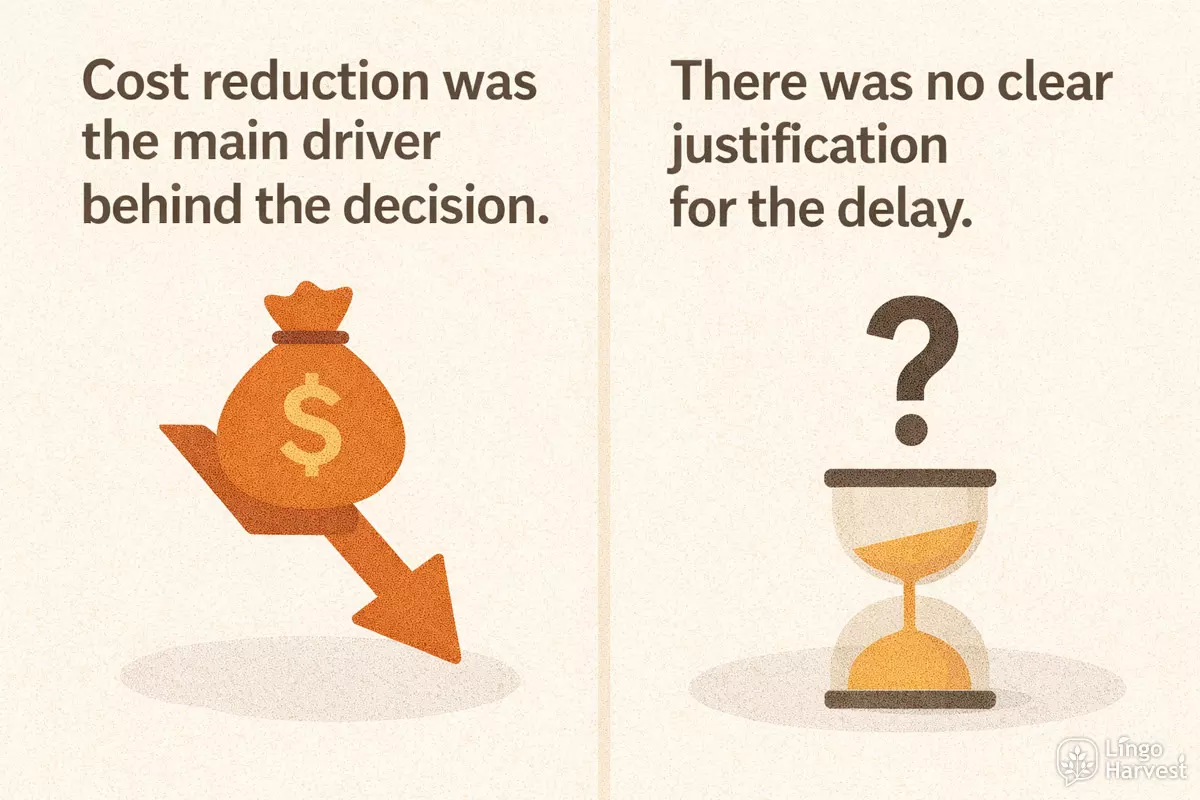
- Driver → Cost reduction was the main driver behind the decision.
- Justification → There was no clear justification for the delay.
- Effectiveness → The effectiveness of the policy was questioned.
- Resulting change → The resulting change improved efficiency.
- Aftereffect → Fatigue was a common aftereffect of the long shift.
- Significance → The discovery is of great significance.
- Resolution → The resolution of the conflict took months.
- Rationale → The rationale behind the strategy was clearly explained.
- Point of origin → Investigators traced the point of origin of the fire.
- Leverage → Technology provides leverage in modern business.
- Incentive → Bonuses act as an incentive for higher performance.
- Catalyst → The announcement was a catalyst for change.
- Determinant → Price is a key determinant of demand.
- Precursor → The warning signs were a precursor to the crisis.
- Root → The root of the problem lies in poor communication.
- Objective → The primary objective is customer satisfaction.
- Supporting factor → Experience was a supporting factor in her promotion.
- Inference → One possible inference is that demand will grow.
Patterns for connecting ideas with causal nouns
Causal nouns are usually paired with prepositions to clarify relationships. Here are some frequent structures:
- As a result of + noun: "As a result of the new policy, productivity increased."
- Due to + noun: "The delay was due to heavy traffic."
- Because of + noun: "She succeeded because of her determination."
- In consequence of + noun: "In consequence of his actions, he was promoted."
- On account of + noun: "The event was canceled on account of the weather."
- Owing to + noun: "Owing to a technical error, the data was lost."
- For the sake of + noun: "For the sake of clarity, the document was revised."
- By reason of + noun: "By reason of his experience, he was chosen for the role."
Comparing causal nouns: expressing cause vs. consequence
| Nouns Expressing Cause | Nouns Expressing Consequence |
|---|---|
| cause reason source motivation factor origin |
effect result consequence impact outcome implication |
Practical tips for clarity
When using nouns to show causal relationships, be specific. For example, instead of saying "The effect was significant," clarify what the effect was and what caused it. Also, try to avoid overusing the same noun repeatedly; instead, choose synonyms or restructure sentences for variety and precision. This strategy not only enriches your writing but also helps readers follow your logic more easily.
Academic vs everyday cause–consequence nouns
Understanding how nouns express cause and consequence is important for clear writing, especially when shifting between academic and informal contexts. Everyday language typically uses more familiar, straightforward terms, while academic writing relies on precise, often abstract nouns to convey complex relationships.
Differences in Use and Tone
In daily conversation, speakers tend to favor words that are direct and concrete. Academic prose, however, often selects nouns that encapsulate broader or more nuanced ideas. For example, while someone might say "the reason" or "the result" in casual talk, a research paper might refer to "the causation" or "the outcome."
Common Nouns in Each Context
The choice of vocabulary can affect clarity and formality. Here is a list of nouns frequently used to indicate causality or results, grouped by context:
- Everyday: reason, result, cause, effect, outcome, impact, side effect, outcome, fallout, chain reaction, aftermath
- Academic: causation, correlation, consequence, implication, derivation, ramification, manifestation, precipitant, antecedent, catalyst, repercussion
Comparing Usage: Everyday vs. Academic
Below is a structured comparison of how certain nouns are used in both informal and scholarly writing:
| Everyday Noun | Academic Equivalent |
|---|---|
| reason | rationale, causation |
| result | outcome, consequence |
| cause | precipitating factor, antecedent |
| effect | impact, implication |
| aftermath | repercussion, ramification |
| side effect | secondary outcome, collateral consequence |
| chain reaction | causal sequence, cascade |
| impact | manifestation, influence |
Choosing the Right Noun
Selecting the most suitable noun depends on your audience and purpose. In academic texts, opting for more formal nouns can clarify complex arguments and show critical thinking. In contrast, everyday conversations benefit from simpler, more concrete terms that are quickly understood. Misusing a highly formal noun in a casual context may sound awkward or pretentious, while using a basic term in a scholarly paper may seem imprecise.
Summary
Being aware of these distinctions helps writers adjust their tone and precision. Whether drafting an essay or chatting with friends, matching your vocabulary to the context ensures your message is both clear and appropriate.
Typical learner errors with causal noun reference
Learners frequently struggle with nouns that express cause or consequence, often due to confusion between word forms, misplacement, or misunderstanding of subtle differences in meaning. These mistakes can weaken clarity and coherence in academic or formal writing.
Common misuses and confusions
One frequent issue is mixing up nouns like reason, cause, effect, result, and consequence. While these words are related, they are not fully interchangeable. For example, "The reason of his absence" is incorrect; the proper phrase is "The reason for his absence." Similarly, learners sometimes use "effect" when "cause" is needed, or vice versa.
Incorrect prepositions and collocations
Another pattern involves using the wrong prepositions. For instance, "the cause for" instead of "the cause of," or "the effect from" instead of "the effect of." These errors are often due to direct translation from a learner's native language or memorizing incorrect patterns.
Omission or redundancy
Students occasionally omit necessary nouns, leading to ambiguity, or add redundant nouns, making sentences awkward. For example:
- Incorrect: "The flood was because heavy rain." (Omission)
- Incorrect: "The cause of the reason is unknown." (Redundancy)
List of frequent mistakes with causal nouns
- Using "reason of" instead of "reason for"
- Writing "cause for" when "cause of" is needed
- Confusing "result" and "consequence"
- Misusing "effect" as a verb
- Using "because" as a noun: "the because of..."
- Omitting articles: "reason is obvious" instead of "the reason is obvious"
- Placing causal nouns incorrectly in a sentence
- Redundant phrasing: "the result outcome was..."
- Direct translation from L1 leading to incorrect structures
- Overusing "due to" as a noun phrase
- Mixing up "cause" and "reason" in formal contexts
- Using "affect" as a noun: "the affect of..."
- Inconsistency in singular/plural forms ("reasons" vs. "reason")
- Confusing "impact" and "effect"
- Incorrect use of "as a consequence of" in place of "because of"
Comparison of correct and incorrect forms
| Incorrect usage | Correct usage |
|---|---|
| The reason of the delay was traffic. | The reason for the delay was traffic. |
| The cause for his illness is unknown. | The cause of his illness is unknown. |
| This had a big affect on the results. | This had a big effect on the results. |
| The result of the consequence was failure. | The consequence was failure. |
| The effect from pollution can be serious. | The effect of pollution can be serious. |
| The because of the problem is unclear. | The cause of the problem is unclear. |
How to avoid these pitfalls
To minimize these errors, learners should pay close attention to standard collocations, practice with real examples, and consult reliable reference materials. Awareness of subtle distinctions among causal nouns, and regular proofreading for preposition and article use, can greatly improve accuracy and naturalness in writing.
Practice: connect ideas using cause and consequence nouns
Connecting your thoughts using nouns that express reasons and results can make your writing clearer and more logical. To develop this skill, it helps to practice identifying, choosing, and applying such nouns in context.
Sentence Completion Task
Fill in the blanks with an appropriate noun from the list above. You may need to change the form (singular/plural) to fit the sentence.
- The main ________ of the flood was heavy rainfall over several days.
- Poor time management is a common ________ of academic failure.
- The ________ of the new policy was an increase in customer satisfaction.
- One negative ________ of social media is reduced face-to-face interaction.
- Curiosity is often the primary ________ behind scientific discovery.
- The loud noise acted as a ________ for his sudden reaction.
- The report identifies the ________ of the data breach.
- Training had a strong ________ on overall performance.
- The election had an unexpected ________.
- These findings have an important ________ for future research.
Show answers
- cause
- factor
- result
- consequence
- motivation
- trigger
- source
- impact
- outcome
- implication
Matching Exercise: Cause vs. Consequence Nouns
Match each noun in the left column (cause) with an appropriate noun in the right column (consequence).
| Cause Noun | Consequence Noun |
|---|---|
| factor | effect |
| reason | outcome |
| origin | repercussion |
| source | result |
| cause | consequence |
Show answers
- factor — effect
- reason — outcome
- origin — repercussion
- source — result
- cause — consequence
Short Writing Task
Write two sentences about a real or imaginary event, using at least one noun that expresses a cause and one that shows a consequence. Example: "The source of the confusion was poor communication. As a consequence, the project was delayed."
Show answers
Answers will vary. Sample: "The main reason for the cancellation was bad weather. The outcome was a disappointed crowd."
Practicing with these nouns will help you express logical relationships in your writing with more precision and variety.