Nouns in Cause and Effect Structures in English Writing

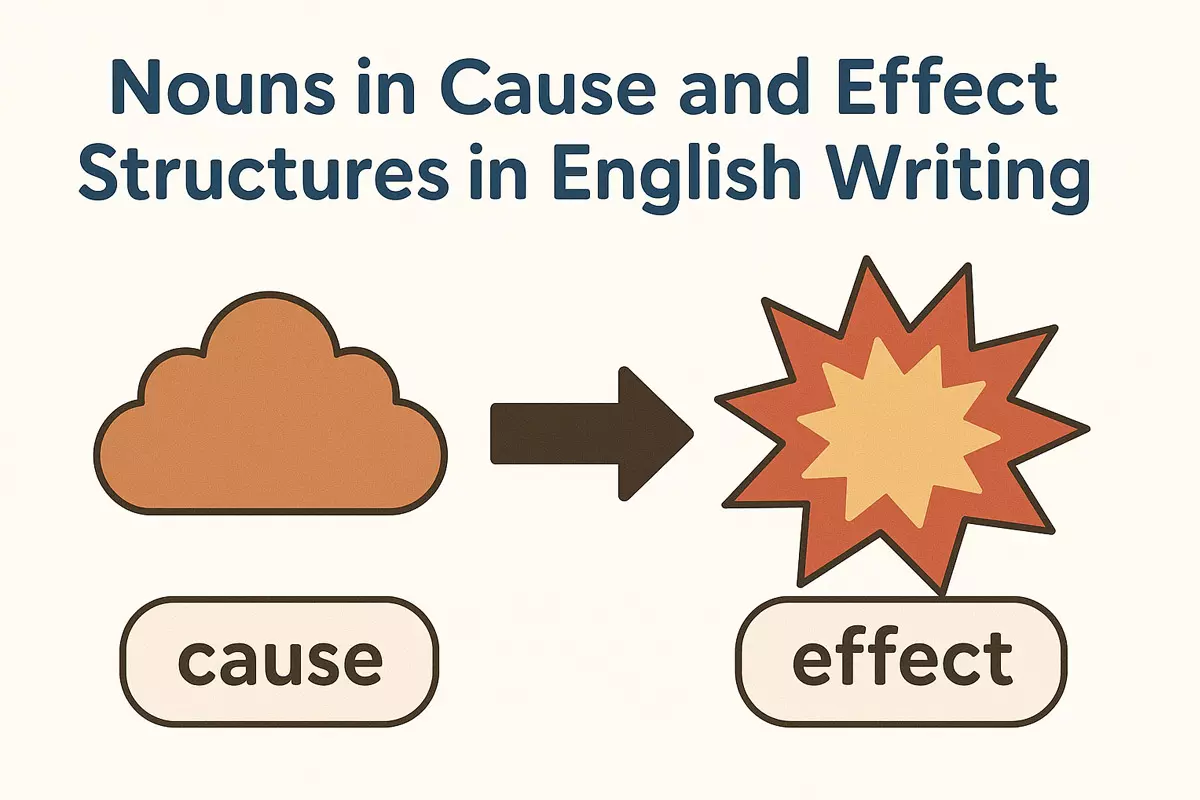 This article explains how nouns such as reason, factor, result, and impact express cause and effect relationships. It covers linking ideas with noun phrases, choosing nouns for academic or daily use, common mistakes, and practice activities.
- How nouns express cause and effect relationships
- Cause nouns like reason, factor, and source
- Effect nouns like result, outcome, and impact
- Linking cause and effect through noun phrases
- Academic vs everyday cause-effect noun choices
- Typical learner mistakes with causal noun forms
- Practice: connect ideas using clear cause and effect nouns
Understanding how naming words, or nouns, function within explanations of reasons and results can significantly enhance clarity and precision in English writing. By examining their role, writers can better connect actions, outcomes, and underlying motivations, allowing for more coherent and logical communication. This awareness not only strengthens the structure of explanations but also helps readers grasp the relationships between different elements in a sentence, ultimately improving the overall effectiveness of written expression.
How nouns express cause and effect relationships
Nouns often play a central role in showing links between causes and outcomes in English writing. Instead of always using verbs or full clauses, writers can use specific nouns to make the connection between an action and its result more compact or formal. These nouns—sometimes called "nominalizations"—allow complex relationships to be expressed in a single word or phrase, making sentences more concise and sometimes more objective.
Common types of cause and effect nouns
Writers frequently use certain nouns to highlight reasons, results, or processes. These include:
- Cause nouns: reason, source, origin, stimulus, trigger, factor, impetus, basis, motivation, root
- Effect nouns: result, outcome, consequence, impact, effect, product, aftermath, fallout, repercussion, influence
- Process nouns (linking both sides): development, increase, decline, change, shift, transformation, escalation, reduction, progression, emergence
Patterns for using nouns in causal structures
Writers can use these nouns in several patterns to clearly show connections. Here are some typical structures:
- Noun + of + noun: "The increase of pollution led to health problems."
- Noun + from + noun: "The result from the experiment confirmed the hypothesis."
- Noun + due to + noun: "The delay due to weather affected the schedule."
- Noun + as a result of + noun: "The growth as a result of investment was significant."
- Noun + caused by + noun: "The damage caused by the storm was extensive."
Comparing noun-based and verb-based cause/effect
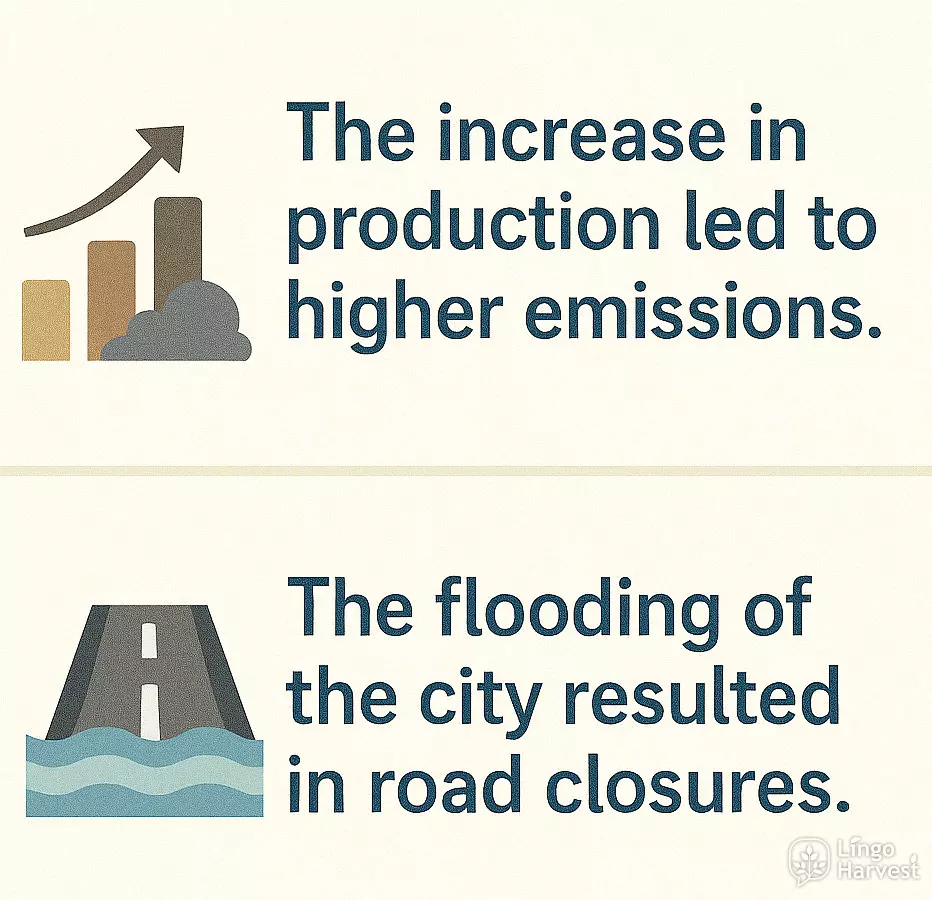
Using nouns instead of verbs can shift the focus from the action to the concept or result itself. This is especially useful in academic or formal texts. Consider these examples:
| Verb-based example | Noun-based example |
|---|---|
| The company increased production, which caused higher emissions. | The increase in production led to higher emissions. |
| Heavy rain flooded the city, and many roads were closed. | The flooding of the city resulted in road closures. |
| Lack of sleep affects concentration. | Sleep deprivation has an effect on concentration. |
| They postponed the meeting because the manager was absent. | The postponement of the meeting was due to the manager's absence. |
Why use noun-based cause and effect?
Choosing nouns for causal relationships can make writing clearer and more formal. It helps writers summarize complex actions, focus on key ideas, and create smoother transitions between sentences. In academic and technical contexts, this approach often leads to more precise and organized writing.
Cause nouns like reason, factor, and source
In English writing, certain nouns are commonly used to express causes within cause and effect structures. Words such as "reason," "factor," and "source" help writers clarify why something happens, or what contributes to a particular outcome. These nouns signal relationships between events or ideas, making arguments and explanations more precise.
Common Cause Nouns and Their Usage
Writers choose from a variety of nouns to indicate causes, depending on the context and the level of certainty or complexity they want to express. Here are some of the most frequent options:
- Reason: Points to an explanation or justification behind an event or decision ("The main reason for the delay was traffic.").
- Factor: Suggests one of several elements contributing to a result ("Poor planning was a significant factor in the failure.").
- Source: Refers to the origin or starting point of something ("The river is the main source of water for the city.").
- Cause: Indicates a direct agent that produces an effect ("Smoking is a cause of lung disease.").
- Origin: Focuses on where or how something began ("The origin of the rumor is unclear.").
- Root: Used for the underlying or fundamental cause ("The root of the problem lies in miscommunication.").
- Agent: Stresses the entity performing an action that leads to an effect ("Bacteria are the agent of infection.").
- Motivation: Refers to the driving force behind a person’s actions ("Financial gain was the motivation for the crime.").
- Trigger: Highlights the specific event that initiates a process ("The announcement was the trigger for protests.").
- Impetus: Implies something that encourages activity or progress ("The new law provided the impetus for reform.").
- Basis: Points to the foundation or justification ("Her decision had a solid basis in evidence.").
- Driver: Used for a force that strongly influences change ("Technology is a major driver of innovation.").
- Stimulus: Refers to something that provokes a response ("The bonus acted as a stimulus for productivity.").
- Influence: Indicates something that affects an outcome ("Peer pressure was a strong influence on his choice.").
- Contributor: Describes one of several elements that add to a result ("Lack of sleep was a contributor to her poor performance.").
Patterns with Cause Nouns
These nouns can be used in a variety of grammatical patterns to clarify relationships:
- "The [cause noun] of/for..." (e.g., "The reason for the error...")
- "One [cause noun] is..." (e.g., "One factor is lack of funding.")
- "Due to [cause noun]..." (e.g., "Due to a technical issue...")
- "[Cause noun] can be attributed to..." (e.g., "The source can be attributed to...")
Comparing Common Cause Nouns
The table below shows distinctions in meaning and typical usage of several key nouns:
| Noun | Typical Context/Usage |
|---|---|
| Reason | General explanation, often for decisions or opinions |
| Factor | One element among several influencing an outcome |
| Source | Origin or place where something begins |
| Cause | Direct agent producing an effect; often scientific or medical |
| Trigger | Specific event that initiates a process or reaction |
| Root | Underlying or fundamental explanation |
Tips for Effective Use
Choosing the right noun to express causality depends on the precision and nuance you want. For example, "factor" is useful when discussing multiple contributors, while "source" or "origin" is best for tracing beginnings. In academic and formal writing, variety and accuracy in selecting these nouns enhance clarity and sophistication.
Effect nouns like result, outcome, and impact
In English academic and formal writing, certain nouns are used to express the consequences or effects of actions, events, or conditions. Words such as result, outcome, and impact are some of the most common. These nouns help writers clearly indicate what has happened as a consequence of a previous cause, making arguments and explanations more precise and logical.
Common Effect Nouns and Their Usage
Writers often choose among several effect-related nouns, depending on the context and the degree of formality. Here are some widely used nouns to convey consequences:
- Result – General term for what happens because of something else.
- Outcome – Often used for final states, especially in research or processes.
- Impact – Indicates a strong or significant effect, sometimes with neutral or negative connotations.
- Consequence – Frequently used for negative or neutral effects.
- Effect – Broad term for any change caused by an action or event.
- Repercussion – Refers to indirect or secondary effects, often negative.
- Influence – Highlights the power to affect or change.
- Product – Used when the effect is something tangible created.
- Aftermath – Describes effects following a significant event, often negative.
- Legacy – Focuses on long-term effects, especially after someone or something is gone.
- Ramification – Emphasizes complex or unexpected results.
- Fallout – Used for widespread or lingering negative effects.
- Payoff – Implies a positive, often final, result.
- Yield – Refers to results, especially in scientific or agricultural contexts.
- Byproduct – An unintended secondary effect.
- Spin-off – A secondary result, often positive or neutral.
Patterns for Using Effect Nouns in Sentences
Effect nouns frequently appear in specific grammatical structures. Common patterns include:
- X was the result of Y. (e.g., "The decrease in sales was the result of poor marketing.")
- Y led to an outcome of X. (e.g., "Poor nutrition led to an outcome of lower energy levels.")
- X had a significant impact on Y. (e.g., "The new policy had a significant impact on productivity.")
- The consequence of Y was X. (e.g., "The consequence of the storm was widespread flooding.")
- X is the effect of Y. (e.g., "Fatigue is the effect of insufficient sleep.")
Comparing Common Effect Nouns
| Effect Noun | Typical Usage Context | Connotation |
|---|---|---|
| Result | General, neutral; academic and everyday English | Neutral |
| Outcome | Research, processes, decision-making | Neutral or formal |
| Impact | Describing strong or significant effects, often in reports | Often strong, sometimes negative |
| Consequence | Discussing negative or inevitable results | Frequently negative |
| Effect | General, for any change or result | Neutral |
Tips for Choosing the Right Effect Noun
- Consider the formality of your writing: "Outcome" and "consequence" are more formal than "result."
- Match the noun to the strength of the effect: Use "impact" for stronger effects, "byproduct" for unintended ones.
- Pay attention to connotation: Some nouns imply something negative or positive.
- Vary your vocabulary to avoid repetition and keep your writing engaging.
Selecting the appropriate effect noun helps clarify relationships in your writing and strengthens the logical flow of your arguments or explanations.
Linking cause and effect through noun phrases
In English writing, noun phrases often serve as a bridge between causes and their resulting effects. Rather than using full clauses, writers frequently opt for condensed structures that pack information into a single phrase, making texts more concise and formal. This can be especially useful in academic or technical writing, where clarity and brevity are important.
Common Patterns for Cause-Effect Noun Phrases
Writers can express complex relationships by turning actions or processes into nouns, a process known as nominalization. For instance, instead of "Because people smoke, they get sick," you might see "Smoking causes illness." This approach shifts the focus from actions to entities or concepts, allowing tighter connections between reasons and outcomes.
- Increase in temperature → melting of ice
- Lack of sleep → decreased concentration
- Economic downturn → job losses
- Overconsumption of sugar → health problems
- Advancement in technology → improved communication
- Pollution → environmental damage
- Deforestation → habitat loss
- High demand → price increase
- Negligence → accidents
- Globalization → cultural exchange
- Inflation → reduced purchasing power
- Inadequate planning → project failure
- Exposure to sunlight → skin damage
- Urbanization → population density
- Automation → workforce reduction
Transforming Clauses into Noun Phrases
To turn a cause-and-effect sentence into a noun phrase, writers often use patterns like "the effect of X," "the result of Y," or "the impact of Z on A." These constructions allow for more abstract discussion and easier integration into larger sentences.
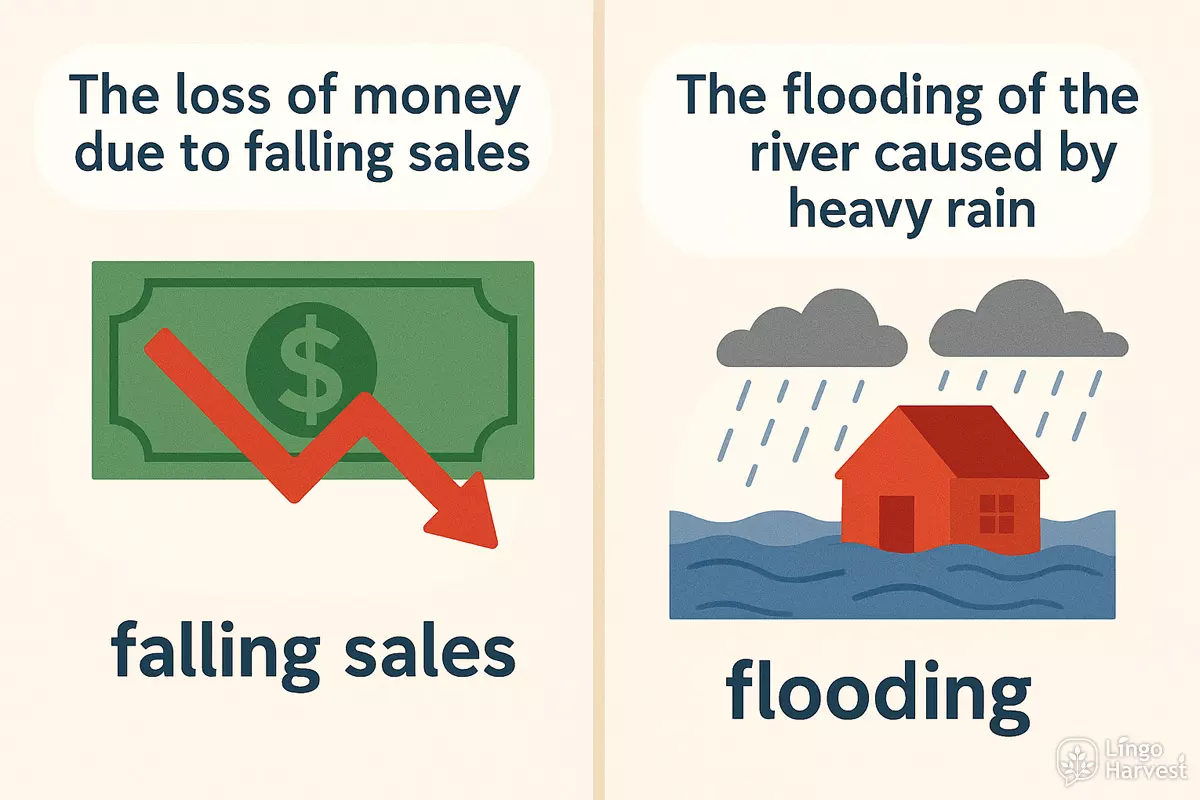
| Cause-Effect Clause | Noun Phrase Structure |
|---|---|
| The company lost money because sales fell. | The loss of money due to falling sales |
| The river flooded as a result of heavy rain. | The flooding of the river caused by heavy rain |
| People became ill after drinking contaminated water. | Illness resulting from contaminated water |
| Students improved their grades because of extra tutoring. | Improvement in grades due to extra tutoring |
Benefits of Using Noun Phrases for Cause and Effect
Noun phrases that express causality make writing more formal and allow for nuanced discussion. They also help writers avoid repetitive sentence structures and create smoother transitions between ideas. By mastering these constructions, you can present complex relationships in a compact and sophisticated way.
Academic vs everyday cause-effect noun choices
Writers often face the challenge of selecting the right nouns to express causes and effects, especially when moving between academic and everyday contexts. The choice of nouns can significantly impact the clarity, tone, and perceived authority of a text. In more formal or scholarly writing, noun selection tends to be more precise and abstract, while casual communication favors concrete and familiar terms.
Key differences in noun selection
Academic language often opts for generalized, abstract nouns that group phenomena or ideas, whereas informal registers use specific, tangible nouns tied to daily experience. This shift in vocabulary affects not just the style, but also how information is processed by readers.
| Academic Noun | Everyday Equivalent | Example Pair |
|---|---|---|
| consequence | result | The consequence/result of the policy was higher prices. |
| factor | reason | A major factor/reason for failure was poor planning. |
| phenomenon | thing/event | This phenomenon/event occurs every year. |
| impact | effect | The impact/effect of pollution is serious. |
| correlation | link | There is a correlation/link between diet and health. |
| outcome | result | The outcome/result was unexpected. |
| variable | factor | This variable/factor changed the results. |
| cause | reason | The cause/reason is unclear. |
| motivation | reason | Her motivation/reason for leaving was personal. |
| implication | meaning | The implication/meaning is important. |
Patterns and preferences in different contexts
In research papers, reports, and essays, writers lean towards nouns like consequence, impact, or implication to convey nuance and avoid ambiguity. In contrast, spoken English and informal writing favor straightforward nouns such as result, thing, or reason. This distinction helps writers adapt their language to suit their audience and communicative goals.
- Academic: "The correlation between variables is significant."
- Everyday: "There’s a link between those things."
- Academic: "The phenomenon was observed in many cases."
- Everyday: "That thing happened a lot."
Why noun choice matters
Using precise, discipline-specific nouns in formal writing can demonstrate expertise and avoid oversimplification. However, overusing abstract nouns in casual contexts may confuse or alienate readers. Matching noun formality to the situation ensures that cause-and-effect relationships are both understood and credible.
Typical learner mistakes with causal noun forms
Many English learners struggle with expressing cause and effect using nouns. Problems often arise from confusing similar nouns, choosing the wrong form, or misplacing the noun in the sentence. These errors can make writing unclear or change the intended meaning.
Common Confusion Between Causal Nouns
Some words look or sound similar but have different meanings or usage. For example, "effect" and "affect" are often mixed up, as are "cause" and "reason." This confusion can lead to awkward or incorrect sentences.
- Using "effect" when "cause" is needed: The effect of pollution is people get sick (should be "The cause of people getting sick is pollution").
- Writing "reason of" instead of "reason for": The reason of his absence... (should be "The reason for his absence...").
- Mixing up "result" and "consequence": The result of not studying is bad grades vs. The consequence of not studying is bad grades (both may work, but context matters).
Incorrect Noun Forms and Collocations
Learners often use the wrong noun form or combine nouns with the wrong prepositions or verbs. Prepositions like "of," "for," and "from" are frequent trouble spots.
| Incorrect Usage | Correct Form | Explanation |
|---|---|---|
| The reason of the delay | The reason for the delay | Use "for" with "reason" to show purpose or cause. |
| The effect to the climate | The effect on the climate | "Effect" takes "on" to indicate what is affected. |
| The cause for the accident | The cause of the accident | "Cause of" is the correct collocation. |
| The result from the experiment | The result of the experiment | Use "of" after "result" to show origin. |
| The consequence for his action | The consequence of his action | "Consequence of" is standard usage. |
Overusing Causal Nouns or Avoiding Them
Some learners repeat the same noun ("reason," "cause," or "effect") too often, making writing monotonous. Others avoid these forms altogether, missing out on concise ways to express relationships. Striking a balance and choosing the right noun for the context is key.
Omitting Articles and Determiners
Another frequent pitfall is forgetting "the" or "a/an" before causal nouns, which can make sentences sound unnatural:
- Reason for delay is unknown. → The reason for the delay is unknown.
- Cause of accident was speed. → The cause of the accident was speed.
Summary of Frequent Errors
A quick checklist of issues to watch for:
- Mixing up "cause," "reason," "effect," "result," and "consequence"
- Using the wrong preposition after causal nouns
- Forgetting articles ("the," "a") before nouns
- Overusing the same noun repeatedly
- Choosing a verb instead of a noun, or vice versa ("affect" vs. "effect")
- Creating awkward noun phrases by translating directly from another language
- Omitting necessary determiners or modifiers
- Using plural forms incorrectly (e.g., "the effects of" vs. "the effect of")
- Confusing abstract and concrete uses of causal nouns
- Misplacing the noun in the sentence, leading to ambiguity
Careful attention to these patterns will help learners use cause and effect nouns more accurately and naturally in English writing.
Practice: connect ideas using clear cause and effect nouns
When writing about reasons and results, selecting precise nouns can help clarify relationships between ideas. This skill is essential for effective academic and professional communication. The following activities and examples will help you recognize and apply appropriate nouns to describe causes and effects in English sentences.
Common Cause and Effect Nouns in Context
Here is a list of useful nouns frequently used to express causality or result. Notice how each word has a slightly different nuance:
- reason → The main reason for the delay was bad weather.
- consequence → One consequence of the decision was higher costs.
- impact → The new policy had a positive impact on productivity.
- result → The result of the test surprised everyone.
- cause → Lack of sleep was the cause of his mistake.
- effect → The medicine had an immediate effect.
- influence → Her advice had a strong influence on the team.
- outcome → The outcome of the negotiations remains unclear.
- factor → Cost is an important factor in this decision.
- solution → They finally found a solution to the problem.
- response → His response was calm and professional.
- contribution → Her contribution helped the project succeed.
- origin → The origin of the idea is hard to trace.
- reaction → His reaction showed clear disappointment.
- trigger → Stress can be a trigger for headaches.
- conclusion → She came to a clear conclusion after reviewing the data.
- implication → The plan has serious implications for the budget.
- source → This report is based on a reliable source.
- contributor → She is a key contributor to the research.
- ramification → The change could have long-term ramifications.
Match the Cause and Effect Nouns
Try to match each sentence with the most suitable noun from the list above:
- The main ________ of the delay was a technical malfunction.
- This policy had a significant ________ on the local economy.
- The ________ of the new law was a decrease in pollution.
- One ________ of climate change is more frequent storms.
- Her hard work was the primary ________ of her success.
- The unexpected reaction was a direct ________ of the announcement.
- Cost is a key ________ in choosing the right solution.
- The final ________ of the discussion was a clear agreement.
- Public opinion had a strong ________ on the decision.
- The change may have serious long-term ________.
Show answers
- cause
- impact
- result
- consequence
- factor
- effect
- factor
- outcome
- influence
- implications
Practice: Rewrite for Clarity
Below are sentences with vague or unclear nouns. Rewrite each using a more precise cause or effect noun from the vocabulary above.
- There was a thing that made the project late.
- This had a big thing on our decision.
- Things happened after the announcement.
- There are many things that affect learning.
- This thing led to unexpected changes.
- That thing explains why the plan failed.
- Several things influenced the final result.
- This thing triggered a strong reaction.
- One thing caused serious problems.
- Things followed after the policy change.
Show answers
- There was a factor that made the project late.
- This had a big influence on our decision.
- Consequences happened after the announcement.
- There are many factors that affect learning.
- This outcome led to unexpected changes.
- That reason explains why the plan failed.
- Several factors influenced the final result.
- This trigger caused a strong reaction.
- One cause created serious problems.
- Results followed after the policy change.
Comparing Patterns: Cause vs. Effect Nouns
| Cause Nouns | Effect Nouns |
|---|---|
| cause origin source trigger factor |
effect result outcome consequence ramification |
| reason contributor influence |
impact response implication |
| stimulus | reaction |
| solution (to a problem) | conclusion |
Quick Check: Identify the Noun Type
Decide if each noun is typically used for a cause or an effect:
- trigger
- impact
- origin
- outcome
- response
- cause
- effect
- factor
- reaction
- result
Show answers
- trigger: cause
- impact: effect
- origin: cause
- outcome: effect
- response: effect
- cause: trigger
- effect: outcome
- factor: cause
- reaction: response
- result: outcome
By practicing with authentic examples and vocabulary, you will improve your ability to express logical relationships clearly and precisely in English writing.