Noun-Based Gradable Categories Like Kind of and Type of

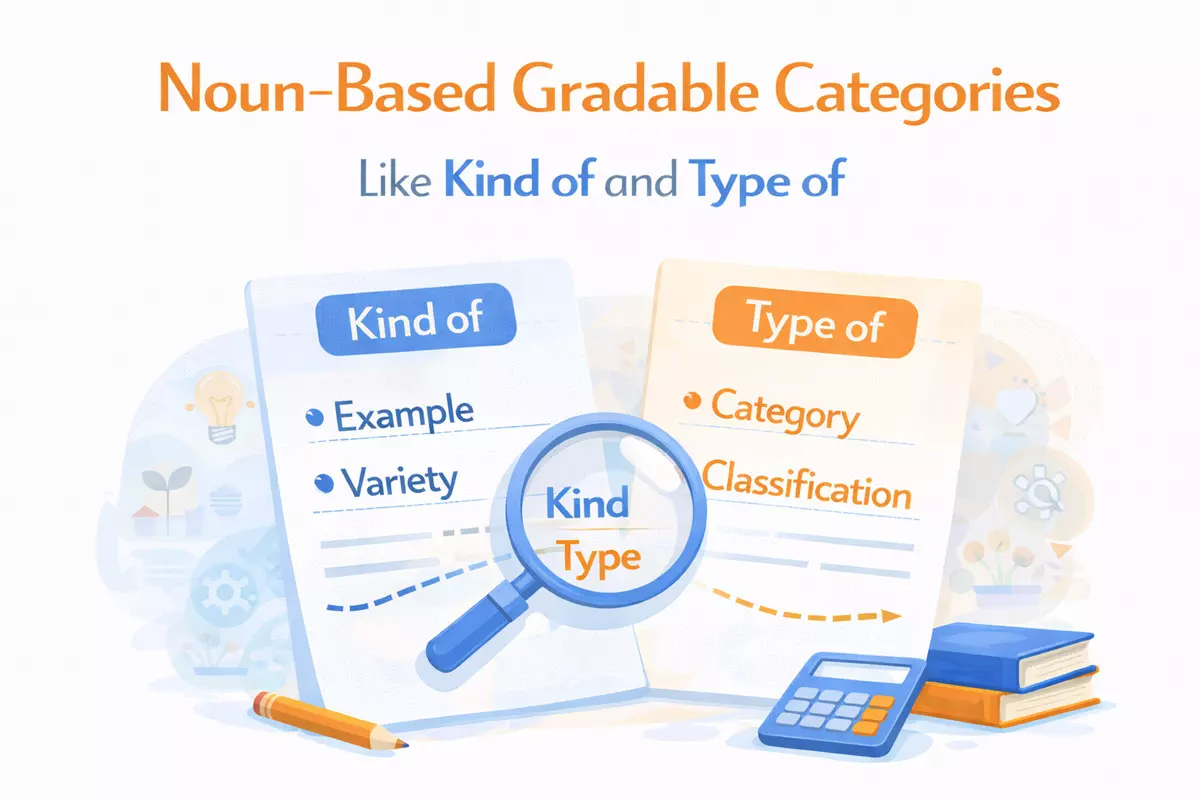 This article explains how English uses gradable category nouns like kind of, type of, and sort of for classification. It covers literal versus approximate meanings, singular and plural forms, register differences, and common learner mistakes.
- What noun-based gradable categories are in English
- Meaning of kind of, type of, and sort of in classification
- Literal vs approximate use of gradable category nouns
- Singular and plural behavior of category nouns
- Register differences in spoken and written English
- Common learner confusion with category expressions
- Practice: classify objects using correct category nouns
Language often uses flexible nouns to describe and compare groups, signaling degrees or categories such as types, kinds, or varieties. By expressing something as a particular sort or variety, we can communicate subtle differences and distinctions within broader groups. This nuanced way of grouping things helps us convey complex ideas more precisely, showing how our choice of words shapes understanding. Examining these linguistic tools reveals much about how we express similarities, differences, and relationships in everyday communication.
What noun-based gradable categories are in English
Noun-based gradable categories in English are ways of grouping things according to shared characteristics, using nouns like "type," "kind," "sort," or "category." These structures let speakers express shades of meaning, differences in degree, or subtle distinctions among items, often by combining these nouns with modifiers such as "somewhat," "very," or "quite." For example, saying "a kind of fruit" or "a type of solution" allows for gradation and comparison across members of a group.
Common Gradable Noun Categories
English uses several nouns to create these flexible groups. Some of the most frequent include:
- kind (e.g., "a kind of music") → This kind of music is popular among younger audiences.
- type (e.g., "a type of fabric") → This type of fabric is suitable for outdoor clothing.
- sort (e.g., "that sort of attitude") → That sort of attitude can damage team morale.
- category (e.g., "in the category of classics") → The novel falls into the category of modern classics.
- class (e.g., "a class of chemicals") → This class of chemicals is regulated by international law.
- group (e.g., "a group of islands") → The study focused on a group of islands in the Pacific.
- form (e.g., "a form of protest") → Online petitions are a common form of protest.
- style (e.g., "a style of painting") → This style of painting emerged in the 19th century.
- variety (e.g., "a variety of apples") → The market sells a wide variety of apples in autumn.
- species (e.g., "a species of bird") → This species of bird is now considered endangered.
- genre (e.g., "a genre of literature") → Crime fiction is a genre of literature with a large readership.
- brand (e.g., "a brand of cereal") → She always buys the same brand of cereal.
- model (e.g., "a model of car") → This model of car is known for its fuel efficiency.
- version (e.g., "a version of events") → Each witness gave a slightly different version of events.
- flavor (e.g., "a flavor of ice cream") → Chocolate is the most popular flavor of ice cream in the survey.
- breed (e.g., "a breed of dog") → This breed of dog requires a lot of exercise.
- range (e.g., "a range of options") → The course offers a range of options for final projects.
- level (e.g., "a level of difficulty") → The exam was set at an intermediate level of difficulty.
How Gradability Works with Noun-Based Categories
Gradability is often shown by using modifiers or by comparing different members within a group. For example, "a very unusual kind of mushroom" or "a more advanced type of software" uses adjectives and adverbs to signal degree. The noun category itself (like "kind" or "type") provides a flexible frame for comparison, and modifiers refine the level or intensity.
Sample Usage Patterns
These gradable noun-based categories appear in patterns like:
- "a kind of X" (e.g., "a kind of sadness")
- "a more/less [category] of X" (e.g., "a more sophisticated type of camera")
- "different/similar [category]s of X" (e.g., "similar styles of architecture")
- "one [category] of many" (e.g., "one genre of many")
Comparing Gradable Noun Categories
Some of these nouns overlap in meaning, but each carries subtle differences in use or tone. Here’s a quick comparison:
| Category Noun | Typical Use / Nuance |
|---|---|
| kind | Broad, informal grouping; subjective qualities |
| type | More objective or technical grouping |
| sort | Very informal, often interchangeable with "kind" |
| category | Formal, often used in classification systems |
| class | Scientific or academic grouping |
| genre | Specific to arts, literature, and media |
| style | Focuses on manner or approach, especially in art or fashion |
In summary, these noun-based categories help English speakers describe and compare things with nuance, gradation, and flexibility—going far beyond simple labels.
Meaning of kind of, type of, and sort of in classification
When people use expressions like "kind of," "type of," and "sort of," they are typically talking about how things are grouped or classified based on shared features. These noun-based gradable category terms help speakers organize and communicate about the world by indicating that something belongs to a particular group, but often with a sense of flexibility or approximation.
How These Terms Work in Categorization
"Kind of," "type of," and "sort of" introduce categories that are not always strictly defined. Instead, they allow for gradation—meaning something can be more or less typical of the group. For example, "a kind of fruit" could refer to anything from an apple to a tomato, even though a tomato is not always thought of as a classic fruit. These expressions are especially useful when:
- Identifying items that share core characteristics
- Allowing for exceptions or borderline cases
- Describing new or unfamiliar categories
- Softening statements to avoid overgeneralization
Comparing "Kind of," "Type of," and "Sort of"
While all three phrases serve a similar function, their usage can imply subtle differences in formality or specificity. "Type of" is often slightly more formal or technical, while "kind of" and "sort of" are more common in everyday speech and may feel more casual or vague.

| Expression | Typical Context | Formality | Example |
|---|---|---|---|
| Kind of | General classification, informal speech | Casual | That’s a kind of cheese I’ve never tried. |
| Type of | More precise or technical grouping | Neutral-formal | This is a type of renewable energy. |
| Sort of | Vague or approximate grouping | Casual | He’s a sort of mentor to me. |
Common Patterns and Examples
These category markers often appear with nouns to describe subgroups or varieties. Here are some typical uses:
- a kind of tree → This park is famous for a kind of tree that blooms in early spring.
- some type of solution → We need some type of solution that works for both teams.
- every sort of animal → The documentary shows every sort of animal living in the rainforest.
- a new kind of phone → The company has released a new kind of phone with an improved camera.
- that type of behavior → That type of behavior is not acceptable in a professional setting.
- no sort of excuse → There is no sort of excuse for lying on an official form.
- another kind of problem → The delay created another kind of problem for the researchers.
- different types of cheese → The market sells many different types of cheese from across Europe.
- the worst sort of pain → For some patients, this is the worst sort of pain they have ever experienced.
- any kind of help → Any kind of help would be appreciated during the busy season.
- all types of people → The programme is open to all types of people, regardless of background.
- some sort of misunderstanding → There seems to be some sort of misunderstanding about the deadline.
- a rare kind of gemstone → The museum displays a rare kind of gemstone found only in this region.
- that type of attitude → That type of attitude makes collaboration very difficult.
- various sorts of questions → In the interview, students asked various sorts of questions about the course.
Flexibility and Gradability
A key feature of these terms is their ability to express gradable categories. Not everything neatly fits into a single group, and using "kind of," "type of," or "sort of" allows speakers to acknowledge uncertainty, overlaps, or degrees of similarity. This makes them valuable tools in everyday conversation as well as academic or scientific contexts where boundaries between categories can be fuzzy. In summary, these expressions help organize knowledge about the world by signaling group membership—often with a built-in sense of approximation or flexibility that reflects how people really think and talk about categories.
Literal vs approximate use of gradable category nouns
Writers and speakers often use category nouns like "kind," "type," or "sort" in varying ways, sometimes referring to clear-cut groupings, and other times signaling approximation or uncertainty. This distinction is important for understanding how these nouns function in real communication.
Literal interpretation: clear membership
A literal use of gradable category nouns means the item truly belongs to the named group. For example, when someone says "This is a type of citrus fruit," they are indicating that the item fits the established botanical definition. Literal usage tends to be precise and reflects well-defined categories. Such statements are common in technical, scientific, or formal contexts.
- "A kind of mammal" (e.g., dolphin, which is scientifically a mammal)
- "A type of metal" (e.g., copper, iron)
- "A sort of pasta" (e.g., penne, fusilli)
- "A variety of apple" (e.g., Granny Smith, Fuji)
Approximate or hedged usage: flexibility and nuance
In everyday conversation, these category nouns often serve to soften claims or express that something only loosely fits a category. Phrases like "kind of," "sort of," or "a type of" can signal approximation, uncertainty, or subjective judgment. This is especially common when describing unfamiliar, hybrid, or ambiguous items.
- "It's kind of a dessert, but also a breakfast food."
- "That’s a sort of blue, maybe teal?"
- "She’s a type of consultant, but more specialized."
- "It's a kind of chair that’s also a recliner."
- "This feels like a type of poem, though it doesn’t rhyme."
- "A sort of friend, more like a colleague."
- "It's kind of spicy, but not overwhelmingly so."
- "That’s a type of music I haven’t heard before."
- "He’s a sort of leader, but unofficially."
- "It's a kind of problem we see often."
Comparing literal and approximate uses
To summarize the contrast, here’s how literal and hedged uses differ in context and effect:
| Literal Use | Approximate Use |
|---|---|
| Clear, objective membership in a category e.g., "A type of fruit: apple" |
Loosely fits or resembles a category e.g., "Kind of fruit: tomato" |
| Often found in scientific or technical contexts | Common in casual speech and subjective description |
| Implies certainty and precision | Signals uncertainty, vagueness, or hedging |
| Limits possible interpretations | Leaves room for debate or nuance |
Why speakers choose approximate phrasing
People often opt for hedged or approximate phrasing to avoid overcommitting, to be polite, or to reflect the fuzzy boundaries of real-world categories. In English, this flexibility is a strength, allowing speakers to describe new phenomena or ambiguous cases without sounding overly rigid. In summary, whether used precisely or loosely, gradable category nouns help us organize information and express subtle shades of meaning in both formal and informal contexts.
Singular and plural behavior of category nouns
Category nouns like "kind," "type," "sort," and "category" show interesting variation in how they behave with singular and plural forms, especially when followed by "of" phrases. The choice between singular and plural often depends on the noun following "of," as well as the intended meaning and the conventions of formal or informal English.
Agreement patterns and typical usage
These category words can appear both in singular and plural, but their agreement patterns shift depending on context. For example, "kind of animal" describes a single category, while "kinds of animals" refers to multiple categories or types. When the noun after "of" is plural, both singular and plural forms of the category noun can be encountered, though the plural is generally preferred in formal writing.
- Kind of animal → one category
- Kinds of animals → several categories
- Type of plant → single category
- Types of plants → multiple categories
- Sort of person → one type of person
- Sorts of people → various types of people
- Category of book → one genre or classification
- Categories of books → multiple genres or classifications
- Form of energy → a specific kind
- Forms of energy → different kinds
- Class of drugs → one group
- Classes of drugs → more than one group
- Style of music → one type
- Styles of music → several types
- Variety of fruit → a single variant
- Varieties of fruit → different variants
- Breed of dog → one breed
- Breeds of dog → multiple breeds
- Group of people → a single group
- Groups of people → several groups
Semantic nuances and flexibility
The use of a singular or plural form can subtly change the meaning. A singular "kind of animals" may imply a specific category within a set, while "kinds of animals" highlights diversity. In casual speech, singular category nouns are sometimes used with plural "of" phrases ("that kind of things"), though this is less common in formal writing. These patterns can also reflect speaker perspective, emphasis, and dialectal variation.
Summary of form selection
| Category Noun | Singular Usage | Plural Usage | Typical Context |
|---|---|---|---|
| kind/type/sort | kind of animal | kinds of animals | General classification |
| category/class | category of book | categories of books | Formal/technical |
| form/variety/breed | form of energy | forms of energy | Scientific/biological |
| group/style | group of people | groups of people | Social/cultural |
In summary, whether to use singular or plural forms with category nouns depends on the focus—whether you are talking about one group or many. Paying attention to these patterns helps produce more natural and precise English.
Register differences in spoken and written English
The use of gradable noun phrases like kind of and type of varies noticeably between informal conversation and more formal writing. In everyday speech, these expressions often signal uncertainty, approximation, or hedging. By contrast, in academic texts and official documents, they tend to be used with more precision to categorize or classify.
Common patterns in conversation

When people talk, they frequently use gradable noun-based phrases for vagueness or to soften statements. For example, someone might say, “It’s kind of cold today,” or “That’s a type of weird.” Here, these phrases serve to make the statement less direct or less absolute.
- “He’s kind of tired.”
- “That’s a type of spicy I don’t like.”
- “It was sort of a surprise.”
- “She’s a kind of mentor to me.”
- “It felt like a kind of magic.”
- “That’s a sort of problem for us.”
- “I got a type of rash on my arm.”
- “It’s kind of late to call.”
- “That’s a sort of difficult question.”
- “He’s a type of leader who listens.”
Usage in formal and written contexts
In written English, especially in academic or technical registers, kind of and type of are generally used for classification. Writers aim for clarity, so these phrases are rarely used for hedging or softening. Instead, they identify categories or subcategories, often with a more precise noun following the phrase.
- “This is a type of bacteria found in soil.”
- “There are several kinds of renewable energy.”
- “Each type of data requires specific handling.”
- “A new kind of polymer has been developed.”
- “The study examined different types of stress.”
Comparison of spoken vs. written usage
The structured comparison below highlights how these phrases function differently across registers:
| Spoken English Example | Written English Example |
|---|---|
| “It’s kind of noisy here.” | “Noise pollution is a kind of environmental hazard.” |
| “She’s a type of person who’s always late.” | “There are two main types of respondents in the survey.” |
| “That movie was sort of boring.” | “The report identifies several kinds of errors.” |
| “I felt kind of awkward.” | “This condition is a type of autoimmune disorder.” |
Summary of register-sensitive choices
In sum, gradable noun-based categories like kind of and type of are flexible tools, but their function and acceptability depend on whether you’re speaking casually or writing for a formal audience. When aiming for clarity and authority, avoid hedging language in writing, and reserve less precise uses for speech or informal writing.
Common learner confusion with category expressions
Learners often face uncertainty when using category words like "kind of," "type of," or "sort of" with nouns. One frequent issue is knowing whether to use singular or plural forms after these expressions. For instance, should we say "a kind of fruit" or "a kind of fruits"? The answer depends on whether the noun represents a general category or specific examples. Another point of confusion is the difference between gradable and non-gradable categories. Words like "kind of" and "type of" suggest that categories can be more or less specific, which leads to questions about which modifiers can be used (e.g., "many kinds of," "the same type of," "different sorts of"). Learners may also be unsure when it's appropriate to use articles ("a," "the") with these expressions.
Typical Mistakes with Noun-Based Category Phrases
Misunderstandings often arise from how these category expressions interact with countable and uncountable nouns, as well as how they fit into sentences. Here are some common pitfalls:
- Using the plural after "a kind of" (e.g., ❌ a kind of animals instead of ✅ a kind of animal)
- Omitting "of" (e.g., ❌ a kind tea instead of ✅ a kind of tea)
- Confusing "kinds of" and "kind of" (e.g., ❌ these kind of books instead of ✅ these kinds of books)
- Using "type" or "sort" incorrectly with uncountable nouns (e.g., ❌ a type of informations)
- Mixing category expressions (e.g., ❌ all sort of types)
- Forgetting to use an article (e.g., ❌ kind of dog instead of ✅ a kind of dog)
- Placing adjectives in the wrong place (e.g., ❌ a red kind of apple instead of ✅ a kind of red apple)
- Using gradable modifiers with non-gradable categories (e.g., ❌ a very kind of fruit)
- Unnecessary repetition (e.g., ❌ different kinds of different fruits)
- Using "kind" or "type" for categories that don't fit (e.g., ❌ a type of happiness when "form of" is better)
Comparing "kind of," "type of," and "sort of"
Learners sometimes wonder if these expressions are interchangeable. While they are often used similarly, there can be subtle differences in formality and usage.
| Expression | Typical Use & Register |
|---|---|
| kind of | General, flexible; used in both spoken and written English |
| type of | More formal or technical contexts; often for scientific or precise groupings |
| sort of | Informal, conversational; sometimes used to hedge or soften statements |
| form of | Used for abstract nouns or when talking about variations of a concept |
Summary Tips
Keep in mind these general guidelines:
- Use the singular noun after "a kind/type/sort of" when referring to one category.
- Use the plural noun after "kinds/types/sorts of" when referring to multiple categories.
- Don't omit "of" after these expressions.
- Match countability: "a kind of bread" (uncountable), "a kind of animal" (countable).
- Choose "type" for technical or scientific grouping, "kind" or "sort" for general use.
Understanding these subtle points helps avoid awkward constructions and improves clarity when describing categories in English.
Practice: classify objects using correct category nouns
Understanding how to choose the right noun to categorize items is an essential language skill. In English, we often use words like "kind," "type," "sort," or "category" to group objects, but selecting the most accurate noun can clarify meaning and improve precision. Below, you'll find exercises and examples to help you practice assigning the most suitable category nouns to various objects and concepts.
Common Category Nouns and Example Objects
- Type of: Used for broad distinctions, e.g., "type of fruit," "type of vehicle."
- Kind of: Often used for more general or subjective groupings, such as "kind of music" or "kind of attitude."
- Sort of: Similar to "kind," but can feel more informal, e.g., "sort of problem," "sort of gadget."
- Category of: More formal, used in academic or technical contexts, e.g., "category of error," "category of data."
- Variety of: Focuses on diversity within a group, e.g., "variety of apples," "variety of opinions."
- Brand of: Used for commercial products, e.g., "brand of toothpaste," "brand of phone."
- Model of: For specific versions within a brand, e.g., "model of car," "model of laptop."
- Species of: Biological classification, e.g., "species of bird," "species of tree."
- Genre of: For artistic works, e.g., "genre of movie," "genre of literature."
- Form of: Used for methods or shapes, e.g., "form of communication," "form of exercise."
Exercise: Match Objects to the Best Category Noun
For each item below, choose the most accurate category noun (type, kind, sort, category, variety, brand, model, species, genre, or form) and rewrite the phrase. Example: "___ of shoe" → "type of shoe."
- ___ of smartphone
- ___ of pasta
- ___ of insect
- ___ of literature
- ___ of exercise
- ___ of chocolate
- ___ of error
- ___ of attitude
- ___ of yogurt
- ___ of music
Show answers
- brand of smartphone
- variety of pasta
- species of insect
- genre of literature
- form of exercise
- kind of chocolate
- category of error
- sort of attitude
- type of yogurt
- genre of music
Compare: Overlapping Uses of Category Nouns
Some nouns can be used interchangeably, but subtle differences exist. The table below compares common contexts:
| Category Noun | Typical Contexts / Examples |
|---|---|
| kind | Emotional, subjective, or informal groupings: "kind of feeling," "kind of weather" |
| type | General classification by features: "type of engine," "type of account" |
| sort | Casual, often interchangeable with "kind": "sort of question," "sort of food" |
| category | Formal, technical, or academic: "category of risk," "category of data" |
Challenge: Create Your Own Examples
Use the list of category nouns above to create your own phrases for these objects:
- Cheese
- Painting
- Car
- Language
- Tea
- Music
- Dog
- Fruit
- Coffee
- Phone
Show answers
- variety of cheese
- genre of painting
- model of car
- type of language
- kind of tea
- genre of music
- breed of dog
- variety of fruit
- blend of coffee
- model of phone