Derivational and Inflectional Morphemes

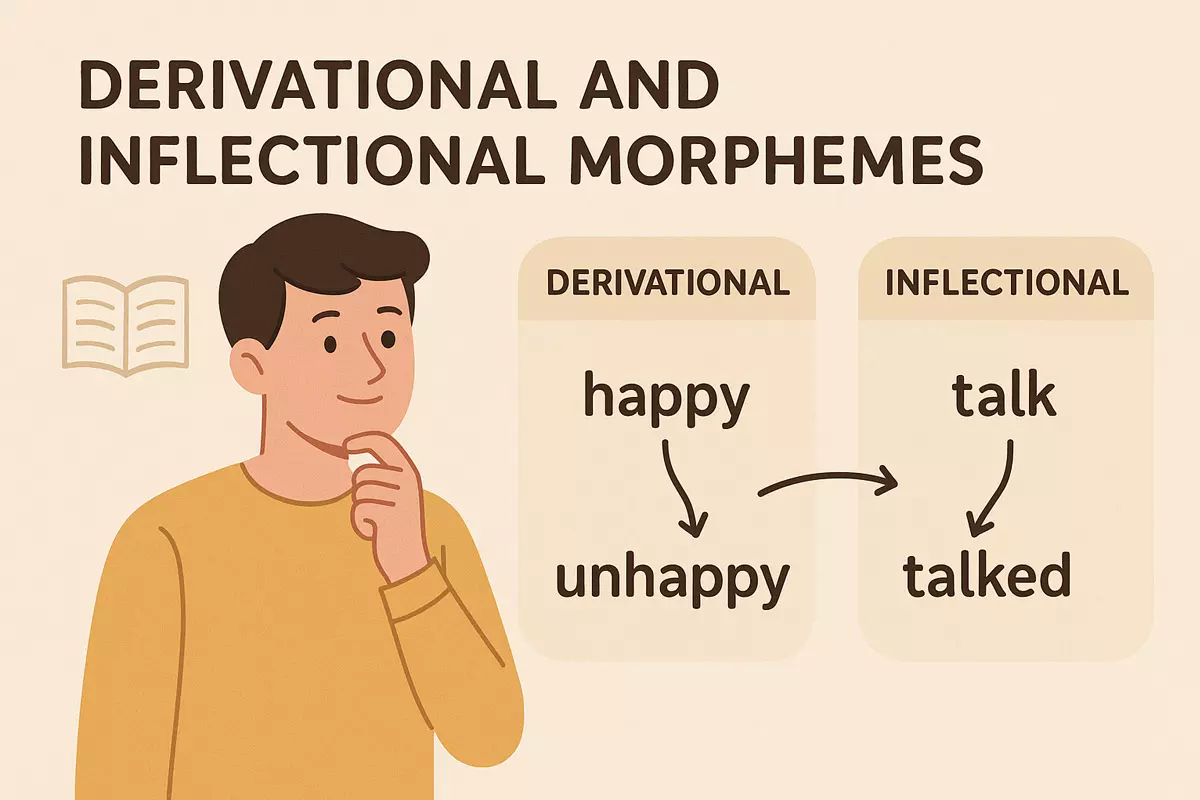 The article defines morphemes and distinguishes between derivational and inflectional types. It explains how morphemes change words, lists common prefixes and suffixes, provides contextual examples, highlights frequent learner mistakes, and offers practice exercises.
Exploring how words evolve in form and meaning offers valuable insights into the structure and adaptability of language. By examining the processes that create new words and modify grammatical features, we can better understand the mechanisms that allow language to remain flexible and expressive over time. These changes reflect not only linguistic creativity but also the influence of cultural and social factors, demonstrating how language adapts to the needs of its speakers and continues to develop in response to new circumstances.
What Are Morphemes?
In linguistics, a morpheme is the smallest grammatical unit that carries meaning. Unlike a word, which may be made up of one or more morphemes, each morpheme cannot be broken down further without losing or altering its meaning. For example, the word unhappiness contains three distinct morphemes: un- (a prefix meaning "not"), happy (the root), and -ness (a suffix turning an adjective into a noun).
Types of Morphemes
Morphemes come in different types, each serving a unique function in word formation. The two main categories are:
- Free morphemes: These can stand alone as words. Example: book, run, quick.
- Bound morphemes: These must attach to other morphemes; they cannot exist independently. Example: -ed, re-, -s.
Within bound morphemes, there are two major subtypes: derivational and inflectional. Derivational morphemes create new words or change the word class (like teach → teacher), while inflectional morphemes modify a word’s tense, number, or degree without changing its core meaning (like cat → cats).
Examples of Morphemes in Action
To better understand how morphemes function, consider these components in common words:
- Un- (as in untrue): negative prefix
- -ed (as in walked): past tense marker
- -s (as in dogs): plural marker
- Re- (as in rewrite): indicates repetition
- -ly (as in quickly): turns adjectives into adverbs
- Bio- (as in biology): relates to life
- -er (as in runner): indicates a person who performs an action
- Dis- (as in disagree): reverses meaning
- -ment (as in enjoyment): forms nouns from verbs
- Pre- (as in preview): indicates before
- -ing (as in singing): present participle marker
- Micro- (as in microscope): means small
Why Morphemes Matter
Understanding morphemes helps with vocabulary, spelling, and grammar. They reveal the building blocks of words and how new terms are created or modified. For learners and linguists alike, analyzing these units provides insight into language structure and development.
Derivational Morphemes
Words often change their meaning or part of speech through the addition of certain affixes. These units, which modify a root to create new vocabulary, play a key role in word formation. By attaching prefixes or suffixes, speakers can expand their lexicon and convey more nuanced ideas.
How Derivation Works
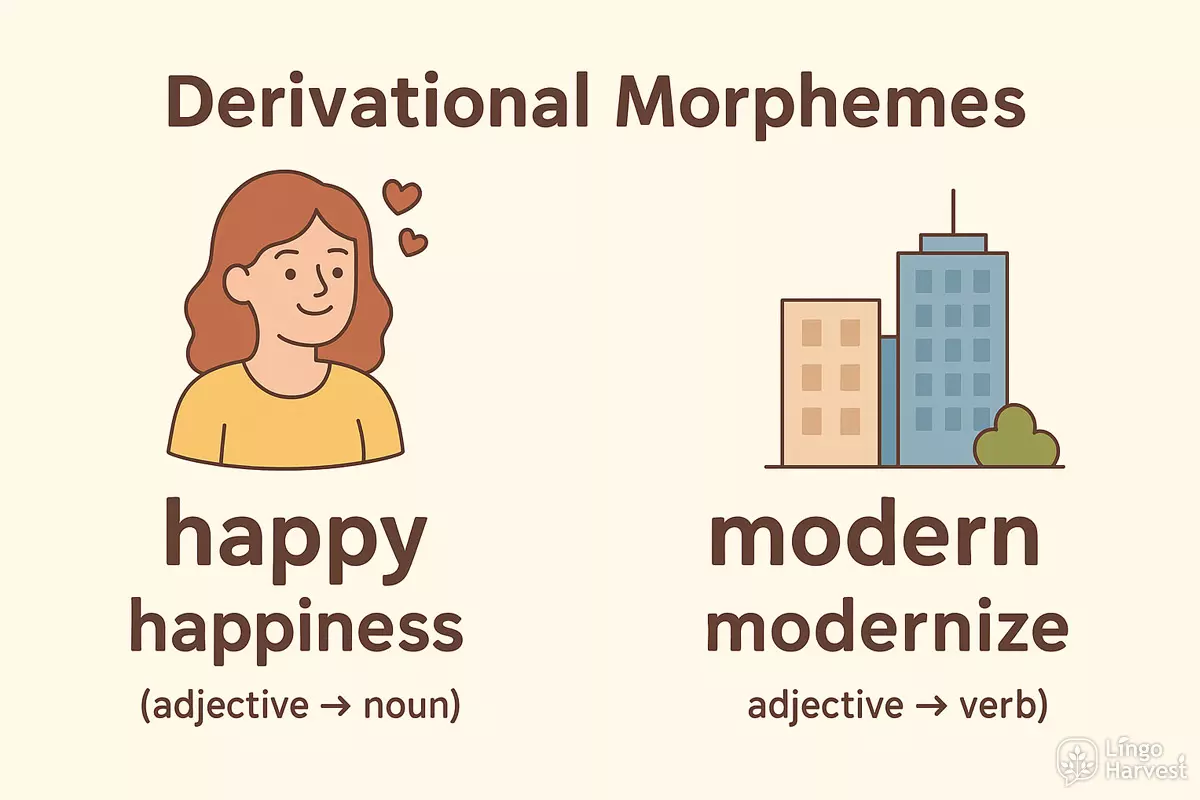
Derivation typically involves adding morphemes to a base word to produce a term with a different grammatical category or meaning. For example, adding -ness to "happy" forms "happiness," transforming an adjective into a noun. Not all affixes produce the same type of change; some create verbs, others nouns, adjectives, or adverbs.
- happy + -ness → happiness (adjective → noun)
- modern + -ize → modernize (adjective → verb)
- read + -able → readable (verb → adjective)
- nation + -al → national (noun → adjective)
- un- + kind → unkind (prefix creates opposite)
- child + -hood → childhood (noun → noun, but changes meaning)
- beauty + -ful → beautiful (noun → adjective)
- friend + -ship → friendship (noun → noun, abstract)
- dis- + agree → disagree (prefix creates opposite meaning)
- quick + -ly → quickly (adjective → adverb)
- act + -or → actor (verb → noun, person)
- move + -ment → movement (verb → noun)
- help + -less → helpless (noun/verb → adjective)
- re- + write → rewrite (prefix indicates repetition)
- inform + -ation → information (verb → noun)
Key Characteristics
- Derivational affixes can change the word class (e.g., noun to verb, adjective to adverb).
- They often significantly alter meaning, not just tense or number.
- Multiple derivational morphemes can sometimes be added to a single word (e.g., "unhappiness").
- Some affixes are productive, allowing the formation of many new words, while others are limited to specific roots.
Common English Derivational Affixes
| Affix | Function/Example |
|---|---|
| -ness | Forms nouns from adjectives (e.g., dark → darkness) |
| -ize | Turns adjectives/nouns into verbs (e.g., final → finalize) |
| un- | Creates opposites, often from adjectives (e.g., fair → unfair) |
| -ly | Makes adverbs from adjectives (e.g., happy → happily) |
| -ment | Forms nouns from verbs (e.g., develop → development) |
| -ful | Adjective-forming, meaning "full of" (e.g., hope → hopeful) |
| dis- | Negates or reverses (e.g., connect → disconnect) |
| -er | Agent noun from verb (e.g., teach → teacher) |
| -able | Adjective-forming, meaning "capable of" (e.g., read → readable) |
| -ship | Forms abstract nouns (e.g., leader → leadership) |
The use of these affixes offers flexibility in expression and enables speakers to build words for new concepts or subtle distinctions. While some derived words become so common they feel basic, the process of derivation is an ongoing and productive force in the language.
Inflectional Morphemes
Grammatical endings and affixes that signal tense, number, comparison, or possession are crucial in shaping the form of a word without altering its basic meaning or word class. These elements are typically predictable and follow regular patterns in a language, serving to indicate grammatical relationships rather than creating new vocabulary.
Key Characteristics
- Do not change the core meaning or lexical category of the word
- Express grammatical distinctions such as plurality, tense, aspect, person, case, gender, or degree
- Are highly productive and regular within a language
- Usually occur at the edge of a word, after any derivational morphemes
Common Types and Examples
In English, there are a limited number of these morphemes, but they appear frequently in everyday language. Here are some of the most common forms and their functions:
- -s for plural nouns (cats, books)
- -'s for possessive nouns (dog's, teacher's)
- -s for third person singular present verbs (she walks, it rains)
- -ed for past tense verbs (jumped, played)
- -ing for present participles/gerunds (running, singing)
- -en/-ed for past participles (broken, finished)
- -er for comparative adjectives (faster, smaller)
- -est for superlative adjectives (biggest, latest)
- -en for plural in some irregular nouns (children, oxen)
- Ablaut vowel changes in irregular verbs (sing/sang/sung, drive/drove/driven)
- Internal vowel changes for plural (man/men, goose/geese)
- Zero morpheme (sheep/sheep, deer/deer)
- Suppletion (good/better/best, bad/worse/worst)
Comparison: English Inflectional Endings
The table below shows typical English inflectional endings, their grammatical function, and some example words.
| Ending | Function | Example |
|---|---|---|
| -s | Plural (Noun) | dogs, cars |
| -s | 3rd Person Singular (Verb) | runs, eats |
| -ed | Past Tense (Verb) | jumped, played |
| -ing | Present Participle | walking, laughing |
| -en/-ed | Past Participle | eaten, walked |
| -'s | Possessive (Noun) | dog's, Anna's |
| -er | Comparative (Adj.) | smaller, faster |
| -est | Superlative (Adj.) | smallest, fastest |
Summary Points
- These affixes always mark grammatical contrasts, not new meanings
- They follow derivational morphemes if both are present in a word (e.g., modern-iz-ation-s)
- Languages differ in how many such forms they have and how they are realized
Whether in English or other languages, these patterns play a vital role in expressing relationships between words and clarifying meaning within sentences, all while keeping the base meaning of the word intact.
How They Change Words
Morphological elements like derivational and inflectional morphemes play distinct roles in shaping the form and function of words. Derivational morphemes typically create new words by attaching to base forms, often changing the word’s grammatical category. For example, adding -ness to “happy” forms the noun “happiness,” while -ly transforms “quick” into the adverb “quickly.” These changes can shift meaning, part of speech, or both. Inflectional morphemes, on the other hand, do not create new words but modify existing ones to express grammatical relationships. This might involve indicating tense, number, person, or comparison. For instance, the suffix -ed marks the past tense in “walked,” and -s signals plural in “cats.”
Types of Word Changes
- Derivational: Alters the core meaning or class (noun, verb, adjective, etc.).
- Inflectional: Expresses grammatical features (tense, number, case, degree) without changing the core meaning or category.
Common Examples
- play + -er → player (derivational: noun from verb)
- hope + -ful → hopeful (derivational: adjective from noun)
- book + -s → books (inflectional: plural)
- run + -ning → running (inflectional: present participle)
- child + -ish → childish (derivational: adjective from noun)
- quick + -est → quickest (inflectional: superlative)
- act + -ion → action (derivational: noun from verb)
- like + -ed → liked (inflectional: past tense)
- read + -able → readable (derivational: adjective from verb)
- friend + -ship → friendship (derivational: noun from noun)
- teach + -es → teaches (inflectional: third person singular)
- beauty + -ful → beautiful (derivational: adjective from noun)
- move + -ment → movement (derivational: noun from verb)
- old + -er → older (inflectional: comparative)
- go + -es → goes (inflectional: third person singular)
Comparison of Effects
| Change Type | Effect on Word | Example |
|---|---|---|
| Derivational | Creates a new word or changes word class | teach → teacher |
| Inflectional | Expresses grammatical relationship; base meaning unchanged | teach → teaches |
| Derivational | Alters core meaning | kind → unkind |
| Inflectional | Shows tense, number, or comparison | fast → fastest |
Understanding these processes reveals how flexible and expressive language can be. By recognizing the different ways words are modified, you gain insight into both vocabulary development and grammar patterns.
Common Prefixes and Suffixes
Understanding how prefixes and suffixes function helps reveal how words are modified to create new meanings or grammatical forms. Prefixes typically appear at the beginning of a word and often adjust its meaning, while suffixes come at the end and may affect either the word’s function or its grammatical category.
Frequent English Prefixes
English uses a wide variety of prefixes to alter the sense of base words. Some are used to negate, indicate repetition, or show position or degree. Here are well-known examples:
- un- (not): unhappy, unclear
- re- (again): rewrite, redo
- pre- (before): prepay, preview
- dis- (opposite of): disconnect, disagree
- mis- (wrongly): misplace, misunderstand
- over- (excessive): overeat, overreact
- sub- (under): submarine, subtext
- inter- (between): interact, international
- anti- (against): antifreeze, antibiotic
- trans- (across): transport, translate
Prefixes typically do not change the grammatical category of a word; they mostly affect meaning. For instance, "happy" and "unhappy" are both adjectives, but the prefix “un-” reverses the meaning.
Common Suffixes and Their Functions
Suffixes play a vital role in both derivation (creating new words or changing word class) and inflection (marking grammatical features). Some suffixes form plurals, tenses, or comparatives, while others create nouns, adjectives, or verbs.
- -s / -es (plural): books, boxes
- -ed (past tense): walked, jumped
- -ing (present participle/gerund): running, singing
- -er (comparative or agent): faster, teacher
- -est (superlative): biggest, smallest
- -ly (adverb): quickly, softly
- -ness (noun): happiness, darkness
- -ful (adjective): helpful, careful
- -less (adjective): careless, hopeless
- -ment (noun): development, agreement
- -able / -ible (adjective): readable, possible
- -tion / -sion (noun): action, decision
Derivational vs. Inflectional Endings
Suffixes can be grouped by their function. Inflectional endings signal grammatical information (like tense or number) and never change a word’s part of speech. Derivational endings, on the other hand, often shift a word into a new lexical category.
| Type | Examples | Function |
|---|---|---|
| Inflectional | -s, -ed, -ing, -er, -est | Show tense, number, comparison; word class unchanged |
| Derivational | -ness, -ment, -ity, -ful, -less, -ation | Form new words and may change word class |
Recognizing these affixes is key to understanding how English words are constructed and how their meanings and grammatical roles can be modified. This knowledge helps with both vocabulary expansion and accurate language use.
Examples in Context
Understanding how morphemes function in real language use can clarify the distinction between derivational and inflectional types. Consider how words change form to express new meanings or grammatical roles. By looking at how these elements appear in sentences or word families, we see their practical impact on communication.
Derivational Morphemes in Everyday Words
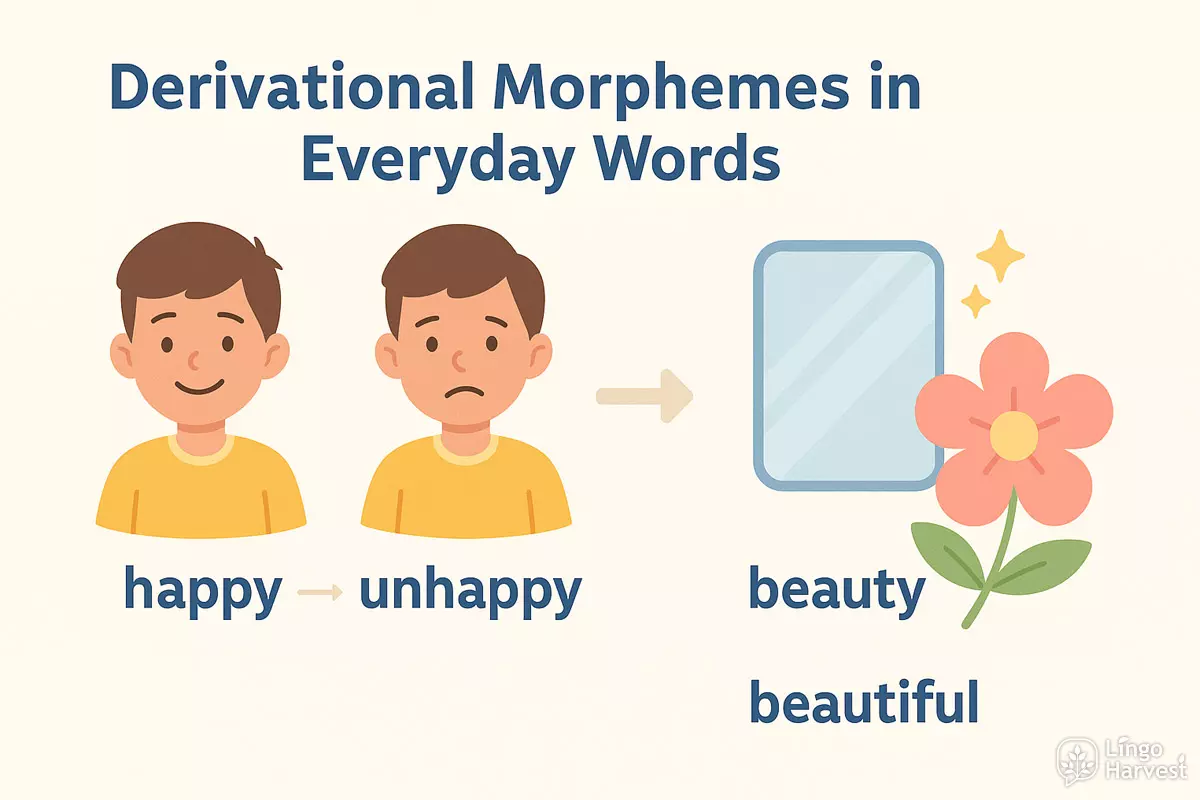
Derivational elements help create new words or shift a word’s grammatical category. Here are some common cases:
- happy → unhappy (un- adds negation)
- read → reader (-er turns a verb into a noun)
- beauty → beautiful (-ful forms an adjective)
- child → childhood (-hood creates an abstract noun)
- nation → national (-al forms an adjective)
- quick → quickly (-ly forms an adverb)
- possible → impossible (im- adds negation)
- friend → friendship (-ship creates a noun)
- organize → organization (-ation forms a noun)
- move → removal (re- and -al create a noun with a different sense)
Inflectional Morphemes in Practice
Inflectional endings don’t change a word’s core meaning or category but adjust it for grammar. English has a limited set:
- cat → cats (-s for plural)
- walk → walked (-ed for past tense)
- run → running (-ing for progressive)
- big → bigger (-er for comparative)
- soft → softest (-est for superlative)
- she → her (pronoun case change)
- play → plays (-s for third person singular)
- mouse → mice (irregular plural)
- child → children (irregular plural)
- go → went (irregular past tense)
Comparing Derivational and Inflectional Morphemes
The following table illustrates the differences using several English words. Notice how the type of morpheme affects form and meaning:
| Base Word | Derivational Example | Inflectional Example | Effect on Word |
|---|---|---|---|
| teach | teacher | teaches | Creates noun vs. marks subject-verb agreement |
| hope | hopeful | hoped | Forms adjective vs. past tense |
| act | action | acted | Makes a noun vs. marks tense |
| happy | unhappy | happier | Negates meaning vs. comparative degree |
By examining these patterns, it becomes easier to recognize the role each type of morpheme plays in word formation and grammatical structure. This awareness supports both language analysis and more effective communication.
Frequent Learner Errors
Learners often confuse derivational and inflectional morphemes, which can affect both word formation and grammar. One recurring issue is misidentifying which morphemes actually change a word’s basic meaning versus those that simply adjust its grammatical role. For example, adding -ed to “walk” (walked) only marks tense, while adding -er to “teach” (teacher) creates a new word. This distinction is subtle but crucial for accuracy.
Common Confusions in Morpheme Use
- Using an inflectional ending where a derivational suffix is required (e.g., “happinessed” instead of “happiness”).
- Overgeneralizing derivational patterns, such as forming “quicklyness” from “quickly.”
- Dropping necessary inflections, leading to ungrammatical forms like “He walk to school yesterday.”
- Misplacing morphemes, especially with irregular forms (e.g., “goed” instead of “went”).
- Confusing plural -s (inflection) with the third-person singular -s in verbs.
- Adding multiple suffixes incorrectly: “unpossible” (should be “impossible”).
- Applying derivational affixes to words that don’t accept them: “childful” instead of “childish” or “childlike.”
- Forgetting that some words require zero derivation (e.g., “advice” vs. “advise”).
- Using comparative or superlative endings on words that take “more” or “most”: “beautifuller” instead of “more beautiful.”
- Incorrectly forming negative adjectives: “unsad” (not standard) instead of “sad” or “happy.”
Derivational vs. Inflectional Forms: Side-by-Side Examples
| Base Word | Derivational Example | Inflectional Example |
|---|---|---|
| act | action, active | acts, acted |
| read | reader, readable | reads, reading |
| happy | unhappy, happiness | happier, happiest |
| child | childish, childhood | children |
| write | writer, rewrite | writes, writing |
Tips for Avoiding Typical Pitfalls
- Check if the affix changes the word’s part of speech or meaning (derivational), or just tense/number (inflectional).
- Review irregular forms separately, as they often break standard patterns.
- Practice with real examples in context to internalize correct usage.
- Be attentive to exceptions—English has many!
Understanding these distinctions can help learners communicate more precisely and avoid common mistakes.
Practice: Identify the Morpheme
Understanding how to spot derivational and inflectional morphemes is crucial for analyzing word structure in English. Let’s work through some practical exercises to help you get comfortable distinguishing between these two types of morphemes. Focus on identifying which part of each word is the morpheme that changes meaning (derivational) or grammatical function (inflectional).
Task 1: Find the Morpheme
Below are words that include either a derivational or inflectional morpheme. For each, identify the added morpheme and classify it as derivational or inflectional.
- happiness
- cats
- unhappy
- writes
- teacher
- faster
- national
- running
- careless
- children
- activation
- played
- quickly
- misread
- books
Show answers
- happiness – -ness (derivational)
- cats – -s (inflectional)
- unhappy – un- (derivational)
- writes – -s (inflectional)
- teacher – -er (derivational)
- faster – -er (inflectional)
- national – -al (derivational)
- running – -ing (inflectional)
- careless – -less (derivational)
- children – -en (inflectional, irregular plural)
- activation – -ation (derivational)
- played – -ed (inflectional)
- quickly – -ly (derivational)
- misread – mis- (derivational)
- books – -s (inflectional)
Task 2: Compare Derivational and Inflectional Morphemes
This table contrasts some common derivational and inflectional morphemes, illustrating their function and typical effect on word form or meaning.
| Type | Common Morphemes | Function | Example |
|---|---|---|---|
| Derivational | un-, re-, -ness, -ful, -less, -able, -ment, -ation, -ize, -ly | Forms new words or changes word class | teach → teacher, quick → quickly |
| Inflectional | -s, -ed, -ing, -er, -est, -en | Shows grammatical features (tense, number, comparison) | play → played, cat → cats |
Task 3: Multiple Choice
Select the correct option for each statement.
- Which morpheme in “friendship” is derivational?
- A. -ship
- B. -s
- C. -ed
- What type of morpheme is -ing in “running”?
- A. Derivational
- B. Inflectional
- In “happier,” the -er is:
- A. Inflectional (comparative)
- B. Derivational (forms agent noun)
Show answers
- 1. A. -ship
- 2. B. Inflectional
- 3. A. Inflectional (comparative)
By regularly analyzing words for their smallest meaningful parts, you’ll become adept at recognizing how morphemes shape both meaning and grammar in English vocabulary.