Negative Noun Formation with Non-, Mis-, Anti-, Dis-

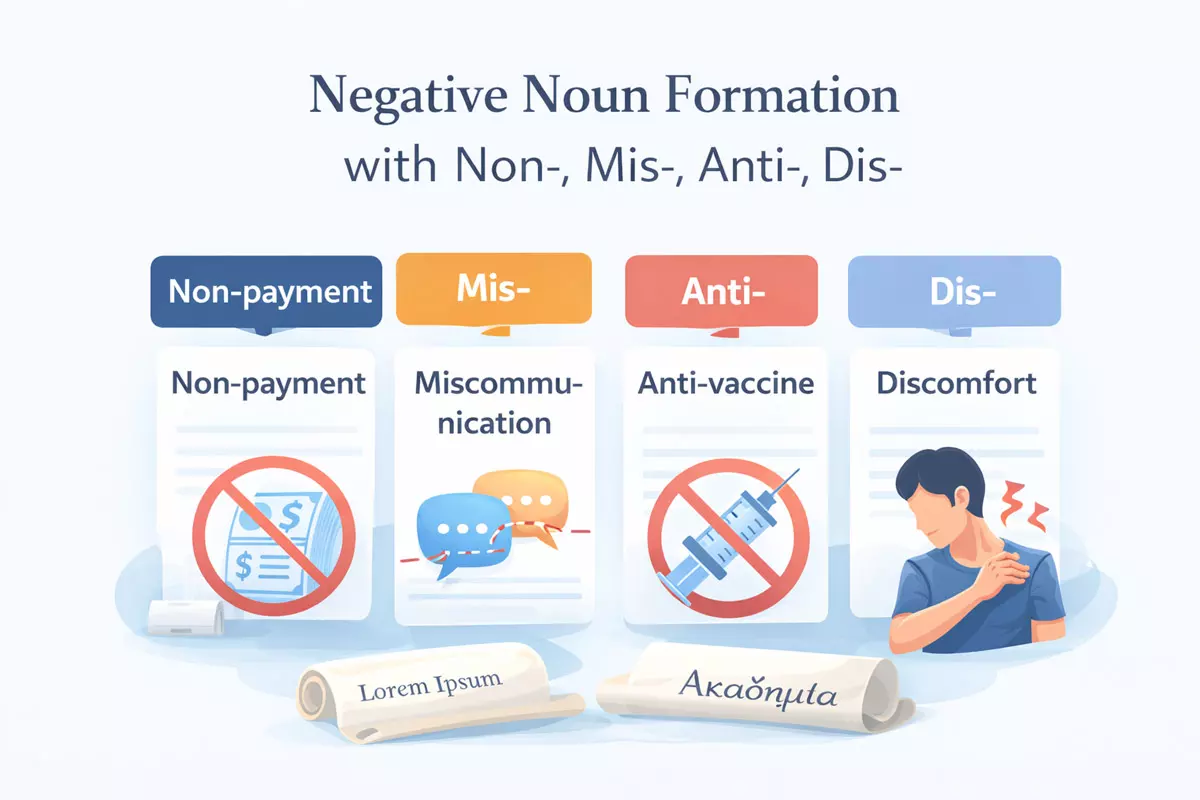 This article explains how English forms negative nouns using prefixes like non-, mis-, anti-, and dis-. It covers their specific meanings, which nouns take them, spelling and pronunciation changes, common mistakes, and includes practice exercises.
- What negative noun formation is in English
- Core negative prefixes used with nouns
- Meaning differences between non-, mis-, anti-, and dis-
- Which nouns commonly take negative prefixes
- Spelling and pronunciation changes with prefixes
- Typical learner errors in negative noun formation
- Practice: form correct negative nouns from base words
English often forms words with opposite or negative meanings by using prefixes such as non-, mis-, anti-, and dis-. These prefixes are attached to existing nouns or adjectives to create new words that convey an absence, opposition, or reversal of the original meaning. For example, adding non- to sense gives nonsense, while mis- in misfortune indicates bad luck. Similarly, anti- can create words like antibiotic, and dis- forms words such as disbelief. These linguistic tools add nuance and precision, enriching the language and allowing for clear expression of complex ideas.
What negative noun formation is in English
English often builds words with a negative or opposite meaning by adding certain prefixes to nouns. This process lets speakers create new terms that express opposition, absence, error, or reversal of the original concept. Common negative-forming prefixes include non-, mis-, anti-, and dis-. These prefixes attach to the front of nouns to generate words that indicate something is lacking, incorrect, or contrary to the base idea.
How negative noun formation works
Negative noun formation typically involves attaching a prefix to an existing noun. The result is a new word with a distinct meaning that often signals the opposite, absence, or adversarial relationship. Here are some examples demonstrating this pattern:
- Non-: nonpayment, nonexistence, nonconformity, nonmember, nonissue
- Mis-: misunderstanding, mismanagement, miscommunication, misbehavior, misfortune
- Anti-: antihero, antibiotic, antisocial, antifreeze, antithesis
- Dis-: disbelief, disorder, disconnect, disadvantage, disapproval
Types of meaning conveyed
The meaning of the new noun depends on the prefix:
- Non- usually shows absence or lack (e.g., nonattendance = lack of attendance).
- Mis- indicates error or wrongness (e.g., misprint = a printing error).
- Anti- signals opposition or counteraction (e.g., antitrust = against monopolistic practices).
- Dis- expresses reversal or negation (e.g., disinterest = lack of interest).
Common negative noun formations: A comparison
| Prefix | Example Noun | Meaning |
|---|---|---|
| non- | nonpayment | the state of not paying |
| mis- | misunderstanding | a failure to understand correctly |
| anti- | antibiotic | a substance that works against bacteria |
| dis- | disagreement | lack of agreement |
| non- | nonconformity | failure to conform |
| mis- | misbehavior | improper or bad behavior |
| anti- | antithesis | the direct opposite |
| dis- | disorder | lack of order |
Key takeaways
Forming negative nouns with prefixes is a productive way to expand vocabulary and clearly convey negative concepts. These word-building tools help English speakers efficiently express nuanced shades of meaning, from simple absence to active opposition.
Core negative prefixes used with nouns
Understanding how negative prefixes modify nouns helps clarify meaning and nuance. In English, several common prefixes—such as non-, mis-, anti-, and dis-—attach to nouns to create new words that express opposition, absence, or reversal. Each prefix brings a distinct shade of meaning, so selecting the right one depends on what you want to convey.
Overview of common negative prefixes
The four main prefixes used to form opposite or negative noun forms are:
- non- (indicating absence or lack)
- mis- (suggesting error or wrongness)
- anti- (showing opposition or hostility)
- dis- (signaling reversal, absence, or separation)
How prefixes change noun meanings
Attaching these prefixes creates nouns with new meanings. For example, non- before "conformity" gives "nonconformity" (lack of conformity), while mis- before "management" forms "mismanagement" (bad management). The change can be subtle or dramatic, so it's important to know each prefix’s typical effect.
Examples of negative noun formation
Here are typical examples of nouns formed with these prefixes:
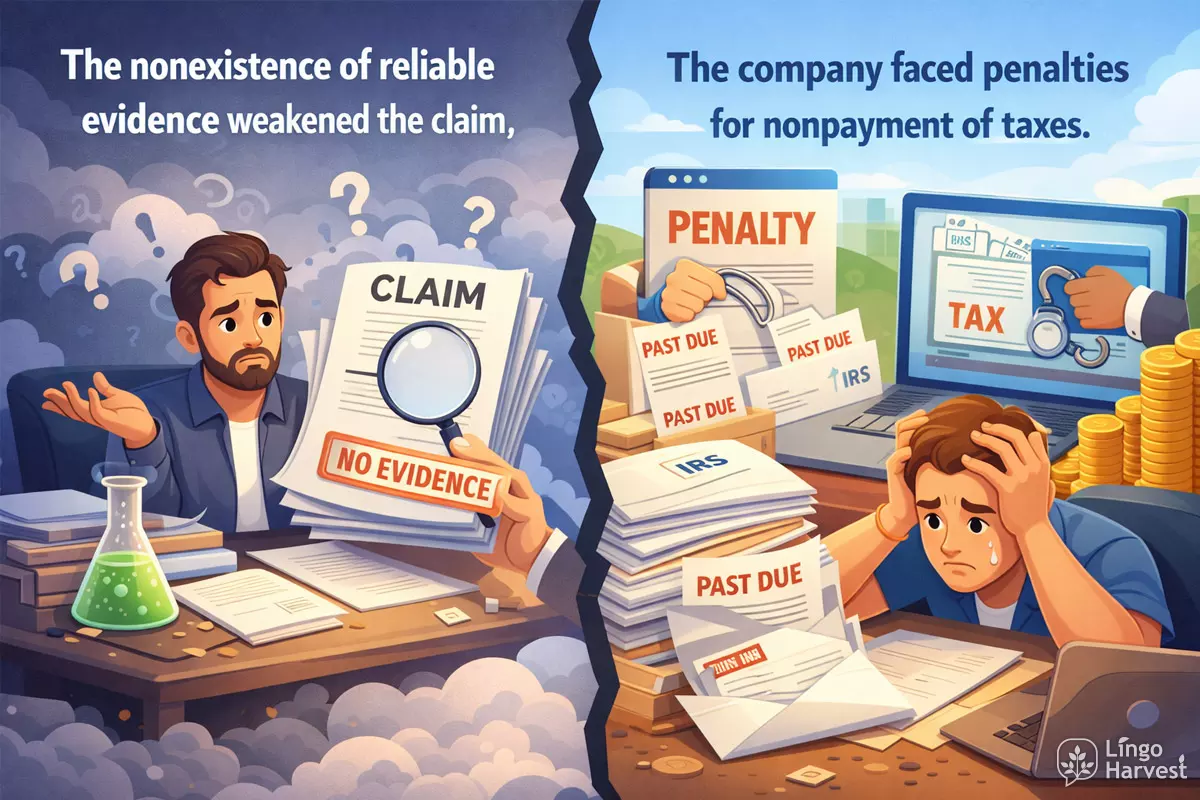
- nonexistence → The nonexistence of reliable evidence weakened the claim.
- nonpayment → The company faced penalties for nonpayment of taxes.
- nonsense → The argument was dismissed as complete nonsense.
- misunderstanding → A misunderstanding caused delays in the project.
- miscommunication → Miscommunication between departments led to errors.
- misfit → He felt like a misfit in the new environment.
- antihero → The novel features an antihero who lacks traditional heroic qualities.
- antivirus → Antivirus software helped protect the system from attacks.
- antagonist → The antagonist challenged the main character throughout the story.
- disorder → The patient was diagnosed with a neurological disorder.
- disagreement → A disagreement arose over the interpretation of results.
- disbelief → The news was met with disbelief among the audience.
- disadvantage → One disadvantage of the method is its high cost.
- disconnection → There was a disconnection between theory and practice.
- noncompliance → Noncompliance with safety rules led to legal consequences.
- misfortune → The accident was a serious misfortune for the community.
- antibiotic → The infection responded well to the new antibiotic.
- disruption → The storm caused major disruption to transportation.
Comparing prefix meanings with nouns
To highlight the differences, here’s a comparison of how each prefix changes the meaning of a base noun:
| Prefix + Noun | Resulting Meaning |
|---|---|
| nonpayment | lack of payment |
| misconduct | improper or wrong conduct |
| antivirus | agent that opposes viruses |
| disorder | absence of order; chaos |
| nonconformity | not conforming to standards |
| misfortune | bad luck; an unlucky event |
| antagonist | opponent or adversary |
| disbelief | lack of belief |
Mastering the use of these prefixes allows for precise expression of negation, opposition, or error in nouns. Not every noun accepts every prefix, so usage depends on convention as well as meaning.
Meaning differences between non-, mis-, anti-, and dis-
Prefixes like non-, mis-, anti-, and dis- all create negative nouns, but their meanings and uses differ in subtle but important ways. Understanding these differences helps choose the right word for the context, especially when describing absence, opposition, error, or reversal.
How each prefix shapes meaning
- Non- typically signals the simple absence or lack of a quality, feature, or group. For example, non-smoker refers to someone who does not smoke, without implying opposition or error.
- Mis- suggests something is done incorrectly or in a mistaken way. For instance, miscommunication means that communication happened, but it went wrong.
- Anti- indicates active opposition or resistance. A term like anti-war refers to someone or something that is against war as a concept or practice.
- Dis- often marks the reversal, absence, or undoing of a state. Disbelief is the state of not believing, while disorder is the loss of order.
Comparing negative noun formation patterns
The table below shows how these prefixes create nuanced differences when forming negative nouns from similar roots or concepts:
| Prefix | Typical Meaning & Example |
|---|---|
| Non- | Absence or neutral lack nonissue (not an issue), nonmember (not a member) |
| Mis- | Error or incorrectness misfit (person who doesn’t fit in), misprint (printing mistake) |
| Anti- | Opposition or resistance antihero (protagonist lacking heroic qualities), antivirus (against viruses) |
| Dis- | Reversal, deprivation, or absence disbelief (lack of belief), disorder (absence of order) |
Examples of negative noun forms
Notice how the nuance shifts with each prefix:
- nonconformist → someone who does not conform
- misalignment → the state of being wrongly aligned
- antagonist → a person who opposes or is hostile
- disapproval → lack or withdrawal of approval
- nonpayment → failure to pay (neutral, not necessarily intentional)
- misadventure → an unlucky or mistaken event
- antibody → a substance working against a body (pathogen)
- disconnection → the act of severing a connection
- nonresident → not residing in a particular place
- misjudgment → a wrong or faulty judgment
- antifreeze → substance preventing freezing
- discomfort → absence of comfort
In summary, the choice of prefix affects not just the meaning, but also the attitude and focus of the word—whether it’s about absence, error, opposition, or reversal. Selecting the right form clarifies intent and avoids ambiguity in communication.
Which nouns commonly take negative prefixes
Many English nouns can gain a negative or opposite meaning by adding prefixes like non-, mis-, anti-, or dis-. These prefixes attach to base nouns to express absence, opposition, or incorrectness. The process isn’t random—certain categories of nouns are more suited to negative prefixation, often depending on their meaning or usage in context.
Types of Nouns That Frequently Take Negative Prefixes
Nouns relating to roles, qualities, actions, and concepts are especially likely to form negative versions. For example, abstract nouns (like “trust” or “belief”) and nouns denoting processes (“management,” “information”) often take these prefixes. The choice of prefix can depend on convention and meaning.
- non-: Absence or lack (e.g., nonexistence, nonpayment)
- mis-: Incorrect or wrong (e.g., misunderstanding, mismanagement)
- anti-: Opposition or counter (e.g., antivirus, antihero)
- dis-: Reversal, absence, or removal (e.g., disagreement, disorder)
Common Examples of Negatively Prefixed Nouns

Here are some of the most frequently encountered nouns formed with negative prefixes:
- Nonconformity → Her nonconformity challenged traditional social expectations.
- Nonpayment → The landlord filed a complaint due to nonpayment of rent.
- Nonprofit → The nonprofit organization supports community education programs.
- Miscommunication → Miscommunication between departments caused major delays.
- Mistrust → Years of conflict created deep mistrust between the groups.
- Misfortune → Losing both files on the same day was pure misfortune.
- Misbehavior → The teacher addressed repeated misbehavior in the classroom.
- Antisocial → Antisocial behavior can result from prolonged isolation.
- Antibody → The antibody successfully targeted the infected cells.
- Antagonist → The antagonist created obstacles for the story’s main character.
- Antipathy → There was clear antipathy between the two rival groups.
- Disagreement → A disagreement emerged over interpretation of the findings.
- Disadvantage → One disadvantage of this method is the high cost.
- Disbelief → The announcement was met with disbelief by the audience.
- Disorder → The patient showed symptoms of an anxiety disorder.
- Disinterest → The students’ disinterest led to low participation rates.
- Disapproval → The proposal received strong disapproval from experts.
Patterns and Considerations
Some nouns are far more likely to appear with particular negative prefixes. For instance, “mis-” is rarely used with concrete objects, while “non-” is commonly attached to a wider array of nouns, including technical and formal terms. “Anti-” often signals opposition, especially in scientific or social contexts. “Dis-” frequently appears with nouns linked to emotions or states.
| Prefix | Typical Noun Examples |
|---|---|
| non- | noncompliance, nonbeliever, nonmember, nonissue, nonresident |
| mis- | misfortune, misunderstanding, misconduct, misprint, misfit |
| anti- | antibody, antithesis, antifreeze, antagonist, antitrust |
| dis- | disorder, disbelief, disadvantage, disservice, discomfort |
Overall, negative noun formation is especially productive with nouns describing qualities, relationships, actions, and abstract concepts, enriching English vocabulary with nuanced opposites and contrasts.
Spelling and pronunciation changes with prefixes
Adding prefixes like non-, mis-, anti-, and dis- to nouns can cause both spelling adjustments and shifts in pronunciation. These changes often depend on the original word’s spelling, the prefix’s ending, and even the stress pattern of the word. For learners, it’s helpful to watch for double consonants, hyphens, and vowel combinations that might affect how the new word is said or written.
Common spelling patterns and rules
- Hyphenation: "Non-" is usually hyphenated when attached to a proper noun (e.g., non-English) or to avoid double vowels (e.g., non-native), but often closed otherwise (nonsense).
- Double consonants: Prefixes ending in a consonant sometimes create double consonants (e.g., misspell, not mispell).
- Vowel collision: When the prefix ends and the base word begins with a vowel, a hyphen is often used for clarity (e.g., anti-inflammatory).
- Silent letters: The addition of a prefix may bring out or obscure silent letters (e.g., dishonest is pronounced with a clear "h").
- Spelling consistency: Some words retain their base spelling while others adapt (e.g., nonentity vs. misalignment).
Pronunciation shifts to note
- Stress shift: Adding a prefix can move the word’s stress (e.g., honest vs. dishonest).
- Vowel reduction: The vowel in the prefix may become a schwa (ə) in rapid speech (e.g., disadvantage).
- Sound assimilation: Adjacent sounds may blend or change (e.g., misstatement often pronounced /mɪsˈteɪtmənt/).
- Prefix pronunciation: "Anti-" can be pronounced /ˈæntaɪ/ or /ˈænti/ depending on region and word (e.g., antivirus).
Examples: How prefixes affect spelling and sound
| Base Noun | With Prefix | Spelling Note | Pronunciation Change |
|---|---|---|---|
| social | antisocial | No hyphen; prefix joined | Stress shifts to "so" |
| trust | mistrust | No change | Prefix is unstressed |
| alignment | misalignment | No hyphen, prefix attached | Prefix vowel reduced |
| entity | non-entity | Hyphen used for clarity | Both parts pronounced clearly |
| belief | disbelief | No hyphen | Stress on "lief" |
| hero | antihero | No hyphen | Prefix often stressed |
| communication | miscommunication | No change | Prefix may be reduced |
| conformist | non-conformist | Hyphen for readability | Both words stressed |
| representation | misrepresentation | No hyphen | Prefix unstressed |
| agreement | disagreement | No change | Main stress unchanged |
Summary tips for learners
- Check for hyphens when adding prefixes, especially with non- and anti-.
- Pay attention to double consonants with mis- (e.g., misspelling).
- Listen for stress and vowel changes in the new word.
- When in doubt, consult a dictionary for both spelling and pronunciation.
Typical learner errors in negative noun formation
Many English learners struggle with choosing the right prefix when forming negative nouns. This often leads to confusion or incorrect word forms, especially because not every negative noun follows the same pattern. Some prefixes are more common with certain roots, while others just don’t “fit” at all, even if they seem logical.
Confusing similar prefixes
One frequent problem is mixing up prefixes like non-, dis-, mis-, and anti-. Learners might assume they’re interchangeable, but in reality, each has a specific use and meaning. For example, non- often means “not” (nonpayment), mis- indicates “wrong” or “badly” (misunderstanding), dis- suggests “opposite of” or “lack of” (disagreement), and anti- usually means “against” (antivirus).
Overapplying negative prefixes
It’s common to see students add a negative prefix to a noun that doesn’t accept it, creating nonstandard or incorrect forms like disfriend or nonpossibility. Not every noun can take a negative prefix, so it’s important to learn which combinations are natural in English.
Spelling and hyphenation mistakes
Another pitfall is spelling errors or confusion about hyphens. While some nouns require a hyphen (anti-virus), others do not (antibody). Hyphenation can also change the meaning or readability of a word.
Incorrect meaning due to prefix choice
Selecting the wrong prefix can lead to a word with a completely different or nonsensical meaning. For instance, misinformation (wrong information) is not the same as disinformation (deliberately false information).
Common incorrect vs. correct forms
Below is a table highlighting some typical mistakes and their correct forms:
| Incorrect Form | Correct Form |
|---|---|
| disunderstanding | misunderstanding |
| nonagreement | disagreement |
| antipayment | nonpayment |
| misbelief (for disbelief) | disbelief |
| disinformation (for misinformation) | misinformation |
| nonfriend | enemy / opponent / rival |
| unpossibility | impossibility |
| antipathy (for antipathy is correct, but learners may use anti-sympathy) | antipathy |
| noncooperation | non-cooperation (hyphen needed) |
| misleader (for misleading person) | misleader (rare), but “deceiver” is more natural |
Summary of typical issues
- Choosing a prefix based on meaning rather than established usage
- Forming nouns that do not exist in standard English
- Ignoring hyphenation rules
- Assuming all negative nouns are formed with the same prefix
- Translating directly from another language, causing unnatural word forms
Paying attention to these areas and checking dictionaries or reliable sources can help learners avoid these common pitfalls with negative noun formation.
Practice: form correct negative nouns from base words
Understanding how to create negative nouns in English is essential for expanding vocabulary and expressing contrasting ideas. By adding prefixes such as non-, mis-, anti-, and dis- to base nouns, you can indicate opposition, the opposite quality, error, or lack of something. Let's work through some practical exercises to reinforce these patterns and help you master the formation of negative nouns.
Task 1: Transform base nouns using the correct negative prefix
Choose the most suitable negative prefix (non-, mis-, anti-, or dis-) and form a negative noun from each base word below:
- Trust
- Behavior
- Agreement
- Belief
- Understanding
- War
- Payment
- Information
- Social
- Approval
- Conception
- Obedience
- Alignment
- Function
- Profit
Show answers
- Distrust
- Misbehavior
- Disagreement
- Disbelief
- Misunderstanding
- Antiwar
- Nonpayment
- Misinformation
- Antisocial
- Disapproval
- Misconception
- Disobedience
- Misalignment
- Dysfunction
- Nonprofit
Common patterns: Negative noun formation
Notice how each prefix shifts the meaning:
- Non- indicates absence or lack (e.g., nonpayment).
- Mis- shows incorrectness or error (e.g., misunderstanding).
- Anti- means opposition or against (e.g., antiwar).
- Dis- expresses the opposite or reverse, often used for abstract nouns (e.g., disbelief).
Comparison of Negative Noun Forms
| Base Noun | Negative Noun | Prefix Used | Meaning |
|---|---|---|---|
| Information | Misinformation | mis- | Incorrect or false information |
| Payment | Nonpayment | non- | Lack of payment |
| War | Antiwar | anti- | Opposition to war |
| Agreement | Disagreement | dis- | Difference of opinion; lack of agreement |
| Conception | Misconception | mis- | Incorrect idea or understanding |
Task 2: Spot the odd one out
In each group, one negative noun uses a different prefix pattern. Identify which word does not belong and explain why.
- Disapproval, Antiwar, Disagreement
- Misinformation, Misbehavior, Nonprofit
- Nonpayment, Nonconformity, Disbelief
- Misalignment, Misconception, Antisocial
- Dislike, Disagree, Antifreeze
- Nonfiction, Nonessential, Misprint
- Antivirus, Antisocial, Discomfort
- Misjudge, Misunderstand, Nonresident
- Disloyal, Disrespect, Anticlimax
- Nonstandard, Nonviolent, Mislead
Show answers
- Antiwar (uses anti-, while others use dis-)
- Nonprofit (uses non-, others use mis-)
- Disbelief (uses dis-, others use non-)
- Antisocial (uses anti-, others use mis-)
- Antifreeze (uses anti-, others use dis-)
- Misprint (uses mis-, others use non-)
- Discomfort (uses dis-, others use anti-)
- Nonresident (uses non-, others use mis-)
- Anticlimax (uses anti-, others use dis-)
- Mislead (uses mis-, others use non-)
Practicing these word formations helps you recognize and build vocabulary with opposite or negative meanings, which is valuable for both comprehension and expression in English.