Simple vs Complex Prepositions

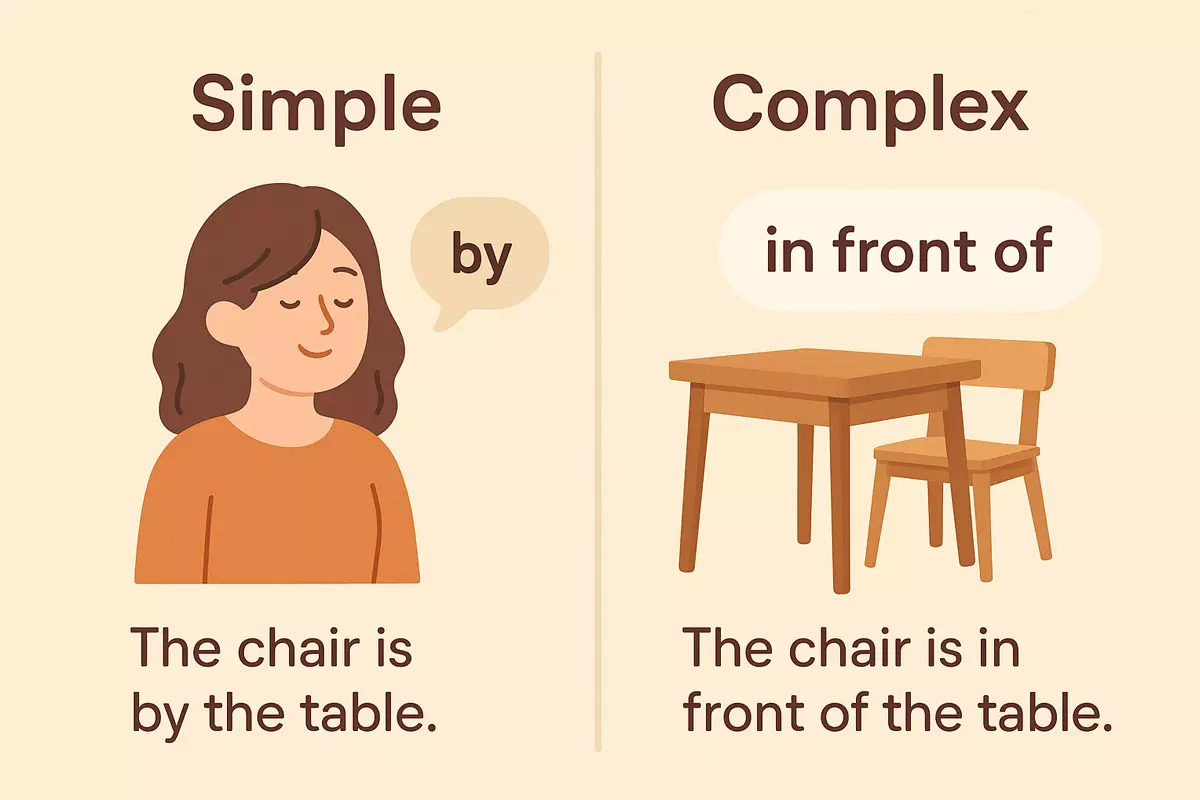 The article explains simple and complex prepositions, showing how they differ in form, meaning, and usage. It provides common examples, placement rules, and a short practice to help you choose the correct preposition in context.
Navigating the various types of prepositions can be challenging, particularly when deciding between simple prepositions, which consist of a single word, and compound or complex prepositions, which are made up of two or more words. Mastering the distinctions between these forms is important for achieving clarity and precision in both written and spoken communication. By recognizing how prepositions function within sentences, writers and speakers can avoid confusion and convey their intended meaning more effectively.
What Simple Prepositions Are
Simple prepositions are the basic building blocks of prepositional phrases in English. They are typically single words that show relationships—such as direction, place, or time—between other words in a sentence. Unlike more complex forms, these prepositions do not combine with other words to form longer phrases. Their main role is to connect nouns or pronouns to other words, clarifying how different elements of a sentence relate to each other.
Common Examples and Their Uses
You’ll find these prepositions in everyday English, usually serving straightforward functions. Here’s a list of frequently used simple prepositions:
- at
- in
- on
- by
- to
- for
- of
- with
- from
- about
- over
- under
- after
- before
- through
- between
- during
- without
Features of Simple Prepositions
Simple prepositions are:
- Short and single-worded—they are never phrases.
- Fixed in form—they don’t change spelling or add endings.
- Versatile—the same word can express different relationships, depending on context.
- Used with nouns or pronouns—they connect these to verbs, adjectives, or other nouns.
How Simple Prepositions Work in Sentences
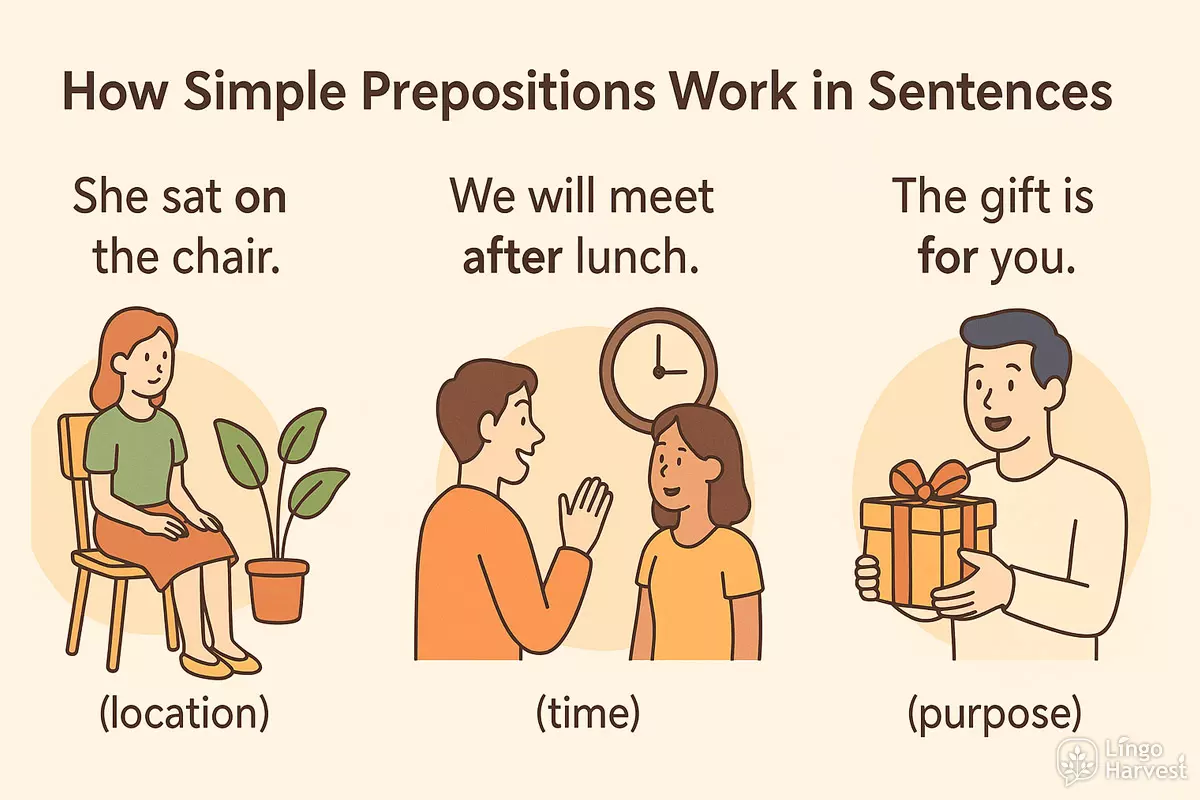
These words answer questions like “where?”, “when?”, and “how?”. For example:
- She sat on the chair. (location)
- We will meet after lunch. (time)
- The gift is for you. (purpose)
Comparison with Complex Prepositions
Simple prepositions are distinct from their more elaborate counterparts. Complex prepositions often involve two or more words (such as “in front of” or “because of”), while simple ones stand alone. Understanding these basic connectors is crucial for clear, effective sentences. They are foundational in English grammar, appearing in almost every conversation and piece of writing.
What Complex Prepositions Are
Complex prepositions are multi-word expressions that function as a single prepositional unit in a sentence. Unlike simple prepositions, which consist of just one word (such as "in," "on," or "at"), these structures usually combine two or more words—often a simple preposition plus another word like a noun, adjective, or adverb. The entire phrase acts together to show relationships of time, place, cause, or manner between different elements in a sentence.
How They Work in Sentences
You’ll encounter complex prepositional phrases most often in formal writing or speech, where they add clarity or nuance. They’re especially common in business, academic, and legal contexts. For example, instead of simply saying "during" or "after," you might see "in the course of" or "in the aftermath of" to describe when something happens.
Common Patterns and Examples
Most of these multi-word prepositions follow a few predictable patterns. Here are some frequent structures:
- Preposition + Noun + Preposition: in front of, on behalf of, in addition to
- Preposition + Adjective + Preposition: in accordance with, in line with
- Preposition + Gerund: by means of, for the sake of
Here’s a longer list of commonly used multi-word prepositions in English:
- according to
- in spite of
- on account of
- by means of
- in front of
- with regard to
- in accordance with
- in reference to
- on top of
- in place of
- as far as
- in case of
- in connection with
- in relation to
- for the sake of
- on behalf of
- in view of
- in comparison with
- in favor of
- in response to
Key Differences from Simple Prepositions
While both types indicate relationships between words, multi-word prepositions tend to be more specific or formal. They can also be more precise, helping to avoid ambiguity. Recognizing these structures helps with understanding more advanced English texts and crafting clearer, more nuanced sentences.
Form Differences
Simple and complex prepositions are easily distinguished by their structure. Simple prepositions are typically single words, often short and familiar, such as “in,” “on,” “at,” or “by.” In contrast, complex prepositions consist of two or more words that function together as a single unit—examples include “according to,” “in front of,” or “because of.” This difference in construction affects both how they are used and their placement within a sentence.
Single-Word vs. Multi-Word Construction
Simple prepositions are formed from a single lexical item. They rarely change form and are generally not altered by context. Complex prepositions, on the other hand, are combinations—often a preposition plus another word (such as a noun, adjective, or another preposition).
- Simple: at, by, from, over, under, with, without, near, past, to
- Complex: because of, in spite of, due to, out of, on account of, in front of, with respect to, by means of, in addition to, except for
Comparison of Structure
The table below illustrates typical forms and how they are constructed:
| Type | Example(s) | Structure |
|---|---|---|
| Simple Preposition | on, in, at, for, to | One word, no spaces |
| Complex Preposition | in front of, in spite of, due to, on top of | Two or more words, fixed phrase |
| Origin | Often Old English or Latin roots | Sometimes formed from a simple preposition + noun or preposition |
| Flexibility | Rarely change form | Must keep words together as a unit |
Summary of Formation Patterns
Simple prepositions are foundational building blocks in English, while complex ones are usually fixed combinations that cannot be separated or changed. When using a compound preposition, it is important to keep all parts together; splitting them can result in ungrammatical sentences. This structural distinction is crucial for both comprehension and correct usage.
Meaning and Usage
Understanding how simple and complex prepositions function helps clarify their roles in English sentences. Simple prepositions are individual words that show relationships—such as in, on, at—and are used to indicate time, place, direction, and more. In contrast, complex prepositions consist of two or more words acting together as a single unit, such as according to, in front of, or because of. Both types are essential, but their structure and usage can differ significantly.
How Simple Prepositions Are Used
Simple prepositions generally come before a noun or pronoun and connect it to another word in the sentence. They are flexible and appear in a wide range of situations. Some common contexts include:
- Indicating time: at midnight, on Monday, in July
- Describing place: under the table, behind the house, near the station
- Showing direction: to the park, into the room, from school
- Expressing means: by train, with a pen
Typical Uses of Complex Prepositions
Complex prepositions are made up of two or more words, often combining a simple preposition with another word (like out of, because of, in spite of). These are used to express more nuanced relationships or to clarify meaning in longer phrases. They always function as a single prepositional unit and are followed by a noun or pronoun.
- Expressing reason: because of the rain, due to traffic
- Showing location: in front of the building, next to the library
- Indicating contrast: in spite of the noise, despite the delay
- Describing manner: by means of technology
Comparison of Simple and Complex Prepositions
| Type | Examples & Typical Usage |
|---|---|
| Simple Prepositions |
|
| Complex Prepositions |
|
Quick Reference: When to Use Each Type
Simple prepositions are ideal for short, direct connections, while complex forms are chosen for more detailed or specific relationships. Using the appropriate type ensures clarity and precision in communication. When in doubt, consider whether a single word suffices or if a phrase better conveys the intended meaning.
Common Examples
Understanding the distinction between simple and complex prepositions is often easier when you see how they're used in real language. Simple prepositions are typically single short words, while complex prepositions are phrases made up of two or more words working together. Many everyday phrases in English rely on both types.
Simple Prepositions in Everyday Use
Simple prepositions usually express basic relationships in space, time, or method. Here are some of the most frequently encountered:
- in
- on
- at
- by
- to
- from
- with
- about
- over
- under
- for
- after
- before
- during
- between
- through
- against
- without
- among
- beside
These words stand alone and are used to show direction, location, time, or other relationships.
Complex Prepositions: Multi-Word Structures
Complex prepositions combine two or more words to convey a specific relationship. They often start with a simple preposition, followed by a noun or adjective, and end with another preposition.
- according to
- because of
- in front of
- in spite of
- on behalf of
- in addition to
- by means of
- due to
- instead of
- out of
- in case of
- with regard to
- apart from
- as well as
- on account of
- with respect to
- in relation to
- for the sake of
- in accordance with
- with reference to
You’ll notice that these are not just two separate prepositions placed together, but set patterns that act as a single unit.
Side-by-Side: Simple vs Complex Prepositions
To illustrate the contrast, here is a comparison showing how similar meanings can be expressed using either a one-word or a multi-word form:
| Simple Preposition | Complex Preposition |
|---|---|
| before | in front of |
| because | because of |
| after | in the wake of |
| about | with regard to |
| for | on behalf of |
By seeing these structures side by side, it becomes clearer how the choice between a single word and a phrase can subtly shift the tone or emphasis of a sentence. Knowing which form to use often depends on context and style, but having a solid grasp of both types is valuable for clear communication.
Placement Rules
Understanding where to position simple and complex prepositions in a sentence is crucial for clarity and correctness. While both types function to show relationships between words, their placement patterns can differ, especially in more advanced structures.
Simple Prepositions
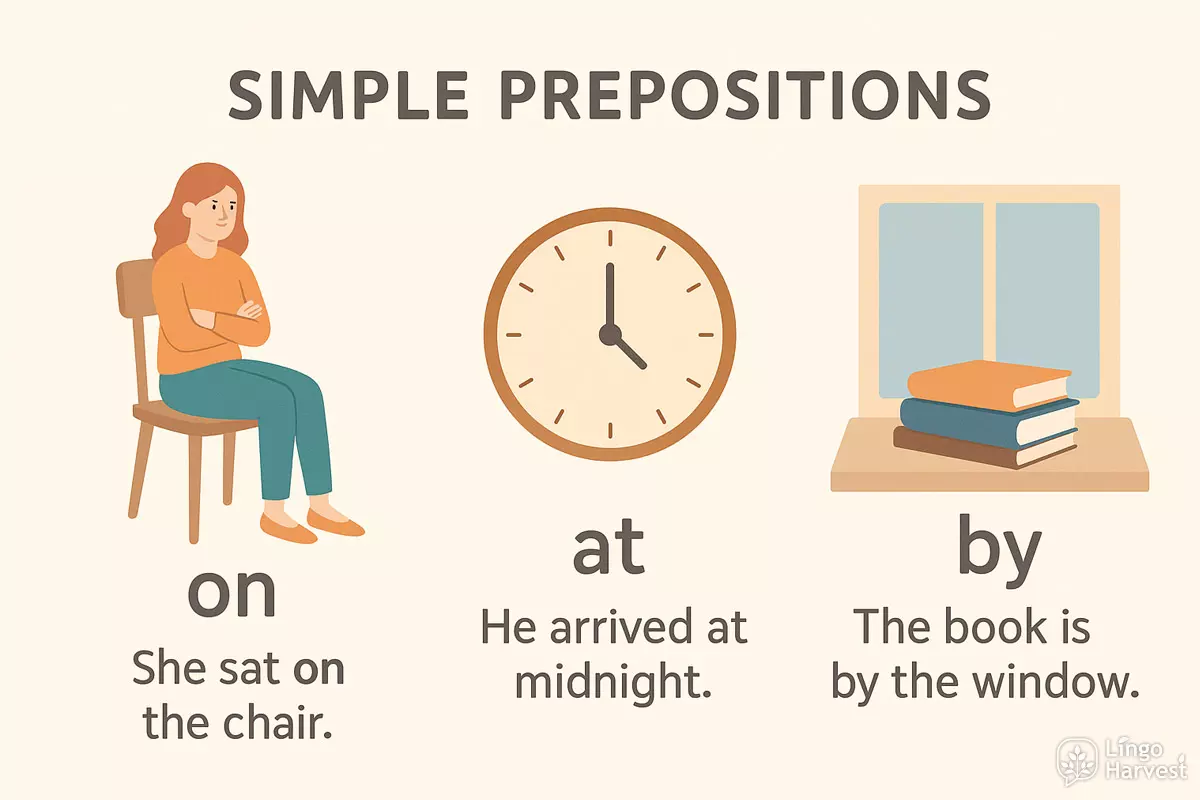
Simple prepositions such as in, on, at, by, and with typically go directly before their object. This object is often a noun, pronoun, or noun phrase. For example:
- She sat on the chair.
- He arrived at midnight.
- The book is by the window.
These words rarely appear at the end of a sentence unless used in questions or relative clauses.
Complex (Compound) Prepositions
Multi-word prepositions like according to, because of, in front of, and in spite of also precede their object, but their structure is more rigid—splitting them is incorrect. For instance:
- The meeting was canceled because of the storm.
- He stood in front of the door.
- She succeeded in spite of difficulties.
You cannot move part of a complex preposition; it acts as a single unit.
Comparison Table: Typical Placement Patterns
| Type | Position in Sentence | Example |
|---|---|---|
| Simple Preposition | Directly before noun/pronoun | The cat is under the table. |
| Complex Preposition | Entire phrase before object | She left because of the noise. |
| Simple (in questions) | Sometimes at end (informal) | Who are you talking to? |
| Complex (in questions) | Rarely at end; usually stays together | Which topic are you referring to? (Not: "Which topic are you referring according?") |
Common Placement Errors ❌
Learners often make mistakes such as:
- Separating parts of a multi-word preposition (e.g., "in front the house of" ❌ instead of "in front of the house" ✅).
- Using a simple preposition when a complex one is needed (e.g., "according the plan" instead of "according to the plan").
- Placing the preposition after the object in formal writing (e.g., "the chair on" instead of "on the chair").
Summary of Key Patterns
- Prepositions (both types) generally come before their object.
- Compound prepositions must stay together as a fixed phrase.
- In informal speech, simple prepositions may appear at the end of questions or relative clauses.
- Complex prepositions almost never end a sentence.
- Never split a complex preposition with its object.
- Always use the full phrase for multi-word prepositions.
By keeping these guidelines in mind, you can avoid common errors and ensure your sentences are clear and grammatically correct.
Quick Practice
Let’s check your understanding of how simple and complex prepositions function in real sentences. Try the exercises below to reinforce the difference between these two types and to see how they are used in context.
Choose the Correct Preposition
For each sentence, select the best option from the parentheses.
- She arrived (at / according to) the airport early.
- The cat is hiding (under / in front of) the sofa.
- We will meet (during / because of) the lunch break.
- He succeeded (because of / with) his hard work.
- The park is (near / in spite of) the school.
Show answers
- at
- under
- during
- because of
- near
Identify: Simple or Complex?
Decide whether each preposition below is simple or complex. Write “S” for simple or “C” for complex.
- before
- in addition to
- between
- instead of
- by
- next to
- for
- in spite of
- after
- because of
Show answers
- before – S
- in addition to – C
- between – S
- instead of – C
- by – S
- next to – C
- for – S
- in spite of – C
- after – S
- because of – C
Common Examples: Simple vs. Complex Prepositions
Here’s a side-by-side comparison of frequently used forms:
| Simple Prepositions | Complex Prepositions |
|---|---|
| at | in front of |
| on | in addition to |
| by | in spite of |
| with | because of |
| in | next to |
| from | out of |
| for | according to |
| to | due to |
| under | instead of |
| after | on top of |
Fill in the Blanks
Complete each sentence with an appropriate preposition. Use either simple or complex forms as needed:
- The dog sat ______ the door, waiting to go outside.
- She finished her homework ______ time.
- ______ the rain, we went for a walk.
- They went to the museum ______ their interest in history.
- He stood ______ me in the line.
Show answers
- in front of
- on
- In spite of
- because of
- next to