Reciprocal Actions: Each Other and One Another Explained

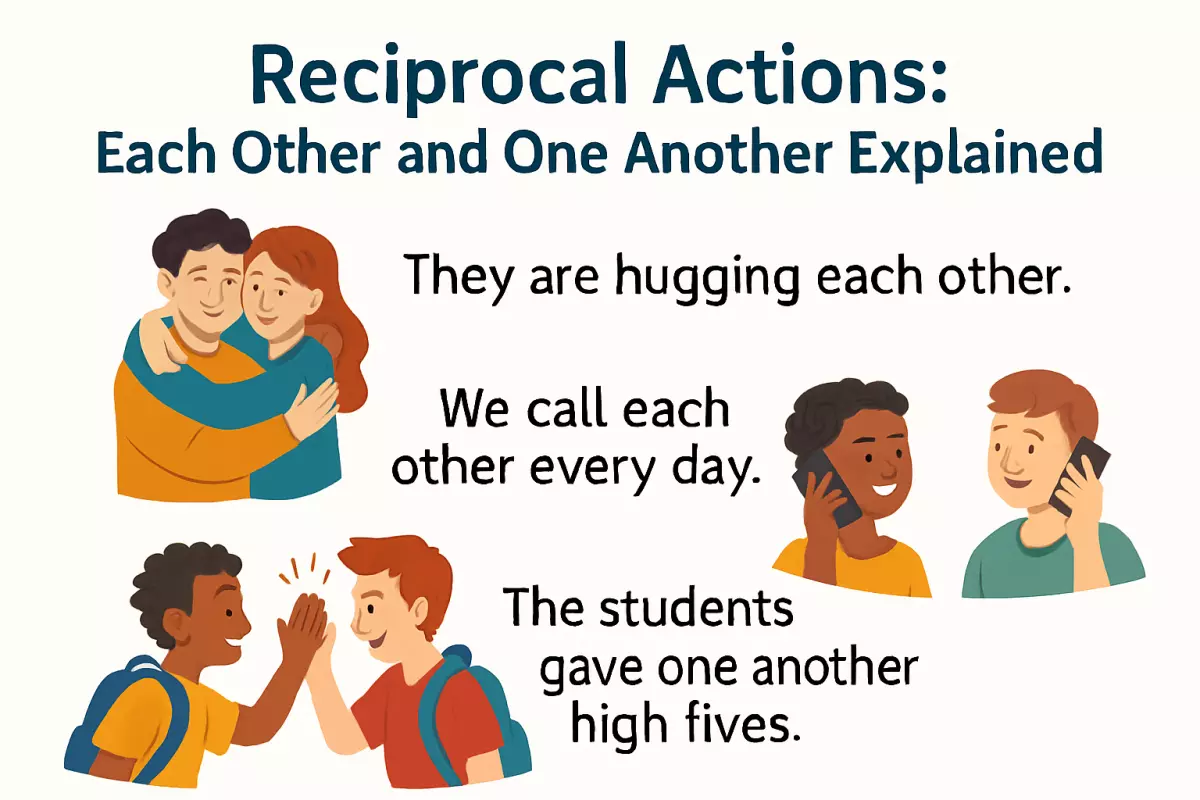 Learn what reciprocal actions are, how to use each other vs one another, which verbs, structures, and prepositions work, and when formal or informal fits. It also flags common learner mistakes, shows context, and ends with homework tasks.
When people do things back and forth, English uses two common phrases to show shared action: each other and one another. This short guide explains how they work in everyday speech and writing, with simple examples that help you choose the right one and keep your meaning clear, natural, and easy to understand in conversation or on the page.
What reciprocal actions mean
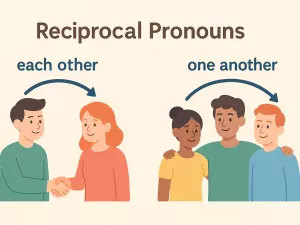
Reciprocal actions describe situations where two or more people (or groups) do the same thing to each other. The focus is on a shared, two-way relationship: both sides act, and both sides receive the action. In grammar, this idea is often expressed with reciprocal pronouns (such as each other and one another) or with verbs that naturally imply mutual activity.
Core idea and typical pattern
A common structure is:
- Subject (plural) + verb + reciprocal phrase → They helped each other.
- The meaning is not “A helped B” only; it is “A helped B and B helped A.”
- Because the action goes both ways, the subject is usually plural (or a coordinated subject like Maria and Jun).
How to recognize a reciprocal meaning
- Mutual involvement: both participants are active, not just one.
- Symmetry: swapping the participants keeps the basic meaning (A to B and B to A).
- Shared result: the outcome depends on both sides (agreement, conflict, cooperation, exchange).
- Context clues: words like together, between them, mutually, or back and forth often reinforce the two-way sense.
Common verbs and phrases that often express two-way actions
- communicate: call, text, email, message, chat
- social connection: meet, talk, hang out, reconnect, introduce themselves
- conflict: argue, fight, disagree, insult, blame
- cooperation: help, support, collaborate, share, trade, exchange
- relationships: trust, respect, understand, forgive, love
- physical interaction: hug, kiss, shake hands, high-five
- competition: compete, challenge, face, race
- comparison: resemble, look like, differ from
Reciprocal vs. one-way actions (quick checks)
- ✅ They apologized to each other. (both apologized)
- ❌ They apologized to the teacher. (not necessarily two-way)
- ✅ Maria and Jun blamed each other. (both blamed)
- ❌ Maria blamed Jun. (one-direction only)
- ✅ The teams exchanged jerseys. (swap implies mutual transfer)
- ❌ The team gave jerseys to the fans. (one-direction giving)
In short, a reciprocal construction packages two linked actions into one idea: the participants are both doers and receivers. This is why reciprocal pronouns are especially useful when the writer wants to highlight shared involvement without repeating the action twice.
Using each other and one another
These reciprocal pronouns show that two or more people (or things) act in a mutual way: the action goes both directions. In most modern English, each other and one another are interchangeable, so the best choice usually depends on clarity, rhythm, and formality.
Core meaning and when to choose which
- Mutual action or relationship: Use a reciprocal pronoun when A affects B and B affects A (help, meet, argue, support, share, text).
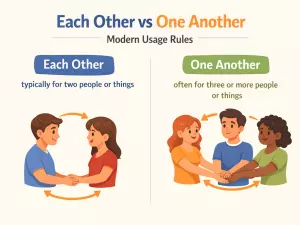
- Two vs. more than two (traditional guideline): Some style guides suggest each other for two and one another for three or more, but everyday usage often ignores this.
- Formality and tone: One another can sound slightly more formal or literary; each other is more common in conversation and general writing.
- Clarity first: If a sentence has multiple groups, pick the option that makes the pairing easiest to understand, or rewrite the sentence to avoid ambiguity.
Common patterns (what typically comes before and after)
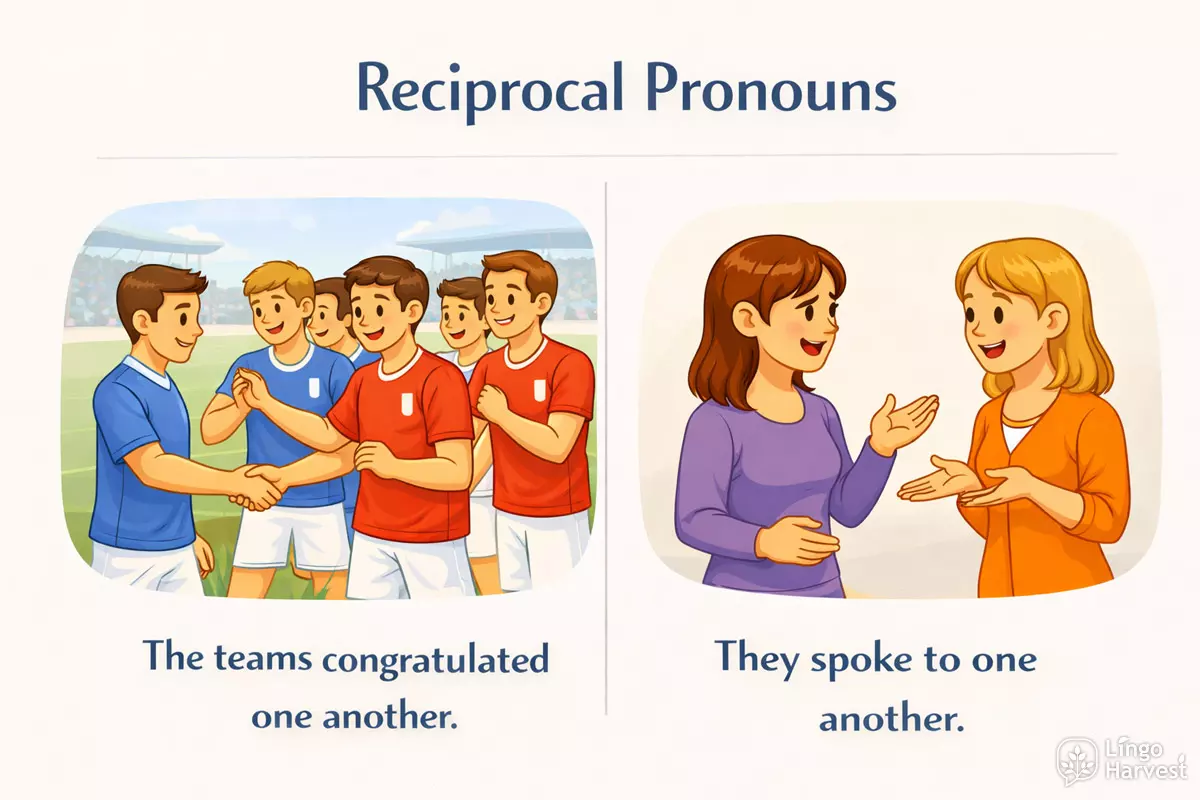
- After a verb: “They respect each other.” / “The teams congratulated one another.”
- After a preposition: “They sat next to each other.” / “They spoke to one another.”
- With modifiers for emphasis: “They helped each other a lot.” / “They barely knew one another.”
- With “from” for separation: “They moved away from each other.”
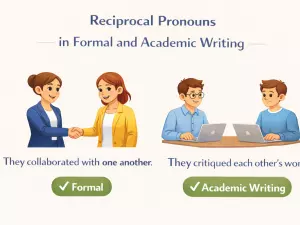
- With “with” for interaction: “They collaborated with one another.”
- With “for” to show support: “They advocated for each other.”
Possessive forms (each other’s / one another’s)
When you need a shared possessive, use the apostrophe-s form. This is standard and widely accepted.
- ✅ “They borrowed each other’s notes.”
- ✅ “The neighbors learned one another’s names.”
- ❌ “They borrowed each others notes.” → Use each other’s.
- ❌ “They learned one anothers names.” → Use one another’s.
Example sentences you can model
- We texted each other after the meeting.
- The two candidates challenged each other on policy details.
- During the hike, we checked on one another regularly.
- The siblings teased each other, but they were affectionate.
- The roommates split chores and reminded one another about bills.
- The players encouraged each other when the score changed.
- After the debate, they thanked one another for staying respectful.
- The dogs sniffed each other cautiously.
- The departments shared data and updated one another on progress.
- They stood behind each other in the photo.
- The friends introduced one another to their families.
- They blamed each other for the delay.
- The partners trusted one another with confidential information.
- They waved at each other across the street.
- The volunteers coordinated with one another to cover every table.
Frequent mistakes and quick fixes
- Using a reciprocal pronoun when the action is one-way: “She helped each other” is incorrect because only one person is helping. → Use “She helped him” or “She helped them.”
- Unclear group reference: “The teachers and students emailed each other” can be ambiguous. → Clarify: “Teachers emailed students, and students emailed teachers.”
- Overuse in the same paragraph: If it repeats, swap in a clearer noun phrase: “the two teams,” “both sides,” “the group members,” or restructure the sentence.
- Wrong possessive spelling: Keep the apostrophe: each other’s, one another’s.
Reciprocal verbs and structures
English often expresses mutual action with a verb plus each other or one another, or with verbs and patterns that already imply “A does something to B and B does the same to A.” The choice depends on whether the verb needs an explicit object and how formal or specific you want the sentence to be.
Common verbs that naturally take “each other / one another”
Many everyday verbs describe actions that can go in both directions, so they frequently appear with a reciprocal object. These verbs usually need an object to show who receives the action.
- meet: They met each other at a conference.
- know: The neighbors have known each other for years.
- help: The teams helped one another during the move.
- support: The siblings support each other through exams.
- trust: After the project, they trusted each other more.
- respect: Good partners respect one another’s boundaries.
- understand: They finally understood each other’s concerns.
- blame: They blamed each other for the mistake.
- forgive: They forgave one another after the argument.
- avoid: They avoided each other at the party.
- ignore: They ignored one another’s messages.
- recognize: They recognized each other immediately.
- admire: They admire each other’s work ethic.
- encourage: They encouraged one another to keep going.
- consult: The doctors consulted each other before deciding.
- introduce: The host introduced them to each other.
Verbs that can be reciprocal without “each other”
Some verbs already suggest a two-way relationship, so the reciprocal pronoun is optional or even unnatural. Adding it can still be possible, but it may sound heavier than needed.
- agree: They agreed on the schedule. (Not usually: “agreed each other” ❌)
- argue: They argued all night. (You can say “argued with each other” if you want to be explicit.)
- fight: They fought yesterday. (Or: “fought each other” when the direct object matters.)
- collaborate: The writers collaborated on the script.
- compete: The two schools competed in the final.
- correspond: They corresponded for decades.
- interact: The groups interacted online.
- negotiate: They negotiated for weeks.
Key structural patterns
Reciprocal meaning is often built with a small set of reliable sentence frames. These patterns help you avoid common errors like using a reflexive pronoun (themselves) when you mean mutual action.
- Verb + each other / one another: The two colleagues called each other after the meeting.
- Verb + with + each other: The managers argued with each other about priorities.
- Be + in touch / in contact + with each other: They stayed in touch with each other after graduation.
- Share + noun + with each other: The roommates shared notes with each other.
- Exchange + noun + (with each other): They exchanged emails after the interview.
- Talk / speak + to/with + each other: The children spoke to each other quietly.
- Look + at + each other: They looked at each other in surprise.
- Smile / wave + at + each other: They waved at each other across the street.
- Be + adjective + with each other: They are honest with each other about money.
- Have + relationship noun: They have a good relationship. (Reciprocity is understood from context.)
Frequent mistakes to avoid
- ✅ They met each other yesterday. → ❌ They met themselves yesterday.
- ✅ They talked to each other. → ❌ They talked each other. (Many verbs need a preposition.)
- ✅ They agreed. → ❌ They agreed each other. (The verb does not take a direct object here.)
- ✅ They introduced them to each other. → ❌ They introduced each other. (You may need both objects: who was introduced and to whom.)
Prepositions with reciprocal expressions
Reciprocal pronouns often follow a preposition to show how two or more people or things relate: position, contact, communication, agreement, conflict, and so on. The preposition usually comes right before each other or one another, and the whole phrase acts like a normal prepositional phrase.
Common patterns and where they appear
- Verb + preposition + reciprocal: “They talked to each other.”
- Adjective + preposition + reciprocal: “They were angry with each other.”
- Noun + preposition + reciprocal: “There is trust between them / trust between each other (less common; see note below).”
- Preposition at the end (informal): “Who are you talking to? They’re talking to each other.” (The preposition still belongs with the reciprocal phrase.)
High-frequency prepositions used with “each other/one another”
- to: “They wrote to each other every week.”
- with: “They agreed with each other on the plan.”
- about: “They argued about each other” (talking about the other person) / “They argued with each other” (arguing against one another).
- for: “They covered for each other at work.”
- from: “They borrowed money from each other.”
- of: “They were proud of each other.”
- at: “They shouted at each other.”
- on: “They relied on each other.”
- in: “They confided in each other.”
- into: “They ran into each other downtown.”
- against: “They competed against each other.”
- between: “There was tension between them / between each other (possible, but often smoother with between them).
- among: “They spread rumors among themselves” (often preferred when the group is larger than two).
- over: “They fought over each other” (fighting about a person) / “They fought with each other” (fighting one another).
- through: “They learned through each other” (less common; used when one person is the channel for learning about something).
Meaning changes: choose the preposition carefully
- talk to (communication) vs. talk about (topic): “They talked to each other” vs. “They talked about each other.”
- laugh with (shared amusement) vs. laugh at (mocking/targeting): “They laughed with each other” vs. “They laughed at each other.”
- agree with (same opinion) vs. agree on (same decision/topic): “They agreed with each other” vs. “They agreed on a date.”
- compete against (opponents) vs. compete with (partners or opponents, depending on context): “They competed against each other” vs. “They competed with each other in the same event.”
- run into (meet by chance) vs. run toward (movement direction): “They ran into each other” vs. “They ran toward each other.”
Placement and form notes
- Keep the reciprocal right after the preposition: ✅ “They sat next to each other.” ❌ “They sat each other next to.”
- Use object forms after prepositions: “They were disappointed in each other,” not “disappointed each other.”
- Consider “each other” vs. “themselves”: “They blamed each other” (one blamed the other) vs. “They blamed themselves” (self-blame).
- “Between” often sounds natural with “them”: “a secret between them” is very common; “between each other” is grammatical but can feel heavier in style.
- For larger groups, “one another” or “among themselves” may read more smoothly: “The team argued among themselves” (group internal disagreement).
Formal vs informal usage
Register affects which reciprocal phrase sounds natural. In careful writing, the choice often follows convention and rhythm; in everyday speech, speakers usually pick the shorter, more familiar option without thinking about a strict rule.
| Context | Typical choice and pattern | Example |
|---|---|---|
| Casual conversation | each other is the default; quick and idiomatic | We help each other when things get busy. |
| Everyday writing (emails, messages) | either works; pick the one that reads smoothly with the sentence | Let’s keep each other updated / Let’s keep one another updated. |
| Formal or academic prose | one another is slightly more common; can sound more measured | The participants influenced one another over repeated trials. |
| Legal/policy/contract language | often prefers one another for a more formal tone; keep wording consistent | The parties agree to indemnify one another under the terms below. |
| Instructions and guidelines | either phrase; clarity matters more than formality | Check each other’s work before submitting. |
What stays the same across registers
- Meaning: both expressions signal a two-way relationship (A affects B and B affects A).
- Grammar: both behave like object pronouns and fit after verbs and prepositions: “support each other,” “talked to one another.”
- Possessive forms: use each other’s / one another’s before a noun: “each other’s notes,” “one another’s perspectives.”
- Consistency: in formal documents, avoid switching back and forth unless there is a clear reason (such as avoiding repetition in a long paragraph).
Common patterns by tone (ready-to-use models)
- Casual: “We text each other after work.”
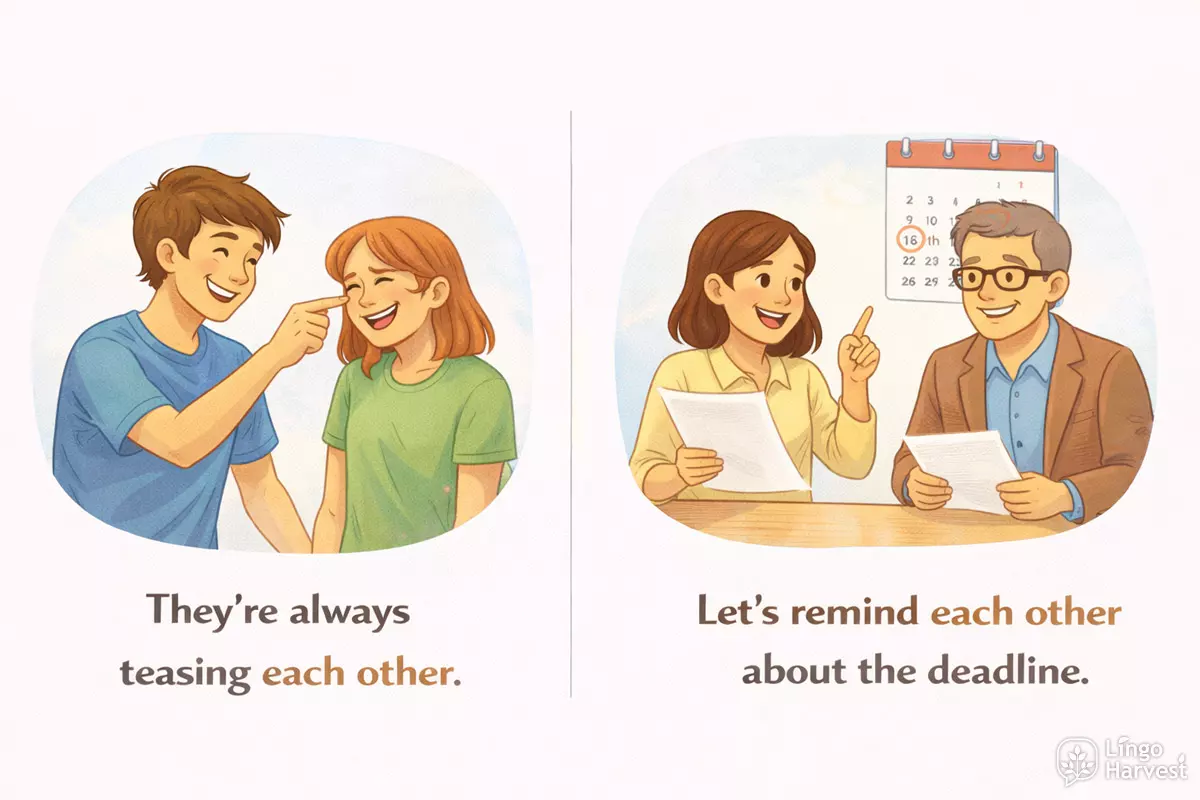
- Casual: “They’re always teasing each other.”
- Neutral: “Let’s remind each other about the deadline.”
- Neutral: “The teams shared feedback with one another.”
- Formal: “The committees consulted one another before drafting the final report.”
- Formal: “The departments coordinate with one another to reduce delays.”
- Policy tone: “Employees must treat one another with respect.”
- Academic: “The variables interact with one another in complex ways.”
- Business: “We’ll keep each other informed as the plan changes.”
- Business: “The partners hold one another accountable for outcomes.”
- With prepositions: “They sat next to each other.”
- With prepositions: “They spoke with one another privately.”
- Possessive: “Please review each other’s slides.”
- Possessive: “They challenged one another’s assumptions.”
Register pitfalls to avoid
- ❌ Over-formalizing casual speech: “We were helping one another move” can sound stiff in a relaxed chat; “helping each other move” is usually more natural.
- ❌ Under-formalizing legal/policy writing: in a contract, “each other” is not wrong, but mixing styles can make the document feel uneven.
- ✅ Best practice: choose the phrase that matches the surrounding diction, then keep it steady throughout the paragraph or section.
Common learner mistakes
Learners often understand the idea of reciprocity but misapply the grammar, pronouns, or context. The issues below show the most frequent patterns and how to correct them.
- Using a singular verb with a plural subject
❌ Each other is important to them.
✅ They are important to each other. - Forgetting the preposition when the verb requires one
Some verbs need to, with, or for before the reciprocal phrase.
❌ They talked each other for hours.
✅ They talked to each other for hours.
❌ They agreed each other.
✅ They agreed with each other. - Placing the phrase in an unnatural position
Put it where it clearly shows who is doing the action to whom.
❌ They each other understand well.
✅ They understand each other well. - Mixing up reciprocal meaning with reflexive meaning
Each other/one another = A does something to B and B does it to A. Reflexives (himself/herself/themselves) are different.
❌ They blamed each other for the accident. (when each person blamed themselves)
✅ They blamed themselves for the accident.
❌ They introduced themselves. (when they introduced one person to the other)
✅ They introduced each other. - Using a reciprocal phrase when the action is not truly mutual
Some actions usually go one way in real life.
❌ The teacher and the student taught each other. (unless both taught)
✅ The teacher taught the student. / They learned from each other. - Using it with more than two people but writing a sentence that sounds like only two
With groups, add wording that makes the “many-to-many” meaning clear.
✅ The teams supported each other throughout the tournament.
✅ Everyone in the class helped one another during the project. - Overcorrecting the “each other vs. one another” rule
Many learners believe one must be for two people and the other for three or more. In modern usage, both are usually acceptable; choose consistency and clarity.
✅ The two sisters call each other every day.
✅ The two sisters call one another every day. - Adding an apostrophe incorrectly
The possessive forms exist, but apostrophes are often misplaced.
❌ each others’ opinions (when referring to two people)
✅ each other’s opinions
❌ one anothers’ work
✅ one another’s work - Using a reciprocal phrase as the subject of the sentence
It usually sounds awkward or unclear. Prefer a clear subject (they, the students, the two friends).
❌ Each other are responsible for the outcome.
✅ They are responsible to each other for the outcome. - Repeating the reciprocal idea unnecessarily
Avoid stacking phrases that say the same thing.
❌ They helped each other mutually.
✅ They helped each other. - Choosing verbs that don’t fit the construction
Some verbs sound more natural with a different structure.
❌ They resembled each other to each other.
✅ They resembled each other.
❌ They married each other. (possible but often clunky)
✅ They got married. / They married. - Using “between” and “among” in a confusing way
The reciprocal phrase already signals a relationship; keep the rest of the sentence simple.
❌ Trust between each other is important.
✅ Trust between them is important. / They trust each other. - Making the reference unclear (who is included?)
Make sure the reader knows exactly which people are involved.
❌ When Anna met Maria and Sofia, they hugged each other. (who hugged whom?)
✅ Anna hugged Maria and Sofia. / Maria and Sofia hugged each other. - Using it with “each” in the wrong pattern
Don’t confuse each other with each as a separate word.
❌ They each hugged other.
✅ They hugged each other.
✅ They each hugged the other. (two people; emphasizes one-by-one)
Reciprocal meaning in context
Use each other and one another when the action, feeling, or relationship goes in two directions: A affects B, and B affects A. The surrounding verb and the situation usually make the “back-and-forth” meaning clear, especially with plural subjects.
Common patterns that signal a two-way action
- Plural subject + reciprocal phrase: “The teammates encouraged each other.”
- Subject + verb + preposition + reciprocal phrase: “They talked to one another.”
- Reciprocal phrase as object of a verb: “The two friends trust each other.”
- Reciprocal phrase after “with” for interactions: “The managers met with one another.”
- Reciprocal phrase after “between” for relationships: “There is tension between them / between each other (less common); prefer “between them.”
- Reciprocal phrase as complement after “be”: “They are always competing with each other.”
- With “both” to stress mutuality: “They both respect one another.”
- With “all” to include everyone in a group: “The students all helped each other.”
- With “from” for separation or distance: “They drifted away from one another.”
- With “over” for conflict topics: “They argued over the plan and blamed each other.”
Meaning shifts: reciprocal vs. one-direction actions
- ✅ “They hugged each other.” (both people hug)
- ❌ “They hugged them.” (could be one group hugging a different group)
- ✅ “The rivals criticized one another.” (criticism goes both ways)
- ❌ “The rivals criticized him.” (one-direction criticism toward someone else)
- ✅ “The partners depend on each other.” (mutual dependence)
- ❌ “The partners depend on the assistant.” (dependence is not shared)
High-frequency verbs that pair naturally with reciprocals
- help, support, encourage, reassure
- trust, respect, understand, forgive
- love, hate, admire, envy
- meet, greet, call, text, email
- talk, speak, listen, respond
- argue, fight, blame, accuse
- compete, compare, challenge, copy
- share, trade, exchange, lend
- agree, disagree, compromise, cooperate
- avoid, ignore, block, exclude
Placement and form: what sounds natural
- After the main verb is the default: “They understand each other.”
- After a preposition when the verb requires it: “They listened to one another.”
- Possessive forms are common for shared relationships: “They borrowed each other’s notes.” / “They visited one another’s families.”
- Pronoun agreement stays plural: “The players congratulated one another after their win.”
- Avoid reflexive confusion: ❌ “They introduced themselves to each other” can be unclear; prefer ✅ “They introduced themselves” (to the group) or ✅ “They introduced each other” (a third person makes introductions).
When context matters most
- Groups larger than two: Both phrases can still work; the sentence usually implies “everyone to everyone,” but you can clarify with “all”: “The committee members all emailed each other.”
- Chain actions: Sometimes the action is shared but not necessarily symmetrical: “They followed one another on social media.” (often mutual, but not guaranteed unless stated)
- Negative reciprocals: “They avoided each other” means mutual avoidance, not one person avoiding the other.
- Repeated interactions: Adverbs make the pattern clearer: “They regularly check on one another.”
Homework: reciprocal action practice tasks
Use these exercises to build control over reciprocal expressions (actions done mutually), especially the choice between each other and one another, plus common verb patterns like talk to, agree with, and share. Focus on meaning first: are two or more people doing the same action back and forth?
Task 1: Choose the best reciprocal phrase
Complete each sentence with each other or one another. Use the option that sounds most natural in modern English.
- After the match, the two players congratulated ________.
- The three departments email ________ when a deadline changes.
- My parents still surprise ________ with small gifts.
- During the workshop, participants introduced themselves to ________.
- The twins often finish ________’s sentences.
- The committee members blamed ________ for the confusion.
- All five roommates agreed to help ________ with chores.
- The two dogs sniffed ________ cautiously.
- In the group chat, we remind ________ about meetings.
- The four finalists wished ________ luck.
- The couple promised to support ________ through the move.
- The classmates compared notes with ________ after the test.
Show answers
- each other
- one another
- each other
- one another
- each other
- one another
- one another
- each other
- one another
- one another
- each other
- each other
Task 2: Fix the pattern (prepositions and verb choice)
Rewrite each sentence so it uses a correct reciprocal pattern. Keep the meaning the same.
- They listened each other carefully.
- We agreed each other about the schedule.
- The two teams competed each other for the trophy.
- My friends apologized each other after the argument.
- The neighbors smiled themselves when they met.
- The students discussed to each other the problem.
- The sisters shared each other their secrets.
- They looked each other’s photos and laughed.
- The managers blamed to each other for the delay.
- The children waved each other as the bus left.
Show answers
- They listened to each other carefully.
- We agreed with each other about the schedule. → (Also possible: We agreed on the schedule.)
- The two teams competed against each other for the trophy.
- My friends apologized to each other after the argument.
- The neighbors smiled at each other when they met.
- The students discussed the problem with each other.
- The sisters shared their secrets with each other.
- They looked at each other’s photos and laughed.
- The managers blamed each other for the delay.
- The children waved at each other as the bus left.
Task 3: Decide if a reciprocal expression is needed
Some sentences need each other/one another; others should not use a reciprocal phrase because the action is not mutual. For each item, rewrite it correctly.
- The teacher and the student understood each other’s instructions.
- The two hikers followed each other’s map to the lake.
- The friends hugged each other when they met at the airport.
- The audience members watched each other during the movie.
- The two companies trusted each other with sensitive data.
- The doctor and the patient called each other yesterday.
- The teammates encouraged each other after the loss.
- The tourists photographed each other’s paintings in the museum.
Show answers
- The teacher and the student understood each other’s instructions. → (Acceptable as written: understanding can be mutual.)
- The two hikers followed the map to the lake. → (Not reciprocal: they are both following one map, not one another’s map.)
- The friends hugged each other when they met at the airport. → (Correct.)
- The audience members watched the movie during the movie. → (Not reciprocal in the intended meaning.)
- The two companies trusted each other with sensitive data. → (Correct.)
- The doctor and the patient spoke yesterday. → (Or: They called each other yesterday, if the meaning is mutual calling.)
- The teammates encouraged each other after the loss. → (Correct.)
- The tourists photographed the paintings in the museum. → (Not reciprocal: the paintings are not “owned” by the tourists.)
Task 4: Production practice (write your own)
Write one sentence for each prompt. Use a reciprocal phrase only when the action goes both ways.
- Two people: an apology (use to if needed).
- Three or more people: exchanging contact details.
- Two teams: competition (choose the correct preposition).
- A couple: support during a difficult week.
- Four coworkers: giving feedback (make it sound professional).
- Two friends: misunderstanding and then resolving it.
- A group of neighbors: sharing tools.
- Two strangers: making eye contact and reacting politely.