Prepositions of Time: Theoretical Overview

 The article explains how to use 'in', 'on', and 'at' with time, covers other time phrases, points out common mistakes, and provides example sentences. It also includes a brief practice section to help you check your understanding.
Examining the ways language conveys moments, durations, and sequences uncovers intriguing patterns in how we express time. This article investigates the core principles that guide our descriptions of when events happen, shedding light on the reasoning embedded in these linguistic structures. By understanding these mechanisms, we gain a deeper appreciation for the complexity and logic that underpin our everyday communication about time and events.
When to Use 'in'
The preposition in is commonly used to indicate nonspecific times during a period, such as months, years, centuries, seasons, and longer periods. It often answers the question "when?" by referring to a general timeframe rather than a specific moment. This usage helps clarify whether an event occurs within a larger span of time, rather than pinpointing an exact date or hour.
Typical Contexts for 'in' with Time
- Months: in January, in September
- Years: in 1999, in 2023
- Decades/Centuries: in the 1980s, in the 21st century
- Seasons: in winter, in summer
- Parts of the Day: in the morning, in the afternoon, in the evening
- Future Periods: in a few minutes, in several weeks, in two years
- Longer Periods: in the past, in the future
- General Timeframes: in ancient times, in recent years
- Developmental Stages: in childhood, in adulthood
- Processes or Durations: in a short time, in record time
How 'in' Differs from Other Prepositions of Time
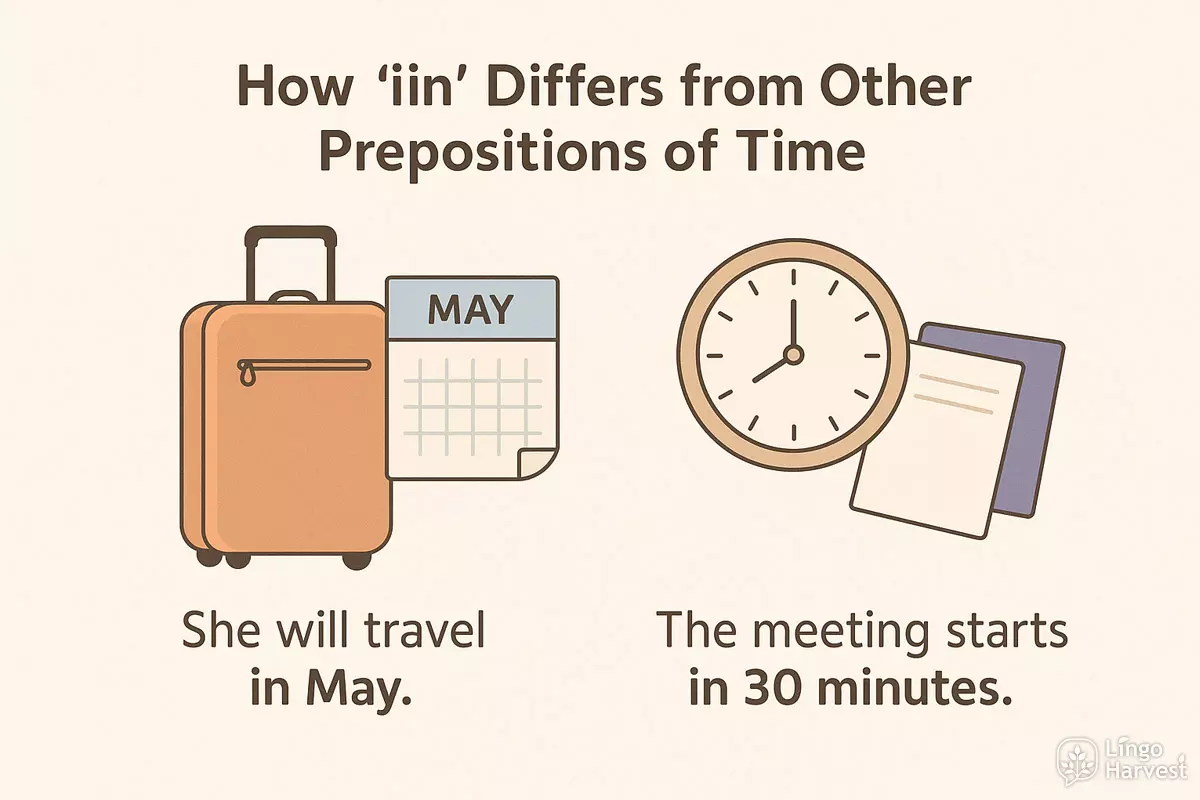
Unlike on or at, which refer to specific dates or times, in provides a broader, less precise reference. For example, saying "in July" means anytime during the month, not a particular day. Similarly, "in the morning" covers the whole period from dawn until noon, not a specific hour.
| Time Expression | Example Usage |
|---|---|
| Month | She will travel in May. |
| Year | They graduated in 2010. |
| Season | It snows a lot in winter. |
| Part of Day | We exercise in the morning. |
| Duration from Now | The meeting starts in 30 minutes. |
| Decade | Music changed in the 1990s. |
| General Period | Much has changed in recent years. |
Key Points to Remember
- Use in for periods longer than a day (months, years, etc.).
- It is appropriate when the exact time is not specified.
- Avoid using in for specific dates or precise times; use on or at instead.
Understanding these patterns helps express time frames more naturally and accurately in English.
When to Use 'on'
The preposition on is typically associated with specific days and dates in English. It helps indicate a particular point in the calendar, such as a certain day of the week or a named holiday. This usage distinguishes it from other time prepositions that refer to broader periods or more general time frames.
Common Contexts for 'on'
You’ll frequently see on paired with:
- Days of the week: on Monday, on Fridays
- Specific calendar dates: on June 1st, on 25 December
- Special days and holidays: on New Year's Day, on my birthday
- Parts of particular days: on Monday morning, on Friday night
- Named events: on the last day of school, on graduation day
- Days with adjectives: on a cold Monday, on the first Sunday of May
- Days in plural expressions: on weekends (in American English)
- Days plus relative terms: on the day before yesterday
- Days with ordinal numbers: on the 2nd of July
- Days of the month: on the 15th
Comparison with Other Prepositions
To clarify how on functions compared to other time-related prepositions, consider the following structured examples:
| Preposition | Typical Use | Example |
|---|---|---|
| on | Specific day or date | on Tuesday, on 5th May |
| in | Months, years, periods | in July, in 2020 |
| at | Precise time or moment | at 5 o’clock, at midnight |
| by | Deadline or end point | by Monday, by noon |
Special Patterns and Notes
- Omit 'on' in informal speech: "See you Monday." (instead of "on Monday")
- Use on for recurring events: "on Sundays," "on every birthday"
- Certain idioms or set phrases may drop the preposition: "next Friday" (not "on next Friday")
- Some regional differences exist: British English often omits on before days more than American English
Choosing on is most appropriate when you want to refer to a distinct day or date, making it clear that an event is tied to a particular spot on the calendar. Remember, for broader periods or exact times, other prepositions are preferred.
When to Use 'at'
Use at to refer to specific points in time rather than longer periods or general spans. This preposition is chosen when you want to indicate an exact hour, a precise moment, or a particular event in time. It is not used for days, months, or years, but instead highlights an exact temporal location.
Typical Contexts for 'at'
- Clock times: at 7:00, at midnight, at lunchtime
- Specific points of the day: at sunrise, at dusk
- Precise events or occasions: at the weekend (British English), at Christmas, at New Year
- Moments in a process: at the beginning, at the end
- Intervals with 'the': at the moment, at present
Common Expressions Using 'at'
- at noon
- at midnight
- at night
- at the same time
- at once
- at the age of (ten, twenty, etc.)
- at Easter
- at the weekend (UK)
- at 5 o’clock
- at the moment
- at the beginning/end
- at a quarter past three
- at dawn
- at this time
- at the time of (the accident, the meeting, etc.)
- at an early stage
Contrasting 'at' with Other Prepositions of Time
It's helpful to see how at differs from in and on when expressing time. The table below illustrates typical usage patterns for each:
| Preposition | Typical Use |
|---|---|
| at | Specific times and points (e.g., at 4pm, at night, at Christmas) |
| on | Days and dates (e.g., on Monday, on July 4th, on my birthday) |
| in | Longer periods (e.g., in June, in 2022, in the morning, in winter) |
Choosing the correct preposition helps clarify exactly when something happens, reducing ambiguity in communication. Remember, at is your go-to for pinpointing a specific moment or event in time.
Other Time Phrases
Beyond the most common prepositions such as at, on, and in, English features numerous expressions to specify moments, durations, or relations in time. These constructions help add nuance, clarify temporal relationships, and enrich communication. Some of these phrases are fixed, while others can be adapted to different contexts.
Common Expressions Indicating Time
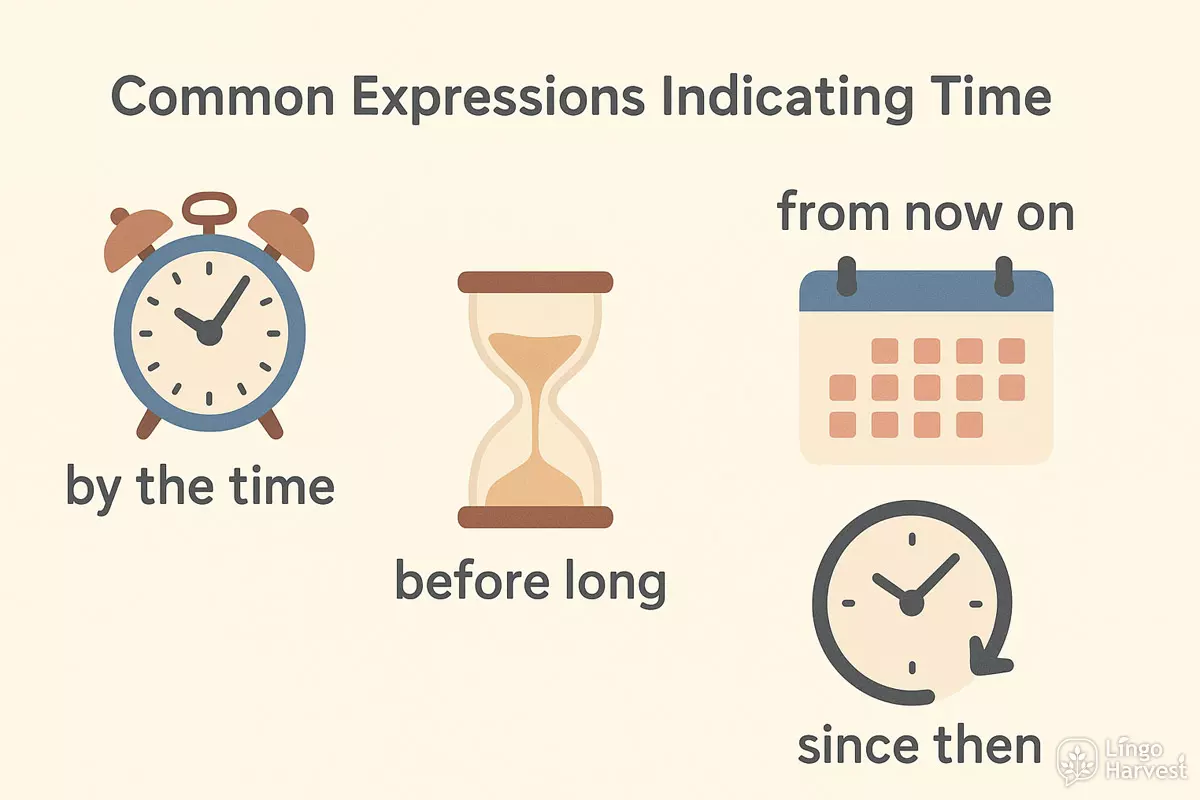
- by the time
- before long
- from now on
- since then
- in the meantime
- as soon as
- the following day
- afterwards
- in advance
- at the last minute
- all of a sudden
- from time to time
- at first
- eventually
- in the past
- at present
- in a while
- over the years
- once in a blue moon
- right away
Comparing Temporal Relationships
Some time-related phrases show subtle differences in meaning and usage. The table below contrasts several commonly confused expressions:
| Phrase | Typical Usage |
|---|---|
| by | Deadline or latest point (e.g., Finish by Friday.) |
| until | Continuing up to a point (e.g., Wait until noon.) |
| during | Within a period (e.g., during the meeting) |
| since | From a point in the past to now (e.g., since 2010) |
| for | Duration (e.g., for two hours) |
Flexible Patterns for Expressing Time
In addition to fixed expressions, English speakers often combine prepositions with time nouns or adverbials to create custom phrases. Examples include:
- at the beginning of the week
- towards the end of the month
- in the early morning
- later that evening
- throughout the summer
Mastering these varied time expressions helps convey precise timing, sequence, and duration, enabling clearer and more natural communication in both spoken and written English.
Common Mistakes
Misusing prepositions that indicate time is a frequent challenge for learners. These errors often arise from translating directly from other languages or misunderstanding the specific contexts in which each preposition is used. Below are some of the most typical pitfalls and confusion points regarding temporal prepositions in English.
Confusing "in", "on", and "at"
Learners often mix up these prepositions because their meanings can overlap, but they are used for different time references. For example, "in" is for months, years, and longer periods, "on" for days and dates, and "at" for precise times.
| Incorrect Usage | Correct Usage | Explanation |
|---|---|---|
| I was born at 1990. | I was born in 1990. | Use "in" with years. |
| We will meet in Monday. | We will meet on Monday. | Use "on" for days of the week. |
| The movie starts in 7:00 pm. | The movie starts at 7:00 pm. | Use "at" for clock times. |
| My birthday is on July. | My birthday is in July. | Use "in" for months. |
| He left at the morning. | He left in the morning. | Use "in" for parts of the day (except "at night"). |
| I will see you in night. | I will see you at night. | Exception: "at night" is correct. |
Using Prepositions with "Last", "Next", "This", "Every"
It’s unnecessary to add a preposition before words like "last," "next," "this," or "every." For example, saying "on last Friday" is incorrect.
- ❌ on last year → ✅ last year
- ❌ in next week → ✅ next week
- ❌ at this morning → ✅ this morning
- ❌ on every Sunday → ✅ every Sunday
Forgetting to Use "Since" and "For" Correctly
"Since" refers to a starting point, while "for" refers to a duration. Confusing these leads to awkward sentences.
- ❌ I have lived here for 2010. → ✅ I have lived here since 2010.
- ❌ She has worked here since five years. → ✅ She has worked here for five years.
Redundant Prepositions
Adding unnecessary prepositions is another trap. Native speakers avoid phrases like "during of the summer" or "until to midnight."
- ❌ during of the meeting → ✅ during the meeting
- ❌ until to midnight → ✅ until midnight
- ❌ before of lunch → ✅ before lunch
Summary of Frequent Errors
In summary, attention to these patterns can help avoid the most widespread difficulties:
- Using "in" with specific times instead of "at"
- Placing a preposition before "last/next/this/every"
- Mixing up "since" and "for"
- Redundant prepositions after time expressions
- Using "on" with months and "in" with days
- Forgetting the exception "at night" (not "in the night")
- Choosing the wrong preposition with "morning," "afternoon," or "evening"
- Direct translation from another language without checking English usage
- Using "at" with holidays instead of "on" (e.g., "on Christmas Day" vs. "at Christmas")
- Incorrectly omitting the preposition where required ("I met her Monday" instead of "on Monday")
Careful observation and practice with these structures can greatly reduce errors and improve overall clarity when talking about time.
Example Sentences
Understanding how prepositions relate to time is easier when you see them in action. These sample sentences illustrate common usage patterns, showing how words like "in," "on," and "at" help specify moments, durations, and time frames. Notice the subtle differences in meaning and structure.
Using "at", "on", and "in" for Time
- We will meet at 6 o’clock.
- She always gets up at sunrise.
- The party is on Saturday.
- My birthday is on April 5th.
- They moved here in 2010.
- Flowers bloom in spring.
- I’ll see you in an hour.
Other Prepositions for Time Relationships
- We finished the assignment before lunch.
- The store opens after 10 a.m.
- You can call me during the afternoon.
- The museum is closed until Monday.
- The lights went out for ten minutes.
- She stayed since last week.
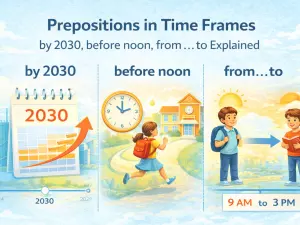
- He works from 9 to 5 every day.
Comparing Prepositions of Time
| Preposition | Example & Context |
|---|---|
| at | at 7 p.m. → a precise time |
| on | on Friday → a specific day or date |
| in | in 2022 / in the morning → longer periods |
| during | during the meeting → within an event or span |
| until | until midnight → up to a point in time |
Pay attention to the way these prepositions position events in time. "At" pinpoints an exact moment, "on" refers to particular days or dates, and "in" covers months, years, or longer stretches. Other words like "before," "after," and "during" clarify relationships between events and periods. Practicing these patterns helps build a more natural sense of temporal relationships in English.
Mini Practice
Understanding how to use words like "at," "on," and "in" for expressing time can be challenging. To reinforce your grasp of these time connectors, try the following exercises and see how well you can apply the concepts.
Choose the Correct Preposition
Fill in each blank with at, on, or in:
- We will meet ___ Monday morning.
- My birthday is ___ July.
- The show starts ___ 8 PM.
- She was born ___ 2001.
- I always feel tired ___ the afternoon.
- Our flight departs ___ Friday.
- He left the office ___ noon.
- The store is closed ___ Sundays.
- I like to travel ___ the summer.
- The meeting is scheduled ___ 15th September.
Show answers
- on
- in
- at
- in
- in
- on
- at
- on
- in
- on
Common Time Prepositions: Quick Reference Table
Compare how different time expressions typically use particular prepositions:
| Preposition | Typical Usage Examples |
|---|---|
| at | at 5 o’clock, at night, at noon, at the weekend |
| on | on Tuesday, on July 4th, on my birthday, on weekends |
| in | in April, in 2020, in the morning, in winter |
| by | by 6 PM, by next week, by the end of the month |
| during | during the meeting, during summer, during the night |
| since | since 2015, since last Friday, since morning |
Identify the Error
Each sentence below contains one mistake with a time preposition. Find and correct it:
- She always wakes up in 6 AM.
- The class is on the evening.
- We will travel at July.
- He has lived here since five years.
Show answers
- She always wakes up at 6 AM.
- The class is in the evening.
- We will travel in July.
- He has lived here for five years.
Practicing these patterns will help you use time-related connectors more naturally. Review your answers, and revisit any that were tricky to reinforce your understanding.