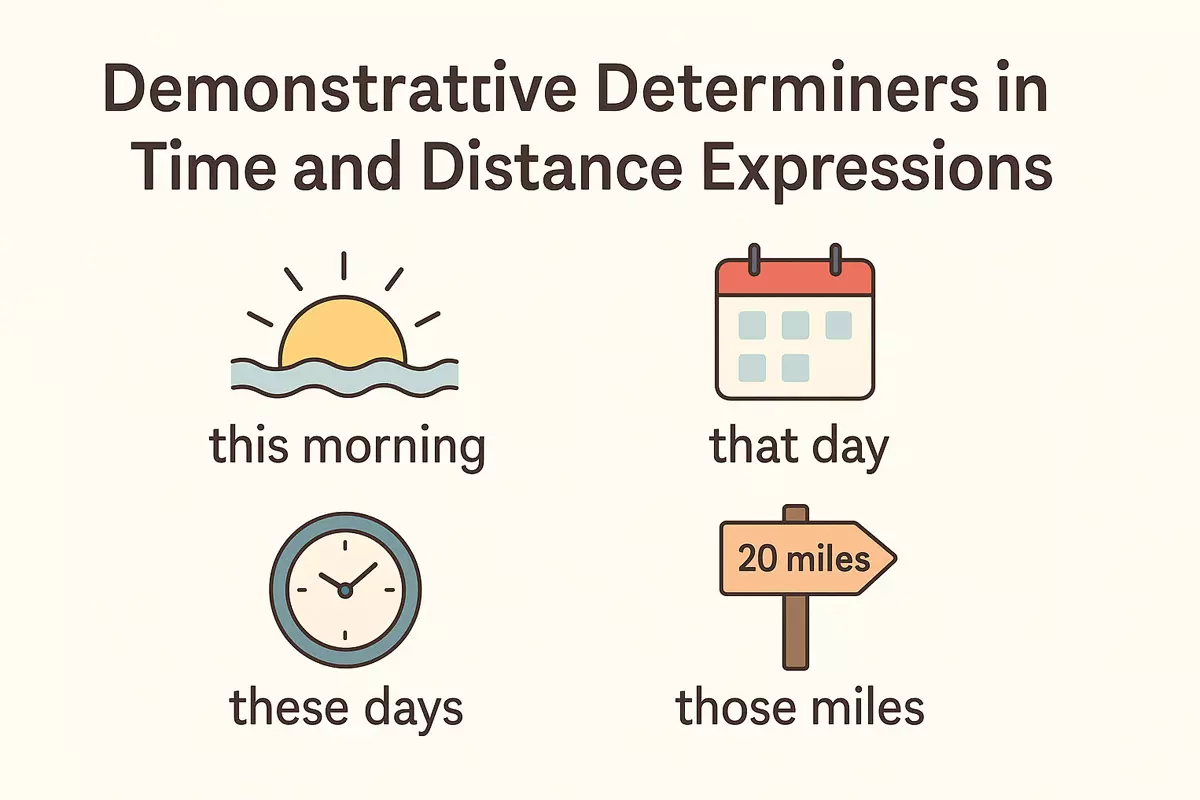
Demonstrative Determiners in Time and Distance Expressions

 The article explains how demonstrative determiners connect to time and distance, shows how to use this, these, that, and those in context, highlights common phrases, compares spoken and written usage, and includes practice exercises for choosing the correct form.
- How demonstrative determiners link to time and distance
- Using this and these for close time and space
- Using that and those for more distant time and space
- Common expressions: this morning, that day, these days, those times
- How context changes the meaning of demonstratives
- Spoken vs written use of time and distance demonstratives
- Practice: choose the correct demonstrative in short dialogues
Pointing words such as this, that, these, and those serve more than just the purpose of identifying objects; they also help us refer to specific times and locations, making our communication clearer and more precise. By using these terms thoughtfully, we can guide listeners or readers to understand exactly what we are referring to and highlight important details in our conversations. Recognizing how these words function allows us to express meaning and emphasis more effectively in everyday language.
How demonstrative determiners link to time and distance
Demonstrative determiners, such as this, that, these, and those, often do more than simply indicate which noun is being discussed. They also help speakers and writers convey a sense of spatial or temporal proximity. When used with time expressions, these words can signal whether an event is near or distant in the past or future. Similarly, with distance expressions, they can show how physically close or far something is relative to the speaker’s perspective.
Connecting demonstratives to temporal meaning
In time-related phrases, demonstrative determiners provide cues about immediacy or remoteness. For example, this morning refers to the current day's morning, while that morning usually points to a morning further back in the past or one that has already been referenced. These choices help listeners or readers orient themselves in time.
- this week → the week we are in now
- that year → a specific year in the past or future, not the current one
- these days → the present period, often recent times
- those days → a period in the past
- this evening → the upcoming or current evening
- that evening → a different or previously mentioned evening
- this moment → right now
- that moment → a specific time in the past or future
- these months → recent or ongoing months
- those months → months further back in time
Spatial relationships and demonstrative determiners
With physical distance, demonstrative determiners indicate how close or far an object or location is from the speaker. The choice between this and that (or these and those) is largely determined by the perceived spatial relationship.
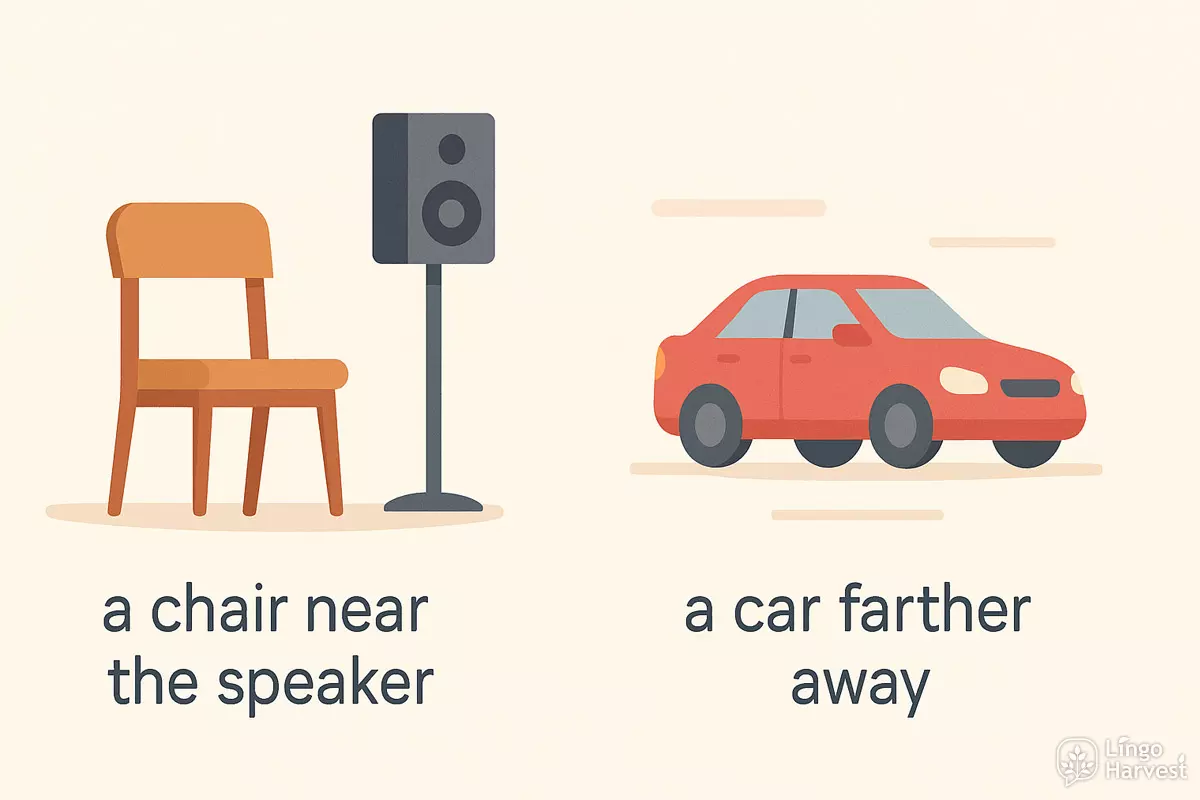
- this chair → a chair near the speaker
- that car → a car farther away
- these books → books within arm’s reach
- those houses → houses across the street or further away
- this side → the side the speaker is on
- that side → the opposite side
- these people → people nearby, possibly in the same group
- those people → people at a distance or not involved
- this place → the current location
- that place → a different or previously mentioned location
Comparison of temporal and spatial usage
| Demonstrative | Temporal Example | Spatial Example | Proximity |
|---|---|---|---|
| this / these | this week, these months | this chair, these books | Near (present or close) |
| that / those | that morning, those days | that car, those houses | Far (past/future or distant) |
By choosing the appropriate demonstrative determiner, speakers clarify whether they are referring to something close in time or space, or something more distant. This subtle distinction helps listeners understand context and reference points, making communication more precise and vivid.
Using this and these for close time and space
Demonstrative determiners like this and these help us point out things that are near—whether in physical space or in time. Their main function is to clarify which objects, people, or periods we mean, especially when something is close to the speaker. In English, this is used for singular nouns, while these is for plurals.
Referring to Nearby Objects and People
When interacting with objects or people that are physically near, these words make your meaning more precise. For example, if you are holding a book, you might say, "I like this book," but if you are discussing several books on the table in front of you, "I like these books" is appropriate.
- This chair is comfortable. (the chair you are sitting on)
- This pen doesn’t work. (the pen in your hand)
- This child is my nephew. (the child next to you)
- These apples are fresh. (apples in a bowl in front of you)
- These keys are mine. (keys you are holding or on your desk)
- These people are my friends. (group standing with you)
Talking About Present or Very Recent Time
In addition to physical proximity, this and these are common when discussing events or periods happening now or very recently. They help anchor the listener in the immediate time frame.
- This morning was busy. (today’s morning)
- This week is hectic. (the current week)
- This year has been challenging. (the ongoing year)
- This moment is important. (right now)
- These days, I wake up early. (current period of days)
- These months are crucial for business. (current stretch of months)
- These times are difficult. (the present era)
Comparing with "That" and "Those"
Understanding how this/these differ from that/those is essential for clarity. The table below summarizes how demonstratives correspond to singular/plural and near/far meanings:
| Demonstrative | Use Case | Number | Example |
|---|---|---|---|
| This | Near in space/time | Singular | This idea is interesting. |
| These | Near in space/time | Plural | These shoes fit well. |
| That | Far in space/time | Singular | That mountain is tall. |
| Those | Far in space/time | Plural | Those days were fun. |
By choosing this or these, speakers make it clear they are referencing something close at hand or happening right now. This distinction is especially important for effective, unambiguous communication in both spoken and written English.
Using that and those for more distant time and space
When we refer to objects, events, or periods that are farther away in space or time, English typically employs "that" for singular nouns and "those" for plurals. These demonstrative determiners help clarify what or when we are talking about, especially in contrast with "this" and "these," which signal nearness.
In spatial contexts, "that" and "those" point to things not immediately present or farther from the speaker, as in:
- Could you hand me that book on the shelf over there?
- I remember those days we spent at the old house.
- Don’t touch that paint; it’s still wet.
- She prefers those shoes at the back of the store.
For time, these determiners often indicate moments or eras that are removed from the present, whether in the past or future. Some common uses include:
- That winter was unusually harsh.
- I’ll never forget those years in college.
- Back in those days, we had no smartphones.
- We’ll cross that bridge when we come to it.
- That was a night to remember.
Contrasting "that/those" with "this/these"
The choice between these sets of words signals how close or distant something feels to the speaker. "This" and "these" relate to closeness, while "that" and "those" mark separation, either physically or emotionally. For example:
- "I love this song" (currently playing or emotionally close)
- "I loved that song" (played earlier or less immediate)
Common patterns with "that" and "those"
Speakers often use these determiners in set phrases or idiomatic expressions to evoke distance:
- At that point → At that point, we realized something was wrong.
- On that occasion → On that occasion, she decided to speak openly.
- For those reasons → For those reasons, the plan was rejected.
- During those times → During those times, life was much harder.
- In that case → In that case, we should inform the manager.
- Over those mountains → Over those mountains lies a small hidden village.
- After that event → After that event, everything changed.
- Beyond those walls → Beyond those walls, the city was full of life.
- Of that era → The art of that era is still admired today.
- With those people → With those people, I always feel comfortable.
- Since that day → Since that day, he has never looked back.
- Among those options → Among those options, this one is the safest.
- From that moment on → From that moment on, she trusted no one.
- Across those fields → Across those fields, the river slowly flows.
- About that time → About that time, the lights suddenly went out.
Summary Table: Demonstratives and Distance
| Demonstrative | Usage Example (Distance/Time) |
|---|---|
| This | This moment is special. (near in time/space) |
| These | These apples are fresh. (near and plural) |
| That | That year was unforgettable. (distant in time/space) |
| Those | Those mountains are beautiful. (distant and plural) |
Choosing between "that/those" and "this/these" not only indicates physical or temporal distance, but also signals whether a speaker feels detached or emotionally removed from what they're describing. This nuance is central to clear and precise communication in English.
Common expressions: this morning, that day, these days, those times
Demonstrative determiners like "this," "that," "these," and "those" are frequently used in English to talk about time periods and moments in relation to the speaker's perspective. These words help to clarify whether the speaker is referring to something close in time or distance, or something further away, either physically or temporally.
Using demonstratives for time
When describing time, demonstratives signal proximity or distance from the present moment. For example, "this morning" means the morning of the current day, while "that day" refers to a specific day in the past or future, often already mentioned or understood in context. "These days" typically refers to the present period, contrasting with "those times," which points to a different era or set of circumstances.
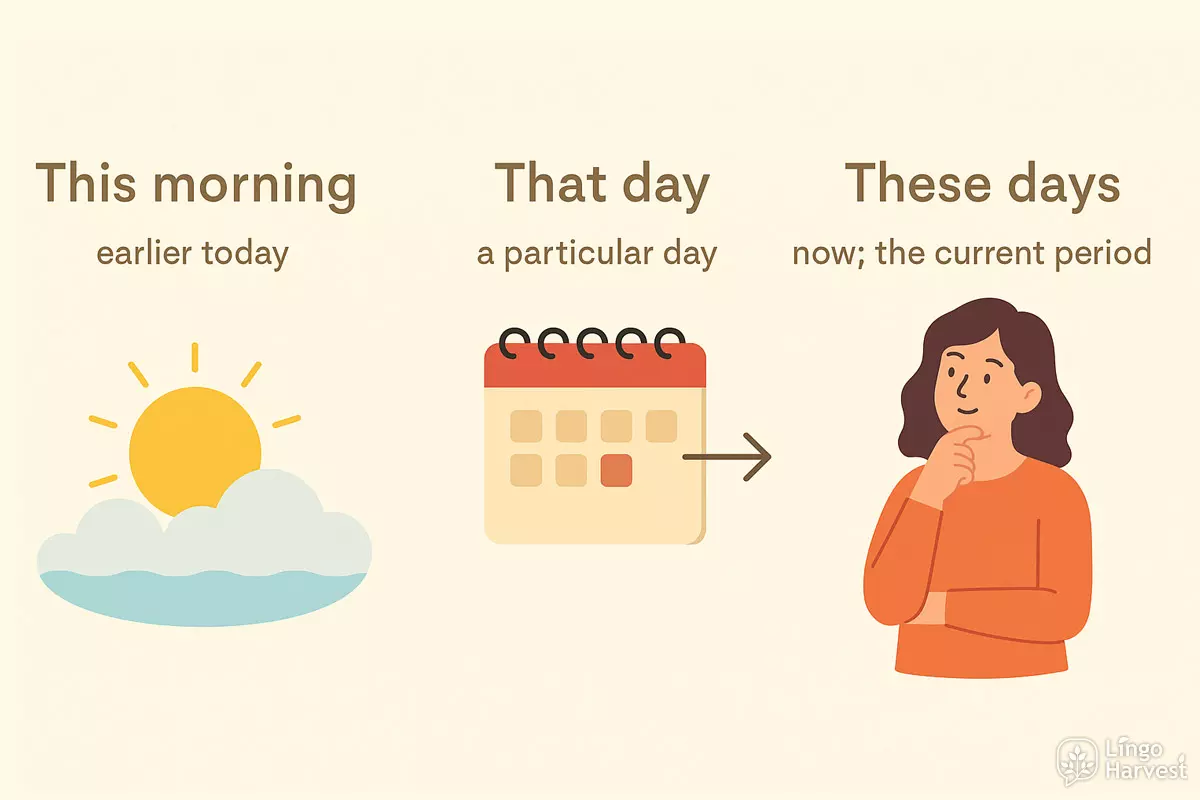
- This morning – earlier today
- That day – a particular day (often in the past)
- These days – now; the current period
- Those times – a period in the past
- This week – the current week
- That month – a specific month (not the current one)
- These years – recent or current years
- Those evenings – evenings from another time, usually past
- This afternoon – later today
- That night – a particular night, usually in the past
- These moments – right now, the present time
- Those days – a period in the past, often with nostalgia
- This era – the current era or age
- That occasion – a specific event or time
- These weekends – weekends happening now or recently
- Those winters – winters in the past
Comparing demonstratives in time expressions
The choice between "this/these" and "that/those" depends on whether the time frame feels immediate or remote. The table below illustrates how demonstratives modify meaning in time-related phrases:
| Expression | Meaning / Reference |
|---|---|
| This morning | The morning of today (current day) |
| That day | A specific day in the past or future (not today) |
| These days | The current period, recent times |
| Those times | Moments or periods in the past (often nostalgic) |
Tips for learners
- Use "this" or "these" to talk about time periods close to now or to yourself.
- Use "that" or "those" for periods further away in time, or when remembering past events.
- Context often clarifies which demonstrative fits best; pay attention to whether you are talking about the present or referencing something removed from now.
- Understanding these patterns helps speakers express time relationships clearly, whether recalling a memory or describing the present.
How context changes the meaning of demonstratives
Demonstrative determiners like “this,” “that,” “these,” and “those” take on different meanings depending on when and where they’re used. Factors such as the physical setting, the relationship between speakers, and even the flow of conversation all play a role in shaping their interpretation. Understanding these shifts is especially important when demonstratives express temporal or spatial relations.
Shifts in Space and Time
The same word can refer to different distances or times, depending on the context. For instance, “this morning” and “that morning” both point to a specific time, but the choice between them depends on whether the speaker feels the event is close (recent or relevant) or removed (more distant or less relevant).
- “this week” – often means the current week, including today
- “that week” – usually refers to a week already discussed or further in the past
- “these days” – implies the present period, often compared with the past
- “those days” – references a previous era or time, often nostalgic
- “this place” – the location where the speaker is or feels connected to
- “that place” – a different location, possibly less familiar or more remote
- “this moment” – right now, the immediate present
- “that moment” – a specific point in the past or a future time already mentioned
- “these years” – the recent or current period in a longer timeframe
- “those years” – a period already discussed or historically distant
Influence of Speaker Perspective
Personal perspective and shared knowledge often determine which demonstrative is chosen. For example, in storytelling, “that night” may refer to a pivotal event already introduced, while “this night” could be used to build immediacy or suspense.
Role of Shared Experience
When speakers share a common background or recent experience, “this” can signal mutual relevance, while “that” may create distance. In contrast, a listener unfamiliar with the reference might interpret the same word differently.
| Expression | Possible Contextual Meanings |
|---|---|
| this day | Today; a day with current relevance; a day being experienced by the speaker |
| that day | A specific day in the past or future; a day previously mentioned in conversation |
| these times | The present era; recent circumstances affecting the speaker and listener |
| those times | A different period, usually in the past; often used with nostalgia or contrast |
| this distance | Current spatial separation; a distance the speaker feels is close or relevant |
| that distance | Spatial separation perceived as farther away or less directly related |
Summary
In short, the meaning of demonstratives is flexible and shaped by context. Physical proximity, emotional connection, narrative structure, and shared knowledge all influence which form is chosen and how it is understood. Recognizing these subtle shifts helps clarify references in both time and space, making communication more precise.
Spoken vs written use of time and distance demonstratives
Usage of demonstrative determiners like "this," "that," "these," and "those" can shift noticeably between conversation and written texts, especially when referencing time or distance. In everyday speech, speakers often rely on context, gestures, and intonation to clarify which point in time or space they mean. Written language, on the other hand, tends to specify more precisely, since readers lack visual cues.
Characteristics in Conversation
In spoken English, demonstratives for time and distance are frequently accompanied by pointing, facial expressions, or shared context. People often use them loosely, assuming the listener understands the reference. For instance:
- "Let's meet this Friday" (spoken with an implied, mutually understood date)
- "Put it over there" (pointing to a spot in the room)
- "I saw her that day" (context supplied by a previous story)
- "These days, everyone's so busy."
- "Come here for a second."
- "Go to that building across the street."
- "Remember those summers at the lake?"
- "This morning was hectic."
- "Back in those days, things were different."
- "Can you bring me that book?"
Features in Written Texts
In writing, clarity becomes more important since readers cannot rely on immediate context or nonverbal signals. Writers often pair demonstratives with specific nouns or clarifying details. For example:
- "This week, the committee will review the proposal."
- "During that period, inflation was high."
- "Those years marked a turning point in her career."
- "That evening, we discussed the project at length."
- "These results suggest a new trend."
- "In those circumstances, caution is advised."
- "That location was chosen for its accessibility."
- "These times are challenging for many."
- "Those distances can be covered by train."
- "This moment will be remembered."
Comparison of Spoken and Written Tendencies
Patterns emerge when we compare how demonstratives function in oral and written communication. The table below outlines some typical differences:
| Spoken Language | Written Language |
|---|---|
| Relies on shared context, gestures, and tone | Requires explicit reference for clarity |
| Demonstratives often stand alone ("this Friday") | Demonstratives paired with specifics ("this Friday, June 10") |
| Temporal and spatial references are often vague | Temporal and spatial references are more precise |
| Immediate feedback allows for clarification | No real-time clarification; anticipates reader questions |
| Frequent use of "here" and "there" with pointing | Uses location names or descriptive phrases |
Summary
To sum up, the way speakers and writers use demonstrative determiners in time and distance expressions reflects the different demands of spoken and written communication. Spoken exchanges lean on context and shared knowledge, while writing aims for accuracy and self-sufficiency, ensuring the reader understands the intended meaning without extra cues.
Practice: choose the correct demonstrative in short dialogues
Understanding how to select the right demonstrative determiner—such as "this," "that," "these," or "those"—is essential when talking about time and distance. The following activities present you with short dialogues. Your task is to choose the most appropriate demonstrative for each blank, based on context.
Fill in the Blanks: Everyday Dialogues
Read these brief exchanges and choose the correct word to complete each one. Consider whether the speaker is referring to something near or far, singular or plural, or to a specific point in time.
- A: When are we meeting again?
B: We're meeting ____ Friday, not next week. - A: Do you remember ____ summer when we went hiking?
B: Of course! It was unforgettable. - A: Are ____ your keys on the table?
B: Yes, I just put them there. - A: I can't believe ____ years have passed so quickly.
B: Time flies! - A: Is ____ your car across the street?
B: No, mine is closer. - A: I love ____ moment right now.
B: Me too, it's perfect. - A: Will you be busy ____ afternoon?
B: No, I'm free. - A: I saw you at the concert ____ night.
B: Yes, it was great seeing you! - A: Are ____ books yours or mine?
B: The ones on the desk are mine. - A: I can't wait for ____ weekend.
B: Me neither!
Show answers
- this
- that
- those
- these
- that
- this
- this
- that
- these
- this
Quick Reference: Demonstratives in Time and Distance
Here's a summary of which demonstrative is most commonly used in various situations:
- This – for singular, near things or moments (e.g., this morning, this book).
- These – for plural, near things (e.g., these days, these shoes).
- That – for singular, distant in space or time (e.g., that year, that chair).
- Those – for plural, distant in space or time (e.g., those times, those people).
Practicing with real dialogues helps you develop an instinct for which demonstrative determiner fits each context—whether you are referring to something close by, far away, happening now, or in the past.