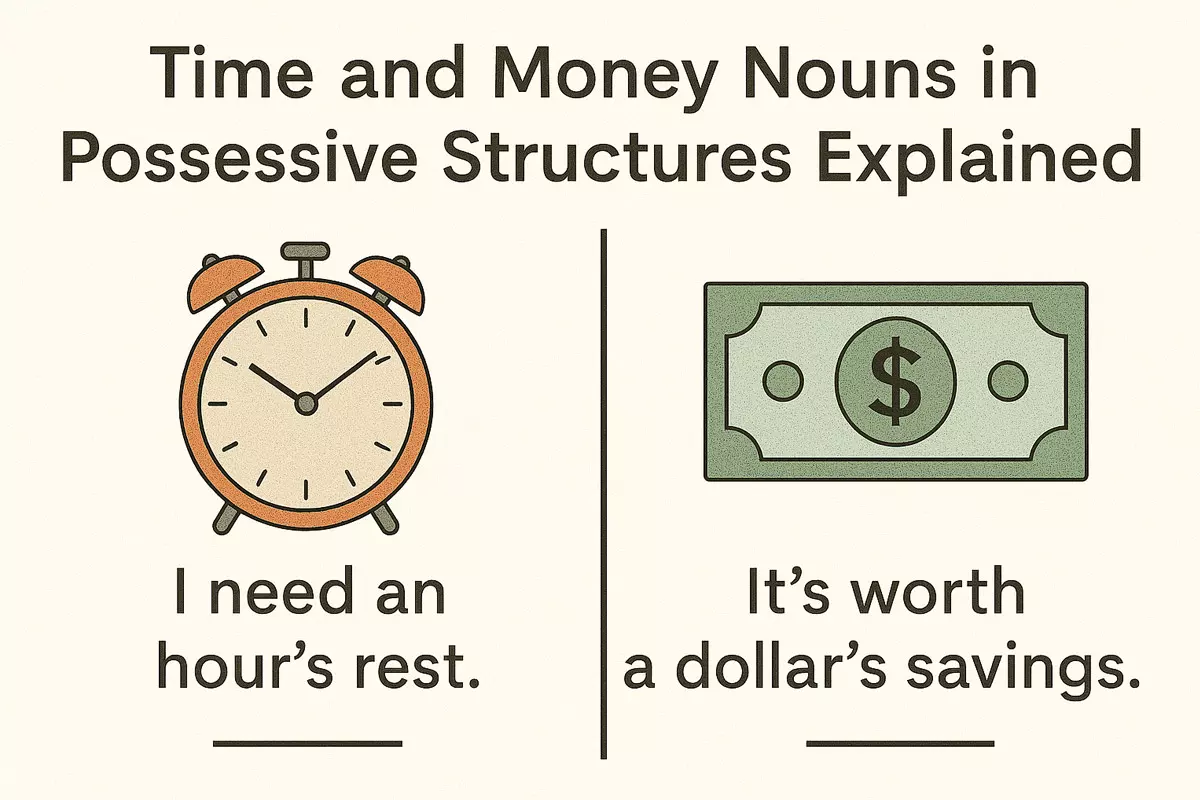
Time and Money Nouns in Possessive Structures Explained

 Here we why English uses possessive forms with time and money, common examples like a day's work and ten dollars' worth, and the difference between possessive and of-phrases. It also highlights typical learner mistakes and includes practice exercises.
- Why time and money use possessive forms in English
- Common time possessives like a day’s work and today’s news
- Money and value possessives in price expressions
- Possessive vs of-phrases with time and money
- Meaning differences between possessive and descriptive forms
- Common learner mistakes with time and money possession
- Practice: choose correct possessive forms in examples
Have you ever wondered why we say a day's work or three weeks' notice? Using the possessive form to express time and amounts of money can be confusing at first, but learning how to use it correctly will help your English sound both natural and accurate. For example, we say a dollar's worth or ten years' experience to show that something belongs to or relates to a specific amount of time or money. Mastering this aspect of grammar not only improves clarity but also enhances the overall quality of your communication.
Why time and money use possessive forms in English
English often treats words related to durations and amounts—like "time" and "money"—as if they can possess something, even when they aren't people or animals. This happens because these nouns can describe relationships or measure value, similar to how ownership works with people. Using possessive structures helps make expressions more natural and concise, especially when talking about quantities or periods.
How possessive forms express measurement and relationships
Possessive forms are not just about actual ownership. In phrases like "a day's work" or "ten dollars' worth," the possessive shows a connection of measurement or value. Instead of saying "work of a day" or "worth of ten dollars," English prefers the compact possessive construction.
- a week's vacation → We took a week's vacation by the sea.
- an hour's delay → There was an hour's delay due to bad weather.
- five minutes' walk → The café is only five minutes' walk from here.
- three months' notice → You must give three months' notice before leaving.
- two years' experience → She has two years' experience in marketing.
- one day's pay → He lost one day's pay because he was late.
- ten dollars' worth of gas → I bought ten dollars' worth of gas.
- twenty pounds' weight → The package has twenty pounds' weight.
- a moment's thought → Give me a moment's thought before I answer.
- six weeks' holiday → They are planning a six weeks' holiday abroad.
- fifty cents' change → I found fifty cents' change in my pocket.
- a year's salary → The bonus equals a year's salary.
- four hours' drive → It’s a four hours' drive to the mountains.
- one night's stay → The price includes one night's stay at the hotel.
- five euros' value → The voucher has five euros' value.
- a decade's progress → A decade's progress was lost after the crisis.
- an afternoon's rain → An afternoon's rain cooled the air.
- two days' journey → It was a two days' journey across the desert.
Why not use "of" instead?
Phrases like "the work of a day" or "the value of ten dollars" are grammatically correct, but they sound more formal or old-fashioned. The possessive form is shorter and more idiomatic in modern English.
Comparison of possessive and non-possessive forms
| Possessive Structure | Alternative (Non-Possessive) |
|---|---|
| one week's pay | the pay of one week |
| five dollars' worth | the worth of five dollars |
| three days' leave | leave of three days |
| an hour's break | a break of an hour |
| a year's subscription | subscription for a year |
Summary
Using possessive forms with durations and sums allows speakers and writers to convey information smoothly and efficiently. This construction highlights the measurement or value relationship, making English more flexible and expressive in describing time and money.
Common time possessives like a day’s work and today’s news
Expressions such as “a day’s work” and “today’s news” showcase how English uses possessive forms to indicate something belonging to or associated with a period of time. Rather than meaning that the day literally owns the work or the news, these phrases describe work completed during a day or news relevant to today. This construction is common with time words and helps make speech and writing more concise and natural.
How time nouns take possessive forms
In these constructions, a time noun (like day, week, month, year, or today) is made possessive with an apostrophe + s. The possessive shows a relationship similar to “of,” but is more idiomatic and fluid. For example, “a week’s vacation” is more common than “a vacation of a week.”
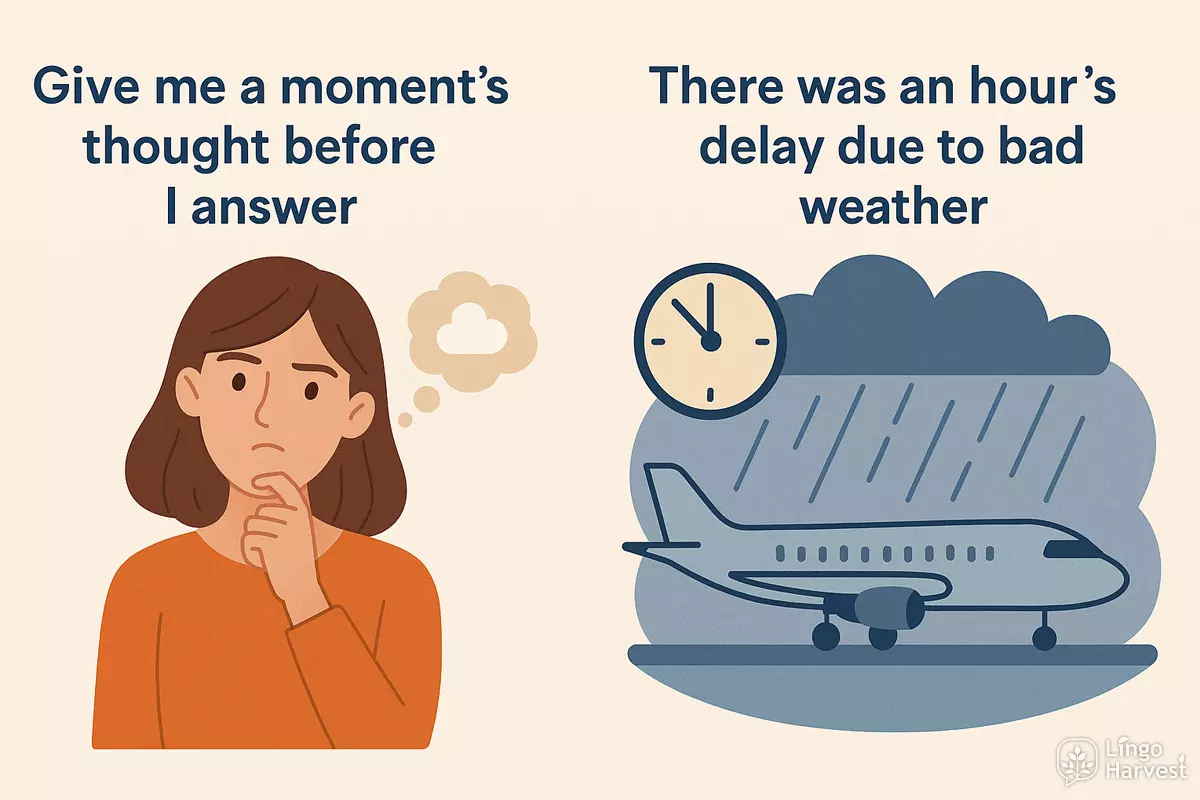
- a moment’s thought → Give me a moment’s thought before I answer.
- an hour’s delay → There was an hour’s delay due to bad weather.
- yesterday’s meeting → Yesterday’s meeting was canceled unexpectedly.
- this month’s report → This month’s report shows strong growth.
- tomorrow’s forecast → Tomorrow’s forecast predicts heavy rain.
- a year’s salary → He earns a year’s salary in bonuses alone.
- last night’s performance → Last night’s performance impressed the audience.
- next week’s schedule → Next week’s schedule is already full.
- a decade’s progress → The city has made a decade’s progress in infrastructure.
- this morning’s headlines → This morning’s headlines focus on the election.
- a fortnight’s notice → The landlord requires a fortnight’s notice.
- this season’s trends → This season’s trends favor neutral colors.
- Sunday’s game → Sunday’s game ended in a draw.
- the century’s discoveries → The century’s discoveries changed medicine forever.
- an evening’s entertainment → The show provided an evening’s entertainment.
- Monday’s agenda → Monday’s agenda includes budget planning.
- last year’s winner → Last year’s winner returned to defend the title.
- the weekend’s results → The weekend’s results surprised many fans.
Meaning and usage notes
The possessive structure with time nouns often indicates:
- Duration: “a month’s leave” (leave that lasts a month)
- Origin or timing: “today’s specials” (specials for today)
- Relevance: “this week’s topic” (the topic relevant this week)
This pattern is especially frequent in news, schedules, and work contexts, where time frames are key.
Comparing possessive and “of” structures
Sometimes, both possessive and “of” forms are possible, but the possessive is usually more natural with time words. For example:
- “a year’s experience” → more idiomatic than “experience of a year”
- “tomorrow’s meeting” → preferred over “the meeting of tomorrow”
Summary
Using possessive forms with time-related nouns is a standard, idiomatic way to refer to duration, timing, or relevance in English. Mastering this structure helps make your language sound more fluent and native-like.
Money and value possessives in price expressions
Expressions involving money and value often use possessive forms to clarify ownership or association, especially when talking about prices, costs, or worth. These structures help specify whose money is being referenced, the value attached to a noun, or the relationship between an amount and what it buys. Understanding these possessive constructions makes it easier to interpret and use price-related phrases accurately in both formal and everyday contexts.
Common patterns in monetary possessives
Price expressions with possessive forms typically fall into a few recognizable patterns. The following list highlights how English uses possessives with money and value nouns:
- Ten dollars’ worth – indicates the value of something in terms of money spent or needed.
- A day’s wages – shows how much someone earns in one day.
- Three months’ rent – refers to the rent amount for a three-month period.
- Five pounds’ weight – expresses the weight of something, but also used for price in some dialects.
- One week’s allowance – the amount given as allowance for one week.
- Two hours’ pay – what someone earns for two hours of work.
- Yesterday’s earnings – money earned yesterday.
- My father’s money – money belonging to my father.
- A month’s salary – salary for a month.
- Children’s pocket money – money given to children for spending.
- Company’s assets – the value owned by the company.
- Ten euros’ worth of petrol – petrol that costs ten euros.
- The shop’s price – the price set by the shop.
- Customer’s payment – the payment made by the customer.
- Investor’s capital – the money invested by someone.
Singular and plural possessive forms
The form changes depending on whether the noun is singular or plural. For singular units of time, money, or value, the possessive is usually ’s (e.g., “a dollar’s worth”). For plural units ending in -s, only an apostrophe is added (“three days’ pay”). This pattern ensures clarity and conciseness in price statements.
| Expression | Meaning |
|---|---|
| One dollar’s worth | Value equal to one dollar |
| Two weeks’ notice | Notice given for a period of two weeks |
| Five years’ experience | Experience gained over five years |
| Three months’ rent | Rent amount for three months |
| A day’s wages | Wages earned in one day |
| Ten euros’ worth of petrol | Petrol costing ten euros |
Usage notes and tips
- These possessive forms are especially common with time and money nouns, but can also apply to other measures like distance or weight when indicating value.
- When the value is abstract or generalized, the possessive structure helps avoid ambiguity (compare: “a five-dollar meal” vs. “five dollars’ worth of food”).
- In spoken English, the possessive form often signals a specific, measured amount rather than an approximate one.
- Always use the apostrophe correctly: after the -s for plurals, before the -s for singular forms.
Correct use of these structures makes financial and value statements precise, helping listeners and readers understand ownership, duration, and worth in context.
Possessive vs of-phrases with time and money
When talking about periods, durations, or amounts involving time and money, English often gives you two grammatical options: the possessive form (using ’s or a plural possessive) and the of-phrase. However, these choices aren't always interchangeable, and the style or emphasis of your sentence can change depending on which you use.
When to Use the Possessive Form

The possessive is common with specific measurements or set periods, especially when the noun is singular or plural but not a complex phrase. It's often preferred in spoken and informal written English.
- an hour's delay → There was an hour's delay because of the storm.
- a week's holiday → She is taking a week's holiday in July.
- two months' notice → Employees must give two months' notice before leaving.
- yesterday's earnings → Yesterday's earnings were higher than expected.
- tomorrow's schedule → Tomorrow's schedule includes three meetings.
- three years' experience → He has three years' experience in marketing.
- one day's pay → The fine was equal to one day's pay.
- five minutes' walk → The café is only five minutes' walk from here.
- a moment's thought → After a moment's thought, she agreed.
- ten dollars' worth → I bought ten dollars' worth of fruit.
- forty pounds' weight → The package has a forty pounds' weight limit.
- a day's wage → He earns a day's wage in just a few hours.
- last month's rent → Last month's rent was paid late.
- a century's progress → A century's progress changed the city completely.
- the week's profits → The week's profits exceeded expectations.
- the company's year's revenue → The company's year's revenue broke a new record.
When to Use of-Phrases
Of-phrases are often favored in formal writing, with longer or more complex noun phrases, or when the possessive would sound awkward. They're also preferred when the period or amount is described by a phrase rather than a single word or simple number.
- the delay of an hour → The delay of an hour caused several passengers to miss their connections.
- the notice of two months → The contract requires the notice of two months before leaving the job.
- the experience of three years → The position demands the experience of three years in marketing.
- the pay of one day → He lost the pay of one day because he was absent.
- the rent of last month → The rent of last month has already been paid.
- the value of ten dollars → The value of ten dollars may seem small, but it adds up.
- the weight of forty pounds → The package exceeded the weight of forty pounds.
- the profits of the week → The profits of the week were higher than expected.
- the revenue of the company for the year → The revenue of the company for the year broke all records.
- the journey of five minutes → The journey of five minutes felt longer in heavy traffic.
- the holiday of a week → The holiday of a week helped her relax completely.
- the thought of a moment → The thought of a moment changed his decision.
- the progress of a century → The progress of a century transformed modern society.
Comparison: Patterns and Preferences
| Possessive Structure | Of-Phrase Structure |
|---|---|
| a day's work | the work of a day |
| two weeks' salary | the salary of two weeks |
| five years' investment | the investment of five years |
| an hour's pay | the pay of an hour |
| six months' leave | the leave of six months |
| ten dollars' worth | the worth of ten dollars |
| three days' journey | the journey of three days |
| last year's profits | the profits of last year |
Usage Notes
In everyday English, the possessive is more concise and idiomatic for time and money measurements. Of-phrases can sound more formal, elaborate, or even awkward if overused in speech. However, both forms are grammatically correct, and your choice may depend on emphasis, rhythm, or the complexity of the noun phrase. When in doubt, consider which option sounds more natural for your context.
Meaning differences between possessive and descriptive forms
Understanding how nouns related to time and money function in possessive and descriptive structures can help clarify subtle shifts in meaning. These forms might look similar, but they often suggest different relationships or nuances. Possessive forms (like "a week's pay" or "a day's work") imply a specific, often measurable, relationship between the noun and the period or amount. Here, the apostrophe + s structure highlights ownership or allocation—usually indicating how much of something fits into a given time or monetary frame. Descriptive forms (such as "weekly pay" or "daily work"), on the other hand, focus on the type or characteristic rather than a fixed quantity. These forms use the noun as an adjective, describing the kind of pay or work rather than the exact amount or duration.
Key distinctions in usage
- Possessive: Emphasizes the total amount tied to a specific period or sum (e.g., "a month's rent" = the rent for one month).
- Descriptive: Describes the general type or frequency (e.g., "monthly rent" = rent that is paid every month, not necessarily how much for a single month).
- Possessive forms are more common with singular time or money units; descriptive forms are typical for regularity or category.
- Switching between forms can subtly change the meaning or focus of a sentence.
Examples of time and money nouns in both structures
- a day's pay → daily pay
- a week's vacation → weekly vacation
- a year's salary → yearly salary
- a month's notice → monthly notice
- an hour's delay → hourly delay
- a dollar's worth → dollar value
- a minute's wait → minute wait
- a pound's fee → pound fee
- a fortnight's holiday → fortnightly holiday
- a season's harvest → seasonal harvest
- a day's travel → daily travel
- a week's groceries → weekly groceries
- a year's subscription → annual subscription
- a century's progress → centennial progress
- a euro's cost → euro cost
- a month's supply → monthly supply
- a day's earnings → daily earnings
- a second's delay → second delay
- a dollar's increase → dollar increase
- a week's allowance → weekly allowance
Comparing implications: when to choose each form
Choosing between these forms depends on whether you want to specify a fixed amount or describe a general category. For example, "a week's pay" refers to the exact sum earned in one week, while "weekly pay" simply tells us that payment happens every week, with no reference to the amount.
| Possessive Form | Descriptive Form |
|---|---|
| a month's salary (salary for one month) |
monthly salary (salary paid every month) |
| a year's subscription (subscription lasting one year) |
annual subscription (type of subscription, paid annually) |
| a day's wage (wage for one day) |
daily wage (wage paid each day) |
| an hour's break (break lasting one hour) |
hourly break (breaks that occur each hour) |
| a dollar's worth (value equal to one dollar) |
dollar value (value measured in dollars) |
In summary, being aware of these distinctions can help you express time and money relationships more precisely in English. The choice between possessive and descriptive forms can subtly alter meaning, so it's worth considering which best fits your intended message.
Common learner mistakes with time and money possession
Misusing possessive structures with time and money nouns is a frequent issue for English learners. Many struggle to decide when to use the possessive ’s, when to use "of," or whether a simple noun modifier is more natural. These challenges often lead to awkward or incorrect phrases that sound unusual to native speakers.
Mixing up possessive ’s and "of"
One common confusion is choosing between "an hour’s work" and "the work of an hour." Although both are technically possible, "an hour’s work" is far more idiomatic. Learners often overuse "of" with time and money expressions, resulting in unnatural sentences.
- ❌ The salary of two months → ✅ Two months’ salary
- ❌ The price of five dollars → ✅ Five dollars’ price (better: Price: five dollars)
- ❌ The work of a week → ✅ A week’s work
Forgetting to use the possessive apostrophe
For time and money nouns, omitting the possessive ending is a common slip. Remember, it’s "a day’s pay," not "a day pay."
- ❌ A three hours delay → ✅ A three-hour delay (adjective form, no ’s)
- ❌ Two week vacation → ✅ Two weeks’ vacation
- ❌ A dollar worth → ✅ A dollar’s worth
Confusing plural and singular forms
It’s easy to mix up where the apostrophe goes, especially with plurals. Compare:
| Incorrect Form | Correct Form |
|---|---|
| One week vacation | One week’s vacation |
| Two week’s notice | Two weeks’ notice |
| Five dollar’s worth | Five dollars’ worth |
| Ten minutes walk | Ten minutes’ walk |
Using “of” when a possessive is needed
Learners sometimes default to "of" structures, which can sound overly formal or just incorrect with time and money nouns.
- ❌ The cost of ten years → ✅ Ten years’ cost (but often: Ten years’ worth)
- ❌ The delay of an hour → ✅ An hour’s delay
Omitting the noun modifier or using the wrong pattern
Sometimes, the noun modifier (e.g., "three-hour") is more appropriate than a possessive. Learners may confuse these:
- ❌ A three hours’ delay → ✅ A three-hour delay
- ❌ A five dollars’ bill → ✅ A five-dollar bill
To sum up, the main pitfalls include confusing possessive forms, misplacing apostrophes, and overusing "of" structures. Paying attention to native patterns, especially with time and money, helps learners sound more natural and precise.
Practice: choose correct possessive forms in examples
Understanding how to form possessive structures with time and money nouns can be challenging. Let’s work through some practical exercises to build confidence in using these forms correctly. The following activities will help you recognize and produce the right structure in different contexts.
Choose the Correct Possessive Form
For each sentence below, select the most natural and grammatically correct possessive structure for the noun in brackets. Decide whether to use the possessive 's form or a standard "of" construction.
- This is (two weeks / two weeks’ / of two weeks) notice.
- He earns (a month salary / a month’s salary / of a month salary).
- The repair took (three hours / three hours’ / of three hours) work.
- She paid (a dollar / a dollar’s / of a dollar) worth of stamps.
- We have (an hour break / an hour’s break / of an hour break) after the exam.
- He gave me (ten minutes / ten minutes’ / of ten minutes) advice.
- This is (a day pay / a day’s pay / of a day pay).
- I need (a moment rest / a moment’s rest / of a moment rest) before we continue.
- Can you lend me (five dollars / five dollars’ / of five dollars)?
- She completed the task in (an hour time / an hour’s time / of an hour time).
Show answers
- two weeks’
- a month’s salary
- three hours’
- a dollar’s
- an hour’s break
- ten minutes’
- a day’s pay
- a moment’s rest
- five dollars
- an hour’s time
Compare: Possessive vs. "Of" Structures
Some time and money expressions can look similar but only one form is natural in English. Review the examples below and notice how the possessive is used.
| Natural Possessive Form | Unnatural or Incorrect Alternative |
|---|---|
| two days’ work | work of two days |
| a week’s holiday | holiday of a week |
| five dollars’ worth | worth of five dollars |
| a year’s experience | experience of a year |
| an hour’s delay | delay of an hour |
| three months’ notice | notice of three months |
| a minute’s silence | silence of a minute |
| ten pounds’ worth of fruit | fruit of ten pounds’ worth |
| a day’s journey | journey of a day |
| twenty years’ service | service of twenty years |
Spot the Error
Find and correct the mistake in each sentence related to time or money possessive forms:
- He gave me a five dollars’ bill.
- This is the result of three years hard work.
- They need a two weeks vacation.
- I waited for a hour’s.
- She has ten years experience in marketing.
- It was a four hours drive.
- We had a one day delay.
- The project took six months work.
- He earns two thousands dollars a month.
- That was a five minutes break.
Show answers
- He gave me a five dollar bill. (No possessive for money denominations.)
- This is the result of three years’ hard work. (Possessive apostrophe required.)
- They need a two weeks’ vacation. (Time expressions need possessive.)
- I waited for an hour. (No possessive needed here.)
- She has ten years’ experience in marketing. (Add possessive apostrophe.)
- It was a four-hour drive. (Use hyphenated adjective.)
- We had a one-day delay. (Hyphenated adjective, not possessive.)
- The project took six months’ work. (Possessive for duration.)
- He earns two thousand dollars a month. (No plural on “thousand”.)
- That was a five-minute break. (Hyphenated adjective.)