Prepositions in Time Frames: by 2030, before noon, from…to Explained

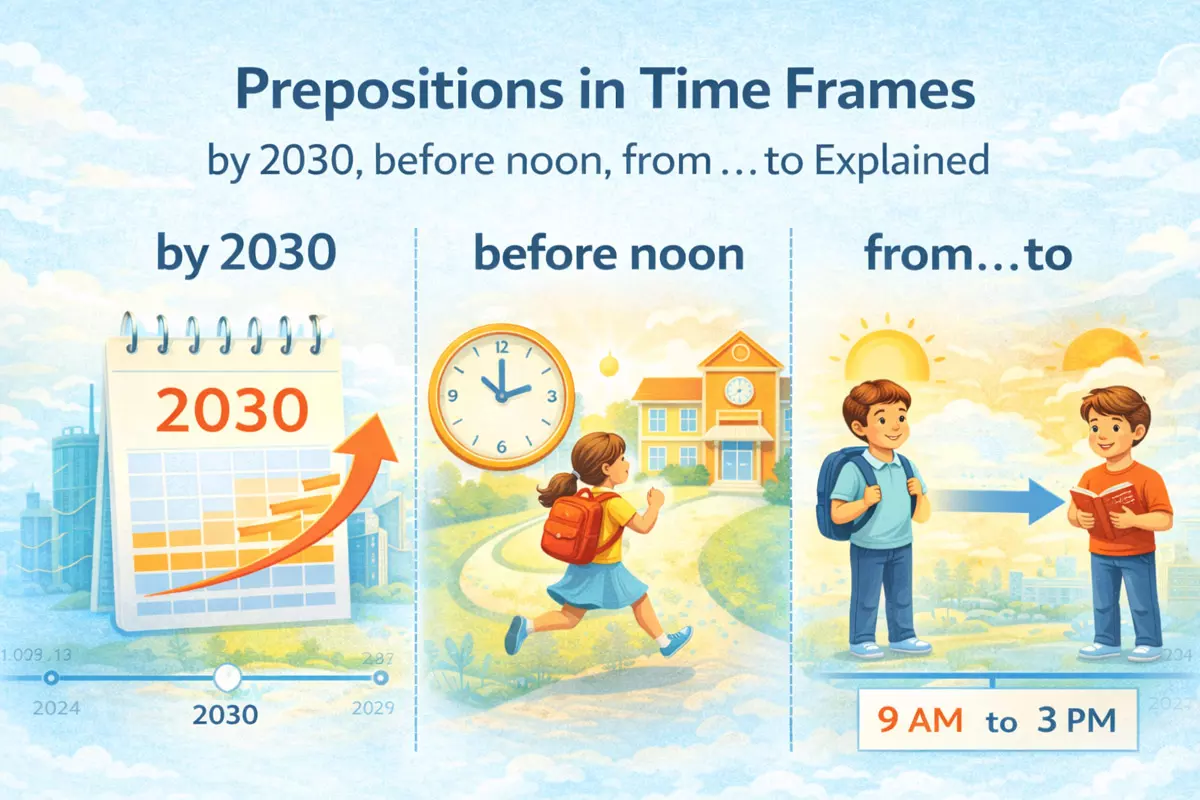 This article explains how to use by, before, after, and from…to for marking deadlines, sequencing events, and showing time ranges. It includes clear timeline diagrams and practice with schedules and project plans.
Mastering English expressions that refer to specific moments or periods, such as setting deadlines, describing durations, or indicating starting and ending points, can be challenging for learners. These small but essential words and phrases—like by, until, since, and during—play a crucial role in making your communication clear and precise. Understanding their correct usage not only helps you avoid common mistakes, but also boosts your confidence when speaking or writing in English. With practice, you will find it easier to express time-related ideas accurately and naturally.
How by marks deadlines and final points
The preposition by is commonly used to indicate a time limit or the latest possible moment for something to happen. It sets a boundary, showing that an action or event must occur no later than a specified moment. Unlike before, which simply means any time prior, by includes the deadline itself as a possible time for the action.
Understanding "by" in time expressions
When you see phrases like by 2030 or by noon, they signal that something should be completed at any time up to and including that moment. The focus is on the end point—what matters is that the task is done no later than the time specified.
- Finish the report by Friday (anytime before or at the end of Friday)
- Arrive by 8 a.m. (at the latest, 8 a.m.)
- Submit your application by the end of the month
- Pay the bill by tomorrow
- Return the book by next week
- Deliver the project by the agreed date
- Finish your meal by the time the movie starts
- Send the email by noon
- Leave the building by closing time
- Resolve the issue by the deadline
- Graduate by 2025
- Make a decision by the meeting
- Complete the assignment by midnight
- Respond by the end of the day
- Sign the contract by Thursday
Comparing "by" and "before"
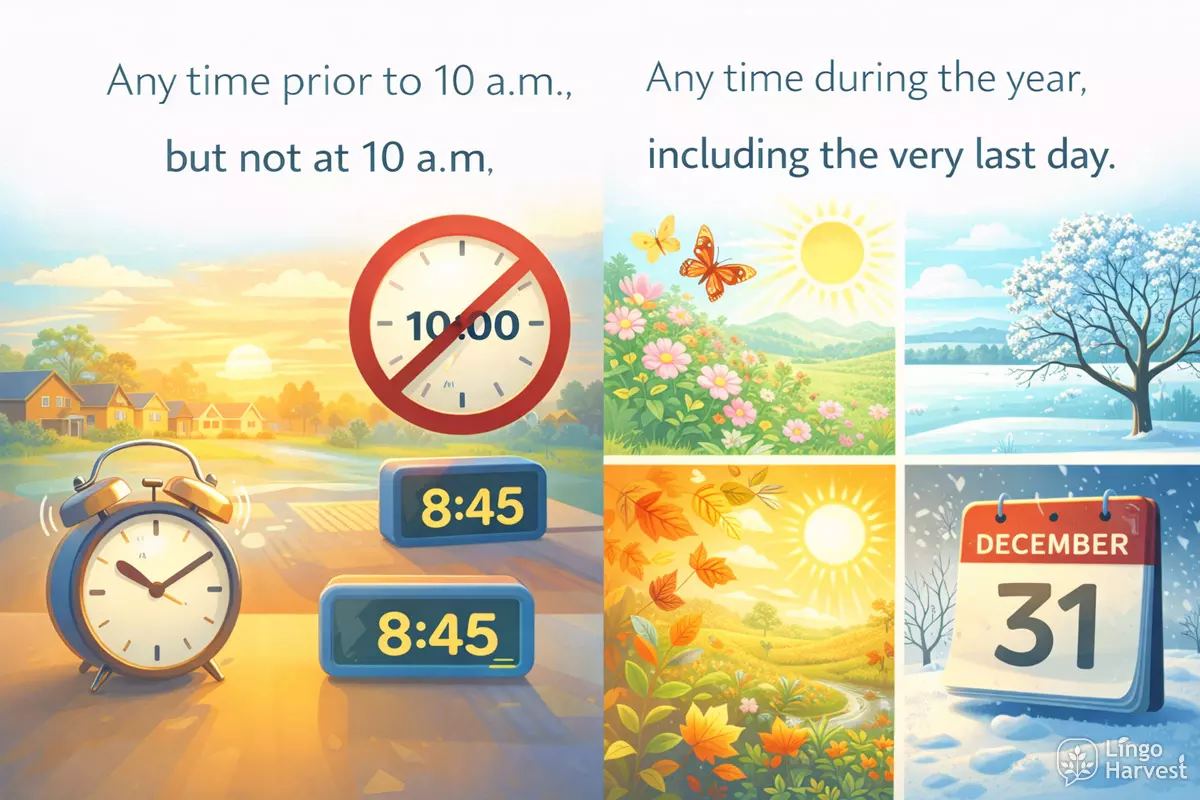
It’s easy to confuse by with before, but their meanings are not identical. Before excludes the limit point, while by includes it. For example, if a task is due by noon, it can be finished at exactly noon. If it is due before noon, it must be done any moment prior to noon, not at noon itself.
| Expression | Meaning |
|---|---|
| by 10 a.m. | Any time up to and including 10 a.m. |
| before 10 a.m. | Any time prior to 10 a.m., but not at 10 a.m. |
| by the end of the year | Any time during the year, including the very last day |
| before the end of the year | Any time up to, but not including, the last day of the year |
Summary: Using "by" for deadlines
Use by to set a clear endpoint when something must be finished, submitted, or achieved. This preposition is essential when you want to communicate the final moment for an action, making it a key part of expressing deadlines and final points in time.
Before and after for ordering events in time
To express the order of events in English, we often use the prepositions before and after. These words help clarify when one action happens in relation to another, making timelines and schedules much clearer. Understanding their usage is crucial for describing routines, historical events, deadlines, and sequences in stories or instructions.
How to use "before" and "after" in time expressions
Before is used to indicate that something happens earlier than another event or point in time. After shows that something takes place later. Both can be followed by a specific time, date, event, or another clause.
- I brush my teeth before breakfast.
- She arrived after noon.
- Please submit your application before July 1st.
- He called me after the meeting.
- They left before it started raining.
- We’ll go out after finishing our work.
- Can you wake me up before 8 a.m.?
- The store opens after 10 o’clock.
- I always check my emails before lunch.
- The lights turn on after sunset.
- Finish your homework before watching TV.
- The concert starts after 7 p.m.
- He got a job after graduating.
- We need to leave before traffic gets bad.
- She called after she arrived home.
Common patterns with "before" and "after"
Both prepositions can introduce a noun, pronoun, or a full clause:
- Before/After + noun: before dinner, after class
- Before/After + pronoun: before him, after them
- Before/After + clause: before she arrived, after we finish
Comparing "before" and "after" in time sequencing
| Preposition | Example Sentence |
|---|---|
| before | Finish your project before the deadline. |
| after | We’ll celebrate after the results are announced. |
| before + clause | I’ll call you before I leave the office. |
| after + noun | Let’s meet after lunch. |
When talking about arranging or describing the timing of events, these prepositions are flexible and widely used. Mastering them helps you communicate schedules, plans, and stories with precision and clarity.
Using from…to for full time ranges
When you want to describe a period that clearly starts at one point and ends at another, English uses the structure from…to. This construction is ideal for expressing the entire span between two times, dates, or even years, making it very clear exactly when something begins and finishes.
How the pattern works
The phrase always includes both the starting and ending points. It can be used for hours, days, months, years, and even centuries. The format is simple: from [start time] to [end time].
- from 9 a.m. to 5 p.m. → I work from 9 a.m. to 5 p.m. every day.
- from Monday to Friday → Our classes run from Monday to Friday.
- from January to March → It usually rains a lot from January to March.
- from 1990 to 2000 → She lived in Canada from 1990 to 2000.
- from noon to midnight → The shop is open from noon to midnight.
- from sunrise to sunset → They were filming from sunrise to sunset.
- from the 18th to the 20th century → The museum covers art from the 18th to the 20th century.
- from today to next week → The offer is valid from today to next week.
- from April 1 to April 10 → The conference runs from April 1 to April 10.
- from the beginning to the end → I enjoyed the movie from the beginning to the end.
- from morning to evening → He studies from morning to evening before exams.
- from birth to death → The book follows the hero’s life from birth to death.
- from the first chapter to the last → I read the novel from the first chapter to the last in one weekend.
- from start to finish → The project was well organized from start to finish.
What “from…to” expresses
This structure emphasizes the full period covered. For example, “She worked from 2010 to 2020” means she was employed throughout that entire decade, not just at the beginning or end.
Comparing with other prepositions
Other prepositions like by, before, and until focus on one endpoint, but from…to always marks a complete range.
| Pattern | Meaning |
|---|---|
| from 8 a.m. to 10 a.m. | The period starts at 8 and ends at 10 (includes all time between) |
| by 10 a.m. | Anytime before or at 10 a.m. (focus on the deadline, not the whole span) |
| until 10 a.m. | Up to but not after 10 a.m. (emphasizes the endpoint) |
| before 10 a.m. | Any time earlier than 10 a.m. (excludes 10 a.m. itself) |
Common mistakes to avoid
- Do not use “from” without “to” (e.g., ❌ I work from 9 a.m. is incomplete)
- Don’t mix up “since” or “during” with this pattern; they have different meanings
- Don’t add extra prepositions: ❌ from 9 a.m. until 5 p.m. is less standard than simply ✅ from 9 a.m. to 5 p.m.
Using this structure is a clear, direct way to show the full extent of a time frame in both spoken and written English.
Choosing between until, by and before in context
Understanding when to use until, by, and before helps you describe deadlines, limits, and time frames precisely. Each preposition expresses a different relationship to time, and using the right one changes the meaning of your sentence.
Core differences at a glance
- Until means up to a certain point in time, including that point.
- By sets a deadline, meaning anytime before or at that moment.
- Before means any time earlier than a specific point, but not at that point.
How each preposition works in time expressions
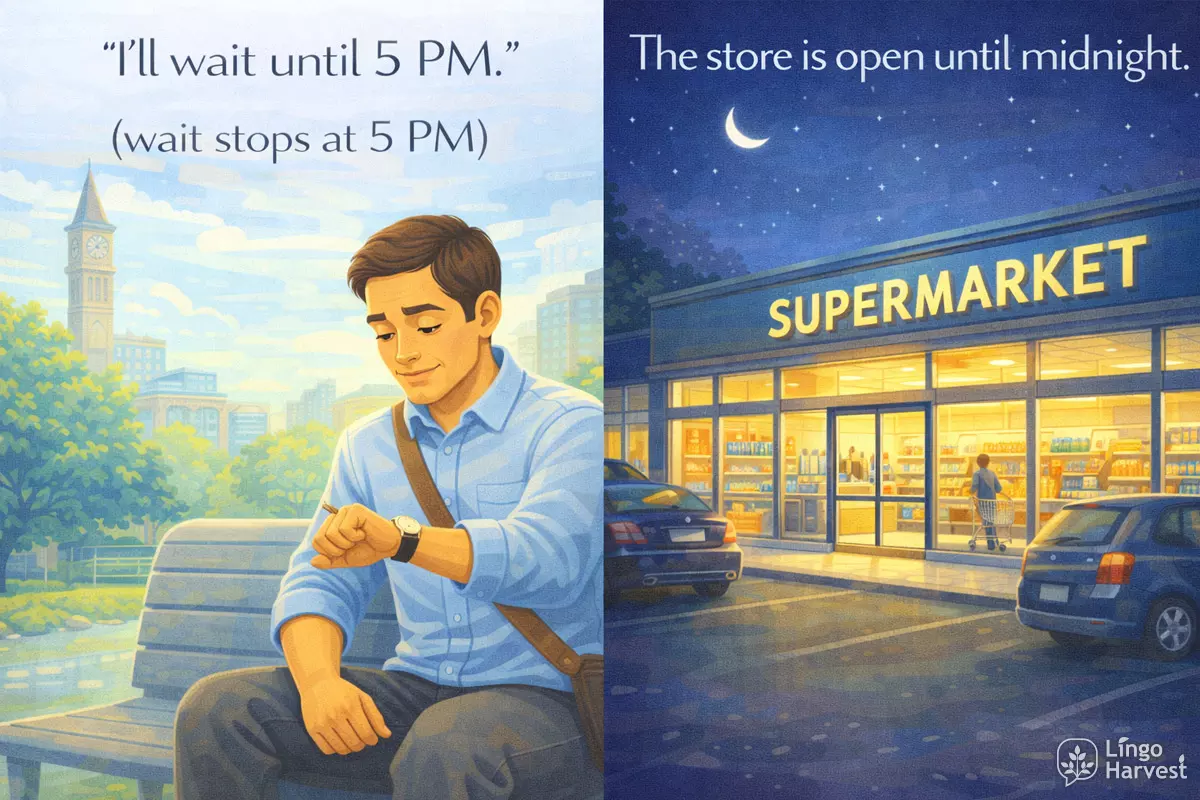
Let’s break down common scenarios where these prepositions are used, with examples to make the distinctions clear.
| Preposition | Typical Usage & Example |
|---|---|
| Until |
|
| By |
|
| Before |
|
Quick guide: Choosing the right preposition
- Use until for ongoing actions that stop at a specific moment (e.g., “stay until the end”).
- Choose by for deadlines when something must be done no later than a time (e.g., “submit by 3 PM”).
- Pick before when you want to express any time earlier than a limit (e.g., “leave before sunset”).
Common mistakes to avoid
- Don’t use by for durations (“She lived there by 2010” means she may have left before 2010, not that she stayed the whole time).
- Avoid until for deadlines (“Hand in your essay until Friday” is incorrect; use “by Friday”).
- Remember, before excludes the reference point, while by includes it.
Practice: Spot the right option
- We have to finish the project by June 1. ✅
- Don’t call me before 8 AM. ✅
- The show runs until September. ✅
- I will be at the office until 6 PM. ✅
- Please submit your application by midnight. ✅
- Arrive before the movie starts. ✅
- Incorrect: “Finish your homework until tomorrow.” ❌ (should be “by tomorrow”)
- Incorrect: “Stay here by 10 PM.” ❌ (should be “until 10 PM”)
Choosing the correct preposition helps clarify your meaning and avoids misunderstandings about timing and deadlines. Practice with different scenarios to get comfortable with these essential time words.
Timeline diagrams to visualise time frames
Understanding how time-related prepositions function is much easier when you picture them on a visual timeline. Timelines let you see the difference between moments, periods, and endpoints at a glance, helping clarify subtle distinctions between prepositions like by, before, from…to, until, and others. Below, we'll explore how these expressions fit onto timelines, and why their positions matter in both written and spoken English.
How prepositions map onto a timeline
Different prepositions describe time frames in unique ways. For instance, by sets a deadline, while before marks any moment earlier than a specific point. From…to clearly marks the start and end of a period. Visualizing these on a timeline helps make sense of their meanings and prevents common mistakes.
| Preposition | Timeline Representation |
|---|---|
| by (e.g., by 2030) | Any time up to and including the specified point. → Deadline |
| before (e.g., before noon) | Any time prior to the stated point; does not include the endpoint. |
| from…to (e.g., from 2010 to 2020) | Clear start and end; includes both points as the span. |
| until/till (e.g., until Friday) | Continuing up to the endpoint, sometimes including it. |
| since (e.g., since 1995) | Starting from a moment and continuing to the present. |
| during (e.g., during summer) | Within a period, but not specifying exact start/end. |
| after (e.g., after midnight) | At any point following the specified time. |
| in (e.g., in June, in 3 hours) | Used for unspecific moments within a period or after a duration. |
| at (e.g., at 8 o’clock) | Refers to a precise, single point on the timeline. |
| for (e.g., for a week) | Emphasizes the length of the period, not the position. |
Quick-reference examples
- by 10pm: Complete any time before or at 10pm.
- before noon: Finish strictly earlier than 12:00.
- from 8am to 5pm: The event starts at 8am and ends at 5pm.
- until midnight: Continuing up to midnight, possibly ending right at 12:00.
- since Monday: Ongoing from Monday to now.
- during the meeting: Any time within the meeting window.
- after lunch: Starts any time following lunch.
- in 2025: Refers to some time within the year 2025.
- at 6 o’clock: Exactly at 6:00.
- for two weeks: Focuses on the duration, not the start or end.
By placing these time expressions on a visual line, learners can easily compare how each preposition interacts with time. This method makes it much simpler to choose the right preposition for the intended meaning, whether setting a deadline, describing a span, or referencing a specific moment.
Practice activities with schedules and project plans
Understanding how prepositions function in time expressions is crucial when creating schedules or outlining project timelines. Here, you’ll find a variety of tasks and examples to help you master phrases such as “by 2030,” “before noon,” and “from…to” in practical contexts.
Fill-in-the-blank: Scheduling Tasks
Complete each sentence with the correct preposition: by, before, after, from, to, until, or during.
- The meeting will start ______ 10:00 am.
- Please submit the report ______ Friday.
- We can finish the initial draft ______ next week.
- Lunch is scheduled ______ 12:30 pm ______ 1:00 pm.
- No work is allowed ______ the weekend.
- The project must be completed ______ July 15th.
- The presentation is planned ______ the afternoon.
- The course runs ______ September ______ December.
- We will discuss the budget ______ the meeting.
- The store opens ______ 8 am ______ weekdays.
Show answers
- at
- by
- before
- from / to
- during
- by
- in
- from / to
- during
- at / on
Project Timeline: Matching Prepositions
Match the time phrases to the correct use in a project plan.
- _______ April 15, all designs must be approved.
- Testing will take place ______ April 16 ______ April 25.
- We cannot start development ______ all materials are ready.
- Feedback is collected ______ the second week of May.
- The team will pause operations ______ the holiday period.
- Client reviews will be held ______ Thursday morning.
- Billing runs ______ the beginning ______ the end of each month.
- We must finish phase one ______ June.
- Progress reports are required ______ every Friday.
- The new schedule applies ______ next year.
Show answers
- By
- from / to
- until
- during
- during
- on
- from / to
- by
- on
- from
Common Time Prepositions in Schedules
- by (a deadline): by 5pm, by next Monday, by 2030
- before (an event/time): before noon, before the meeting
- after (an event): after lunch, after delivery
- from…to (duration): from 9am to 11am, from January to March
- until (end point): until Friday, until the project is finished
- during (period): during the conference, during the afternoon
- at (exact time): at 3pm, at midnight
- in (future period): in 2 days, in 2025
- on (date/day): on Monday, on July 1st
- since (starting point, with present perfect): since 2020
Rewriting Sentences: Improving Clarity
Rewrite each sentence using a different time preposition (where possible) to express the schedule more accurately:
- The report is due before Friday. (Use "by")
- The workshop continues from 2pm to 4pm. (Use "between")
- He will be on vacation during the last week of July. (Use "in")
- Finish the task at 5pm. (Use "by")
- The team worked from Monday to Wednesday. (Use "between")
- They must submit the design before June. (Use "by")
- The event will take place during October. (Use "in")
- We arrived at 10pm. (Use "by")
- The class runs from March to May. (Use "between")
- He finished the homework during the evening. (Use "in")
Show answers
- The report is due by Friday.
- The workshop is between 2pm and 4pm.
- He will be on vacation in the last week of July.
- Finish the task by 5pm.
- The team worked between Monday and Wednesday.
- They must submit the design by June.
- The event will take place in October.
- We arrived by 10pm.
- The class runs between March and May.
- He finished the homework in the evening.
Comparing Time Expressions in Schedules
Let’s see how different prepositions change the meaning of a deadline or schedule.
| Expression | Meaning in a Schedule |
|---|---|
| by 2030 | Any time before or up to 2030 (including 2030) |
| before noon | Any time earlier than 12:00 pm (not including noon) |
| from 9am to 5pm | Starting at 9am and finishing at 5pm (includes both times) |
| until Friday | Up to and including Friday (stop on Friday) |
| after the meeting | Any time later than the meeting (meeting not included) |
Short Practice: Identify the Error
Spot which sentence uses the wrong preposition:
- We need to finish the presentation by tomorrow.
- The office is open from 8am at 6pm.
- He will join us after lunch.
- Payments are accepted until the end of the month.
- The conference starts in Monday morning.
- The store is closed during the night.
- They worked between 9am until 3pm.
- The course runs from September to December.
- Please arrive until 10am.
- I usually exercise in the evening.
Show answers
- Correct
- Error: “from 8am at 6pm” → from 8am to 6pm.
- Correct
- Correct
- Error: “in Monday morning” → on Monday morning.
- Correct
- Error: “between 9am until 3pm” → between 9am and 3pm.
- Correct
- Error: “arrive until 10am” → arrive by 10am.
- Correct