What Are Conjunctions? Full Explanation

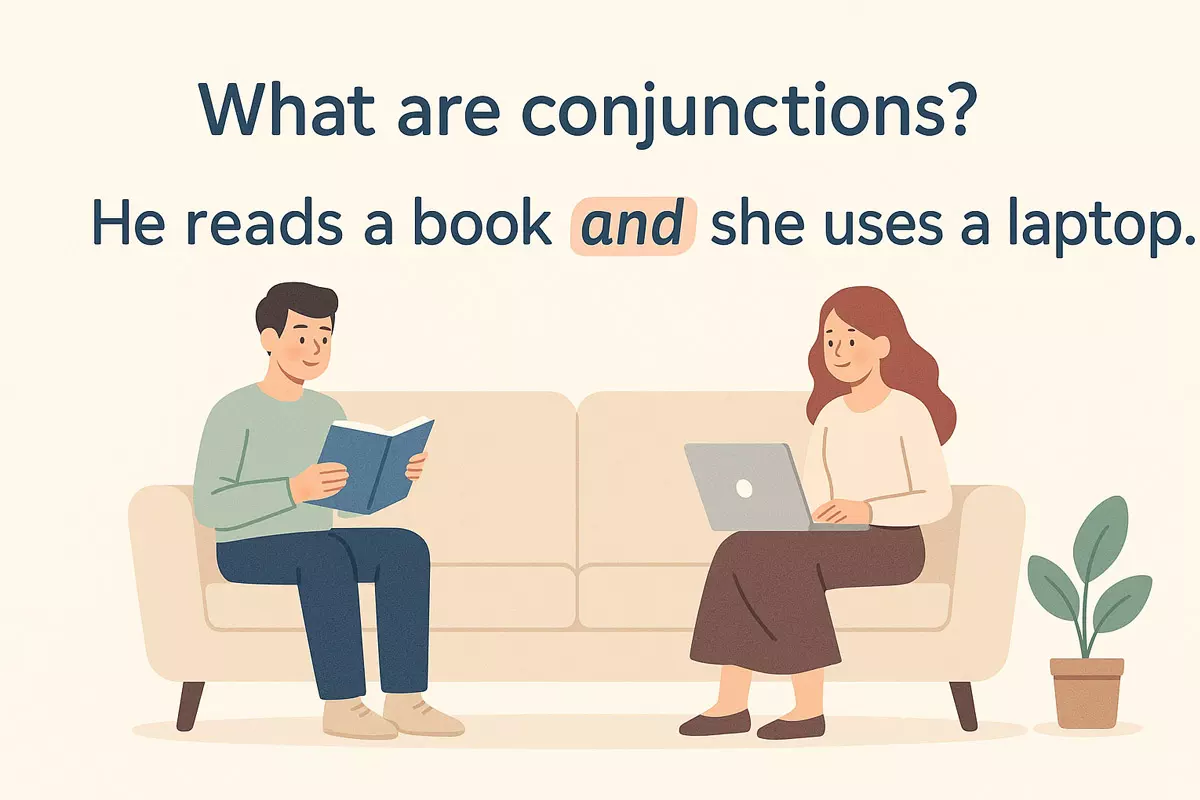 This article explains how conjunctions connect words, phrases, and clauses. It covers the main types, joining rules, common examples, their meaning and structure, typical mistakes, and includes practice exercises.
Have you ever wondered how sentences flow smoothly and ideas connect seamlessly within a paragraph? This is achieved through the use of connectors, which are small but essential words that join thoughts and clarify relationships between ideas. Mastering the use of connectors can significantly improve your writing by making it more coherent and easier for readers to follow. Whether you are writing an essay, an email, or any other form of communication, understanding how to use these connectors effectively is a valuable skill.
What Conjunctions Do
Conjunctions act as connectors in sentences, linking words, phrases, or entire clauses to show relationships between ideas. Rather than writing in short, choppy sentences, these words help create smooth, complex expressions. They clarify how different parts of a sentence relate, whether by joining similar concepts, contrasting ideas, or explaining cause and effect.
Joining Words and Phrases
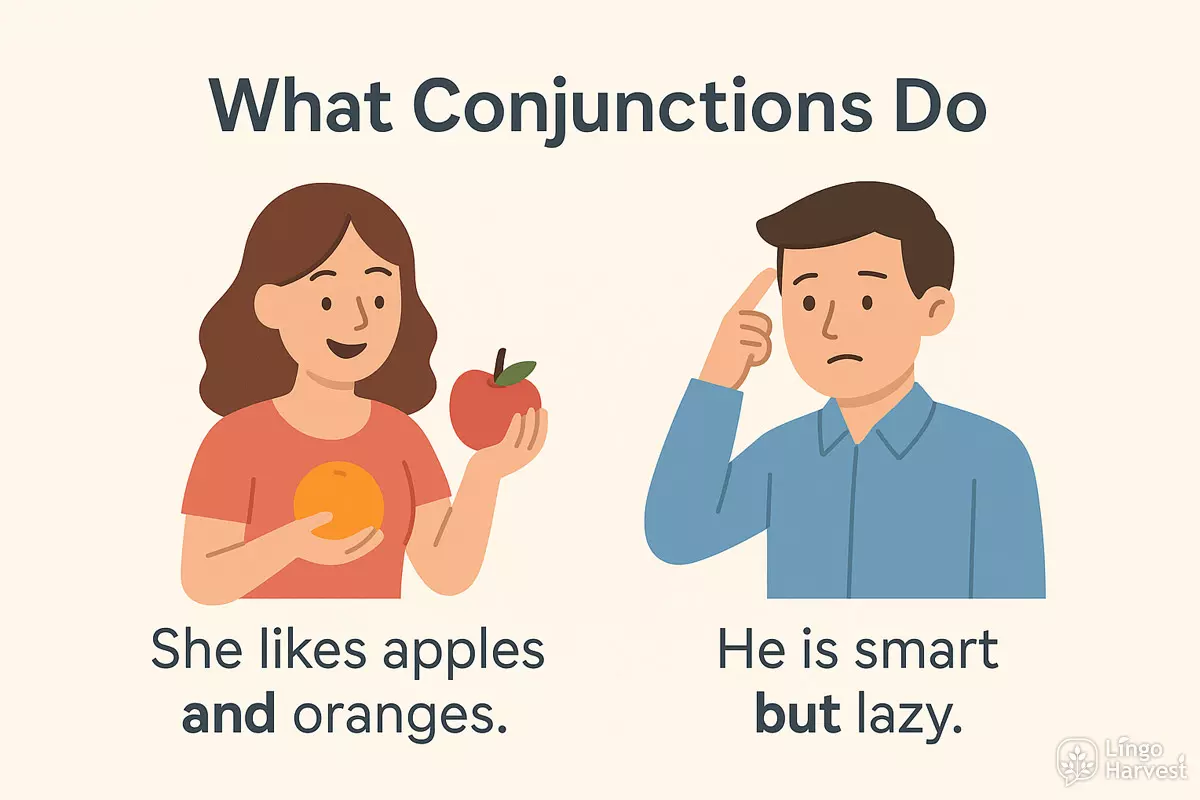
Conjunctions are frequently used to join individual words or groups of words. This is especially common in lists or when describing multiple qualities or actions. For example:
- She likes apples and oranges.
- He is smart but lazy.
- We can go now or later.
Connecting Clauses
These linking words also combine independent or dependent clauses, allowing you to create more nuanced statements. This helps avoid repetitive structures and makes writing more engaging. For instance:
- She went home because she was tired.
- I will call you when I arrive.
- He studied hard, so he passed.
Expressing Relationships
Different types of conjunctions signal various relationships between ideas. Some indicate addition, others contrast, alternatives, or reasons. Here’s a breakdown of common purposes:
| Function | Example Conjunctions | Sample Sentence |
|---|---|---|
| Addition | and, as well as | You can have tea and coffee. |
| Contrast | but, yet, although | She is young, but very wise. |
| Choice | or, either...or | Would you like cake or ice cream? |
| Reason/Cause | because, since, as | He left early because he was tired. |
| Time | when, after, before | After she finished, she went out. |
| Condition | if, unless, provided that | If it rains, we’ll stay inside. |
Examples of Common Conjunctions
To illustrate how these words appear in everyday language, here is a list of widely used connectors:
- and
- but
- or
- nor
- so
- for
- yet
- although
- because
- since
- while
- unless
- if
- when
- after
- before
- even though
- as soon as
Why Use These Connecting Words?
By using appropriate conjunctions, writers and speakers can build clearer, more logical sentences. This improves flow, avoids repetition, and helps the audience understand the relationships between different points. Whether you’re writing essays, reports, or emails, these small words play a big role in tying ideas together.
Main Types
When exploring how words connect ideas and clauses, it's helpful to look at the three fundamental categories: coordinating, subordinating, and correlative forms. Each group plays a specific role in linking thoughts, clarifying relationships, or balancing parts of a sentence.
Coordinating Conjunctions
These are perhaps the most familiar. Their job is to join words, phrases, or independent clauses of equal grammatical rank. The classic mnemonic "FANBOYS" makes them easy to remember:
- for
- and
- nor
- but
- or
- yet
- so
For example: "She wanted to go for a walk, but it was raining."
Subordinating Conjunctions
These are used to introduce dependent (subordinate) clauses, showing a relationship such as time, cause, or condition. Unlike coordinators, they create a hierarchy between ideas, making one clause dependent on the other. Common examples include:
- because
- although
- since
- unless
- while
- after
- before
- if
- though
- as
- even though
- whereas
- until
Example: "I will call you when I arrive."
Correlative Conjunctions
Correlative pairs work together to join elements of equal importance. They always appear in matched pairs within a sentence, enhancing emphasis or contrast. Here are some of the most used pairs:
- either ... or
- neither ... nor
- both ... and
- not only ... but also
- whether ... or
- just as ... so
Example: "Not only did she finish early, but also she helped others."
| Type | Function | Examples |
|---|---|---|
| Coordinating | Links equal elements (words, phrases, clauses) | for, and, nor, but, or, yet, so |
| Subordinating | Connects a dependent clause to an independent clause | because, although, if, unless, since, while |
| Correlative | Works in pairs to correlate two parallel elements | either ... or, both ... and, not only ... but also |
Understanding these distinctions helps clarify how sentences are constructed and how meaning is conveyed through structure. Each type brings its own set of patterns and typical uses, so recognizing them is key to effective writing and comprehension.
Basic Joining Rules
To connect words, phrases, or clauses smoothly in English, certain guidelines help make sentences clear and effective. Conjunctions act as bridges, but each type follows its own conventions. Understanding these will help you avoid common mistakes and write more naturally.
How to Join Words and Phrases
When linking similar parts of speech—like nouns, adjectives, or verbs—use coordinating conjunctions such as and, or, and but. The connected elements should be parallel in structure. For example:
- Books and magazines
- Quickly or slowly
- She smiled but said nothing
Avoid mixing different forms (like a noun with a verb) unless the context makes it clear.
Joining Clauses: Punctuation Matters
When combining two independent clauses, a comma is usually placed before the coordinating conjunction:
- He was tired, but he finished his work.
- Do you want tea or coffee?
However, do not use a comma when joining two items or short phrases.
Subordinating Conjunctions
These words, such as because, although, and since, join dependent and independent clauses. If the dependent clause comes first, use a comma:
- Because it was raining, we stayed home.
If the main clause comes first, usually no comma is needed:
- We stayed home because it was raining.
Common Pitfalls to Avoid
- Fragmented sentences: Don’t leave clauses incomplete after a conjunction.
- Double conjunctions: Avoid using two joining words together (e.g., "and but").
- Parallelism errors: Make sure linked elements match in form.
Quick Reference: Coordinating vs. Subordinating Conjunctions
| Coordinating Conjunctions | Subordinating Conjunctions |
|---|---|
| and | because |
| but | although |
| or | since |
| nor | unless |
| for | if |
| so | while |
| yet | after |
Tips for Effective Use
- Choose the conjunction that best matches the relationship between ideas (contrast, addition, choice, etc.).
- Keep sentence structure consistent when joining similar elements.
- Use commas appropriately to avoid run-on sentences and confusion.
- Check that both sides of the link are complete when connecting independent clauses.
- Avoid overusing conjunctions within a single sentence for better readability.
By following these principles, your sentences will flow more logically and be easier to understand.
Common Examples
When learning about conjunctions, it helps to see how they function in real sentences. These little words and phrases join together thoughts, actions, or descriptions, making language more fluid and connected. The most frequently used ones fall into three main categories: coordinating, subordinating, and correlative.
Coordinating Conjunctions
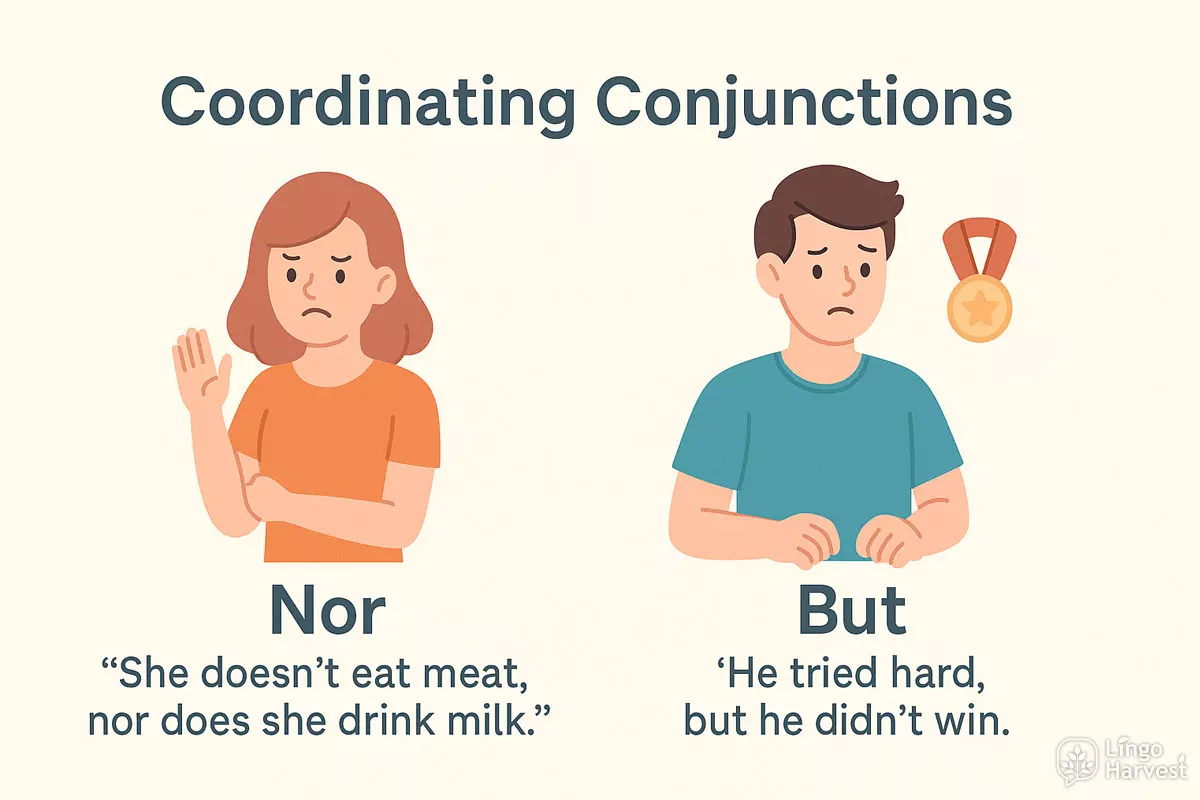
Coordinating conjunctions are used to link words, phrases, or independent clauses that are grammatically equal. The classic set can be remembered with the acronym FANBOYS:
- For – explains reason: "She was tired, for she had worked all day."
- And – adds one element to another: "He likes coffee and tea."
- Nor – presents a negative choice: "She doesn’t eat meat, nor does she drink milk."
- But – shows contrast: "He tried hard, but he didn’t win."
- Or – offers alternatives: "Would you like juice or water?"
- Yet – introduces something unexpected: "It was raining, yet they went for a walk."
- So – indicates result: "She was hungry, so she made a sandwich."
Subordinating Conjunctions
These connect a dependent (subordinate) clause to a main clause, showing relationships like time, cause, or condition. Here are some widely used subordinators:
- Although – "Although it was late, they kept talking."
- Because – "She left because she was tired."
- Since – "Since you’re here, let’s start the meeting."
- Unless – "You won’t pass unless you study."
- While – "She read while he cooked."
- After – "After the show ended, everyone applauded."
- Before – "Call me before you leave."
- If – "If it rains, we’ll stay inside."
- Though – "Though he was tired, he finished the race."
- When – "When you arrive, let me know."
Correlative Conjunctions
Correlative pairs work together to relate equal sentence elements. Here are some of the most common combinations:
| Pair | Example Sentence |
|---|---|
| Either / Or | You can either call me or send a message. |
| Neither / Nor | Neither the manager nor the assistant was available. |
| Both / And | Both the teacher and the students were excited. |
| Not only / But also | She is not only talented but also hardworking. |
| Whether / Or | He doesn’t know whether he’ll stay or leave. |
These examples show how connecting words help structure ideas and clarify meaning. By understanding the various types and their uses, you can make your writing clearer and more engaging.
Meaning and Structure
Conjunctions serve as essential connectors in language, joining words, phrases, or clauses to create smoother, more complex sentences. Without these linking words, communication would be choppier and ideas would be harder to relate to one another. Their main purpose is to show relationships such as addition, contrast, cause and effect, or choice between ideas.
What Do Conjunctions Do?
The primary function of conjunctions is to link elements within a sentence. They help organize thoughts and clarify how different parts of a sentence relate. For example, in the sentence "She wanted tea, but he preferred coffee," the word "but" connects two contrasting ideas.
Main Types of Conjunctions
There are three main categories:
- Coordinating conjunctions: Connect words, phrases, or clauses of equal importance (e.g., and, but, or, nor, for, so, yet).
- Subordinating conjunctions: Link a dependent (subordinate) clause to an independent one (e.g., because, although, if, unless, since, while, after, before).
- Correlative conjunctions: Work in pairs to connect balanced elements (e.g., either...or, neither...nor, not only...but also, both...and).
How Conjunctions Fit into Sentences
Conjunctions can join single words, groups of words, or whole clauses. Their position in a sentence depends on what they are connecting. For instance:
- Words: "Cats and dogs"
- Phrases: "in the morning or in the evening"
- Clauses: "He stayed home because it was raining."
Common Examples and Patterns
Here’s a selection of conjunctions, showing the variety and flexibility they bring:
- and
- but
- or
- so
- yet
- for
- nor
- because
- although
- since
- unless
- while
- after
- before
- if
- even though
- as long as
- both...and
- either...or
- not only...but also
Quick Comparison: Coordinating vs. Subordinating vs. Correlative
| Type | Purpose | Examples |
|---|---|---|
| Coordinating | Join equal elements (words, phrases, clauses) | and, but, or, so, yet, for, nor |
| Subordinating | Connect dependent clause to independent clause | because, although, if, since, unless, when |
| Correlative | Work in pairs to link balanced elements | either...or, neither...nor, both...and |
Understanding how these connectors work allows you to express ideas clearly and combine information smoothly, making your writing and speech more effective.
Typical Mistakes
Understanding how to use conjunctions correctly can be tricky, especially for learners and even native speakers. Many errors stem from confusion about how to join ideas or from overusing certain linking words. Here are some of the most common pitfalls and misunderstandings that arise when working with these connectors.
Common Errors When Using Linking Words
- Using a comma before "because":
Incorrect: I stayed home, because it was raining.
Correct: I stayed home because it was raining. - Joining two sentences with only a comma (comma splice):
Incorrect: She likes tea, he prefers coffee.
Correct: She likes tea, but he prefers coffee. - Misplacing correlative pairs (either...or, neither...nor):
Incorrect: Either you can call me or send a message.
Correct: You can either call me or send a message. - Using "and" or "but" at the beginning of every sentence (overuse):
For variety and clarity, try different connectors or sentence structures. - Confusing "although" and "but":
Incorrect: Although it was late, but he kept working.
Correct: Although it was late, he kept working. - Omitting needed conjunctions:
Incorrect: He wanted to leave he stayed until the end.
Correct: He wanted to leave, but he stayed until the end. - Incorrect sequencing with "so" and "because":
Incorrect: Because I was tired, so I went to bed early.
Correct: I was tired, so I went to bed early. - Mixing up "since" (time) and "since" (cause):
Be mindful of context to avoid ambiguity. - Using "and/or" too often:
This can confuse readers; choose one connector for clarity. - Forgetting parallel structure after paired conjunctions:
Incorrect: She likes to swim and biking.
Correct: She likes swimming and biking. - Inserting unnecessary conjunctions:
Incorrect: Because he was late, so he missed the bus. - Overusing "so" for every result:
Consider alternatives like "therefore," "thus," or simply rephrasing. - Repeating the same conjunction too frequently in a paragraph.
Contrast and Comparison Confusion
Writers often mix up connectors that express contrast or similarity. The table below shows examples of commonly confused pairs and how to use them properly.
| Incorrect Usage | Preferred Form |
|---|---|
| He is tall but he plays basketball. | He is tall, and he plays basketball. (Use "but" for contrast, "and" for addition.) |
| Although he was tired, but he finished the race. | Although he was tired, he finished the race. (Use only one conjunction.) |
| She is not only smart but also she is creative. | She is not only smart but also creative. (Keep parallel structure.) |
| He neither likes apples or oranges. | He likes neither apples nor oranges. (Use "nor" with "neither.") |
How to Avoid These Issues
Reading your sentences aloud can help spot awkward connections or missing links. Practice using a variety of connecting words, and double-check that each one fits the relationship you want to express. Remember, clear communication is the goal—if a sentence feels forced or confusing, try rephrasing or using a different connector.
Quick Practice
Ready to check your understanding? This section offers hands-on tasks to help you master the use of linking words in English sentences. You'll encounter fill-in-the-blank exercises, sentence combining tasks, and opportunities to identify correct connectors—all designed to reinforce your learning.
1. Fill in the Blanks
Choose the correct connecting word from the list to complete each sentence. Options: and, but, or, because, although.
- She likes apples, ____ she doesn't like oranges.
- We can go to the park ____ the museum.
- He was tired ____ he finished his homework.
- ____ it was raining, they played outside.
- I will stay home ____ it is too cold.
Show answers
- but
- or
- but
- Although
- because
2. Combine the Sentences
Join each pair of sentences using an appropriate connector. Choose from: and, so, but, because.
- It was late. We went home.
- She studied hard. She passed the exam.
- Tom is tall. His brother is short.
- I wanted to buy the book. I didn't have enough money.
Show answers
- It was late, so we went home.
- She studied hard, so she passed the exam.
- Tom is tall, but his brother is short.
- I wanted to buy the book, but I didn't have enough money.
3. Identify the Conjunction
In the sentences below, spot the linking word and write it down:
- Jane went out because the weather was nice.
- You can have tea or coffee.
- I will call you when I arrive.
- He was tired, yet he finished the project.
Show answers
- because
- or
- when
- yet
4. Common Coordinating and Subordinating Conjunctions
Here’s a handy reference list of widely-used connectors in English. These are grouped by type to help you recognize patterns and expand your vocabulary:
- Coordinating: and, but, or, nor, for, so, yet
- Subordinating: because, although, since, unless, while, after, before, if, when, even though
- Correlative: either...or, neither...nor, both...and, not only...but also, whether...or
5. Spot the Error
One of the following sentences contains a mistake with the connector. Find it:
- She wanted to go for a walk, but it was raining.
- He is smart and he is hardworking.
- I will visit you although I finish my project.
- They can have pizza or pasta for dinner.
Show answers
The mistake is in sentence 3: "although" should be "after" or "when" (correct: I will visit you after I finish my project.)