Numbers as Determiners: One, Two, Three

 Here we what number determiners are, how they’re used to count or identify nouns, where to place them in a sentence, and the different patterns for singular and plural forms. It also provides usage examples and a short practice section.
From counting apples to organizing teams, the use of digits such as one, two, or three shapes how we describe and clarify objects in everyday language. These simple numbers serve as precise clarifiers, helping us communicate quantities and specifics clearly. By recognizing how numbers function as descriptive words, we gain insight into their importance in effective communication, making our intentions and ideas easier for others to understand.
What Number Determiners Are
Numerals like “one,” “two,” and “three” often act as determiners in English, coming before nouns to specify quantity in a clear, countable way. In grammar, these are called cardinal number determiners. Their main job is to answer the question “How many?” about the noun that follows. Unlike adjectives that describe qualities, number determiners always indicate a specific count, which helps listeners or readers understand exactly what or how much is being referred to.
How Numerals Function as Determiners
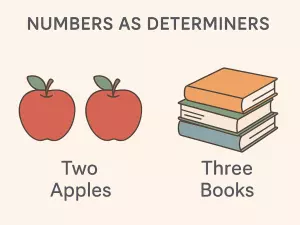
When a number is placed before a noun, it limits or “determines” the noun’s reference. For example, in “three cats,” the word “three” tells us exactly how many cats are being discussed. This is different from saying “few cats” or “many cats,” which are more general.
- one apple → a single fruit
- two chairs → a pair of seats
- five books → a specific set of books
- ten pencils → an exact number of writing tools
- four dogs → a counted group of animals
- seven tickets → a fixed quantity of entry passes
- twelve eggs → a measured set, often a carton
- nineteen students → a defined number of people in a group
- one hundred dollars → a precise amount of money
- thirty days → a complete period of time
- eight bottles → a specific count of containers
- six countries → a counted number of nations
- fifteen questions → a set number of tasks or prompts
- twenty cars → a defined quantity of vehicles
- three ideas → a small group of concepts
Key Features of Number Determiners
Number words used this way have a few important characteristics:
- They always come before the noun they modify (“two apples,” not “apples two”).
- They do not change form for singular or plural nouns, except for “one” (which only goes with singular nouns).
- They can combine with other determiners like “these” or “my” only in certain structures (e.g., “my three friends,” but not “the two the books”).
- They answer the question “how many?” directly.
Cardinal vs. Ordinal Numbers
It’s useful to distinguish between cardinal and ordinal numbers. Cardinal numbers (“one,” “two,” “three”) express quantity. Ordinal numbers (“first,” “second,” “third”) indicate position or order, and while they can also act as determiners, their function is slightly different.
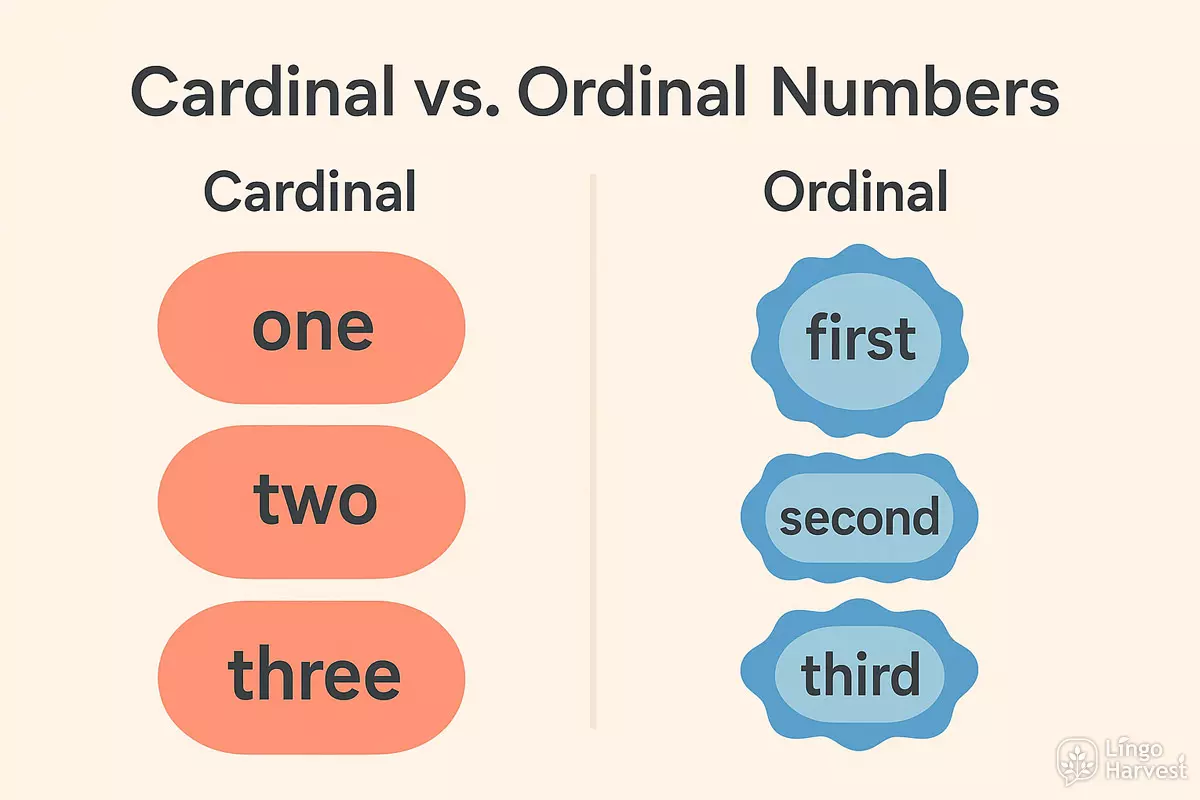
| Cardinal Number | Ordinal Number |
|---|---|
| one | first |
| two | second |
| three | third |
| four | fourth |
| five | fifth |
| six | sixth |
| seven | seventh |
| eight | eighth |
| nine | ninth |
| ten | tenth |
Grasping how numbers work as determiners helps clarify both meaning and grammar in English sentences. While they seem basic, these words play a crucial role in everyday communication by providing precise information about quantity.
Counting vs Identifying
Understanding how numbers work as determiners involves recognizing two distinct uses: quantifying items and distinguishing which item is meant. When using numbers like "one," "two," or "three," we might be focusing on how many objects there are, or which specific object is being referred to among several possibilities.
Counting: Expressing Quantity
When you use numbers to indicate how many objects are present, you are counting. This is the most familiar use, seen in sentences like "I have two apples" or "She found three coins." Here, the numeral tells us the exact amount, without specifying which particular apples or coins are involved. Counting answers questions like "How many?" and typically involves plural nouns for values above one.
- One cat is on the roof. (singular)
- Two cats are in the yard.
- Three books fell off the shelf.
- Five chairs are missing.
- Ten students joined the club.
- Six pencils are on the desk.
- Seven days make a week.
- Nine planets are in the solar system (by older models).
- Four cookies were eaten.
- Eight candles are on the cake.
Identifying: Specifying Which Item
Numbers can also help distinguish or identify a particular item from a group, much like demonstratives ("this," "that") or definite articles. In this context, the numeral singles out a specific member of a set. For example, "the one apple that is red" refers to a particular apple among several, not just to any apple. Identification answers questions such as "Which one?" or "Which ones?"
- Take the two envelopes on the left. (Which envelopes?)
- I want the one with the blue cover. (Which book?)
- Choose three questions to answer. (Which questions?)
- Pick the five best photos. (Which photos?)
- The ten runners who finished first. (Which runners?)
- She chose the four shortest routes. (Which routes?)
- The three students who arrived early. (Which students?)
- Give me the six clean plates. (Which plates?)
- He bought the seven largest eggs. (Which eggs?)
- Read the two most interesting articles. (Which articles?)
Comparison: Quantity vs. Specification
It helps to see the difference clearly by comparing how numbers work in both contexts side by side:
| Counting (How many?) | Identifying (Which ones?) |
|---|---|
| She has three dogs. (Total number owned) |
She walked the three dogs with spots. (Specifically those with spots) |
| There are five chairs in the room. | He repaired the five broken chairs. |
| I read two books last week. | I finished the two books you lent me. |
| We saw four birds outside. | We photographed the four colorful birds. |
Recognizing the difference between quantifying and specifying helps avoid confusion and clarifies meaning, especially in sentences where context could imply either interpretation. In summary, numbers as determiners have a flexible role: they can simply tell us the amount, or they can help us single out particular items from a group.
Placement Before Nouns
When we use numbers like one, two, or three to describe how many of something there are, they always come directly before the noun they modify. This position is fixed in standard English grammar, and it helps listeners or readers immediately understand the quantity being discussed. For instance, in the phrase "three books," the word "three" is placed right before "books" to indicate the exact number.
- one apple
- two chairs
- three dogs
- four pencils
- five students
- six cars
- seven houses
- eight tickets
- nine ideas
- ten fingers
- eleven cities
- twelve months
- thirteen questions
- fourteen birds
- fifteen minutes
Multiple Determiners: Order Matters
If you add other determiners (like "the," "my," or "these") along with a number, the number typically goes after the main determiner but before any adjectives and the noun. This order keeps the meaning clear and natural. For example, "my two old friends" is correct, while "two my old friends" sounds awkward.
| Correct Structure | Example |
|---|---|
| Determiner + Number + Adjective + Noun | these three large boxes |
| Possessive + Number + Noun | my two cousins |
| Article + Number + Noun | the five answers |
| Number + Adjective + Noun | four interesting stories |
Common Mistakes ❌
Some learners may mistakenly place the number after the noun ("books three") or separate it from the noun with other words ("the books three red"). Both patterns are incorrect in English. Always keep the number directly before the noun or any adjectives describing the noun.
Quick Tips ✅
- Numbers come before the noun, even with adjectives: "two tall men."
- If there is a determiner, the number follows it: "those five cats."
- Never put the number after the noun: Incorrect: "cats five."
- Use numbers for countable nouns, not for uncountables: "three bottles of water," not "three waters."
Understanding where to put numbers in relation to other words helps your sentences sound natural and clear. This pattern is consistent, making it easier to build correct English phrases as you communicate quantities.
Singular vs Plural Patterns
Understanding how numbers interact with nouns is essential in English grammar. When a number acts as a determiner, it directly affects whether we use a singular or plural noun. The most basic rule is that "one" pairs with a singular noun, while any number greater than one requires a plural form. However, there are nuances and exceptions that are helpful to know.
How Numbers Affect Noun Forms
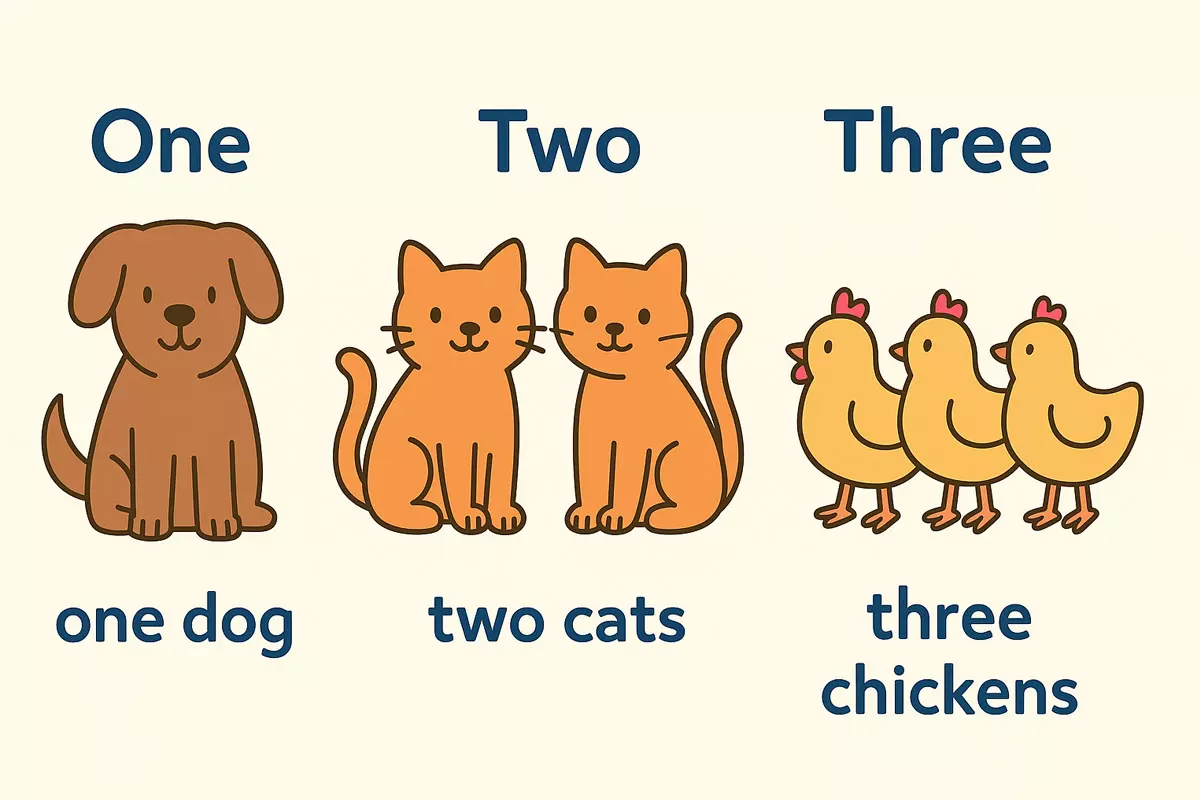
Numbers like "one," "two," or "three" are placed before countable nouns to indicate quantity. "One" is unique in that it always precedes a singular noun (e.g., "one apple"), while "two" and higher numbers are used with plural nouns ("two apples," "three chairs").
- One cat
- Two dogs
- Three books
- Four students
- Five cars
- Six houses
- Seven pencils
- Eight birds
- Nine cups
- Ten ideas
- Eleven tables
- Twelve eggs
Exceptions and Special Cases
Some nouns are uncountable and do not change form with numbers (e.g., "water," "information"). In these cases, you can't use numbers directly: ❌ "two waters" (unless referring to bottles of water). Instead, use a quantifier phrase: "two bottles of water." Collective nouns (e.g., "group," "team") usually remain singular even if the number is more than one: "one team," "two teams," but the members within may be plural.
Summary Table: Number + Noun Agreement
| Number | Example Phrase | Noun Form | Correct? |
|---|---|---|---|
| One | One apple | Singular | Yes (correct: singular after "one") |
| Two | Two apples | Plural | Yes (correct: plural after "two") |
| Three | Three apple | Singular | No (error: singular after "three"; should be plural: apples) |
| Three | Three apples | Plural | Yes (correct: plural after "three") |
| One | One dogs | Plural | No (error: plural after "one"; should be singular) |
| Five | Five book | Singular | No (error: singular after "five"; should be plural) |
| Five | Five books | Plural | Yes (correct: plural after "five") |
| Twenty | Twenty child | Singular | No (error: wrong form; should be "children") |
| Twenty | Twenty children | Plural | Yes (correct irregular plural) |
Quick Tips
- Always use a singular noun after "one."
- For numbers two and above, use the plural form.
- Do not use numbers directly with uncountable nouns.
- Watch for irregular plural forms (e.g., "one child," "two children").
- Some phrases with numbers are fixed expressions ("a pair of scissors").
Paying attention to these patterns helps your sentences sound natural and grammatically correct when using numbers as determiners.
Usage Examples
Numbers such as "one," "two," and "three" often act as determiners in English, directly modifying nouns to indicate quantity. They are used before countable nouns to specify exact amounts, helping to clarify meaning in both spoken and written language. Here are some practical ways these numerals appear in everyday contexts.
Common Patterns
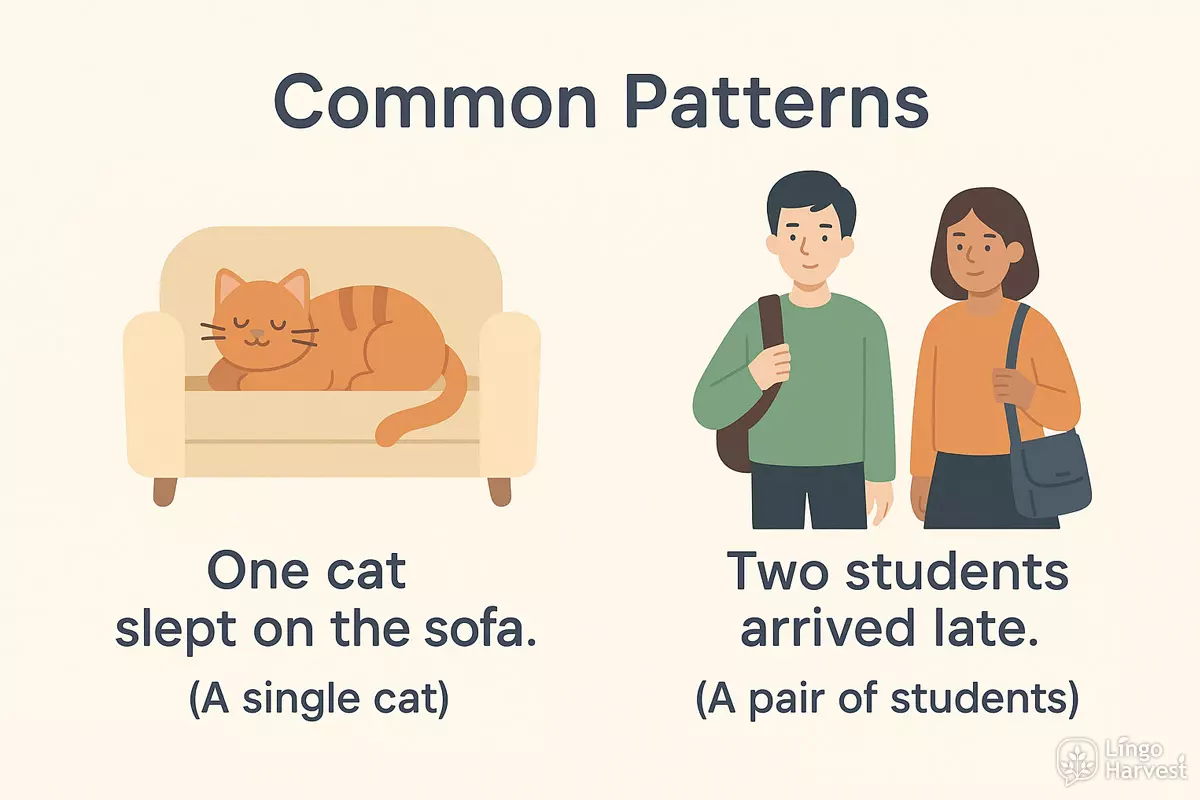
- One cat slept on the sofa. (A single cat)
- Two students arrived late. (A pair of students)
- Three apples are on the table. (Exactly three apples)
- One question remains unanswered.
- Two cars are parked outside.
- Three children played in the yard.
- I have one suggestion.
- She bought two tickets.
- We need three chairs for the meeting.
- One of the books is missing.
- Two weeks have passed.
- Three different colors are available.
Comparing Usage: Singular vs. Plural
| Number | Example Sentence |
|---|---|
| One | One dog barked loudly. ✅ (Singular noun) |
| Two | Two dogs barked loudly. ✅ (Plural noun) |
| Three | Three dogs barked loudly. ✅ (Plural noun) |
| One | One chair is broken. ✅ (Singular form) |
Notes on Usage
When using these words as determiners, remember to match the noun’s form: "one" is followed by a singular noun, while "two" and "three" take plural nouns. They can also be combined with adjectives: "two red apples," "three interesting books." This structure keeps quantity clear and sentences precise.
Short Practice
Understanding how to use numbers like one, two, and three as determiners is key to expressing precise quantities. Try the following activities to reinforce your grasp of their use in sentences. Practice identifying the noun each number is describing, and pay attention to how the noun often changes from singular to plural.
Fill in the Blanks
Complete each sentence by adding the appropriate number (one, two, or three) to match the quantity described in parentheses.
- I have ______ apple. (1)
- She saw ______ dogs in the park. (2)
- We bought ______ books at the store. (3)
- There is ______ chair in the room. (1)
- He caught ______ fish yesterday. (2)
- They have ______ bicycles. (3)
- I need ______ pencil. (1)
- Can you give me ______ cups? (2)
- She made ______ sandwiches. (3)
- There is ______ window open. (1)
Show answers
- one
- two
- three
- one
- two
- three
- one
- two
- three
- one
Identify the Determiner
In each sentence below, find and write down the word that acts as a determiner.
- One cat is sleeping on the sofa.
- Two birds are singing outside.
- Three friends went to lunch together.
- I saw one butterfly in the garden.
- He needs two tickets for the movie.
Show answers
- One
- Two
- Three
- one
- two
Quick Reference Table
This table shows how the noun changes depending on the number used. Notice the shift from singular to plural forms.
| Number | Example Phrase |
|---|---|
| one | one apple |
| two | two apples |
| three | three apples |
| one | one book |
| two | two books |
| three | three books |
Remember, using these basic numbers as determiners helps you specify exactly how many items or people you mean. With practice, you’ll naturally choose the correct form for both the numeral and the noun.