Quantifiers with Food, Drinks, and Containers Explained

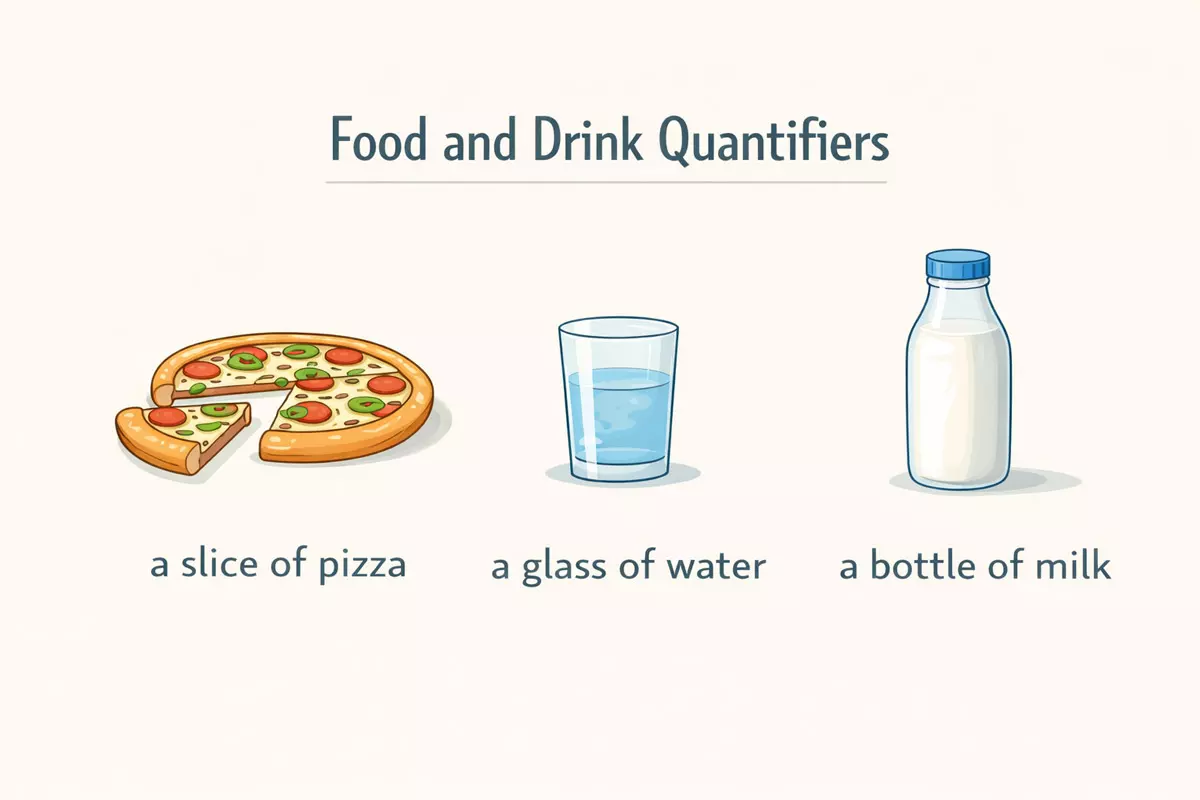 The article explains why food and drinks need container quantifiers, reviews common container nouns, shows their use in real-life contexts and menus, clarifies food items versus substances, highlights learner errors, and provides practice choosing the right quantifier.
- Why food and drinks often need container quantifiers
- Common container nouns and their usage
- Difference between food items and substances
- Sentence patterns with container expressions
- Typical everyday contexts for usage
- Common learner errors with food quantifiers
- Examples from menus and daily speech
- Practice: selecting the right food quantifier
Knowing how to discuss quantities when talking about food, drinks, and packaging helps you communicate more clearly and accurately. Whether you are describing how much coffee you want, how many slices of pizza you ate, or the number of bottles of water you bought, using the correct terms for amounts and containers makes your conversations easier to understand. Being able to specify quantities such as a cup of tea, a loaf of bread, or a piece of cake is useful in everyday situations, especially when ordering, shopping, or sharing recipes.
Why food and drinks often need container quantifiers
When talking about food and drinks, we frequently use container words to specify quantity, because many foods and liquids are naturally uncountable. You can’t simply say “three waters” or “two rices” without sounding odd or unclear. Instead, we rely on container quantifiers to make the meaning precise—both for everyday conversation and for clarity in recipes or shopping lists.
Making uncountable nouns countable
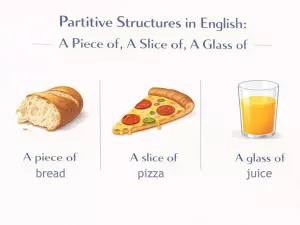
Most drinks and many foods are substances, not objects. To talk about a specific amount, we use a container or unit: “a cup of tea,” “a bottle of milk,” or “a slice of bread.” This helps listeners or readers understand exactly how much is meant.
- a glass of juice → I drank a glass of juice.
- a can of soda → He bought a can of soda.
- a bowl of soup → She had a bowl of soup for lunch.
- a piece of cake → I ate a piece of cake.
- a jar of honey → We opened a jar of honey.
- a packet of sugar → Can I have a packet of sugar?
- a slice of cheese → He put a slice of cheese on the sandwich.
- a carton of eggs → I need a carton of eggs.
- a cup of coffee → She made a cup of coffee.
- a bar of chocolate → I bought a bar of chocolate.
- a loaf of bread → We picked up a loaf of bread.
- a bottle of wine → They ordered a bottle of wine.
- a box of cereal → There is a box of cereal in the pantry.
- a tube of toothpaste → I need a new tube of toothpaste.
- a handful of nuts → He ate a handful of nuts.
- a pinch of salt → Add a pinch of salt.
- a stick of butter → She used a stick of butter.
- a drop of oil → Put a drop of oil on the pan.
Why containers add clarity
Specifying a container or unit helps avoid confusion. For example, “milk” by itself doesn’t tell you how much is needed or available. But “a glass of milk” or “two cartons of milk” gives clear information about the amount. This is especially important in recipes, restaurants, or stores, where misunderstanding could lead to mistakes or waste.
Comparing container quantifiers
Different foods and drinks use different container words, and some items can take more than one. Here’s a quick comparison:
| Food/Drink | Common Container Quantifiers |
|---|---|
| Milk | glass, bottle, carton, jug |
| Bread | slice, loaf, piece |
| Water | glass, bottle, cup, jug |
| Rice | bag, bowl, cup, packet |
| Soup | bowl, can, cup |
| Coffee | cup, mug, pot |
| Chocolate | bar, piece, box |
| Cereal | box, bowl, packet |
Summary
Container quantifiers are essential for expressing clear quantities with foods and drinks that can’t be counted directly. Using the right container word makes your meaning precise, whether you’re ordering at a café, following a recipe, or writing a shopping list.
Common container nouns and their usage
When talking about food and drinks, we often use specific words for containers to clarify quantity or presentation. These nouns help us describe how much of something there is, especially for items that aren’t easily counted on their own. They’re essential for everyday conversation and for following recipes or shopping lists.
Typical container nouns you’ll hear with food and drinks
You’ll often hear people use terms like “bottle,” “jar,” or “can” to talk about amounts of liquids or small items. These words aren’t just for physical objects—they also help us express quantity. Here are some common examples:
- a bottle of water → She drank a bottle of water after the workout.
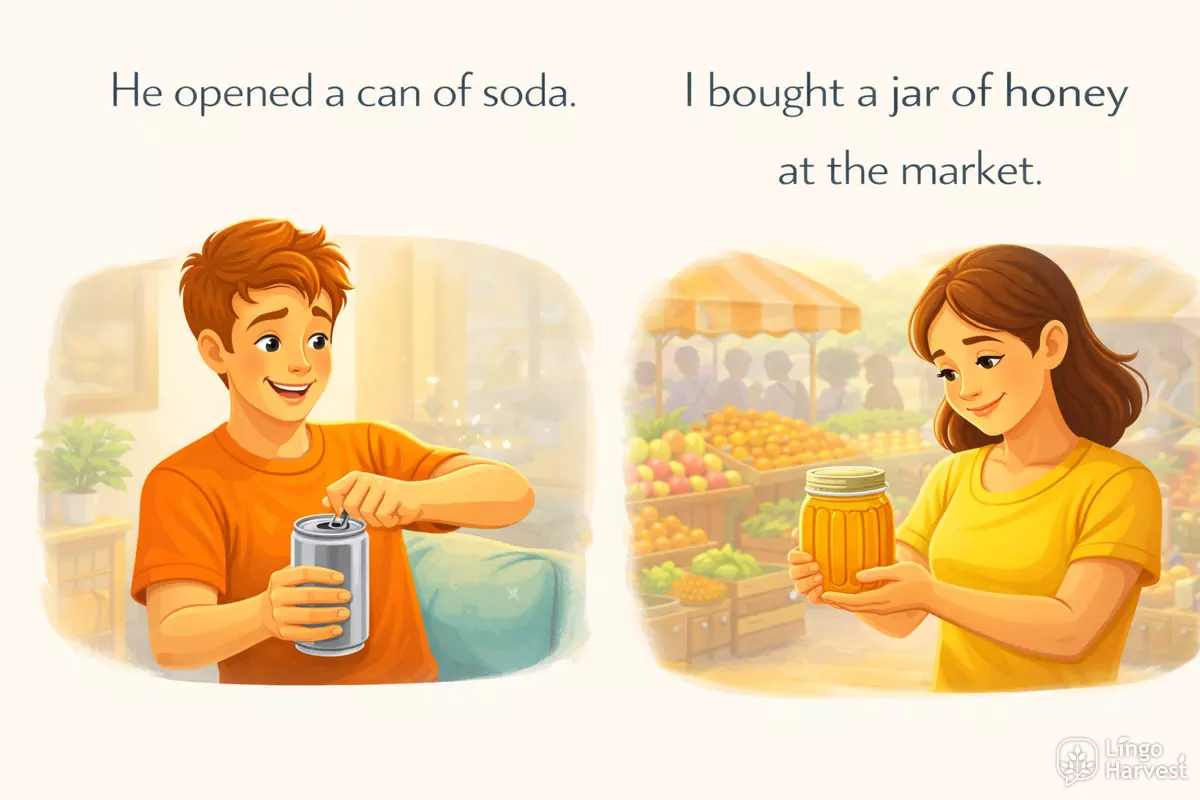
- a can of soda → He opened a can of soda.
- a jar of honey → I bought a jar of honey at the market.
- a box of cereal → There is a box of cereal on the shelf.
- a bag of rice → We need a bag of rice for dinner.
- a carton of milk → She poured a carton of milk into the fridge.
- a cup of tea → He made a cup of tea.
- a glass of juice → I had a glass of juice with breakfast.
- a bowl of soup → She ate a bowl of soup.
- a packet of chips → He shared a packet of chips.
- a tube of toothpaste → I bought a new tube of toothpaste.
- a slice of bread → She toasted a slice of bread.
- a piece of cake → I had a piece of cake.
- a bar of chocolate → He bought a bar of chocolate.
- a pot of yogurt → She opened a pot of yogurt.
- a roll of paper towels → We used a roll of paper towels.
- a stick of butter → Add a stick of butter to the pan.
- a bunch of grapes → He washed a bunch of grapes.
How container nouns work in sentences
Container nouns usually come after a quantifier (like “a” or a number) and before the preposition “of.” For example: “two bottles of juice,” “three cans of beans,” or “a loaf of bread.” This pattern lets us be specific about how much food or drink we mean.
Comparing common container nouns
Below is a table showing typical foods or drinks with containers that are used to describe them. This can help you choose the right word when talking about shopping, cooking, or ordering.
| Container Noun | Typical Contents |
|---|---|
| Bottle | Water, juice, wine, oil |
| Can | Soda, beans, soup, tuna |
| Jar | Jam, honey, pickles, peanut butter |
| Carton | Milk, eggs, juice, cream |
| Box | Cereal, pasta, cookies, tea bags |
| Bag | Rice, flour, chips, coffee |
| Packet | Sugar, seeds, instant soup, seasoning |
| Bowl | Soup, salad, noodles, fruit |
Why container nouns matter
Choosing the correct container expression can prevent confusion and make your meaning clear. For example, “a glass of milk” is very different from “a bottle of milk.” Using the right term helps you sound natural and precise in English conversations about food and drink.
Difference between food items and substances
Understanding how food is categorized in English is important for choosing the right quantifiers. In everyday speech, some foods are treated as individual items (countable), while others are seen as general substances (uncountable). This distinction affects which words you can use to talk about amounts, containers, and servings.
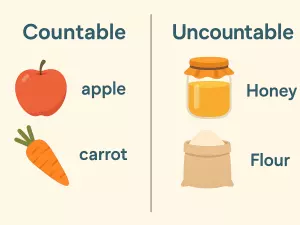
Countable food items
Countable foods are things you can separate and count individually. These often refer to whole units, pieces, or naturally discrete objects. For example, you can say “three apples” or “two sandwiches.” When you use quantifiers like many, a few, or numbers, you’re dealing with these kinds of foods.
- apple → I ate an apple after lunch.
- sandwich → She made two sandwiches.
- egg → He cooked three eggs for breakfast.
- carrot → Add one carrot to the soup.
- cookie → The child ate a cookie.
- banana → I bought five bananas.
- potato → We need four potatoes.
- tomato → She sliced a tomato.
- grape → He ate a grape.
- bottle (of water) → I drank a bottle of water.
Uncountable food substances
In contrast, some foods are treated as mass nouns or substances. These are not usually counted as individual pieces, but measured by volume, weight, or container. Words like much, a little, or some are typical quantifiers for these foods.
- milk → There is some milk in the fridge.
- rice → We cooked a lot of rice.
- cheese → She added some cheese to the pasta.
- water → Drink plenty of water.
- butter → Use a little butter.
- flour → I need some flour for the cake.
- sugar → Don’t add too much sugar.
- honey → He put a little honey in his tea.
- bread → We bought some bread.
- tea → She drinks tea every morning.
How grammar changes with food type
Choosing the right quantifier depends on whether the food is countable or uncountable. Here’s a quick comparison:
| Countable Food Item | Uncountable Food Substance |
|---|---|
| an apple, two apples | some apple, a bit of apple |
| a cookie, several cookies | some cookie dough, a little cookie mix |
| a sandwich, many sandwiches | some sandwich filling, much sandwich meat |
| a grape, a few grapes | some grape juice, a little grape jelly |
| a potato, a dozen potatoes | some mashed potato, much potato salad |
Changing context changes category
Some foods can be both countable and uncountable, depending on context. For example, “chicken” as a substance (“some chicken”) is uncountable, but as an item (“a chicken” on a farm or “two chickens” at the market), it’s countable. The same goes for “coffee”: “two coffees” means two cups, while “some coffee” means the drink in general.
- “I’d like three teas, please.” → Three cups of tea (countable by container)
- “There isn’t much tea left.” → The substance (uncountable)
- “We bought some bread.” → Uncountable substance
- “We bought three loaves of bread.” → Countable by type/container
Recognizing whether you’re talking about a food item or a general substance helps you pick the correct quantifiers and express quantities clearly in English.
Sentence patterns with container expressions
When talking about food and drinks, we often mention the container or amount to be more specific. Expressions like “a cup of tea” or “three bottles of water” help us describe exact quantities, making our meaning clearer in daily conversations. These structures are common in requests, offers, and when giving instructions or shopping lists.
How to build sentences with container phrases
The basic pattern is: Number/Quantifier + Container + of + Food/Drink. This structure lets you specify both the type and the amount of what you want or need. Here are some common ways to use these patterns:
- Could I have a glass of juice?
- We need two bottles of water for the trip.
- She bought a jar of honey at the market.
- He ordered a cup of coffee.
- Please get a loaf of bread.
- There is a packet of sugar in the cupboard.
- Can you pass me a bowl of soup?
- I ate a slice of cake.
- We have a carton of milk in the fridge.
- She poured a pitcher of lemonade.
- Buy a bag of rice at the store.
- He took a piece of chocolate.
- There’s a can of soda on the table.
- I’d like a handful of nuts.
- They shared a plate of pasta.
- Add a spoonful of salt to the soup.
- She made a pot of tea.
- We ordered a bucket of chicken.
Variations in container expressions
Sometimes, expressions use quantifiers like “some,” “many,” or “a few” instead of numbers. For example:
- We bought some cans of soda.
- There are a few boxes of cereal left.
- Do you have any jars of jam?
Comparing container and non-container quantifiers
When making choices about how much or how many, the container expression changes the focus from the item itself to the packaging or serving. Here is a comparison of typical quantifier patterns with and without containers:
| Without Container | With Container |
|---|---|
| some milk | a glass of milk |
| rice | a bowl of rice |
| water | a bottle of water |
| cheese | a slice of cheese |
| tea | a cup of tea |
| pasta | a plate of pasta |
Tips for using container-based patterns
- Choose containers that match the food or drink (e.g., “a carton of eggs,” not “a bottle of eggs”).
- Use singular or plural forms depending on quantity: “a bag of chips” vs. “two bags of chips.”
- For uncountable foods, containers help express quantity clearly.
- Pay attention to prepositions; “of” is almost always used after the container word.
By mastering these patterns, you can give and understand more precise information about food, drinks, and their packaging in English conversations.
Typical everyday contexts for usage
Quantifiers are a practical part of daily communication, especially when talking about food, beverages, and various containers. Whether shopping for groceries, preparing meals, or sharing food with others, people rely on these words to describe amounts clearly and avoid confusion. They help ensure everyone understands exactly how much of something is needed, wanted, or available.
In the kitchen and at the table
When cooking, measuring, or serving, it’s common to use expressions like “a cup of flour” or “a slice of bread.” These phrases make recipes and instructions easy to follow. During meals, requests such as “Can I have another glass of water?” or “Would you like some more salad?” use quantifiers to offer or ask for portions politely.
- Ordering at restaurants: “A bowl of soup,” “two bottles of water,” “some cheese.”
- Making grocery lists: “A bag of rice,” “a dozen eggs,” “a loaf of bread.”
- Sharing food: “A piece of cake,” “some cookies,” “a plate of fruit.”
- Describing leftovers: “There’s a little milk left,” “not much pasta remains,” “plenty of apples.”
- Giving directions: “Add a pinch of salt,” “pour half a cup of oil,” “use several tomatoes.”
- Offering drinks: “Would you like a cup of tea?” “Do you want another glass of juice?”
- Talking about preferences: “I don’t eat much meat,” “She likes a lot of vegetables.”
- Counting for recipes: “Three tablespoons of sugar,” “a handful of nuts.”
- Describing purchases: “A carton of milk,” “a pack of butter,” “a jar of honey.”
- Discussing quantity: “Too much salt,” “just enough flour,” “not enough coffee.”
Comparing quantifiers for different contexts
Some quantifiers are more appropriate for countable items, while others fit uncountable substances or specific containers. The table below highlights common patterns and their typical uses with foods, drinks, and packaging:
| Quantifier | Typical Example | Common Context |
|---|---|---|
| a slice of | a slice of cheese | Serving or sharing food |
| a bottle of | a bottle of water | Buying or offering drinks |
| a handful of | a handful of nuts | Adding ingredients to a recipe |
| some | some bread | General reference, uncountable items |
| many | many apples | Talking about countable foods |
| much | much sugar | Referring to quantity of uncountable foods |
| a cup of | a cup of tea | Drinks, cooking measurements |
| a can of | a can of soda | Buying or describing packaged drinks/foods |
Using the right quantifier helps make requests and instructions clear—whether you’re asking for “a piece of chocolate,” telling someone you have “a lot of fruit,” or specifying “a jar of jam” in your shopping list. These expressions are woven into the routines of eating, drinking, shopping, and cooking, making them essential for smooth and polite communication.
Common learner errors with food quantifiers
Understanding how to use words like "some," "any," "much," "many," and container phrases with food and drinks can be tricky for English learners. Learners often mix up which expressions go with countable or uncountable nouns, or use awkward combinations that don’t sound natural in English. Recognizing these typical mistakes is helpful for building confidence and fluency.
Mixing up countable and uncountable nouns
One of the biggest challenges is knowing which quantifier to use with different types of nouns. For example, "much" is used with uncountable items (like "water"), while "many" is for countable items (like "apples"). Learners sometimes use the wrong one, leading to confusion. Here are some examples of common mismatches and their corrections:
| Incorrect Usage ❌ | Correct Usage ✅ |
|---|---|
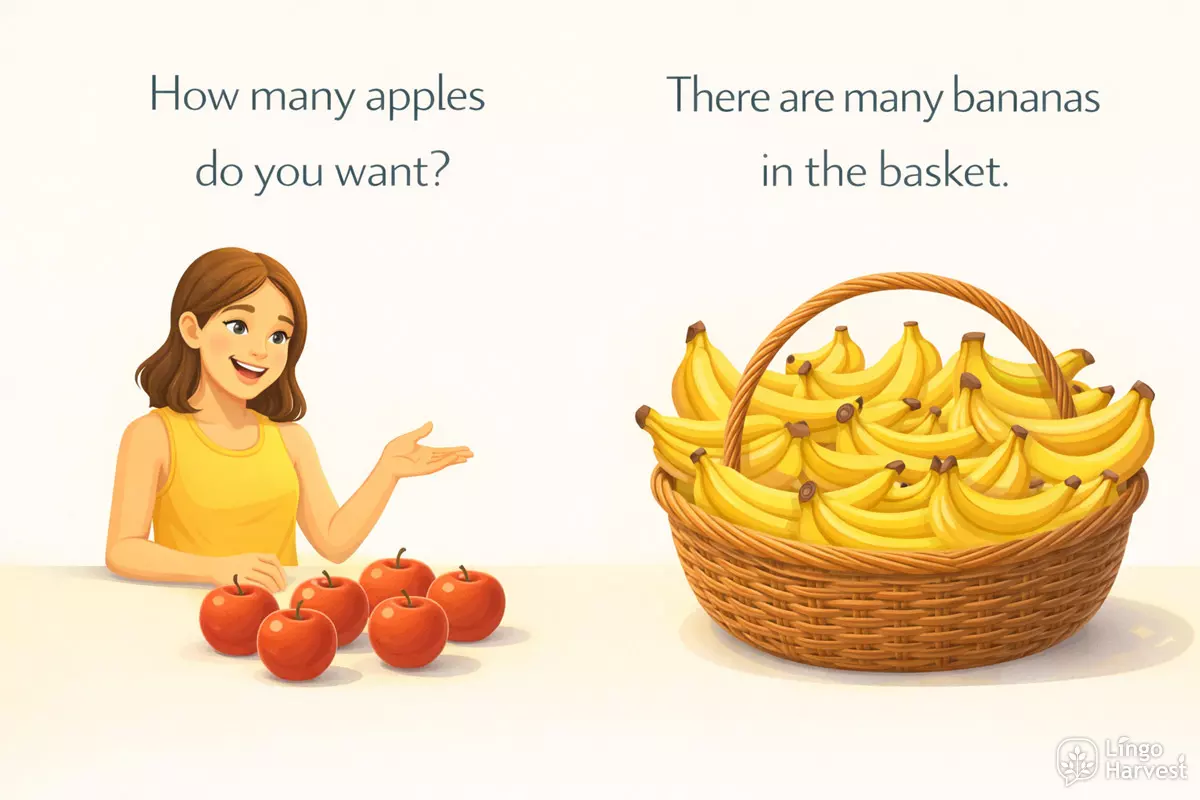
| How much apples do you want? | How many apples do you want? |
| I don’t have many milk. | I don’t have much milk. |
| There are much bananas in the basket. | There are many bananas in the basket. |
| I bought two breads. | I bought two loaves of bread. |
| I drank three waters. | I drank three bottles of water. |
Incorrect use of "some" and "any"
"Some" and "any" are often confused, especially in questions and negative sentences. "Some" is generally used in positive statements, while "any" is preferred in negatives and most questions. Here are a few examples:
- ❌ Do you have some eggs? → ✅ Do you have any eggs?
- ❌ I don’t have some juice. → ✅ I don’t have any juice.
- ❌ There isn’t any apples. → ✅ There aren’t any apples.
Problems with container phrases
Referring to uncountable foods (like "rice," "water," "bread") with numbers alone can sound unnatural. Instead, use container words or units, such as "a cup of," "a piece of," or "a slice of." Here are frequent mistakes and their improved versions:
- ❌ I’d like two coffees. → ✅ I’d like two cups of coffee.
- ❌ She bought three breads. → ✅ She bought three loaves of bread.
- ❌ Give me a water. → ✅ Give me a bottle of water.
- ❌ I ate a cheese. → ✅ I ate a piece of cheese.
Overusing "a lot of" and "lots of"
While "a lot of" and "lots of" are flexible and work with both countable and uncountable nouns, using them exclusively can make speech repetitive and imprecise. Try to vary your language by using "several," "a few," "a little," or specific container phrases.
- Try "several apples" instead of "a lot of apples."
- Use "a little milk" instead of "lots of milk."
- "A few sandwiches" is often more natural than "a lot of sandwiches."
Summary of tips to avoid mistakes
- Check if the food/drink noun is countable or uncountable.
- Use "many" for countable foods, "much" for uncountable items.
- Remember "some" for positive sentences, "any" in negatives or questions.
- Use containers or units for uncountable items when you need to count them.
- Vary your quantifiers for more natural language.
Practicing with real examples and noticing these patterns will help you avoid common pitfalls and sound more natural when talking about food and drinks.
Examples from menus and daily speech
When ordering meals or chatting about food and drinks, quantifiers and container words pop up everywhere. They help us specify amounts, portions, and serving sizes in clear terms. Whether you’re reading a restaurant menu or describing what you had for breakfast, these expressions make communication about food much easier and more precise.
Common phrases with quantifiers and containers
- a slice of pizza → He ate a slice of pizza.
- a cup of tea → She made a cup of tea.
- a piece of cake → I had a piece of cake.
- a bottle of water → He drank a bottle of water.
- a bowl of soup → She ordered a bowl of soup.
- a glass of juice → I poured a glass of juice.
- a can of soda → He opened a can of soda.
- a loaf of bread → We bought a loaf of bread.
- a bar of chocolate → She bought a bar of chocolate.
- a plate of pasta → He cooked a plate of pasta.
- a handful of nuts → She ate a handful of nuts.
- a jar of jam → I opened a jar of jam.
- a packet of chips → He shared a packet of chips.
- a spoonful of sugar → Add a spoonful of sugar.
- a jug of milk → There is a jug of milk on the table.
- a carton of eggs → We need a carton of eggs.
Real menu and conversation patterns
You might notice these expressions in both written and spoken English. For example, a café menu could offer “two scoops of ice cream,” while someone at home might say, “Could you pass me a bowl of rice?” These patterns help clarify how much or what size is being discussed.
| Menu Example | Daily Speech Example |
|---|---|
| “A pot of herbal tea” | “Let’s share a pot of tea.” |
| “Three slices of toast” | “I had two slices of toast for breakfast.” |
| “A pint of lager” | “Can I get a pint of beer?” |
| “A bowl of miso soup” | “Would you like a bowl of soup?” |
| “A basket of fries” | “They brought us a basket of fries.” |
| “A pitcher of lemonade” | “We made a pitcher of lemonade.” |
Typical quantifiers for food and drinks
We often use quantifiers like “some,” “a little,” “a lot of,” or “many” when discussing food in general, especially for things that can’t be counted individually. For example:
- “There’s a little milk left in the fridge.”
- “She ate some grapes.”
- “We don’t have much coffee.”
- “How many cookies are there?”
- “He drinks a lot of water.”
These expressions are not just about quantity—they also convey politeness, precision, and context, making them essential for natural, effective communication about meals and beverages.
Practice: selecting the right food quantifier
Choosing the correct quantifier for food, drinks, and containers can be confusing, especially when switching between countable and uncountable nouns. To build your confidence, this section offers guided exercises and examples to help you match food items with the most natural quantifiers in English.
Common Quantifiers and Food Examples
Here’s a list of typical quantifiers used with different types of foods and beverages. Notice how some quantifiers work only with uncountable nouns, while others fit countable items or containers.
- a slice of bread → She toasted a slice of bread.
- a loaf of bread → We bought a loaf of bread.
- a piece of cake → He ate a piece of cake.
- a cup of tea → I made a cup of tea.
- a glass of water → Drink a glass of water.
- a bottle of juice → She opened a bottle of juice.
- a bar of chocolate → He bought a bar of chocolate.
- a bowl of soup → She had a bowl of soup for lunch.
- a can of soda → He drank a can of soda.
- a jar of honey → I opened a jar of honey.
- a carton of milk → There is a carton of milk in the fridge.
- a packet of biscuits → She shared a packet of biscuits.
- a handful of nuts → He ate a handful of nuts.
- a bunch of grapes → She washed a bunch of grapes.
- a spoonful of sugar → Add a spoonful of sugar.
- a plate of pasta → He ordered a plate of pasta.
- a bag of rice → We need a bag of rice.
- a drop of oil → Add a drop of oil to the pan.
- a pinch of salt → Add a pinch of salt.
- a piece of cheese → She cut a piece of cheese.
Matching Quantifiers to Food Items
Let’s see how different quantifiers pair with various foods and drinks. This table shows which quantifiers are typically used with common items.
| Food/Drink | Natural Quantifier(s) |
|---|---|
| Bread | a slice, a loaf, a piece |
| Milk | a glass, a cup, a bottle, a carton |
| Chocolate | a bar, a piece, a box |
| Rice | a bowl, a bag, a cup |
| Tea | a cup, a pot, a glass |
| Soup | a bowl, a cup, a pot |
| Sugar | a spoonful, a bag, a cube |
| Water | a glass, a bottle, a drop |
| Pizza | a slice, a piece, a whole |
| Honey | a jar, a spoonful, a drop |
Quick Practice: Choose the Correct Quantifier
For each sentence below, select the most natural quantifier from the options. Write your answer, then check below:
- I’d like ________ of cake, please. (a slice / a glass / a bag)
- She poured ________ of juice for everyone. (a cup / a bottle / a loaf)
- He bought ________ of rice from the store. (a bag / a bar / a drop)
- Would you like ________ of water? (a glass / a piece / a plate)
- They shared ________ of pizza at the party. (a slice / a spoonful / a jar)
- She added ________ of sugar to her coffee. (a spoonful / a slice / a bottle)
- He ordered ________ of soup for lunch. (a bowl / a bar / a packet)
- I need ________ of bread for breakfast. (a loaf / a drop / a cup)
- She bought ________ of chocolate at the shop. (a bar / a bag / a jug)
- Can you pass me ________ of salt? (a pinch / a piece / a carton)
Show answers
- a slice
- a bottle
- a bag
- a glass
- a slice
- a spoonful
- a bowl
- a loaf
- a bar
- a pinch
Tips for Selecting Quantifiers
- Use container words for liquids (e.g. a cup, a bottle, a glass).
- Choose portion words for foods that can be divided (e.g. a slice, a piece, a bar).
- Remember, some foods require specific quantifiers (e.g. a loaf of bread, a bunch of grapes).
- If unsure, “some” works for most uncountable foods, but sounds less precise.