Numbers as Determiners: Two Apples, Three Books

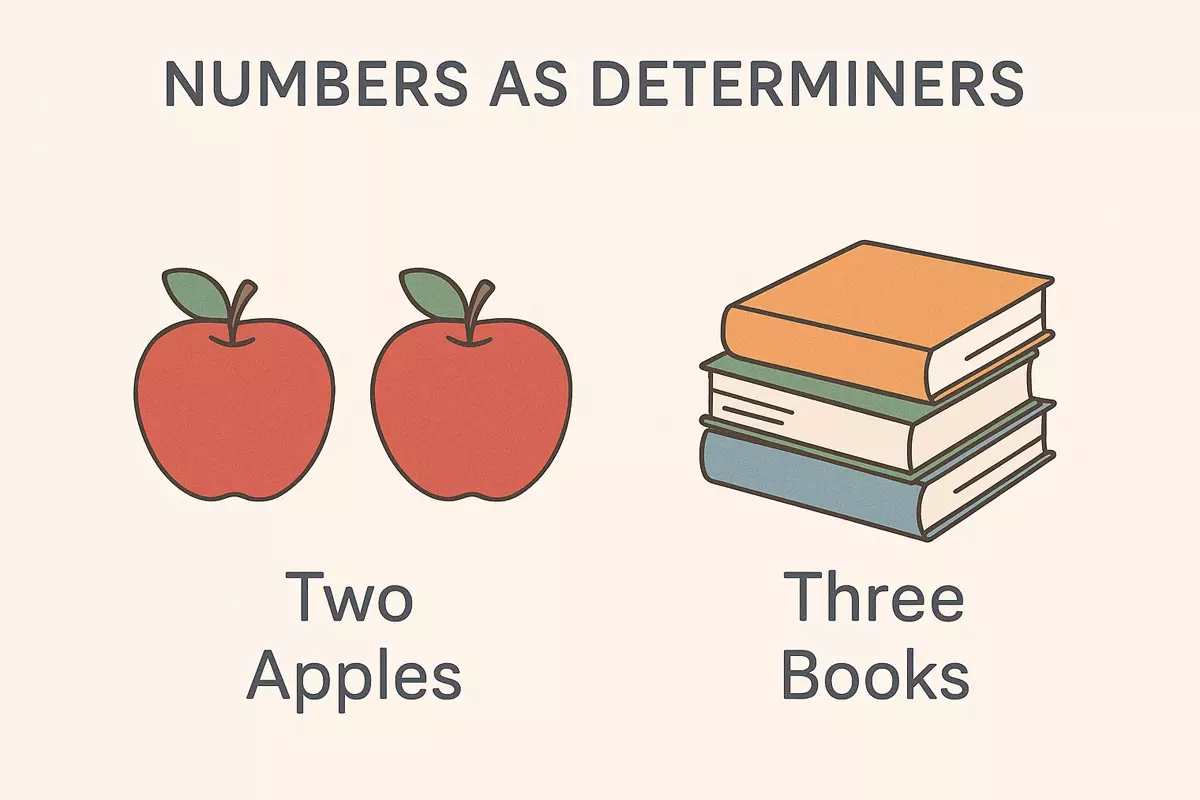 This article explains number and noun agreement in English, including how to use numbers with singular, plural, and of-phrases like a group of. It covers real-life examples in shopping, cooking, and planning, plus common mistakes and practice tips.
From our earliest experiences counting objects as children, we discover that words such as two and three serve a dual purpose: they not only indicate quantity but also specify which and how many items are being referred to in conversation. Examining the grammatical role of these numerals highlights their importance in fostering precise and effective communication, as they help us convey clear information and avoid ambiguity in everyday language.
Number + Noun Agreement (singular/plural)
When numbers are used as determiners before nouns, the form of the noun changes depending on the value of the number. For most countable nouns, using "one" requires the singular form, while numbers greater than one require the plural. This rule helps keep communication clear and grammatically correct.
How Numbers Affect Noun Forms
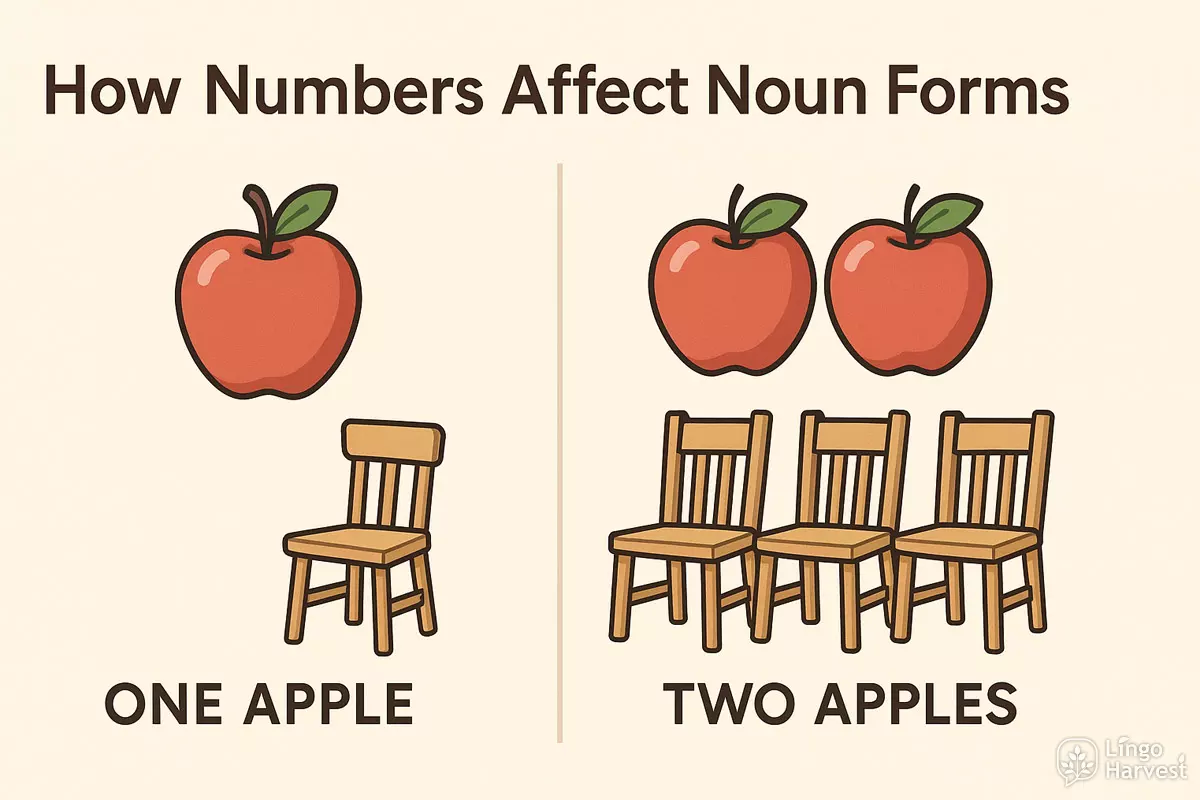
If you use “one,” always pair it with a singular noun: “one apple,” “one chair.” For any number that is two or higher, use the plural noun: “two apples,” “three chairs.” This pattern is consistent for regular countable nouns in English.
Common Examples
- one book → three books
- one car → seven cars
- one dog → five dogs
- one student → ten students
- one apple → two apples
- one house → four houses
- one cat → six cats
- one pen → nine pens
- one child → eight children
- one foot → two feet
- one person → three people
- one mouse → five mice
- one tooth → seven teeth
- one goose → ten geese
- one man → six men
- one woman → two women
- one leaf → four leaves
- one box → five boxes
- one baby → three babies
- one city → two cities
Irregular Plurals and Special Cases
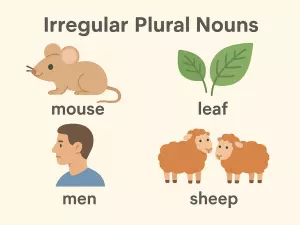
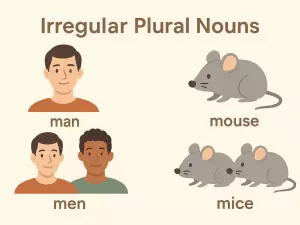
Some nouns have irregular plural forms that do not simply add -s or -es. For example, “child” becomes “children” and “mouse” becomes “mice.” Always check the correct plural form when using numbers with these nouns.
| Singular (after “one”) | Plural (after numbers ≥2) | Example Sentence |
|---|---|---|
| one child | two children | There are two children in the room. |
| one man | three men | Three men are waiting outside. |
| one mouse | five mice | We saw five mice in the field. |
| one tooth | seven teeth | He lost seven teeth last year. |
| one person | four people | Four people joined the meeting. |
Uncountable Nouns
Numbers are not used directly with uncountable nouns like “water,” “rice,” or “information.” To express quantity, a measure word is needed: “two bottles of water,” “three pieces of information.”
Summary Tips
- Use singular nouns with “one.”
- Use plural nouns with numbers two or higher.
- Check for irregular plural forms.
- For uncountables, add a counting word (e.g., “three cups of tea”).
Making sure the noun matches the number helps your sentences sound natural and accurate.
Zero vs One vs Many
When using numbers as determiners, the distinction between none, a single item, and more than one is fundamental to meaning and grammar. Languages often treat these cases differently, influencing not just the words we use but also verb agreement and noun forms. Let's explore how "zero," "one," and "many" shape our expressions about quantity.
Zero: Expressing Absence
The concept of "zero" signals that nothing of a particular item is present. In English, we say "zero apples" or "no books." Notice that the noun takes the plural form, even though the count is none. This pattern is consistent across many quantifiable nouns:
- Zero chairs
- No pencils
- Zero options
- No coins
- Zero mistakes
Unlike "one," which needs the singular, zero always pairs with plural nouns. This reflects the idea that zero refers to the absence of any members of a set.
One: Singularity and Specificity
Using "one" marks a single item. Here, the noun is singular: "one apple," "one book." The verb that follows also matches the singular subject. Some languages may use a special singular form only with "one," and English sometimes allows dropping the number entirely if context is clear:
- One cat is sleeping.
- One glass remains.
- One ticket is left.
- One student passed.
- One reason matters.
The article "a" or "an" can often substitute for "one," but using "one" adds emphasis or contrast.
Many: Plurality in Numbers
Once the quantity is greater than one, the noun changes to the plural form: "two apples," "three books," "four chairs." Verbs adjust to agree with the plural subject. In English, all numbers above one use the plural, but in some languages, different forms exist for small numbers (such as special dual or paucal forms).
- Two apples are on the table.
- Three books were borrowed.
- Five students attended.
- Ten coins were found.
- Twenty options remain.
- Hundreds of mistakes were corrected.
Note that the pattern holds regardless of the actual number, as long as it's not one or zero.
Comparison Overview
| Quantity | Noun Form & Example | Typical Verb Agreement |
|---|---|---|
| Zero | Plural: zero apples, no books | Plural verb: There are no apples. |
| One | Singular: one apple, one book | Singular verb: There is one apple. |
| Many (2+) | Plural: two apples, three books | Plural verb: There are two apples. |
Understanding these differences helps with accurate and natural-sounding sentences, especially for learners of English and other languages that mark quantity through noun and verb forms. The interplay between the number word, the noun, and verb agreement is an essential foundation for expressing quantity clearly.
With of-Phrases (a group of)
When expressing numbers in English, it’s common to use “of” phrases to describe collections or quantities in a more flexible way. Instead of simply stating “two apples” or “three books,” you might say “a pair of apples” or “a stack of books.” These constructions let you group items, often with a nuance of arrangement, type, or relationship. The noun following “of” is always in the plural if it refers to countable items.
Common Patterns with “of” Phrases
You’ll encounter a variety of expressions that use this structure. Some refer to specific numbers, while others describe an indefinite group. Here are typical forms:
- a pair of shoes
- a bunch of grapes
- a set of keys
- a group of friends
- a flock of birds
- a pile of books
- a pack of cards
- a dozen of eggs (more commonly “a dozen eggs” but sometimes with “of”)
- a collection of stamps
- a row of houses
- a cluster of stars
- a team of players
- a herd of cows
- a stack of plates
- a troop of scouts
- a string of pearls
- a fleet of ships
- a series of events
When to Use “of” Phrases
Use these constructions when you want to emphasize the nature of the group or the way items are organized:
- Describing collections: “a collection of rare books”
- Indicating arrangement: “a row of chairs,” “a bunch of flowers”
- Referring to typical groupings: “a pack of wolves,” “a school of fish”
They’re especially useful when the number is less exact or when the grouping itself is more important than the precise count.
Comparing Simple Numbers and “of” Phrases
Simple numeral expressions focus on quantity, while “of” phrases often add context or detail. For instance, “three apples” just tells you the number, but “a bunch of apples” suggests the apples are together, possibly on a stem.
| Simple Number | “Of” Phrase | Nuance/Context |
|---|---|---|
| two apples | a pair of apples | Exactly two, usually matched or linked |
| twelve eggs | a dozen of eggs | Standard quantity, often packaged |
| five books | a stack of books | Arranged in a pile, no exact number |
| ten cards | a pack of cards | Full set, typically 52, grouped as a unit |
| many birds | a flock of birds | Group moving or living together |
Notes on Usage
Some “of” phrases are standard and well-established (“a herd of cattle”), while others are more creative or context-specific. The noun after “of” usually takes a plural form for countable objects, but there are exceptions with mass nouns (“a glass of water”). Be attentive to idiomatic usage, as some phrases are fixed and can’t be freely formed. In summary, these group expressions add flexibility and vividness, helping you describe not just how many, but how items are organized or related.
Real-Life Uses (shopping, cooking, planning)
Numbers as determiners show up everywhere when we talk about daily tasks. Whenever you buy groceries, follow a recipe, or organize events, using numbers to specify amounts keeps things clear and efficient. Instead of saying “some apples,” saying “two apples” removes confusion about quantity and helps with organization.
Examples in Everyday Activities

- At the supermarket: “I need five bananas and three lemons.”
- In recipes: “Add two cups of flour and one teaspoon of salt.”
- Making a to-do list: “Complete three assignments today.”
- Event planning: “Reserve ten chairs for the meeting.”
- Packing: “Bring four shirts and two pairs of jeans.”
- Budgeting: “Spend no more than twenty dollars.”
- Scheduling: “Meet with two clients this afternoon.”
- Ordering food: “We’d like three pizzas, please.”
- Household chores: “Wash six plates and four cups.”
- Travel: “Book two tickets for Friday.”
- Shopping for gifts: “Buy eight cards for the team.”
- Inventory: “Count twelve notebooks in stock.”
- Sharing: “Divide the cake into six pieces.”
- Classroom: “Hand out five worksheets to each group.”
- Gardening: “Plant ten seeds per row.”
- Moving: “Pack three boxes with books.”
- Meal prep: “Chop four carrots.”
- Exercise: “Do fifteen push-ups.”
- Decorating: “Hang up seven balloons.”
- Pet care: “Feed the cat two times a day.”
Why Precise Quantities Matter
Stating exact numbers helps avoid misunderstandings. If a recipe calls for three eggs, using the correct number ensures the dish turns out right. In shopping, specifying “two bottles of water” prevents overbuying or running short. When planning, numbers help allocate resources and time efficiently.
Comparing Quantity Expressions
| General Expression | Number as Determiner |
|---|---|
| Some apples | Two apples |
| Many books | Three books |
| Several tickets | Five tickets |
| A few chairs | Ten chairs |
| Enough plates | Six plates |
Using numerals to specify quantity is a practical tool in communication, streamlining everything from shopping lists to event schedules. It ensures tasks are completed accurately and expectations are clear for everyone involved.
Typical Mistakes and Repairs
When using numbers as determiners in English, especially with countable nouns like "apples" or "books," learners often make predictable errors. These usually involve agreement, noun forms, or word order. Below, you'll find detailed notes and practical advice to help avoid common pitfalls and polish your usage of numeric determiners.
Frequent Errors with Number Determiners
- Using singular nouns after numbers greater than one: Incorrect: "two apple" ❌ Correct: "two apples" ✅
- Adding an article before the number: Incorrect: "the two apples" (when simply counting) ❌
- Omitting the noun and leaving the number dangling: Incorrect: "I have two." (when the noun is not clear from context) ❌
- Mixing up word order: Incorrect: "apples two" ❌
- Pluralizing uncountable nouns: Incorrect: "three milks" ❌ Correct: "three bottles of milk" ✅
- Using plural verbs with singular subjects: Incorrect: "One books are on the table." ❌
- Forgetting to change the noun for irregular plurals: Incorrect: "two childs" ❌ Correct: "two children" ✅
- Repeating the number unnecessarily: Incorrect: "I have two of two apples." ❌
- Using "a" or "an" instead of "one" for emphasis: Incorrect: "A apple is missing." (for emphasis) ❌
- Confusing "a couple of" with exact numbers: Incorrect: "a couple apples" (missing "of") ❌
How to Fix These Mistakes
To improve accuracy, follow these repair strategies:
- Always match the noun form: Use plural nouns after numbers greater than one, and the singular after "one."
- Drop articles before number determiners unless you are specifying a known group ("the two apples on the plate").
- Clarify the noun if context doesn’t make it obvious, especially in writing or formal speech.
- Keep the order: number + noun (e.g., "three books," not "books three").
- For uncountable items, use a quantifying phrase: "two glasses of water," not "two waters."
- Learn irregular plural forms and double-check them in sentences.
Quick Reference: Correct and Incorrect Usage
| Incorrect Example | Corrected Version |
|---|---|
| three apple | three apples |
| the two books | two books |
| five childs | five children |
| seven waters | seven bottles of water |
| books three | three books |
| one apples | one apple |
By paying attention to these details, you can use numeric determiners confidently and avoid mistakes that commonly trip up learners. Practice with a variety of nouns, both regular and irregular, to reinforce these patterns in everyday speech and writing.
Practice: Describe Quantities
Understanding how numbers function as determiners is essential for clear communication. Let’s explore how to accurately describe amounts in different contexts, using both simple and slightly more complex examples.
Task 1: Identify the Quantity
Read each phrase and write down the number and the object being counted:
- Four chairs
- Seven pencils
- Nine oranges
- One cat
- Sixteen candles
- Three buses
- Twelve eggs
- Five books
- Eight sandwiches
- Ten coins
Show answers
- Four chairs: 4 chairs
- Seven pencils: 7 pencils
- Nine oranges: 9 oranges
- One cat: 1 cat
- Sixteen candles: 16 candles
- Three buses: 3 buses
- Twelve eggs: 12 eggs
- Five books: 5 books
- Eight sandwiches: 8 sandwiches
- Ten coins: 10 coins
Task 2: Make Sentences Using Quantities
Combine a number and a noun from the list below to create a correct phrase. For example, “two apples.”
- 2, 11, 4, 13
- cars, plates, dogs, windows
Example answers: 2 cars, 11 plates, 4 dogs, 13 windows.
Show answers
- 2 cars
- 11 plates
- 4 dogs
- 13 windows
Task 3: Choose the Correct Quantity
Select the correct number for each sentence:
- There are _____ apples in the basket. (five / fifteen)
- She has _____ notebooks. (one / eleven)
- We saw _____ birds in the tree. (three / thirty)
- He bought _____ shirts. (seven / seventeen)
Show answers
- five
- eleven
- three
- seven
Common Patterns with Numbers as Determiners
Below is a table showing how numbers can be used with different countable nouns to describe quantities:
| Number | Example Phrase |
|---|---|
| Two | Two apples |
| Three | Three books |
| Five | Five chairs |
| Ten | Ten pencils |
| Twelve | Twelve eggs |
Task 4: Describe the Picture (Imagination Exercise)
Imagine you see a table with the following objects. Write a sentence for each, using the correct number as a determiner.
- 5 cups
- 3 plates
- 8 spoons
- 1 teapot
- 7 napkins
Show answers
- There are five cups on the table.
- There are three plates on the table.
- There are eight spoons on the table.
- There is one teapot on the table.
- There are seven napkins on the table.
By practicing these exercises, you can improve your ability to use numbers as determiners and describe quantities clearly in everyday situations.