Interjections in Grammar (Not Usage)

 The article details interjections in grammar, discussing their function, where they appear in sentences, punctuation guidelines, how they interact with clauses, and restrictions on their use. It ends with brief practice exercises.
Bursting with emotion or surprise, those little words we blurt out—such as wow or ouch—serve a unique purpose in the structure of sentences. Known as interjections, they express feelings, reactions, or sudden exclamations, and are often set apart from the main flow of a sentence. By injecting excitement, pain, or other emotions, interjections add flavor and spontaneity to our language, making conversations more lively and authentic. Their presence highlights how language can capture immediate responses and convey tone beyond basic grammar.
Grammar Status
Interjections occupy a unique position in the structure of language. Unlike nouns, verbs, or adjectives, these expressive words do not typically interact with other sentence elements through grammatical agreement or syntactic roles. They stand apart, often inserted into sentences to convey emotion, reaction, or spontaneous feeling, without affecting the grammatical construction of the sentence itself.
Recognizing Interjections in Sentence Structure
Interjections are considered independent elements. They are not required for a sentence to be grammatically complete, and their removal does not disrupt sentence structure. For example, in "Wow, that was unexpected," the word "Wow" expresses surprise but does not modify or relate grammatically to the rest of the sentence.
Features Distinguishing Interjections
- No grammatical relation to other words in the sentence
- Do not inflect for tense, number, or gender
- Often set apart by punctuation such as commas or exclamation marks
- Can function as standalone utterances (e.g., "Ouch!")
- Express emotion, reaction, or sudden feeling
- May be used in both formal and informal contexts, though more common in speech
- Cannot be modified by adjectives or adverbs in the usual way
- Do not serve as subjects, objects, or predicates
- Sometimes borrowed sounds or words (e.g., "ugh", "psst")
- Can appear at the beginning, middle, or end of a sentence
Comparison with Other Word Classes
| Word Class | Role in Grammar |
|---|---|
| Noun | Serves as subject or object; agrees with verbs and determiners |
| Verb | Expresses actions or states; conjugates for tense, aspect, and agreement |
| Adjective | Modifies nouns; may inflect for degree |
| Interjection | Independent; expresses emotion or reaction; no grammatical links to sentence |
Typical Examples
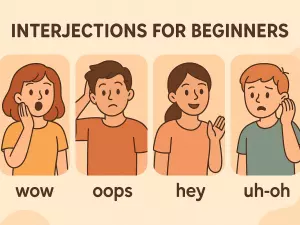
Here are some frequently used interjections that illustrate their grammatical independence:
- Oh
- Wow
- Hey
- Oops
- Yikes
- Alas
- Bravo
- Uh-oh
- Hurray
- Ouch
- Ah
- Aha
- Gee
- Ugh
- Yay
- Hmm
- Shh
- Whoa
Interjections add color and immediacy to language, but from a structural perspective, they remain outside the core systems of grammar. Their main function is to convey speakers’ feelings or reactions, rather than to serve any syntactic or morphological purpose.
Sentence Position
Where interjections appear in a sentence can affect both their function and the tone they convey. Unlike most parts of speech, these words or phrases are set apart by punctuation and are not linked grammatically to the rest of the clause. They most commonly come at the very beginning, but can also appear in other locations for emphasis or stylistic reasons.
Common Placements for Interjections
Writers and speakers tend to place these expressions in three main spots:
- Initial: At the start of a statement, before the main clause (e.g., Wow, that’s amazing!).
- Medial: Inserted within a sentence, often offset by commas or dashes (e.g., The answer, alas, was incorrect.).
- Final: At the end, sometimes after the main thought (e.g., You did it, hooray!).
Punctuation and Separation
Interjections are usually separated from the surrounding sentence by a comma, exclamation point, or dash. The choice depends on the intensity and the flow of the sentence. A strong emotion might call for an exclamation mark, while a milder reaction is often set off by commas.
Examples in Different Positions
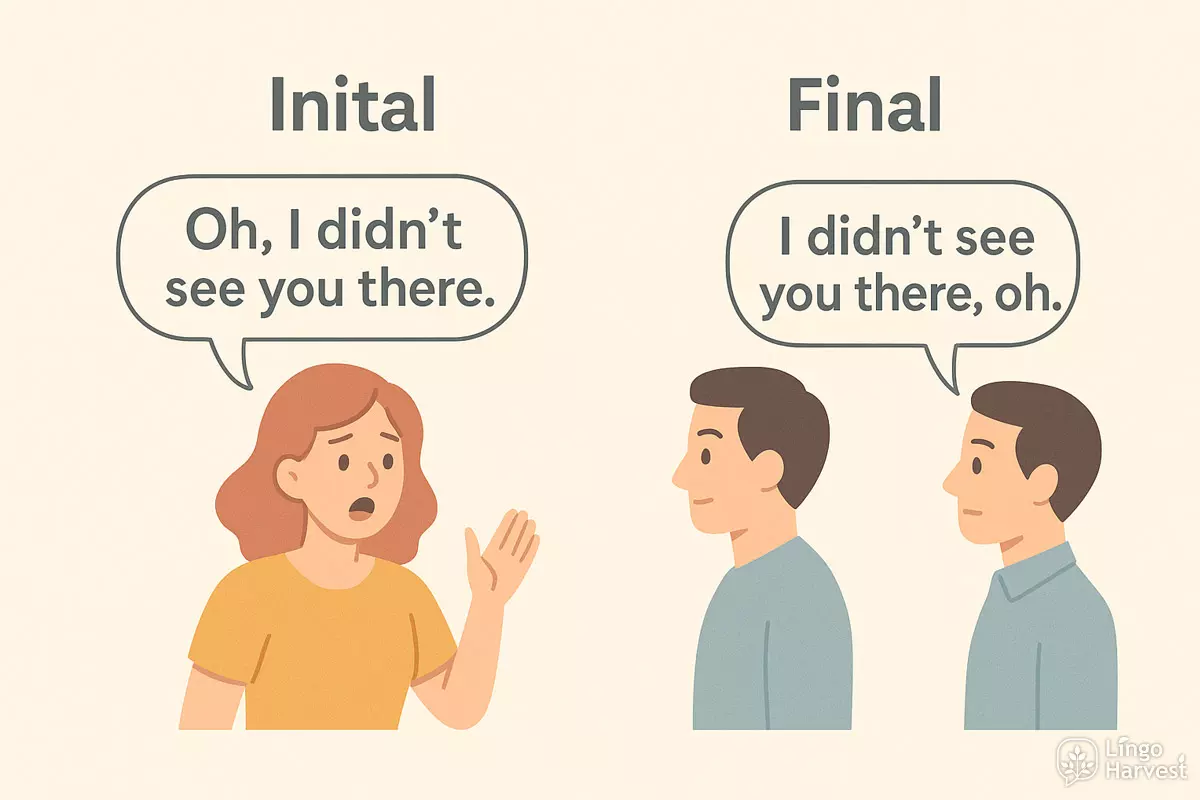
Placement can subtly shift the nuance or emphasis. Consider these examples:
- Oh, I didn’t see you there. → Initial
- I didn’t see you there, oh. → Final
- The test, whew, was difficult. → Medial
- Hmm... let’s think about it. → Initial
- That was, yikes, a close call. → Medial
- You won, bravo! → Final
- Phew! We made it on time. → Initial
- The answer is, unfortunately, incorrect. → Medial
- We missed the bus, ugh. → Final
- Hey, what’s going on? → Initial
- I’m not sure, hmm, what to do. → Medial
- She finished first, wow! → Final
Comparing Placement Effects
The location of an interjection can subtly change the mood or focus. For more structured comparison, see the table below:
| Position | Effect & Example |
|---|---|
| Beginning | Immediately grabs attention; sets emotional tone. Oops, I forgot my keys. |
| Middle | Interrupts for emphasis or adds nuance. The food, yum, was delicious. |
| End | Acts as a punchline or afterthought. You missed it, darn! |
Summary
Interjections are flexible in placement but always remain separate from the core grammar of the sentence. Their position—initial, medial, or final—can influence both the reader’s focus and the emotional impact of the statement.
Punctuation Rules
When interjections appear in sentences, their punctuation depends on the emotional force and their position. These exclamatory elements often stand alone, but they can also be woven into statements, questions, or commands. The choice of punctuation helps convey the speaker’s feelings and intent.
Common Punctuation Marks for Interjections
Writers use several marks to signal the tone and function of these words or phrases. Here’s how they typically appear:
- Exclamation point (!): Used for strong emotion or surprise (e.g., Wow! Oops!).
- Comma (,): Indicates mild emotion or a pause (e.g., Well, I suppose so.).
- Question mark (?): Used for uncertainty or surprise in a question (e.g., Huh? Really?).
- Period (.): Rare, but possible when the interjection is calm or understated (e.g., Oh. I didn’t know.).
Placement in Sentences
Interjections can appear at the beginning, middle, or end of a sentence. When they interrupt, set them off with commas or em dashes. For example:
- Beginning: Alas, we missed the bus.
- Middle: The answer, oh, is more complicated.
- End: You finished the race—bravo!
Examples of Interjections with Punctuation
Below are examples of how these expressions interact with punctuation in actual sentences:
- Yikes! That was close.
- Hmm, I’m not sure about this plan.
- Uh-oh, we forgot the tickets.
- Hey! Watch out!
- Well, let’s get started.
- Oh. You’re here already.
- Bravo! You did it!
- Ouch! That hurt.
- Wow, that’s impressive.
- Gee, thanks for the help.
- Ugh, I can’t believe it.
- Oops, I spilled my coffee.
- Eh, it’s not important.
- Phew! That was exhausting.
- Yay! We won!
- Oh no! The cake is ruined.
- Huh? What did you say?
- Shh, the movie is starting.
- Ah, that makes sense now.
- Whoa! Did you see that?
Quick Reference Table
| Interjection | Punctuation Mark | Effect/Usage |
|---|---|---|
| Wow | ! | Strong surprise or admiration |
| Well | , | Mild hesitation or introduction |
| Oh | . / ! / , | Surprise, realization, or pause |
| Hmm | , | Thinking, uncertainty |
| Huh | ? | Confusion or question |
| Oops | ! / , | Minor mistake or accident |
Summary Tips
Choose your punctuation based on the emotion and place of the interjection. Exclamation marks show intensity, commas signal softer pauses, and question marks fit uncertainty. Proper punctuation helps readers interpret the mood and rhythm of your writing.
Interaction with Clauses
Interjections typically stand apart from the main structure of sentences, but their relationship with clauses is worth examining. Unlike verbs, nouns, or conjunctions, these words or phrases do not form part of the core grammatical architecture of independent or dependent clauses. Instead, they often interrupt, precede, or follow clauses, providing emotional color, emphasis, or reaction without altering the clause’s grammatical integrity.
Position Relative to Clauses
Interjections can appear at the very beginning of a sentence, before the main clause, or even between clauses. Their placement affects the tone and rhythm of speech or writing but does not change the clause’s grammatical function. Some common patterns include:
- Before the main clause: Wow, that was unexpected.
- Within a clause (parenthetically): That was, alas, the last piece.
- After the clause: You finished the race, bravo!
Punctuation and Separation
Because they are not grammatically linked to clauses, interjections are usually set off with commas, exclamation marks, or dashes. This separation visually and audibly marks their independence from clause structure, emphasizing their role as emotional or contextual commentary.
Effect on Clause Meaning
While these elements do not modify the grammatical structure, they do influence interpretation and nuance. For instance, “Oh, you’re here” can express surprise, whereas “Well, you’re here” might signal resignation or expectation.
Examples of Interjections in Relation to Clauses
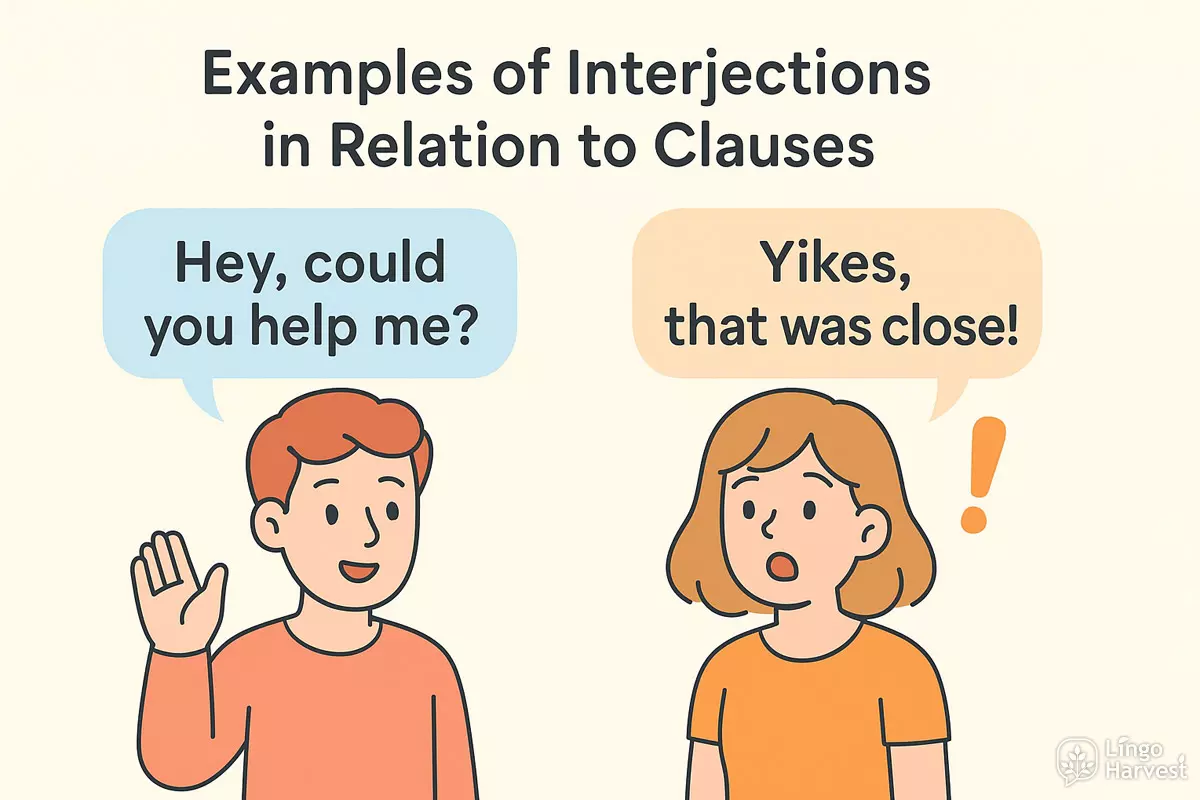
A variety of words and phrases can function in this way. Here are several examples showing their interaction with surrounding clauses:
- Oh, I didn’t see you there.
- Geez, that’s a lot of work!
- It’s raining, ugh.
- Hey, could you help me?
- Yikes, that was close!
- Hmm, I’m not sure.
- Well, let’s get started.
- Oops, I dropped it.
- Bravo, you did it!
- Alas, it was too late.
- Wow, what a view!
- Phew, that was tough.
- Ah, now I understand.
- Hey, is anyone there?
- Oh no, we’re lost!
Summary Table: Interaction Patterns
| Interjection Position | Example with Clause |
|---|---|
| Sentence-initial | Ouch, that hurt. |
| Parenthetical (within clause) | That was, alas, inevitable. |
| Sentence-final | You did it, wow! |
| Between clauses | We tried our best—well, almost. |
In summary, interjections interact with clauses by providing commentary or reaction, but they remain outside the grammatical framework of the clause itself. Their placement and punctuation signal this independence while still affecting the tone and meaning of the overall sentence.
Restrictions on Use
While interjections add emotion and spontaneity to language, there are important boundaries on where and how they fit within grammatical structures. These expressive words or phrases do not typically interact with other sentence elements and, as such, are not always welcome in every context.
In formal writing or professional communication, using interjections is generally discouraged. Their informal, often exclamatory nature can undermine the tone of academic papers, business documents, or legal texts. Instead, they are most at home in dialogue, casual writing, or spoken exchanges, where conveying emotion, surprise, or reaction is appropriate.
Contexts Where Interjections Are Limited
- Academic essays ❌
- Formal reports or official correspondence ❌
- Legal and technical documents ❌
- News articles (except in direct quotations) ❌
- Professional presentations ❌
- Conversational speech ✅
- Fictional dialogue ✅
- Personal letters or emails ✅
- Text messages and informal chats ✅
- Children’s literature and comics ✅
Grammatical Boundaries
Unlike nouns or verbs, interjections do not have grammatical relationships with other sentence components. They stand alone, often set off by punctuation (commas, exclamation marks), and cannot be conjugated, declined, or modified. Attempting to attach grammatical endings or use them as substitutes for other parts of speech is incorrect.
Common Interjection Misuses
- Placing an interjection within a clause: Incorrect: "He, wow, finished early."
- Using as a subject or object: Incorrect: "Oops was the answer."
- Adding tense or number endings: Incorrect: "He ohs loudly."
- Overusing in formal settings: Too many "oh!" or "well," in a research paper.
Summary Table: Acceptable vs. Restricted Use
| Situation | Interjection Usage |
|---|---|
| Formal Academic Writing | Not appropriate ❌ |
| Spoken Conversation | Common and natural ✅ |
| Fictional Dialogue | Often used for realism ✅ |
| Business Emails | Best avoided ❌ |
| Texting/Informal Messaging | Widely accepted ✅ |
In sum, while exclamatory words and sounds bring color and immediacy to informal exchanges, they are limited by context and grammatical independence. Recognizing these boundaries ensures both clarity and appropriateness in communication.
Short Practice
To reinforce your understanding of interjections as grammatical elements, try identifying, classifying, and using them in different contexts. Interjections are unique in that they often stand alone or insert emotion, reaction, or sound into a sentence. Below are some targeted exercises and a reference list to build your familiarity with common forms.
Identify the Interjection
Read each sentence below. Underline the word or phrase functioning as an interjection.
- Oops, I dropped my keys!
- Wow! That was an amazing performance.
- Hey, could you help me with this?
- Uh-oh, looks like we’re out of milk.
- Yikes, that was a close call.
Show answers
- Oops
- Wow
- Hey
- Uh-oh
- Yikes
Common Interjections by Emotion
Here is a categorized list of interjections, grouped by the feeling or function they tend to express. Use this as a quick reference or inspiration for your own examples.
- Surprise: Wow, Whoa, Oh, Gosh
- Pain: Ouch, Ow, Yowch
- Hesitation: Um, Er, Uh
- Greeting: Hello, Hi, Hey
- Disgust: Ew, Yuck, Ugh
- Relief: Phew, Whew
- Joy: Yay, Hooray, Woohoo
- Attention: Look, Listen, Shh
- Agreement: Yes, Yeah, Yup
- Disagreement: No, Nope, Nah
- Farewell: Bye, Goodbye, See ya
- Encouragement: Go, Come on, Bravo
- Shock: Whoa, Goodness, Heavens
- Disappointment: Alas, Oh no, Drat
Choose the Correct Interjection
Fill in the blank in each sentence below with an appropriate interjection from the list above:
- _____, I can’t believe you remembered my birthday!
- _____, that hurt when I stubbed my toe.
- _____, someone is at the door.
- _____, let’s get started!
- _____, I finally finished my project!
Show answers
- Wow / Oh
- Ouch / Ow
- Hey / Look
- Come on / Go
- Yay / Hooray / Woohoo
Interjection Placement Comparison
Compare how the position of an interjection can affect the tone or clarity of a sentence. Here are several examples:
| Sentence | Effect |
|---|---|
| Oh, I didn’t see you there. | Surprise or realization |
| I didn’t see you there, oh. | Surprise after the fact, more reflective |
| Hey! Stop that. | Getting attention, emphasis on command |
| Stop that, hey! | Command first, interjection as an afterthought |
Practice Writing Your Own
Try composing three sentences of your own that begin with, end with, or include an interjection. Focus on variety in emotion and placement.
Show answers
- Yikes, that was unexpected!
- Can you believe it, wow?
- Hooray! We finished on time.