Adverbs of Frequency: Always, Usually, Sometimes, Never

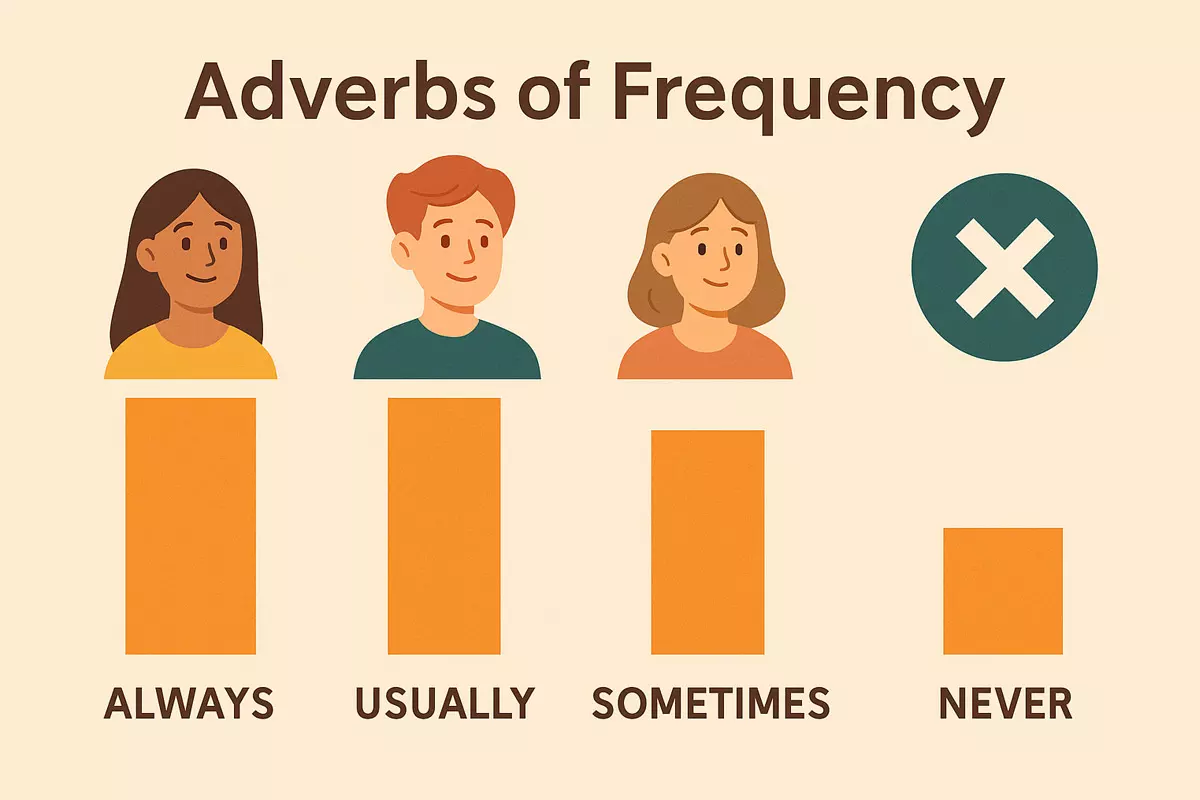 This article explains adverbs of frequency, their scale from 0 to 100 percent, and correct placement with be and other verbs. It covers using them for habits in present simple, common errors like double negatives, and practice for weekly routines.
If you want to talk about how frequently you do something in English, you can use words like always, usually, sometimes, and never. These adverbs of frequency help you describe your habits and routines in a clear and natural way. For example, you might say, I always have coffee in the morning, or I never eat dessert after dinner. Learning to use these words correctly will make your conversations more precise and help others understand your daily activities and preferences.
Meaning on a Scale (0–100%)
When we use words like "always," "usually," "sometimes," and "never," we’re really talking about how often something happens. Each of these adverbs expresses a different frequency, representing a position on a scale from 0% (not at all) to 100% (all the time). Understanding where each fits on this scale helps you communicate more precisely about how often things occur in daily life.
Frequency Ranges for Common Adverbs
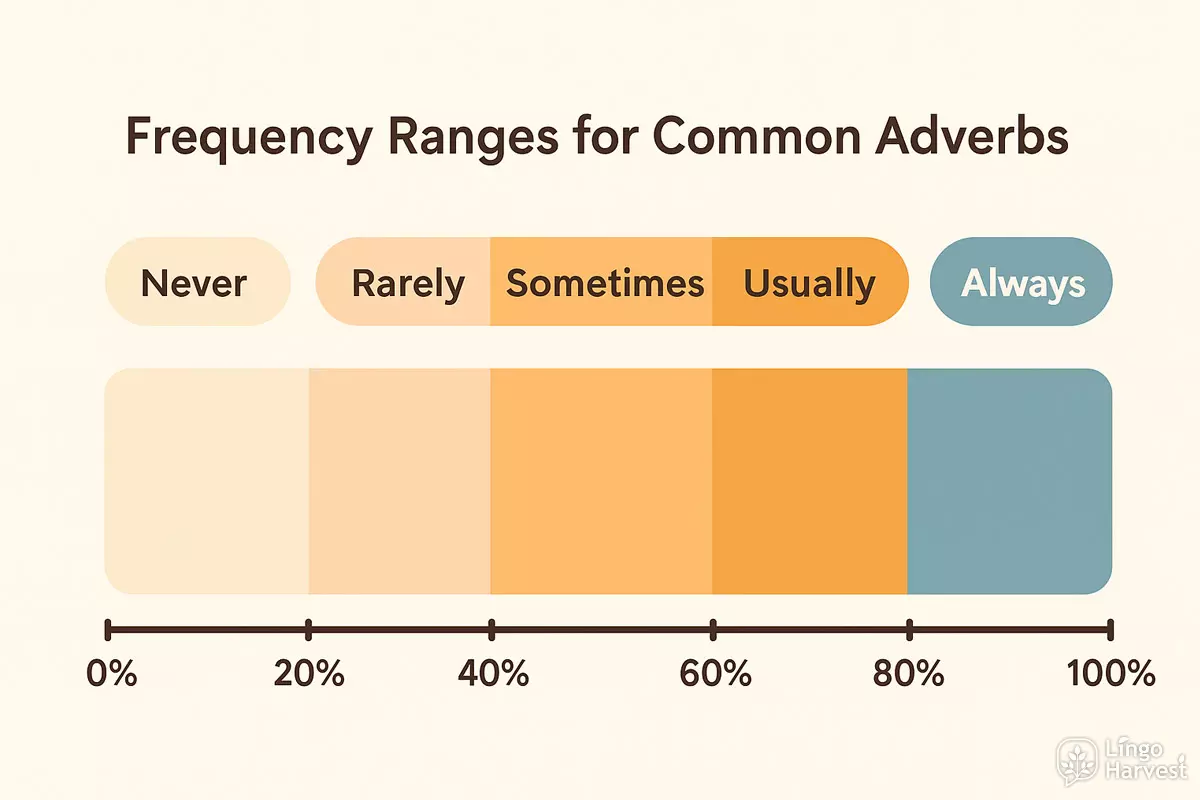
You can think of these words as markers along a spectrum. Here’s where each typically falls:
- Always – 100% of the time
- Usually – about 80–90%
- Often – around 60–80%
- Frequently – about 60–80%
- Sometimes – roughly 30–50%
- Occasionally – about 10–30%
- Rarely – 5–10%
- Seldom – 5–10%
- Hardly ever – 1–5%
- Never – 0%
Comparing Adverbs of Frequency
To see the differences more clearly, here is a structured comparison of several common options, showing approximate percentages and example sentences:
| Adverb | Approximate Frequency | Example |
|---|---|---|
| Always | 100% | She always drinks tea in the morning. |
| Usually | 80–90% | We usually walk to work. |
| Often | 60–80% | He often plays chess after dinner. |
| Sometimes | 30–50% | They sometimes eat out on Fridays. |
| Occasionally | 10–30% | I occasionally read poetry. |
| Rarely | 5–10% | We rarely watch TV. |
| Never | 0% | He never smokes. |
Key Points to Remember
- The scale is not absolute—context and personal habits can shift meanings slightly.
- Some adverbs overlap in range (for example, "often" and "frequently"), so choose the one that feels most natural for your situation.
- Using these words makes your statements clearer and helps listeners understand exactly how often you mean.
By matching these expressions with their typical percentages, you can make your English more accurate and nuanced when talking about routines, habits, and exceptions.
Where They Go with Be vs Other Verbs
Adverbs of frequency—like always, usually, sometimes, and never—have specific places in English sentences, and their exact position depends on the main verb. With the verb be, these adverbs typically come directly after the verb itself. In contrast, for all other verbs, the adverb usually goes before the main verb but after the subject. This difference can make a big impact on how natural your sentences sound.
Placement with the Verb Be
When using forms of be (am, is, are, was, were), place the frequency adverb right after the verb. For example:
- She is always on time.
- They are usually friendly.
- I am sometimes tired in the morning.
- He was never late for class.
Placement with Other Verbs
For all other verbs (like eat, go, work), the adverb comes after the subject but before the main verb. This is the most common word order in everyday English:
- She always eats breakfast.
- They usually play soccer on weekends.
- I sometimes read before bed.
- He never forgets his keys.
Comparing Word Order
To make it easier to visualize, here’s a side-by-side comparison of how adverbs of frequency fit into sentences with be verbs versus other verbs:
| With Be Verbs | With Other Verbs |
|---|---|
| She is never late. | She never arrives late. |
| They are usually happy. | They usually smile a lot. |
| I am sometimes busy. | I sometimes work late. |
| He was always polite. | He always greeted everyone. |
Extra Tips for Using Frequency Adverbs
- Don’t put frequency adverbs at the very start or end of the sentence (except for emphasis or informal speech).
- In questions, place the adverb after the subject: “Do you usually walk to work?”
- With modal verbs (can, will, should), the adverb comes after the modal: “You can always ask for help.”
- Some adverbs (sometimes, usually) can move for emphasis, but the most neutral position is before the main verb or after be.
Mastering these positions helps your English sound smoother and more natural, making your meaning clear every time you use words like never or always.
Habits and Routines in Present Simple
Daily actions and typical behaviors are often described using the present simple tense, especially when talking about what someone does on a regular basis. Adverbs of frequency—such as always, usually, sometimes, and never—help clarify how often these activities happen. These words add useful detail and make it easier to describe patterns in everyday life.
Using Adverbs of Frequency
Frequency adverbs usually go before the main verb (except to be, where they come after). Here are some common examples in context:
- I always drink coffee in the morning.
- She usually walks to school.
- They sometimes play chess after dinner.
- We never eat fast food.
- He is always on time.
- My brother never watches horror movies.
- We usually have lunch together.
- It sometimes rains in April.
- I always read before bed.
- She never forgets her keys.
Placement of Adverbs
The position of these adverbs is important for clarity. Most often, they are placed:
- Before the main verb: He usually cooks dinner.
- After the verb "to be": They are always friendly.
Comparing Frequency
Different adverbs express different levels of frequency. The table below shows how these words compare in describing how often something happens:
| Adverb | Frequency (%) | Example |
|---|---|---|
| Always | 100% | I always brush my teeth. |
| Usually | 80–90% | She usually gets up early. |
| Sometimes | 30–50% | We sometimes go to the cinema. |
| Never | 0% | He never eats meat. |
Common Habits to Describe
Here are some typical daily and weekly routines you might talk about using these adverbs:
- Go jogging in the morning
- Check email after breakfast
- Read the news online
- Call parents on Sundays
- Do homework before dinner
- Take the bus to work
- Cook dinner at home
- Walk the dog in the evening
- Meet friends on weekends
- Watch TV before bed
- Visit the gym after work
- Water the plants every week
- Go shopping on Fridays
- Play a musical instrument
- Clean the house on Saturdays
- Drink tea in the afternoon
- Write in a journal
- Listen to music while studying
Short Answers and Follow-ups
When talking about how often something happens, we often answer questions quickly and then add more information. This is common in everyday conversation, especially when using words like “always,” “usually,” “sometimes,” or “never.” Giving a short answer first makes communication clear and efficient, and a follow-up sentence helps explain your habits or routines in detail.
Common Short Answer Patterns
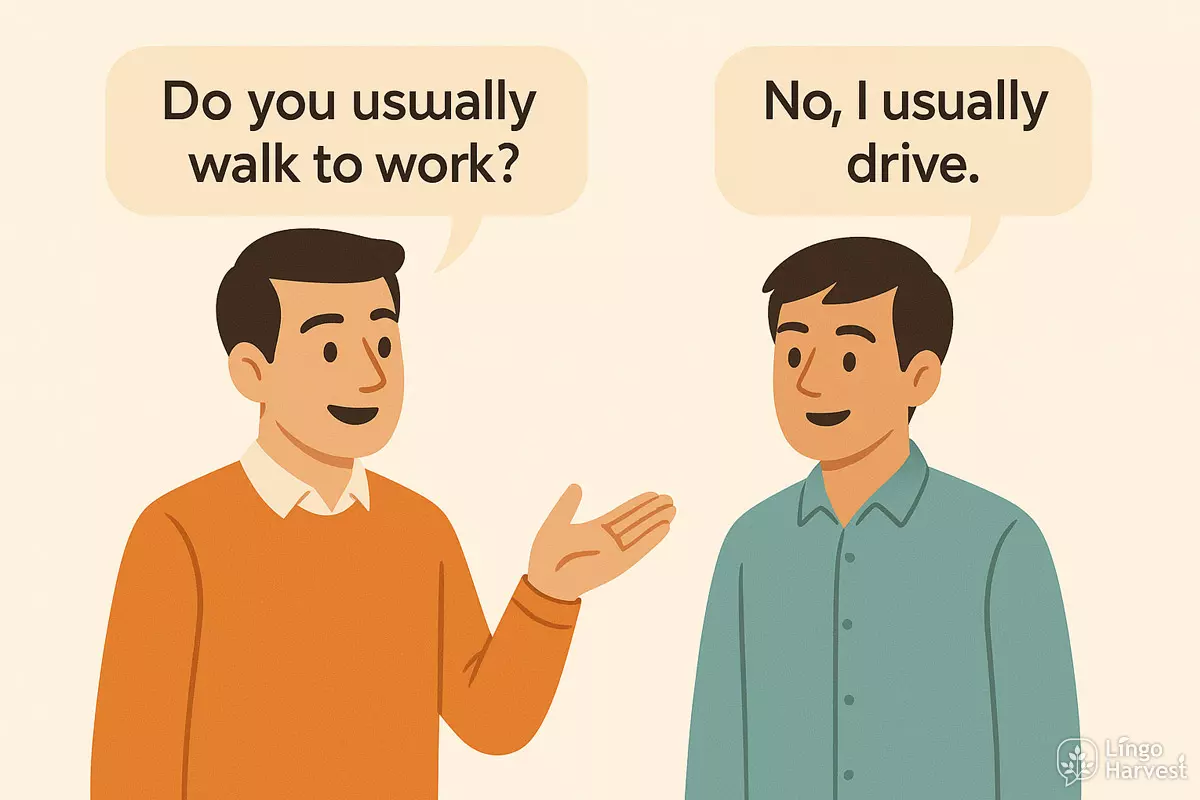
You can respond to questions about frequency with concise answers. Here are some typical patterns:
- ✅ “Do you always eat breakfast?” – “Yes, I always do.”
- ✅ “Do you usually walk to work?” – “No, I usually drive.”
- ✅ “Do you sometimes watch TV in the evening?” – “Yes, sometimes.”
- ✅ “Do you ever skip lunch?” – “No, never.”
These responses are short and direct, but you can add a follow-up to give more information or clarify your answer.
Typical Follow-up Sentences
After a brief response, it’s natural to add extra details. This helps the conversation flow and gives your listener more context. Here are some examples:
- “Yes, I always do. I can’t start my day without breakfast.”
- “No, I usually drive. It’s faster for me.”
- “Yes, sometimes. It depends on how tired I am.”
- “No, never. I think lunch is important.”
- “I usually go jogging in the morning, but sometimes I skip it if it’s raining.”
- “I always finish my homework before dinner.”
- “I never drink coffee at night. It keeps me awake.”
- “Sometimes I stay up late, especially on weekends.”
- “I usually read before bed, but not every night.”
- “I never forget my keys. I keep them by the door.”
Short Answer and Follow-up Structure
Notice the structure: first, a quick reply, then more detail. This helps conversations feel natural and informative.
| Question | Short Answer | Follow-up Example |
|---|---|---|
| Do you always exercise? | Yes, always. | I exercise every morning before work. |
| Do you usually eat at home? | No, not usually. | I often eat at restaurants with friends. |
| Do you sometimes travel for work? | Yes, sometimes. | It depends on the project schedule. |
| Do you ever forget your phone? | No, never. | I always check before leaving the house. |
Using these patterns makes your English sound natural and helps you express how often you do things with just the right amount of detail. Try practicing both the brief reply and a follow-up to build confidence in real conversations.
Common Mistakes (double negatives)
One frequent problem for English learners is using two negatives in the same sentence, especially with adverbs of frequency like "never." In standard English, double negatives are considered incorrect because they can make the meaning confusing or even the opposite of what the speaker intends.
Understanding the Issue
When you say “I don’t never go there,” the double negative can actually suggest you do go there, though in casual speech some people use it for emphasis. In formal or correct English, use just one negative to clearly express that something never happens.
Examples of Incorrect and Correct Usage
- ❌ Incorrect: I don’t never eat fish.
- ✅ Correct: I never eat fish.
- ❌ Incorrect: She doesn’t usually never call me.
- ✅ Correct: She usually doesn’t call me. or She never calls me.
- ❌ Incorrect: We don’t always never agree.
- ✅ Correct: We don’t always agree. or We never agree.
- ❌ Incorrect: He doesn’t sometimes never finish his work.
- ✅ Correct: He sometimes doesn’t finish his work. or He never finishes his work.
- ❌ Incorrect: They don’t never arrive on time.
- ✅ Correct: They never arrive on time.
- ❌ Incorrect: You don’t never listen.
- ✅ Correct: You never listen.
- ❌ Incorrect: I can’t never find my keys.
- ✅ Correct: I can never find my keys.
- ❌ Incorrect: She doesn’t always never help.
- ✅ Correct: She doesn’t always help. or She never helps.
Quick Tips
- Use “never” or another negative word just once in a sentence.
- If you use “never,” do not add “don’t,” “doesn’t,” or “can’t” before the verb.
- For negative meaning, choose either a negative adverb (never, rarely) or a negative verb form—not both.
Practice: Talk About Your Week
Using adverbs of frequency is a great way to describe your weekly routines and habits. When you talk about your schedule, these words help others understand how often you do different activities. For this exercise, try to use adverbs like always, usually, sometimes, and never as you write or speak about your typical week.
Common Activities and Frequency Adverbs
Below is a list of sentences describing weekly routines. Think about your own habits and try to complete similar sentences:
- I always wake up before 7 a.m. on weekdays.
- I usually have coffee in the morning.
- I sometimes walk to work instead of taking the bus.
- I never skip breakfast.
- I always check my emails after lunch.
- I usually cook dinner at home.
- I sometimes meet friends after work.
- I never go to bed before 10 p.m.
- I always read a book before sleeping.
- I usually exercise on weekends.
- I sometimes watch movies at night.
- I never forget to call my family on Sundays.
Structured Practice: Fill in the Blanks
Complete each sentence with the most suitable adverb of frequency: always, usually, sometimes, or never.
- I ________ eat lunch at my desk.
- I ________ work late on Fridays.
- I ________ forget my keys at home.
- I ________ go jogging in the morning.
- I ________ visit my grandparents on weekends.
Show answers
- usually
- sometimes
- never
- always
- usually
Writing Task: Your Weekly Routine
Now, write a short paragraph about your week, using at least four different adverbs of frequency. Try to include a variety of activities and be specific about how often you do them. For example:
- I usually get up early and always make breakfast. Sometimes I go for a run before work. I never skip my morning coffee.
Show answers
Sample answer: I always take the bus to work. I usually have meetings in the afternoon. Sometimes I eat out with colleagues. I never work on weekends.
Adverbs of Frequency: Quick Reference
Here’s a simple guide to help you remember where these adverbs fit in a sentence:
- Always – 100% of the time
- Usually – about 80% of the time
- Sometimes – about 50% of the time
- Never – 0% of the time
These words usually go before the main verb, but after be (am/is/are):
- I always eat breakfast. / She never drinks tea.
- He is usually on time. / They are sometimes late.