Adverbs with Verbs: Where and How to Use Them

 Here we what adverbs are, their main types—manner, time, and place—where to position them with verbs, and how to avoid using double adverbs. It also includes examples and practice exercises for using adverbs correctly.
Adding descriptive words to actions can make your sentences clearer and more engaging, but knowing where to place them is not always obvious. Placing modifiers correctly alongside verbs ensures your meaning is precise and your writing flows smoothly. For example, in the sentence "She quickly finished the assignment," the modifier "quickly" is placed before the verb "finished" to describe how the action was performed. By paying attention to word order, you can skillfully enhance your writing and avoid confusion for your readers.
What Are Adverbs?
Adverbs are words that modify or describe verbs, adjectives, or even other adverbs, providing extra information about how, when, where, or to what extent something happens. They help clarify the action in a sentence by answering questions such as "How?" "When?" "Where?" and "To what degree?" For example, in the sentence "She sings beautifully," the word "beautifully" explains the manner in which she sings.
Common Functions of Adverbs
- Describing the way an action is performed (e.g., quickly, softly)
- Indicating time or frequency (e.g., yesterday, often, never)
- Specifying place or direction (e.g., here, outside, everywhere)
- Expressing degree or intensity (e.g., very, almost, completely)
- Modifying adjectives or other adverbs (e.g., really fast, quite easily)
Examples of Adverbs in Sentences
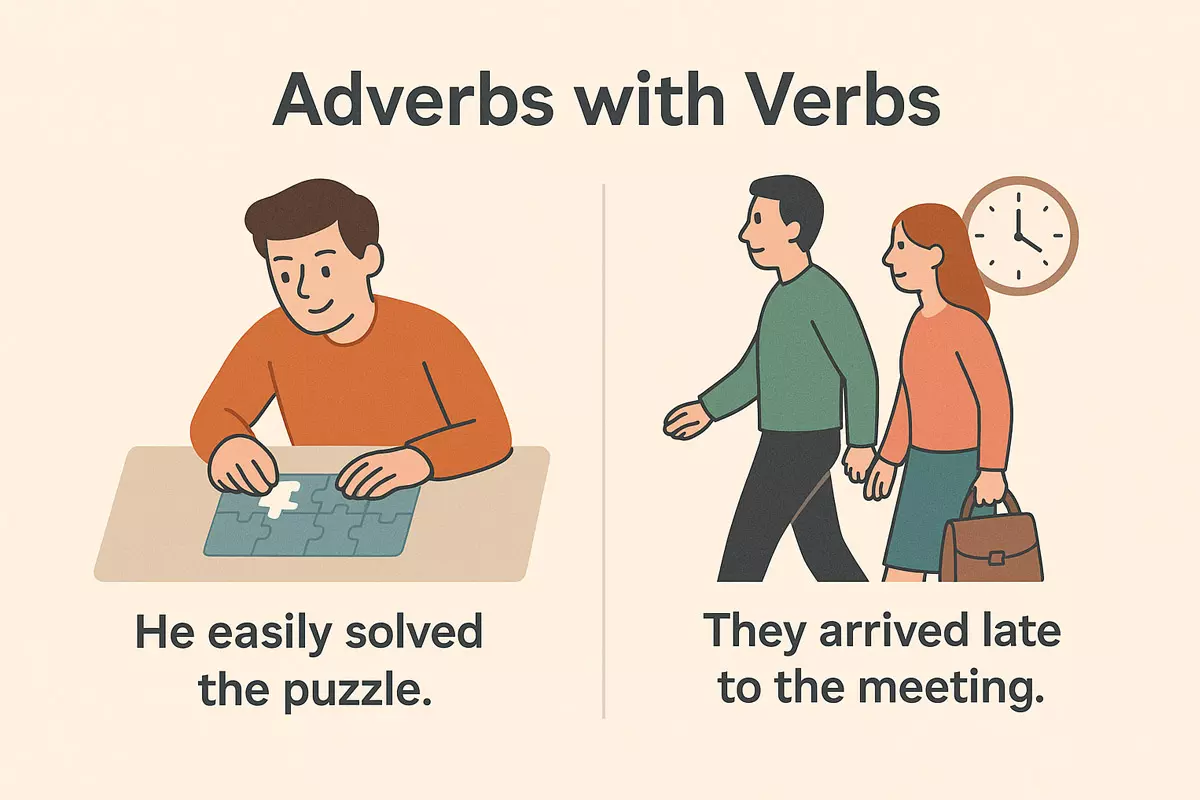
- He easily solved the puzzle.
- They arrived late to the meeting.
- The cat waited outside.
- She speaks very quietly.
- We will leave soon.
- The work was almost finished.
- I never eat breakfast.
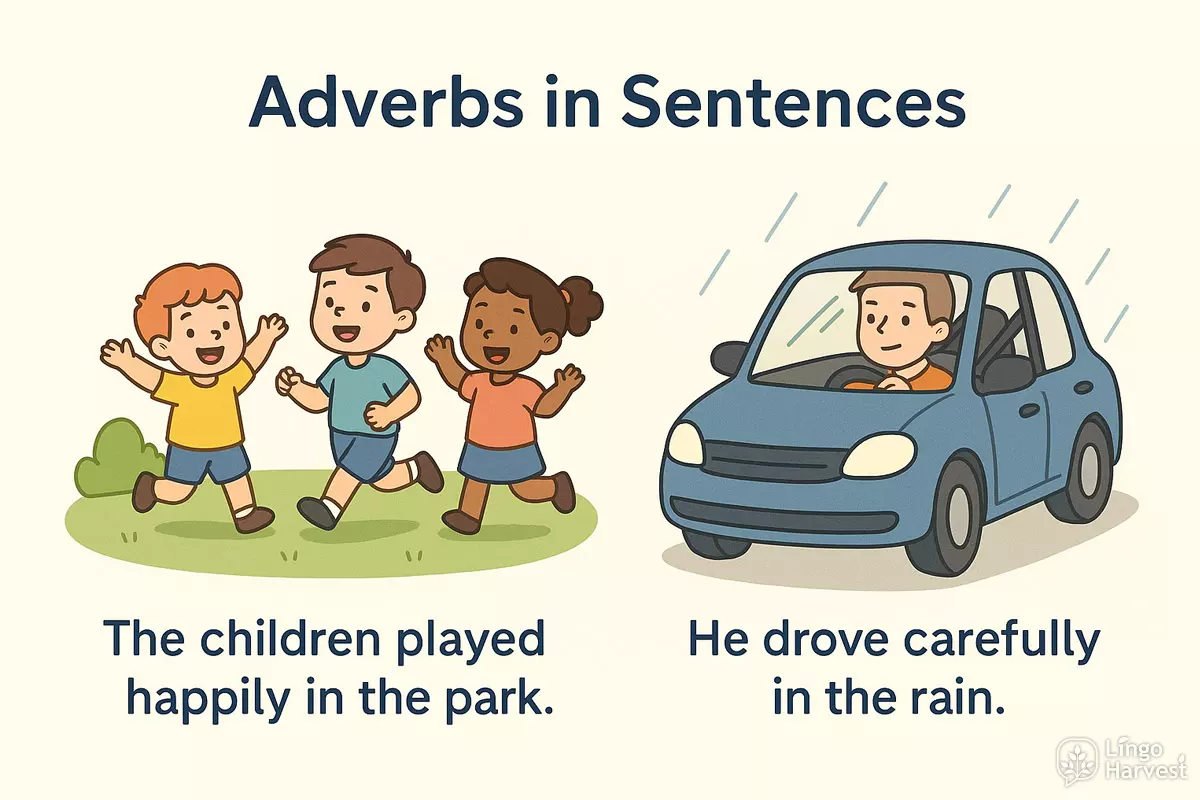
- The children played happily in the park.
- Please sit here.
- He drove carefully in the rain.
Types of Adverbs
Different categories of adverbs exist, each serving a unique role in modifying verbs and other sentence elements. Some of the most common types include:
- Adverbs of manner: Describe how something happens (e.g., gently, loudly)
- Adverbs of time: Indicate when an action occurs (e.g., now, always, then)
- Adverbs of place: Show location or direction (e.g., nearby, away, upstairs)
- Adverbs of frequency: Tell how often (e.g., rarely, frequently, sometimes)
- Adverbs of degree: Express intensity (e.g., almost, extremely, totally)
How to Identify Adverbs
Many adverbs in English end with -ly, like "quickly" or "silently," but not all do. Words such as "very," "well," or "now" are also adverbs. To spot them, look for words that answer questions about the action or description in the sentence, especially those modifying verbs, adjectives, or other adverbs.
Types of Adverbs
When describing how actions are performed, words that modify verbs often fall into several categories. Each group serves a particular function, offering clarity about time, manner, place, frequency, or degree. Understanding these distinctions helps you choose the right modifier for each context.
Adverbs of Manner
These answer the question "How?" and describe the way an action is carried out. They often end in "-ly" and typically appear after the main verb or the object. Common examples include:
- quickly
- carefully
- loudly
- gently
- happily
- slowly
- badly
- easily
- silently
- bravely
Adverbs of Time
These provide information about when an action happens. They can appear at the beginning or end of a sentence.
- yesterday
- soon
- now
- already
- later
- eventually
- immediately
- still
- tonight
- recently
Adverbs of Place
Words in this category describe where an action occurs. Placement is typically after the main verb or object.
- here
- there
- everywhere
- outside
- upstairs
- abroad
- nearby
- downstairs
- inside
- away
Adverbs of Frequency
These show how often an action takes place. They usually come before the main verb but after the verb "to be."
- always
- usually
- often
- sometimes
- rarely
- never
- frequently
- occasionally
- seldom
- hardly ever
Adverbs of Degree
This group modifies the intensity or extent of a verb, adjective, or another adverb. They typically precede the word they modify.
- very
- quite
- almost
- too
- enough
- barely
- just
- completely
- fully
- absolutely
Comparison of Adverb Types
Below is a summary that contrasts the main categories and their typical questions and example words:
| Category | Answers the Question | Typical Examples | Usual Position |
|---|---|---|---|
| Manner | How? | quickly, carefully, silently | After verb or object |
| Time | When? | yesterday, soon, now | Start or end of sentence |
| Place | Where? | here, outside, abroad | After verb or object |
| Frequency | How often? | always, often, rarely | Before main verb |
| Degree | To what extent? | very, almost, quite | Before modified word |
By recognizing which group a modifier belongs to, you can place it accurately and ensure your sentences are clear and natural. Each category brings nuance, helping you express actions more precisely.
Where Adverbs Go with Verbs
Adverbs can appear in several places in a sentence, but their position often depends on what you want to emphasize and the type of adverb you’re using. Typically, adverbs that describe how, when, or where an action happens are placed close to the verb they modify. However, English allows some flexibility, so understanding the usual patterns helps your sentences sound natural.
Common Positions for Adverbs with Verbs
- After the main verb: This is the most common spot, especially for adverbs of manner.
She sings beautifully. - Before the main verb: Many adverbs of frequency and degree go here.
He always forgets his keys. - Between the auxiliary and main verb: If there’s an auxiliary (helping) verb, the adverb often fits between them.
They have already left. - At the beginning or end of the sentence: Adverbs describing time or place can sometimes go here for emphasis.
Yesterday, we visited the museum. / We visited the museum yesterday.
Patterns with Different Types of Adverbs
Some adverbs have preferred positions, while others are more flexible. Here are some typical placements:
| Type of Adverb | Usual Position with Verbs |
|---|---|
| Manner (how?) |
After the main verb She spoke softly. |
| Frequency (how often?) |
Before the main verb / After “be” He usually eats breakfast. She is always late. |
| Time (when?) |
End or start of the sentence They arrived yesterday. Tomorrow, we leave. |
| Degree (how much?) |
Before the verb or adjective She almost missed the bus. He completely forgot. |
| Place (where?) |
Usually at the end We met outside. |
Examples of Adverb Placement
- He quickly finished his homework. → (adverb before main verb)
- She laughed loudly. → (adverb after main verb)
- They have never traveled abroad. → (between auxiliary and main verb)
- Sometimes, I walk to work. → (sentence-initial position)
- We will meet you there. → (adverb at the end)
- He is always cheerful. → (after the verb "be")
- She can hardly wait. → (between modal and main verb)
- The train already left. → (before main verb in simple tenses)
- He answered correctly. → (after main verb for manner)
- I will see you tomorrow. → (adverb of time at end)
In summary, adverbs often appear close to the verb they modify, but the exact spot can vary depending on the type of adverb and what you want to highlight. With practice, choosing the natural position becomes more intuitive.
Adverbs of Manner, Time, and Place
Understanding how these three groups of adverbs interact with verbs can help you form more precise and natural English sentences. Each type answers a different question about the action: manner explains how something happens, time tells us when, and place indicates where the action occurs.
How Adverbs of Manner Work
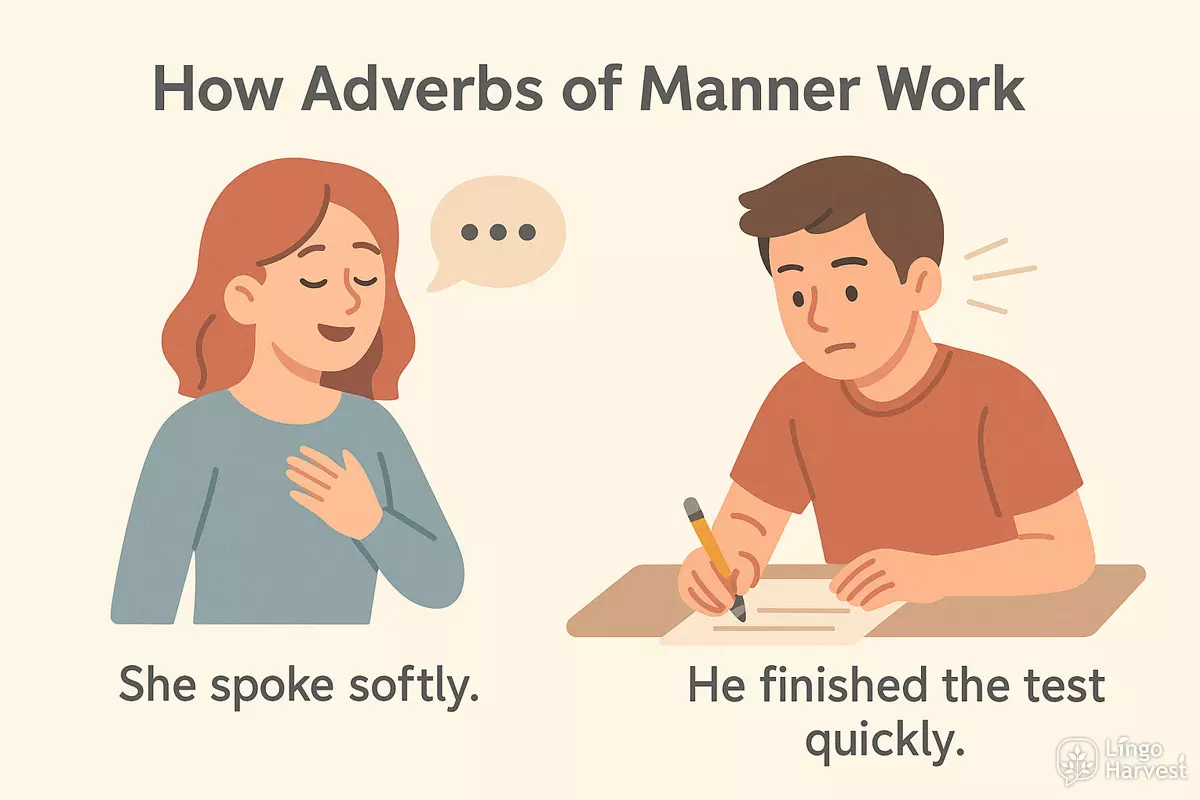
Adverbs that describe manner usually come after the verb or the object. They add detail to the action by answering the question “How?” For example, “She spoke softly,” or “He finished the test quickly.” Here are some common manner adverbs:
- quickly
- slowly
- loudly
- silently
- carefully
- badly
- well
- happily
- easily
- gently
Using Time Adverbs with Verbs
Words that show time typically appear at the beginning or end of a sentence. They let us know when something happens. For instance, “Yesterday, we arrived early.” or “He will call soon.” Here are some useful time adverbs:
- now
- then
- yesterday
- today
- tonight
- soon
- already
- finally
- recently
- later
- eventually
- immediately
Describing Location with Place Adverbs
Place adverbs tell us where an action happens. They often follow the main verb, or the verb and its object. Examples include “She looked outside,” “Please sit here,” and “The children played everywhere.” Some common ones are:
- here
- there
- everywhere
- nowhere
- upstairs
- downstairs
- inside
- outside
- abroad
- nearby
- away
- above
- below
Comparing Usage Patterns
Each group of these modifiers follows its own placement rules, but sometimes several can appear in one sentence. When combining them, the general order is: verb + manner + place + time. Here’s a quick comparison:
| Adverb Type | Typical Position & Example |
|---|---|
| Manner | After verb/object He answered politely. |
| Place | After verb/object They went outside. |
| Time | Start or end of sentence Yesterday, I called. I called yesterday. |
By keeping these patterns in mind, you can make your sentences clearer and more effective, whether you want to add detail, set the scene, or simply clarify when and where something happens.
Avoiding Double Adverbs
Using more than one adverb together can make sentences awkward or confusing. In English, adverbs are meant to clarify or modify verbs, adjectives, or other adverbs, but stacking them often leads to redundancy or unclear meaning. For example, saying “She sang very beautifully well” is not only unnecessary but also incorrect. Instead, choose the single, most precise adverb to express your idea.
Common Problems with Multiple Adverbs
Writers sometimes use two adverbs hoping to intensify meaning, but this usually weakens the sentence. Double adverbs can make your writing wordy and distract from your main point. It's best to avoid combinations that do not add clarity or value.
- “He ran extremely quickly fast.” ❌ (redundant: both adverbs modify “ran” in a similar way)
- “She answered very politely courteously.” ❌ (overlaps in meaning)
- “They worked really efficiently well.” ❌ (pick one)
- “The dog barked so loudly noisily.” ❌ (choose the most accurate adverb)
How to Spot and Fix Overuse
To keep your writing clear, look out for sentences where two or more adverbs appear together. Ask yourself if both are necessary or if one alone does the job. In most cases, a single, strong adverb is better than two weak or similar ones.
- Delete the less specific adverb: “He spoke very softly quietly.” → “He spoke softly.”
- Replace two weak adverbs with a stronger single one: “She moved really very quickly.” → “She rushed.”
- Use a verb that includes the meaning of the adverb: “He laughed really loudly.” → “He roared with laughter.”
Examples of Redundant Double Adverbs and Better Alternatives
Below is a list of frequent double adverb errors and improved versions:
- “almost nearly” → “almost” or “nearly”
- “very extremely” → “extremely”
- “too excessively” → “excessively”
- “quite absolutely” → “absolutely”
- “really truly” → “truly”
- “completely totally” → “completely” or “totally”
- “fully entirely” → “entirely”
- “so very” → “so” or “very”
- “just simply” → “simply”
- “highly greatly” → “highly”
- “especially particularly” → “especially”
- “barely hardly” → “barely”
- “almost practically” → “practically”
- “utterly completely” → “utterly”
- “absolutely definitely” → “definitely”
- “nearly approximately” → “approximately”
- “really actually” → “actually”
Summary
When modifying verbs, stick to one clear adverb that best fits your meaning. Avoid stacking similar adverbs, as this rarely improves clarity or style. Streamlining your sentences not only makes your writing more effective but also easier for readers to understand.
Examples in Everyday Sentences
Understanding how adverbs work with verbs becomes much easier when you see real-life usage. Below you’ll find a variety of sample sentences showing different adverbs modifying verbs. Notice how placement and meaning shift slightly depending on the type of adverb and the verb it describes.
Common Patterns with Adverbs and Verbs
- She quickly finished her homework. (Adverb before the verb)
- They laughed loudly at the joke.
- He rarely eats breakfast.
- I will call you tomorrow.
- The dog barked angrily at the stranger.
- We always arrive early for meetings.
- She sings beautifully.
- He never forgets a birthday.
- The children played outside after dinner.
- I just saw her at the store.
- They sometimes walk to work.
- He answered politely despite being upset.
- We will leave soon.
- You completely misunderstood the question.
- The cat quietly entered the room.
- She usually drinks tea in the morning.
- He already finished his assignment.
- They hardly ever argue.
Comparing Adverb Placement
Placement can affect emphasis or even meaning. Here’s a comparison of how the same adverb can move in a sentence:
| Sentence | Effect |
|---|---|
| She always remembers my birthday. | Describes frequency of remembering |
| She remembers my birthday always. | Less natural; adds extra emphasis |
| Always, she remembers my birthday. | Emphatic, often used in formal or literary style |
| She remembers always my birthday. | ❌ Incorrect in standard English |
Takeaways
These sample sentences demonstrate not only where adverbs typically appear but also how they influence the verb’s meaning. Experimenting with placement helps you express yourself more naturally and with the intended nuance.
Practice: Add Adverbs Correctly
Mastering the placement of adverbs with verbs is essential for clarity and precision in sentences. Let's work through some hands-on activities and examples to reinforce your skills. Pay attention to where the adverb naturally fits and how it changes the meaning of the sentence.
Exercise 1: Insert the Adverb
For each sentence, insert the given adverb in the correct position. Sometimes more than one placement is possible, but choose the most natural-sounding one.
- She (quickly) finished her homework.
- They (usually) eat dinner at 7 PM.
- He (never) forgets his keys.
- The dog (eagerly) waited for its walk.
- We (rarely) watch television.
- You (carefully) painted the wall.
- The train (already) left the station.
- I (often) read before bed.
- They (silently) entered the room.
- He (always) tells the truth.
Show answers
- She quickly finished her homework.
- They usually eat dinner at 7 PM.
- He never forgets his keys.
- The dog eagerly waited for its walk.
- We rarely watch television.
- You carefully painted the wall.
- The train already left the station.
- I often read before bed.
- They silently entered the room.
- He always tells the truth.
Common Adverb Placement Patterns
Understanding typical adverb positions helps form natural-sounding sentences. Here’s a comparison of where different types of adverbs are usually placed in relation to verbs:
| Adverb Type | Usual Position | Example |
|---|---|---|
| Manner (how?) |
After the main verb or object | She sang beautifully. He opened the box carefully. |
| Frequency (how often?) |
Before the main verb; after "be" | They often visit. She is always happy. |
| Time (when?) |
Usually at the end (sometimes at the beginning) | We met yesterday. Tomorrow, I will call. |
| Degree (how much?) |
Before the word it modifies | He almost finished. She nearly cried. |
| Place (where?) |
Usually at the end | They looked everywhere. He lives nearby. |
Exercise 2: Choose the Correct Placement
Decide which sentence in each pair uses the adverb correctly.
-
- I completely understand the problem.
- I understand completely the problem.
-
- We will meet tomorrow at the cafe.
- We will tomorrow meet at the cafe.
-
- She is always cheerful.
- She always is cheerful.
-
- He drives carefully his car.
- He drives his car carefully.
Show answers
- I completely understand the problem.
- We will meet tomorrow at the cafe.
- She is always cheerful.
- He drives his car carefully.
Tips for Adding Adverbs
- Adverbs of frequency (often, never, always) usually go before the main verb but after "be".
- Adverbs of manner (slowly, quietly) often come after the verb or at the end of the sentence.
- Place and time adverbs tend to appear at the end of the sentence.
- Adverbs modifying adjectives or other adverbs go directly before the word they modify.
- If in doubt, try reading the sentence aloud to check for natural flow.