Prepositions for Dates: In, On, At Explained Simply

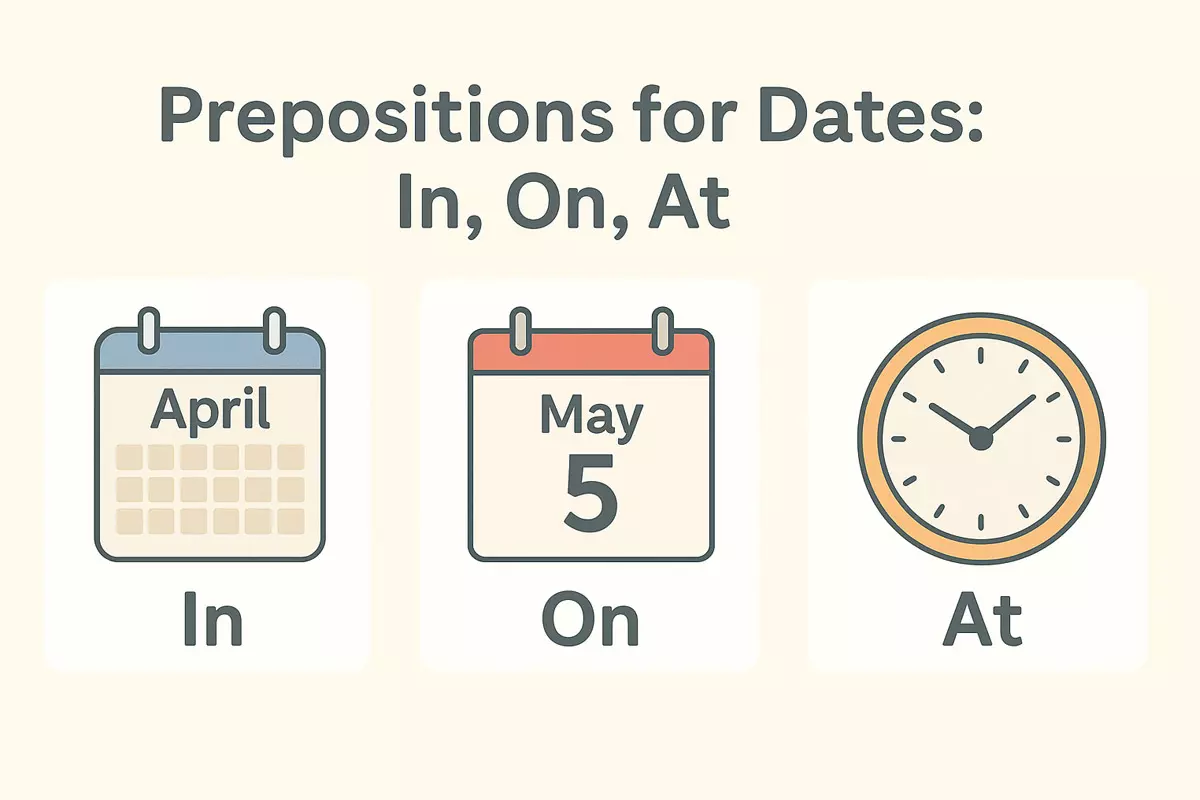 This article explains how to use in for months and years, on for days and dates, and at for precise times. It covers common expressions, typical mistakes, and includes practice sentences to help you master these prepositions.
Selecting the correct preposition before days, months, or specific moments can be challenging for English learners, but mastering this helps your sentences sound natural and clear. Generally, we use "on" with specific days and dates, such as on Monday or on July 4th. Use "in" for months, years, and longer periods, like in June or in 2023. For precise times, such as clock hours, use "at," as in at 5 PM or at midnight. Remembering these basic rules will make your spoken and written English much more accurate and fluent.
Using In for Months and Years
The preposition in is the standard choice when talking about months, years, and longer periods. This usage helps pinpoint a general time frame rather than a specific date or moment. When you mention a month or a year without referring to a particular day, in fits naturally.
Common Patterns with "In"
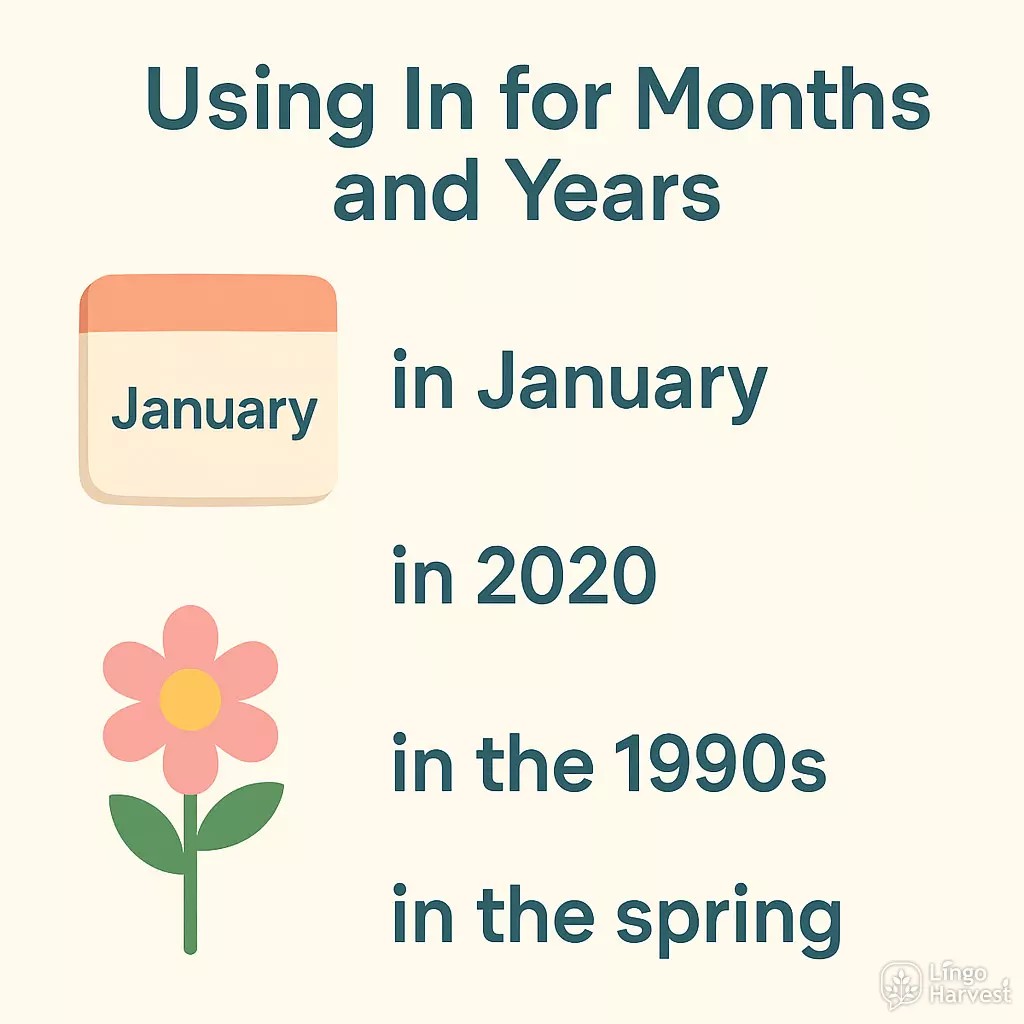
- in January
- in 2020
- in the 1990s
- in the spring
- in March 2022
- in the 21st century
- in the summer
- in December
- in the Middle Ages
- in the morning (for general parts of the day)
Notice how in is not used for specific dates or days. It always suggests a broader period. For example, "in July" means any time during July, not a particular day. Similarly, "in 2015" refers to any time within that year.
Comparing "In" with Other Prepositions
| Preposition | Typical Use |
|---|---|
| in | Months, years, centuries, long periods e.g. in April, in 1999, in the 18th century |
| on | Specific days and dates e.g. on Monday, on July 4th, on my birthday |
| at | Exact times and some holidays e.g. at 5pm, at midnight, at Christmas |
| ❌ Incorrect | on 1990, at June (not correct) |
Quick Tips
- Use in for months: in October
- Use in for years: in 2012
- Use in for seasons: in winter
- Do not use on or at with months or years
When in doubt, remember that in covers the broad, general time periods, making your sentences sound natural and correct in English.
Using On for Days and Dates
The preposition on is the go-to choice for talking about specific days and calendar dates in English. Whenever you mention a particular day of the week or a precise date, “on” is usually the correct preposition to use. This helps listeners and readers understand exactly when something will happen or has happened.
When to Use "On"
Use on before:
- Days of the week (e.g., Monday, Friday)
- Specific dates (e.g., March 15th, July 4)
- Special days or holidays with “day” in the name (e.g., on Christmas Day, on New Year’s Day)
- Days combined with morning, afternoon, evening, or night (e.g., on Monday morning)
Examples of "On" with Days and Dates
- on Monday
- on Tuesday evening
- on March 3rd
- on July 15
- on my birthday
- on the weekend (mainly American English; British English prefers “at” or “over”)
- on New Year's Day
- on the last day of school
- on Friday night
- on Halloween
- on Christmas Eve
- on April Fool’s Day
- on Sunday morning
- on the first of May
- on a sunny day
Common Mistakes to Avoid
- ❌ Incorrect: I was born in July 12.
✅ Correct: I was born on July 12. - ❌ Incorrect: The meeting is at Monday.
✅ Correct: The meeting is on Monday.
Quick Reference Table: "On" with Days and Dates
| Type of Time Expression | Usage with "On" |
|---|---|
| Day of the week | on Friday, on Sunday |
| Specific date | on March 8th, on December 25 |
| Named day/holiday | on Christmas Day, on Halloween |
| Day + part of day | on Monday morning, on Saturday night |
| Special occasions | on my birthday, on our anniversary |
To sum up, on is the right preposition for pinpointing days and dates. When you need to mention a particular day or a specific calendar date, use “on” to make your meaning clear and natural in English.
Using At for Precise Times
The preposition at is reserved for pinpointing specific moments. It is used when referring to exact times on the clock, particular points in the day, and set times for events. This makes it different from in and on, which are used for more general periods or dates.
When to Use "At"
Choose at when mentioning a precise time. This applies to both clock times and some common expressions about parts of the day. Here are some clear cases:
- at 3:00 pm
- at noon
- at midnight
- at sunrise
- at sunset
- at lunchtime
- at dinnertime
- at the moment
- at the weekend (UK English)
- at the same time
- at 7 o’clock
- at first light
- at the beginning
- at the end of the day
Common Mistakes
A frequent error is using at for longer periods or dates. For example, avoid saying at Monday or at June—these require on or in instead.
| Correct Usage | Incorrect Usage |
|---|---|
| at 8:30 am | at January |
| at noon | at Monday |
| at night | at summer |
| at midnight | at the morning |
Summary
Use at to indicate a specific time or a particular point in the day. It helps make your statements clear and accurate when talking about schedules, appointments, or routines. By choosing the right preposition, your communication becomes more precise and natural.
Common Expressions (On My Birthday)
When talking about birthdays and the correct preposition, “on” is the standard choice. This is because birthdays refer to specific calendar days. English speakers use a variety of set phrases and idiomatic expressions to refer to birthdays, events, and plans for that special day.
Here are some of the most frequent and natural-sounding ways to talk about this occasion using the preposition “on” (and sometimes others for contrast):
- I was born on May 3rd.
- Let’s meet on my birthday.
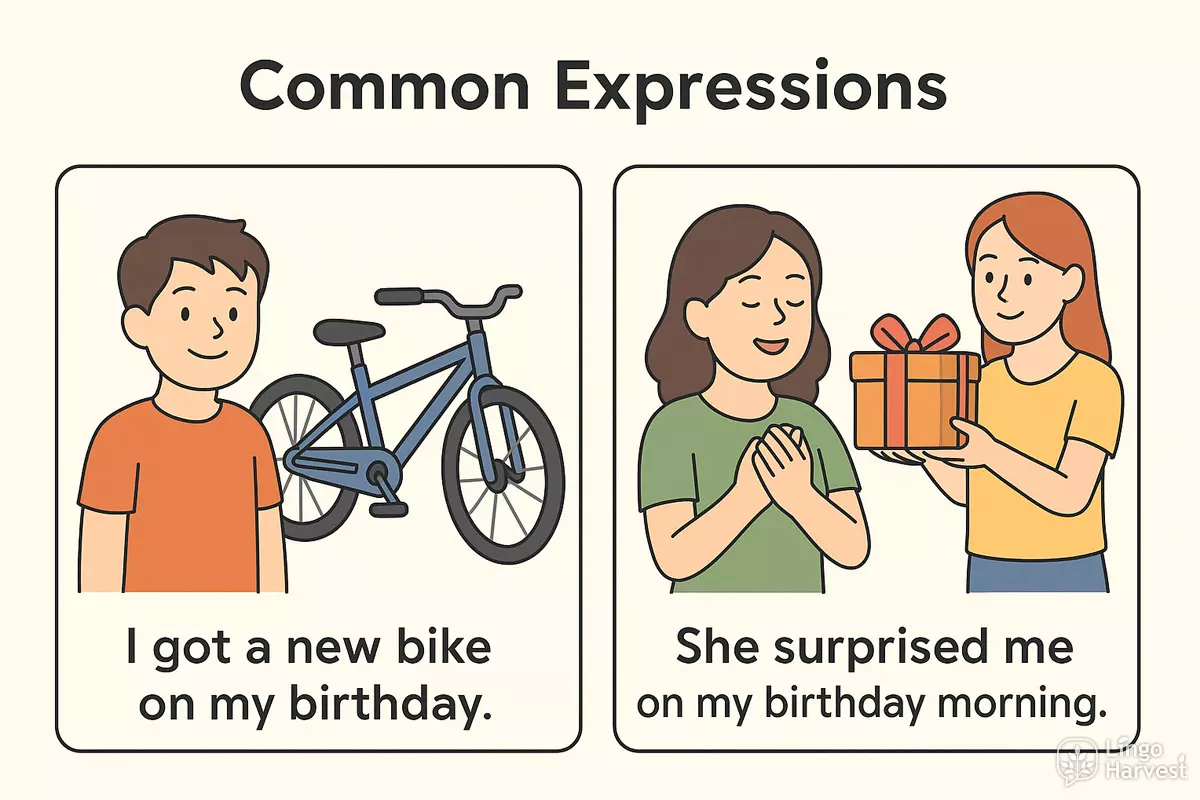
- I got a new bike on my birthday.
- She surprised me on my birthday morning.
- We usually go out to dinner on his birthday.
- He received a call from his family on his birthday.
- They baked a cake on her birthday.
- The concert is on my birthday this year!
- Did you get any gifts on your birthday?
- It snowed on my birthday last year.
- I have an exam on my birthday. ❌
- We’ll celebrate on my birthday weekend.
- He was away on his birthday.
- I’ll be turning 21 on my next birthday.
- She felt happy on her birthday evening.
- They always call me on my birthday.
- He proposed to her on her birthday.
- We had a party on my birthday last year.
Prepositions: “On” vs. “At” vs. “In” with Birthdays
Only “on” is correct when referring to the exact date of a birthday. “At” and “in” are not used before “my birthday” when you mean the day itself. For clarity, here’s how the prepositions work with dates and birthdays:
| Preposition | Correct Example |
|---|---|
| On | We went to the zoo on my birthday. |
| In | I was born in May. (not: in my birthday) |
| At | We met at my birthday party. (not: at my birthday) |
| On | He called me on my birthday morning. |
Quick Tips
- Use on for the specific day (“on my birthday”).
- Use in for months or years (“in June”, “in 1990”).
- Use at for parties or events (“at my birthday party”).
Remember, saying “on my birthday” is the natural and correct way to refer to your special day in English.
Typical Mistakes
Many learners get tripped up by prepositions when talking about dates. Confusing “in,” “on,” and “at” is one of the most frequent issues, especially when switching between languages that use different rules. Below are some common errors and explanations to help you avoid these pitfalls.
Confusing “on” and “in” with Dates
Using the wrong preposition with days or months is a frequent stumbling block. For example, people often say “in Monday” or “on July,” which are incorrect. Remember, “on” is for specific days and dates, while “in” is for longer periods like months, years, or centuries.
- ❌ Incorrect: I was born in 5th May.
- ✅ Correct: I was born on 5th May.
- ❌ Incorrect: The event is on July.
- ✅ Correct: The event is in July.
Mixing Up “at” with Dates
The preposition “at” is rarely used with dates, but sometimes learners use it incorrectly, especially with complete dates or days.
- ❌ Incorrect: The party is at Friday.
- ✅ Correct: The party is on Friday.
- ❌ Incorrect: I will arrive at 12th March.
- ✅ Correct: I will arrive on 12th March.
Forgetting Articles and Ordinal Numbers
When writing dates, learners sometimes forget to use ordinal numbers or articles, which can make sentences sound unnatural. For example, “on 5 May” is possible in British English, but “on the 5th of May” is more typical.
Common Error Patterns
Here are typical incorrect and correct preposition uses with dates and time periods:
| Incorrect Form | Correct Form |
|---|---|
| in Monday | on Monday |
| on 2023 | in 2023 |
| at July | in July |
| in 10th May | on 10th May |
| on the morning | in the morning |
| at Monday morning | on Monday morning |
| at night of 12th | on the night of the 12th |
| in Christmas Day | on Christmas Day |
| on the weekend (US) | at the weekend (UK) |
| in the 5th of May | on the 5th of May |
Tips to Avoid Mistakes
- Use “on” for days and exact dates: on Monday, on 5th July.
- Choose “in” for months, years, decades, and centuries: in April, in 2022, in the 1990s.
- Pick “at” for precise times: at 5pm, at midnight.
- Never use “at” for full dates or days of the week.
- Double-check for article or ordinal number errors, especially in written English.
By keeping these patterns and corrections in mind, you can avoid the most frequent issues with date prepositions and communicate more clearly.
Practice: Complete the Sentences
Strengthen your understanding of using in, on, and at with dates by trying these fill-in-the-blank activities. These exercises help you spot which preposition fits different time expressions, from years and months to exact times and holidays.
Fill in the Blanks
- My birthday is ___ July.
- The meeting starts ___ 2:00 PM.
- We will travel ___ Monday morning.
- The concert is ___ May 15th.
- She was born ___ 1999.
- Let's meet ___ the weekend.
- Our exam is ___ Friday.
- I usually relax ___ the evening.
- They got married ___ September 3rd, 2012.
- The shop opens ___ noon.
- We have a tradition ___ New Year's Eve.
- He left ___ the 18th of June.
- Her flight arrives ___ night.
- Summer begins ___ June.
- We celebrate Christmas ___ December 25th.
Show answers
- in
- at
- on
- on
- in
- at
- on
- in
- on
- at
- on
- on
- at
- in
- on
Common Preposition Patterns for Dates and Times
Review these typical patterns to help you remember which preposition matches a particular date or time phrase.
- in + month/year/season: in April, in 2020, in winter
- on + specific day/date: on Monday, on July 4th, on New Year's Day
- at + clock time/special periods: at 6:30, at midnight, at the weekend
Choose the Correct Preposition
Select the right word for each sentence. Choose from in, on, or at.
- ___ the morning
- ___ August 1st
- ___ 2015
- ___ 11:45 AM
- ___ the afternoon
- ___ Saturday night
- ___ Halloween
- ___ the end of the month
Show answers
- in
- on
- in
- at
- in
- on
- on
- at
Quick Reference: Prepositions with Dates and Times
| Preposition | Typical Usage |
|---|---|
| in | months, years, centuries, seasons in March, in 2022, in summer |
| on | days, dates, specific holidays on Tuesday, on July 10th, on Christmas Day |
| at | exact times, festive periods, parts of the day at 5:00, at noon, at the weekend, at night |