Articles with Days, Months, and Seasons: Basic Use

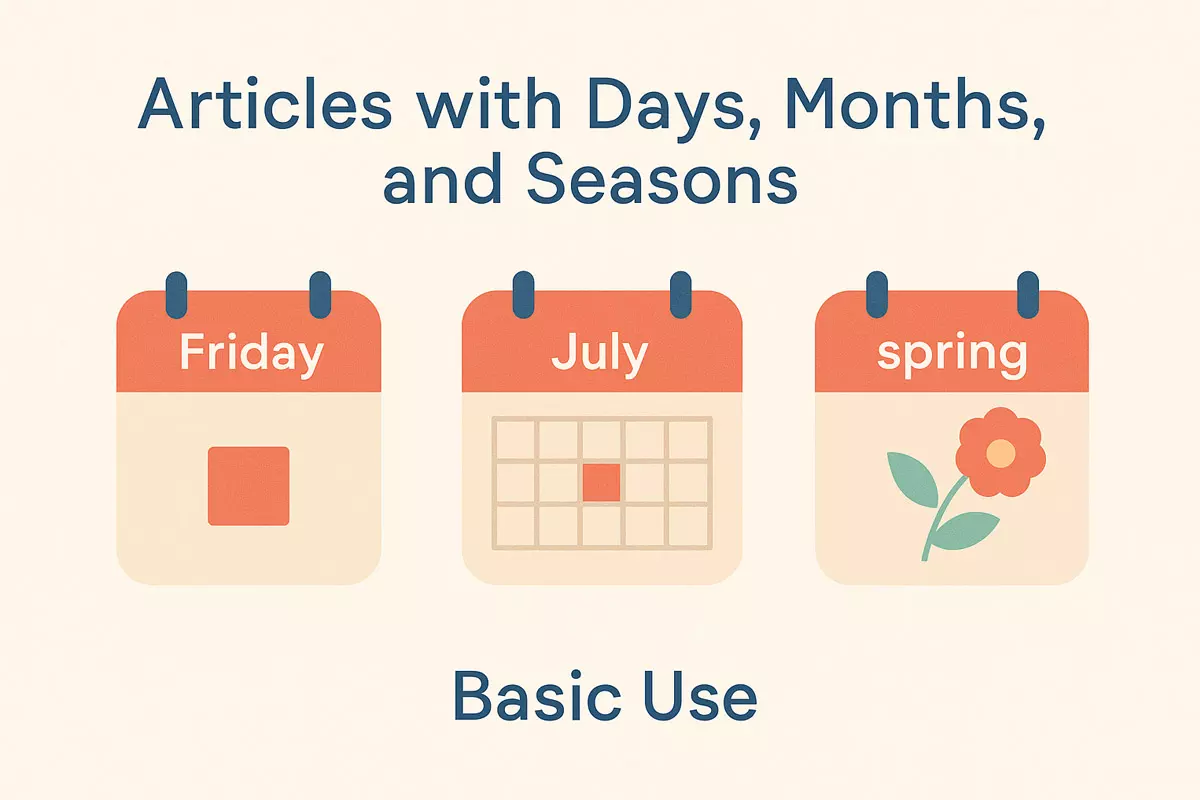 Here we when to use articles with days, months, and seasons, including exceptions and fixed expressions with the. It also lists common mistakes and provides practice exercises to test your understanding.
Knowing when to use "a," "an," or "the" with names of days, months, and seasons can be challenging for English learners, but following some simple guidelines can help. Generally, articles are not used before days or months, as in "Monday" or "July," unless you are specifying a particular one, such as "the Monday after the event." With seasons, you might say "in summer" or "in the summer," both of which are correct, though "the" adds specificity. Mastering these patterns leads to more natural and precise communication.
Do we use articles with days?
When talking about days of the week—like Monday, Saturday, or Friday—English usually does not use articles such as "the," "a," or "an." This means you’ll often see sentences like “I’ll see you on Tuesday” or “Classes start Monday” without any article before the day. Days are treated as proper nouns, much like names, so articles are generally omitted. However, there are some exceptions when an article is used for emphasis or specificity. For example, “The Monday after the holiday was very quiet,” or “It happened on a Friday.” In these cases, using "the" or "a" helps clarify which particular day is meant or adds a nuance of generality.
Typical Patterns Without Articles
- I have a meeting Monday.
- Our trip starts on Thursday.
- She works late Fridays.
- Let’s meet next Wednesday.
- We play soccer every Saturday.
- He left last Sunday.
- My birthday is this Tuesday.
- School resumes after the holidays on Monday.
- They usually arrive by Thursday.
- We travel on weekends.
When Articles Are Used with Days
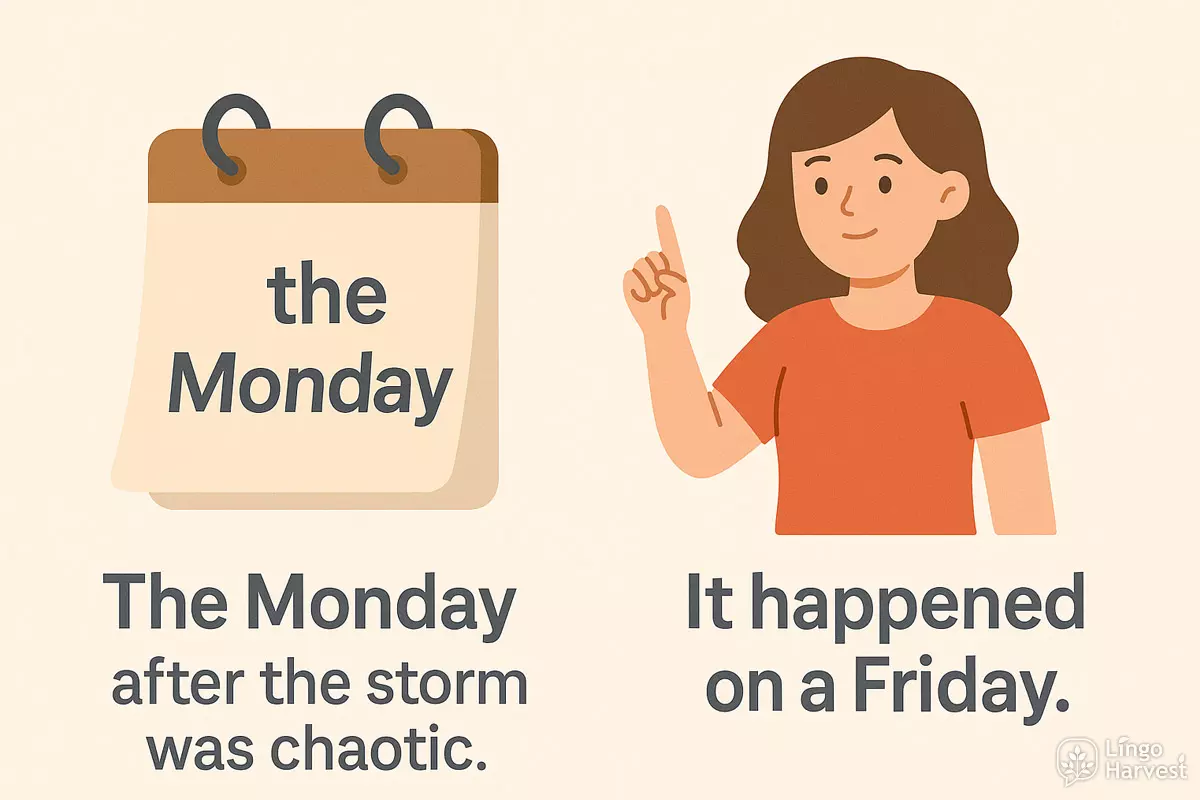
In some contexts, articles appear with days to indicate a specific instance or to generalize:
- “The Monday after the storm was chaotic.” (a particular Monday)
- “It happened on a Friday.” (any Friday, not a specific one)
- “We’ll decide the Sunday before.”
- “I remember a Tuesday in July.” (one unspecified Tuesday)
Summary Table: Articles with Days
| Usage | Example |
|---|---|
| No article (most common) | We meet Monday. |
| With "the" (specific day) | The Monday after the exam was relaxing. |
| With "a" (any one day, not specified) | It happened on a Friday. |
| With "the" for recurring events | The Sunday market is popular. |
In summary, articles are rarely used with days of the week unless you want to be specific or generalize. For most everyday communication, simply use the day’s name by itself.
Do we use articles with months?
When discussing months in English, articles such as "a," "an," or "the" are generally not used before the names of months. Months are considered proper nouns, much like the names of people or countries, so they stand alone without an article in most contexts. For example, you would say, "I was born in July," not "I was born in the July." However, there are special cases where an article might appear before a month, usually when the month is being specified or described in a particular way. For instance, "The January of 2020 was unusually warm." Here, "the" is used because you are talking about a specific January, not the month in general.
Common Patterns without Articles
Most of the time, when mentioning months, you simply use the name:
- We will meet in March.
- School starts in September.
- Her birthday is in December.
- He graduated last May.
- They arrived in November.
- The festival happens every July.
- I have a vacation planned for August.
- Flu season peaks in January.
- Our anniversary is in October.
- The conference is scheduled for April.
When Articles Are Used with Months
Articles can appear before a month in certain structured or descriptive phrases. This usually happens when you are referring to a specific occurrence or emphasizing a particular time:
- The March of 2020 was unforgettable. ✅
- It was a January to remember. ✅
- The December before the war was peaceful. ✅
- We all remember the July when it rained every day. ✅
In these cases, the article adds specificity or context, often with an adjective or additional phrase.
Incorrect Use of Articles with Months
Using an article with a month name alone is almost always a mistake:
- The May is beautiful. ❌
- An October is my favorite. ❌
- A July was hot. ❌
These sentences sound unnatural to native speakers. The article is only appropriate when the month is being described or specified.
Summary Table: Articles with Months
| Example | Correct? |
|---|---|
| I start work in June. | ✅ Yes |
| The June of 2021 was rainy. | ✅ Yes |
| The August is hot. | ❌ No |
| We met in the October. | ❌ No |
| A March to remember. | ✅ Yes (if describing a specific March) |
In summary, month names usually go without articles, unless you are specifying or describing a particular instance. If in doubt, leave the article out unless the context clearly demands it.
Seasons: rules and exceptions
When talking about the four seasons—spring, summer, autumn (fall), and winter—English speakers often follow certain patterns with articles, but there are notable exceptions. The use of "the" with seasons depends on context, emphasis, and sometimes even personal preference.
General Patterns
- No article: Most of the time, seasons are used without an article to talk about them in general.
Example: Spring is my favorite time of year. - With "the": Use "the" when referring to a specific season, especially if you mean a particular instance or period.
Example: The winter of 2021 was unusually warm.
Special Cases and Exceptions
There are situations where articles with seasons change the meaning or are required for clarity. Consider the following points:
- Use the when specifying a particular season: the summer we met, the spring of her graduation.
- Use a when describing an unspecified or typical season: a mild winter, a dry summer.
- No article when talking in general: Winter is cold, Autumn brings rain.
- With adjectives, both forms can be correct, depending on meaning: Spring flowers (general), the spring flowers in my garden (specific).
- "In" + season is the usual prepositional phrase: in winter, in the summer (both are possible, but "in summer" is more general).
Common Usage Patterns
| Structure | Example |
|---|---|
| No article + season | Summer is hot here. |
| The + season (specific) | The spring of 2020 was rainy. |
| A + descriptive season | We had a long winter. |
| In + (the) + season | In autumn, leaves fall. / In the autumn, days get shorter. |
| With possessives | This summer's heat was record-breaking. |
| With adjectives | I love early spring mornings. |
Quick Reference: When to Use "the" with Seasons
- ✅ When specifying a particular year or event: the winter of 1995
- ✅ To highlight a unique or memorable period: the summer we got married
- ❌ Not for general statements: Spring is beautiful (not the spring is beautiful)
To sum up, articles with seasons depend on whether you’re speaking generally, referring to a specific period, or describing a feature. Pay attention to these subtle differences to sound natural in English.
Fixed expressions with the
When talking about days, months, and seasons, English often uses set phrases where the article the appears as part of common usage. These expressions don’t always follow typical grammar rules, so it’s helpful to learn them as fixed patterns. Recognizing these will make your language sound more natural and fluent.
Common expressions with “the” and time words
Some phrases always use the definite article before days, months, or seasons, usually because they refer to something specific or culturally recognized. Here are several widely used examples:
- the day after tomorrow
- the day before yesterday
- the first of May
- the middle of June
- the end of March
- the beginning of the week
- the weekend
- the last Sunday in April
- the summer of 2020
- the winter holidays
- the spring term
- the month of August
- the night before Christmas
- the following Monday
- the next day
- the previous month
- the early 1990s
- the late autumn
Structure and meaning
These set phrases often combine the article with a preposition or adjective, pinpointing a particular time or sequence. For example, “the end of June” refers to a specific part of the month, while “the last Sunday in April” identifies a unique date within a month. Using “the” signals that the speaker and listener both understand which period is being discussed.
Comparing standard and fixed phrases
Notice the difference between ordinary references and these set expressions:
| Standard reference | Fixed phrase with the |
|---|---|
| Monday | the Monday after the exam |
| April | the end of April |
| summer | the summer of 2022 |
| week | the week before last |
| night | the night before Christmas |
Learning these collocations will help you avoid common mistakes and express time references more precisely. When in doubt, listen for these patterns in authentic English or refer to reliable usage guides.
Typical mistakes
Learners frequently struggle with when to use or omit articles before days, months, and seasons in English. Misunderstanding these patterns can lead to awkward or incorrect sentences. Below, you'll find some of the most common pitfalls, illustrated with clear examples and explanations to help you avoid confusion.
Mixing up article use with days and months
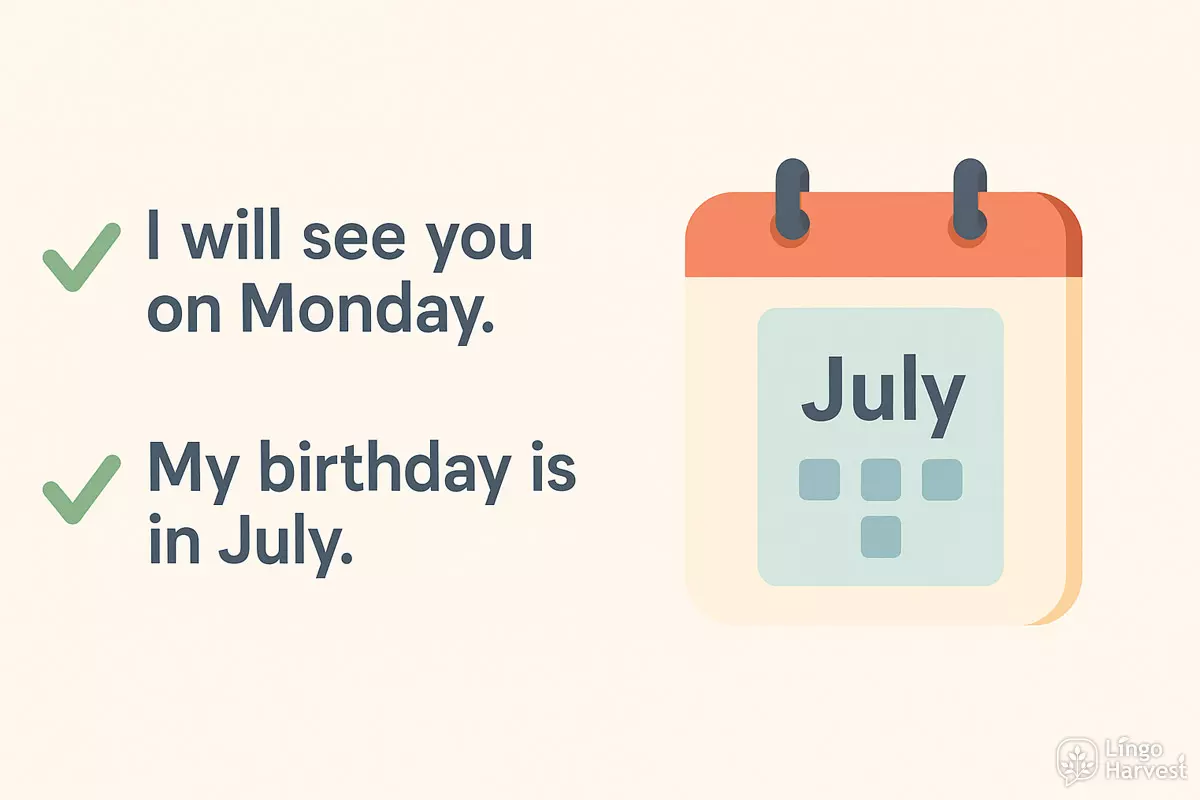
English does not use articles before names of days or months in most cases, but this can be confusing for speakers of other languages. For example, saying "the Monday" or "a January" is usually incorrect unless you are specifying or distinguishing a particular case.
- ❌ I will see you on the Monday.
- ✅ I will see you on Monday.
- ❌ My birthday is in a July.
- ✅ My birthday is in July.
Incorrect article use with seasons
Seasons can take an article in certain contexts, but are often used without one. This often depends on whether you are speaking generally or about something specific.
- ❌ The summer is hot in Spain. (when speaking generally)
- ✅ Summer is hot in Spain.
- ✅ The summer of 2020 was unusual. (specific summer)
- ❌ The winter is cold in Canada. (general statement)
- ✅ Winter is cold in Canada.
- ❌ The spring is beautiful here. (general)
- ✅ Spring is beautiful here.
- ❌ The autumn starts in September. (general)
- ✅ Autumn starts in September.
- ❌ The night is dark in the countryside. (general)
- ✅ Night is dark in the countryside.
Confusing article patterns: summary table
| Expression | Correct Usage |
|---|---|
| Day of the week (general) | No article: I start work on Monday. |
| Day with modifier (specific) | Use "the": I remember the Monday we met. |
| Month (general) | No article: School starts in September. |
| Season (general) | Usually no article: Spring is beautiful here. |
| Season (specific) | Use "the": The winter of 2010 was cold. |
Other frequent errors
- Adding "the" to every time expression: the Monday, the July, the summer (often incorrect)
- Using "a" with months or days: a November, a Friday (rarely appropriate)
- Omitting "the" when specifying: I remember Monday we met (should be "the Monday")
- Forgetting articles with "of" phrases: the winter of 1999 (article needed for specificity)
- Using articles inconsistently: mixing correct and incorrect forms in one paragraph
To master these patterns, pay attention to whether you are speaking about something in general or referring to a specific instance. Practice with real examples, and double-check your writing for these subtle but important details.
Practice section
Test your understanding of how to use articles with days of the week, months, and seasons. The exercises below will help you apply the basic rules and spot common mistakes. Review the patterns, then try the quiz and check your answers.
Quick Reference: Article Usage Patterns
- No article with days and months: on Monday, in June
- “The” with seasons if specific or unique: the winter of 1945, the summer she left
- No article with seasons in general: in summer, in winter
- “A”/“an” rarely used, only for describing a type: a cold winter
Fill in the Blanks
Choose the correct article (the, a, or leave blank) for each sentence:
- _____ Monday is the first day of the week for many people.
- I was born in _____ March.
- We always go skiing in _____ winter.
- _____ summer of 2010 was unforgettable.
- He left the city _____ August.
- It was _____ unusually warm October.
- The school will reopen on _____ Tuesday after the break.
- _____ spring is my favorite season.
Show answers
- Blank — Monday is the first day of the week for many people.
- Blank — I was born in March.
- Blank or the (both can be correct, but usually blank for general) — We always go skiing in winter.
- The — The summer of 2010 was unforgettable.
- In August (no article) — He left the city in August.
- An — It was an unusually warm October.
- Blank — The school will reopen on Tuesday after the break.
- Blank or the (both possible, but usually blank for general) — Spring is my favorite season.
Identify the Correct and Incorrect Sentences
Mark each sentence with ✅ (correct) or ❌ (incorrect):
- We met on the Monday.
- I love the January in Paris.
- She always feels happy in spring.
- The autumn is a beautiful season.
- He traveled in July.
- It was a cold winter.
- We have a meeting on Friday.
- The summer in Italy is very hot.
- She was born in the May.
- They left on New Year’s Day.
- The night was very quiet.
- I usually wake up early in the morning.
Show answers
- ❌ We met on the Monday. (Correct: We met on Monday.)
- ❌ I love the January in Paris. (Correct: I love January in Paris.)
- ✅ She always feels happy in spring.
- ❌ The autumn is a beautiful season. (Correct: Autumn is a beautiful season. Or: The autumn of 2020 was beautiful.)
- ✅ He traveled in July.
- ✅ It was a cold winter.
- ✅ We have a meeting on Friday.
- ❌ The summer in Italy is very hot. (Correct: Summer in Italy is very hot. Or: The summer in Italy that year was very hot.)
- ❌ She was born in the May. (Correct: She was born in May.)
- ✅ They left on New Year’s Day.
- ✅ The night was very quiet.
- ✅ I usually wake up early in the morning.
Common Article Usage Examples
| Expression | Correct Form |
|---|---|
| ___ Monday | on Monday |
| ___ June | in June |
| ___ winter (general) | in winter |
| ___ summer of 1999 | the summer of 1999 |
| ___ warm autumn | a warm autumn |
| ___ spring (general) | in spring |
| ___ Monday morning | on Monday morning |
| ___ July | in July |
| ___ last winter | last winter (no article) |
| ___ winter she visited London | the winter she visited London |
By practicing these patterns and reviewing the examples, you'll gain confidence in choosing the right article for days, months, and seasons. Keep referring to these examples until the forms feel natural in your writing and speech.