From vs Since: Clear Guide to Time Starting Points in English

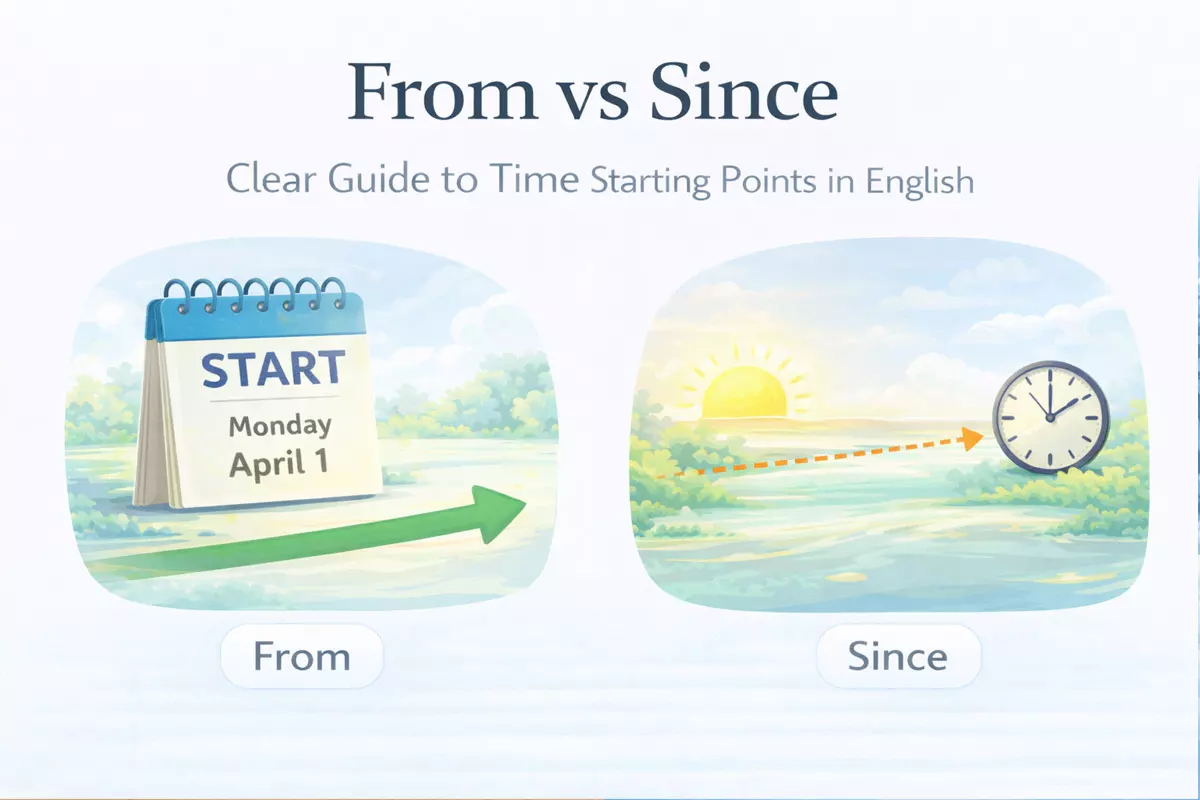 This article explains how from marks the start of a period, why since is linked to perfect tenses, and compares from…to with since plus present perfect. It also covers common time expressions, learner errors, and includes practice timelines.
Mastering expressions that indicate when something begins can be challenging in English, as many words appear similar but have specific uses. Understanding the differences among terms like "since," "from," "starting," and "beginning" is essential for clearly communicating the start of events or actions. By learning the correct contexts for each, you can avoid confusion and express timing accurately. This guide offers clear explanations and examples to help you choose the right words and use them with confidence in both spoken and written English.
How from marks the beginning of a period
The word from is commonly used in English to signal the starting point of a time span or duration. It tells us exactly when something begins, whether we’re talking about events, routines, or changes. This preposition is especially helpful when you want to make the start of a period clear, either by itself or paired with to, until, or till, to show both the beginning and end.
Typical patterns with “from”
You’ll often see from used in sentences describing schedules, historical periods, or the start of actions. Here are some common patterns:
- From + [clock time] (e.g., from 8:00)
- From + [date] (e.g., from July 1st)
- From + [year] (e.g., from 1990)
- From + [day of the week] (e.g., from Monday)
- From + [event or moment] (e.g., from the moment you arrived)
- From + [age] (e.g., from age 12)
- From + [season or month] (e.g., from spring, from January)
- From + [place, for context] (e.g., from the beginning)
- From + [adjective/adverb] (e.g., from early on)
- From + [noun phrase] (e.g., from the first day)
Examples in context
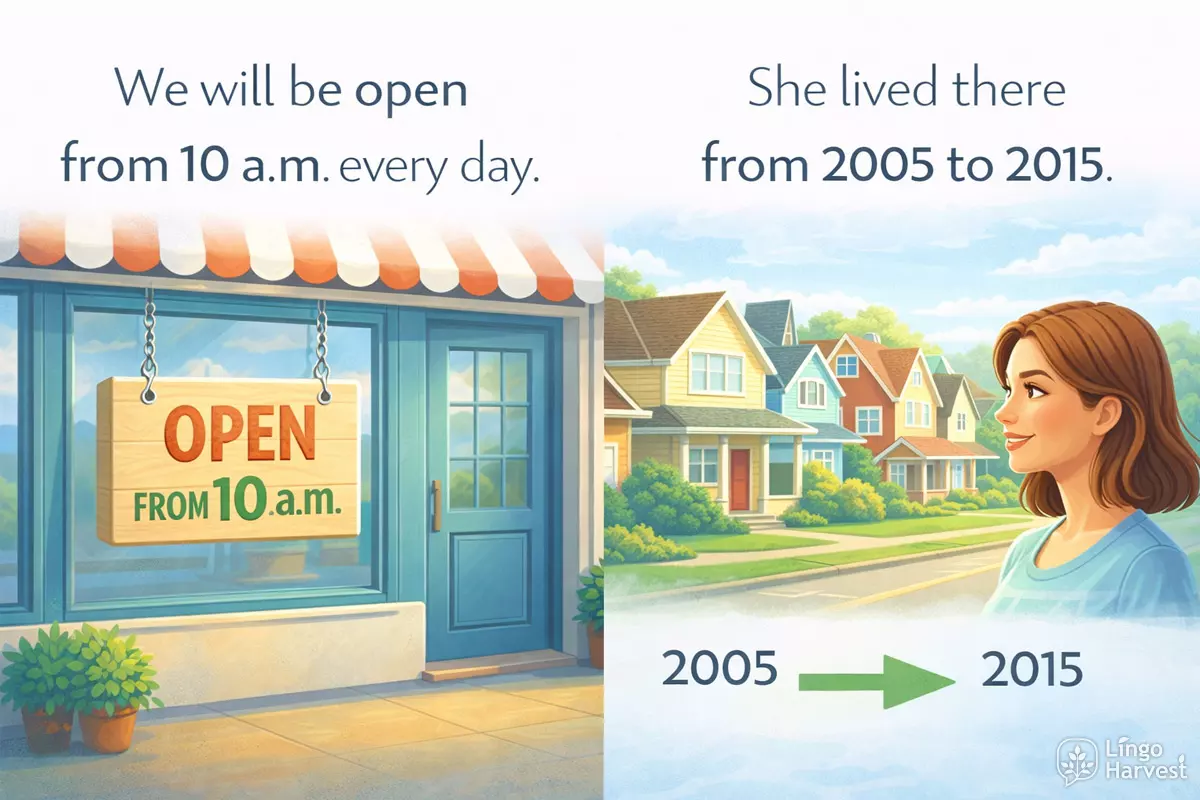
Here are several ways from is used to mark when something starts:
- We will be open from 10 a.m. every day.
- She lived there from 2005 to 2015.
- From next month, the rules will change.
- They have been friends from childhood.
- Classes run from Monday to Friday.
- From the first moment, I knew it was special.
- The exhibition is open from June through September.
- From now on, please submit forms online.
- He worked there from the age of 18.
- From the beginning, the project was ambitious.
- The shop is closed from Christmas until New Year’s Day.
- From early morning, the streets are busy.
“From” vs “Since” in time expressions
While both from and since can refer to starting points, they are not interchangeable. From is used with periods and ranges, often paired with an endpoint, while since is used for actions or states that began in the past and continue to the present.
| Use of “from” | Use of “since” |
|---|---|
| From 2010 to 2020, I lived in Paris. | I have lived in Paris since 2010. |
| Open from 9 a.m. until 5 p.m. | The shop has been open since 9 a.m. |
| Classes run from Monday to Friday. | I have attended classes since Monday. |
| From January, the weather improves. | The weather has improved since January. |
In summary, from highlights when a period or event starts, and is flexible for describing a range of time frames. It’s a practical tool for pinpointing the starting boundary of any duration in English.
Why since is linked to perfect tenses
The word since naturally fits with perfect tenses because it marks the exact point in the past when an action or state began, while the perfect tense describes that action’s relevance up to the present (or another reference point). Perfect tenses—including present perfect, past perfect, and future perfect—are specifically designed to connect past events to later moments. Since provides the anchor for this connection by specifying when something started.
How "since" connects time and tense
When using perfect tenses, we often want to explain how long something has continued. Since tells us the starting point, and the perfect tense shows that the action or state is still relevant or ongoing. For example, “I have lived here since 2015” means I started living here in 2015 and still live here now.
Common patterns with "since" in perfect tenses
- I have known her since childhood.
- She has worked here since last year.
- They have been friends since university.
- We have not spoken since the argument.
- He has felt better since he changed his diet.
- The company has grown since its founding.
- I have played the piano since I was six.
- She has improved since she started practicing.
- He has been absent since Monday.
- They have lived together since 2018.
- We have waited since morning.
- My English has improved since I moved here.
- He has not driven since the accident.
- She has been happier since the promotion.
- They have not met since high school.
- I have felt tired since last week.
- She has studied French since her trip to Paris.
- We have been neighbors since 2010.
Why not use "since" with simple tenses?
Simple tenses (like the simple past or present) do not show the ongoing connection between a starting point and the present. For example, “I live here since 2015” ❌ is incorrect; only the perfect form works: “I have lived here since 2015” ✅.
Comparison: "since" and "for" in perfect tenses
| Usage | Example |
|---|---|
| Since + starting point (exact time or event) | I have worked here since 2012. She has been sad since her cat died. |
| For + duration (length of time) | I have worked here for 10 years. She has been sad for a week. |
In summary, since is a natural partner for perfect tenses because it specifies when something began, matching the perfect tense’s focus on time connections and ongoing situations. This makes since essential for clearly expressing how the past links to the present or another reference point.
Comparing from…to with since + present perfect
When talking about time periods in English, “from…to” and “since” with the present perfect tense serve different purposes. “From…to” sets clear start and end points in the past, while “since” with the present perfect focuses on an action or state that began at a specific time in the past and continues up to now.
“From…to”: Defining Time Ranges
The phrase “from…to” is used to express a completed period. Both the beginning and ending are known, and the action or event is finished.
- I lived in Paris from 2010 to 2015. ✅
- She worked at the company from January to June last year.
- Our meeting lasted from 2 pm to 4 pm.
These sentences use the simple past because the time frame is over.
“Since” + Present Perfect: Focusing on Continuity
“Since” with the present perfect tense describes something that started in the past and still continues. It does not specify an end point.
- I have lived here since 2010. ✅
- She has worked here since January.
- They have been friends since childhood.
Notice that the present perfect (“have/has + past participle”) links the past with the present.
Summary Table: Usage & Patterns
| Pattern | Example & Usage |
|---|---|
| from…to | Used with simple past to show a finished period. “He studied from 2012 to 2016.” |
| since + present perfect | Used to show something started in the past and continues now. “He has studied here since 2012.” |
| from…to (event) | Both start and end are clear and completed. “The exhibition ran from March to May.” |
| since (point in time) | Refers to the starting point only; continuing now. “I have known her since university.” |
Quick Comparison Points
- “From…to”: Both dates/times are given; action is finished.
- “Since” + present perfect: Only the starting point is mentioned; action is still happening.
- Do not use “from…to” with the present perfect tense. ❌
- “Since” usually requires the present perfect (or present perfect continuous).
- “From” can be used with “until” or “till” as alternatives to “to”.
- “Since” cannot be used with the simple past.
- If you want to emphasize duration, use “for” with present perfect: “I have lived here for ten years.”
- “Since” points to the start, “from…to” shows both start and finish.
- “From…to” answers “When did it happen?”; “Since” answers “How long has it been happening?”
- Typical present perfect forms: “have/has + past participle”.
Understanding these differences helps make your time references in English clear and precise.
Time expressions that commonly follow each preposition
When choosing between "from" and "since" to indicate the beginning of a time period, it’s important to know which types of words or phrases typically follow each preposition. The right expressions help your sentences sound natural and clear.
Typical phrases after "from"
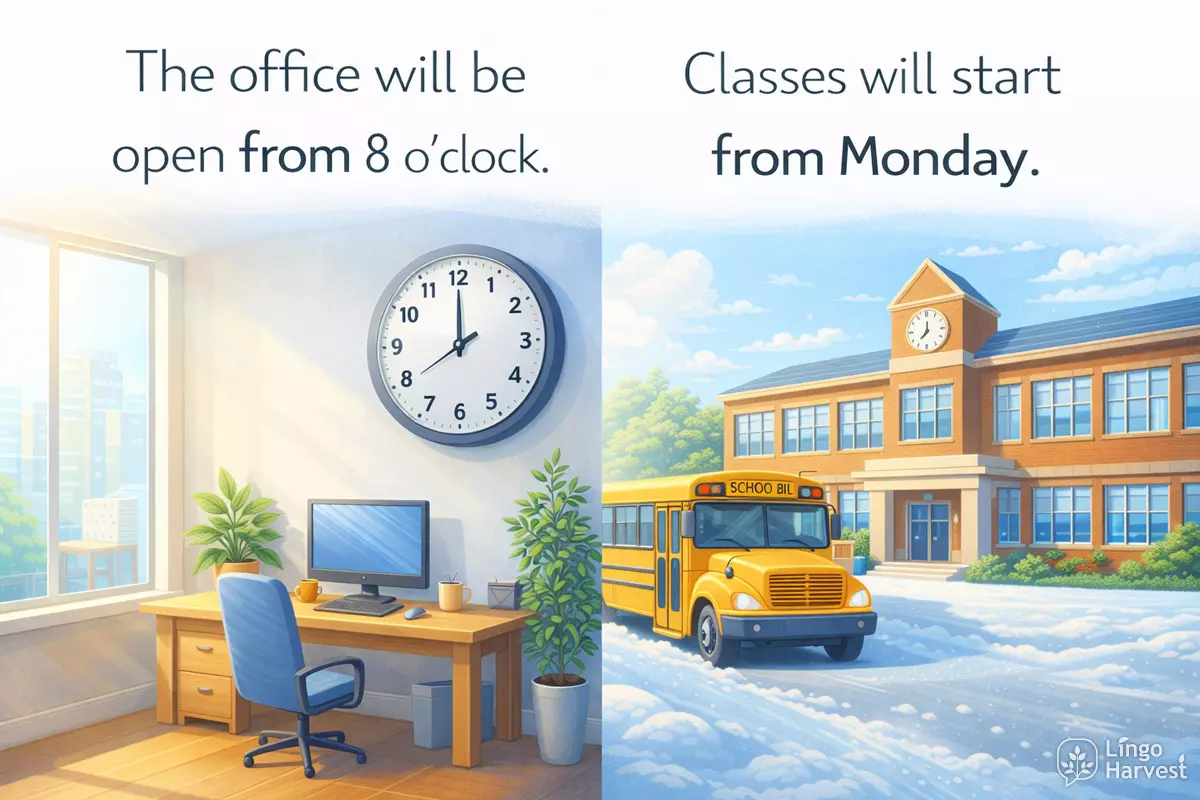
"From" is usually paired with specific points in time, such as clock times, days, dates, months, years, and even event names. It can also start a time range that is finished or ongoing. Here are some common examples:
- From 8 o’clock → The office will be open from 8 o’clock.
- From Monday → Classes will start from Monday.
- From January → The new rules apply from January.
- From 1999 → She has lived here from 1999.
- From the beginning → He supported the idea from the beginning.
- From the first day → She showed talent from the first day.
- From lunchtime → The café is closed from lunchtime.
- From last week → I’ve been feeling better from last week.
- From my birthday → I started learning English seriously from my birthday.
- From the moment you arrived → Everything changed from the moment you arrived.
- From the start of the meeting → He was silent from the start of the meeting.
- From now → From now, we will communicate by email.
- From early morning → The streets were busy from early morning.
- From the 18th century → This building dates from the 18th century.
- From yesterday → I’ve had a headache from yesterday.
- From the announcement → Prices increased from the announcement.
Notice that these are all definite, clear starting points—moments or periods that can be identified on a calendar or clock.
Common expressions after "since"
"Since" works with definite moments in the past that continue up to the present. Unlike "from," it’s not used for future times. The expressions that follow "since" are often dates, times, events, or periods marking when something started. Here are some typical options:
- Since 8 o’clock → I have been at work since 8 o’clock.
- Since Monday → She has been ill since Monday.
- Since January → We have lived here since January.
- Since 1999 → The company has operated here since 1999.
- Since last year → He has studied English seriously since last year.
- Since I was a child → I have loved music since I was a child.
- Since we met → Everything has changed since we met.
- Since the beginning of the month → Sales have increased since the beginning of the month.
- Since lunchtime → She hasn’t eaten anything since lunchtime.
- Since my birthday → I have felt more confident since my birthday.
- Since yesterday → I haven’t heard from him since yesterday.
- Since the accident → He hasn’t driven since the accident.
- Since the announcement → Prices have risen since the announcement.
- Since the project started → The team has worked overtime since the project started.
- Since I moved here → I have made many friends since I moved here.
- Since the pandemic → Many people have worked remotely since the pandemic.
- Since the last update → The app has improved a lot since the last update.
These expressions all point to a precise moment or event in the past, showing when a situation or action began and is still true now.
Quick comparison of "from" and "since" with time phrases
For a clearer side-by-side view, here’s a table illustrating how each preposition pairs with different time expressions:
| Preposition | Example Time Expressions |
|---|---|
| From | From 10 AM, from last Friday, from the start, from 2015, from the announcement |
| Since | Since 10 AM, since last Friday, since the start, since 2015, since the announcement |
As you can see, many time expressions can follow both "from" and "since," but the context and verb tense will determine which is correct. "From" often introduces a range (from...to/until), while "since" connects the past to the present. Use these patterns to make your English time references accurate and natural.
Typical learner errors with from and since in timelines
English learners frequently mix up from and since when describing the starting points of events or actions on a timeline. This confusion often leads to sentences that sound unnatural or are incorrect. Understanding where each word fits is essential for clear communication, especially when explaining durations or origins in time.
Common misuse patterns
- Using since with periods, not points in time (e.g., since two years ❌ instead of for two years ✅)
- Applying from with present perfect tense (e.g., I have lived here from 2010 ❌ instead of since 2010 ✅)
- Combining from with since in the same phrase (e.g., from since last summer ❌)
- Using since with future tenses (e.g., I will start since Monday ❌ instead of from Monday ✅)
- Omitting from in time ranges (e.g., the shop is open 9 to 5 instead of open from 9 to 5)
- Using since for past time ranges instead of an end-point (e.g., since 1990 to 2000 ❌)
- Placing from with present perfect continuous (e.g., I have been studying from last year ❌ instead of since last year ✅)
- Using since with general time words (e.g., since always ❌ instead of since I was a child or always)
- Incorrectly using from for habitual actions (e.g., From Mondays, I exercise ❌ instead of On Mondays or Every Monday)
- Switching from and since in time clauses without considering tense
Key difference in timelines
The main issue is that from introduces a starting point (often with an end point: from…to…), while since shows the start of something that continues up to now. Mixing these can confuse listeners about when something began or whether it is still happening.
| Incorrect Example | Corrected Form |
|---|---|
| I have worked here from 2018. | I have worked here since 2018. |
| The course runs since March. | The course runs from March. |
| She lived in Paris since 2010 to 2015. | She lived in Paris from 2010 to 2015. |
| We will start since next week. | We will start from next week. |
| I have been here from two hours. | I have been here for two hours. |
| The museum is open since 10am to 6pm. | The museum is open from 10am to 6pm. |
| From I was young, I liked music. | Since I was young, I have liked music. |
| He works since Mondays. | He works on Mondays. |
How to avoid confusion
Pay attention to whether you’re describing an action that continues up to now (since + present perfect) or talking about a starting point in a range (from…to…). When in doubt, check if your sentence refers to a duration or a specific time point—this helps you choose the right preposition and avoid the most frequent mistakes.
Practice timelines to choose the correct preposition
Understanding when to use “from” and “since” often depends on how you interpret time in English. Let’s look at timelines and practical examples to clarify these choices. Both prepositions point to a starting moment, but their uses differ in subtle yet important ways.
Visualizing time with “from” and “since”
Imagine a timeline stretching from the past to the present. “From” marks the starting point of a period or event, often paired with “to” or “until.” “Since” indicates when something began and is still relevant or continuing now.
- We have lived here since 2010. (We still live here.)
- The meeting is from 2 pm to 3 pm. (Specific time frame.)
- She has worked here since March. (She still works here.)
- The exhibition runs from Monday until Friday.
- I have known him since childhood.
- The shop is open from 9 am.
- They have been friends since school.
- The course lasts from June to August.
- I haven’t seen her since last year.
- The road will be closed from next week.
- He’s been ill since Monday.
- The sale is from 1st to 7th July.
- We’ve been waiting since noon.
- The park is open from dawn until dusk.
Quick comparison: choosing the right preposition
| Use “from” when... | Use “since” when... |
|---|---|
| You state the start and end of a period. (from… to/until…) |
You refer to when something started and it continues until now. (since + point in time) |
| The action or period is finished or scheduled. “The show runs from 6 to 9 pm.” |
The action or state is ongoing. “He has lived here since 2015.” |
| You describe opening/closing times, schedules, or durations. | You use perfect tenses (present/past perfect) to show duration up to now. |
| You mention a starting point without focus on continuation. “Open from Monday.” |
You emphasize that the situation began in the past and still continues. “Since last summer.” |
Timeline practice: choose “from” or “since”
Read each sentence and decide which preposition fits best.
- We have been friends ____ 2012.
- The store is open ____ 10 am to 8 pm.
- He’s worked here ____ last year.
- The festival runs ____ Thursday ____ Sunday.
- I haven’t eaten pizza ____ last month.
- The art class is ____ 3 pm ____ 5 pm.
- She has lived in Paris ____ January.
- The exhibition is open ____ Monday.
- I’ve been waiting here ____ 7 o’clock.
- The course lasts ____ April ____ June.
- He hasn’t called me ____ yesterday.
- The shop will be closed ____ Friday.
- They have owned this house ____ 2005.
- The meeting is scheduled ____ 2 pm ____ 4 pm.
- She’s been very busy ____ the beginning of the month.
Show answers
- since
- from
- since
- from, to
- since
- from, to
- since
- from
- since
- from, to
- since
- from
- since
- from, to
- since
By visualizing time as a line, it becomes easier to select the correct preposition. “Since” points to a start that matters now, while “from” sets a starting point, often for a limited period or schedule. Practice with real timelines to master the difference.