Prepositions of Time: at 7, on Monday, in June

 This article explains how to use at, on, and in with clock times, days, months, years, and holidays. It covers parts of the day, common expressions, key differences, frequent mistakes, and includes practice for your schedule.
Have you ever wondered why we use different prepositions like at 7, on Monday, or in June when talking about time? Understanding how to use these small words correctly is essential for expressing when something happens and can make your English sound both more natural and more precise. Learning the rules for using at, on, and in with times, days, and months helps you communicate your ideas clearly and avoids confusion in everyday conversations or writing.
Clock Times (at), Days (on), Months/Years (in)
When talking about when something happens, English relies on a few specific prepositions. Each is used for a different type of time reference, and getting them right makes your sentences clearer and more natural.
Using "at" for Specific Times
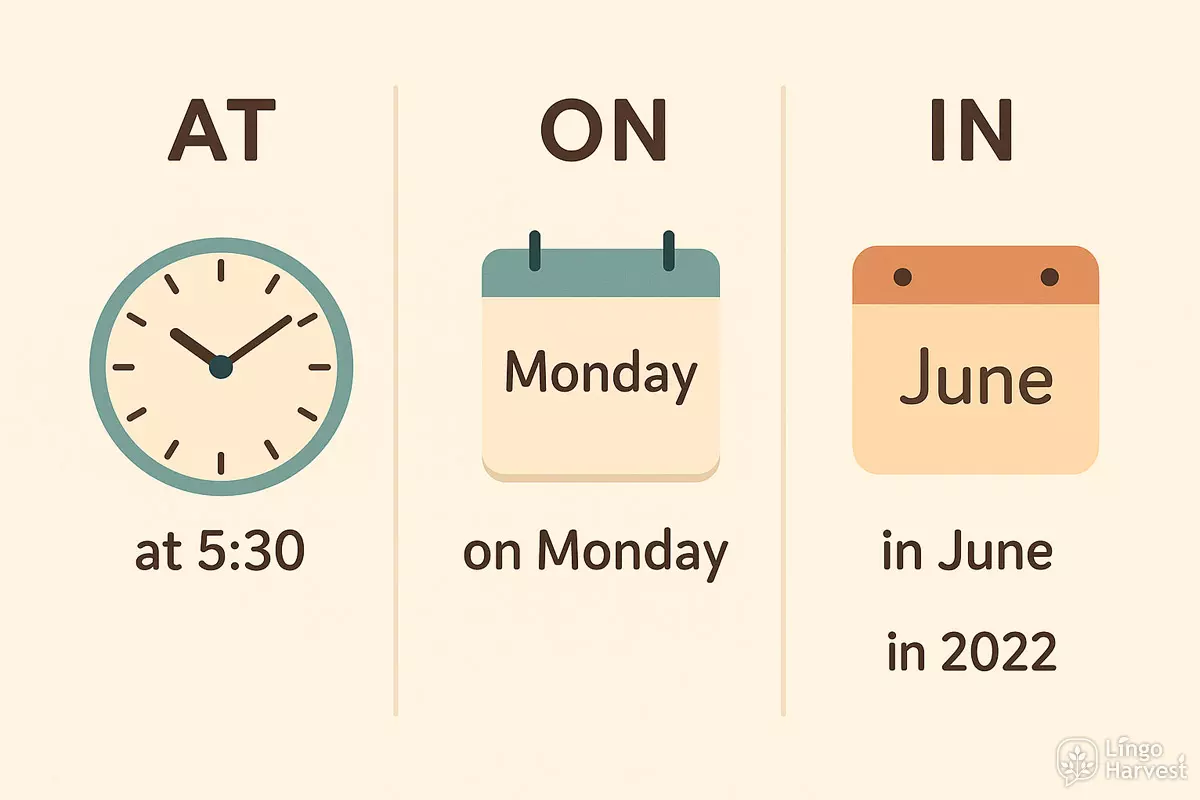
The preposition "at" is used to pinpoint exact moments on the clock or very specific periods. It’s the go-to choice for times of day and some fixed phrases:
- at 7 o’clock
- at midnight
- at noon
- at 5:30
- at sunrise
- at lunchtime
- at the weekend (UK; in the US, "on the weekend" is common)
- at Christmas (referring to the festive period, not the day itself)
Using "on" for Days and Dates
"On" is reserved for days, dates, and specific parts of days (when the day is mentioned):
- on Monday
- on Friday morning
- on June 5th
- on New Year’s Eve
- on my birthday
- on the weekend (US English)
- on the 1st of May
- on Sunday afternoon
- on Christmas Day
- on a cold day
Using "in" for Longer Periods
For months, years, seasons, centuries, and longer time spans, "in" is the standard choice:
- in June
- in 2024
- in the morning
- in the 21st century
- in summer
- in the past
- in the future
- in the 1990s
- in October
- in the evening
Quick Comparison Table
| Preposition | Typical Uses & Examples |
|---|---|
| at |
|
| on |
|
| in |
|
Choosing the right preposition depends on how specific your time reference is. "At" works for precise moments, "on" for named days or dates, and "in" for broader spans like months, years, or centuries. Practice these patterns to build confidence in everyday English communication. If you’re unsure, think about whether you’re talking about a point, a day, or a period—this usually points to the right word.
Parts of the Day, Weekends, Holidays
Understanding when to use "at," "on," and "in" with different times, days, and special occasions is essential for clear English communication. Each preposition matches specific situations, such as times of day, weekly routines, and annual celebrations.
Using Prepositions with Parts of the Day
For general times of the day, "in" is typically used, but there are important exceptions. For example, "at" is used with "night," and "on" is not generally paired with parts of the day. Here are some common patterns:
- in the morning (e.g., I exercise in the morning.)
- in the afternoon
- in the evening
- at night (e.g., The stars are visible at night.)
- at noon
- at midnight
Note that "at" is used for more specific times, while "in" covers broader periods.
Talking about Weekends
When referring to weekends, different varieties of English may use different prepositions. In British English, "at the weekend" is common, while American English often uses "on the weekend." Both are widely understood.
- at the weekend (UK)
- on the weekend (US)
- on Saturday
- on Sunday morning
For specific days, "on" is the standard choice.
Prepositions for Holidays and Special Occasions
The choice of preposition with holidays depends on whether you mean the specific day or the period around it. Use "on" for the exact date, and "at" or "in" for longer periods or general references.
| Phrase | Correct Preposition |
|---|---|
| on New Year's Day | on |
| at Christmas | at |
| on Christmas Day | on |
| at Easter | at |
| on Easter Sunday | on |
| in the holidays | in |
| at the weekend (UK) | at |
| on the weekend (US) | on |
Quick Reference: Common Expressions
Here is a list of frequently used time expressions that illustrate these rules:
- at 7 o'clock
- on Monday
- in June
- in the morning
- at night
- on my birthday
- at the weekend
- on Christmas Day
- at Christmas
- in summer
- in the 21st century
- on New Year's Eve
- at noon
- on Sunday afternoon
- in the holidays
Mastering these patterns helps you sound natural and precise when you talk about times, days, and special periods in English.
Common Expressions (in the morning)
When talking about time, especially the early part of the day, English speakers use specific prepositions and set phrases. “In the morning” is a standard way to refer to the time between sunrise and noon, and it appears in many everyday expressions. Understanding these patterns helps you communicate more naturally about routines, schedules, or plans that occur before midday.
Typical Phrases Using “in the morning”
- I get up in the morning.
- She goes for a run in the morning.
- We have meetings in the morning.
- It’s quieter in the morning than in the afternoon.
- The shop opens in the morning.
- They study English in the morning.
- Breakfast is served in the morning.
- He feels most energetic in the morning.
- There’s a lot of traffic in the morning.
- Do you prefer tea or coffee in the morning?
- My alarm rings in the morning.
- We often walk the dog in the morning.
- I make to-do lists in the morning.
- She practices piano in the morning.
- They listen to the news in the morning.
Comparing “in the morning” with Other Time Prepositions
Prepositions of time can be confusing, especially when referring to different parts of the day. Here’s how “in the morning” compares with “at” and “on” in common usage:
| Expression | Example |
|---|---|
| in the morning | I study in the morning. |
| at 7 (o’clock) | The bus leaves at 7. |
| on Monday morning | We have a meeting on Monday morning. |
| in June | School ends in June. |
Quick Tips
- Use in the morning for general times (not exact hours).
- Use at with precise clock times (e.g., at 8 AM).
- Use on with days and dates (e.g., on Monday, on the 5th).
These patterns will help you choose the right preposition when discussing when something happens, especially in relation to the start of the day.
Differences You Must Memorize
Understanding which preposition to use with different expressions of time is crucial for clear communication in English. The main challenge is that "at," "on," and "in" are not interchangeable—they each pair with specific types of time references. Here's what you need to know:
How Each Preposition Works with Time
"At" is used for precise clock times or specific moments, "on" is for days and dates, and "in" is for longer periods such as months, years, seasons, or parts of the day. Mixing them up can make your sentence sound unnatural or confusing.
| Preposition | Typical Use |
|---|---|
| at | Exact times (at 7 o’clock), holidays without “day” (at Christmas), specific points (at midnight, at noon) |
| on | Days and dates (on Monday, on July 4th, on my birthday), days + parts (on Monday morning) |
| in | Months, years, centuries, seasons (in June, in 2020, in winter), periods of the day (in the morning, in the evening) |
Key Examples to Remember
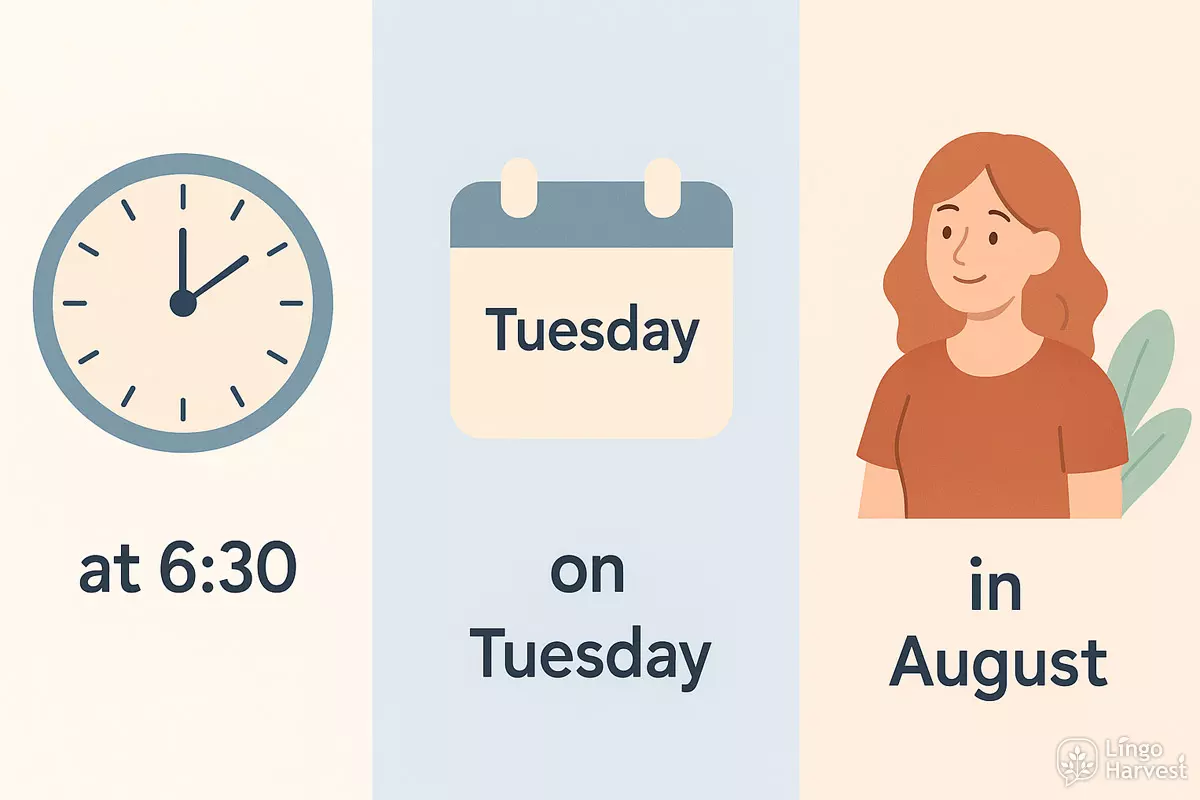
- at 6:30 ✅ (exact time)
- on Tuesday ✅ (day of the week)
- in August ✅ (month)
- at night ✅ (exception: not “in the night” for general time)
- on Christmas Day ✅ (specific day)
- at Christmas ✅ (the holiday period)
- in 1995 ✅ (year)
- on the weekend (US) ✅ / at the weekend (UK) ✅
- in the afternoon ✅
- at noon ✅
- on the 1st of May ✅
- in the 21st century ✅
Common Pitfalls
Learners often confuse "at night" (general time) with "in the night" (meaning during one specific night), or use "on" with months ("on June" ❌). Always check if you’re referencing a point, a day, or a larger period—this will guide your choice. If you memorize these patterns, your use of time prepositions will become much more natural.
Most Frequent Mistakes
Learners often confuse the correct use of time-related prepositions due to similarities in meaning or differences between their native language and English. These errors can lead to misunderstandings or awkward phrasing, especially in both spoken and written communication.
Mixing Up "at", "on", and "in"
A common challenge involves choosing the appropriate preposition for specific points, days, or periods. For instance, people often use "in" when "on" or "at" is required, or vice versa. Here are some typical confusion points:
- Saying in Monday instead of on Monday
- Using on 7 o’clock instead of at 7 o’clock
- Writing at June instead of in June
- Mixing in the night and at night incorrectly
- Using on the weekend (BrE: at the weekend, AmE: on the weekend)
- Saying in Christmas rather than at Christmas
- Writing on 2023 instead of in 2023
- Using at Monday morning instead of on Monday morning
- Putting at the morning instead of in the morning
- Confusing in time with on time
- Writing at the afternoon instead of in the afternoon
- Using in the weekend instead of at/on the weekend
- Putting on night instead of at night
- Saying at Tuesday instead of on Tuesday
- Writing in 7 pm instead of at 7 pm
- Using in the evening of Monday instead of on Monday evening
Comparing Prepositions: When to Use Each
To clarify these distinctions, see the structured overview below, which highlights the right preposition for different time expressions:
| Expression | Correct Preposition | Example |
|---|---|---|
| Clock times | at | at 7 o’clock |
| Days and dates | on | on Monday, on 12th June |
| Months, years, seasons | in | in June, in 2023, in winter |
| Parts of the day | in | in the morning, in the afternoon |
| Night (general) | at | at night |
| Weekend (BrE/AmE) | at/on | at the weekend (BrE), on the weekend (AmE) |
| Special holidays | at | at Christmas, at Easter |
Other Subtle Traps
Sometimes, learners use the wrong preposition because of literal translation from their first language or because some periods can take more than one preposition depending on context. For example, "in the night" (during the night, not sleeping) vs. "at night" (general nighttime). Precision matters: "on time" (punctual) and "in time" (before a deadline) are not interchangeable. To avoid these pitfalls, practice matching prepositions to specific time expressions and review examples regularly. This awareness helps ensure your sentences sound natural and clear.
Practice: Talk About Your Schedule
Discussing your plans and daily routine is a great way to get comfortable with prepositions of time. Use “at” for precise times, “on” for days and dates, and “in” for months, years, and longer periods. Let’s look at how you might describe when you do different activities.
Common Sentences for Scheduling
- I wake up at 7 o’clock every morning.
- We have English class on Mondays.
- My birthday is in June.
- The meeting starts at noon.
- I go to the gym in the evening.
- Our project is due on Friday.
- She travels in December.
- Let’s meet at 3 PM.
- The concert is on the 12th of March.
- He moved here in 2021.
- They work at night.
- I study in the morning.
- We celebrate New Year on January 1st.
- The store closes at midnight.
- Her vacation is in the summer.
- My appointment is on Tuesday afternoon.
- I visit my grandparents in the spring.
- The exam is at 10 AM on Monday.
- The festival happens in September.
- We have lunch at noon.
Practice Tasks
- Choose the correct preposition (at, on, or in) for each sentence:
- My flight is ___ 8:30.
- She usually rests ___ the afternoon.
- The party is ___ Saturday.
- We travel ___ April.
- The deadline is ___ 15th May.
- Write five sentences about your weekly routine using different prepositions of time.
Show answers
- at 8:30
- in the afternoon
- on Saturday
- in April
- on 15th May
Sample sentences for your routine:
- I have breakfast at 8 AM.
- I study in the afternoon.
- I play football on Wednesdays.
- I visit my friend in May.
- I go to bed at midnight.
Quick Reference: Prepositions of Time
| Preposition | Example Usage |
|---|---|
| at | at 6 PM, at noon, at midnight, at sunrise |
| on | on Monday, on my birthday, on 12th March, on weekends |
| in | in June, in 2024, in the morning, in summer, in the 21st century |
Try using these patterns when you talk about your upcoming plans, events, or regular activities. Practicing with real examples will help you remember when to use each preposition naturally.