Some and Any in Questions and Dialogues

 This article explains when to use some and any, covering their use in positive, negative, and question forms. It also discusses fixed expressions like something and anyone, and includes practice sentences for better understanding.
Understanding the difference between certain and indefinite quantities can be challenging, particularly when speaking English. Mastering the correct use of these terms in questions and daily conversations not only improves your communication skills but also makes your speech sound more fluent and natural. By practicing how to choose between specific and non-specific words or phrases, you can express yourself more clearly and avoid misunderstandings, which is essential for effective interaction in both formal and informal settings.
When to Use Some
The word some is commonly used in English to refer to an unspecified quantity or number, especially in affirmative sentences and certain types of questions. It often appears when the speaker expects the answer to be "yes," or when offering or requesting something in a polite or friendly way. Understanding the contexts where this word fits naturally will help your English sound more fluent and idiomatic.
Affirmative Statements
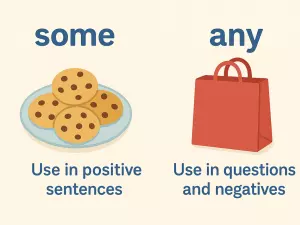
In most positive sentences, this word is used before plural countable nouns and uncountable nouns to indicate an indefinite amount. For instance:
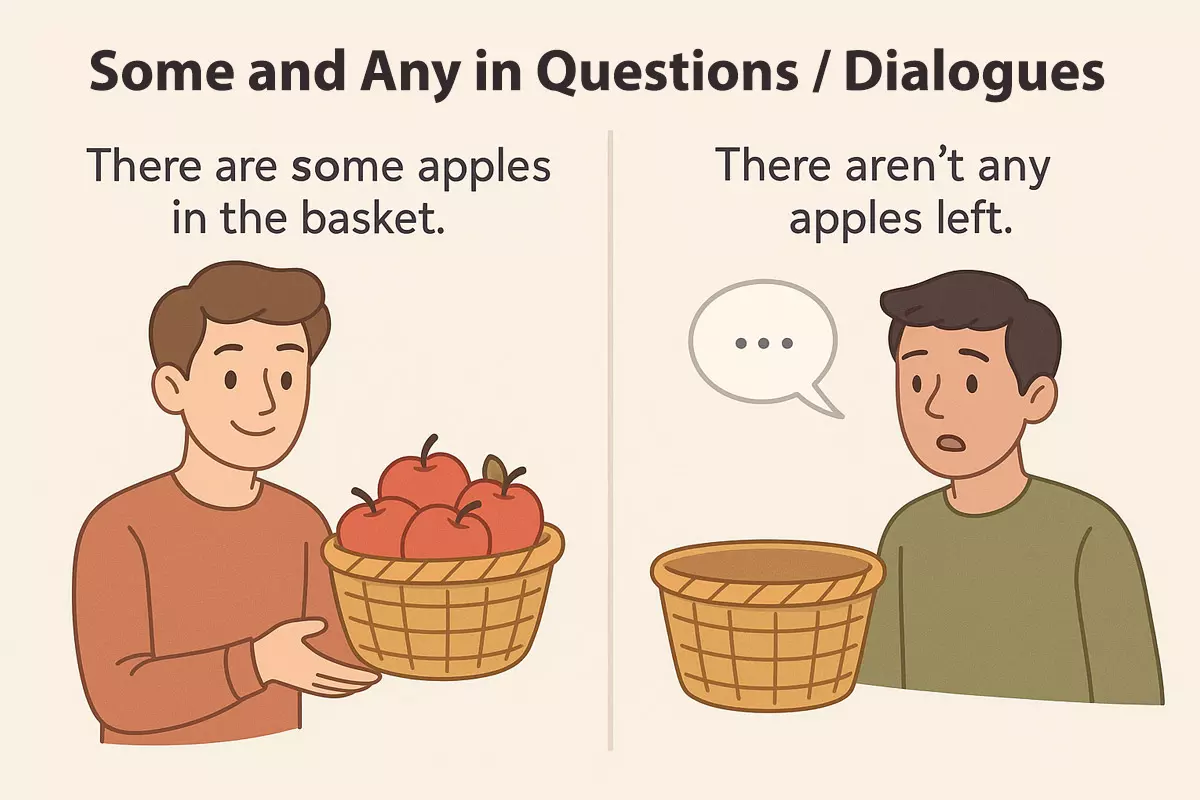
- There are some apples in the basket.
- She has some information about the project.
- We need some help with this task.
- I bought some bread at the store.
- He saw some friends at the party.
Polite Offers and Requests
This term is also preferred in questions when making offers or requests, as it sounds more courteous and less direct. Examples include:
- Would you like some tea?
- Can I get you some water?
- Could you lend me some money?
- Shall I bring some snacks?
- May I have some advice?
Expecting a Positive Response
When asking questions where you expect the answer to be "yes," this word is frequently chosen. For example:
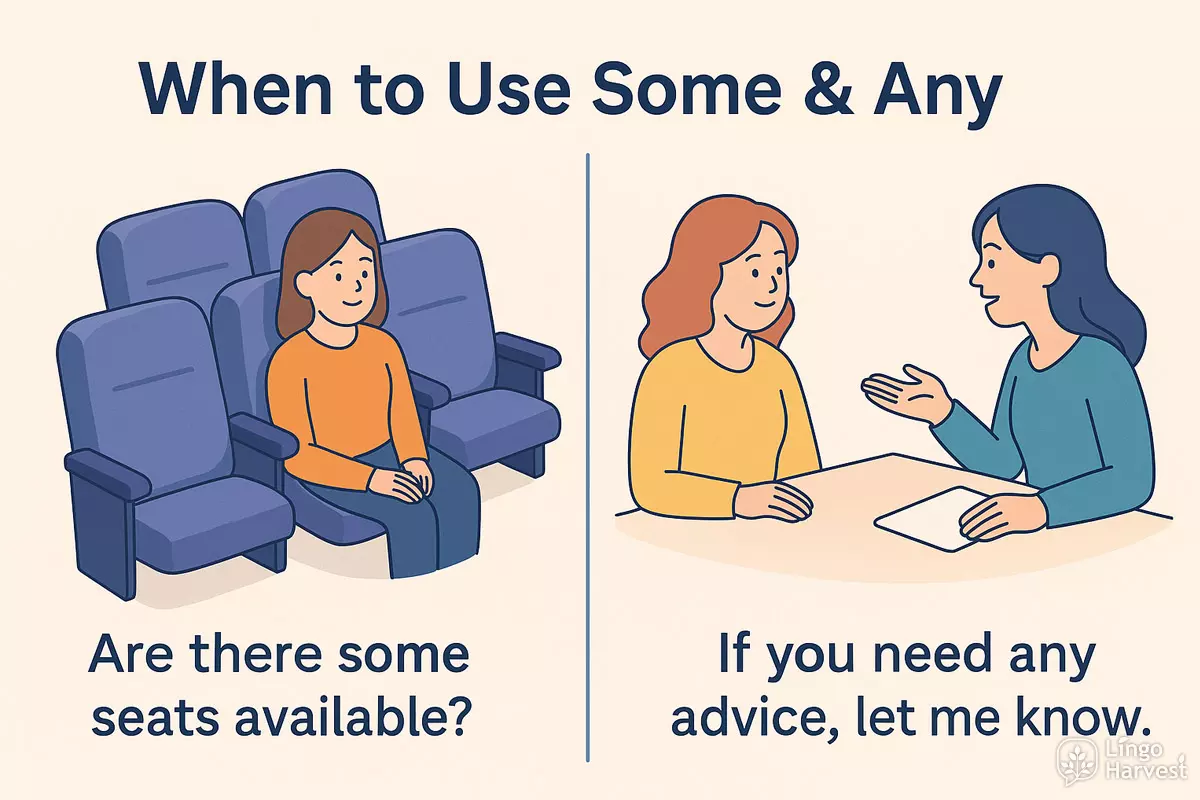
- Are there some seats available?
- Did you buy some milk?
- Is there some cake left?
- Have you got some time to talk?
Quick Comparison: Some vs. Any in Questions
| Form | Typical Usage | Example |
|---|---|---|
| Some | Offers / polite requests, expecting "yes" | Would you like some coffee? |
| Any | Neutral questions, no expectation | Do you have any questions? |
| Some | Affirmative statements | There are some cookies left. |
| Any | Negative statements | There aren’t any cookies left. |
Summary of Key Uses
- Indicating an unspecified but positive quantity in statements.
- Making friendly offers or polite requests in questions.
- Framing questions where a positive answer is likely or expected.
- Using with both countable (in plural) and uncountable nouns.
Mastering these uses will help you sound natural in English conversations, especially in everyday dialogues and polite exchanges.
When to Use Any
The word “any” is common in negative sentences and questions, especially when you are not sure if something exists or is available. English speakers use it when talking about an indefinite amount or number, and it often appears when we ask about or refer to the possibility of things or people.
Common Situations for “Any”
- Negative statements: Used to show that nothing or nobody is present (“There aren’t any apples left”).
- Questions: Used to ask about the existence or availability of something (“Do you have any questions?”).
- Offers and requests: Sometimes appears in polite requests or offers, especially in questions (“Would you like any help?”).
- Conditional sentences: Used when talking about possible situations (“If you have any problems, call me”).
Examples in Context
- Are there any seats available?
- She didn’t buy any bread.
- Do you need any water?
- If you see any mistakes, let me know.
- He doesn’t have any friends here.
- Has anyone called?
- We couldn’t find any information.
- Is there any coffee left?
- They won’t accept any excuses.
- Do you know any good restaurants nearby?
- Without any warning, the storm began.
- Are you bringing any guests?
- We don’t need any more chairs.
- If you have any further questions, ask now.
- She hardly made any mistakes.
- Is there any reason to worry?
Comparison: “Some” vs. “Any” in Questions
| Form | Example with “Some” | Example with “Any” |
|---|---|---|
| General question | Would you like some tea? | Do you have any tea? |
| Negative statement | We don’t use “some” here | We don’t have any milk. |
| Uncertainty or offer | Can I get you some help? | Is there any help available? |
| Conditional sentence | If you want some advice, ask. | If you need any advice, let me know. |
Choosing between “some” and “any” depends on the type of sentence and the level of certainty. “Any” fits best when you are uncertain about existence or quantity, especially in questions, negatives, and conditionals.
Positive, Negative, and Question Forms
Understanding when to use "some" and "any" depends on whether a sentence is affirmative, negative, or interrogative. These words help us talk about quantities in different types of statements, and their use changes based on the context.
Affirmative Sentences
In positive statements, "some" is commonly used to refer to an unspecified quantity or number. It gives a friendly, non-specific sense, often suggesting availability or existence.
- I have some friends in London.
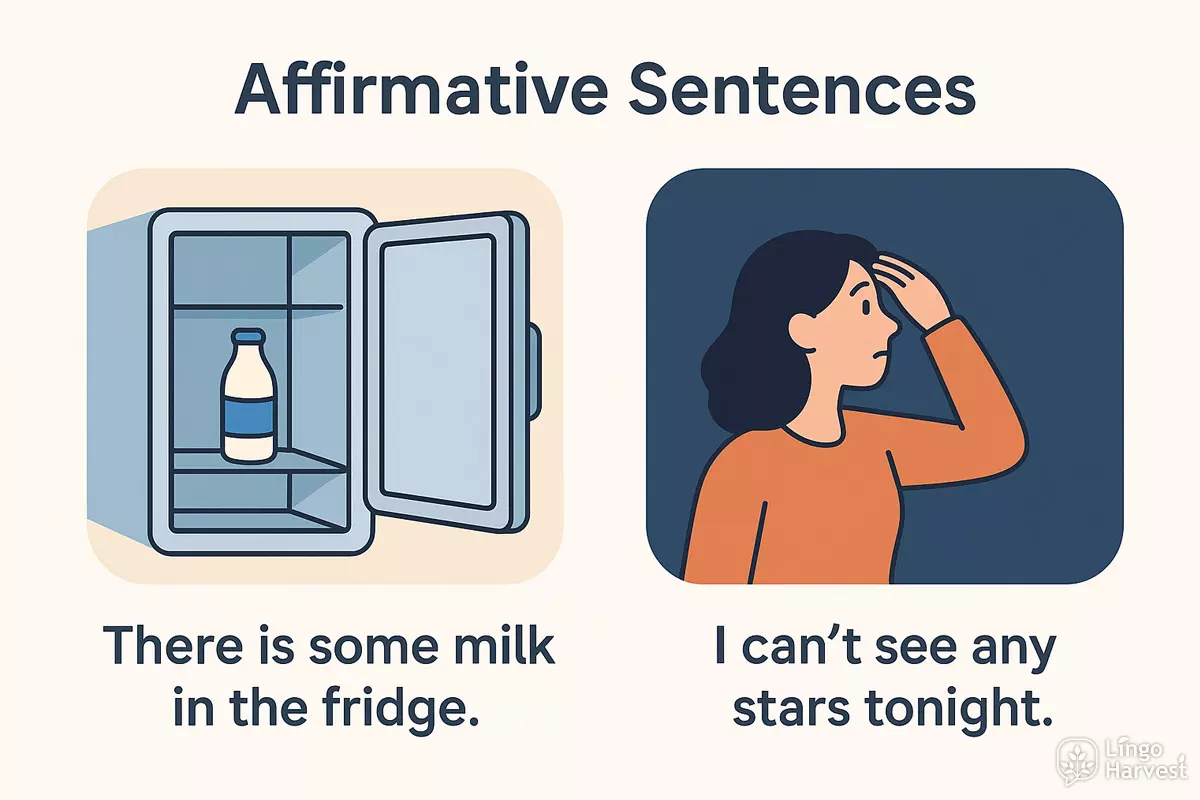
- There is some milk in the fridge.
- She bought some apples at the market.
- We need some help with this project.
Negative Sentences
For negative statements, "any" is typically used. It emphasizes the absence or non-existence of a thing or amount.
- They don’t have any sugar left.
- He didn’t find any mistakes in the report.
- There isn’t any water in the bottle.
- I can’t see any stars tonight.
Questions
When asking questions, "any" is usually preferred, but "some" can also appear in certain polite offers or requests. The choice depends on the expected answer or the speaker’s intention.
| Sentence Type | Typical Usage | Example |
|---|---|---|
| Affirmative | some | She has some ideas. |
| Negative | any | He doesn’t have any questions. |
| Question (general) | any | Do you have any brothers or sisters? |
| Question (offer/request) | some | Would you like some tea? |
Polite Offers and Requests
While "any" is standard in most questions, "some" is used when offering or requesting something politely, especially when expecting a positive response.
- Would you like some coffee? ✅
- Can I have some water, please? ✅
Quick Reference: Usage Patterns
- Affirmative: "some" (I need some information.)
- Negative: "any" (We don’t have any news.)
- Questions: "any" (Do you have any advice?)
- Offers/Requests: "some" (Could I borrow some money?)
- With uncountable nouns: both "some" and "any" apply (milk, advice, information)
- With plural countable nouns: both "some" and "any" apply (books, friends, cookies)
Being precise with "some" and "any" makes dialogues clearer and more natural. Noticing these patterns helps learners sound more fluent in everyday English conversations.
Fixed Expressions (something, anyone)
Some words formed with some and any act as set phrases in English, especially in conversation. Expressions like something, anything, someone, and anyone are commonly used in questions, offers, requests, and even in indirect ways. Their meaning and usage often depend not just on grammar rules, but also on the context and tone of the dialogue.
Common Usage Patterns
While something and anything are both used to refer to unspecified things, their choice in a question or a statement can subtly change the meaning. Generally, something suggests the speaker expects or hopes for a positive answer, whereas anything is more open or neutral. Similarly, someone and anyone follow the same pattern for people.
- Would you like something to drink? → (Offering, expecting a 'yes')
- Is there anyone in the room? → (General inquiry, open possibility)
- I need someone to help me. → (A specific but unknown person)
- Did you see anything unusual? → (No assumption about the answer)
- Can I get you something? → (Polite offer)
- Has anyone called for me? → (General question)
- There is something I want to tell you. → (Indefinite but real thing)
- Do you know anyone who speaks Spanish? → (General inquiry)
- Would you like to eat something? → (Offering food)
- Is there anything I can do for you? → (Open offer of help)
- I don't need anything else. → (Negative statement)
- She didn't see anyone there. → (Negative statement)
Special Cases and Set Phrases
Certain combinations appear so often that they feel almost idiomatic. For example, “anything else?” is a standard question in shops or restaurants. In polite offers or requests, “would you like something” or “is there anything I can help you with” are routine. These are not just about grammar—they’re about social interaction.
| Expression | Typical Use |
|---|---|
| something | Offers, suggestions, expect positive answer (e.g., "Would you like something to eat?") |
| anything | Questions, negatives, open possibilities (e.g., "Did you see anything unusual?") |
| someone | Referring to an unspecified, real person (e.g., "Someone is at the door.") |
| anyone | General or negative reference (e.g., "Is anyone here?") |
| something else | Offers, adding alternatives (e.g., "Would you like something else?") |
| anything else | Final check in offers or sales (e.g., "Anything else for you?") |
By recognizing these patterns, it becomes easier to understand and use the right word in everyday English conversations. The choice between these expressions often signals your expectation or the openness of the situation, not just the grammar.
Practice: Complete Sentences with Some/Any
When learning to use "some" and "any" in questions and dialogues, context is essential. Both words help us talk about quantities when the exact number isn’t important, but their use depends on whether the sentence is positive, negative, or a question. Below, you'll find focused practice to help you choose the correct word in different types of sentences.
Fill in the Blanks
Try to complete the sentences below by choosing either "some" or "any." Think about whether the sentence is positive, negative, or a question, and consider if it sounds natural in everyday conversation.
- Are there ____ apples left in the fridge?
- I need ____ help with my homework.
- She doesn’t have ____ friends in this city.
- Would you like ____ tea?
- Did you buy ____ bread?
- There isn’t ____ milk in the bottle.
- Let’s buy ____ flowers for the table.
- Is there ____ water in your bottle?
- I didn’t see ____ of my classmates at the party.
- We have ____ interesting books to read.
Show answers
- any
- some
- any
- some
- any
- any
- some
- any
- any
- some
Quick Reference: "Some" vs. "Any" in Context
Below is a summary to help you remember typical uses. Review these patterns and then try to create your own examples.
- Use some in positive sentences: "I have some time."
- Use some when offering or requesting: "Would you like some juice?" "Can I have some water?"
- Use any in negative sentences: "I don’t have any money."
- Use any in most questions: "Do you have any questions?"
- But, use some in questions when offering or requesting: "Would you like some cake?"
Identify the Correct Usage
Decide whether the sentences below use "some" or "any" correctly. If not, rewrite them with the correct word.
- Do you want any coffee?
- There isn’t some cheese in the fridge.
- Can I have any more paper, please?
- We bought some fruit at the market.
Show answers
- Correct (for a general question, but "some" is more natural when offering: "Do you want some coffee?")
- Incorrect. Should be: "There isn’t any cheese in the fridge."
- Incorrect. Should be: "Can I have some more paper, please?"
- Correct.
Common Mistakes to Avoid
Watch out for these pitfalls when choosing between "some" and "any":
- Using "any" in positive statements: Incorrect: "I have any money."
- Using "some" in negative sentences: Incorrect: "I don’t have some time."
- For offers and polite requests, "some" is generally preferred, even in questions.
By practicing with these examples and reviewing the patterns above, you’ll become more confident when using "some" and "any" in your own questions and conversations.