Questions with Quantifiers in English: Rules and Examples

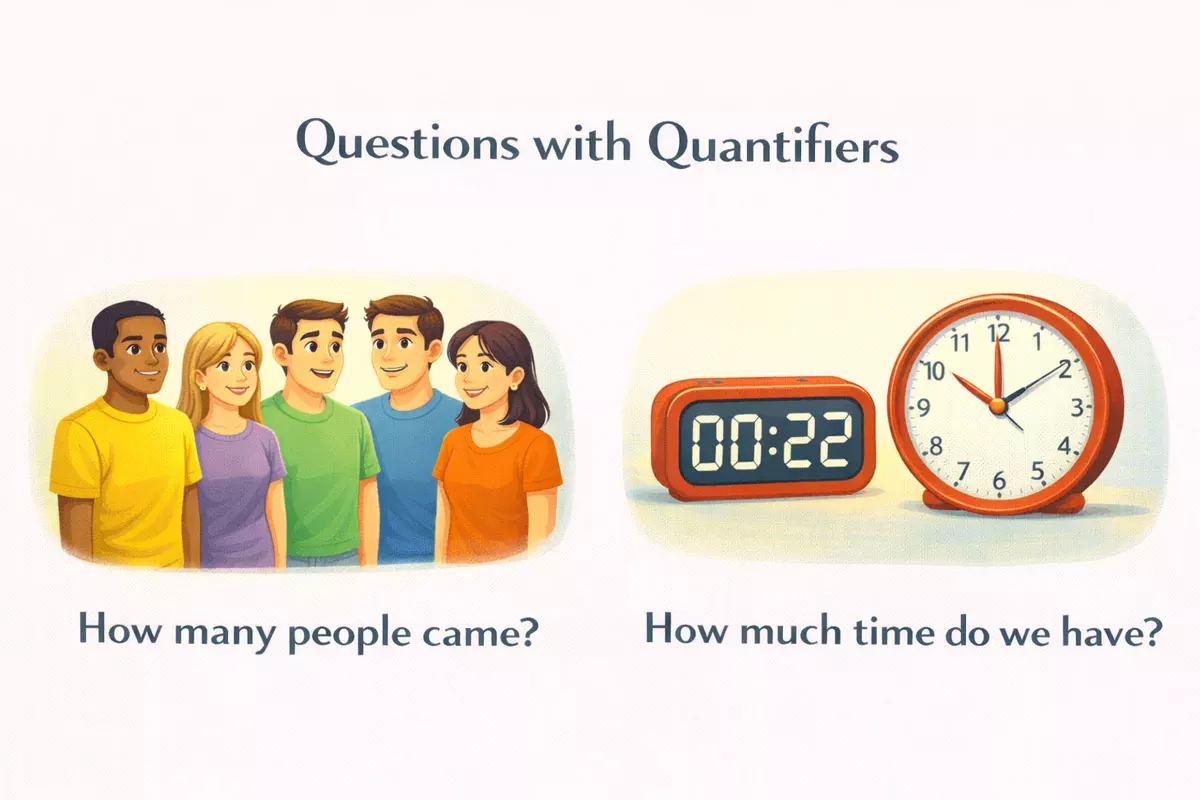 This article explains how to use quantifiers like much, many, few, little, some, and any in questions. It covers their roles with countable and uncountable nouns, highlights common mistakes, and includes practice exercises with self-checks.
If you want to ask questions using words like many, much, or a few in English, it’s important to understand how each one works with different types of nouns. Use many with countable nouns, such as How many books do you have? Use much with uncountable nouns, like How much water do you need? When you want to ask about a small quantity, use a few for countable nouns—Do you have a few minutes?—and a little for uncountable nouns—Can I have a little sugar? Practicing these structures will help make your conversations clearer and more accurate.
Role of Quantifiers in Questions
Quantifiers help speakers and writers ask about amounts, numbers, or degrees, making questions more precise and meaningful. By using words like some, any, much, or many, we can focus our queries on specific quantities or generalize about an entire category. These words are essential for both everyday conversations and formal English, as they guide the listener to provide the right kind of information.
How Quantifiers Shape Questions
Choosing the appropriate quantifier depends on the noun (countable or uncountable), the context (positive, negative, or interrogative), and the level of formality. For example, "How much water do you need?" asks about an uncountable noun, while "How many apples are left?" targets a countable one. In questions, quantifiers often appear before the noun or as part of the question structure.
- How much sugar do you want in your coffee? → Just one teaspoon, please.
- How many students attended the lecture? → About forty students.
- Are there any seats available? → Yes, there are a few seats left.
- Do you have some time to talk? → Yes, I have a few minutes now.
- Is there enough food for everyone? → Yes, there’s enough for everyone.
- Did you see several birds in the park? → Yes, I saw several birds near the lake.
- Are all the documents ready? → Yes, they’re all ready.
- Did both of you enjoy the movie? → Yes, we both enjoyed it.
- Is little progress being made? → Yes, very little progress so far.
- Have you got plenty of ideas? → Yes, I have plenty of ideas.
- Do either of you play tennis? → Yes, I do.
- Can you give me some examples? → Sure, I can give you a few examples.
- Are there few options left? → Yes, there are only a few options left.
- Is most of the work finished? → Yes, most of it is finished.
- Do you need more information? → Yes, I need a bit more information.
- Did you find any errors? → Yes, I found a couple of errors.
- Would you like another piece? → Yes, I’d like another piece, please.
- Is there no solution? → No, there is a solution.
Comparing Quantifiers in Interrogative Forms
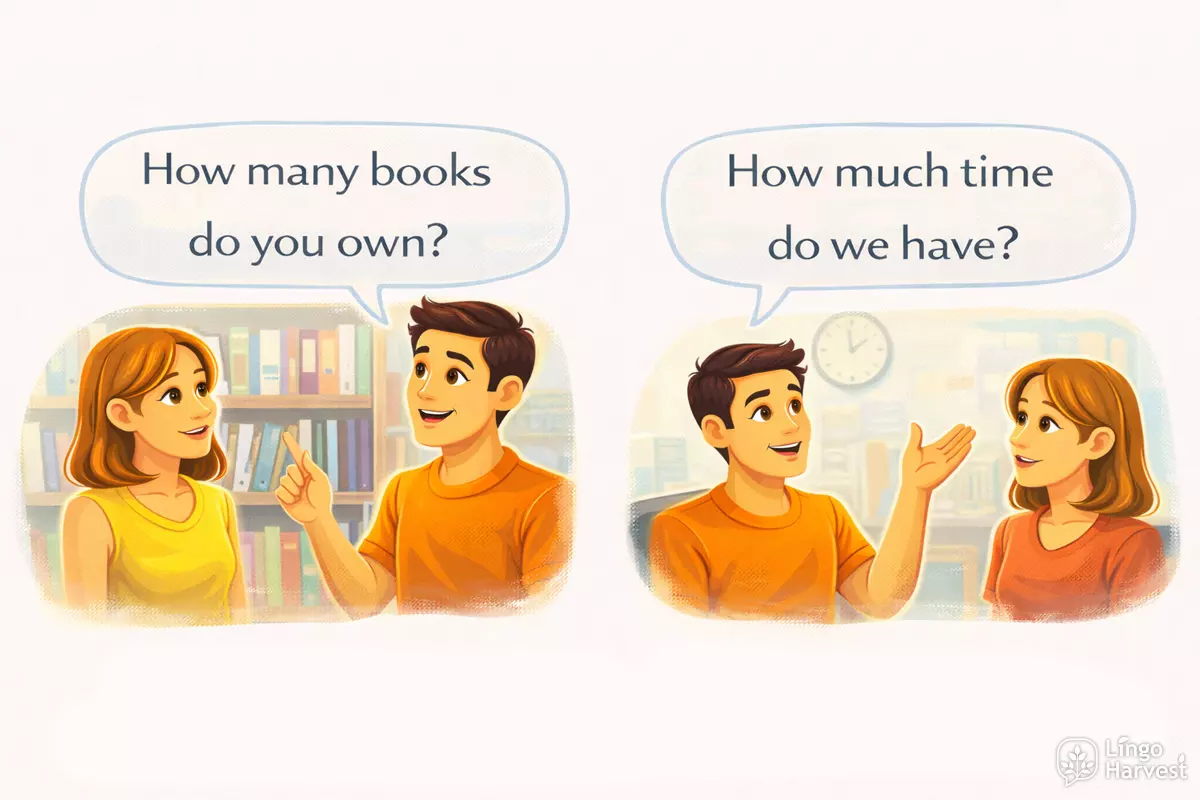
Different quantifiers fit different situations. To clarify their usage, here’s a comparison of common quantifiers in questions based on whether they are used with countable or uncountable nouns:
| Quantifier | Example Question | Countable/Uncountable |
|---|---|---|
| How many | How many books do you own? | Countable |
| How much | How much time do we have? | Uncountable |
| Any | Are there any cookies left? | Both |
| Some | Can I have some advice? | Both |
| Few | Are few people attending? | Countable |
| Little | Is there little hope? | Uncountable |
| Several | Did you visit several cities? | Countable |
| Much | Is there much interest? | Uncountable |
Key Points to Remember
- Pick quantifiers based on the noun type and the information you want.
- In negative and interrogative sentences, any is more common than some.
- For offers and requests, some is often preferred: "Would you like some tea?"
- Quantifiers can change the focus or tone of a question, from general ("any") to more specific ("several," "most," "all").
Understanding these patterns helps in forming natural, clear questions in English, whether you are asking about quantities, seeking details, or making polite requests.
Much and Many in Questions
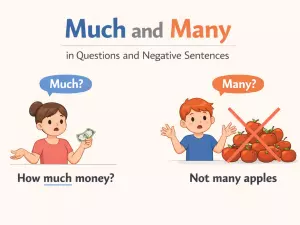
Understanding when to use much and many in English questions is essential for clear and correct communication. These quantifiers help us ask about quantity, but each one fits different types of nouns. Much is used with uncountable nouns, while many is used with countable nouns. Choosing the right word depends on what you are asking about—things you can count (like "books") or things you cannot count individually (like "water").
When to Use "Much"
Use much when asking about a quantity of something that cannot be counted as separate items. Common uncountable nouns include liquids, substances, and abstract ideas. Here are some examples:
- How much money do you have? → I don’t have much money right now.
- How much time is left? → There’s about ten minutes left.
- How much sugar do you need? → Just a little sugar is enough.
- How much information did you find? → I found quite a lot of useful information.
- How much water should I pour? → Pour about half a glass.
- How much traffic was there? → There was a lot of traffic this morning.
- How much noise can you hear? → Not much noise at all.
- How much sleep did you get? → I only got about five hours of sleep.
- How much effort did it take? → It took a lot of effort.
- How much advice did you receive? → I received some helpful advice.
When to Use "Many"
Choose many when asking about things you can count as individual units. Countable nouns refer to objects, people, or ideas that can be separated and counted. For instance:
- How many books do you own? → I own quite a few books.
- How many students are in the class? → There are twenty students.
- How many apples did you buy? → I bought six apples.
- How many cars are parked outside? → About ten cars are parked outside.
- How many emails did you get? → I got a lot of emails today.
- How many friends came to the party? → Around fifteen friends came.
- How many mistakes did you make? → I made only a few mistakes.
- How many questions are there? → There are twelve questions.
- How many chairs do we need? → We need four more chairs.
- How many opportunities did you find? → I found several good opportunities.
Quick Comparison
To make it easier to see the difference between these two quantifiers when forming questions, here’s a side-by-side comparison:
| Quantifier | Example Question | Type of Noun |
|---|---|---|
| Much | How much milk is left? | Uncountable |
| Many | How many cookies are there? | Countable |
| Much | How much energy do you have? | Uncountable |
| Many | How many pencils are in the box? | Countable |
In summary, select much for questions about uncountable nouns and many for countable nouns. This distinction is a key part of phrasing questions naturally in English.
Few and Little in Questions
When asking about small quantities in English, "few" and "little" are commonly used, but they aren’t interchangeable. "Few" is applied with countable nouns, while "little" matches uncountable nouns. In questions, these quantifiers help us focus on whether there is a small amount of something, and often imply that the amount is less than expected or desired.
Understanding the Use
To form questions, "few" and "little" are typically placed after "how," as in "How few" or "How little," or simply used in negative or rhetorical questions. This helps clarify if the quantity is sufficient, or to express surprise or concern about scarcity.
- How few people came to the meeting? → Only a handful of people showed up.
- How little water do we have left? → We have almost no water left.
- Did you notice how few options there are? → Yes, there are very limited options.
- Are there few apples in the basket? → Yes, there are only a few apples left.
- Is there little time before the deadline? → Yes, there’s very little time left.
- How few students understood the lesson? → Only a small number of students understood it.
- Why is there so little milk in the fridge? → Because it was almost all used up.
- Have we got little hope of success? → Unfortunately, yes, there’s little hope.
- How few chances did we get? → We only got one or two chances.
- Is there little evidence to support this? → Yes, there’s very little evidence.
- How few cars passed by last night? → Hardly any cars passed by.
- How little interest did he show? → He showed almost no interest.
- Did she have few friends at school? → Yes, she had only a few friends.
- Is there little information available? → Yes, only limited information is available.
- How few words did he speak? → He barely said a word.
- Do you have little patience for delays? → Yes, I don’t have much patience.
- How little progress have we made? → We’ve made very little progress.
Countable vs. Uncountable: Quick Comparison
| Quantifier | Example Question | Type of Noun |
|---|---|---|
| Few | How few books are on the shelf? | Countable |
| Little | Is there little bread left? | Uncountable |
| Few | Did few people volunteer? | Countable |
| Little | Why is there little hope? | Uncountable |
Tips for Accurate Usage
- Use "few" with things you can count (books, apples, ideas).
- Use "little" with things you measure but don’t count individually (water, time, money).
- Questions with these quantifiers often expect a negative or surprising answer.
- Adding "very" (e.g., "very few," "very little") strengthens the sense of scarcity.
Choosing between these words in questions depends on the type of noun and the context. This helps keep your English clear and precise, especially when discussing limited amounts or expressing concern about a shortage.
Some and Any in Questions
Understanding when to use some and any in interrogative sentences is a common challenge for English learners. Both words are quantifiers, but they appear in slightly different contexts when forming questions. The key difference often depends on whether the speaker expects a positive answer or is making a genuine inquiry without assumptions.
General Guidelines
- Some is generally used in questions when offering or requesting something, especially if you expect the answer to be "yes" or want to sound more polite and friendly.
- Any is more typical in most other questions, especially when you do not know if the answer will be "yes" or "no," or you are asking in a more neutral or open-ended way.
Examples of Usage
- Would you like some tea? (Offering; expecting a positive response)
- Can I have some water, please? (Requesting politely)
- Do you have any questions? (Open inquiry)
- Are there any apples left? (Not sure if apples remain)
- Could I borrow some sugar? (Polite request)
- Did you buy any bread? (Neutral question)
- Would you like some help with your homework? (Offering assistance)
- Is there any milk in the fridge? (Checking availability)
- Shall I get some snacks for the meeting? (Offering to provide)
- Did you see any interesting movies lately? (General inquiry)
- Could you bring some chairs from the other room? (Polite request)
- Do you need any help? (General offer, open-ended)
- Would you like some more cake? (Offering more)
- Are there any messages for me? (Checking for presence)
- Could I have some information about your courses? (Requesting details)
- Do you want some coffee? (Offering, expecting a yes)
- Have you got any siblings? (Open-ended question)
- Is there any news? (Checking for updates)
- Shall we buy some flowers for her? (Offering/suggesting)
- Have you seen any of my keys? (Unsure if they have been seen)
Summary Table: Typical Uses in Questions
| Form | When to Use | Example |
|---|---|---|
| Some | Offers or polite requests, expecting a "yes" | Would you like some juice? |
| Any | General questions, uncertain about the answer | Are there any seats available? |
| Some | Suggesting or inviting | Shall we order some pizza? |
| Any | Checking for existence or presence | Did you find any errors? |
Common Mistakes to Avoid
- Using some in neutral questions where any is expected can sound unnatural. For instance, "Do you have some questions?" usually sounds odd unless you are fairly certain the person has questions.
- Remember, some is rarely used in negative questions; any is standard: "Don’t you have any money?" ✅
- In formal or written English, any is generally safer for most open questions.
Mastering the use of these quantifiers in interrogative sentences helps you sound more natural and polite in English conversations. Practice by noticing how native speakers use them in context.
Quantifiers with Countable Nouns
When talking about things you can count individually, English uses specific quantifiers to express number or amount. These words help you ask and answer questions like “How many apples are there?” or “Are there any students in the room?” The choice of quantifier depends on whether the noun is singular or plural, as well as the exact quantity or degree you want to convey.
Common Quantifiers for Countable Nouns
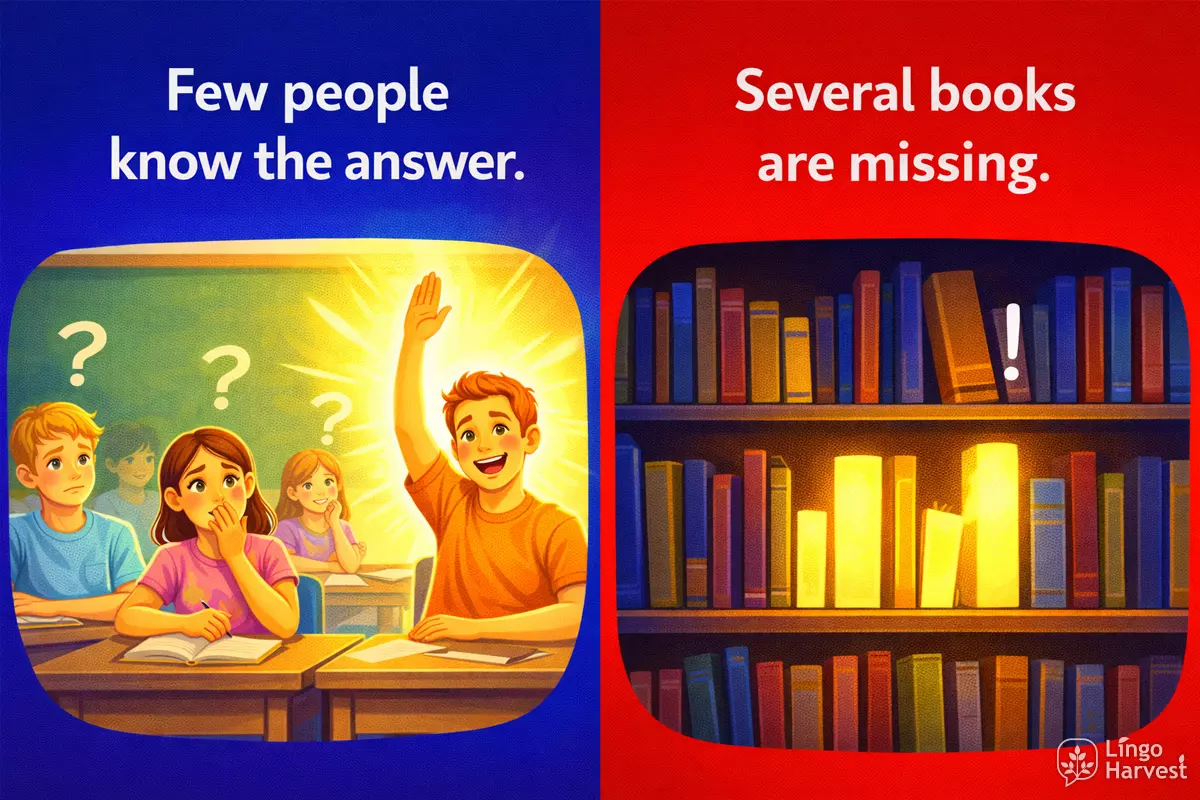
Some quantifiers are used only with plural countable nouns. These include words and phrases that indicate a specific or nonspecific number. Here are the most frequent options:
- many – “Are there many parks nearby?”
- a few – “We have a few minutes left.”
- few – “Few people know the answer.”
- several – “Several books are missing.”
- a number of – “A number of students were absent.”
- each – “Each child received a gift.”
- every – “Every car must be inspected.”
- a couple of – “I saw a couple of friends at the café.”
- both – “Both answers are correct.”
- any (in questions/negatives) – “Do you have any siblings?”
- no – “No tickets are available.”
- all – “All seats are taken.”
- none – “None of the lights are on.”
- several – “Several options exist.”
- hundreds/thousands of – “Hundreds of people attended.”
Questions Using Quantifiers
You’ll often hear quantifiers in questions, especially when asking about amounts. For example, “How many chairs do we need?” or “Are there any bananas left?” The quantifier comes before the plural noun.
| Question Pattern | Example |
|---|---|
| How many + plural noun | How many emails did you get? |
| Are there any + plural noun | Are there any buses at this hour? |
| Do you have a few + plural noun | Do you have a few minutes? |
| Did you find several + plural noun | Did you find several solutions? |
Special Notes and Tips ✅
- Many is common in questions and negatives: “I don’t have many friends.”
- A few means some, but “few” (without “a”) means not many and can sound negative.
- Each and every are used with singular nouns, but refer to all members of a group.
- Any is mostly used in questions and negatives, not positive statements.
- Use no or none to emphasize zero quantity: “No cookies are left.”
Mastering these quantifiers helps you ask clear questions and give precise answers about items you can count. Practice using them in real conversations to sound more natural and accurate.
Quantifiers with Uncountable Nouns
When talking about substances, qualities, or abstract concepts that can't be counted individually—like water, information, advice, or happiness—we need special words to describe amounts. These are called quantifiers, and they help us ask and answer questions about “how much” rather than “how many.” Choosing the right quantifier depends on whether what you're talking about is measurable in discrete units or not.
Common Quantifiers for Uncountable Nouns
Some quantifiers are almost exclusively used for things that can’t be counted separately. Here are several of the most frequently used options:
- Much (e.g., How much money do you have?)
- A little (e.g., Can I have a little sugar?)
- Little (e.g., There is little hope left.)
- A bit of (e.g., Would you like a bit of cake?)
- Some (e.g., I need some advice.)
- Any (e.g., Do you have any information?)
- No (e.g., There is no time.)
- Enough (e.g., Do we have enough milk?)
- Plenty of (e.g., There is plenty of space.)
- A great deal of (e.g., She has a great deal of patience.)
- A large amount of (e.g., He drank a large amount of water.)
- Lots of (e.g., We have lots of work.)
- Hardly any (e.g., There is hardly any coffee left.)
Patterns for Questions with Uncountable Nouns
When forming questions, the structure usually follows “How much + [uncountable noun]...?” for precise amounts, or uses quantifiers like “any” or “some” in yes/no questions. Here are some examples:
- How much time do we need?
- Is there any cheese in the fridge?
- Can you give me some advice?
- Do we have enough information?
- Is there a lot of traffic today?
Comparing Quantifiers with Uncountable Nouns
Different quantifiers express different shades of meaning, from very small to very large amounts. Here’s a quick comparison:
| Quantifier | Example with Uncountable Noun |
|---|---|
| Much | How much sugar do you want? |
| Little / A little | There is little hope. / We have a little time. |
| Some / Any | Is there any milk? / I need some help. |
| Plenty of / A lot of | There is plenty of water. / We have a lot of evidence. |
Tips for Usage ✅
- Use “much” mostly in questions and negatives (e.g., I don’t have much time).
- “Some” and “any” can both be used, but “some” is more common in positive sentences and offers, while “any” is typical in questions and negatives.
- For emphasis on a small amount, use “a little” or “a bit of.”
- To talk about large, non-specific amounts, “a lot of,” “lots of,” or “plenty of” fit naturally.
Remember, the right quantifier depends not just on the noun but also on how specific or general you want to be about the amount. Practice with real examples helps build confidence in using these forms.
Common Learner Mistakes
When forming questions with quantifiers, English learners often run into specific trouble spots. These errors usually come from confusion about word order, choosing the wrong quantifier, or not matching countable and uncountable nouns correctly. Understanding these pitfalls can help you build more accurate and natural-sounding questions.
Mixing Up Quantifiers for Countable and Uncountable Nouns
A frequent stumbling block is using quantifiers like "many" or "much" with the wrong type of noun. "Many" is used with countable nouns, while "much" fits uncountable nouns. Swapping these can make your questions sound odd. For example:
- Incorrect: How much apples do you want?
- Correct: How many apples do you want?
Incorrect Word Order in Questions
Learners sometimes position quantifiers incorrectly in questions, especially with auxiliary verbs. Remember, in English, the question word and auxiliary usually come first, followed by the quantifier and the noun.
- Incorrect: Many do you have friends?
- Correct: How many friends do you have?
Confusing "Any," "Some," and "A Lot of"
Choosing between "any," "some," and "a lot of" can be tricky. "Any" is generally used in questions and negatives, while "some" is more common in offers and requests.
- Incorrect: Do you have some money? (as a general question)
- Correct: Do you have any money?
Overusing "How Much" and "How Many"
Not every question about quantity needs "how much" or "how many." Sometimes, learners use these phrases where a different structure is more natural.
- Incorrect: How many milk do you want?
- Correct: How much milk do you want?
Table: Typical Quantifier Errors and Corrections
| Incorrect Question | Corrected Version |
|---|---|
| How many bread do you need? | How much bread do you need? |
| How much chairs are there? | How many chairs are there? |
| Do you have much friends? | Do you have many friends? |
| Any people came to the party? | Did any people come to the party? |
| Do you want any tea or coffee? | Would you like some tea or coffee? |
Omitting "How" in Quantifier Questions
Forgetting to use "how" before "much" or "many" is a frequent slip. The correct structure is "How much..." or "How many..." at the start of a question.
- Incorrect: Much money do you need?
- Correct: How much money do you need?
Summary List: Other Frequent Missteps
- Using "a few" and "few" interchangeably, despite their different meanings.
- Forgetting to invert subject and auxiliary in questions (e.g., You have how many books? → How many books do you have?).
- Placing quantifiers before the verb instead of before the noun (e.g., How many do you have books?).
- Using "a lot of" in formal questions where "many" or "much" is expected.
- Mixing quantifiers with negative questions incorrectly (e.g., Don't you have any? is correct, but Don't you have some? is not).
Learning to spot and correct these typical mistakes will make your use of quantifiers in questions much more accurate and natural.
Practice Exercises and Self-Check
Strengthen your understanding of quantifier questions in English with practical tasks below. These activities are designed to help you spot and use quantifiers correctly in various types of questions. Read each instruction carefully and try to answer before checking the solutions.
1. Fill in the Blank: Choosing the Correct Quantifier
Complete each question by choosing the most suitable quantifier from the options in parentheses.
- ________ (How much / How many) sugar do you put in your coffee?
- ________ (How much / How many) countries have you visited?
- Are there ________ (any / much) apples left in the basket?
- Do you have ________ (many / any) experience with programming?
- ________ (How much / How many) time do you need to finish this?
- Is there ________ (many / any) milk in the fridge?
- ________ (How much / How many) emails did you get today?
- Are there ________ (much / any) seats available?
- ________ (How much / How many) money do you have with you?
- Do you have ________ (much / any) information about the schedule?
Show answers
- How much
- How many
- any
- any
- How much
- any
- How many
- any
- How much
- any
2. Identify the Quantifier
Underline the quantifier in each question below (write out the quantifier if you’re not using paper):
- Do you have any brothers or sisters?
- How many people are coming to the party?
- Is there much traffic in your city?
- Are there many options available?
- Did you see any mistakes in the report?
- Do you have enough time to finish?
- Are there several meetings today?
- Have you got a few minutes to talk?
- Is there any information on the website?
- Do you need more examples?
Show answers
- any
- How many
- much
- many
- any
- enough
- several
- a few
- any
- more
3. Correct or Incorrect?
Decide if each question is correct (✅) or incorrect (❌). If incorrect, think about what should be changed.
- How much apples do you want?
- How many water do we need?
- Are there any tickets left?
- Do you have much friends?
- Is there any milk in the fridge?
- How many homework do you have tonight?
- Is there many traffic on the highway?
- Do you have any advice for me?
- How much chairs do we need?
- Are there much problems with the plan?
Show answers
- ❌ (Should be: How many apples do you want?)
- ❌ (Should be: How much water do we need?)
- ✅
- ❌ (Should be: Do you have many friends?)
- ✅
- ❌ (Should be: How much homework do you have tonight?)
- ❌ (Should be: Is there much traffic on the highway?)
- ✅
- ❌ (Should be: How many chairs do we need?)
- ❌ (Should be: Are there many problems with the plan?)
4. Make Your Own Questions
Create five questions using quantifiers. Try to use a mix of “how much,” “how many,” “any,” “much,” and “many.” Then, check your questions for correct quantifier use.
Show answers
- How many pens do you have?
- How much coffee do you drink?
- Is there any bread left?
- Do you have many hobbies?
- Is there much snow in your country?
Use these exercises to monitor your progress and get more comfortable forming questions with quantifiers. The more you practice, the more natural these patterns will become in your spoken and written English.