Using Prepositions with Gerunds and -ing Forms: Complete Guide

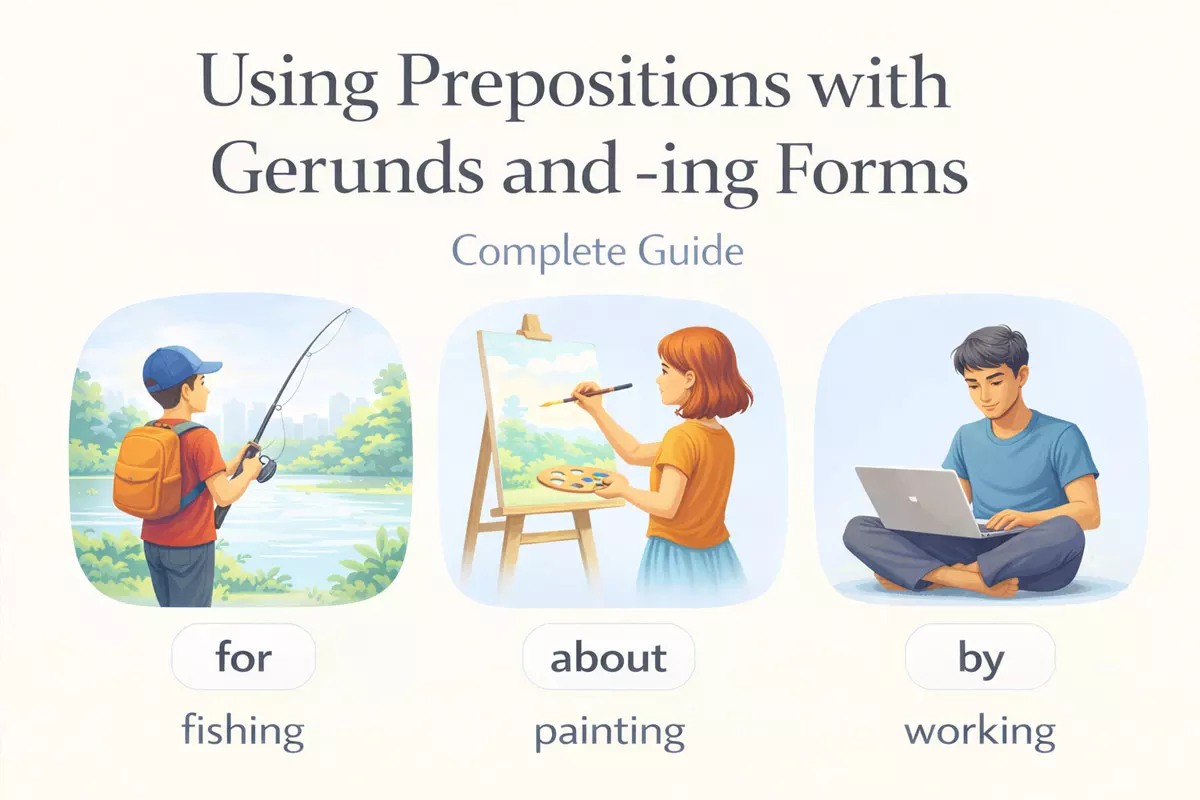 The article explains why gerunds follow prepositions, lists common verb and preposition plus -ing combinations, and distinguishes gerund objects from subjects. It also discusses gerunds after adjectives and nouns, frequent mistakes, and offers practice activities.
- Why gerunds follow prepositions in English
- Common verb + preposition + -ing combinations
- Differences between gerund objects and gerund subjects
- Using gerunds after adjectives and nouns with prepositions
- Frequent mistakes when replacing infinitives with gerunds
- Practice activities: complete and rewrite with correct -ing forms
Mastering how to connect prepositions with verbs ending in -ing is essential for making your English sound more fluent and natural. Understanding these combinations helps you avoid awkward phrasing and communicate your ideas more clearly. For example, common expressions like interested in learning, good at cooking, or worried about missing are built with prepositions followed by verbs in the -ing form. Practicing these patterns will improve both your writing and speaking, helping you express yourself with greater accuracy and confidence.
Why gerunds follow prepositions in English
Understanding why the -ing form appears after prepositions begins with recognizing how English treats verb forms and sentence structure. In English, prepositions must be followed by a noun, pronoun, or noun-like word. Gerunds—verbs ending in -ing that act as nouns—are perfectly suited for this role. This is why you’ll see sentences like “She’s interested in learning Spanish” or “He apologized for being late,” where the gerund follows the preposition and functions as a noun.
The grammatical logic
After a preposition, only a noun or something functioning as a noun is grammatically correct. Regular verbs (the base form, like “go” or “see”) cannot serve this function. The gerund, however, transforms a verb into a noun-like entity, making it the natural choice after prepositions. For example:
- They talked about traveling.
- She’s good at drawing.
- He left without saying goodbye.
Common prepositions followed by gerunds

Many prepositions are regularly followed by -ing forms. Here are some of the most frequent patterns:
- after → After I finished the report, I went home.
- before → Before I left the office, I turned off the lights.
- without → He left without asking for permission.
- by → You can improve your English by practicing every day.
- for → She apologized for arriving late.
- about → I’m nervous about meeting his parents.
- in → He succeeded in finding a better solution.
- on → On arriving at the hotel, we checked in immediately.
- instead of → Instead of driving, we took the train.
- because of → The game was cancelled because of heavy rain.
- from → He stopped her from making the same mistake again.
- to (when part of a prepositional phrase, not infinitive) → I look forward to seeing you next week.
- at → She was surprised at winning the first prize.
- over → He spent hours overthinking the situation.
- since → Since I moved here, I have made many friends.
- without → He signed the document without knowing the full details.
Contrast: Incorrect forms after prepositions
It’s important to avoid using the base verb after a preposition. This is a common mistake for learners. Compare:
- ✅ She’s afraid of flying.
- ❌ She’s afraid of fly.
Quick reference: Prepositions and gerund patterns
Below is a table illustrating how different prepositions pair naturally with gerunds and not with base verbs:
| Preposition | Correct Example (with gerund) | Incorrect Example (with base verb) |
|---|---|---|
| about | They talked about moving. | They talked about move. |
| after | After finishing the work, she left. | After finish the work, she left. |
| without | He left without saying goodbye. | He left without say goodbye. |
| in | She succeeded in passing the exam. | She succeeded in pass the exam. |
| for | This tool is useful for cutting wood. | This tool is useful for cut wood. |
| by | You can improve by practicing daily. | You can improve by practice daily. |
| to (as preposition) | Look forward to meeting you. | Look forward to meet you. |
| before | Wash your hands before eating. | Wash your hands before eat. |
Summary
The -ing form reliably follows prepositions because it acts as a noun, fulfilling the requirement for a noun phrase. This is a fixed pattern in English grammar, and mastering it helps learners sound more natural and avoid common sentence errors.
Common verb + preposition + -ing combinations
Understanding how verbs naturally join with specific prepositions followed by an -ing form is essential for fluent English. These patterns are often fixed, and using the wrong preposition—or forgetting the -ing ending—can make sentences sound awkward or incorrect. The following sections outline some of the most frequently encountered structures, along with practical examples.
Frequent Patterns in Everyday English
Many verbs are commonly followed by particular prepositions, after which a gerund (-ing form) is required. Here are some widely used combinations:
- look forward to + -ing
Example: I look forward to meeting you. - be interested in + -ing
Example: She is interested in learning Spanish. - apologize for + -ing
Example: He apologized for arriving late. - insist on + -ing
Example: They insisted on paying for dinner. - worry about + -ing
Example: Don’t worry about making mistakes. - think about/of + -ing
Example: I’m thinking of changing jobs. - feel like + -ing
Example: Do you feel like going out? - succeed in + -ing
Example: She succeeded in passing the exam. - be capable of + -ing
Example: He is capable of finishing the project. - accuse (someone) of + -ing
Example: They accused him of cheating. - prevent (someone) from + -ing
Example: The rain prevented us from leaving. - concentrate on + -ing
Example: Please concentrate on reading the instructions. - apologize for + -ing
Example: She apologized for interrupting. - be responsible for + -ing
Example: He is responsible for organizing the meeting. - believe in + -ing
Example: I believe in helping others. - complain about + -ing
Example: She complained about being tired. - approve of + -ing
Example: Do you approve of smoking here? - forgive (someone) for + -ing
Example: Please forgive me for being late. - be tired of + -ing
Example: He’s tired of working overtime. - be good at + -ing
Example: She’s good at solving problems.
Summary Table: Verb + Preposition + Gerund
| Verb + Preposition | Example with -ing Form |
|---|---|
| look forward to | I look forward to hearing from you. |
| be interested in | We are interested in joining the club. |
| insist on | She insists on paying the bill. |
| prevent (someone) from | The noise prevented me from sleeping. |
| be capable of | He’s capable of running a marathon. |
| complain about | They complained about waiting too long. |
| be tired of | I’m tired of listening to this song. |
| approve of | Does your family approve of you moving abroad? |
Tips for Mastering These Patterns
To use these structures naturally, pay attention to the preposition that follows each verb, and always use the gerund (-ing) form after the preposition. Reading and listening to native English can help reinforce these combinations. When in doubt, check a reliable reference or dictionary to confirm the correct pattern. Regular practice will make these structures feel automatic over time.
Differences between gerund objects and gerund subjects
Understanding how -ing forms function in sentences is essential for mastering prepositions and gerund usage. Gerunds can appear as the subject of a sentence or as an object (often after certain verbs or prepositions). Their position and role affect both sentence structure and meaning.
Gerunds as Subjects
When a gerund acts as the subject, it typically comes at the beginning of the sentence. This form is used to talk about activities or actions in a general way.
- Swimming is good exercise.
- Reading helps you learn new things.
- Traveling broadens your perspective.
- Listening is an important skill.
- Cooking takes patience.
In these examples, the -ing word is what the sentence is about—it’s the “doer” of the action.
Gerunds as Objects
A gerund used as an object usually follows a verb or a preposition. Here, the gerund receives the action or completes the meaning of the verb or preposition.
- She enjoys swimming.
- They talked about traveling.
- I’m interested in learning Spanish.
- He admitted cheating on the test.
- We’re thinking of moving abroad.
In these cases, the -ing form is not the main focus of the sentence but rather what is being done, discussed, or considered.
Comparing Subject and Object Roles
The main distinction lies in sentence function—whether the gerund is doing the action (subject) or receiving it (object). The table below highlights these differences with parallel examples:
| Role | Example Sentence |
|---|---|
| Gerund as Subject | Jogging is a great way to stay fit. |
| Gerund as Object (after verb) | She enjoys jogging in the park. |
| Gerund as Object (after preposition) | They are excited about jogging together. |
| Gerund as Subject | Writing can be challenging. |
| Gerund as Object (after verb) | He dislikes writing reports. |
| Gerund as Object (after preposition) | She is tired of writing essays. |
Quick Reference: Recognizing Gerund Roles
- Check if the -ing form is at the start of the sentence (likely a subject).
- If it follows a verb or preposition, it’s usually an object.
- Some verbs always require gerund objects (e.g., enjoy, avoid, suggest).
- Prepositions always take gerunds, not infinitives, as their objects.
Both uses involve the -ing form, but their grammatical role in the sentence determines whether they’re functioning as a subject or an object. Recognizing these patterns will help you use gerunds naturally and correctly with prepositions.
Using gerunds after adjectives and nouns with prepositions
When an adjective or a noun is followed by a preposition, it’s common in English to use a gerund (-ing form) as the object of that preposition. This structure allows for more precise and fluid expression, especially when describing feelings, attitudes, or activities. Understanding which prepositions typically follow certain adjectives and nouns can help you form natural-sounding sentences.
Common patterns with adjectives + prepositions + gerunds

Certain adjectives are regularly paired with specific prepositions, which are then followed by a gerund to complete the idea. Here are some frequently used combinations:
- afraid of flying → She is afraid of flying at night.
- interested in learning → He is interested in learning Japanese.
- capable of solving → She is capable of solving difficult problems.
- tired of waiting → I’m tired of waiting for a reply.
- good at drawing → He is good at drawing portraits.
- famous for singing → The artist is famous for singing live without backing tracks.
- worried about missing → She was worried about missing the last train.
- excited about starting → They’re excited about starting a new project.
- responsible for organizing → He is responsible for organizing the event.
- accustomed to working → She is accustomed to working under pressure.
- interested in joining → I’m interested in joining the volunteer program.
- proud of achieving → They are proud of achieving their goals.
- used to getting up early → I’m used to getting up early on weekdays.
- fond of reading → She is fond of reading mystery novels.
- committed to helping → We are committed to helping our customers succeed.
- concerned about losing → He is concerned about losing his passport.
- keen on hiking → She’s keen on hiking in the mountains.
- opposed to changing → They are opposed to changing the schedule.
Typical noun + preposition + gerund combinations
Nouns can also be linked with prepositions and gerunds to express habit, preference, or necessity. Here are some useful pairings:
- advantage of living → One advantage of living here is the mild climate.
- reason for leaving → She gave no reason for leaving early.
- method of solving → This is a useful method of solving complex problems.
- chance of winning → They have a good chance of winning the match.
- difficulty in understanding → He had difficulty in understanding the instructions.
- interest in painting → She has a strong interest in painting landscapes.
- way of improving → Reading daily is a great way of improving your vocabulary.
- problem with finding → I had a problem with finding the right address.
- fear of failing → His fear of failing stops him from trying.
- experience in teaching → She has years of experience in teaching adults.
- excuse for being late → He had no excuse for being late again.
- opportunity of meeting → I never got the opportunity of meeting her in person.
- responsibility for managing → He took responsibility for managing the entire team.
- habit of checking → She has a habit of checking her phone during meetings.
- preference for working alone → I have a preference for working alone when I need to focus.
Overview: Patterns with adjectives, nouns, and gerunds
| Adjective/Noun + Preposition | Example with Gerund |
|---|---|
| afraid of | She is afraid of speaking in public. |
| interested in | They are interested in learning Spanish. |
| reason for | There’s no reason for complaining. |
| good at | He is good at making friends. |
| problem with | We had a problem with getting tickets. |
| responsible for | You’re responsible for cleaning the kitchen. |
| advantage of | There’s an advantage of arriving early. |
| used to | I’m used to waking up early. |
| famous for | The city is famous for hosting festivals. |
| difficulty in | She had difficulty in understanding the instructions. |
These structures are essential for expressing complex ideas in fluent English. When building sentences, always check which preposition follows the adjective or noun, and remember to use the gerund form after the preposition. This approach helps avoid common mistakes and makes your communication clearer and more natural.
Frequent mistakes when replacing infinitives with gerunds
Switching between infinitives and gerunds in English can lead to subtle errors, especially when prepositions are involved. Learners often assume that any verb following a preposition must be in the -ing form, but some verbs, expressions, and contexts require more attention.
Confusing verbs that change meaning
Some verbs can take both infinitives and gerunds, but the meaning changes. For example, “stop to smoke” is different from “stop smoking.” Replacing one with the other can result in sentences that are confusing or incorrect.
- Remember to do (don’t forget to do something) vs. Remember doing (recall a past action)
- Try to do (make an effort) vs. Try doing (experiment with an action)
- Forget to do (not remember to perform a task) vs. Forget doing (not recall a past event)
- Regret to tell (introducing bad news) vs. Regret telling (feeling sorry about a past action)
Incorrect use after certain verbs
Some verbs strictly require either the infinitive or the gerund. Using the wrong form is a frequent source of mistakes.
- enjoy → enjoy reading (not “enjoy to read”)
- want → want to go (not “want going”)
- decide → decide to leave (not “decide leaving”)
- avoid → avoid making (not “avoid to make”)
Misusing gerunds after prepositions
It’s true that verbs after prepositions usually take the -ing form, but there are exceptions:
- After “except” or “but” (sometimes the bare infinitive is correct): “She did nothing but complain.”
- After “to” as part of an infinitive: “I want to go.” (Not “to going”)
Common verbs and expressions: What actually works?
Learners often mix up which verbs take infinitives, gerunds, or both. Here’s a helpful comparison:
| Verb/Expression | Correct Form | Example |
|---|---|---|
| admit | Gerund (-ing) | He admitted cheating. |
| hope | Infinitive (to + verb) | She hopes to pass the exam. |
| suggest | Gerund (-ing) | They suggested going out. |
| plan | Infinitive (to + verb) | We plan to travel soon. |
| avoid | Gerund (-ing) | He avoided answering the question. |
| decide | Infinitive (to + verb) | She decided to leave early. |
| keep | Gerund (-ing) | They keep talking. |
| promise | Infinitive (to + verb) | I promise to help. |
| enjoy | Gerund (-ing) | We enjoy playing chess. |
| offer | Infinitive (to + verb) | He offered to drive. |
Summary tips
- Check if the verb changes meaning with a gerund or infinitive.
- Remember that verbs after prepositions usually use the -ing form, but not after “to” as an infinitive marker.
- Learn which verbs require gerunds, infinitives, or both—it’s often best to memorize them in context.
- Watch out for exceptions with expressions like “nothing but” or verbs of perception (“see,” “hear,” etc.).
Confusion between gerunds and infinitives is normal, but understanding patterns and exceptions will make your English clearer and more natural.
Practice activities: complete and rewrite with correct -ing forms
Strengthening your understanding of prepositions with gerunds and other -ing forms requires hands-on practice. Below, you'll find a variety of exercises, including sentence rewrites, fill-in-the-blank activities, and error correction tasks. These are designed to help you notice patterns and apply the correct forms in context.
Rewrite the sentences using the correct -ing form after prepositions
- She is interested in (learn) new languages.
- They apologized for (be) late.
- We talked about (go) to the museum.
- He succeeded in (finish) the marathon.
- Are you afraid of (fly) in airplanes?
- She insisted on (pay) for dinner.
- He is good at (solve) puzzles.
- They are excited about (start) a new job.
- I look forward to (see) you soon.
- We are tired of (wait) in long lines.
Show answers
- She is interested in learning new languages.
- They apologized for being late.
- We talked about going to the museum.
- He succeeded in finishing the marathon.
- Are you afraid of flying in airplanes?
- She insisted on paying for dinner.
- He is good at solving puzzles.
- They are excited about starting a new job.
- I look forward to seeing you soon.
- We are tired of waiting in long lines.
Choose the correct -ing form to complete each sentence
- She’s good at (draw/drawing).
- They left without (say/saying) goodbye.
- I’m thinking about (move/moving) to another city.
- He’s responsible for (organize/organizing) the event.
- We’re excited about (travel/traveling) together.
- She apologized for (be/being) late.
- He insisted on (pay/paying) for the meal.
- I look forward to (meet/meeting) you soon.
- They are interested in (learn/learning) Spanish.
- She succeeded in (pass/passing) the exam.
Show answers
- drawing
- saying
- moving
- organizing
- traveling
- being
- paying
- meeting
- learning
- passing
Common prepositions followed by gerunds: Patterns to remember
- after (e.g. after finishing)
- before (e.g. before leaving)
- by (e.g. by studying)
- instead of (e.g. instead of watching)
- without (e.g. without asking)
- for (e.g. for helping)
- about (e.g. about starting)
- in (e.g. in doing)
- on (e.g. on improving)
- of (e.g. of making)
- at (e.g. at playing)
- from (e.g. from learning)
- to (when part of a prepositional phrase, e.g. look forward to meeting)
Error correction: Find and fix the mistakes
- She’s interested in to learn Spanish.
- We talked about go to the concert.
- He apologized for forget her birthday.
- They left without to say anything.
- I’m looking forward to meet you.
- He succeeded in to finish the project.
- She insisted on pay for dinner.
- They left before to say goodbye.
- I’m good at to cook Italian food.
- He’s afraid of to speak in public.
Show answers
- She’s interested in learning Spanish.
- We talked about going to the concert.
- He apologized for forgetting her birthday.
- They left without saying anything.
- I’m looking forward to meeting you.
- He succeeded in finishing the project.
- She insisted on paying for dinner.
- They left before saying goodbye.
- I’m good at cooking Italian food.
- He’s afraid of speaking in public.
Quick reference: Prepositions + -ing form examples
| Preposition | Example with Gerund |
|---|---|
| about | They talked about moving abroad. |
| for | Thank you for helping me. |
| without | He left without saying goodbye. |
| after | After finishing dinner, we watched a movie. |
| of | She is capable of solving the problem. |
| in | He succeeded in passing the exam. |
| before | Wash your hands before eating. |
| by | You can improve by practicing every day. |
| instead of | We stayed home instead of going out. |
| to (as part of a phrase) | I look forward to hearing from you. |
By regularly rewriting sentences, correcting errors, and referring to these patterns, you’ll build confidence in using prepositions with gerunds and other -ing forms in English.