Sentence-Initial Preposition Phrases for Cohesion and Flow in Writing

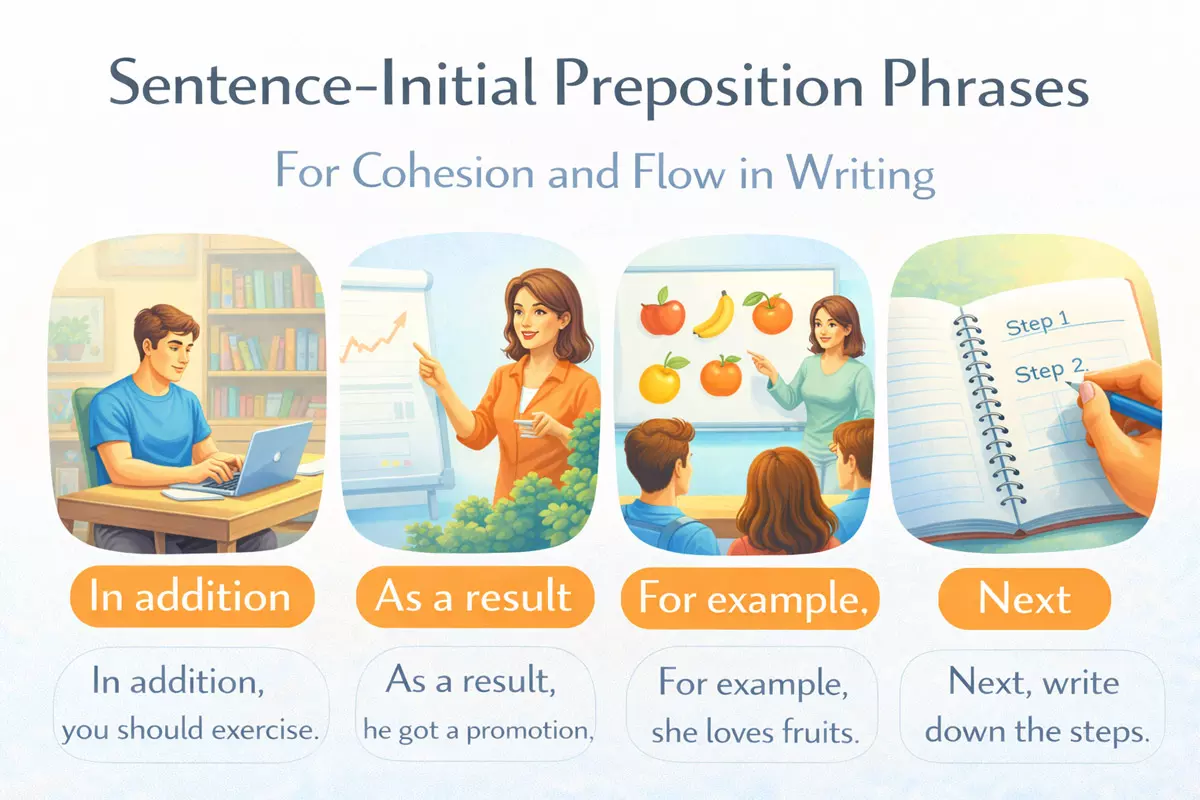 Here we how fronted prepositional phrases guide readers, set time and place, connect ideas logically, and create focus or emphasis. It also outlines punctuation rules, ways to avoid awkward openings, and offers practice making writing flow.
- The Signposting Function: Using fronted prepositional phrases to guide the reader
- Setting the Scene: Temporal and spatial framing (e.g., 'In the late 19th century', 'Across the region')
- Logical Connectors: Mastering 'In addition to', 'In contrast with', and 'By comparison'
- Focus and Emphasis: How fronting shifts the 'Theme' of a sentence for rhetorical impact
- Punctuation Rules: Managing the comma after introductory prepositional phrases
- Avoiding 'Clunky' Openings: Strategies to prevent prepositional phrase stacking at the start
- Practice: Transforming disconnected sentences into a cohesive narrative using fronted markers
Beginning sentences with prepositional phrases can significantly improve the rhythm and coherence of your writing, helping to create smoother transitions between ideas. When writers place prepositional phrases at the start of a sentence, they guide readers naturally from one point to another and establish clear relationships between different parts of their text. This technique not only adds variety to sentence structure but also contributes to a more engaging and connected reading experience, making the overall narrative easier to follow and more enjoyable.
The Signposting Function: Using fronted prepositional phrases to guide the reader
Writers often use sentence-initial prepositional phrases to orient the reader, clarify relationships, and create a smoother reading experience. By placing these modifiers at the beginning of a sentence, you can immediately signal context, time, or cause—helping your audience anticipate what follows. This technique functions as a kind of verbal signpost, making transitions between ideas more explicit and guiding attention to what matters most.
How Fronted Prepositional Phrases Work as Signposts
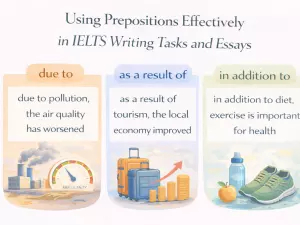
When you move a prepositional phrase to the front of a sentence, you highlight information that might otherwise be buried. For example, starting with “In recent years,” shifts the focus to a time frame, while “According to experts,” signals the source of information. These introductory elements not only clarify meaning but also help readers follow your argument or narrative more easily.
- In academic writing: “In contrast to previous studies, this research…”
- In storytelling: “On a stormy night, the travelers arrived.”
- In instructions: “Before starting the engine, check the oil level.”
- In analysis: “From a linguistic perspective, the shift is significant.”
Common Types of Fronted Prepositional Phrases Used for Signposting
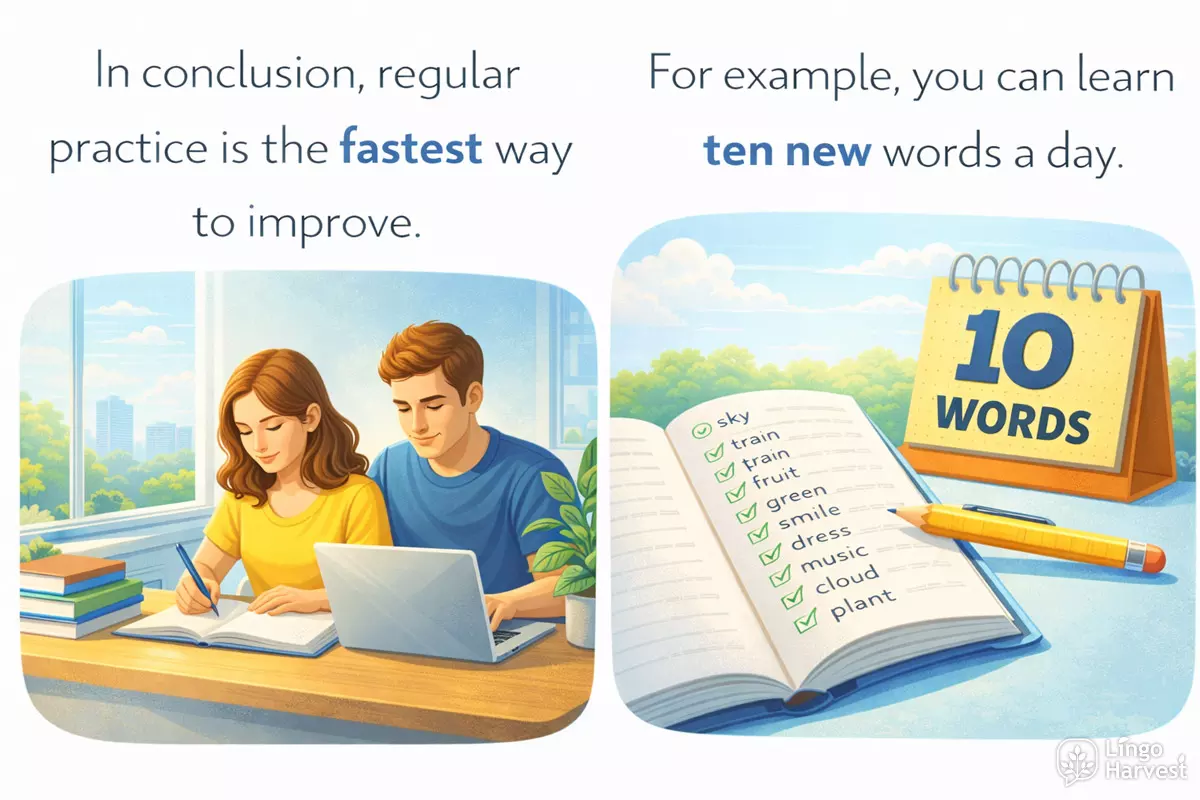
Writers rely on a variety of introductory phrases to guide readers through different types of content. Here are some widely used patterns:
- In conclusion, → In conclusion, regular practice is the fastest way to improve.
- For example, → For example, you can learn ten new words a day.
- On the other hand, → On the other hand, too much pressure can slow your progress.
- By comparison, → By comparison, this method is simpler and more reliable.
- Under these circumstances, → Under these circumstances, it is best to postpone the meeting.
- To summarize, → To summarize, focus on clarity, not perfection.
- In the context of, → In the context of online learning, feedback matters even more.
- According to recent data, → According to recent data, most learners quit without a routine.
- Throughout history, → Throughout history, people have learned languages through immersion.
- During the experiment, → During the experiment, we recorded every response time.
- With regard to this issue, → With regard to this issue, we need a clear policy.
- Across different cultures, → Across different cultures, greetings follow different rules.
- Between the two approaches, → Between the two approaches, the second one is more flexible.
- After careful consideration, → After careful consideration, we decided to change the plan.
- In light of recent events, → In light of recent events, the schedule has been updated.
- From a practical standpoint, → From a practical standpoint, this tool saves time.
- Without further delay, → Without further delay, let’s begin the lesson.
- At the beginning of the chapter, → At the beginning of the chapter, the author defines the key terms.
Comparing Sentence Flow With and Without Fronted Prepositional Phrases
| With Fronted Prepositional Phrase | Without Fronted Prepositional Phrase |
|---|---|
| In recent years, researchers have discovered new treatments. | Researchers have discovered new treatments in recent years. |
| During the meeting, several solutions were proposed. | Several solutions were proposed during the meeting. |
| According to the report, sales increased by 20%. | Sales increased by 20% according to the report. |
| By contrast, the second experiment yielded no results. | The second experiment yielded no results by contrast. |
| On the other hand, this method is less reliable. | This method is less reliable on the other hand. |
Tips for Effective Use
- Use fronted prepositional phrases to clarify time, place, source, or contrast.
- Avoid overusing them; variety enhances readability.
- When starting a sentence with a long prepositional phrase, use a comma for clarity.
- Choose phrases relevant to your purpose and audience.
- Balance signposting with concise, direct sentences for flow.
Adopting this approach can make your writing more cohesive and accessible. By thoughtfully positioning prepositional phrases at the start of sentences, you help readers navigate your ideas with less effort and greater understanding.
Setting the Scene: Temporal and spatial framing (e.g., 'In the late 19th century', 'Across the region')
Writers often introduce context by opening sentences with prepositional phrases that indicate time or place. This technique helps readers immediately understand when or where the following information is situated, creating a clear frame of reference and improving narrative flow. By anchoring statements in a particular era or location, authors guide their audience and establish continuity between ideas.
Why Temporal and Spatial Phrases Matter
Initial prepositional phrases related to time and space provide essential background, especially in academic, historical, or descriptive writing. They answer implicit questions—"When did this happen?" or "Where is this taking place?"—without requiring lengthy explanations. This contributes to both cohesion and readability, making transitions smoother.
Common Patterns for Framing
Writers frequently use set expressions to orient readers. Some widely used temporal and spatial openers include:
- In the early 21st century → In the early 21st century, smartphones reshaped daily communication.
- During the Renaissance → During the Renaissance, artists experimented with perspective and realism.
- At the turn of the millennium → At the turn of the millennium, many industries shifted to digital systems.
- Across the globe → Across the globe, people celebrate important milestones in different ways.
- Within the city limits → Within the city limits, public transport is usually more frequent.
- On the eve of the revolution → On the eve of the revolution, tensions rose across the country.
- Throughout the decade → Throughout the decade, the company expanded into new markets.
- Under colonial rule → Under colonial rule, local economies were often reshaped for export.
- In recent years → In recent years, remote work has become far more common.
- Amidst the chaos → Amidst the chaos, the team focused on basic safety procedures.
- Outside the capital → Outside the capital, housing is often more affordable.
- On the northern border → On the northern border, winters can be especially harsh.
- Inside the laboratory → Inside the laboratory, researchers must follow strict protocols.
- Along the riverbanks → Along the riverbanks, small towns developed around trade routes.
- Prior to 1945 → Prior to 1945, many borders in the region looked very different.
- At the site of discovery → At the site of discovery, archaeologists documented every detail.
- In the aftermath of the storm → In the aftermath of the storm, repairs took several weeks.
- Beyond the immediate vicinity → Beyond the immediate vicinity, the landscape becomes much drier.
- During the summer months → During the summer months, electricity demand often increases.
- Across linguistic boundaries → Across linguistic boundaries, clear visuals can improve understanding.
Comparing Temporal and Spatial Openers
| Temporal Framing | Spatial Framing |
|---|---|
| In the mid-1800s | Across the continent |
| After World War II | Within urban centers |
| Throughout the 1990s | Outside the city walls |
| Before the digital era | Along the coastline |
Tips for Effective Usage
Begin sentences with these framing devices to clarify context, but avoid overuse in consecutive sentences. Vary your prepositional phrases and ensure they genuinely add clarity or emphasis. When used judiciously, such openers enhance cohesion and help the reader follow shifts in setting or chronology.
Logical Connectors: Mastering 'In addition to', 'In contrast with', and 'By comparison'
Using prepositional phrases at the start of sentences—such as "In addition to," "In contrast with," and "By comparison"—helps writers create cohesion and guide readers through complex ideas. These connectors clarify relationships between statements, making transitions smoother and arguments clearer.
How These Connectors Improve Cohesion
Sentence-initial connectors set the stage for what follows. "In addition to" signals extra information, "In contrast with" highlights differences, and "By comparison" draws attention to similarities or contrasts. By leading with these phrases, writers help readers anticipate the direction of the discussion.
If you want to check how these connectors affect dialogue-heavy versus descriptive passages, use a dialogue–narration balance analyzer to evaluate the structure of your text.
Usage Patterns and Practical Examples
Choosing the right phrase depends on the logical relationship you want to express. Here’s how each functions in context:
- In addition to improved clarity, sentence-initial connectors also enhance flow.
- In contrast with earlier research, the current study finds a significant difference.
- By comparison, the revised draft is much more concise than the original.
- In addition to grammar, vocabulary choice affects the tone of writing.
- In contrast with informal speech, academic writing favors explicit connectors.
- By comparison, this method is less time-consuming.
- In addition to these points, consider the audience’s background.
- In contrast with previous approaches, this technique requires fewer resources.
- By comparison, the new policy is more flexible.
- In addition to structure, coherence depends on clear transitions.
- In contrast with the earlier plan, the revised proposal includes more details.
- By comparison, last year’s results were less impressive.
- In addition to these benefits, there are some drawbacks to consider.
- In contrast with the optimistic forecast, recent data shows a decline.
- By comparison, manual processes introduce more errors.
- In addition to fluency, accuracy is essential in academic writing.
- In contrast with automated systems, human oversight can catch subtle mistakes.
- By comparison, digital submissions are processed faster.
Comparing the Three Connectors
Writers sometimes wonder when to use each phrase. The following table outlines their core functions and typical uses:
| Connector | Primary Function | Typical Use |
|---|---|---|
| In addition to | Adds similar or supporting information | Expanding on a point |
| In contrast with | Highlights differences | Presenting opposing or alternative ideas |
| By comparison | Shows similarities or differences by direct juxtaposition | Evaluating or weighing two or more items |
Tips for Effective Use
- Use these connectors at the start of sentences to clarify relationships.
- Pair each phrase with a comma to separate it from the main clause.
- Avoid overusing any one connector; variety improves readability.
- Make sure the connection between sentences is logical — don’t force a contrast or addition where it doesn’t fit.
- Mastering these sentence-initial prepositional phrases strengthens cohesion and flow, guiding readers through your writing with clarity and precision.
Focus and Emphasis: How fronting shifts the 'Theme' of a sentence for rhetorical impact
Moving a prepositional phrase to the start of a sentence is a powerful way to control what readers notice first, subtly guiding their attention to specific details. This technique, known as fronting, allows writers to foreground information that might otherwise remain in the background, creating a shift in the sentence's 'Theme'—that is, the element the reader encounters first and may perceive as most significant. When you front a prepositional phrase, you can highlight context, location, time, or even cause, without changing the core meaning of the sentence. This approach is especially useful for emphasizing setting or linking ideas across sentences, helping your writing flow smoothly and logically.
How Fronting Alters Emphasis
Readers naturally give more weight to what comes first in a sentence. By placing a prepositional phrase at the start, you can:
- Draw attention to time or place (e.g., In 2020, many trends emerged.)
- Create clear connections between sentences or paragraphs
- Provide contrast or background before introducing the main action
- Set up expectations or frame the topic
- Signal shifts in perspective or argument
- Add variety to sentence structure and rhythm
Comparing Neutral vs. Fronted Structures
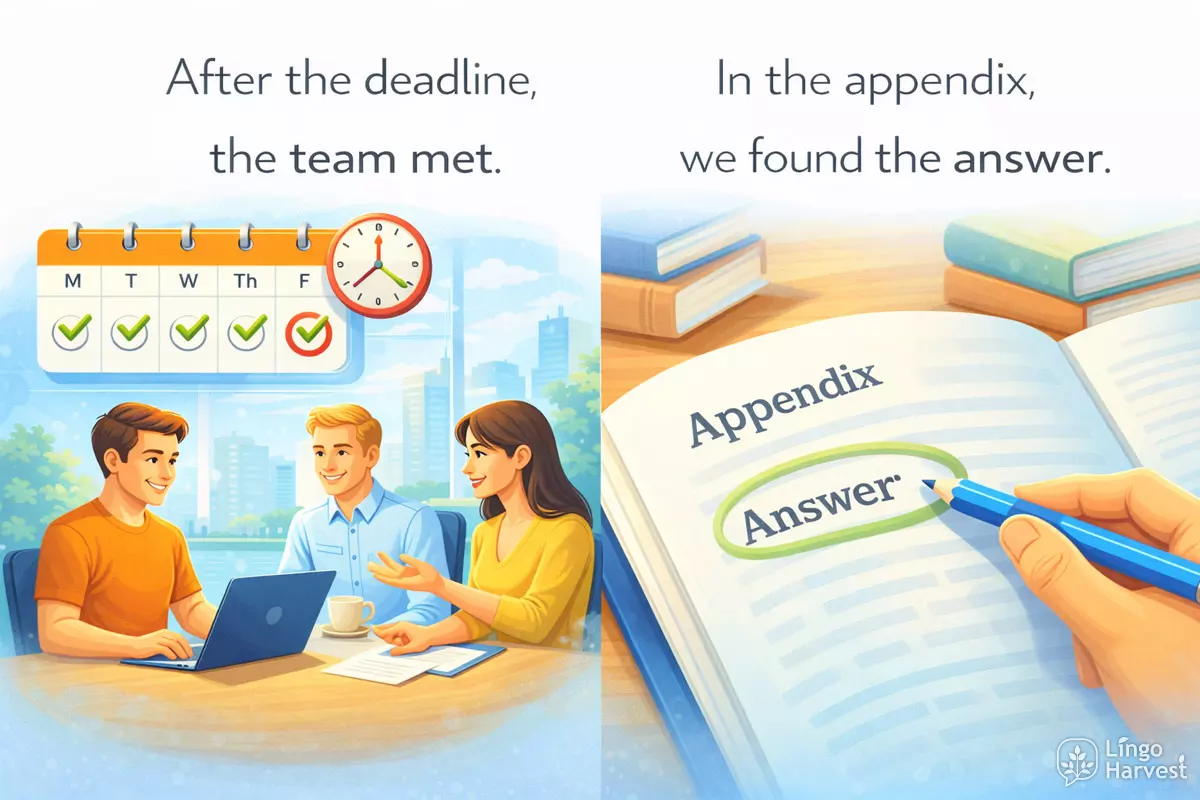
To see how fronting affects focus, consider these pairs:
| Standard Order | Fronted Prepositional Phrase |
|---|---|
| The team met after the deadline. | After the deadline, the team met. |
| We found the answer in the appendix. | In the appendix, we found the answer. |
| She made her decision with careful thought. | With careful thought, she made her decision. |
| He was promoted because of his dedication. | Because of his dedication, he was promoted. |
| The solution appeared during the experiment. | During the experiment, the solution appeared. |
When to Use Fronting for Rhetorical Effect
Deliberate fronting is most effective when you want to:
- Emphasize sequence or timing in narratives and reports
- Highlight causes or reasons in arguments
- Guide readers through complex explanations by foregrounding context
- Link sentences together for smoother flow
- Vary sentence openings to maintain reader interest
Writers can use this strategy to subtly influence which details readers remember, or to set up contrasts and connections in academic, creative, or professional writing. Experimenting with sentence-initial prepositional phrases not only enhances cohesion but also gives your prose nuance and rhetorical sophistication.
Punctuation Rules: Managing the comma after introductory prepositional phrases
Using prepositional phrases at the beginning of a sentence can create smooth transitions and emphasize context. However, deciding when to insert a comma after these introductory elements often confuses writers. The general guideline is that shorter prepositional phrases (typically three words or fewer) do not require a comma, while longer or more complex phrases benefit from one to aid clarity.
When to Use a Comma
Longer introductory prepositional phrases or those that consist of multiple phrases are typically followed by a comma. This helps readers quickly identify where the main clause begins, improving readability. For example:
- After the meeting, everyone went home.
- In the middle of the night, the alarm rang.
- On top of the hill, we saw the sunrise.
- At the beginning of the semester, students often feel overwhelmed.
When to Skip the Comma
If the introductory phrase is short—usually three words or fewer—a comma is often unnecessary unless omitting it would cause confusion. Consider these examples:
- After lunch we resumed work.
- In time we will understand.
- On Friday she arrived early.
Special Considerations and Exceptions
Clarity always comes first. Use a comma if the sentence might be misread without it, or if the phrase is followed by a proper noun or a personal pronoun that could cause ambiguity. Also, if several prepositional phrases appear in a row, a comma after the last one keeps the sentence clear.
Quick Reference: Common Patterns
Here’s a list of sentence starters and whether they typically require a comma:
- In the morning, → In the morning, the streets are usually quiet.
- During the storm, → During the storm, flights were delayed.
- On the other hand, → On the other hand, this option is more affordable.
- For example, → For example, you can practice speaking every day.
- With great enthusiasm, → With great enthusiasm, she accepted the challenge.
- At noon → At noon, the meeting officially began.
- By chance → By chance, they met again years later.
- Under pressure, → Under pressure, he made a quick decision.
- After school → After school, students gathered in the library.
- Between classes, → Between classes, he reviewed his notes.
- Across the street, → Across the street, a new café just opened.
- Without warning, → Without warning, the lights went out.
- Throughout the year, → Throughout the year, sales remained stable.
- In 2020 → In 2020, many companies shifted to remote work.
- Over time, → Over time, her confidence improved.
- From the beginning, → From the beginning, the rules were clearly explained.
Summary Table: Comma Usage After Introductory Prepositional Phrases
| Phrase Length & Complexity | Comma Needed? |
|---|---|
| Short (1–3 words) | No comma, unless clarity requires |
| Long (4+ words) | Comma recommended |
| Multiple phrases in sequence | Comma after last phrase |
| Ambiguous or confusing phrasing | Comma for clarity |
Sticking to these patterns will help you punctuate your introductory prepositional phrases with confidence, ensuring your writing remains clear and fluid.
Avoiding 'Clunky' Openings: Strategies to prevent prepositional phrase stacking at the start
Writers often slip into the habit of beginning sentences with back-to-back prepositional phrases, which can slow down the reader and make prose feel unnecessarily heavy. Instead of launching with a string of location, time, or manner details, consider how you can streamline your sentence openers for greater clarity and flow.
Why Overusing Prepositional Openings Feels Awkward
Starting with two or more prepositional phrases in a row can obscure the main subject and verb, making the sentence harder to follow. For example: “In the middle of the night, on the roof of the building, under the pale moonlight, the cat prowled.” While atmospheric, this structure delays the action and can tire the reader.
Effective Ways to Vary Sentence Openings
- Combine Details: Merge related prepositional phrases into one, or integrate them elsewhere in the sentence.
- Start with the Subject: Move the main noun and verb to the front, adding context later.
- Use Adverbs or Participles: Replace prepositional phrases with adverbs or participial phrases for conciseness.
- Omit Unnecessary Information: Cut details that don’t add value to the narrative or argument.
- Vary Sentence Length: Alternate between short and long sentences to maintain rhythm.
- Ask a Question: Begin with a question to engage the reader and avoid repetitive structures.
- Employ Direct Address: Speak directly to the reader to shift focus.
- Use Conjunctions: Start with “While,” “Although,” or “Because” clauses to embed context smoothly.
- Begin with a Quotation: Lead with dialogue or a relevant quote to set the scene.
- Shift the Preposition: Place the prepositional phrase after the verb or at the end of the sentence.
- Break Up Long Sentences: Split overly complex structures into two or more sentences for readability.
- Introduce Action Early: Let the verb take the spotlight, saving modifiers for later.
- Use Appositives: Insert descriptive phrases directly after the subject for variety.
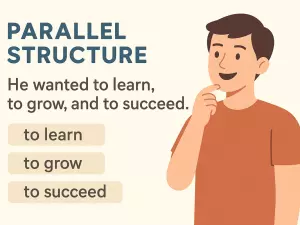
- Employ Parallel Structure: When details are necessary, present them in a balanced, parallel form.
Comparing Sentence Openings: Before and After
| Stacked Prepositional Start | Revised Opening |
|---|---|
| In the early morning, on the edge of the forest, with a sense of urgency, the hikers set out. | The hikers set out early in the morning on the edge of the forest, feeling a sense of urgency. |
| Under the old bridge, along the muddy riverbank, with little light, the fox searched for food. | The fox searched for food along the muddy riverbank under the old bridge, where little light reached. |
| During the meeting, in a quiet room, with everyone listening, the manager announced the changes. | The manager announced the changes to a quiet, attentive room during the meeting. |
| At the end of the street, beyond the tall gates, with anticipation, the parade began. | The parade began beyond the tall gates at the end of the street, greeted by anticipation. |
Quick Tips for Smoother Sentences
- Read sentences aloud to catch awkward stacking.
- Look for more direct ways to express time, place, or manner.
- Remember that clarity often improves with simplicity.
By being mindful of how you open your sentences, you can maintain cohesion and flow without overwhelming your reader with a pile-up of prepositional phrases.
Practice: Transforming disconnected sentences into a cohesive narrative using fronted markers
Bringing isolated sentences together into a smooth, logical narrative is a vital writing skill. One effective technique involves using prepositional phrases or other introductory elements at the beginning of sentences—these are known as “fronted markers.” They help signal relationships such as time, place, cause, contrast, or sequence, making your writing more connected and easier to follow.
Common Fronted Markers for Cohesion
- After a long day, → After a long day, he decided to stay home and rest.
- In contrast, → In contrast, the second option requires less time.
- On the other hand, → On the other hand, this solution is more cost-effective.
- As a result, → As a result, productivity increased significantly.
- At the same time, → At the same time, several teams were working on related tasks.
- During the meeting, → During the meeting, key issues were discussed.
- Despite the rain, → Despite the rain, the event continued as planned.
- For example, → For example, regular reviews help maintain quality.
- In the morning, → In the morning, she checks her schedule.
- Because of this, → Because of this, the deadline was extended.
- In addition, → In addition, the update improves security.
- Under these circumstances, → Under these circumstances, caution is advised.
- Before the deadline, → Before the deadline, all documents must be submitted.
- With great effort, → With great effort, the team completed the project.
- Without hesitation, → Without hesitation, she accepted the offer.
- Across the street, → Across the street, a new bookstore opened.
- Throughout the year, → Throughout the year, demand remained steady.
- By the end of the day, → By the end of the day, all tasks were finished.
- In summary, → In summary, consistency leads to better results.
- According to the report, → According to the report, sales increased last quarter.
Exercise: Connect the Sentences
Below are pairs of simple sentences. Rewrite each pair as a single, cohesive narrative by adding a suitable fronted marker (prepositional phrase or similar) to the second sentence. Try to show the logical relationship between the two ideas.
- Maria forgot her umbrella. She got soaked on her way home.
- The workshop ended. The participants shared their experiences in a group chat.
- Tom was feeling tired. He decided to take a short nap.
- The power went out. The students continued working using flashlights.
- Jason studies every morning. He often reviews his notes in the evening as well.
- The park was closed. We had to find another place to play.
- The deadline was extended. Everyone had more time to finish the task.
- Emma missed the bus. She arrived late at work.
- The weather improved. The match continued as planned.
- He saved his work frequently. He did not lose any data.
Show answers
- Since Maria forgot her umbrella, she got soaked on her way home.
- After the workshop ended, the participants shared their experiences in a group chat.
- Because Tom was feeling tired, he decided to take a short nap.
- When the power went out, the students continued working using flashlights.
- In the morning, Jason studies; in the evening, he often reviews his notes as well.
- Because the park was closed, we had to find another place to play.
- After the deadline was extended, everyone had more time to finish the task.
- Because Emma missed the bus, she arrived late at work.
- When the weather improved, the match continued as planned.
- Because he saved his work frequently, he did not lose any data.
Comparing Disconnected vs. Connected Narratives
Notice how fronted markers create smoother transitions and clarify relationships between ideas.
| Disconnected Sentences | Cohesive Version with Fronted Marker |
|---|---|
| She finished her assignment. She took a break. | After finishing her assignment, she took a break. |
| The bell rang. The students went outside. | When the bell rang, the students went outside. |
| The weather was bad. The event continued as planned. | Despite the bad weather, the event continued as planned. |
| We arrived early. We found the best seats. | By arriving early, we found the best seats. |
Tips for Effective Use
- Choose fronted markers that clarify time, cause, contrast, or place.
- Vary your sentence openings to avoid repetition.
- Read your paragraph aloud to check the flow.
- Use these markers to highlight important transitions or shifts in your narrative.
Practicing with fronted phrases will help you create more unified, engaging, and readable paragraphs in your writing.