Prepositions in Storytelling and Fiction: Narrative Usage Guide

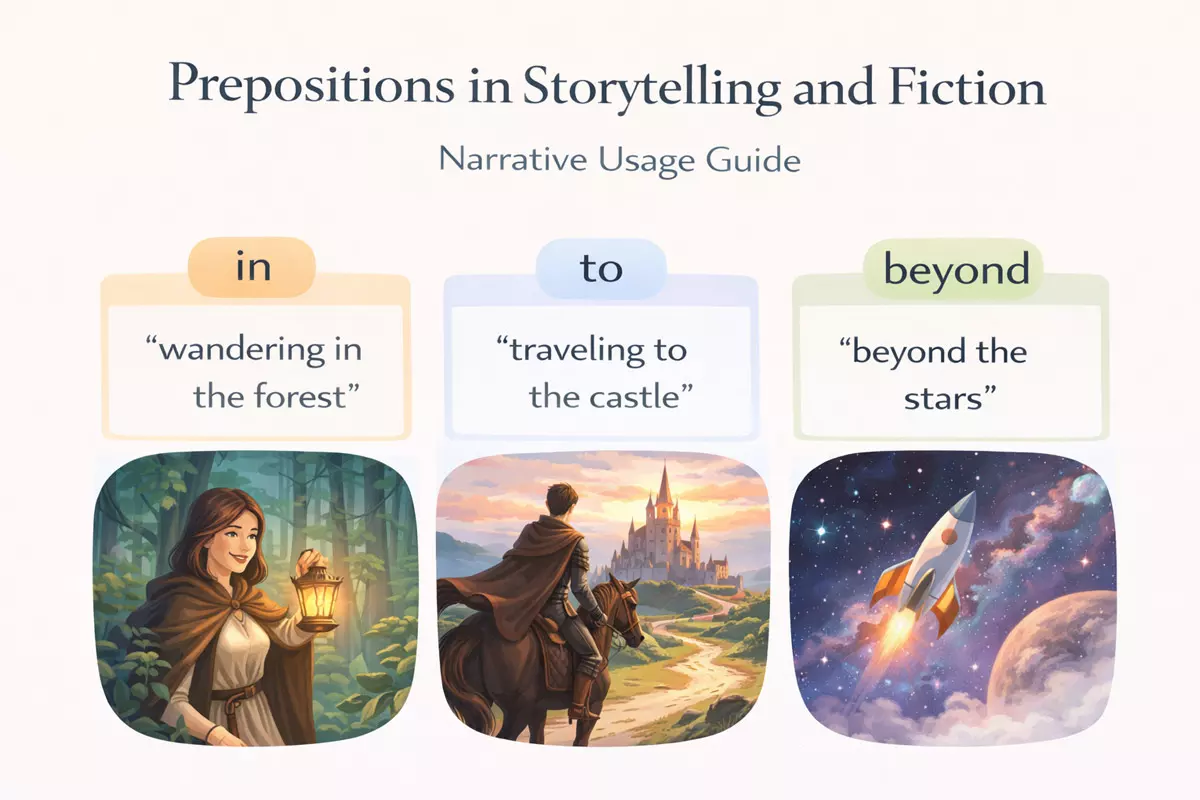 Here we how spatial and atmospheric prepositions guide the reader’s perspective, establish mood, influence pacing, reveal character states, vary by genre, enrich sensory details, and enhance prose by replacing static verbs with dynamic movement.
- Cinematic Framing: Using spatial prepositions to direct the reader's 'camera' eye
- Atmospheric Prepositions: Creating mood through 'oppressive' vs. 'expansive' spatial markers
- Narrative Pacing: Controlling sentence rhythm with prepositional phrase length and frequency
- Character Focalization: How preposition choice reflects a protagonist's physical and mental state
- Genre-Specific Style: Prepositional density in descriptive Gothic fiction vs. minimalist Noir
- Sensory Layering: Integrating 'beyond', 'amidst', and 'beneath' for multi-dimensional world-building
- Practice: Enhancing prose by replacing static verbs with dynamic prepositional movement
Small words like prepositions may seem insignificant, but they play a crucial role in storytelling by guiding readers smoothly through the narrative and helping to build immersive fictional worlds. Mastering the use of prepositions allows writers to create clear, engaging scenes where readers can easily follow the action and understand relationships between characters and settings. By paying attention to these connectors, authors can enhance the flow of their stories and ensure that their writing is vivid, coherent, and enjoyable to read.
Cinematic Framing: Using spatial prepositions to direct the reader's 'camera' eye
Writers often guide the reader’s attention much like a film director positions a camera. Spatial prepositions—words like “behind,” “above,” “through,” or “between”—are essential tools for focusing the narrative lens, helping readers visualize movement, relationships, and atmosphere within a scene. By carefully choosing these terms, authors can effectively choreograph action, reveal important details, and subtly control pacing.
Directing Visual Attention with Prepositions
Spatial prepositions establish where things are in relation to each other, shaping the mental image a reader constructs. For example, “The letter lay beneath the candle” instantly places two objects in a clear hierarchy, while “Shadows flickered across the ceiling” encourages the imagination to scan upward. This kind of linguistic framing can be used to:
- Set the mood by emphasizing isolation (“alone among the ruins”)
- Highlight relationships (“beside her father’s grave”)
- Imply movement and action (“darted through the alley”)
- Focus on detail (“on the edge of his sleeve”)
- Build suspense (“behind the closed door”)
- Guide perspective (“from the top of the hill”)
- Suggest hidden elements (“underneath the floorboards”)
- Establish distance (“far beyond the city walls”)
- Contrast settings (“between light and shadow”)
- Anchor the reader in space (“at the center of the square”)
- Frame action (“into the darkness”)
- Create layering (“among the tangled roots”)
- Show progression (“along the winding road”)
- Imply boundary or limit (“within the confines of the cell”)
- Offer a character’s viewpoint (“through the frosted glass”)
- Reveal what’s obscured (“beneath the heavy cloak”)
- Highlight proximity (“near the flickering lantern”)
- Convey enclosure (“inside the abandoned house”)
- Suggest surveillance (“over his shoulder”)
- Mark transition (“past the iron gate”)
Comparing Spatial Prepositions in Narrative Contexts
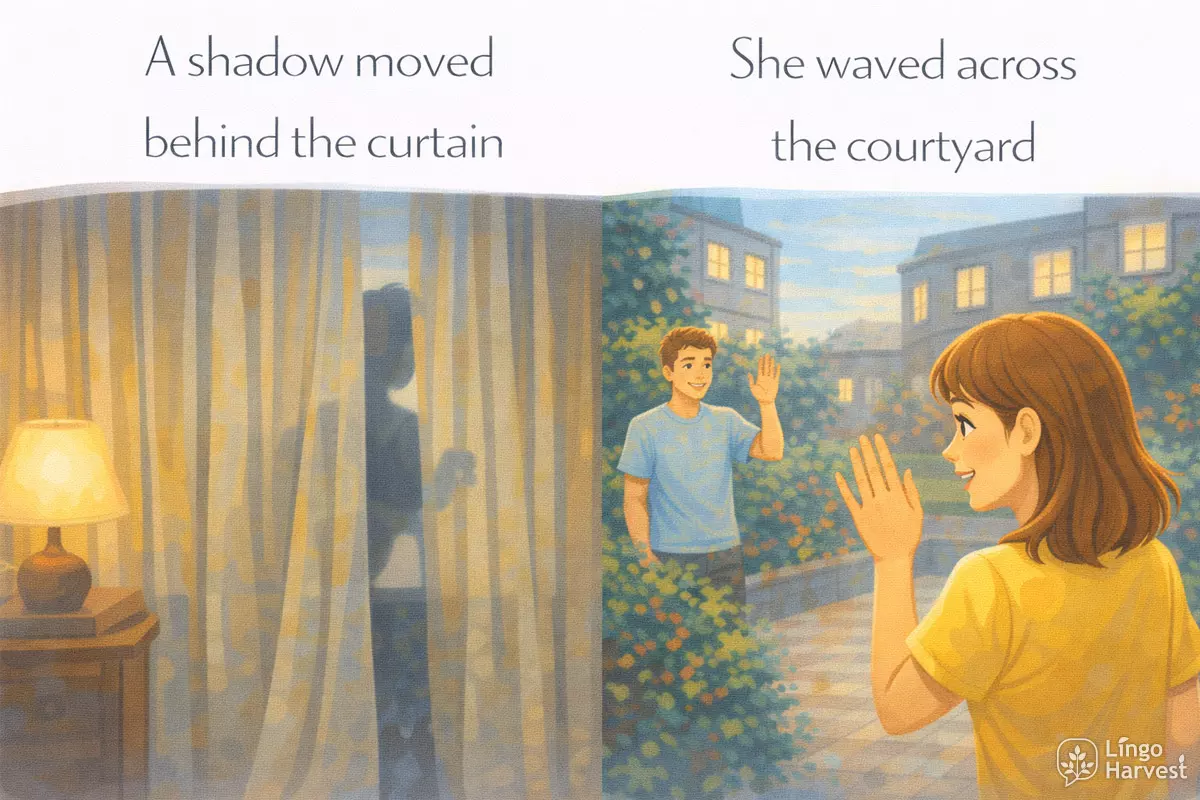
Different prepositions can shift the “camera angle” of a scene, affecting both the reader’s emotional response and the clarity of the setting. Here’s a structured look at how some common spatial prepositions can alter narrative focus and reader experience:
| Preposition | Effect in Narrative |
|---|---|
| Above | Creates a sense of surveillance, height, or dominance (e.g., “clouds gathered above the rooftops”) |
| Behind | Suggests concealment, secrecy, or unseen presence (“a shadow moved behind the curtain”) |
| Across | Indicates movement or separation (“she waved across the courtyard”) |
| Between | Highlights division, tension, or connection (“between two worlds”) |
| Through | Conveys passage or transition (“light filtered through the leaves”) |
| Under | Implies something hidden, protected, or subordinate (“under the table”) |
| Along | Suggests following a path or journey (“along the riverbank”) |
| Within | Creates a sense of enclosure or internal focus (“within the ancient walls”) |
Tips for Effective Narrative Framing
To make the most of spatial prepositions, consider the following strategies:
- Visualize each scene as a series of camera shots—what do you want readers to see first?
- Use specific spatial terms to avoid vagueness and to clarify relationships between elements.
- Vary your prepositions to keep descriptions fresh and avoid repetitive imagery.
- Pair spatial prepositions with strong nouns and verbs for vivid, immersive scenes.
- Balance detailed orientation with narrative momentum—don’t let spatial detail slow the story too much.
By mastering spatial prepositions, storytellers can craft dynamic, visually engaging scenes that guide the reader’s imagination as skillfully as a director operates a camera.
Atmospheric Prepositions: Creating mood through 'oppressive' vs. 'expansive' spatial markers
Writers often use spatial prepositions to subtly shape the emotional climate of a scene. The choice between prepositions that imply confinement and those that suggest openness can shift the reader’s perception, making settings feel either stifling or liberating. These linguistic cues work quietly but powerfully, reinforcing the intended atmosphere through the way characters and objects relate to their environment.
Conveying Confinement and Tension
Prepositions such as within, beneath, inside, under, and between can evoke a sense of enclosure or limitation. When used with care, they help establish feelings of claustrophobia, secrecy, or danger. For example, describing a character as “trapped beneath the collapsed beams” instantly generates a sense of peril. These markers are particularly effective in suspenseful or emotionally charged moments.
Suggesting Openness and Freedom
On the other hand, terms like above, beyond, across, throughout, and around expand the fictional space, inviting the reader to imagine vastness or possibility. “She gazed beyond the rolling hills” invites a feeling of hope or adventure. Expansive prepositions often suit scenes of exploration, wonder, or relief.
Comparing 'Oppressive' and 'Expansive' Preposition Usage
| Spatial Marker Type | Typical Prepositions & Example Usage |
|---|---|
| Oppressive (confining, limiting) |
|
| Expansive (open, liberating) |
|
Expanded List: Prepositions for Shaping Setting and Mood
- within → The documents must be submitted within the deadline.
- beneath → The keys were hidden beneath the table.
- under → The bridge was repaired under difficult conditions.
- inside → Please wait inside the building.
- between → The café is located between the bank and the bookstore.
- behind → She stood behind the door and listened.
- among → He felt comfortable among experienced professionals.
- amid → Amid the confusion, the announcement was missed.
- above → The temperature stayed above average this week.
- beyond → The solution is beyond our current resources.
- across → They walked across the street together.
- throughout → The noise continued throughout the night.
- around → There were several shops around the station.
- outside → Let’s wait outside the entrance.
- along → They planted trees along the river.
- upon → Upon arrival, please report to reception.
- into → She poured the milk into the glass.
- over → He has control over the entire process.
- past → We drove past the old factory.
- beside → She sat beside her colleague during the meeting.
Writers can deliberately select these spatial markers to reinforce a scene’s emotional tone, whether the goal is to intensify suspense or evoke a sense of openness. The right preposition can make a setting feel either suffocating or boundless, subtly guiding the reader’s emotional response without explicit description.
Narrative Pacing: Controlling sentence rhythm with prepositional phrase length and frequency
Writers often shape the flow of a story by adjusting how often and how extensively they use prepositional phrases. These phrases—such as “in the moonlight” or “over the broken fence”—can either quicken or slow a reader’s perception of action, depending on how they’re woven into sentences. Short, sparing use tends to create a brisk, energetic feel, while longer or more frequent phrases bring detail and can stretch out a moment, making readers linger.
How Prepositional Phrases Affect Rhythm
The rhythm of your prose changes with the length and placement of these modifiers. A sentence like “He ran” moves faster than “He ran across the dew-soaked grass under the dim morning sky.” The latter builds atmosphere, but also slows the pace, inviting readers to visualize the scene more deeply.
- Short, infrequent phrases: Build tension or speed up action scenes.
- Long, layered phrases: Encourage reflection and immersion in setting or emotion.
- Initial position: Starting a sentence with a prepositional phrase can set the scene quickly (“In the alley, shadows danced”).
- Medial position: Inserting phrases mid-sentence can redirect focus (“She, with a trembling hand, reached for the key”).
- Final position: Ending with a phrase often provides a lingering detail (“He waited by the window”).
Balancing Pacing with Prepositional Phrases
Moderation is key. Overloading sentences with too many prepositions can make prose feel heavy or confusing. On the other hand, avoiding them altogether can strip your writing of nuance. Consider the following examples for variety and effect:
- Without prepositional phrases: “The cat slept.”
- One short phrase: “The cat slept on the windowsill.”
- Multiple, varied lengths: “The cat, curled on the sunlit windowsill, dreamed of distant fields beyond the glass.”
Common Prepositional Phrases in Fiction
Writers often return to familiar patterns to control tempo or mood. Here are some frequently used examples:
- In the dark → We waited in the dark until the lights came back on.
- By the fire → They sat by the fire, talking late into the night.
- Across the room → She noticed him smiling at her across the room.
- Under the stars → We slept under the stars during the camping trip.
- With a sigh → With a sigh, he closed his laptop and stood up.
- On the edge → She stood on the edge of the stage, waiting for her cue.
- Between the lines → If you read between the lines, the message is clear.
- Near the water → They built a small house near the water.
- Over the hill → The sun disappeared over the hill.
- Through the doorway → Light streamed through the doorway.
- Behind the curtain → The actors were waiting behind the curtain.
- At sunrise → We started our hike at sunrise.
- During the storm → The power went out during the storm.
- Along the path → Flowers grew along the path.
- Inside the box → The documents were hidden inside the box.
- Upon the table → The keys were placed upon the table.
- After midnight → He finally returned home after midnight.
- Within reach → Keep your phone within reach at all times.
- Without warning → Without warning, the alarm went off.
- For a moment → For a moment, everything was completely silent.
Comparing Sentence Rhythm: Short vs. Long Prepositional Phrases
| Short/Minimal Prepositional Phrases | Long/Multiple Prepositional Phrases |
|---|---|
| He jumped over the fence. | He jumped over the fence at the edge of the old, overgrown garden near the woods. |
| She waited by the door. | She waited by the door with a bouquet of wildflowers in her trembling hands, beneath the flickering porch light. |
| The dog barked at sunrise. | The dog barked at sunrise from the porch, under the pale pink sky that stretched across the quiet village. |
| Wind blew through the trees. | Wind blew through the trees along the winding road, carrying the scent of rain from distant mountains beyond the valley. |
Tips for Adjusting Sentence Flow
- Read passages aloud—notice where longer phrases slow you down.
- Vary phrase length to match the scene’s mood: use shorter phrases for action, longer for introspection.
- Trim unnecessary prepositional phrases during revision for clarity and punch.
- Balance detail and pace by alternating between concise and descriptive sentences.
By thoughtfully varying the length and placement of prepositional phrases, writers can subtly guide a reader’s experience, enhancing both the tempo and the texture of their storytelling.
Character Focalization: How preposition choice reflects a protagonist's physical and mental state
Writers often reveal a protagonist’s internal and external experiences through subtle choices, especially in the use of prepositions. The way a narrative describes spatial relationships or emotional states using “in,” “on,” “under,” or “through” can show not just where a character is, but how they feel, think, and perceive their world. These small words can signal a character’s agency, vulnerability, perspective, or detachment, shaping the reader’s immersion in their journey.
Prepositions as Windows into Perception
When a story is filtered through a character’s viewpoint, prepositions become more than functional connectors—they evoke mood and orientation. For example, “She hid beneath the table” versus “She sat at the table” conveys not only location but also fear or composure. The selection of prepositions can indicate whether a character feels overwhelmed (“under pressure”), empowered (“at the helm”), or isolated (“outside the group”).
Common Narrative Effects of Preposition Choices
- “Within” suggests introspection or internal conflict.
- “Against” implies opposition or resistance.
- “Amid” places a character among chaos or confusion.
- “Through” signals process, endurance, or transition.
- “Over” can indicate dominance or a sense of being burdened.
- “Under” conveys subjugation, secrecy, or duress.
- “Across” suggests boundaries being crossed, physically or emotionally.
- “Beyond” hints at aspiration or alienation.
- “Between” denotes conflict, indecision, or mediation.
- “Around” implies avoidance or uncertainty.
- “Into” marks entry, involvement, or immersion.
- “Out of” highlights escape, withdrawal, or exclusion.
- “Upon” can suggest immediacy or formality.
- “Along” indicates accompaniment or progress.
- “With” shows connection or alliance.
- “Without” underscores loss or absence.
- “Near” evokes longing or proximity.
- “Behind” signals secrecy, support, or being left out.
- “Before” can denote anticipation or confrontation.
- “Upon” (again, contextually) can carry weight or expectation.
Comparative Examples: Physical vs. Mental Focalization

Writers may shift preposition use to match changes in a character’s mindset or physicality. See how subtle shifts alter the narrative focus:
| Physical Focalization | Mental/Emotional Focalization |
|---|---|
| He walked through the forest. | He struggled through his memories. |
| She stood behind the curtain. | She hid behind a forced smile. |
| They gathered around the table. | Rumors swirled around her name. |
| He climbed over the fence. | He got over his disappointment. |
Tips for Using Prepositions to Deepen Characterization
- Choose prepositions that reflect not just setting, but perception and attitude.
- Vary your usage to signal shifts in mood or point of view.
- Let prepositions reveal vulnerability, agency, or conflict without overt exposition.
- Pay attention to idiomatic uses that echo the protagonist’s mental landscape.
- Subtly repeat certain prepositions to reinforce a theme or emotional state.
Through intentional preposition selection, narrative voice becomes richer and more attuned to character psychology, making every scene more immersive and authentic.
Genre-Specific Style: Prepositional density in descriptive Gothic fiction vs. minimalist Noir
Writers often adapt their use of prepositions to fit the mood and expectations of specific genres. In ornate Gothic fiction, descriptions rely heavily on prepositional phrases to layer atmosphere, spatial detail, and emotional nuance. By contrast, hardboiled Noir tends toward brevity, stripping sentences of excess, including many prepositional phrases, to maintain a taut, immediate feel.
Prepositional Usage in Gothic Descriptions
Dense, atmospheric prose is a hallmark of classic Gothic tales. Authors employ prepositions to build intricate settings, locate characters, and evoke a sense of envelopment or claustrophobia. Consider the difference between “The moon hung over the ruined abbey, among twisted branches, beyond the crumbling gate” versus a simpler description. Each preposition situates elements in space and time, layering mood.
- Amidst the shadows
- Beneath the ancient archways
- Within the echoing halls
- Beyond the rusted gates
- Upon the cold stone floor
- Between the flickering candles
- Among the withered roses
- Under a shroud of mist
- Inside the forgotten chapel
- Across the rain-slicked courtyard
These phrases not only clarify relationships but also immerse the reader in a palpable world.
Minimalist Approach in Noir Narratives
Noir fiction, on the other hand, is characterized by punchy sentences and a focus on action. Prepositions are used sparingly; location and atmosphere are suggested rather than spelled out. The result is a sense of urgency and directness. Instead of “He waited in the shadows beneath the flickering neon,” a Noir writer might simply say, “He waited in the shadows.” The rest is implied.
- In the alley → They met quietly in the alley behind the building.
- By the bar → He was waiting by the bar when the show ended.
- On the street → Musicians were performing on the street.
- At midnight → The train arrived at midnight.
- With a gun → The suspect was seen with a gun.
- Under the lights → The team practiced under the lights.
- Through the door → She heard voices through the door.
- After the rain → The air felt fresh after the rain.
- From behind → Someone called his name from behind.
- Without a sound → He left the room without a sound.
Here, prepositional phrases are brief, often limited to one per sentence, and act as quick stage directions rather than immersive detail.
Comparative Patterns
The contrast between these two styles can be seen in the frequency and complexity of prepositional phrases. Gothic tends toward multiple, often nested, prepositions per sentence; Noir typically uses one, if any, per sentence, favoring verbs and nouns for effect.
| Gothic Fiction Example | Noir Fiction Example | Prepositional Phrases Per Sentence |
|---|---|---|
| “In the gloom beneath the broken rafters, shadows moved among the relics of the past.” | “Shadows moved in the rafters.” | 3 vs. 1 |
| “She wandered through the corridors, past shattered mirrors, into the heart of the house.” | “She wandered the corridors.” | 3 vs. 0 |
| “A chill crept along the walls, across the cold flagstones, under the heavy doors.” | “A chill crept along the walls.” | 3 vs. 1 |
| “He stood at the threshold, between light and shadow, before the silent gathering.” | “He stood at the threshold.” | 3 vs. 1 |
Key Takeaways
- Descriptive genres like Gothic fiction often feature high prepositional density, enriching setting and mood.
- Noir narratives minimize prepositional use, favoring economy and forward motion.
- Adapting prepositional usage to genre helps reinforce stylistic goals and reader expectations.
Sensory Layering: Integrating 'beyond', 'amidst', and 'beneath' for multi-dimensional world-building
Writers often use prepositions to guide readers through physical and emotional landscapes. Terms like "beyond," "amidst," and "beneath" enable authors to build layered settings and emotional resonance. These words allow a story to stretch past the visible, immerse readers in the thick of action or feeling, and hint at what lies hidden or foundational in a scene.
Expanding Depth with 'Beyond'
"Beyond" encourages the reader to look past immediate boundaries, evoking curiosity and suggesting further mysteries. It is especially useful for hinting at off-stage events, unseen threats, or future possibilities.
- The mountains beyond the city shrouded in mist
- A secret kept beyond the reach of memory
- Dreams that extend beyond the waking world
- Questions lingering beyond the final page
- Hope that persists beyond despair
Immersion with 'Amidst'
"Amidst" places characters or readers within an environment or state, highlighting complexity or chaos. This preposition is ideal for scenes that require a sense of being surrounded or engulfed.
- Amidst the clamor of the marketplace
- Lost amidst swirling autumn leaves
- Amidst confusion, a single truth emerged
- Amidst ruins, life continues
- Amidst laughter, a shadow passed
Uncovering Layers with 'Beneath'
"Beneath" directs attention to what is hidden, foundational, or underlying. It works well for revealing secrets, subtext, or the physical underpinnings of a setting.
- Beneath the city, tunnels wound like veins
- Fear lurked beneath his calm exterior
- Beneath the surface, old wounds festered
- Beneath the stars, promises were made
- Beneath the floorboards, something whispered
Comparative Uses in World-Building
To see their distinct narrative effects, consider the following structured examples:
| Preposition | World-Building Effect |
|---|---|
| Beyond | Suggests unexplored realms, future challenges, or the unknown. Useful for foreshadowing or expanding the scope of the setting. |
| Amidst | Places the reader or character within a context or crowd, emphasizing immersion in ongoing events or emotions. |
| Beneath | Draws attention to hidden layers, secrets, or foundational elements—physical or psychological—of the story world. |
Tips for Multi-Layered Narrative Settings
Using these prepositions thoughtfully can enrich your fiction:
- Combine them to create scenes with multiple sensory planes: e.g., "Amidst the celebration, tension simmered beneath the laughter, hinting at conflicts beyond the horizon."
- Pair with sensory language—sounds, textures, scents—to deepen immersion.
- Use them to signal emotional or thematic currents, not just physical details.
- Vary their use to avoid repetition and keep the narrative fresh.
Integrating "beyond," "amidst," and "beneath" allows for nuanced, textured storytelling that both orients and unsettles the reader, drawing them deeper into your fictional world.
Practice: Enhancing prose by replacing static verbs with dynamic prepositional movement
Writers often default to static verbs like "is," "was," or "sat," which can make prose feel flat and lifeless. By integrating movement with prepositions, you can inject energy and vividness into your narrative. This section explores how to transform static descriptions into dynamic scenes, using prepositional phrases to create a sense of action and flow.
Recognizing Static Verbs in Narrative
Static verbs merely indicate a state or existence without suggesting any real action or change. Consider these common examples:
- She was in the kitchen.
- The cat sat on the windowsill.
- He is at the door.
While clear, these sentences do little to engage the reader’s imagination.
Transforming Sentences with Prepositional Movement
Dynamic prepositional structures emphasize movement or direction, making scenes more immediate. Here are ways to revise static sentences:
- She moved through the kitchen, sunlight following her steps.
- The cat leapt onto the windowsill, tail flicking over the edge.
- He stood at the door, hands pressed against the wood.
Common Patterns for Dynamic Prepositional Usage
Writers can draw from a broad palette of verbs and prepositions to convey activity, intention, or spatial relationships. Here are useful pairs and constructions:
- Slipped into → She slipped into the room without anyone noticing.
- Stepped across → He stepped across the puddle in one careful move.
- Glanced over → She glanced over her notes before the meeting.
- Dashed between → The cat dashed between the parked cars.
- Crawled under → He crawled under the fence to retrieve the ball.
- Leaned against → She leaned against the wall, catching her breath.
- Wandered through → They wandered through the old town at dusk.
- Climbed up → He climbed up the ladder to fix the light.
- Ducked behind → The child ducked behind the sofa.
- Sank into → He sank into the chair after a long day.
- Peered around → She peered around the corner to see who was there.
- Reached for → He reached for his phone when it rang.
- Pressed against → The crowd pressed against the barriers.
- Rushed toward → She rushed toward the exit when the alarm sounded.
- Settled onto → The bird settled onto the branch.
- Strode along → He strode along the corridor with confidence.
- Twisted around → She twisted around to look behind her.
- Shuffled past → The elderly man shuffled past the doorway.
- Hovered over → Doubt hovered over the decision.
- Slid across → The box slid across the floor.
Before-and-After: Static vs. Dynamic Prose
Below is a comparison of flat versus energized sentences using prepositional movement.
| Static Sentence | Dynamic Revision |
|---|---|
| He was in the library. | He wandered through the library, fingers trailing along the shelves. |
| The rain was on the roof. | Rain drummed across the roof, echoing through the rafters. |
| She sat at the table. | She sank into the chair at the table, elbows resting against its edge. |
| The dog was by the door. | The dog paced near the door, nose pressed against the crack beneath it. |
| Light was in the room. | Light filtered into the room, spilling over the wooden floorboards. |
Quick Practice: Revise the Following Sentences
Rewrite each sentence to add movement and a prepositional phrase. Try to evoke a visual scene:
- The boy was on the playground.
- The wind was in the trees.
- The teacher was at the front of the class.
- The book was on the desk.
- The bird was in the sky.
- The cat was under the table.
- The lights were above the stage.
- The children were near the river.
- The car was behind the house.
- The footprints were along the path.
Show answers
- The boy darted across the playground, laughter echoing behind him.
- The wind rustled through the trees, leaves whispering in its wake.
- The teacher strode to the front of the class, her gaze sweeping over the students.
- The book slid across the desk, its pages fluttering open.
- The bird soared across the sky, wings cutting through the clouds.
- The cat curled up under the table, hidden from view.
- The lights glowed above the stage, illuminating the performers.
- The children played near the river, splashing water onto the bank.
- The car idled behind the house, barely visible from the road.
- The footprints stretched along the path, leading into the forest.
Tips for Developing Dynamic Scenes
- Favor verbs that suggest action, not just existence.
- Pair verbs with prepositions to establish direction, location, or movement.
- Visualize the scene: what is moving, and how?
- Read your prose aloud to check for flow and rhythm.
- Experiment with different prepositions for nuance and variety.
By making these conscious revisions, your storytelling will gain vitality, drawing readers more fully into your fictional worlds.